A guide to green fee value for money

Category: 4 star (Page 11 of 20)

88. Murrayshall. 16 Sep 2018

Murrayshall is a nice parkland course, but its hotel partner course (Lynedoch) is much better value.

Round  £50 ( variable on-line).   Par 70.  Value (out of 5) – 3

The Murrayshall estate, first built in 1664, was established as a commercially successful Country House hotel in the early 1970s, following the sale of the estate by the Norrie-Millar family, of whom Francis Norrie-Millar was one of the key instrumentalists in building the General Accident insurance company in nearby Perth, only 3 miles to the west of Murrayshall.
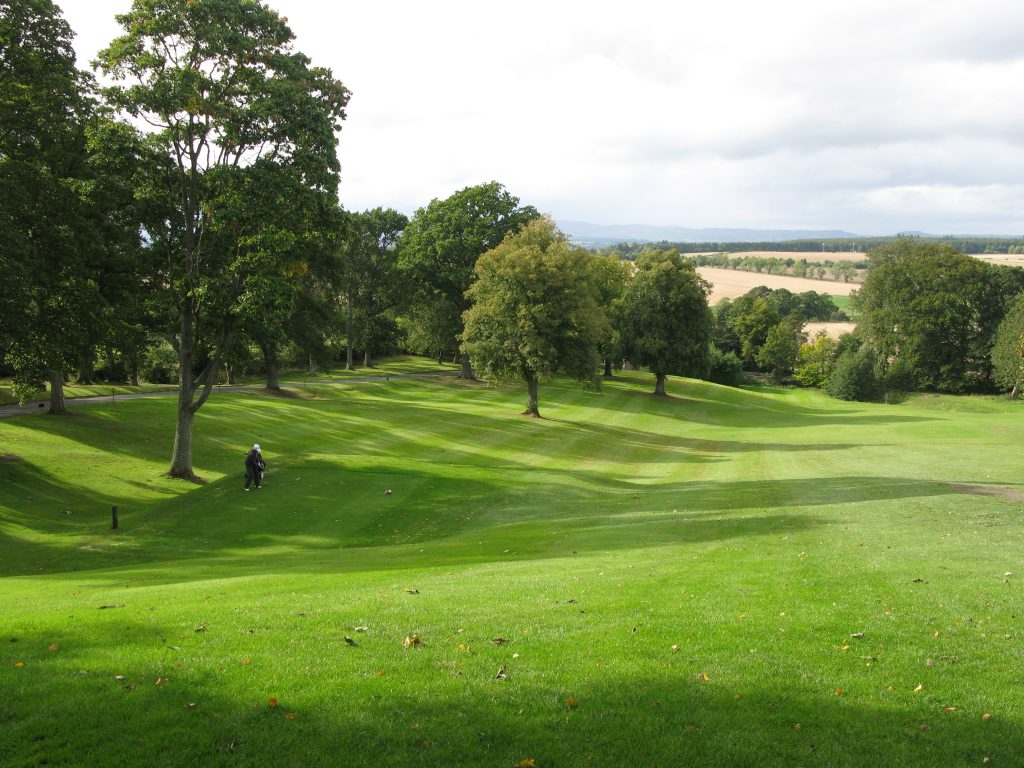
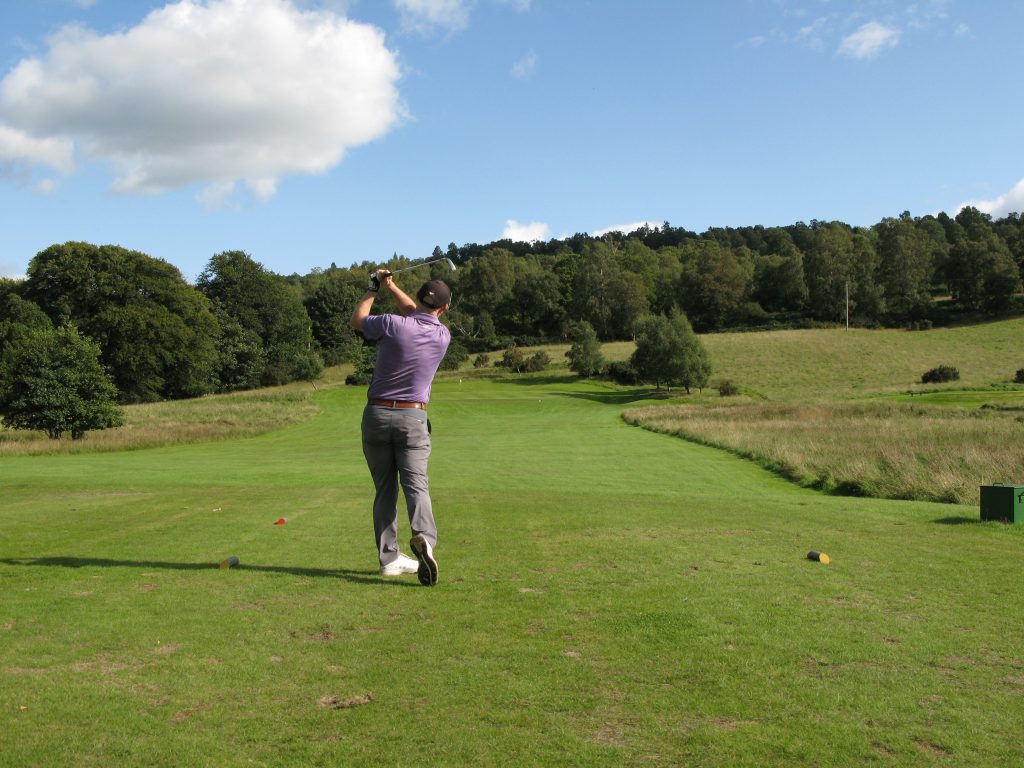
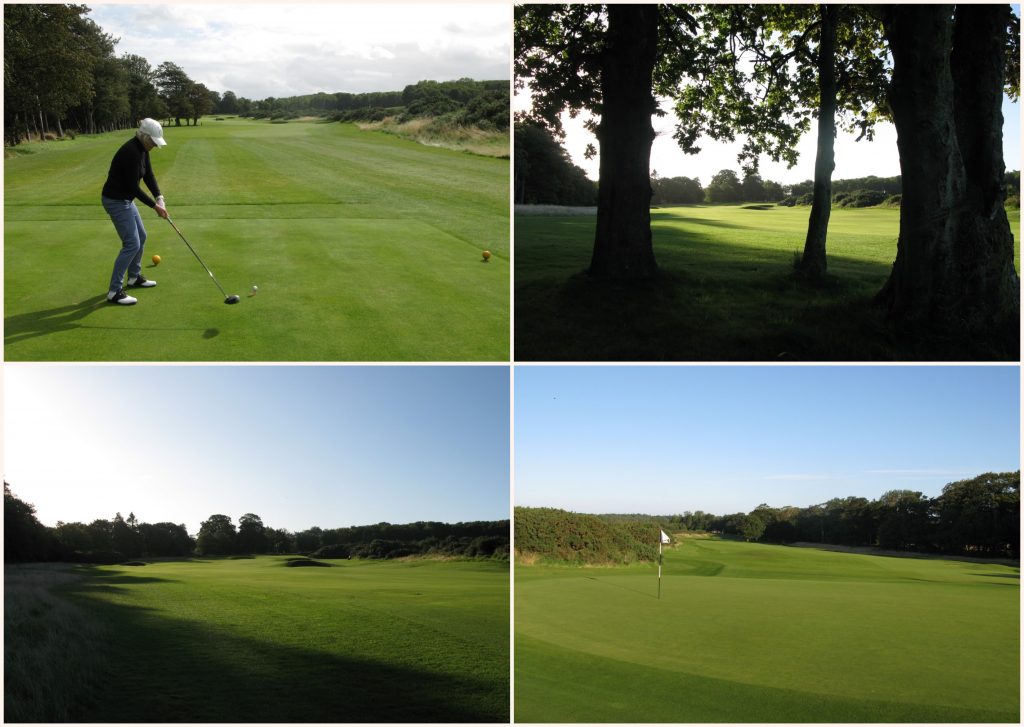
Fran plays at the par 5 9th at Murrayshall

The esteemed golf architect Hamilton J Strutt (grandson of James Braid’s foreman) designed this Championship course in the 70s, and returned to design the Lynedoch course which opened in 2000.   The Murrayshall course is indeed a fine example of Strutt crafting a course amidst mature parkland, leaving an impression that the course has been there for a hundred years.  This is almost completely true except for the bland and exposed par 4 13th hole, which was oddly the SI1 hole (more of later).
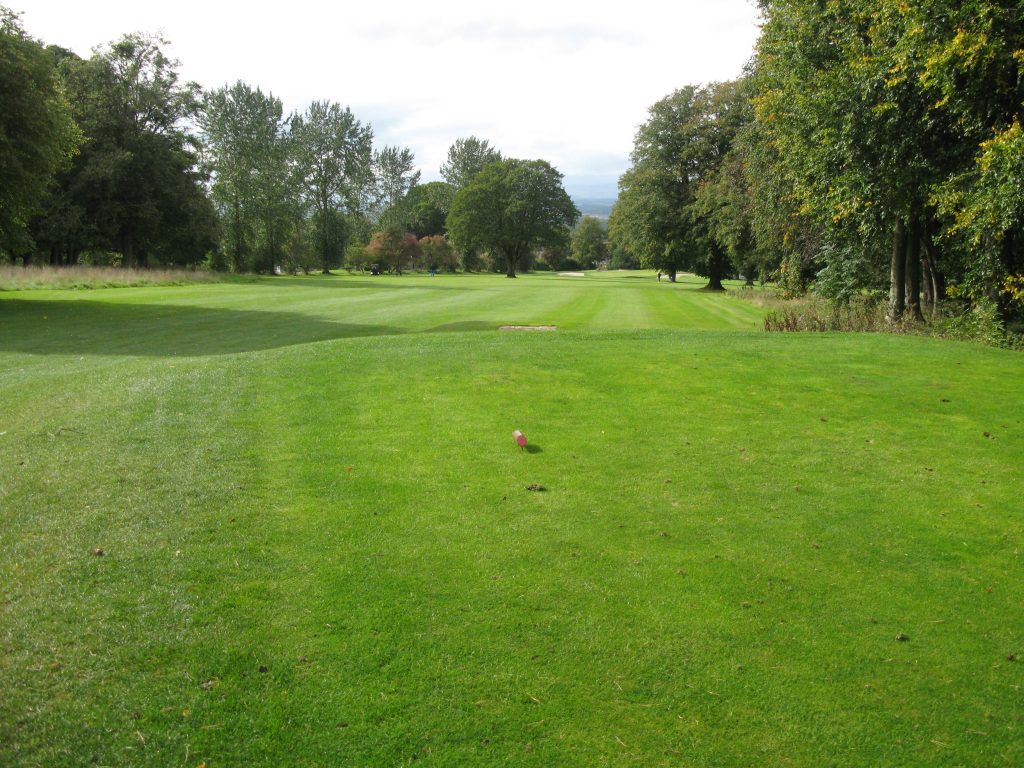
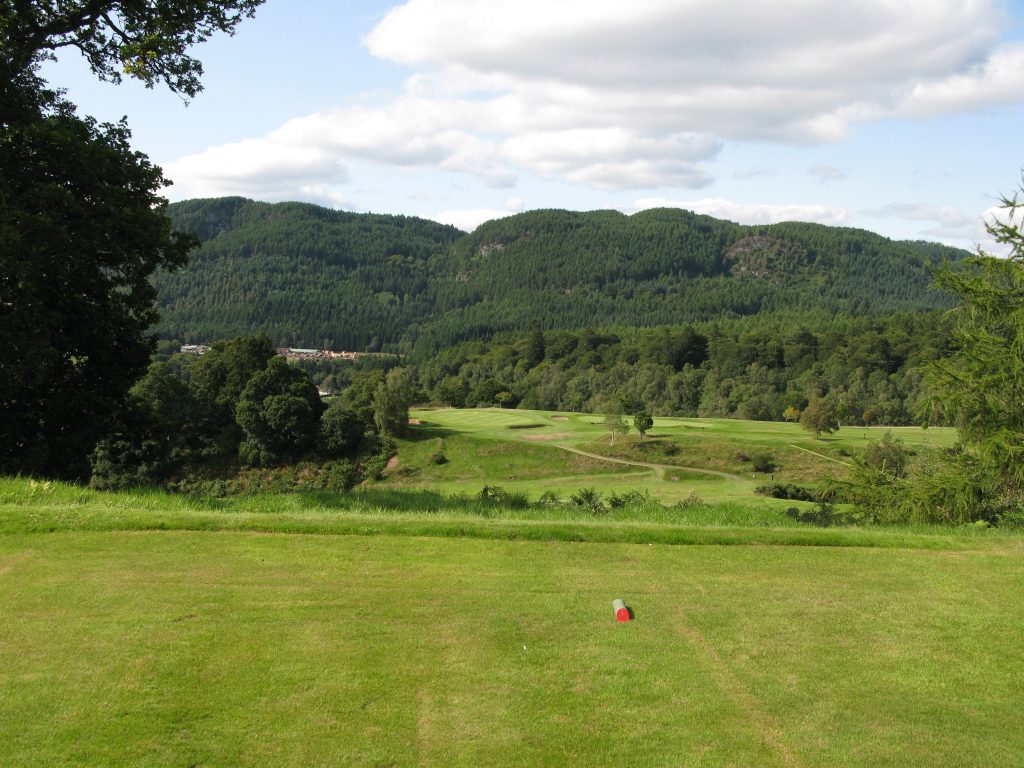
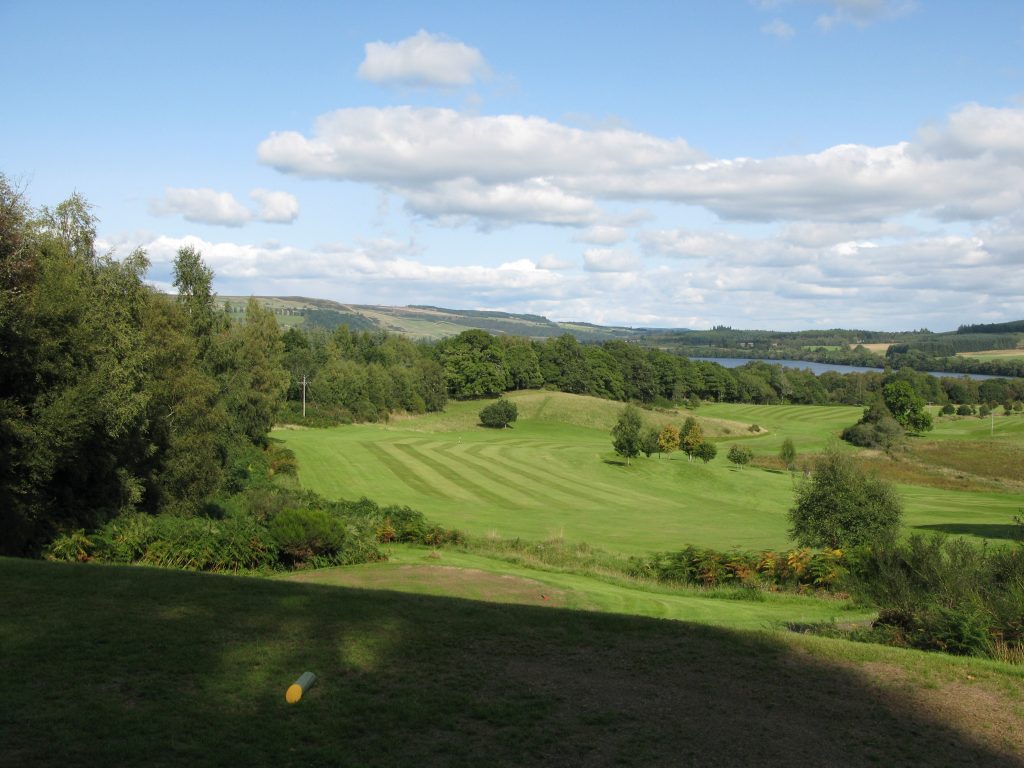
The 6th tee view, typical of the Murrayshall course

Whereas the sister Lynedoch course is partly woodland, Murrayshall is exclusively parkland.  I had previously played the Lynedoch track and had been very impressed (read my blog here).  I was therefore greatly looking forward to playing the hotel’s premium course, but must admit that I don’t think the higher price is worth it is versus its shorter neighbour.   It’s still a very nice course, with some outstanding countryside views, nice greens and good bunkering;  but, other than being a longer course, it lacked the guile of its smaller sister course.
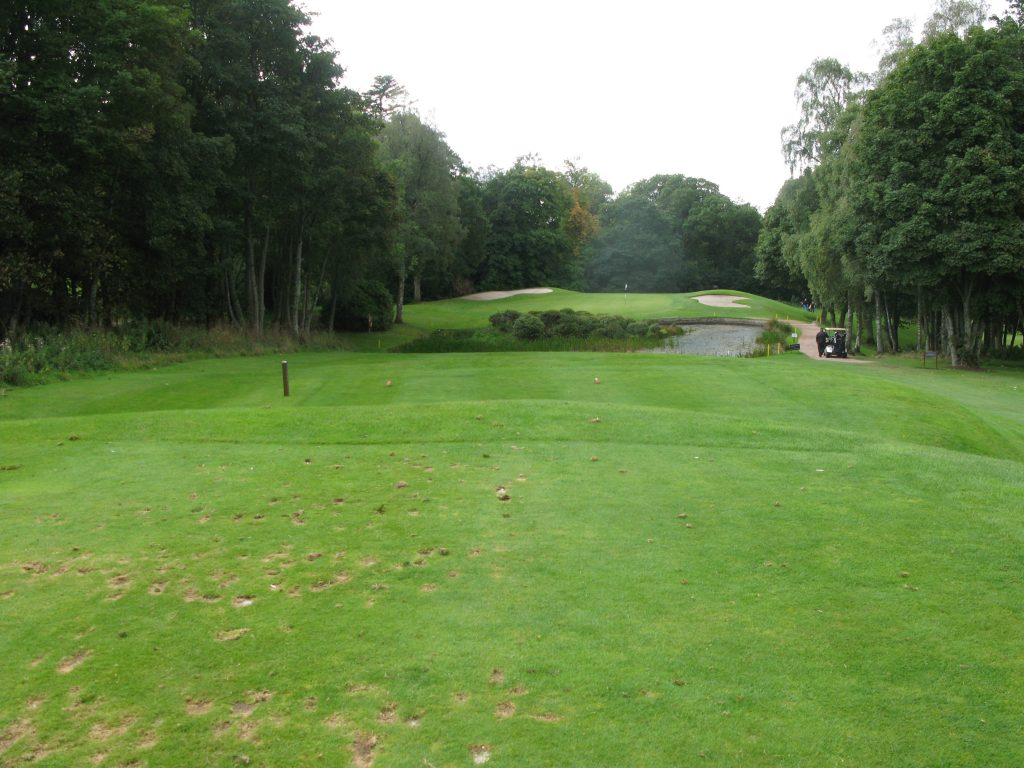
The short par 3, 4th hole, at Murrayshall

The course was in good condition when I played and I had a nice round of 89, for 37 stableford points (off 17);  including a birdie at the 13th, the stoke index 1 hole, which was one of the more bland holes played towards a local farmyard.  My score also reflects the fairly open fairways and relatively accessible surrounds of the trees.  Other notable holes were the stretch of 6th, 7th and 8th, a really nice set of challenges, with a reachable par 4, a difficult par 4, and a tricky par 3.  Also noteworthy is the mix holes, with five par 5s and five par 3s, its an odd mix.
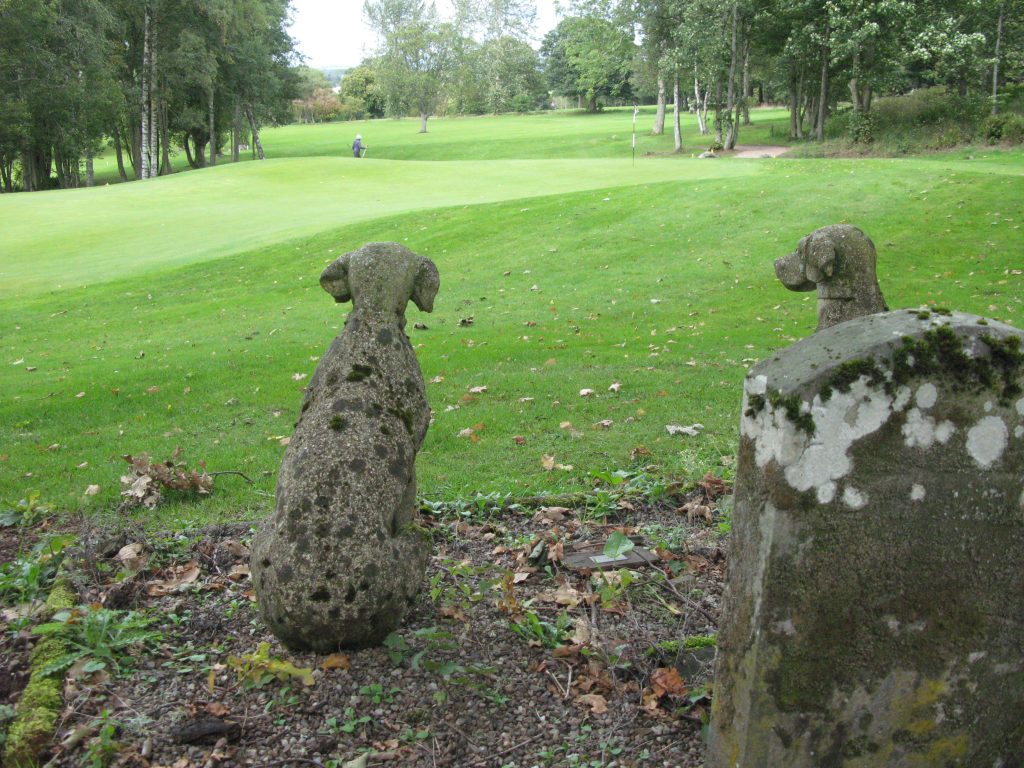
The two dogs (Isla and Joseph) whose grave guards the very difficult pay 4 7th, “Dogs Grave”

Unfortunately, the round at Murrayshall was the slowest I’ve played for several years, at around 4.5 hours.  Having caught up with the 4-ball in front, on hole 2, which actually turned out to be the last group of about 10 groups making up a society day, we then were delayed at about 5 minutes per hole for the remained of the round!  I’m writing this, to give context to my “value” assessment.  How should an assessment be dictated by pace of play?  Well, if I hadn’t been doing a blog, we would have walked in after 12 holes.   It was anything but value for money.  How many times have you heard “we would let you through, but it’s the group ahead holding us up” – I refer everyone to the Etiquette section of the rules of golf, which clearly recommends allowing a faster grouping through, regardless of circumstances.

It is worth playing, but perhaps check whether a society is playing in front!

Some Facts

Course Type: Parkland

Par 70 (5 par 5s, 8 par 4s, 5 par 3s)

Distance (white)   5868 yards

Moly’s Gross Score  89
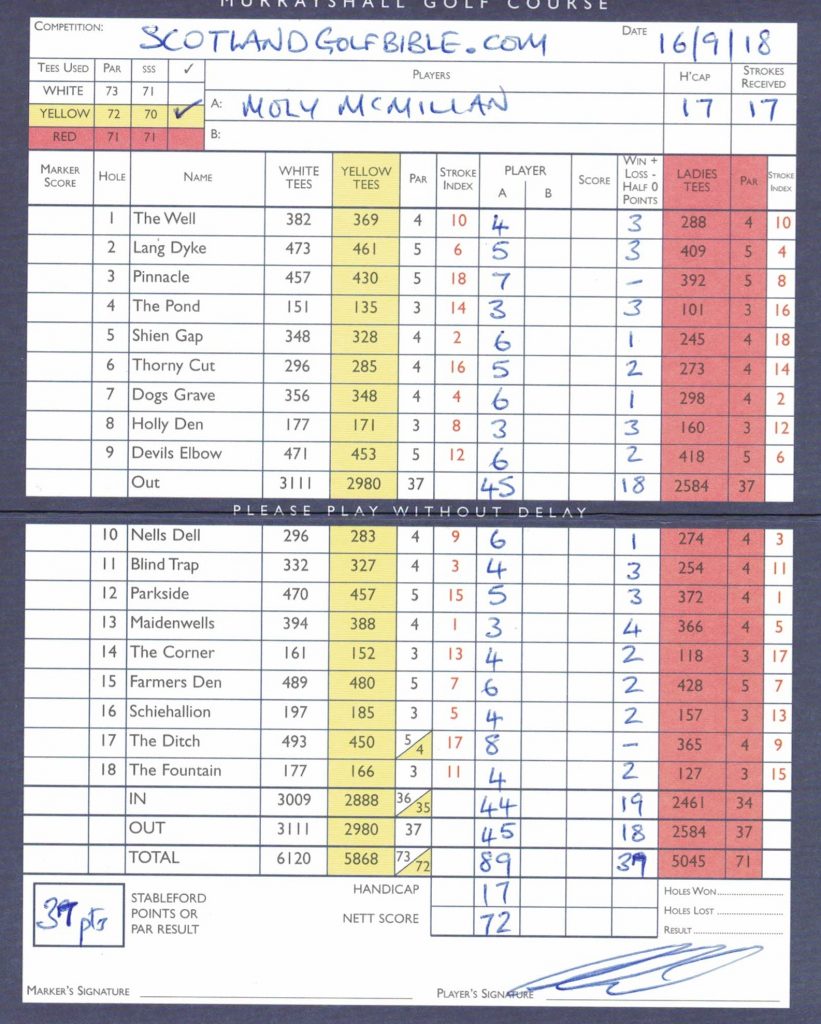
Moly’s 89 at Murrayshall – a decent round given the chilly weather
87. Archerfield – Dirleton Links. 13 Sep 2018.

One of the two courses on the Archerfield Estate, Dirleton demands a place in the “Faux” Links discussion

Round £90…plus hotel residency!   Par 72.  Value (out of 5) – 3.5

Nestled between Muirfield and North Berwick, and adjacent to the magnificent Renaissance, the Dirleton Links and Fidra Links courses form the golfing challenges of the Archerfield Estate, a development created by the Edinburgh businessman Kevin Doyle over the last 15 years.   These additions strengthen the case that this East Lothian region is Scotland’s premier golfing destination.  Read my Fidra Links blog here and my Renaissance blog here.

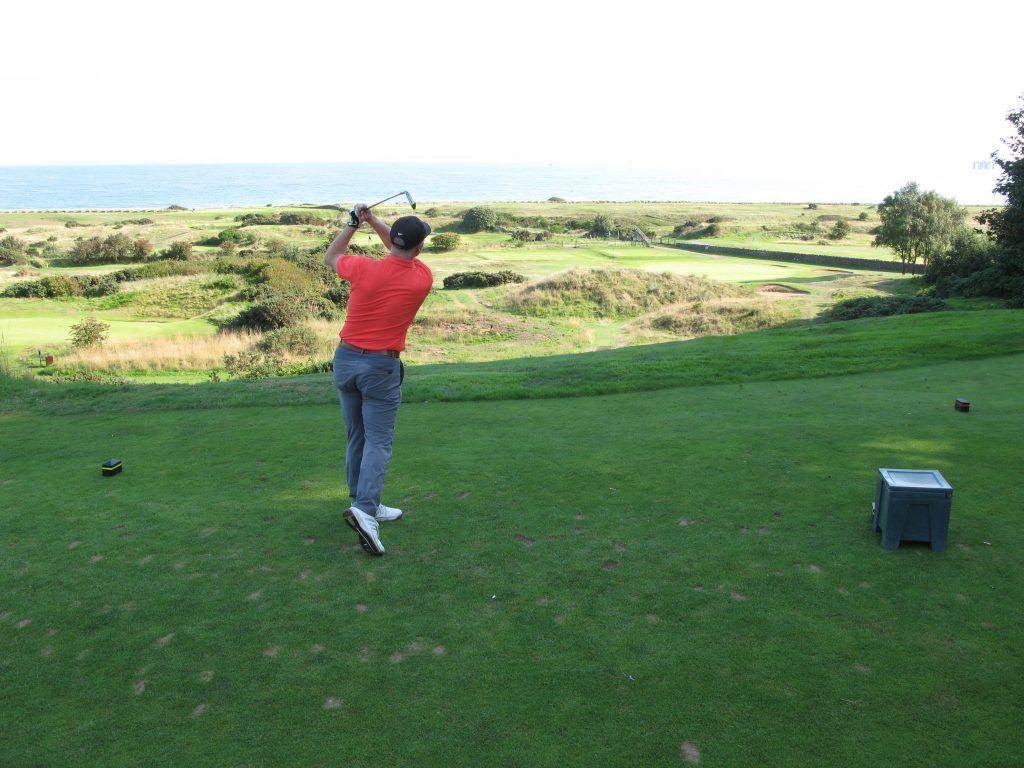
The magnificent par 5 5th at Archerfield’s Dirleton Links, with Fran on the tee,

The estate has a range of 5 star accommodation options, with the 17th Century, 16 bedroom, flagship Archerfield House being available to rent in part or in whole.    With great accommodation, a quite superb Scandinavian inspired spa (I thoroughly recommend the Golfers Recover massage), and first rate practice facilities on offer, this is a world class golf resort on Edinburgh’s doorstep.  Curiously, the clubhouse restaurant and bar is adorned with African art, giving it a colonial feel?

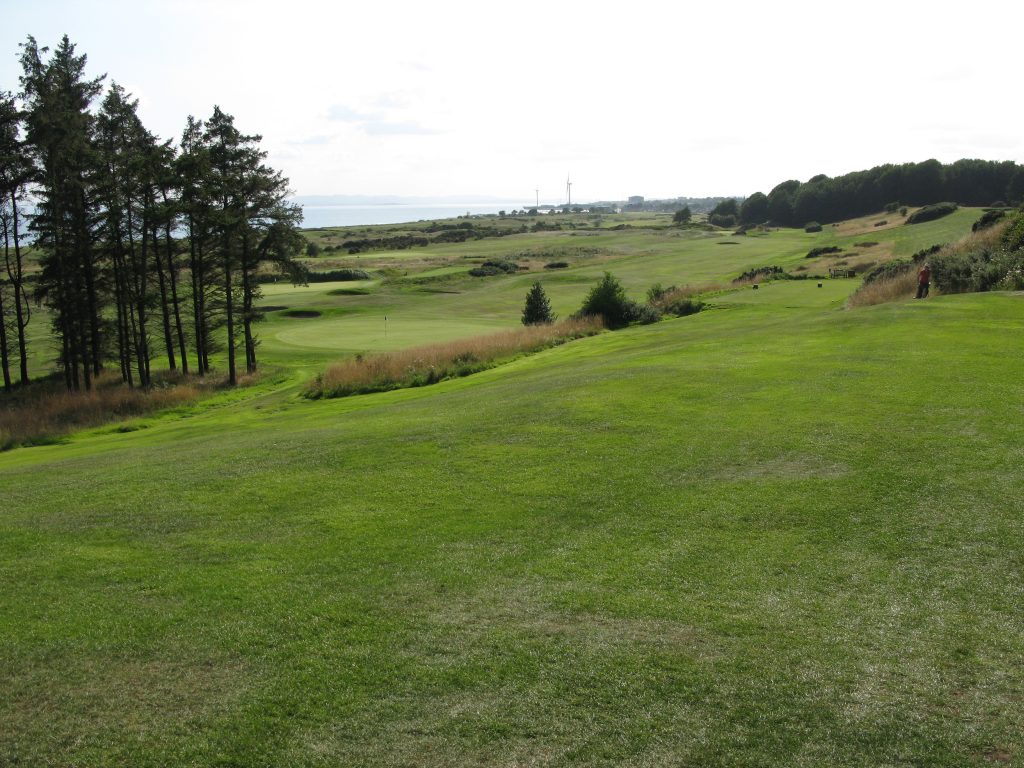
The par 4 2nd, a typical hole at Dirleton, with the gorse surrounding the fairways.

In considering Dirleton Links, there is an argument that this is a “Faux” Links, a term that has gained traction in recent years, mainly coined for inland courses, designed to replicate Links conditions.  A couple of definitions are worth referring to:

The Wikipedia Definition of a Links course includes  “..comes via the Scots, meaning “rising ground, ridge” and refers to an area of coastal sand dunes and …. is typically characterised by () an undulating surface, and a sandy soil unsuitable for arable farming but which readily supports various indigenous browntop bents and red fescue grasses, that result in the firm turf associated with links courses and the ‘running’ game…”

Whereas the meaning of “faux” is “made in imitation; artificial”.

So is Dirleton Links a true links course?  I think what has crept into the game is the thought that Gorse forms a key part of a links layout, and that is what the creator of Dirleton, David J Russell, has surrounded the course with.  However, there is no sand dues to be seen, and I’m convinced that you could plant a fair few “Tatties” on those fairways.  So for me, its not a real links, regardless of the course name.

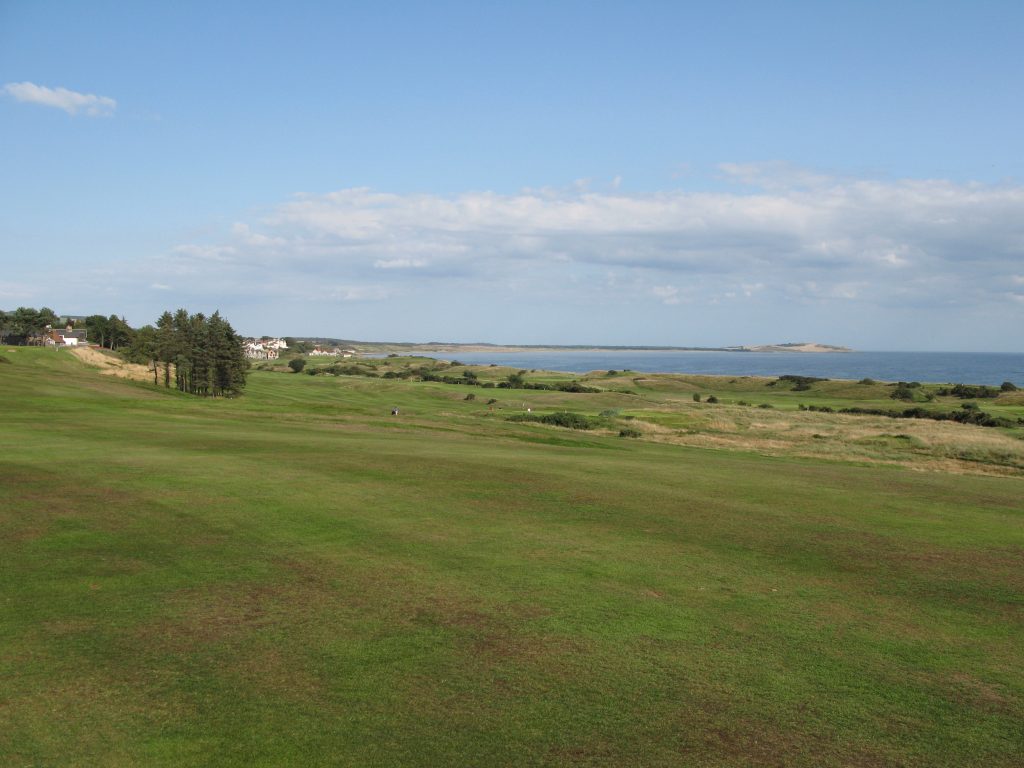
The view over the “Faux” Links from the beautiful 6th green at Dirleton

However, that’s not to say its a poor course, on the contrary it’s a terrific golf course, which in my opinion is better than its sister Fidra, which appears higher on most ratings lists of

The Archerfield House behind the 7th green at Dirleton Links; which was rented out complete by 4 Americans, during our stay.

Scottish courses.

It’s a very traditional layout with both the outward and back 9s made up of 5 pars 4s, 2 pars 3s and 2 par 5s.  This is my favourite layout, and in addition there is a great mix of long and short par 4s.  The course meanders around itself, so wind direction was always changing from hole to hole.  It was one of those courses where the wind most often seemed to be against though!  It was a very windy day – gusts of up to 45mph, which played havoc with both Fran and my scores.   The fairway bunkers are really well positioned and force strategic decisions off the tee.   Overall a course I would like to take my A game to.

It’s not cheap;  membership via a debenture costs about £30,000, then around £3,000 annual fees.  But, you do get your shoes cleaned and don’t need to worry about paying for range balls.  You can have a “golf experience day” (price unknown), or as I did pay a £90 green fee as an accommodation occupant; I suspect many golfers play both courses either side of a single night B&B stay, which costs about £500; not bad for a short of this quality.  The clubhouse food is pretty good too, and not overpriced.  One of the benefits of the fee was a superb course planner, which was included, illustrated by Kenneth Reed FRSA.

The wonderful course planner at Archerfield’s Dirleton Links, illustrated by Kenneth Reed FRSA.

If you can afford it, its worth staying and playing at Archerfield.

Plus, whether a “Faux” or real Links, its a great course.

Facts:

Course Type: Links

Par 72 (4 par 5s, 10 par 4s,  4 par 3s)

Distance (white): 6133 Yards

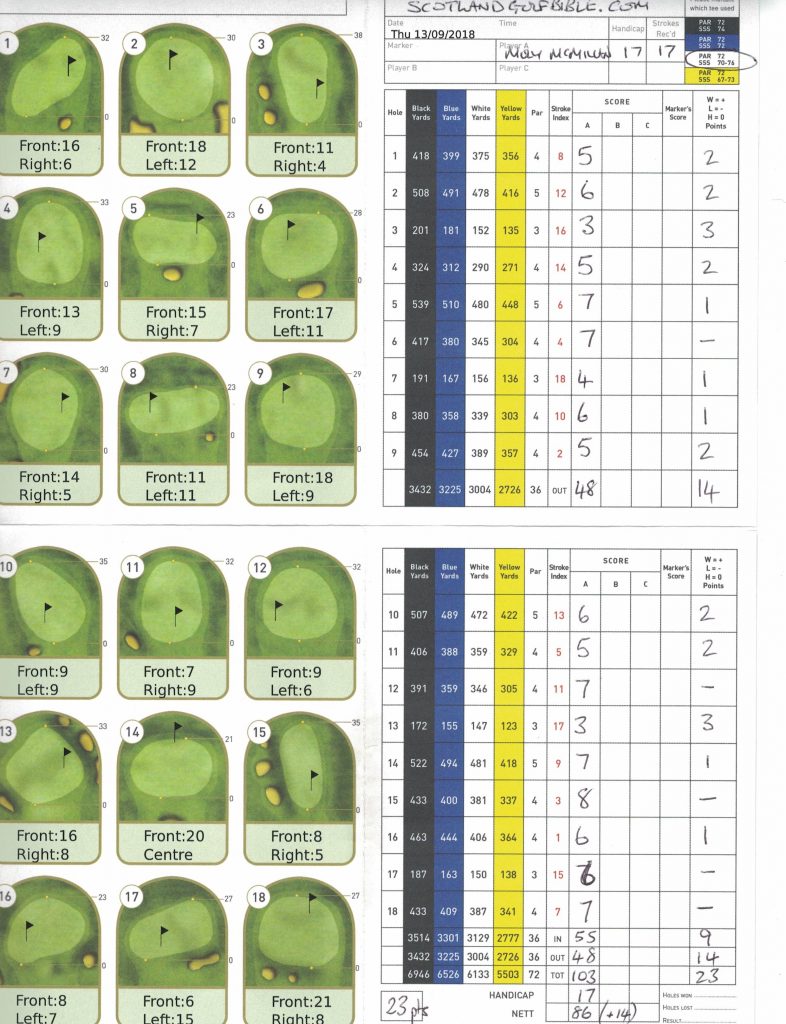
Moly’s Gross score: 103

The very high winds – gusts of 40mph – explain the 103 for 23 points

84. Lundin. 31 Aug 2018.

This historic links is a marriage made in golfing heaven 

Round £75.   Par 70.  Value (out of 5) – 5

Winston Churchill one said “this is a long speech because I’ve not had time to prepare a short one”.  That feels like my dilemma in writing about the wonderfully crafted golf course at Lundin Links; what to leave out?  I say the golf course “at” Lundin Links, because that is actually the name of the town, which sits on the southerly Fife coast about 12 miles south of St Andrews, where the Lundin Golf Club is based.  I think it’s the only place in the world where the town has the more appropriate golfing name than its golf course!

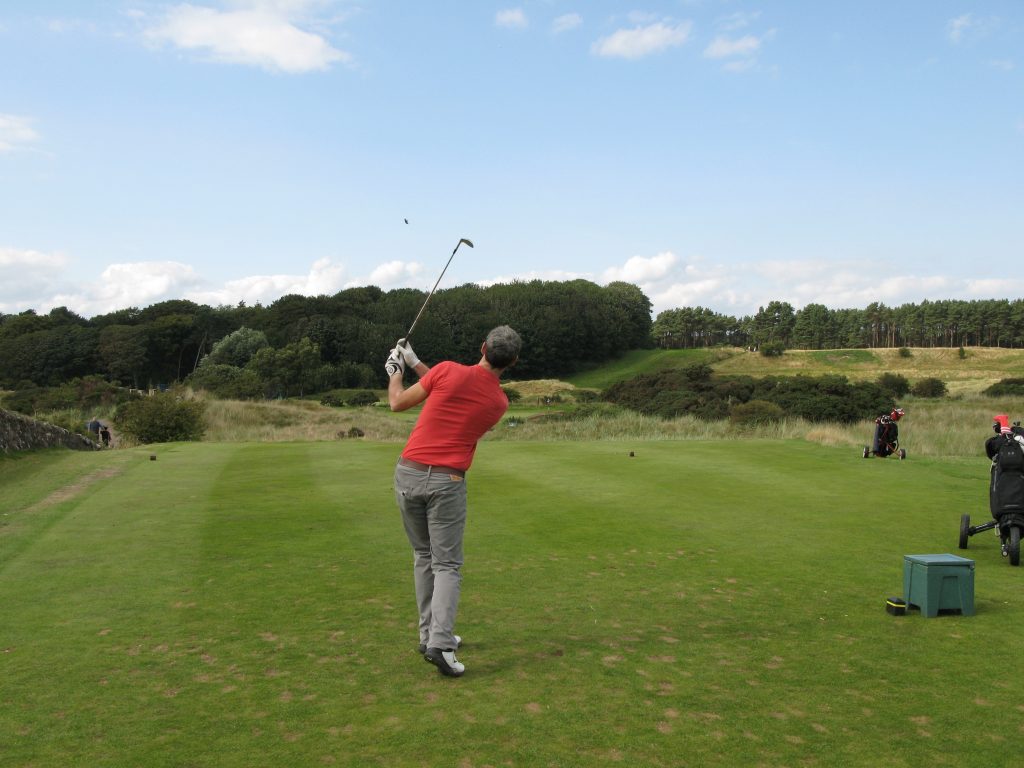
Moly at Lundin’s par 3 14th – where you can see all the 18 greens!

This naming conundrum is aesthetically appropriate because Lundin golf course poses a few other riddles.  Along with the adjacent Leven Links (the name of the golf course by the way, not the town, which is simply called Leven; au contraire!) it had the first ever 18 hole golf course with 18 separate greens, established in 1868.  That original 18 hole layout, 9 holes of the current Leven Links course plus 9 from Lundin, separated by the Mile Dyke, is still played, but only once per year in a competition to mark its history.  I covered the history of the split in the courses fully in the Leven Links blog here.

View across the Lundin course from the 13th fairway.

The real riddle at Lundin was the architectural one given to James Braid, who was tasked in 1908 with adding 9 holes on the inland side of the 9 holes crafted by Old Tom Morris, to leave us with the current 18 hole layout.  The resulting course is an absolute beauty, and I’m sure Braid tinkered with the bunkering of Old Tom’s holes as well.  Old Tom’s holes are now the first 5 and last 4.

The course is a nice length at about 6400 yards; not long by today’s standards, but with some fascinating decision making, especially from the tee.  Until very recently it was used for final qualifying when the Open was staged at St Andrews, a measure of its quality and condition.

View from the 12th green at Lundin, looking towards Leven

The course was in excellent condition when I played, as a guest of local member Eric Brown and his wife, Moira.  I ungraciously won the “6 point per hole” match play game, although it was nip and tuck most of the way round.  My 9 pars off my 16.8 handicap did rightly elicit a self induced “bandit” conversation, albeit my 3 lost balls (1 resulting in an 8 at the par 4 18th), meant that my 36 points on a fine day would likely have been only in the handicap buffer zone!  That’s my defence anyway M’Laud!

Enough about me, the golf course is the star here.   It’s also a good time to introduce readers to Golf Club Atlas a non commercial web site run by and for golf course architects, where you can find some excellent reviews of many of the worlds great courses.  Being reviewed by Golf Club Atlas is a measure of a course’s pedigree, as well as giving great insight as with their entry for Lundin.

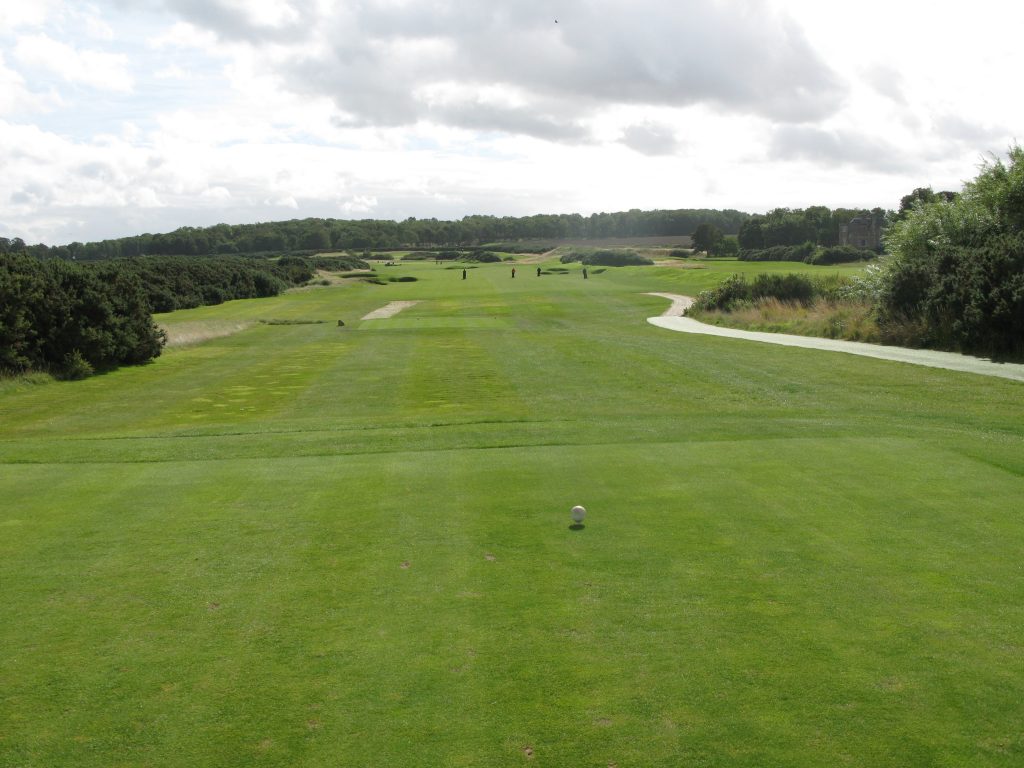
The first 4 holes are classic links holes, played normally into the prevailing wind, with OOB along the left with the beach awaiting a wild hook.  The first is a difficult 400+ yards par 4, with a mid to long iron needed to an uphill plateaued green;  the second, a shorter par 4, requires good judgement to stop short of a fairway burn with your tee shot;  then the 3rd, another short par 4, presents a challenging drive to miss several fairway bunkers.    The 4th, however, is where many a round will come unstuck.  Any time a James Braid influenced course has a stroke index 1 hole without any fairway bunkers, one needs to probable play it as a par 5.  I failed to adhere to this plan, and ended up hitting a decent second shot with a hybrid to the right on the green and never saw it again – whether it cleared the deep burn I will never know!

Eric Brown playing at the par 3 5th hole, one of only 2 holes at Lundin not playing in the coastline direction.

After a relatively short par 3 5th, you leave Old Tom’s legacy and move to the other side of an old railway line that slices the course in half, and play the 9 Braid holes, the first 3 of which have the railway as OOBs to the right.    By the time you have played the 6th and 7th, you might also have picked up another clever feature of this course – the short par 4s tend to have very tricky greens.

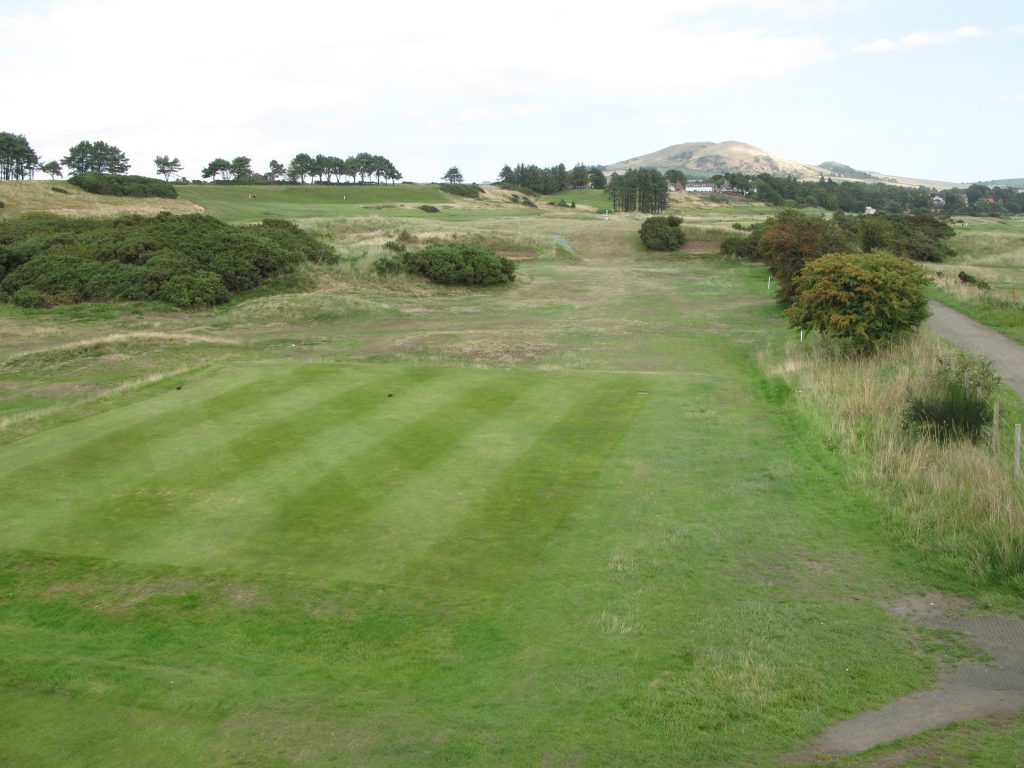
The view from the 6th tee, one of the short par 4s with a very tricky green.

The 10th hole was another of the typical strategic challenges;  the fairway is cut in two between the tee and green;  go left where no bunkers exist, but leave a blind second with the green side bunkering obscured, or go right for an easier approach shot, as long as you miss the well placed fairway bunkers.  A joy of a hole.

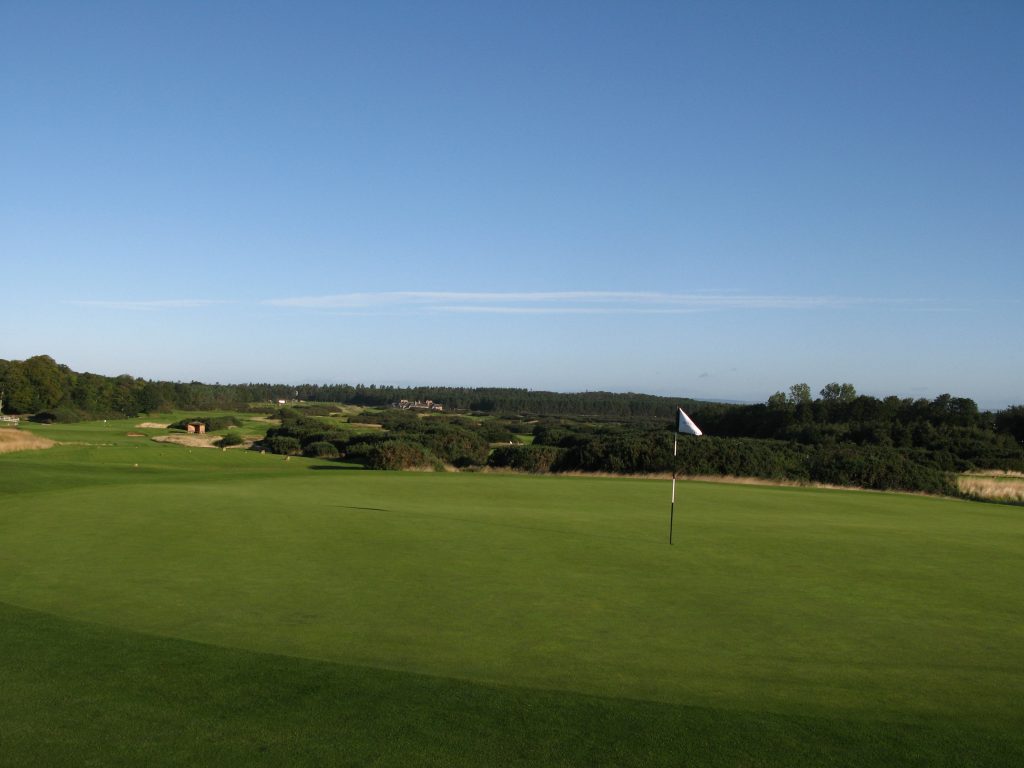
After playing the, arguably parkland, inland holes of 11 through 13, you reach a place arguably unique in world golf.  From the 14th tee, you can see every green on the course, along with a magnificent view of the Firth of Forth and the North Berwick coast in the distance.  This view is worth the green fee alone.  The 14th is also a great par 3, with a significant drop, so club selection is key to this hole – it’s better being long than short here by the way.

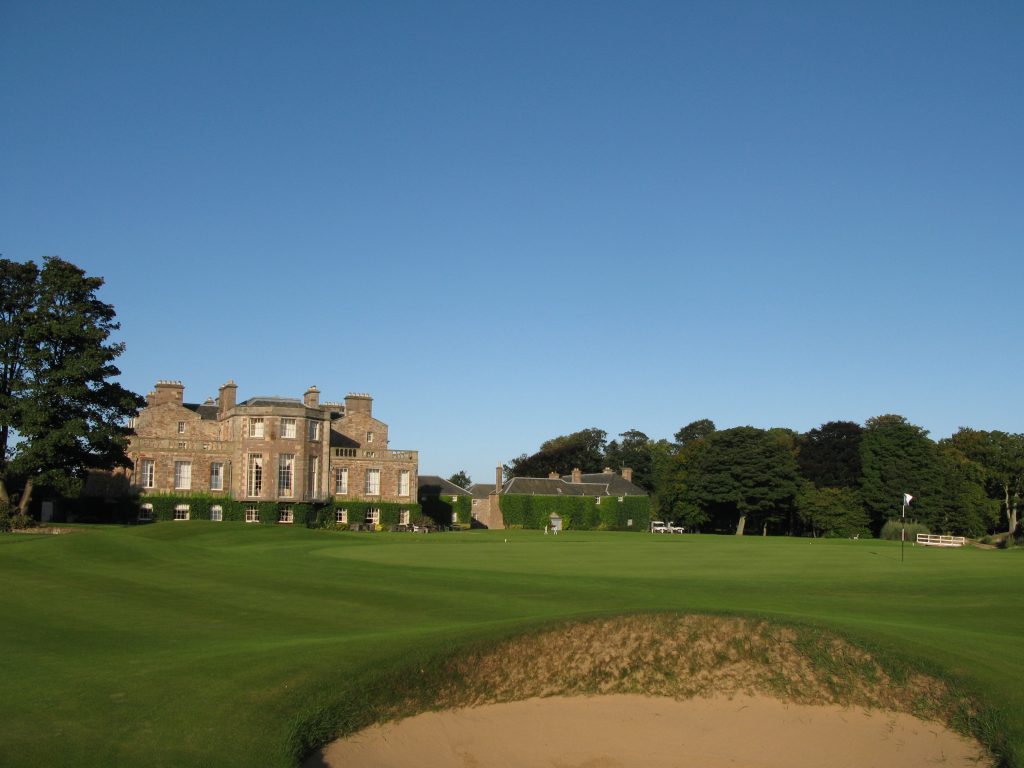
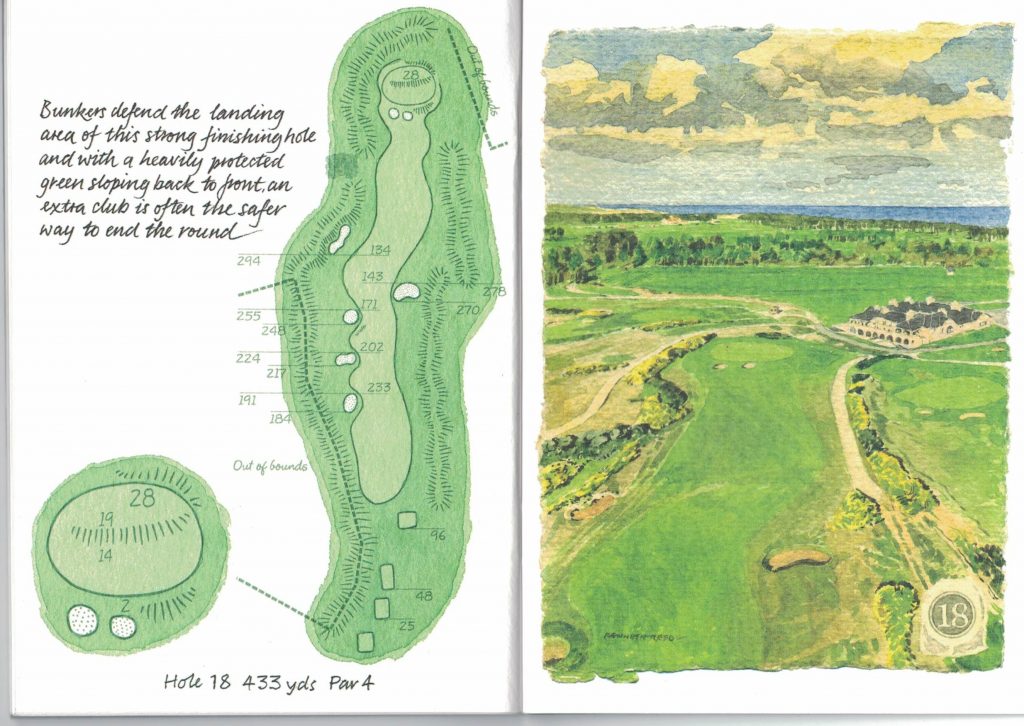
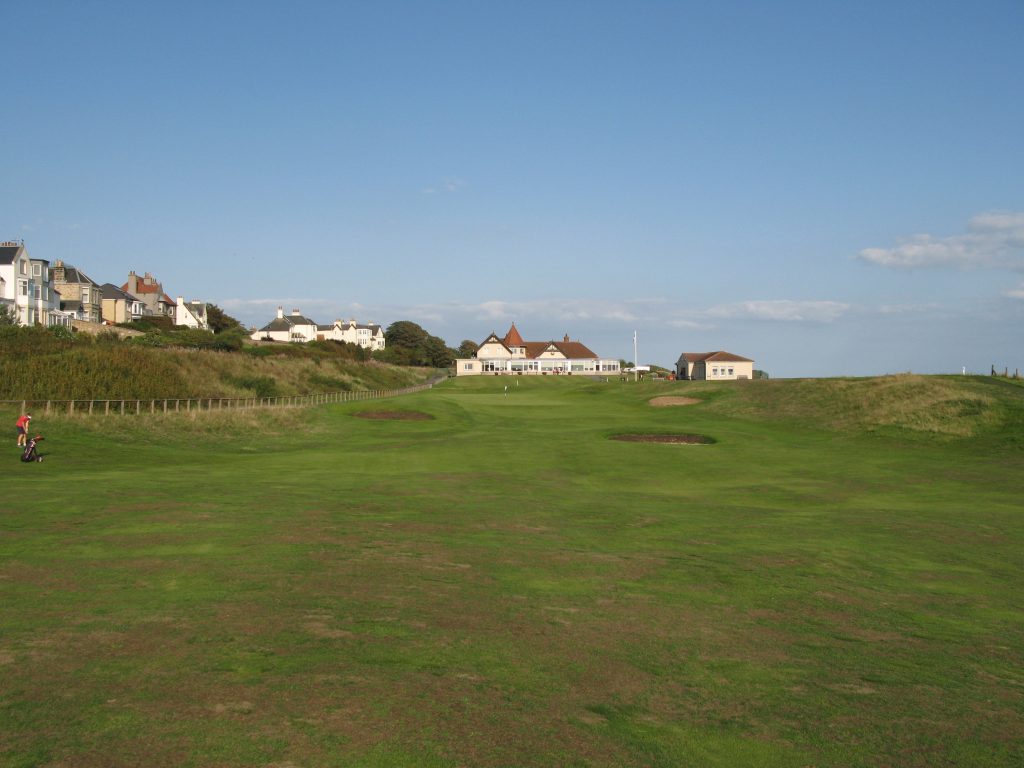
After a nice set of par 4s, you come to the very difficult last hole, a long par 4 played to a long and slightly raised green that slopes from back to front in front of the terrific clubhouse.  I think the number of visiting golfers that find this green in regulation will be low;  plus the sting in the tail is that it has a very difficult green to finish.  I ended up with an 8, having put my second OOB to the left.

The difficult long par 4 18th hole, in front of the lovely Lundin clubhouse.  Moira, seen here playing her approach, having just stayed in bounds on the left.

People say that Lundin is a “gem”, but I disagree.  Its much better than that;  for me, the term “gem” has evolved into one used to describe “great courses, but somewhat unknown or off the beaten track”.  Lundin is very much on the well trodden track, is a merge of architectural significance by 2 of the greats, and it is a joy, for many reasons.

A must play Scottish golf course.   Buy the Course Guide, and study the holes!

Facts:

Course Type: Links

Par 70 (2 par 5s, 13 par 4s,  3 par 3s)

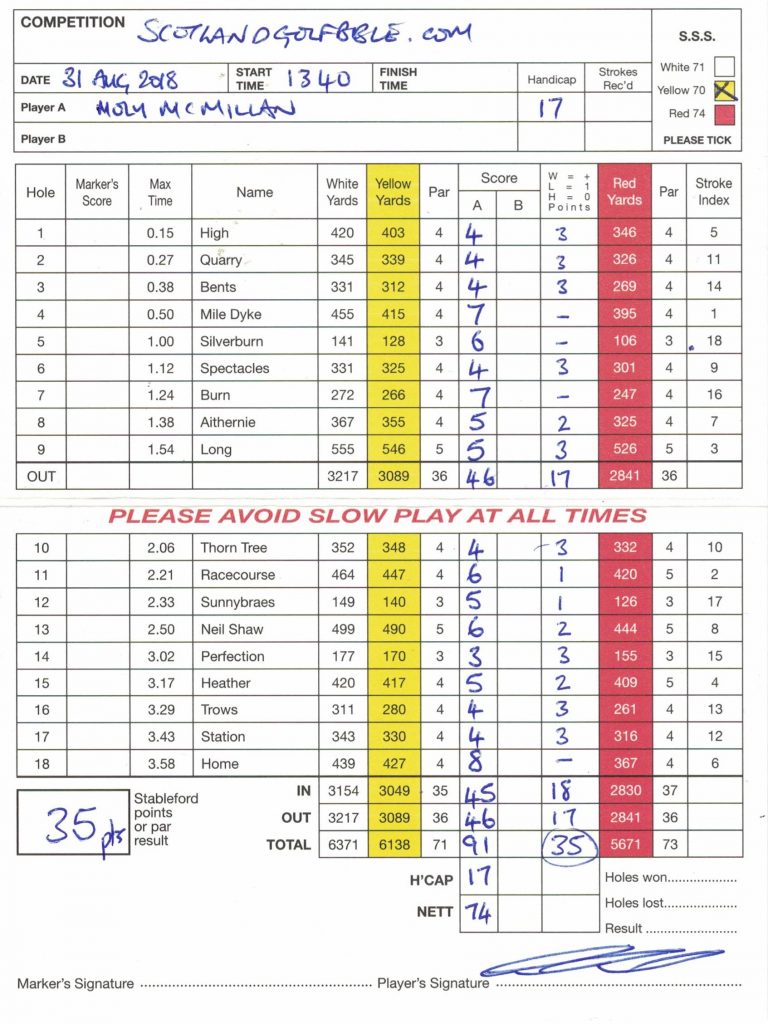
Distance (yellow): 6138 Yards

Moly’s Gross score: 91

Moly’s very mixed Lundin scorecard – 9 pars, but still 21 over par for 91!

83. Dunkeld & Birnam. 25 Aug 2018.

This brilliantly located course, with great countryside views, is a tough 18 hole undulating walk – I wonder whether in time the club may reflect it should have stayed as a 9 hole layout? 

Round £30.   Par 69.  Value (out of 5) – 3.5

Dunkeld and Birnam Golf  Course is just a few miles east of Dunkeld, in the village of Birnam,  in what the club describe on their website as “Highland Perthshire”.    Birman and Dunkeld were actually different villages set on opposite banks of the river Tay, until they were connected in 1809 by a Thomas Telford bridge.  It is in an area of outstanding beauty, and I suspect many visitors may decide to play golf whilst on holiday.

Moly at the par 3 11th, one of the new holes created in 2000.

The course was designed by Old Tom Morris in 1892, and was only extended to 18 holes in 2000.  The new holes are very much more open parkland, and slightly out of sorts with many of the original holes, which provide some typical “highland” holes.

The new layout also caused a change in the hole order, with the 17th and 18th (both originally part of the 9 hole course) being 2 of the 4 par 3s of the 18 hole course.  This makes for a rather unbalanced course in my view.  With the increasing debate about 9 hole golf competitions, as a means of encouraging play, I wonder whether Dunkeld and Birnam should have remained a 9 hole course?  I certainly think there is a charm in the “highland 9 holer”, which arguably has been lost.

The risk reward par 4 6th hole, with the picturesque surrounds.

The course is relatively short, but it feels much longer, due to the many undulating holes, and there are a couple of fairly long walks between green and tee (the 7th to 8th being the longest, between the old and new holes).  The walk up to the 18th green warrants a buggy hire in its own right and, thankfully, there are several available for hire.

The tough approach shot at the par 4 8th at Dunkeld and Birnam

Having said all this, which might be unfairly critical, it’s really well worth the visit to play Dunkeld and Birnam.  The overall condition of the course was excellent and the greens were lovely.  The views were outstanding, including overlooking Dunkeld and taking in The Loch of the Lowes, and I think that playing in early Autumn must be particularly spectacular, due to the many trees surrounding the local hillsides.  It is an area renowned for local bird life.

The 9th tee, with The Loch of the Lowes in the distance.

Even if not playing golf here, the Golf Club has a really nice clubhouse, with beautiful countryside views and would be nice to visit for the good food also on offer.   The members were very friendly to Fran and I, and they were very proud of their club.   They are also an enterprising club and have an apartment for rent in the clubhouse.

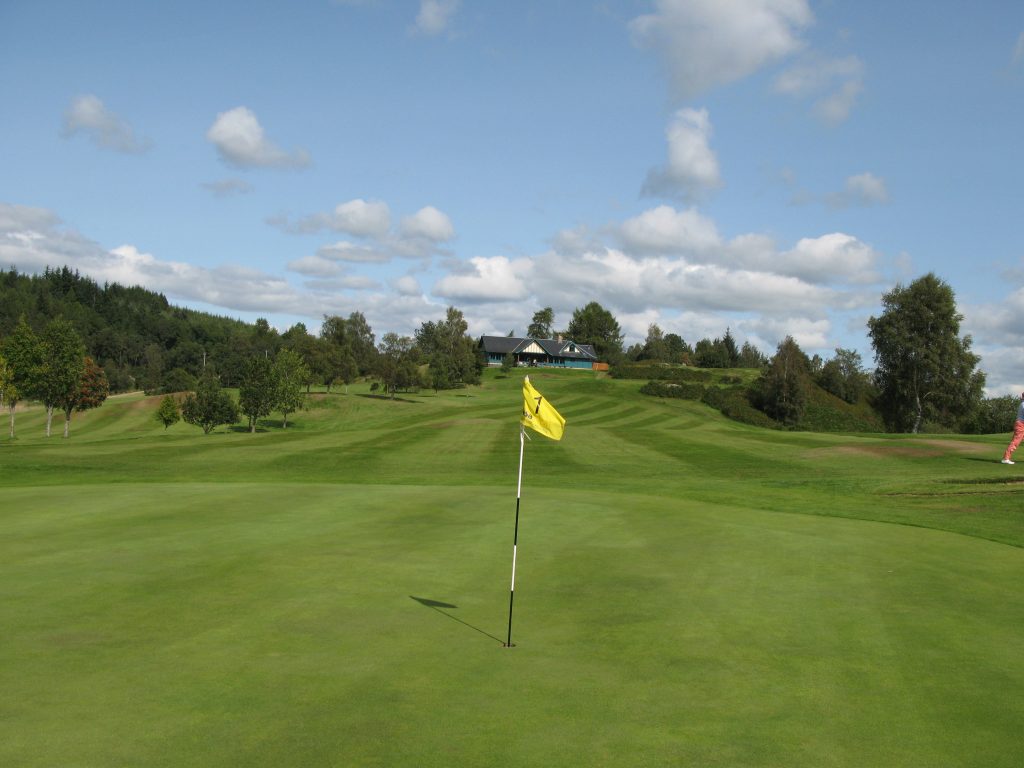
The first green looking towards the lovely club house at Dunkeld and Birnam

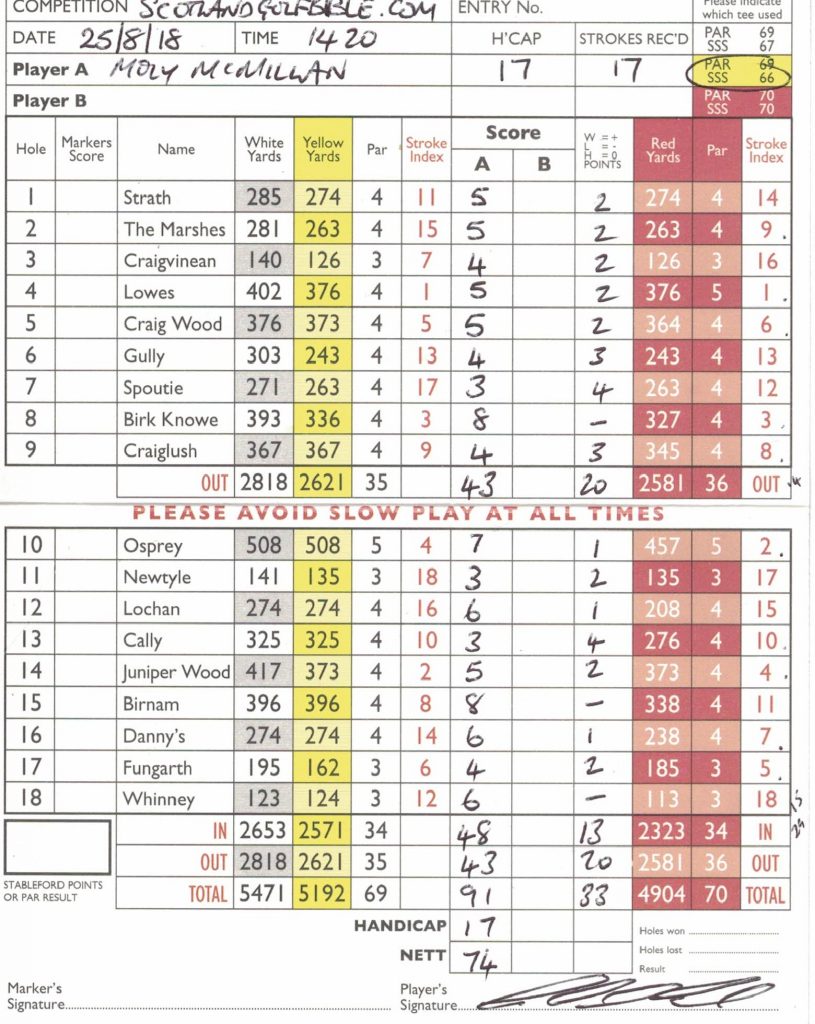
The course has some very interesting holes, and also several short par 4s which present the classic risk and reward dilemma, no more so than the 6th, one of several drive-able holes; on the day I stuck to a conservative strategy, albeit my scoring (91 for 33 points), may indicate I should have played driver more often!

The best hole for me was the SI3 7th hole, where a mid iron is likely needed to a raised green surrounded by trouble.    I suggest you play more club than you think towards the left side of the green.

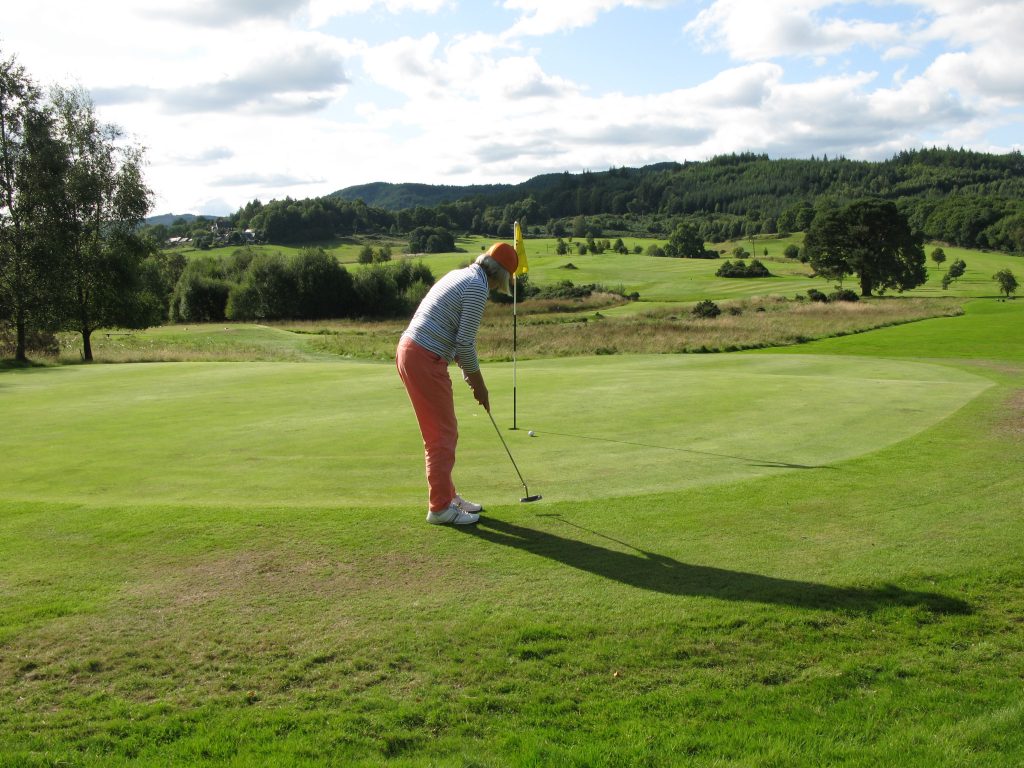
Fran putting at the 11th at Dunkeld and Birnam


Worth playing Dunkeld and Birnam, not least for the friendly welcome and the outstanding views from the clubhouse, over the tipple of your choice.

Facts:

Course Type: Heathland

Par 69 (1 par 5s, 13 par 4s,  4 par 3s)

Distance (yellow): 5192 Yards

Moly’s Gross score: 91

Moly’s 91 scorecard at Dunkeld & Birnam

« Older posts Newer posts »

© 2025 Scotland Golf Bible

Theme by Anders NorenUp ↑