A guide to green fee value for money

Category: Commercial (Page 1 of 9)

188. Turnberry Ailsa. 27 Mar 23

Holy Willy has taken over Tam o’ Shanter’s Links

Value – 5 / 5, using ‘The Art of the Deal’

Moly’s Score – 89
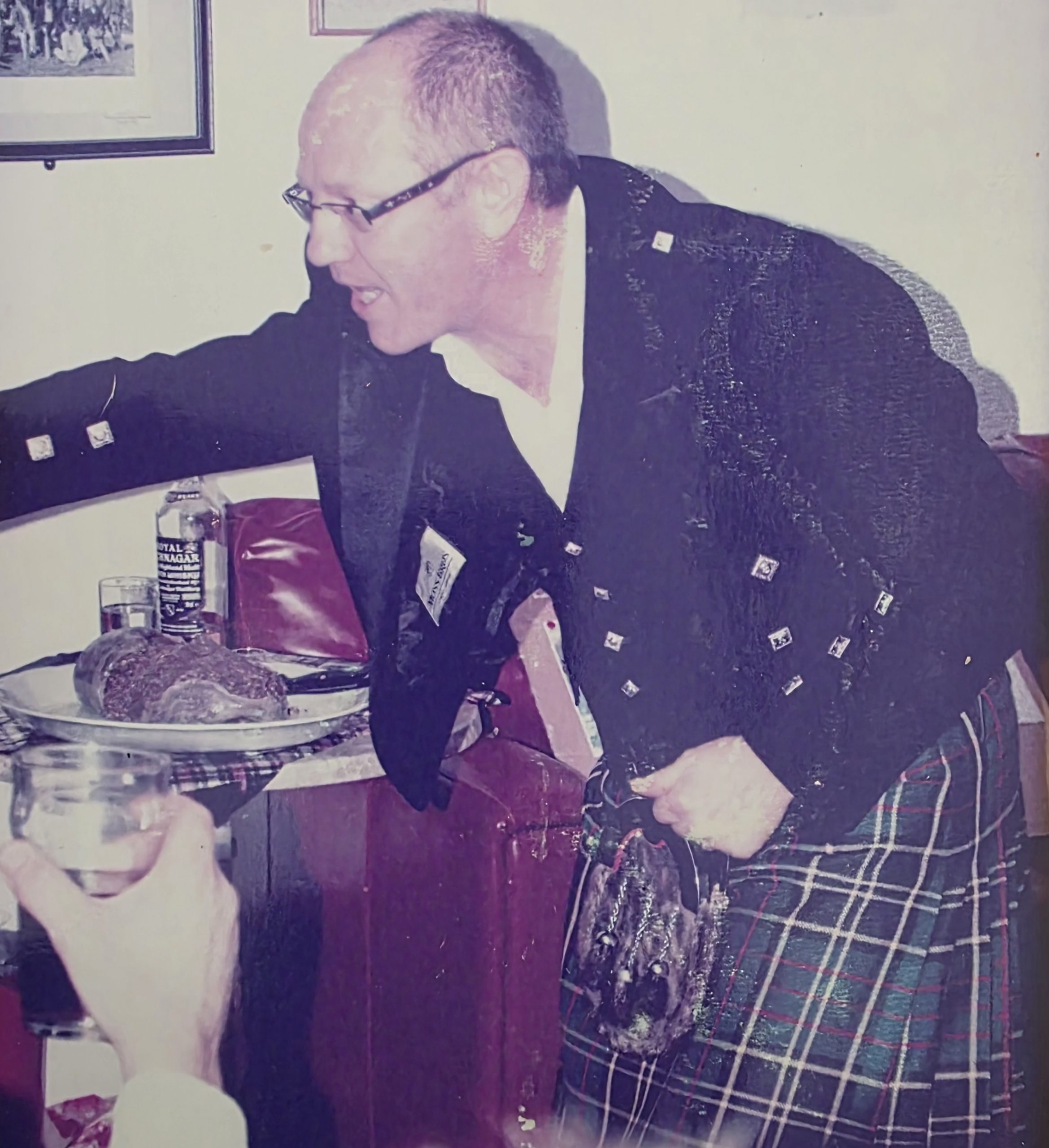
Moly ‘addressing the haggis’ – a prelude to Burns’ later work, Tam o’ Shanter

I’m a Burns man. I know his poems, songs and characters. When I unearthed that the real-life inspiration for Burns’ poem Tam o’ Shanter farmed one mile from Turnberry’s first tee, I had to dig deeper.

Shanter Farm sits adjacent to ‘Maidens’ on the Ayrshire coast. Douglas Graham farmed it in the late 1700s. His drinking ‘crony’ was John Davidson, a cobbler from Kirkoswald. Burns was just 16, in 1775, when he was sent to study in Kirkoswald, where he met Douglas and John, presumably in the pub. They made a lasting impression on the young Robert, who 15 years later used them as the blueprint for ‘Tam o’ Shanter’ and ‘Souter Johnnie’, the hero and his trusted companion, in, arguably, the greatest narrative Scottish poem.

The land of Tam o Shanter would become one of the finest golf courses on earth, but the metaphorical ownership by Burns’ characters wouldn’t end there.
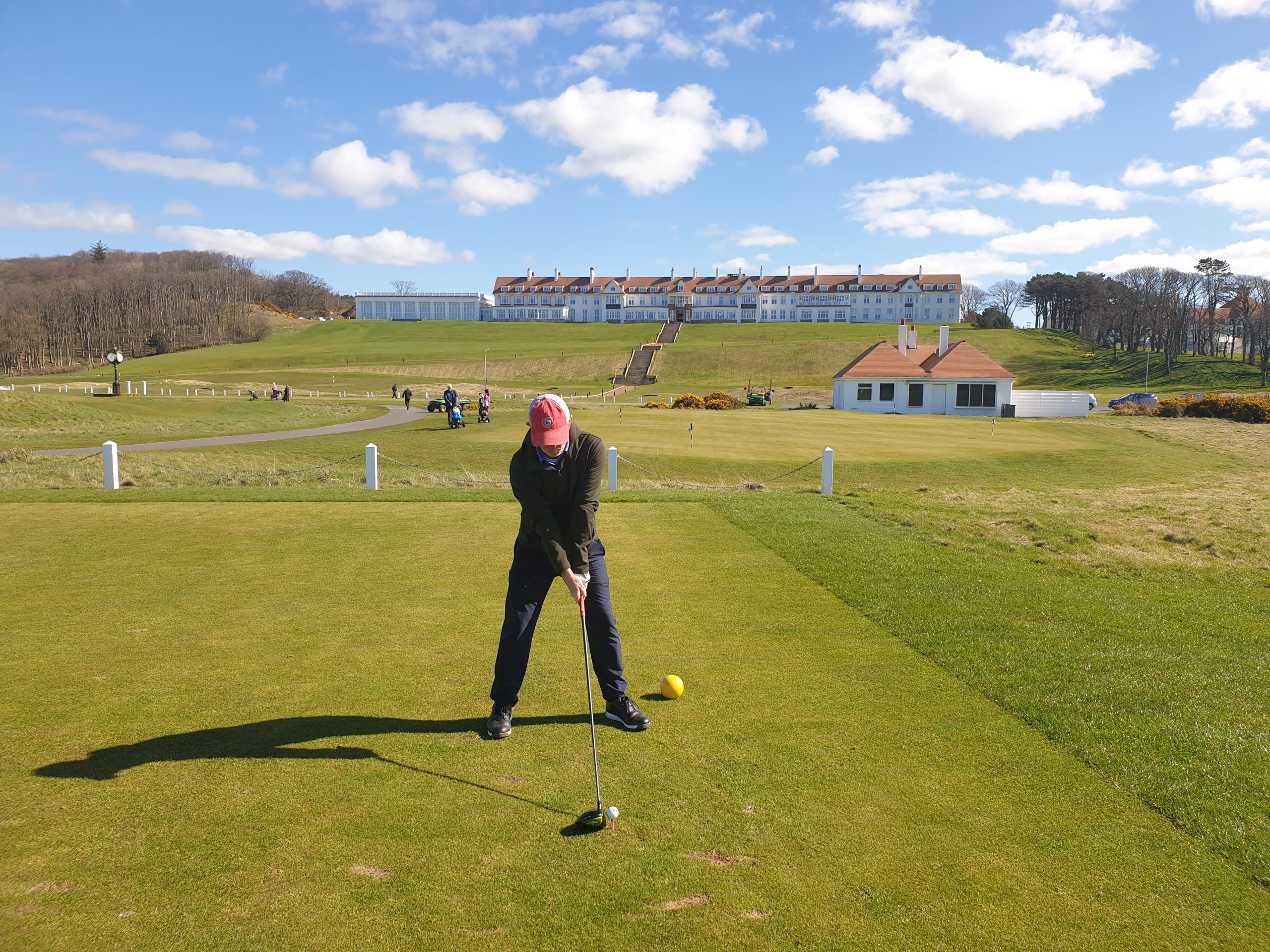
Moly on the first tee, with the Turnberry hotel behind. I just had to wear a Hoodie.

The Course

The Ailsa is in my top three of the 300 plus courses I’ve played to date (at June 2026). It also sits comfortably in most top 20 lists for courses world wide.

A course was laid out in 1901 by Willie Fernie, who was commissioned by Archibald Kennedy, the 3rd Marquess of Ailsa, who foresaw the links could be highly profitable with a railway and hotel, both of which duly opened in 1906. Sadly, the World Wars obliterated the golf resort – the railway closed permanently in 1942. Between 1949 and 1951, Philip Mackenzie Ross, the pre-eminent post war architect, restored the layout to the one which, in 1977, famously hosted the “Duel in the Sun”, between Nicklaus and Watson.

‘The Donald’ purchased the resort in 2014 for £47m, renaming it ‘Trump Turnberry’ and, between 2015 and 2016, Martin Ebert reconstructed the five holes along the coast and transformed the 9th from a par four into arguably the most dramatic par three in Scottish golf. Later he would extend the 16th into a challenging par 4, which will hopefully one day test Open entrants.

The headline rate to play in Summer is an astonishing “up to £1000” (2026). Which begs the question, “How much is perfection worth?”, a hyperbolic one probably crafted by Trump himself. Unbeknownst to Donald, Burns wrote a potentially prophetic and skewering poem about his like, called ‘Holy Willie’s Prayer”. ‘Holy Willie’, a man of towering narcissism who presents himself as chosen and blessed, operating by rules that apply to everyone else. Joking aside, the course is magnificent; perhaps Holy Willie occasionally got it right.
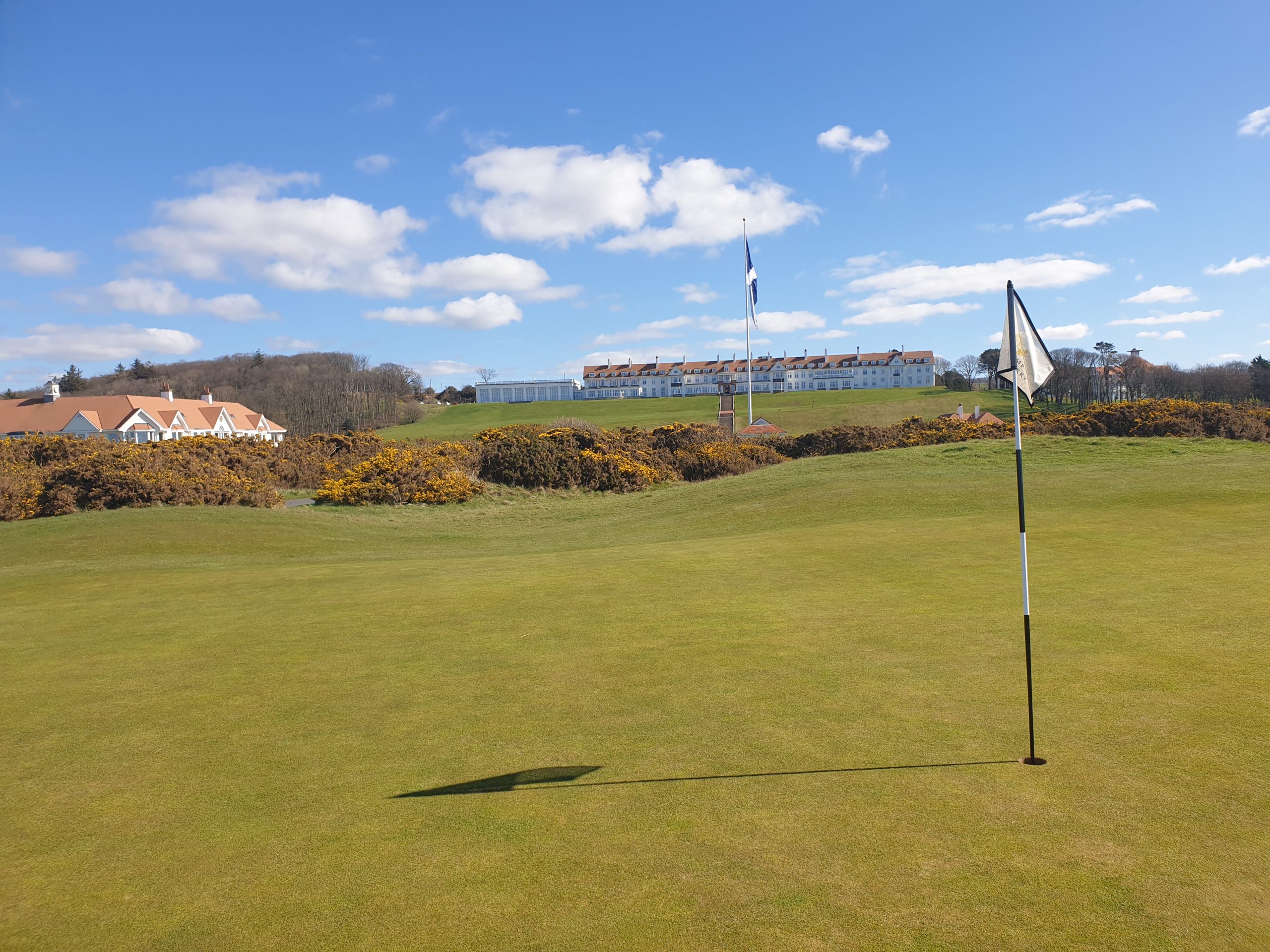
Light breeze on a perfect March day, the greens in Summer condition, here at the 2nd

The Art of The Deal?

At Scotland’s posh courses, like Muirfield or Royal Troon, the list price is the list price. They don’t negotiate. Trump operates differently – he’ll do a deal. When I played, the eye watering rate was £500. Looking late on the day before, the tee sheet showed plenty of spaces. I phoned the Pro shop, deployed my persuasive Dundonian vernacular, explaining I could only afford a ‘hundred quid that I’d saved up’. We settled at what might be my best value golf ever – £130. The man on the other end of my call had, in his own small way, something of the Bard’s spirit from Burns’ The Jolly Beggars; happy to set aside rank and rule for an afternoon, and let an ordinary punter in on the deal. He operated outside the script and created a very happy man..

So, is it perfect? At £500 (2023) I would give it four out of five on value, still exceptional, because very few courses in Scotland could justify that price. At £130 it is five out of five without hesitation. My greatest value ever.
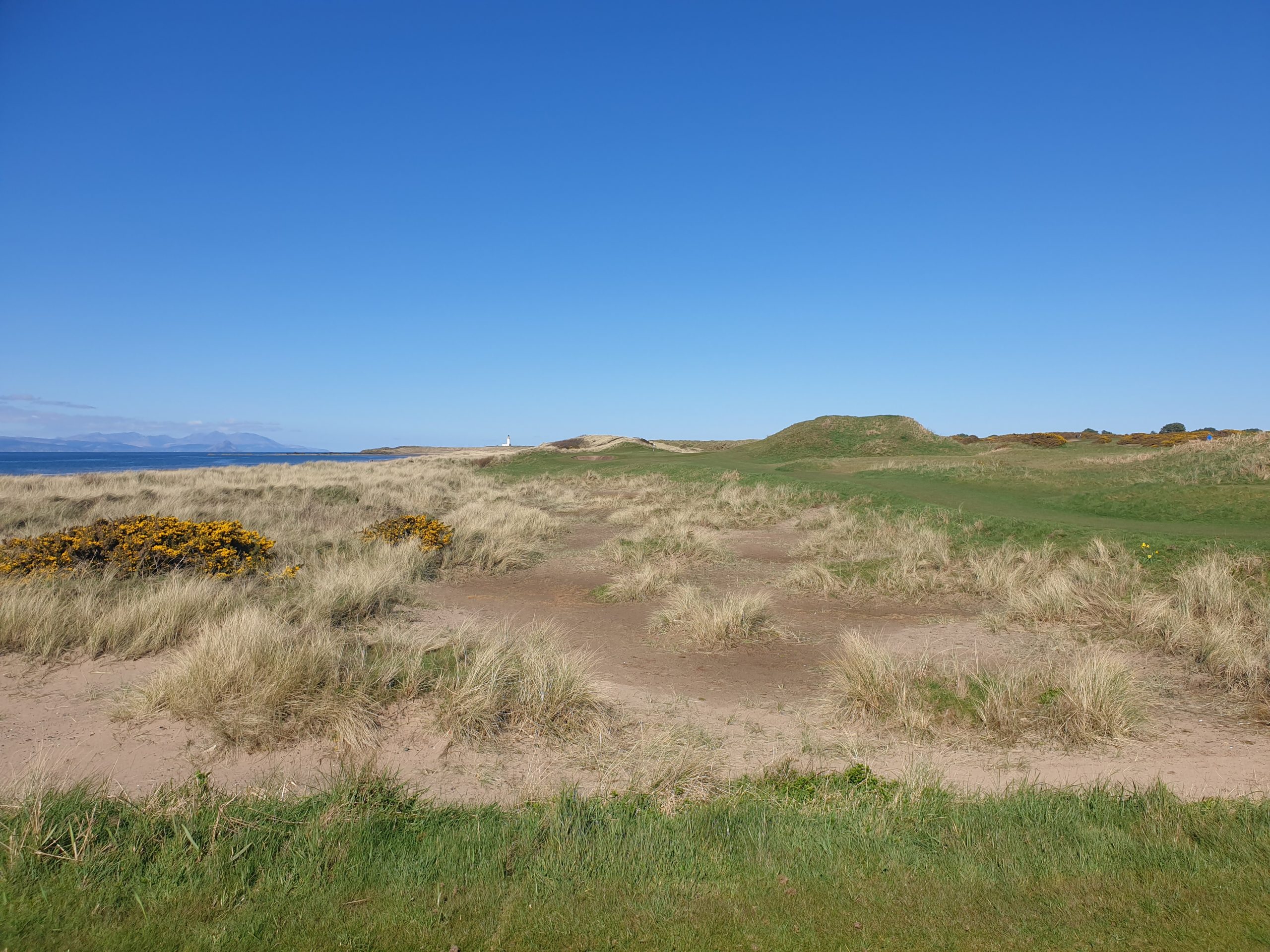
The partially obscured tee shot at the fourth, with the full panoply on view – Arran, Lighthouse, Dunes, Gorse, Rough.

The Round

I was paired with 8 handicapper Ian Moffat of Cumbernauld, a naval submariner home on leave, who chose to play from the white tees (6,543 yards), whilst I played the yellows (6,110 yards). The added 433 yards sounds manageable unless you are playing into a stiffening links breeze on a treacherous layout.

Despite a few early lost balls Ian continued off white, displaying the perseverance of submariners. Whilst I didn’t keep Ian’s score, I suspect it was the wrong side of a century, as mine would have been off white. Ian was, in the finest Burns tradition, one ‘Tam Samson’, the Kilmarnock sportsman Burns immortalised for his dogged refusal to leave the field, a man who would rather perish in the attempt than concede defeat. Burns wrote that Tam Samson’s dying words would be that he had never given up. Ian Moffat did not give up either – well done Ian.
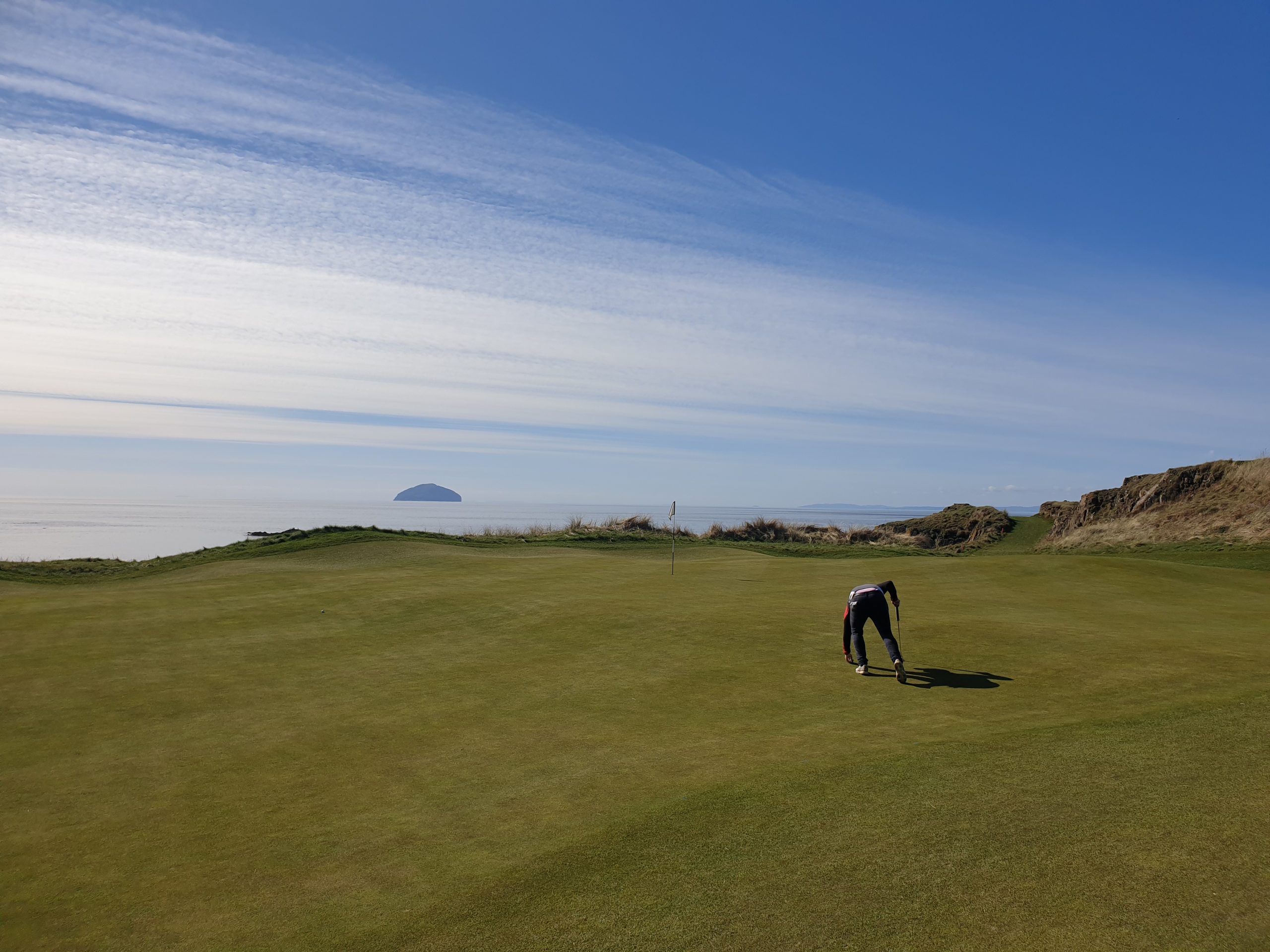
Ian Moffat on the 8th green, Ailsa Craig perfectly framed in the March sunshine.

I shot 89, with three triple bogeys. I hit the ball about as well as I can. If Burns had played golf – and given his appetite for competitive pursuits, convivial company, and the Ayrshire outdoors, I suspect he would have been a natural – he would have recognised himself in the honest, truth-seeking spirit of the game. He was always ‘Davie’, the brother poet, the man seeking meaning in simple honest experience rather than in rank or gold. I’d like to think that summarised our day at Turnberry.
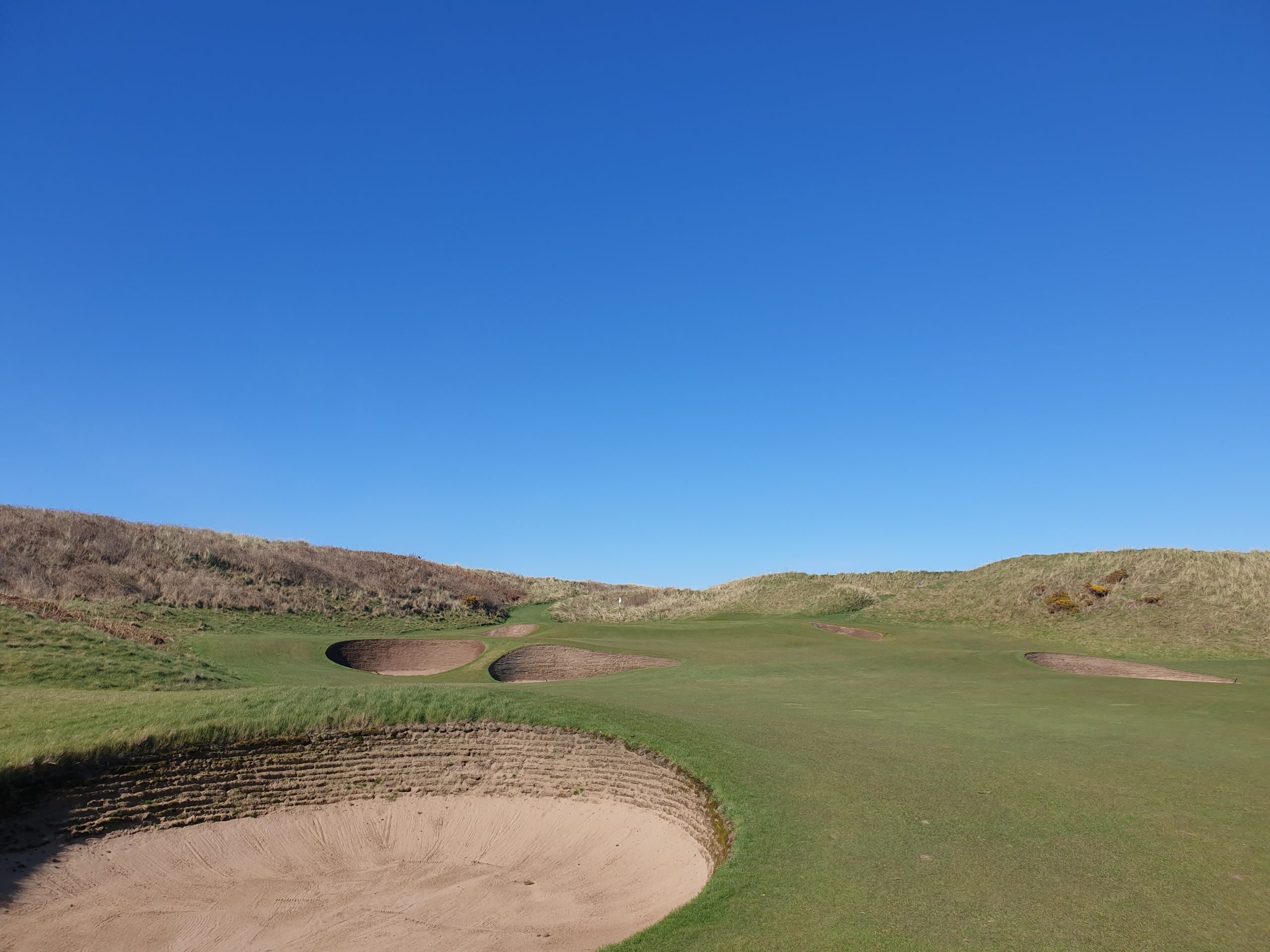
The wonderfully green entrance at the par 5 fifth hole. The bunkers gave me 8!

The first two holes ease you in, running through inland undulations with the hotel presiding grandly over everything. By the third, the sea begins to announce itself. By the fourth, you are into the dunes proper, the gorse blazing yellow in the March light.
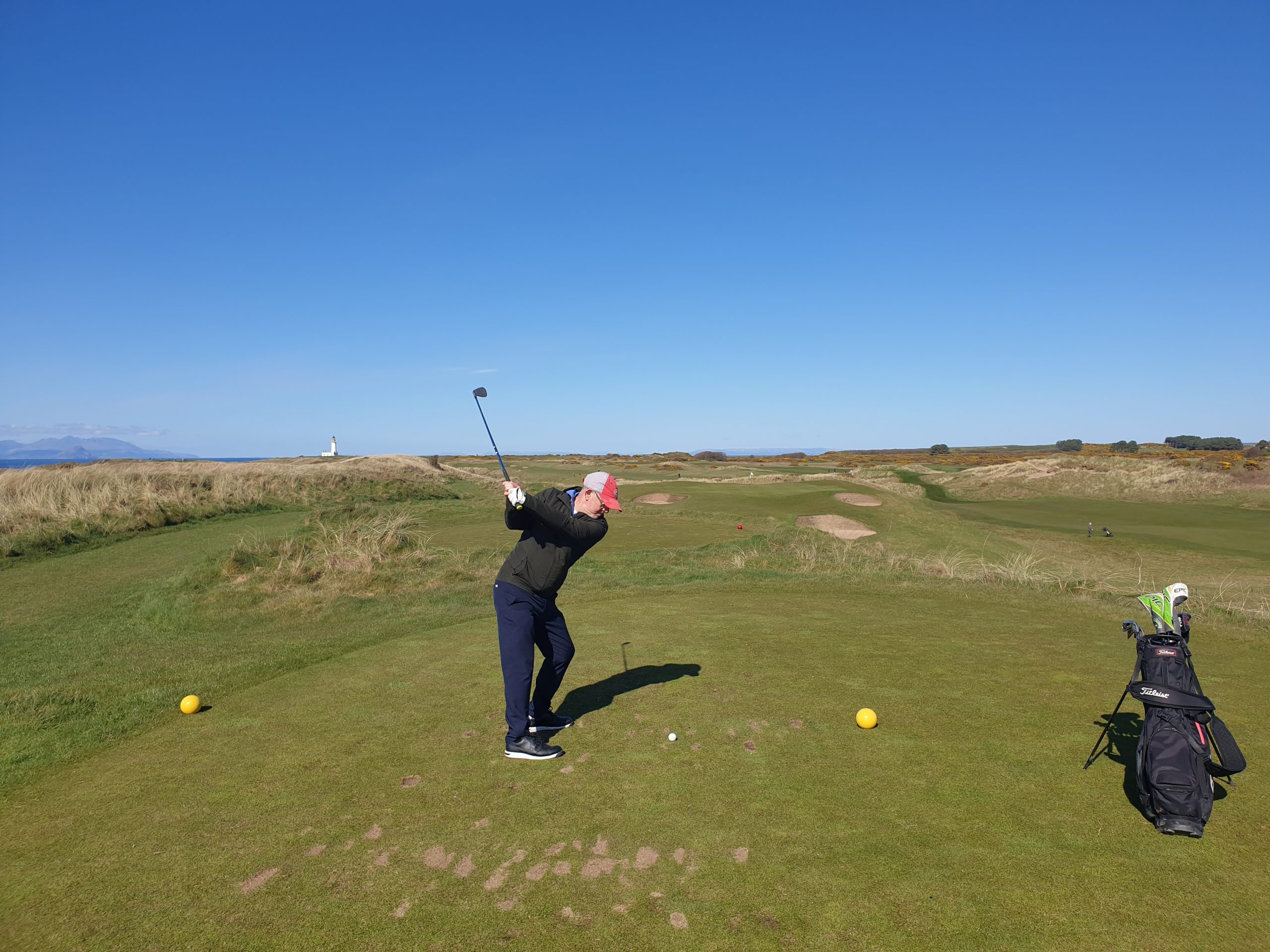
Moly at the 6th, a short par three, where the prevailing westerly will be a challenge.

The coastal sequence from holes four to eleven is beautiful. Ebert’s redesign brought several of these holes right to the clifftop edge. The seventh was already magnificent; a long par five threading between dunes with the sea appearing and disappearing to the left.
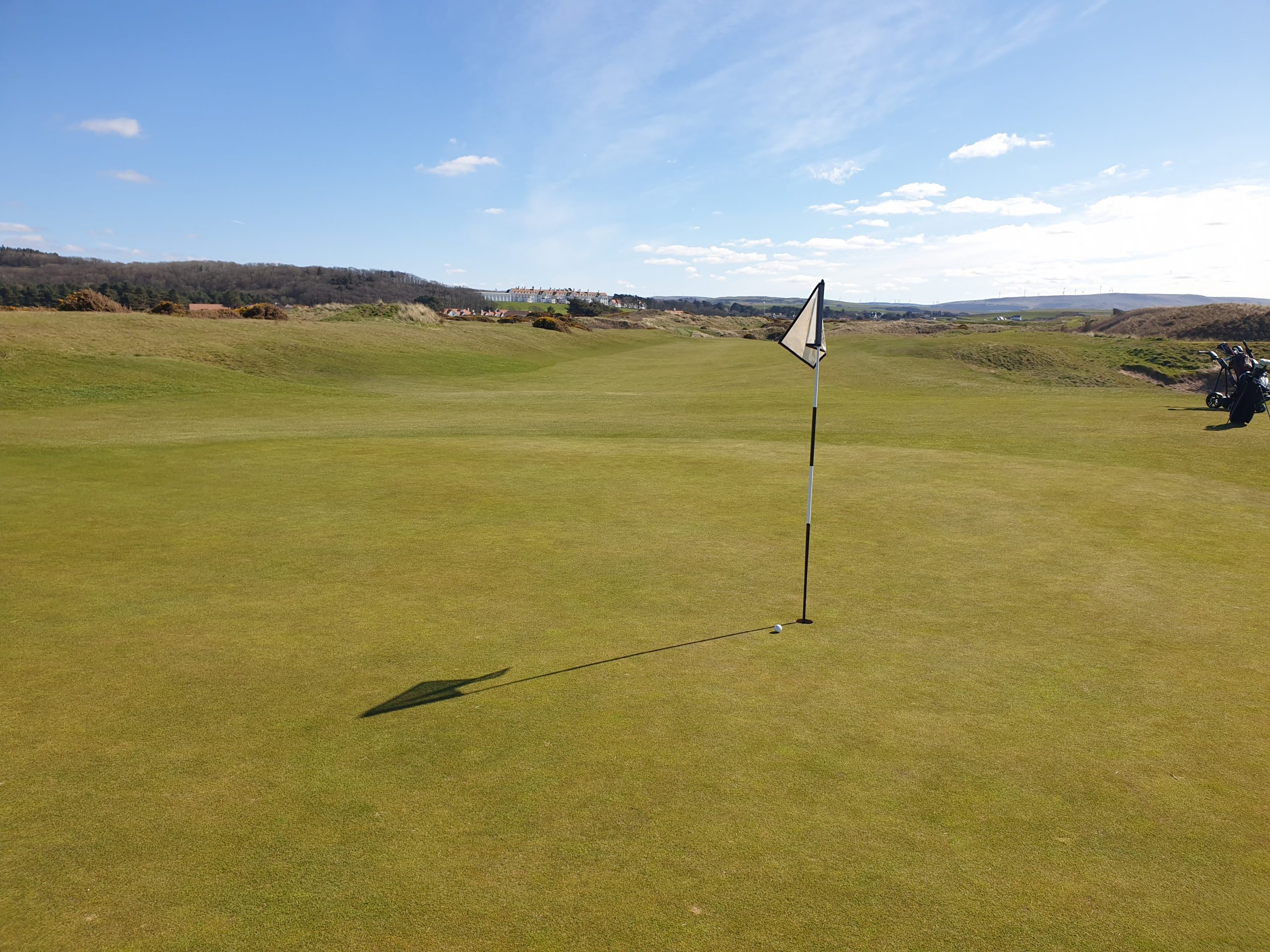
The 7th, a par 5 . My birdie putt awaits!

The Ninth

The ninth hole at Turnberry Ailsa is now one of the great short holes in world golf; but not really short for us mortals! Ebert converted it from a par four, placing the tee on the cliff beside the ruins of Turnberry Castle; birthplace, most likely, of Robert the Bruce, though that story belongs to the other course here, the King Robert the Bruce course. The green sits just below the lighthouse, perched above the rocks and the sea, perhaps the best half way house in golf.
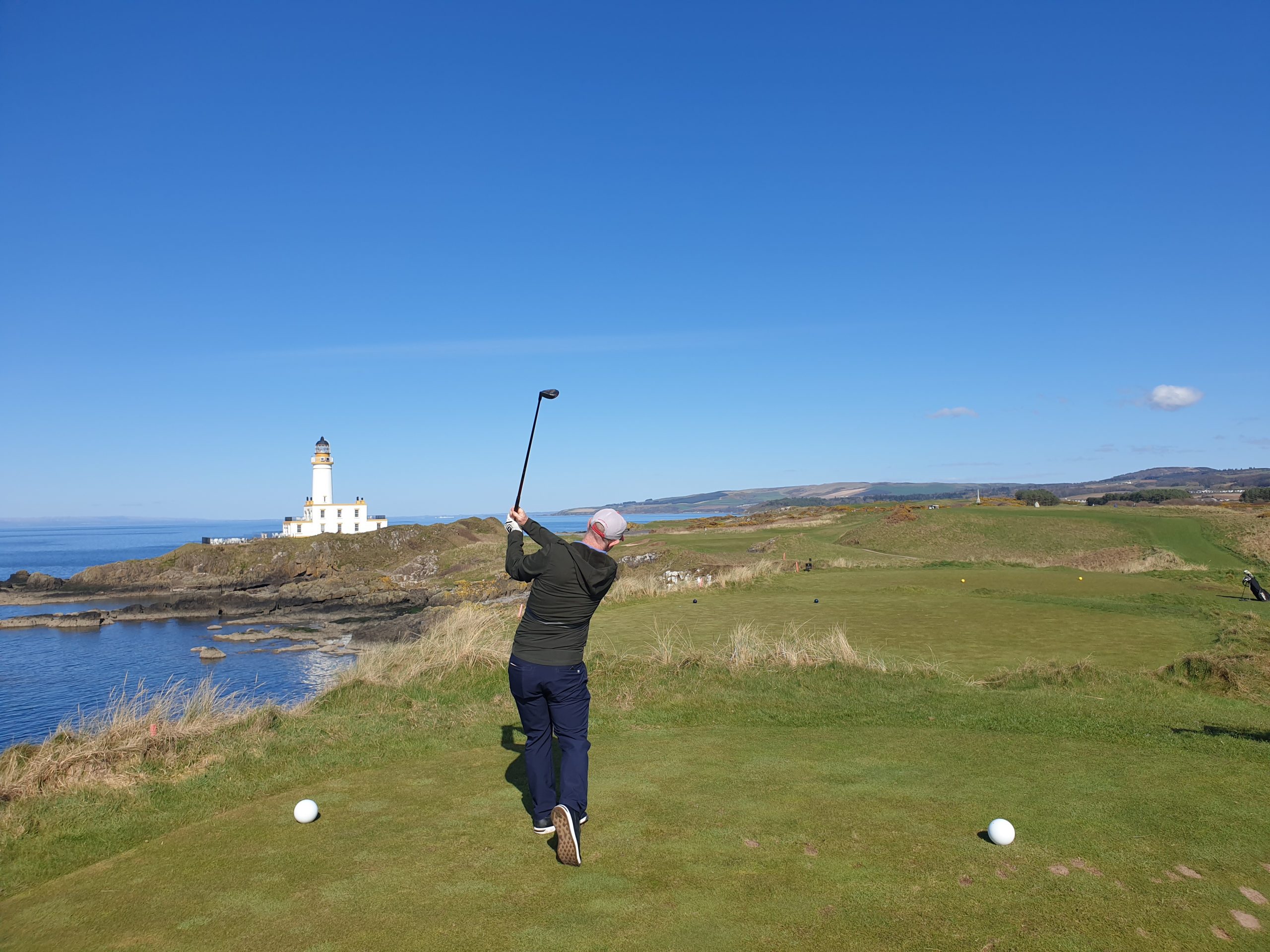
With Arran visible across the water and a light breeze off the Firth, standing on the 9th tee at Turnberry is one of those moments that reminds you why you play this game.

Was Burns a Golfer?

It is worth pausing to consider how old this story is. Jack Boyd, in his history of Turnberry Golf Club, quotes a letter of 15th February 1751 from Archibald Kennedy (most likely the great-grandfather of his namesake who built the course in 1901) to Sir Thomas Kennedy, describing golf at Girvan, five miles south of Turnberry, among lairds, a minister, and a doctor, with Sir John judge of both the golf and the drinking. So, three years before the St Andrews Golf Society was formed, golf was being played on the Ayrshire coast. Burns, born in 1759, would have known golfers and recognised all the aforementioned players. He would have found Tam o’ Shanter among them.
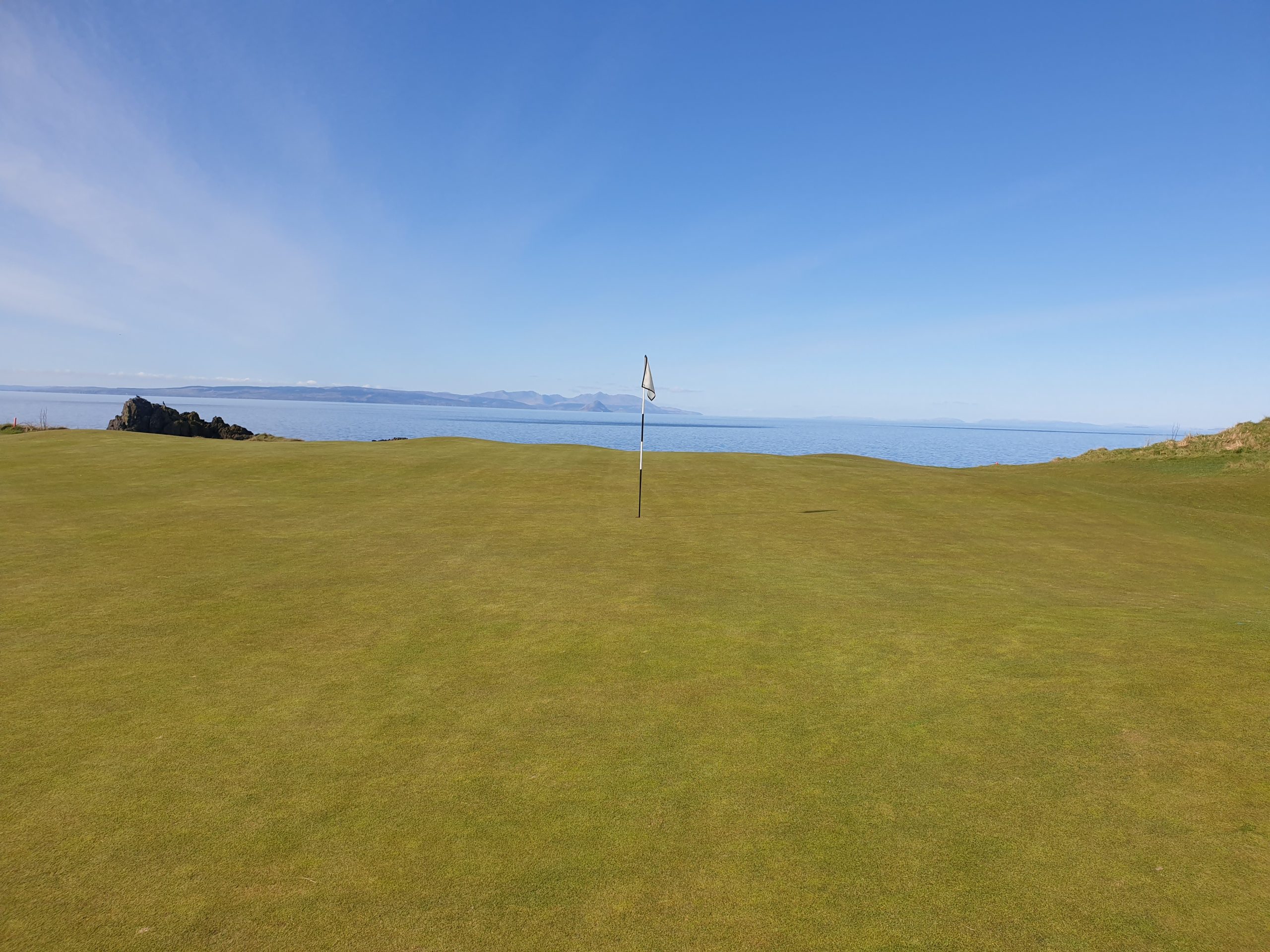
The manicured 10th green to start the back nine.

The twelfth tee looks back toward the war memorial on the hill — a stark reminder that this land was twice an RAF airfield, its fairways buried under concrete and tarmac while pilots trained and died here. Something approaching 200 men lost their lives at Turnberry during the two wars.
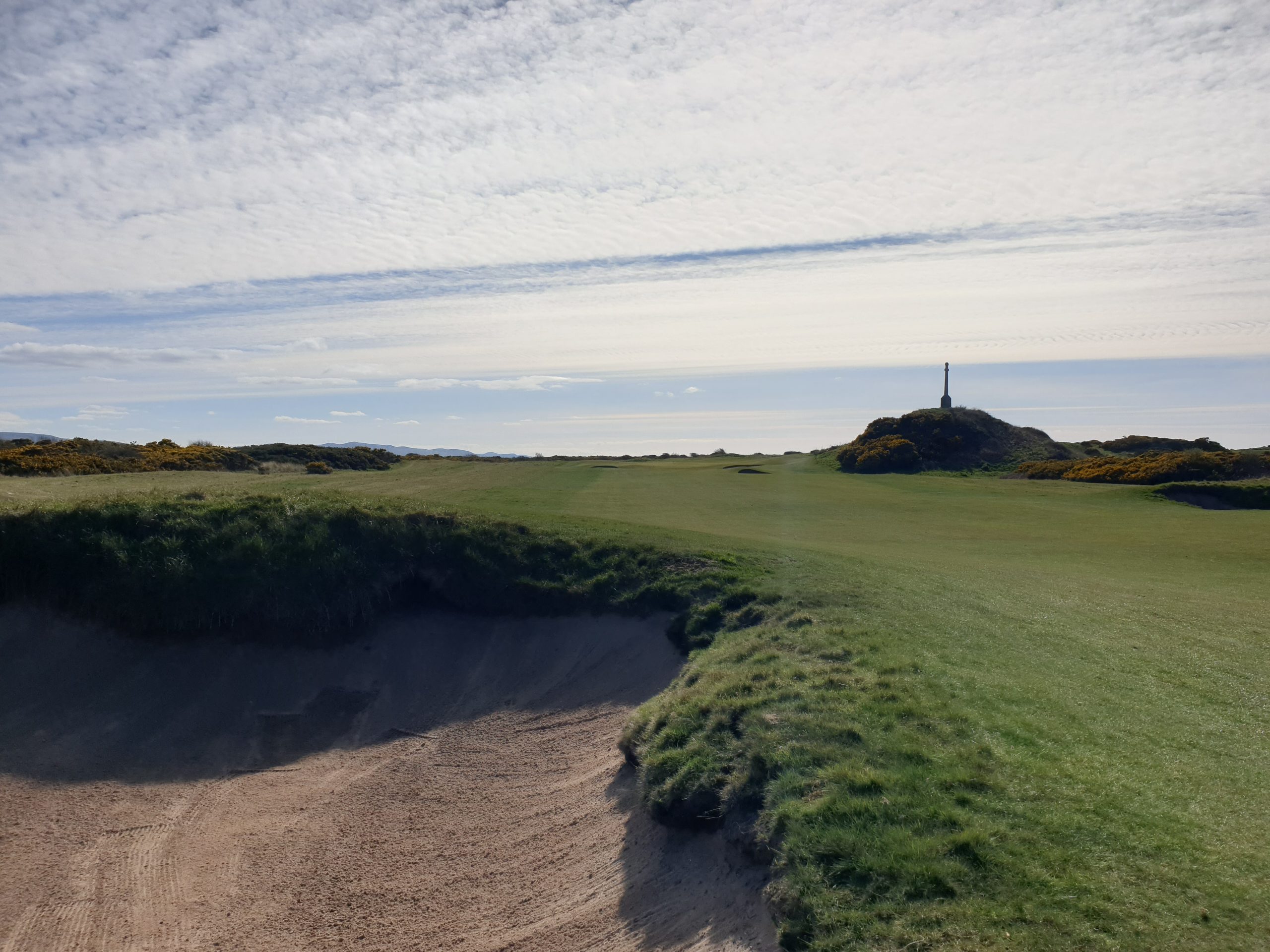
The War Memorial stands above the twelfth green, here seen from the fairway bunker 150 yards from the green.

From thirteen onward the course begins its journey home, moving back through the dunes toward the hotel. These holes are less dramatic than the coastal sequence but beautifully crafted — fair, strategic, and very demanding but dependent on the prevailing wind..
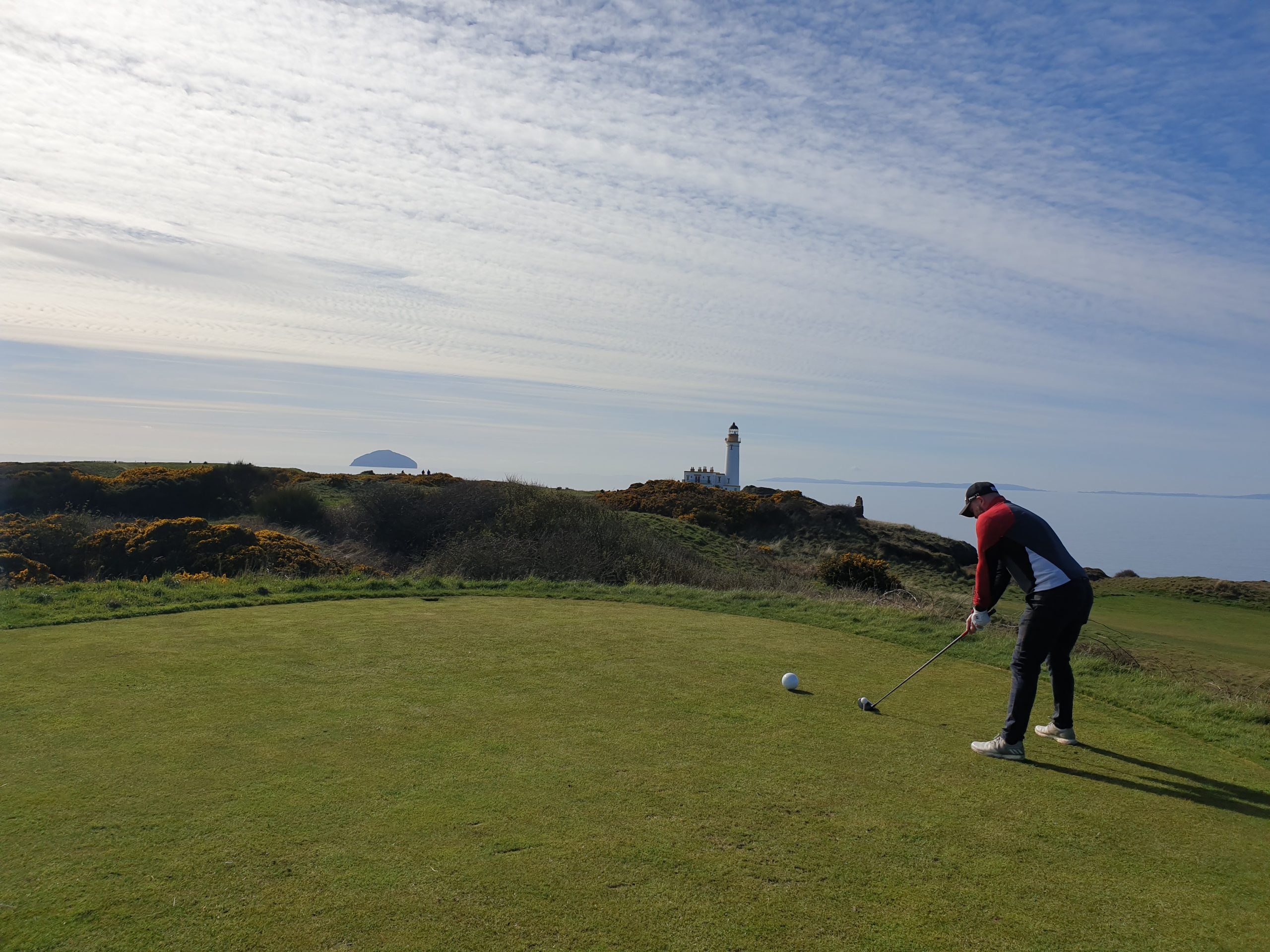
Ian Moffat on the tee at 13th tee.

The sixteenth is perhaps the most challenging hole on the course — a long par four that turns slightly left, the hotel reappearing on the horizon as you play back toward it. It was extended by Ebert with a redefined sharper burn.
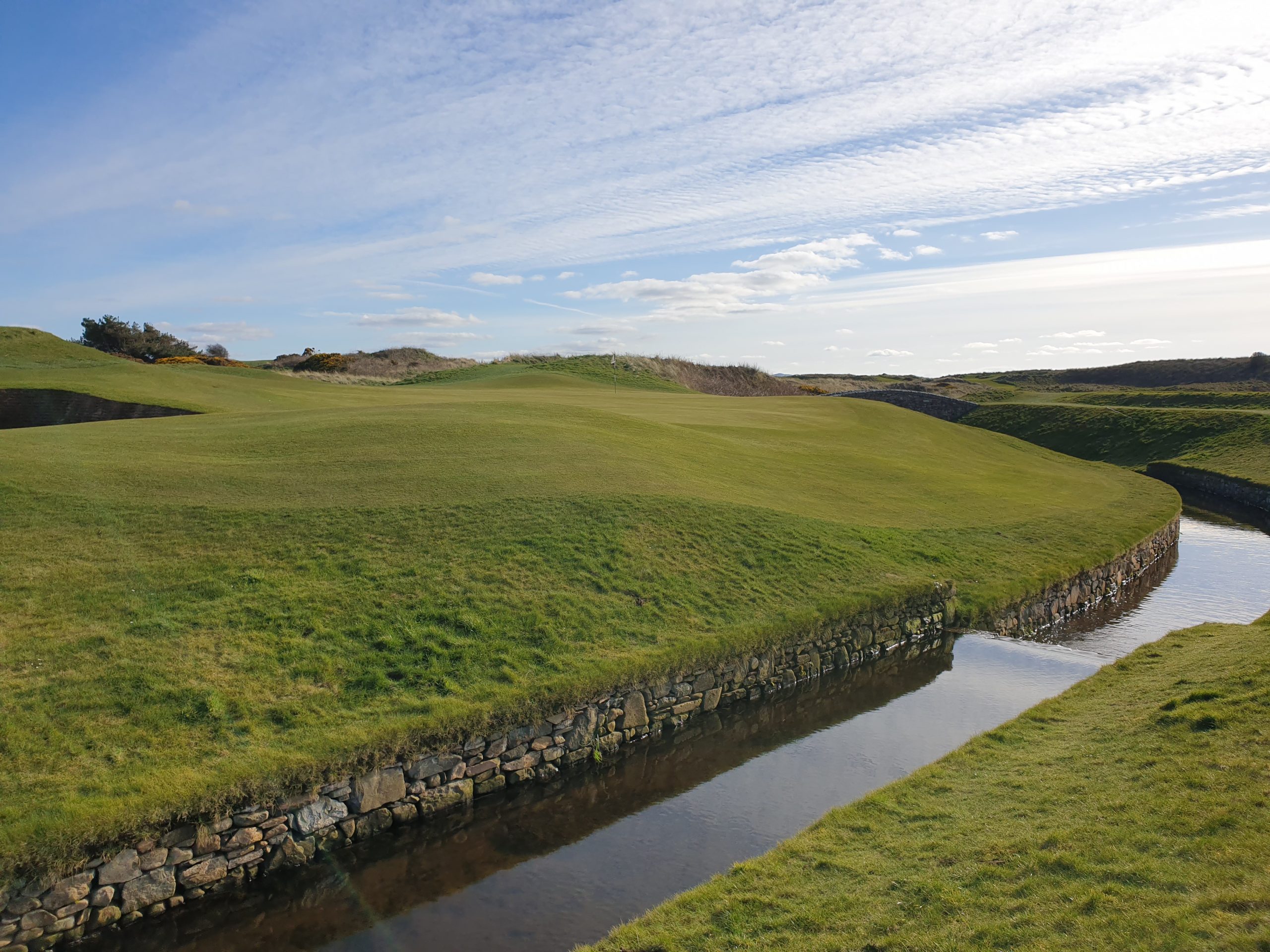
This burn at the long par 4 16th will be a card wrecker even for the pros.

After the Round

The clubhouse at Turnberry is exactly what you would expect from a five-star resort that has hosted four Open Championships. Leather armchairs. Views across the course to the sea. A club sandwich and a pot of tea for £27, served with a Turnberry-branded paper bag and an air of quiet confidence that it is entirely worth it – maybe.
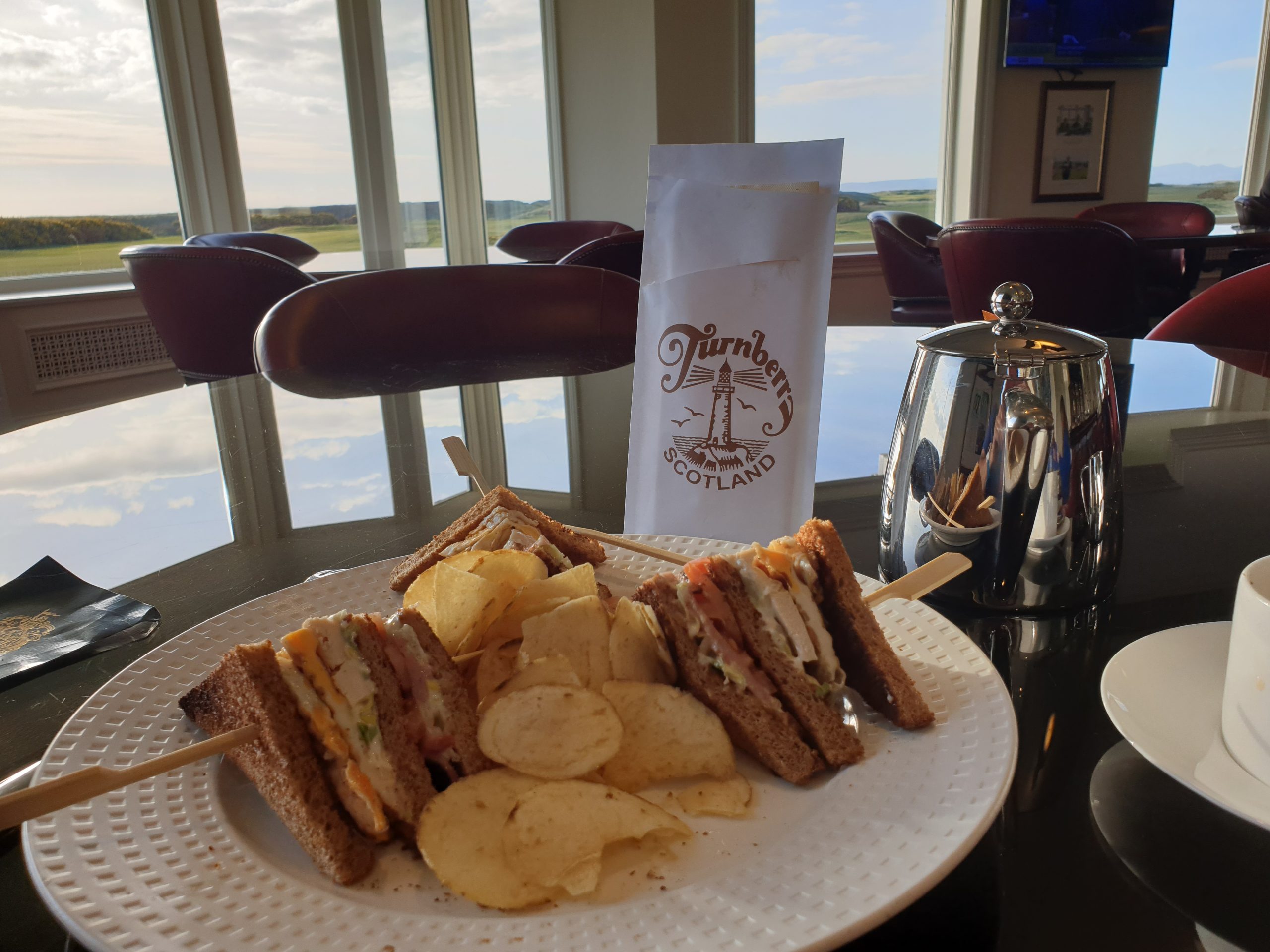
Trump Club and pot of tea, only £27

The Verdict

Turnberry Ailsa is magnificent. Burns walked this coast. Douglas Graham farmed a mile north of the first tee. The Girvan Gang played golf five miles to the south while Burns’ father was still a young man. The lighthouse stands on the ruins of a castle that shaped Scottish history. Two World Wars tried to destroy the course and failed. Holy Willie bought it and made it better.

Whatever you think of the branding, the course itself demands only one response: reverence.

Played: 27 March 2023
Paid: £130 (list price approximately £500)
Score: 89 gross, 34 Stableford points, handicap 15, yellow tees (6,110 yards, SSS 70, Slope 124)
Value: ⭐⭐⭐⭐⭐ at £130 / ⭐⭐⭐⭐ at rack rate
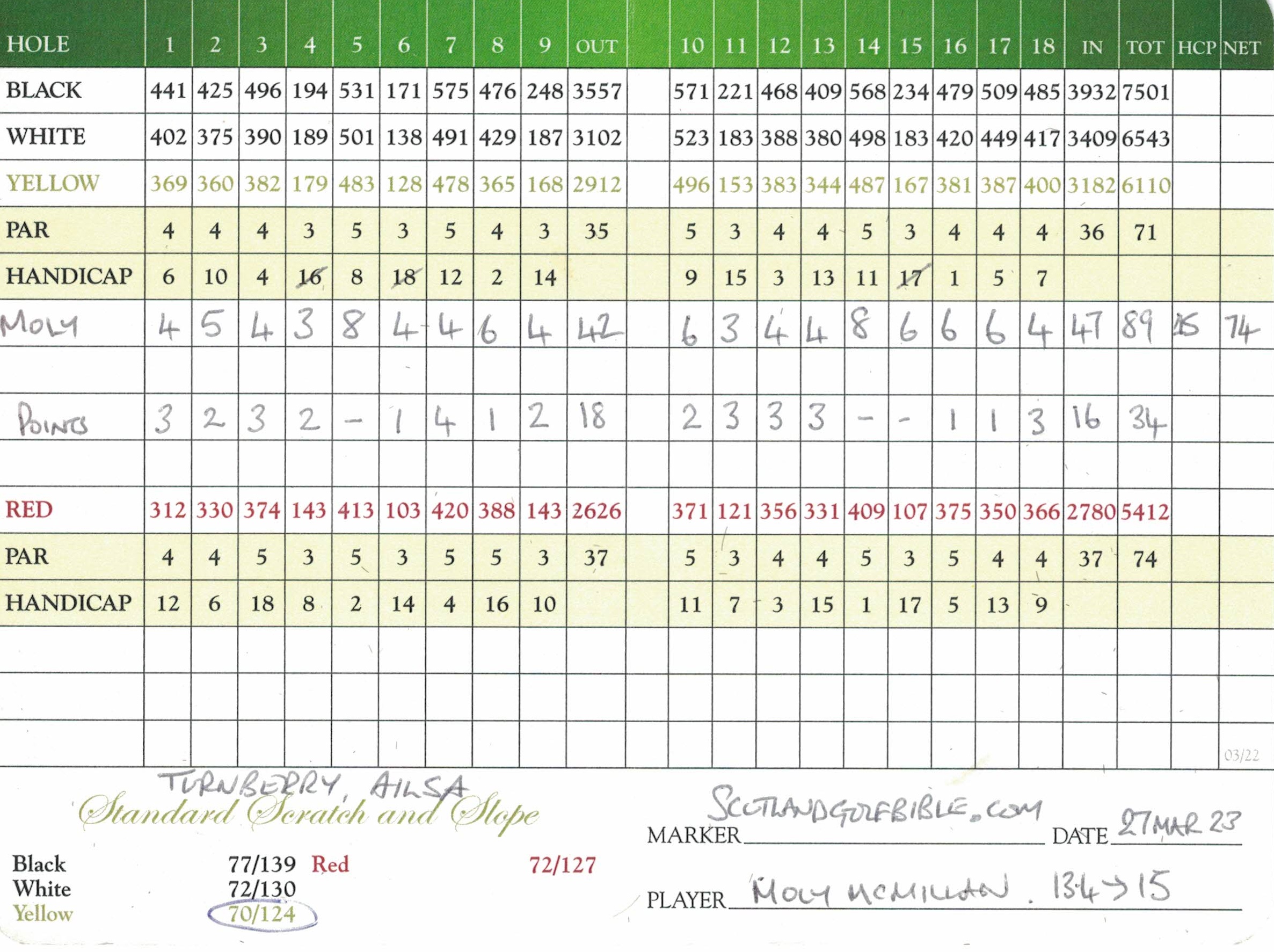
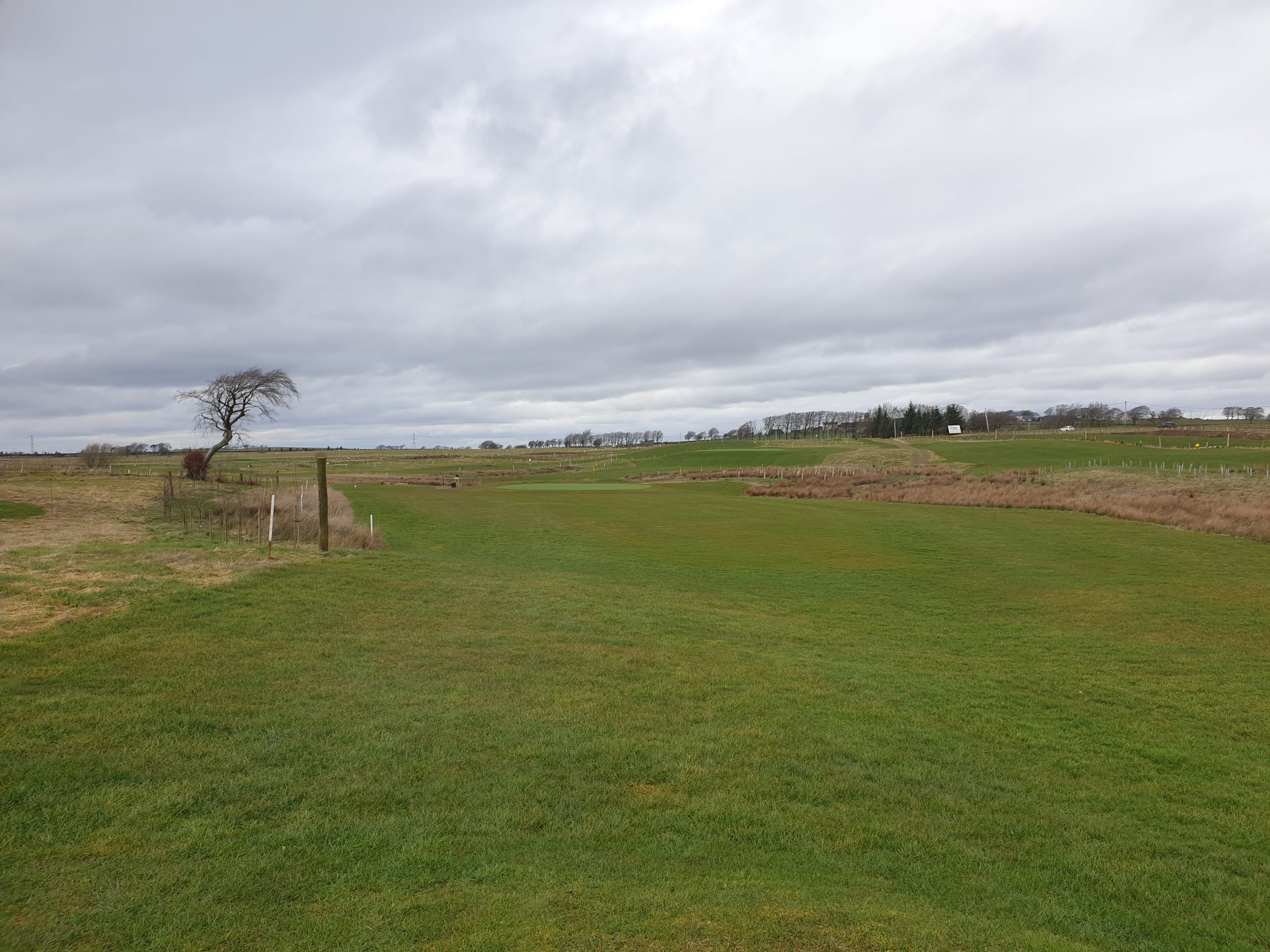
A great day for me, never to be forgotten. 89

186. Broadlees Par 3. 25 Mar 2023

Scotland’s first synthetic greens course, probably.

Price: £8. Par 27. Value: 4/5.

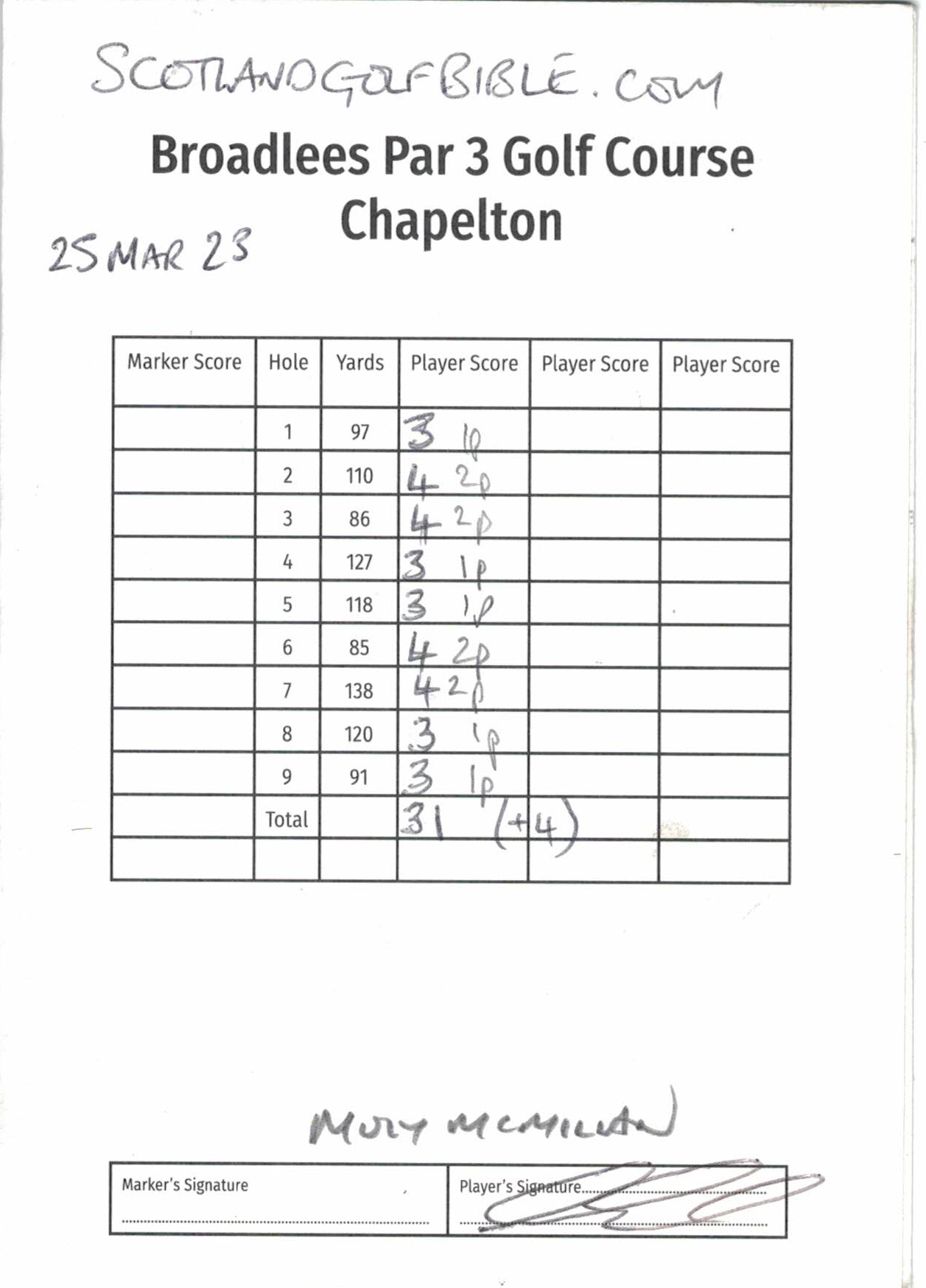
Moly’s Score: 31 (+4)

The backstory is in Blog 185, the main Broadlees course. In summary, since 2004, Robert and Barbara Anderson have built a diverse golf operation – range, 9-hole course, crazy golf, footgolf, academy, café and Santa’s grotto – to compete in an area stocked with golfing alternatives, many of them subsidised.

In 2021, they added something possibly unique in Scotland: a 9-hole par 3 course with synthetic greens and tees, playable every day of the year regardless of weather or ground conditions. The commercial reasoning is sound: a course needing no greenkeeping on its playing surfaces, generating income in January.

The first (97 yards) with the startlingly green synthetic surface immediately apparent against the March gloom. You are not playing a normal golf course.

From the start the scene is stripped back entirely with open ground, single windswept tree, and a synthetic “green” looking like a piece of discarded carpet. Not aesthetic, but very interesting, with the graves of golfing Architects stirring?

Synthetic tees matter commercially as much as the greens, as grass par 3 tees are brutally punished and need constant repair, reseeding, levelling and divot mix. The cost of upkeep of mats is negligible, plus they play consistently.

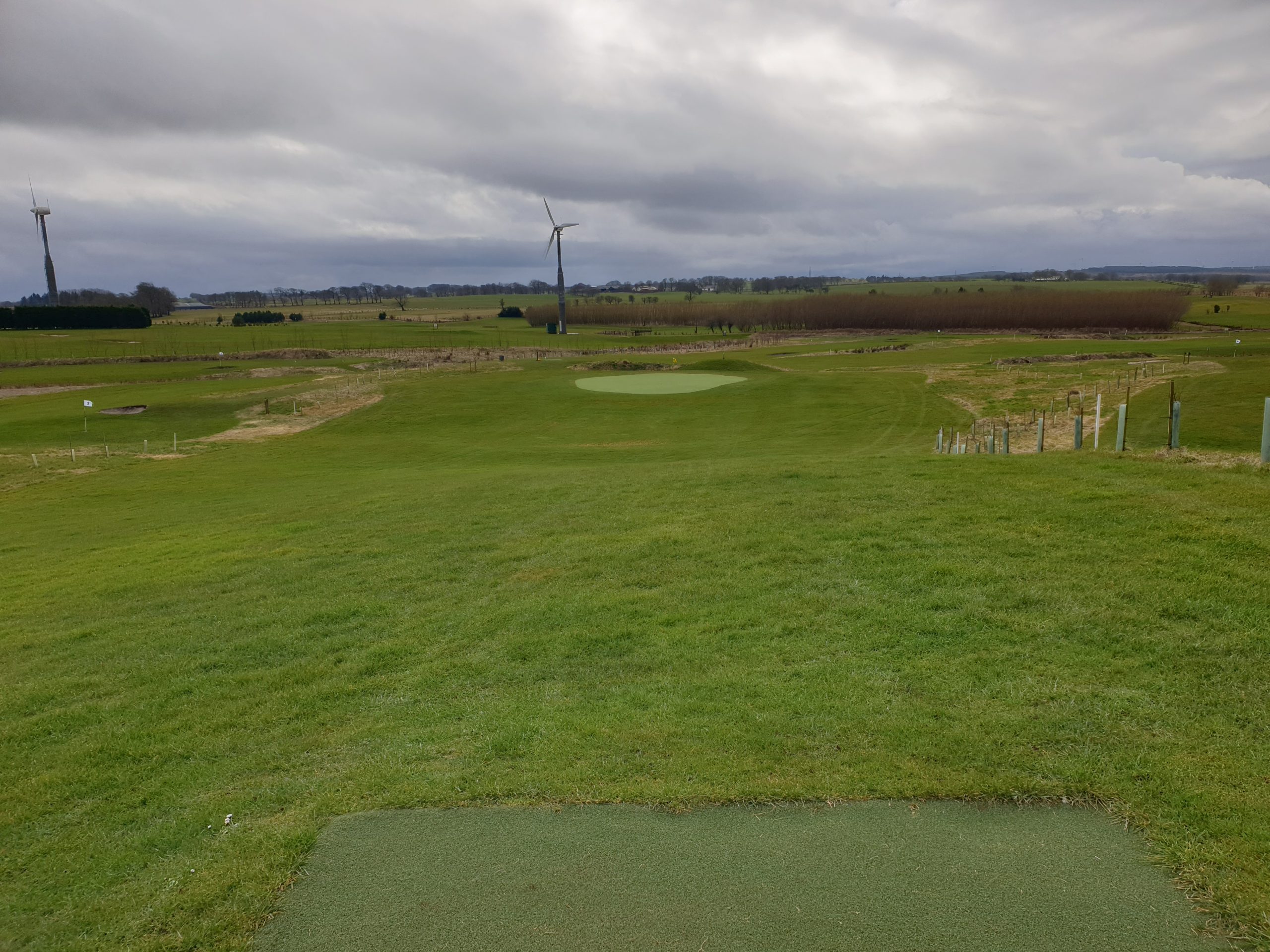
Hole 3 from elevated tee. The two wind turbines are a constant presence.

Holes range from 85 to 138 yards, so this is great wedge practice. They are not architecturally interesting in any way. But the holes have several water hazards to contend with.

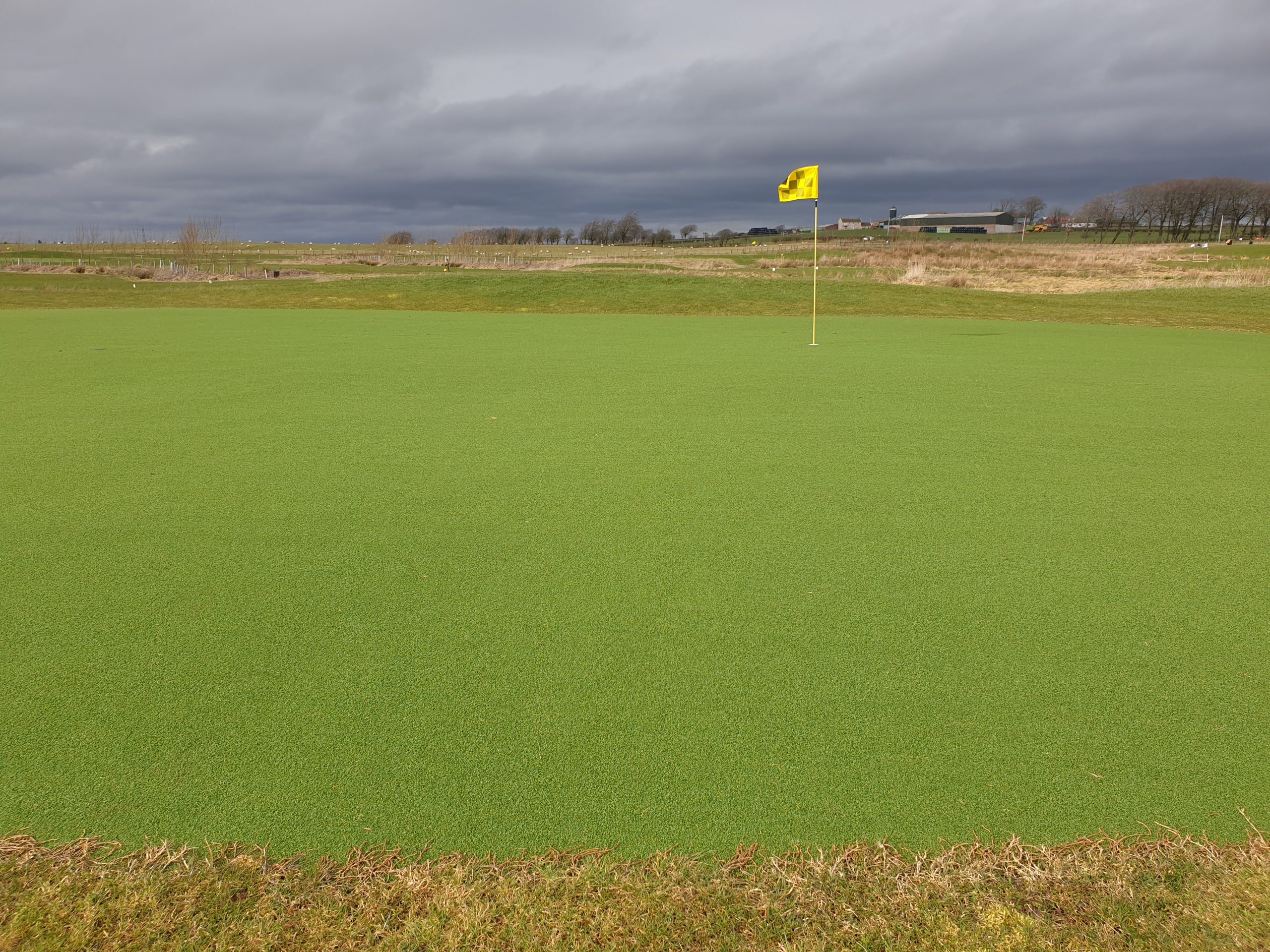
The fourth green with synthetic pile; dense, uniform with its own playing logic.

The key question is “how do the greens play?”. The answer is situational. In wet March conditions the green surrounds were too soft for a chip and run approach. The only option was to fly the ball onto the front of the green and allow it to release. The surface bounces more than ‘checks’ on full shots, so that requires careful judgment. Land too deep into the green and the ball runs through; land short and it stops on wet grass short.

Short chips around the green, played softly, were a different matter — the synthetic pile had enough give to generate some check, certainly more than expected. A useful discovery, though it came too late on the card to rescue early bogeys. On the greens themselves the ball rolled true, although breaking differently from a grass surface.

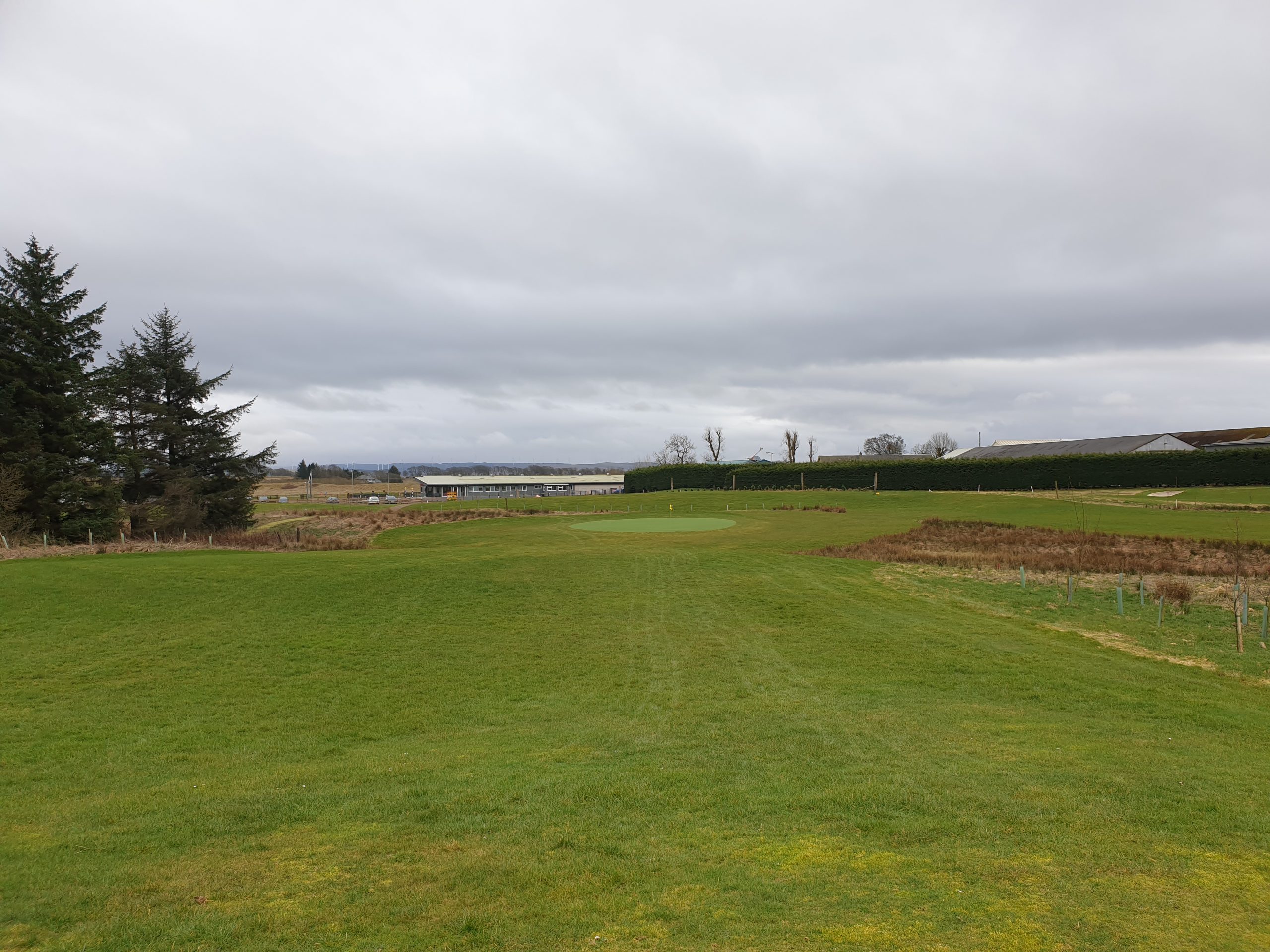
The 9th (91 yards), looking towards the Broadlees clubhouse, with cafe, range, and main course off to the right.

I shot 31 gross, four over par. On the two holes where I holed from outside ten feet I correctly read that the ball would not break as much as expected. It was an education. I’m sure regular players hole lots of putts.

At £8 for nine holes (2023) this is great ‘novelty’ value. I would think there is a commercial opportunity to price a combined fee with 9 holes on this course and 9 holes on the main Broadlees course.

Value: 4/5, to play Scotland’s first and possibly only synthetic greens course

Facts:

Course type: Par 3, synthetic tees and greens

Par 27 . Distance: 972 yards.

Moly’s Gross Score: 31 (+4)

See also: Blog 185 — Broadlees Golf Course

185. Broadlees. 25 Mar 2023.

If a farmer builds a golf course, this is what might be par.

Price: £16. Par 36. CR 69.0, Slope 119.

Value: 3.5 / 5.

Moly’s Score: 45

In 1987, the UK Government launched the Farm Diversification Grant Scheme, to incentivise farmers to diversify; by the early 1990s courses began sprouting at a rate that may have startled Old Tom Morris. My own club, Isle of Wedmore in Somerset, was built in 1992 on Lineage Farm by Ken Abraham, using a standard hymn sheet – rolling agricultural land, modest construction budget, an unfussy layout, and a prayer that golfers would cover the mortgage.

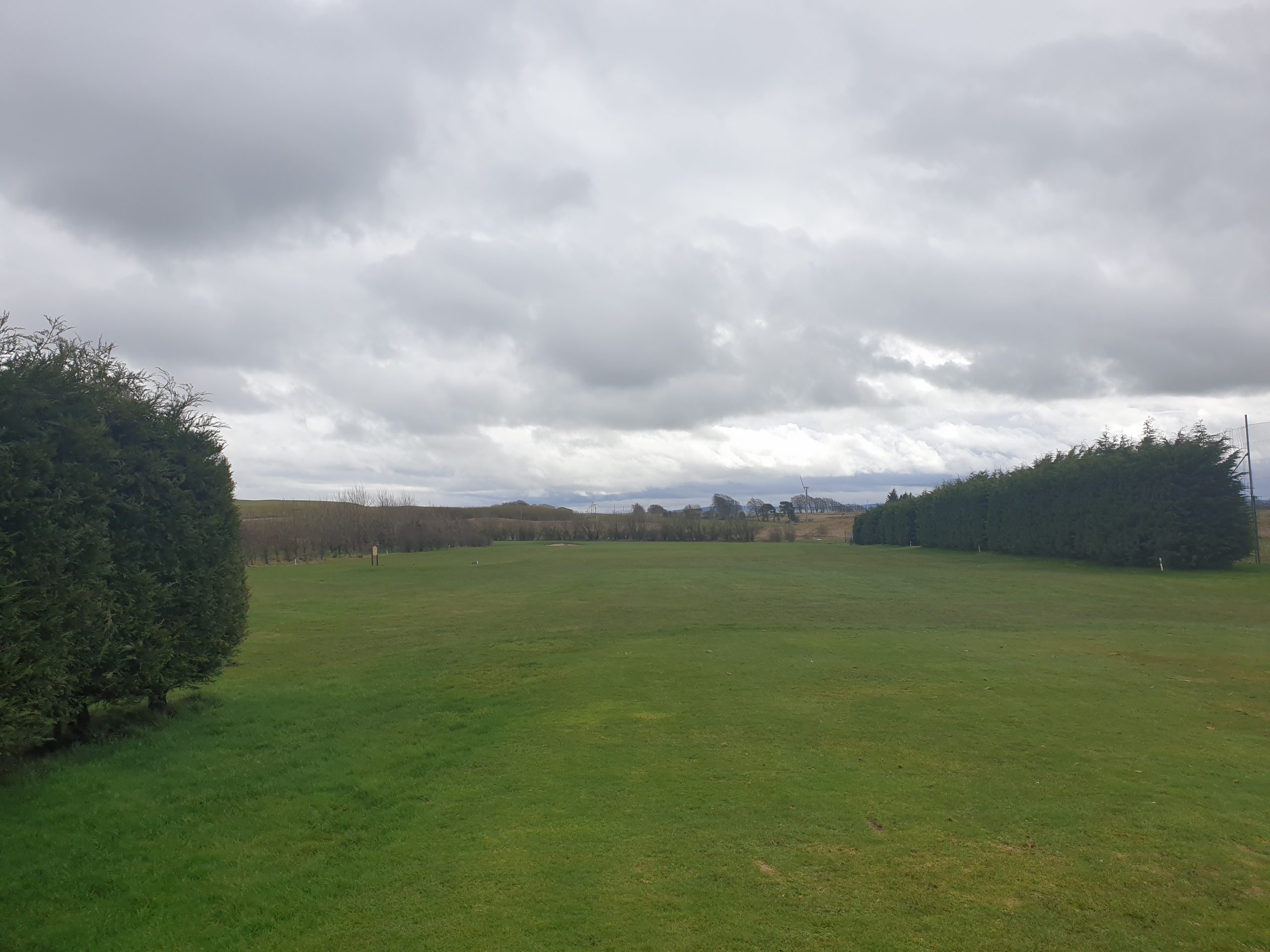
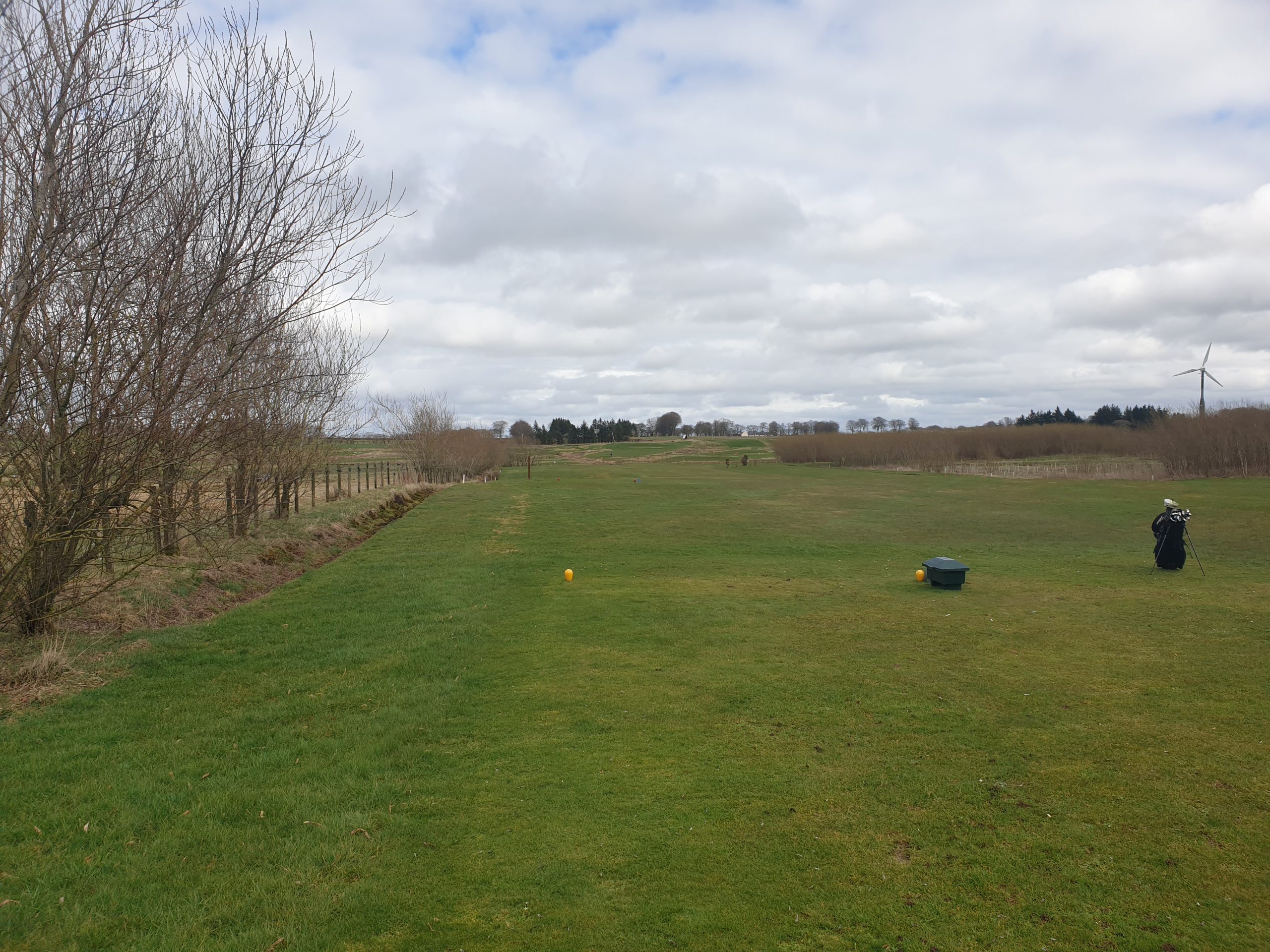
“Anderson’s Garage” the aptly named first hole, par 4, surrounded by Farmer’s fields

Robert and Barbara Anderson did the same in 2004, converting their South Lanarkshire farm into the Broadlees Golf operation; range, 9-hole course, crazy golf, footgolf, academy, cafe and in 2021 a second very unusual addition (covered in Blog 186). They self-confidently named the course’s address “Anderson” Drive, Chapelton, after themselves!

The workmanlike hole names also gives insight to the Andersons; ‘Anderson’s Garage’, ‘Gas Works’, ‘Worker’s Way’, ‘Out the Moss’, ‘Old Road’ and ‘Five Acre’. The ‘Powmillon’ burn (hole 4) runs through well-heeled Strathaven a few miles to the south-east, whose own Golf Club has more bourgeois hole names.

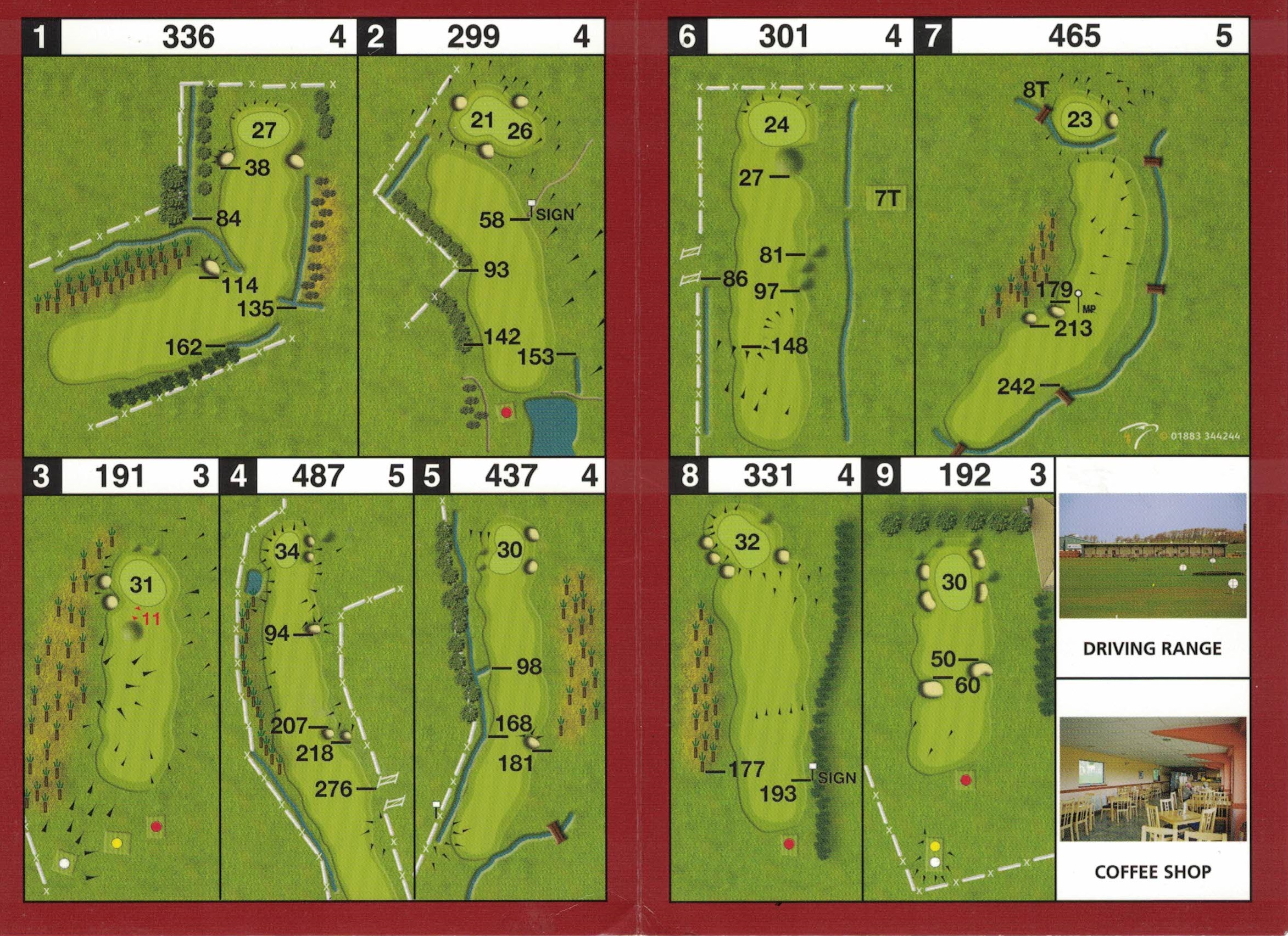
The Broadlees free laminated course guide, that much grander clubs could learn from.

The Andersons display good commercial instincts, no more so than with the ‘free’ laminated course guide (see above). For a pay-and-play operation of this scale it is more than you expect, and much better than many established member clubs that charge several times the greenfee.

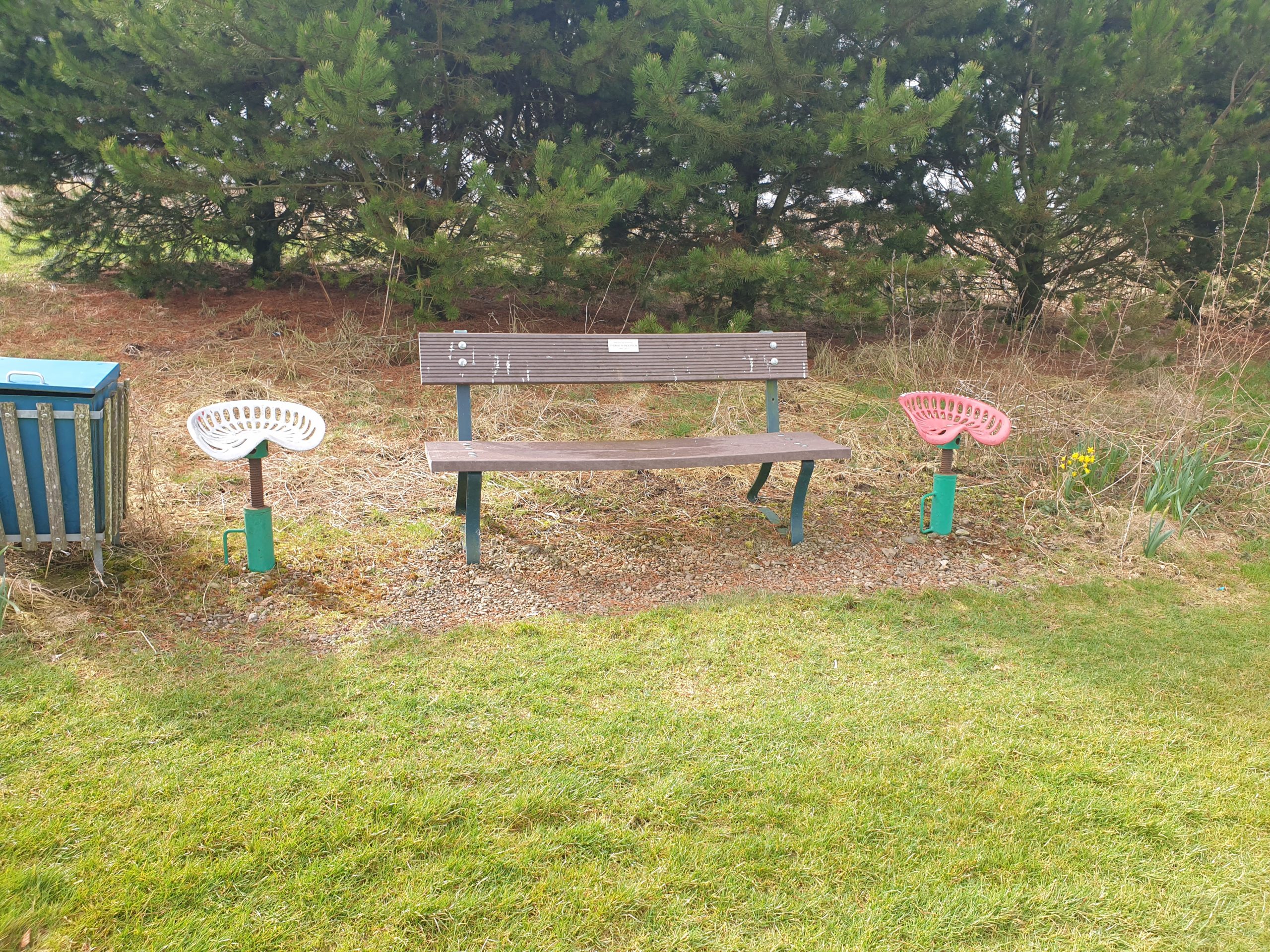
A poignant fifth hole spot with tractor seats (?) repurposed for rest — an honest summary of Broadlees origins. The memorial bench commemorates John Anderson.

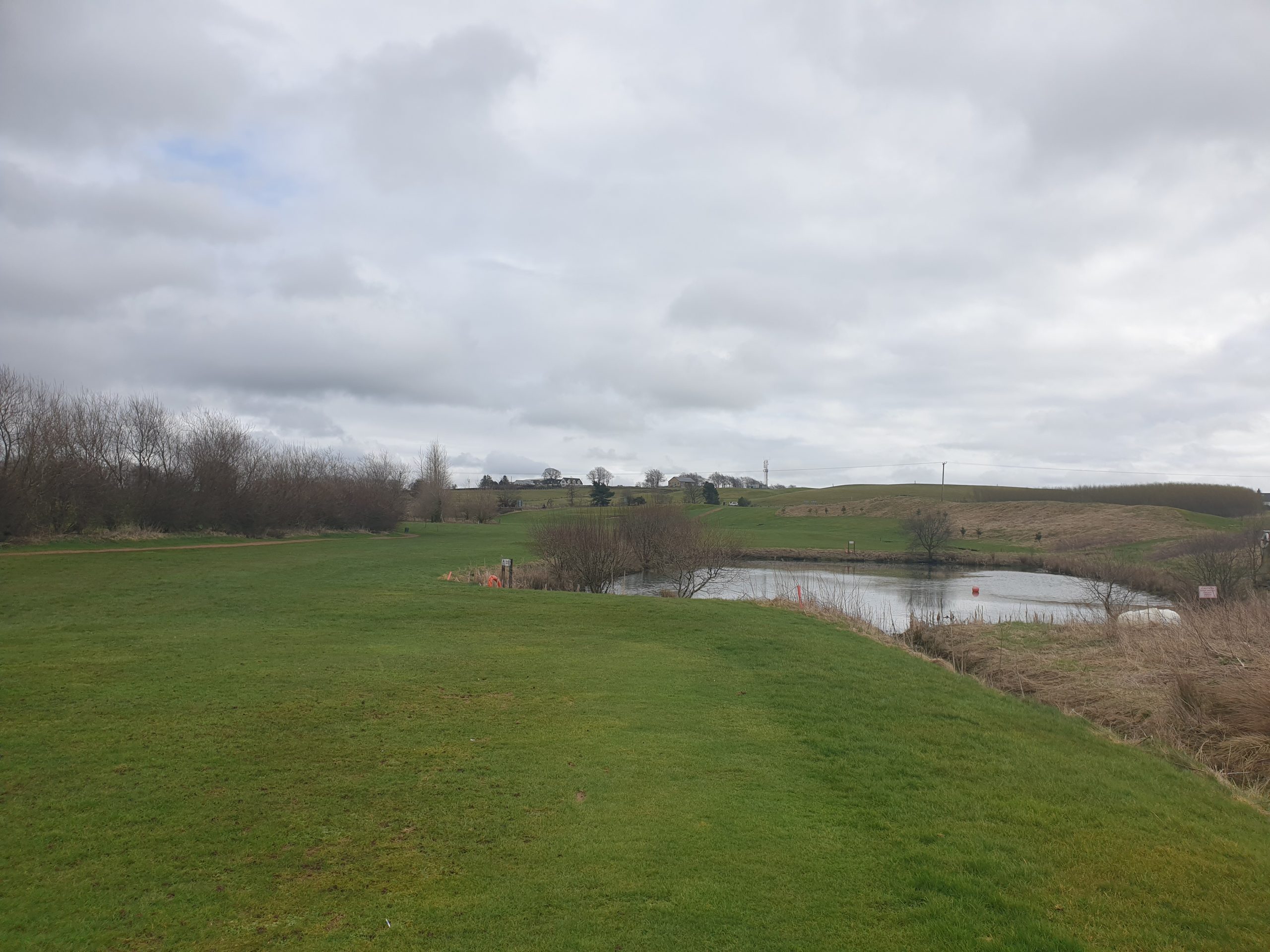
What you might get when a farmer builds a golf course on a limited budget is, I think, what you get here. The bones are reasonable at around 3000 yards, a par 36 with two par fives and two par threes. The par-five 4th (Powmillion, 479 yards) and the par-five 7th (Over the Burn, 456 yards) give the round depth. Water features on some holes, including a pond at the 2nd and a burn that winds its way around the 7th green, retained by a rustic timber revetted bank. Bunkering is sufficient, but was unraked when I played.

The limited framing developed is shown here at the 2nd hole, ‘Gas Works’, a short par 4.

The central challenge with designing a course on open farmland, such as Broadlees, is framing. Well framed holes visually present a picture using trees, contour, rough, bunkers, water and elevation. This skill is epitomised by the Camoufleur Alister MacKenzie, whose work can be seen at Pitreavie (Dunfermline) see blog 150. At Broadlees, fairways unceremoniously bleed into rough. The trees planted are still young; scrub and rough areas are unformed; the contours, while present, have not yet sharpened. I hope the Anderson family get to see Broadlees mature.

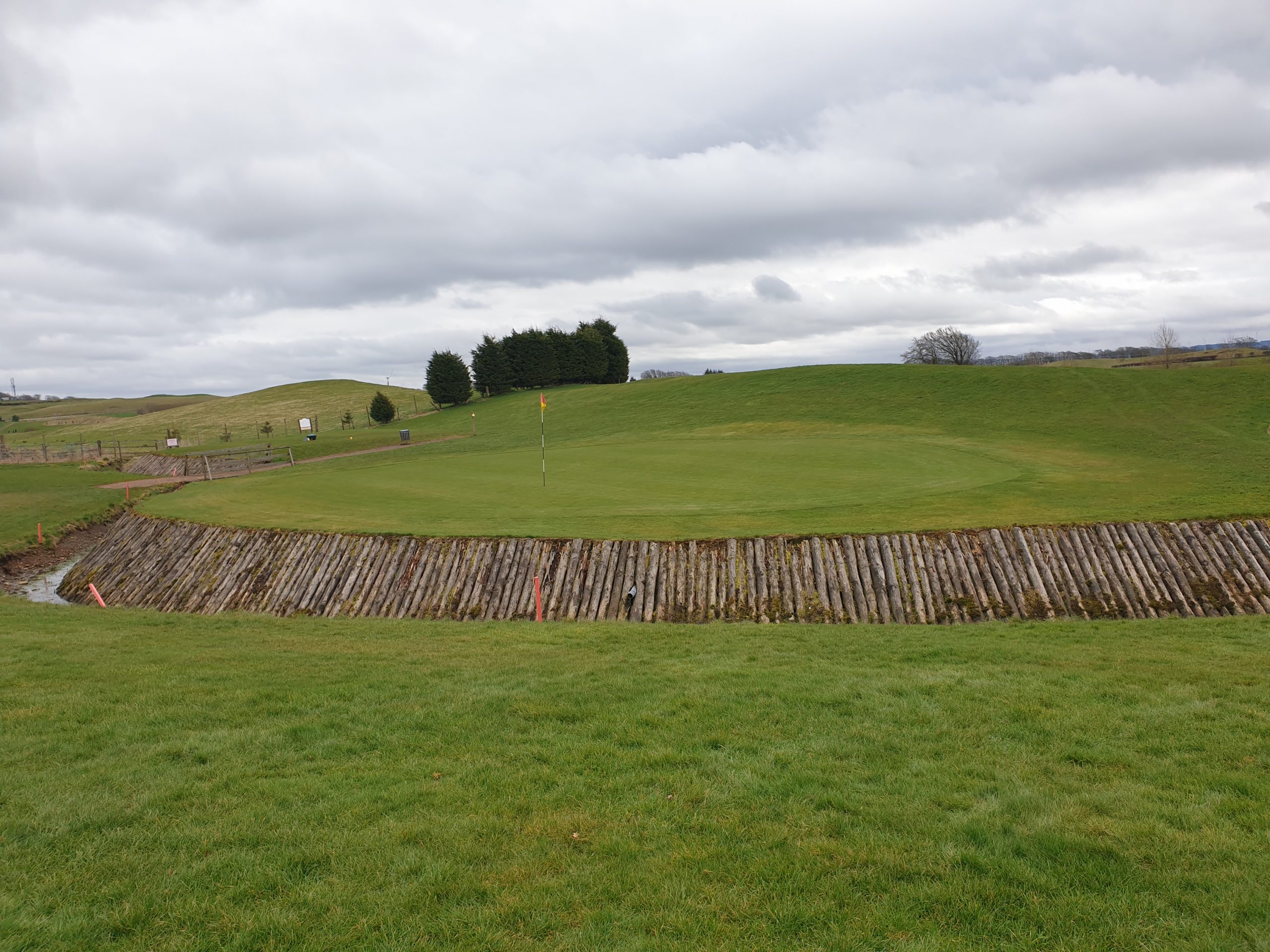
The 7th green (Over the Burn, par 5, 456 yards), its rustic timber-revetted bank is the course’s most marked piece of construction.

The greens are the strongest element. True, consistent and well-presented on a late-March morning when much of the course was still very wet. However, the claim that they rank among the finest putting surfaces in Lanarkshire is bold, and nowhere near the truth in my opinion.

The 6th, ‘Out the Moss’ (par 4, 290 yards). A typical hole on Broadlees

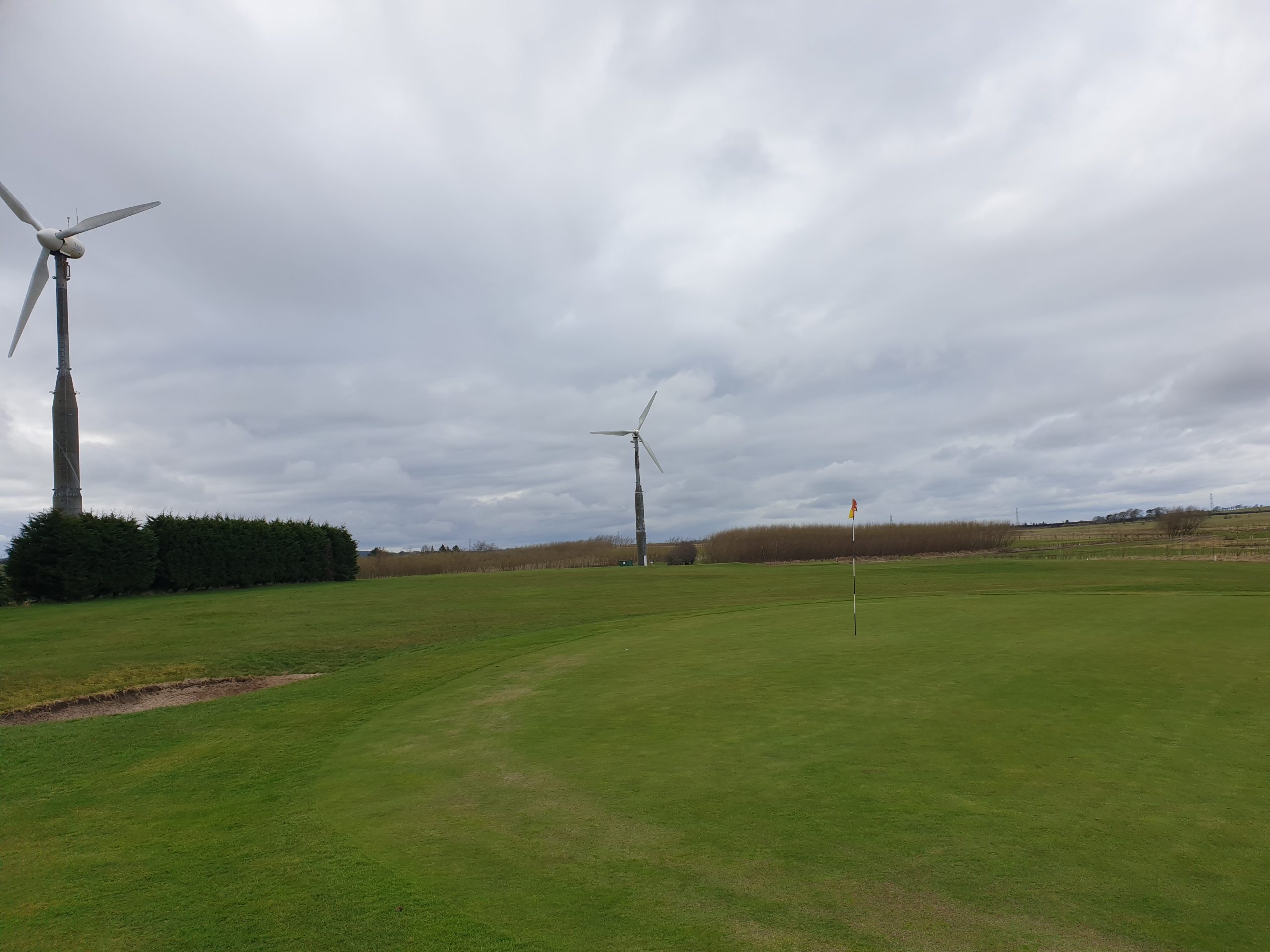
The two wind turbines deserve a mention as they are visible from most holes and dominate the final green. They present a reminder that Broadlees is a commercial enterprise built by farmers who needed multiple revenue streams from a single property. The turbines, golf course, cafe, Santa’s grotto. Each a response to the same challenge – making a small rural business pay in a Scottish golf landscape where established member clubs and council-owned courses provide stiff, and often quietly subsidised, competition.

The ninth, with Farm windturbines

At £16 for nine holes, Broadlees is cheap, and relatively good value. Within a few miles, South Lanarkshire golfers have many choices, so Broadlees needs to keep well below the competition fees, certainly until the course matures.

The Andersons, however, were not finished. In 2021, they added a second course — and this one was genuinely unlike anything else in Scotland. See Blog 186 to find out more.

Value: 3.5 / 5. The Andersons have built something from nothing and kept adding to it for twenty years. That deserves acknowledgement. But a golf course is not only measured by the effort that went into building it. The framing will come. It just wasn’t there yet. But at the price it’s good value.

Facts:

Course type: Parkland/Pasture

Par 36 (2 par 5s, 5 par 4s, 2 par 3s)

Distance: 2,954 yards (yellow tees)

Moly’s Gross Score: 45 (9 holes)

See also: Blog 186 — Broadlees Par 3 Golf Course

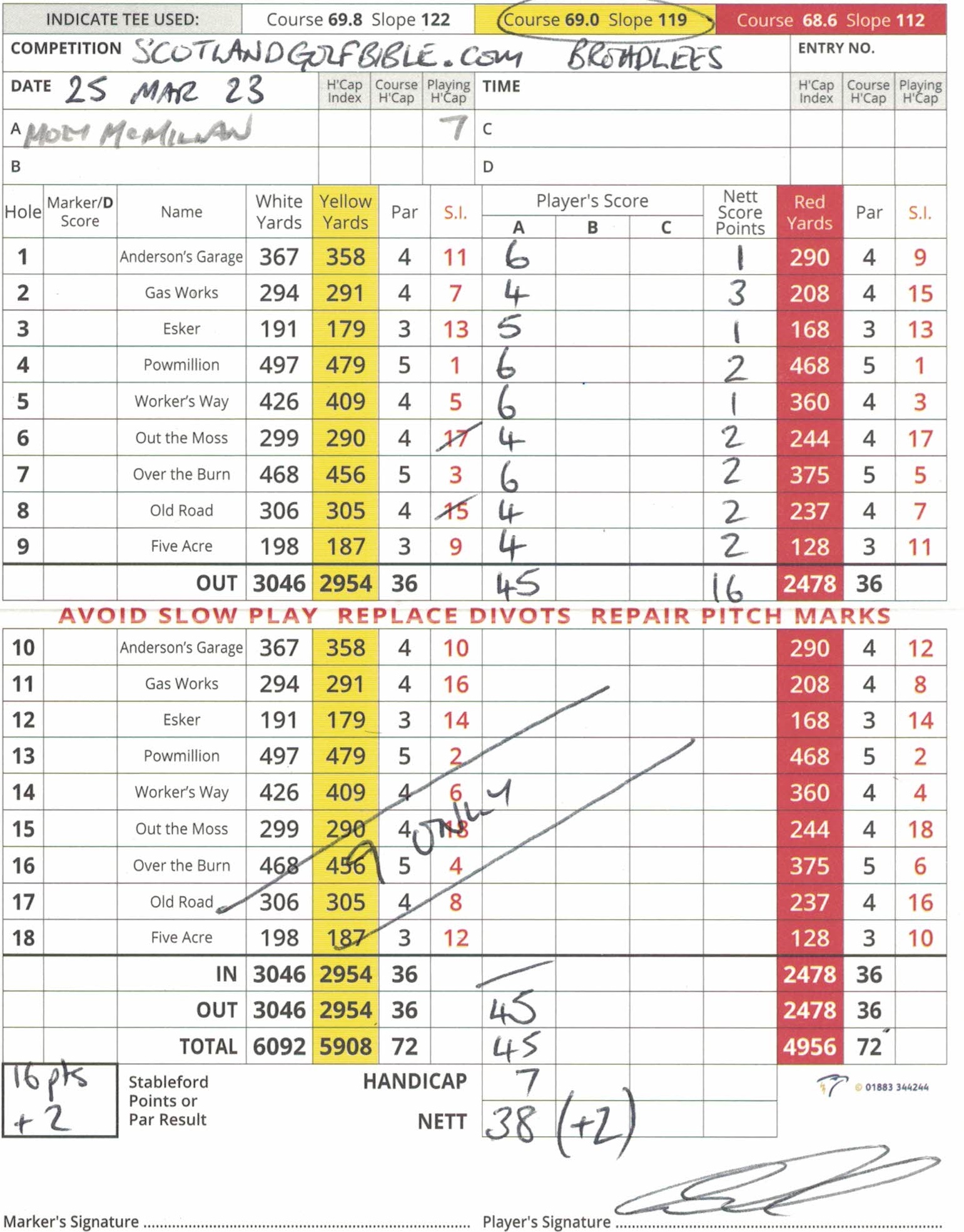
Moly’s card. Level 5s, I hit the ball pretty steady.

183. Mearns Castle. 24 Mar 23.

“Most scenic and challenging in the area.” An exaggerated claim by the Academy.

Round £10 (GolfNow Hot Deal, now £20). Par 31. Value 2/5.

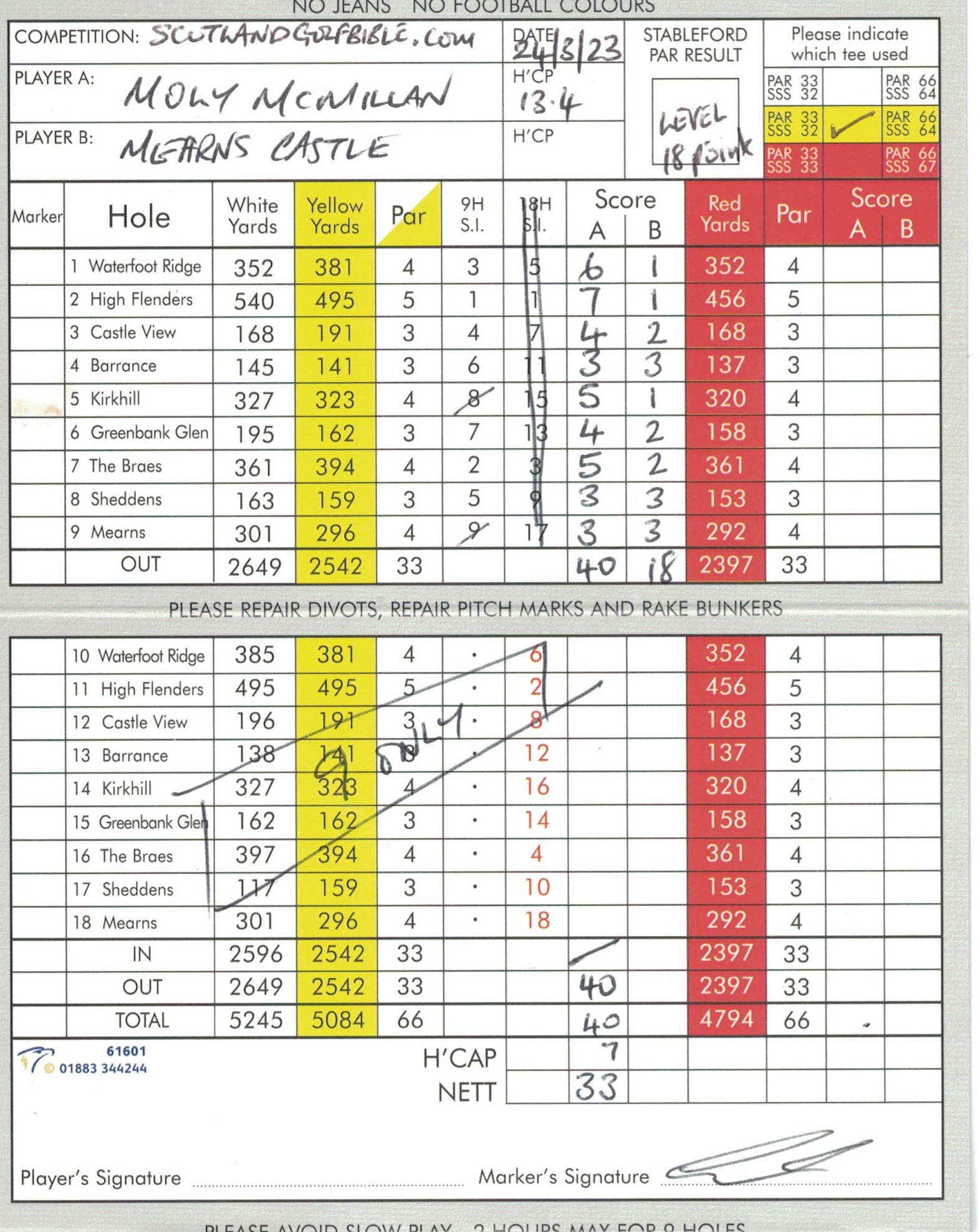
Moly’s Score – 40

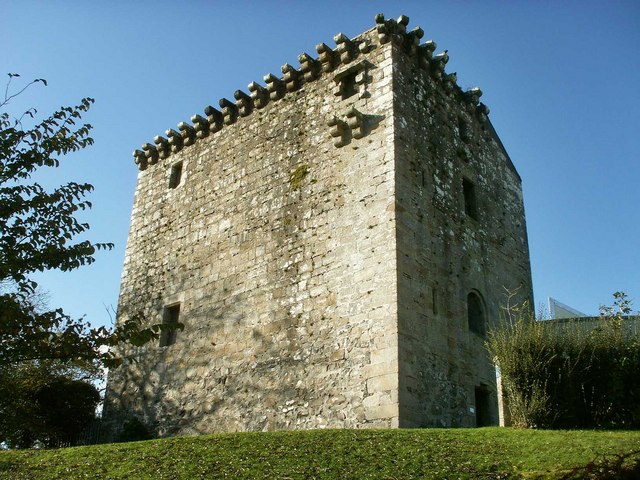
There is a real Mearns Castle about half a mile from the golf course, built in 1449 by Lord Herbert Maxwell. The same Maxwell family whose descendants would eventually own Southerness on the Solway Firth, reviewed in Blog 164, a course that justifies the word “scenic” more than anything I encountered here.

The actual nearby ‘Mearns Castle’, a 15th century Maxwell tower house, which the course takes its name. I wonder if Satnav ever gets this confused with the course.

The castle has, as far as I can establish, no connection whatsoever to the golf academy except proximity and, one suspects, the marketable romance of a medieval tower.

The golf academy is a substantial operation with Toptracer range, tuition, café, fitness studio, nail salon, and a massage therapist! More of a leisure complex with a 9-hole course attached. Nothing wrong with that, but problems begin when the website describes that course as “one of the most scenic and challenging courses in the area.”

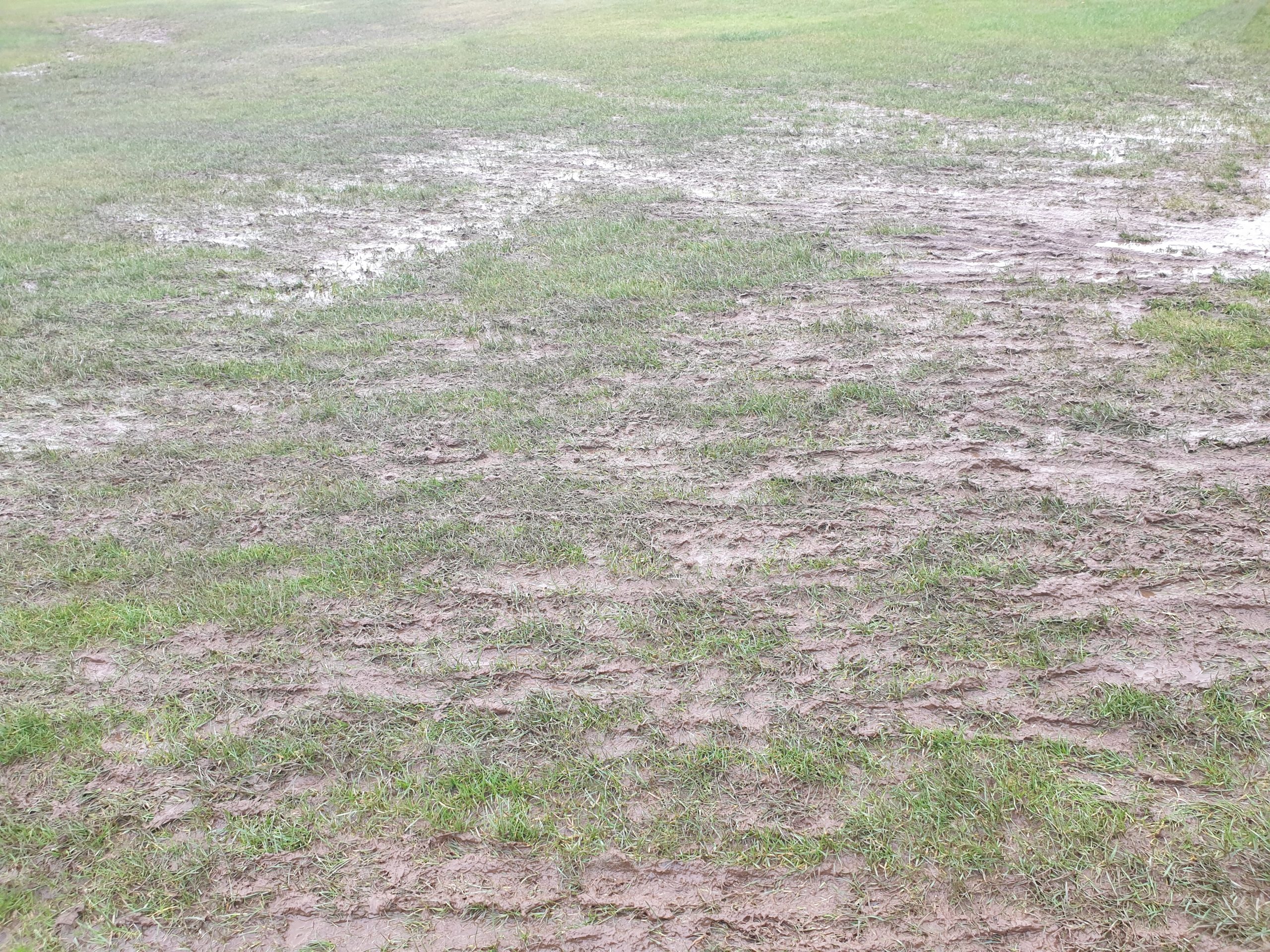
I played it on 24 March 2023, via a GolfNow Hot Deal, for £10. It was waterlogged. It should have been closed.

How could you allow play with fairways like this in several places. Sometimes short term economics doesn’t make sense. One never knows if a Blogger will come along!

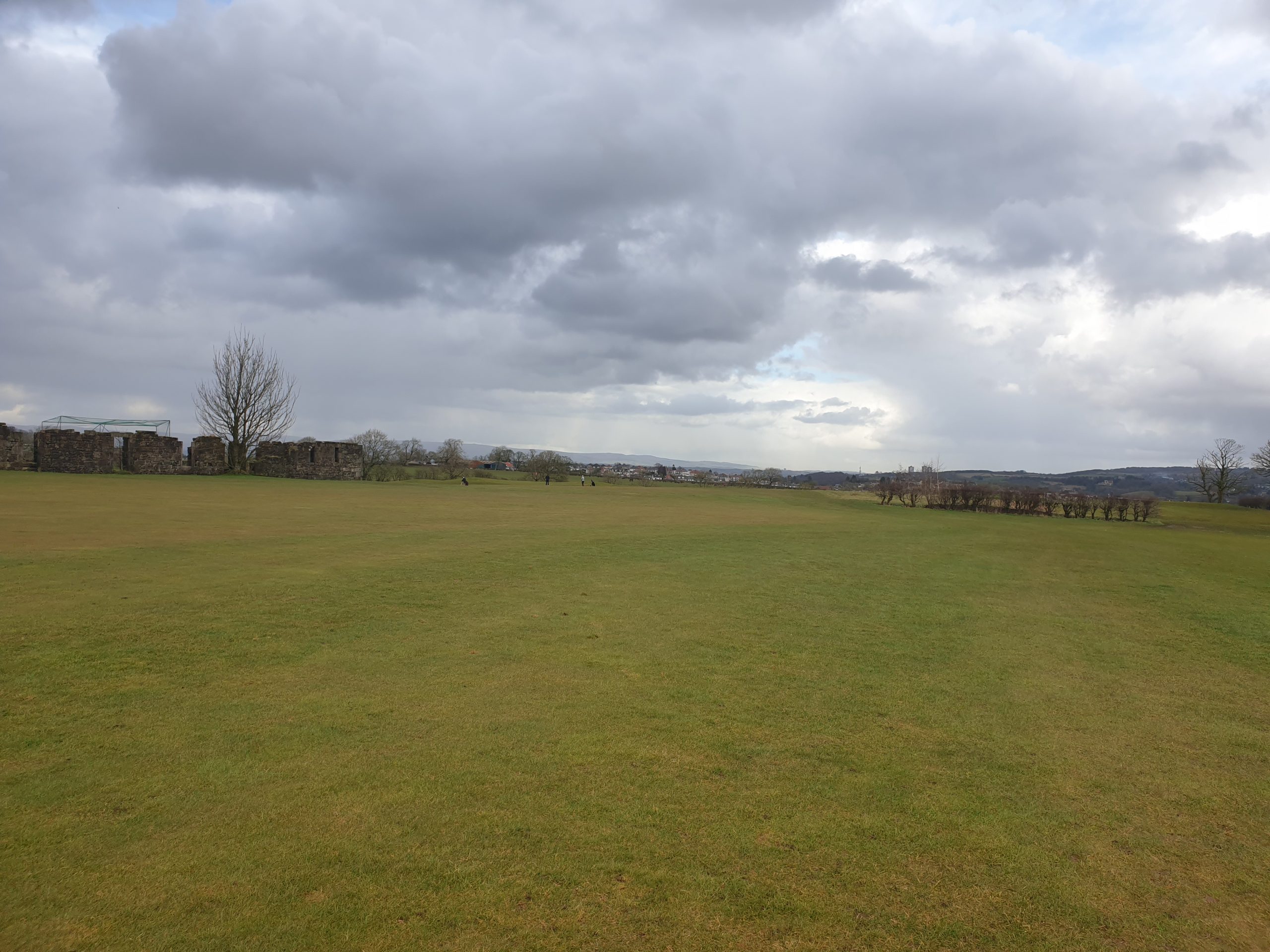
The course occupies pleasant enough parkland on the southern fringes of Newton Mearns, the well heeled commuter town south of Glasgow. The 1st offered an early introduction to the course’s style: there is a hidden fairway ditch ready to swallow a ball without warning. This was one of the very few “challenging” features though.

The course had minimal fairway bunkering. However the greens were surprisingly good surfaces, so well done to the greenkeepers. It is the one positive comment I can offer.

The greens were redeeming, a benefit for players learning the game. Here at the 4th.

The course website mentioned “continued investment in drainage and course improvements.” This is a tacit acknowledgement that drainage was a problem, which again raises the question why the course was open. A course that quietly admits its drainage issues while remaining open in March when waterlogged is providing very poor value, even at £10.

The was the typically bland approach view, here at the 5th hole, with the building ruins on the left being one of the very few interesting features.

The list price is now £20 for nine holes, I paid £10 on a Hot Deal. But golf on a course that should have been closed, is not good value at any price. The marketing overclaim tips it further – a course that sets expectations it cannot meet is doing its visitors a disservice.

Facts:

Course Type: Parkland

Par 31 (9 holes)

Moly’s Gross Score: 40 (net par)

Round: £10 (GolfNow Hot Deal). List price £20 (9 holes).

Value: 2/5

Moly shot 40 on a waterlogged day.

« Older posts

© 2026 Scotland Golf Bible

Theme by Anders NorenUp ↑