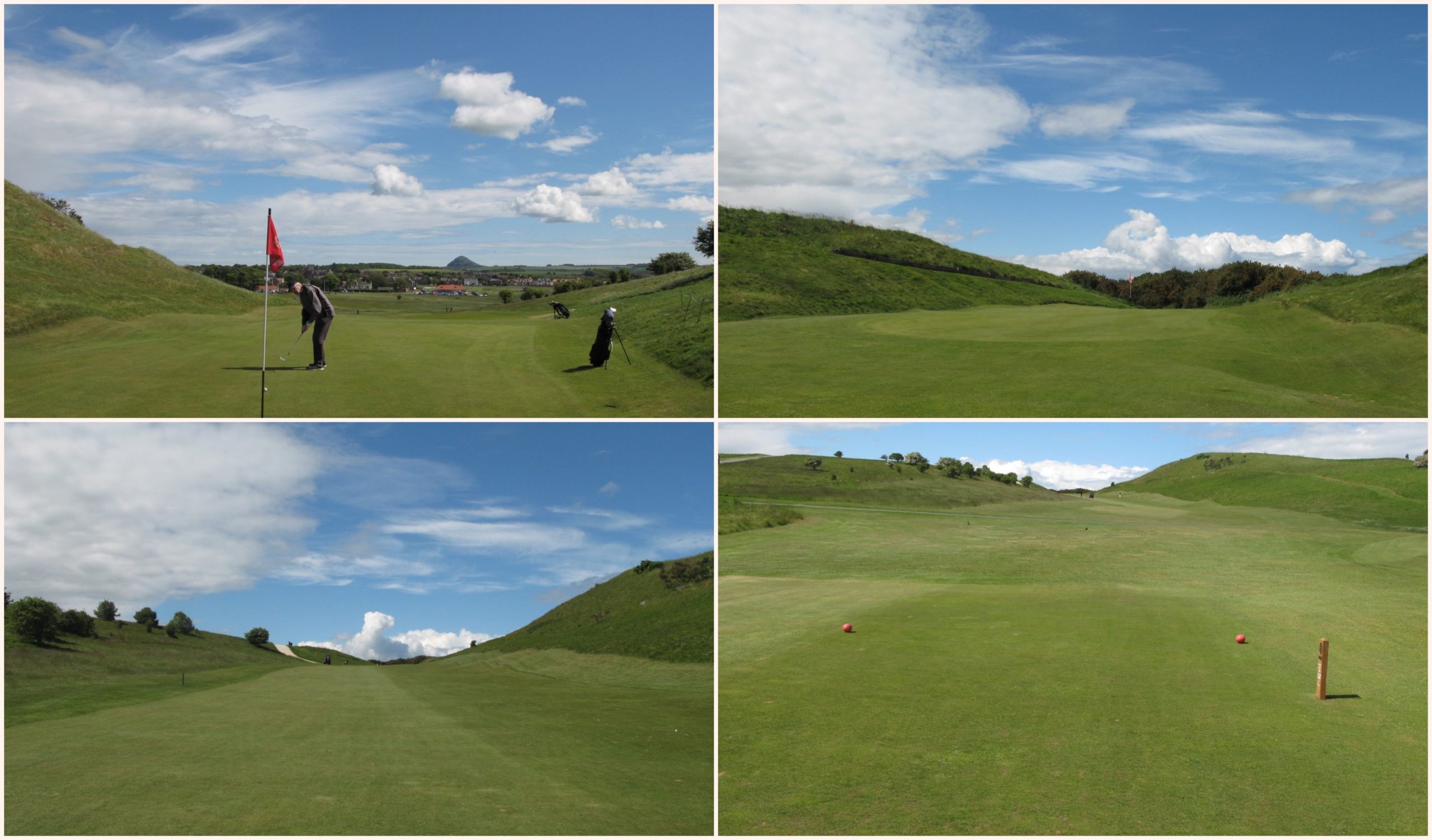
The course that broke Kilspindie’s heart — a story for another blog.
Value 3/5 (4/5 using GolfNow)
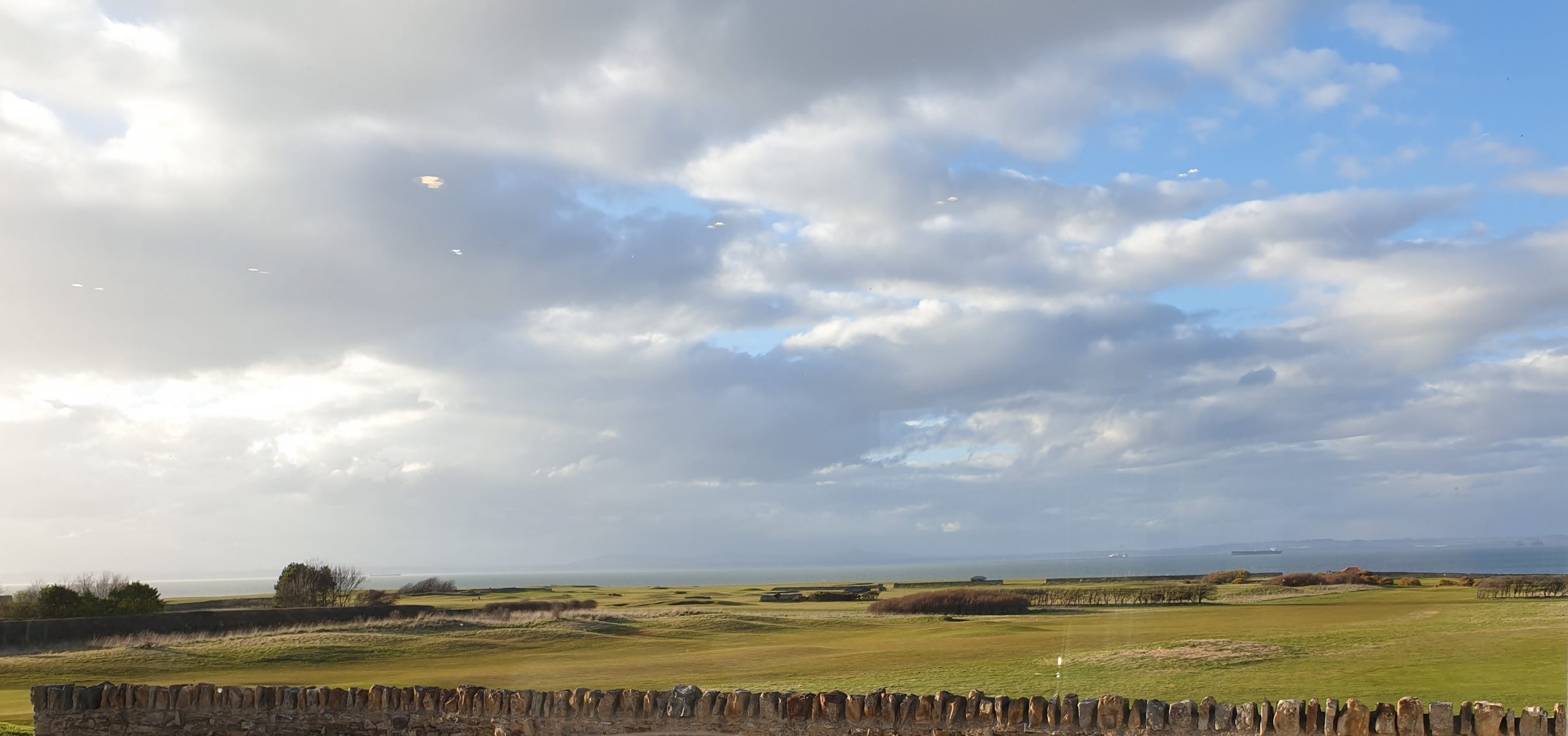
The panoramic clubhouse view back over Craigielaw links towards the Firth of Forth. On a clear day, as good as East Lothian gets.
Craigielaw Golf Club is on Wemyss and March Estates land – the same Estate that has leased its land to neighbouring Kilspindie Golf Club since 1867. In 2001, after two years of fractious negotiations, the Estate cancelled a deal that would have allowed Kilspindie to operate a second course and announced they themselves would build and run Craigielaw Golf Club. Kilspindie’s members, who had already paid handsomely for the privilege of playing ‘their’ second course, were left short changed — that story will feature in Kilspindie’s blog.
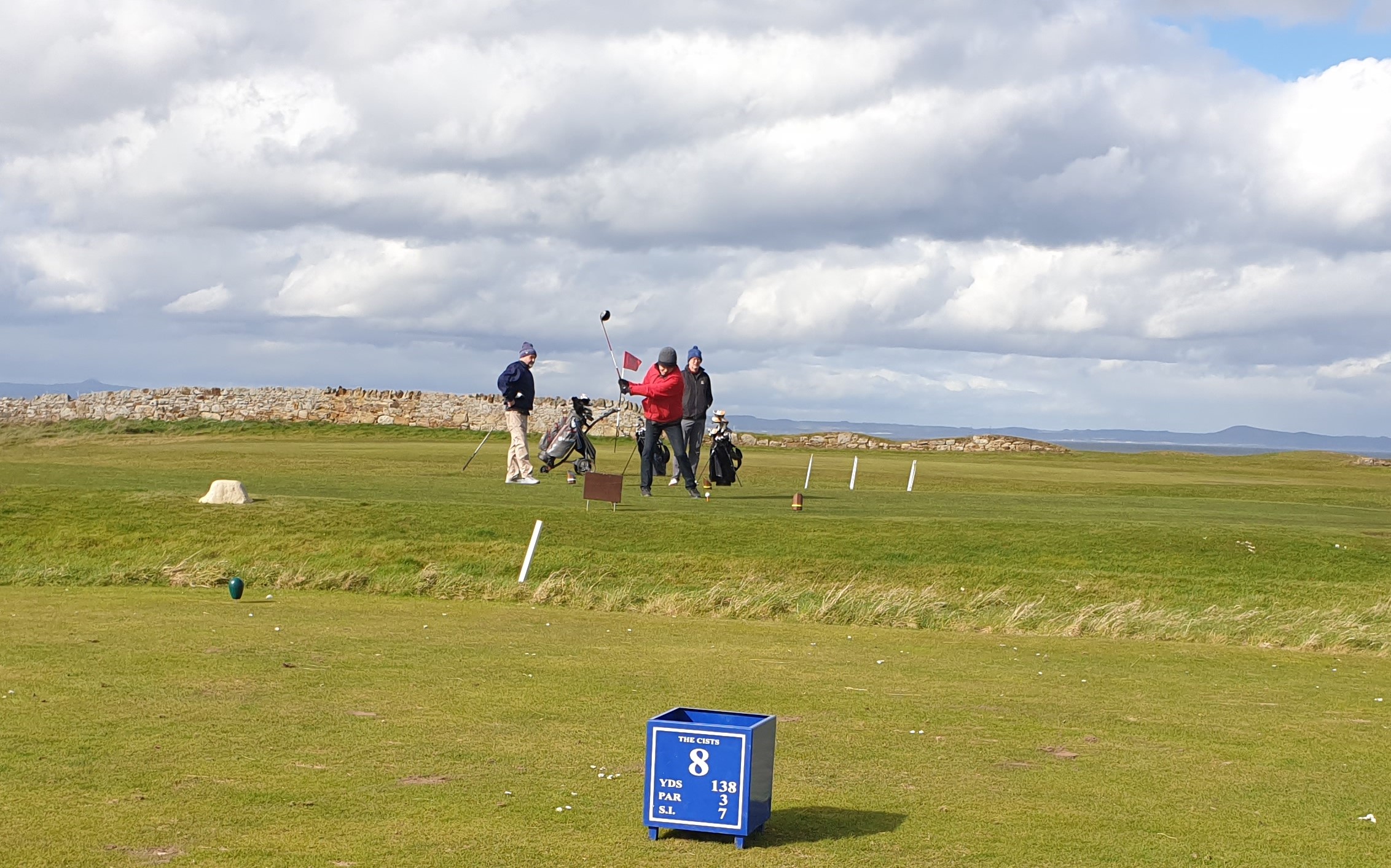
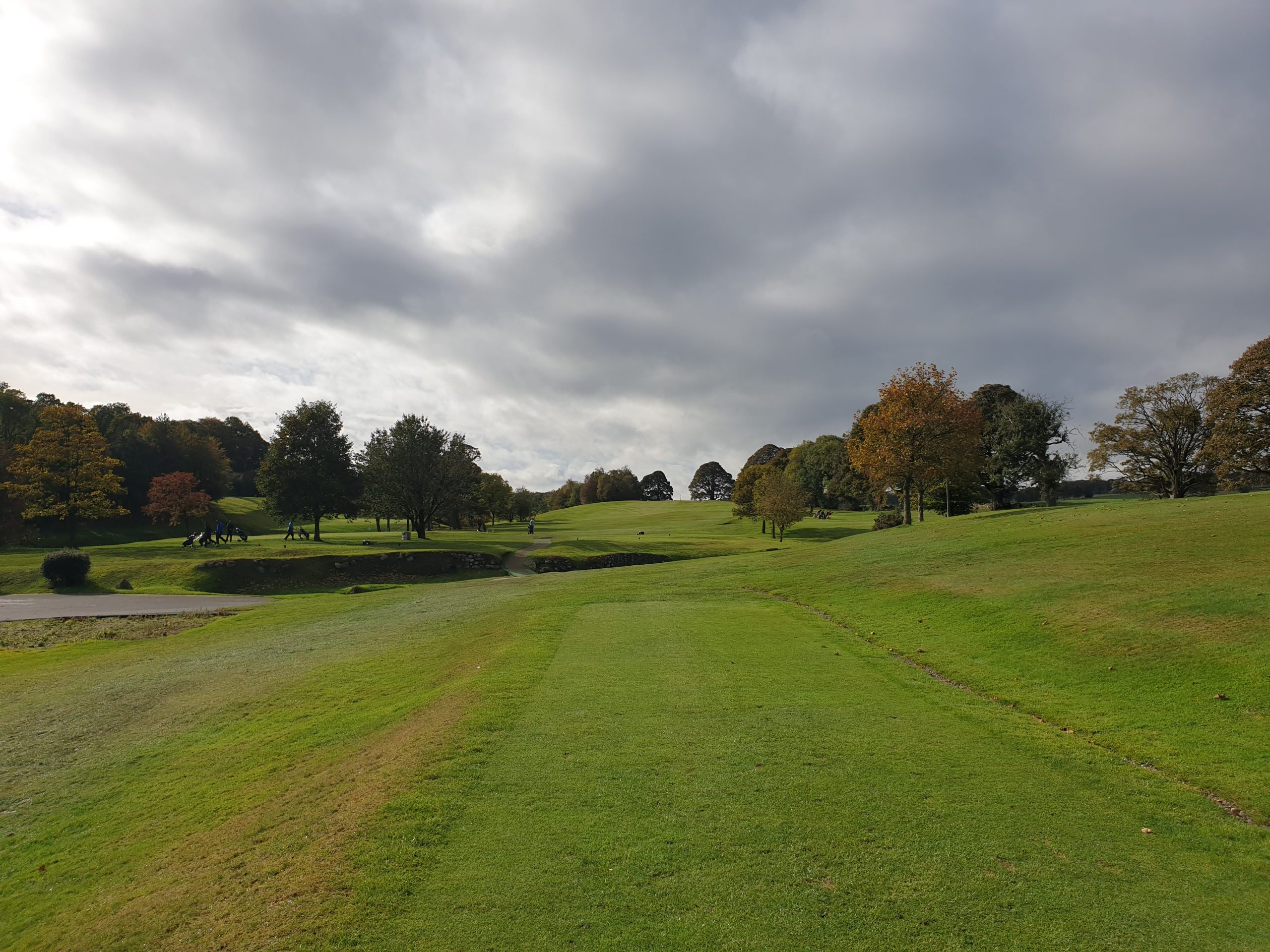
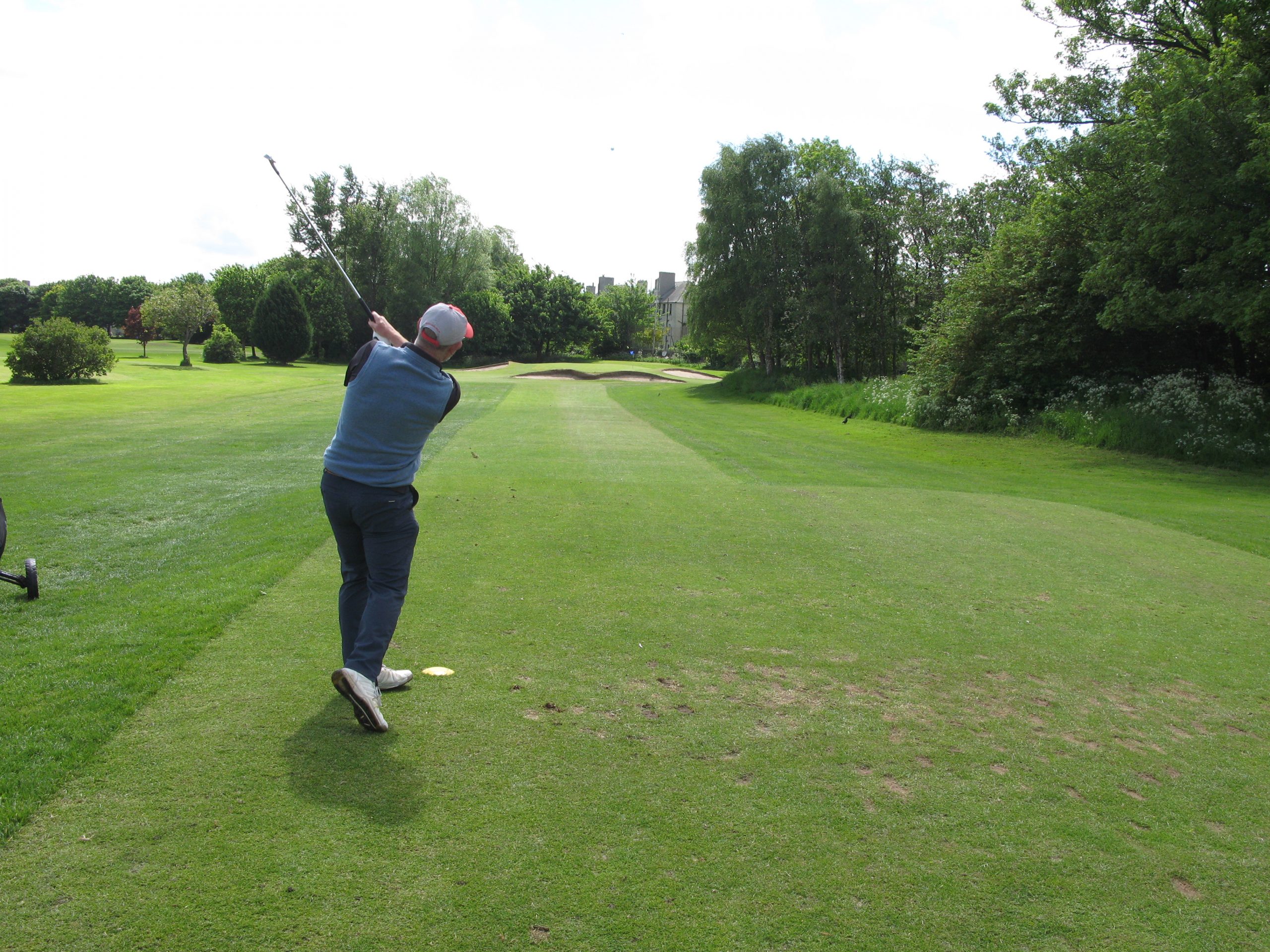
The 8th tee — a short par 3. The golfers here are not playing Craigielaw, they are on the 18th hole of the entirely separate Kilspindie Golf Club. Possibly the two closest tees from independent clubs anywhere? If you know of closer, let me know.
What elevates this origin story beyond a mere property dispute is who, at the time, was the Countess of Wemyss and March (see picture below). In 1995, James Charteris, 13th Earl of Wemyss, had married Amanda Feilding — an English aristocrat, artist, drug policy reformer, and the world’s most committed advocate of trepanation, the practice of drilling a hole in the skull to enhance consciousness and cerebral blood flow.
Amanda Feilding, Countess of Wemyss, with her pet pigeon Birdie, and a human skull, a tribute to her belief in trepanning. [Credit: Beckley Foundation — permission pending]
In 1970, Amanda had drilled a hole in her own forehead with a dentist’s drill, filmed the entire procedure, and called the resulting short film Heartbeat in the Brain. Audiences at early New York screenings were reportedly seen dropping from their seats. She stood for Parliament twice — in 1979 and 1983 — on the sole platform of free trepanation on the NHS, receiving 40 votes and then 139. She later founded the Beckley Foundation, dedicated to psychedelic research, and lived to see much of that work vindicated by mainstream science before her death in May 2025, aged 82.
So when the Wemyss and March Estates Directors, including Lady Wemyss, decided on the use of the land, it might have been fitting if anyone said “We need to operate a golf course like we need a hole in the head!”.
Back to golf. Designed by Donald Steel, Craigielaw is a thoughtful layout. The hole names are a delight — Coffin Lane, Bellfire Knowe, Doos Wa’s.
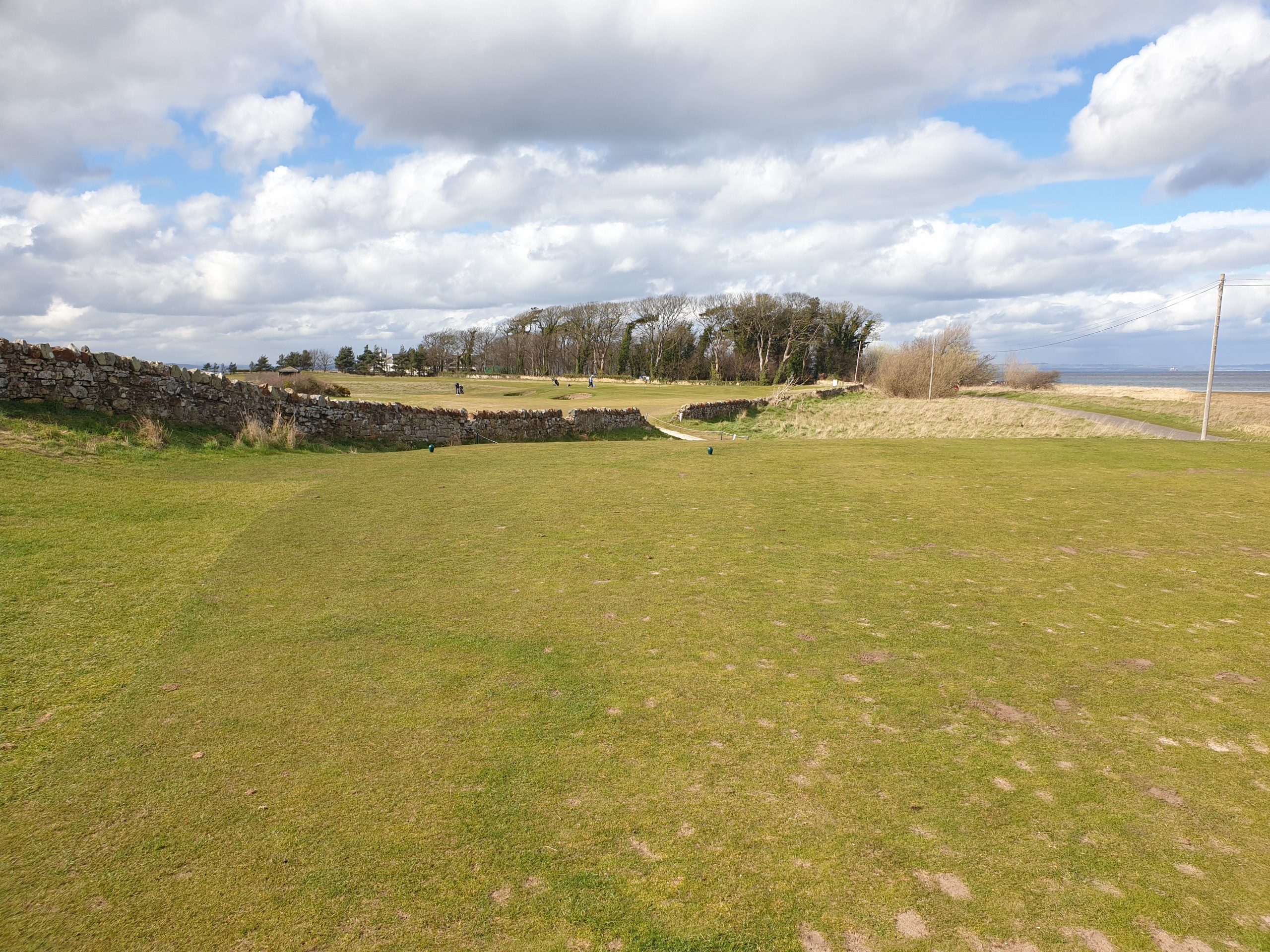
The sixth, ‘Kilspindie’, a respectful but perhaps pointed name, a tough par 3 where the prevailing wind will challenge the out of bound right.
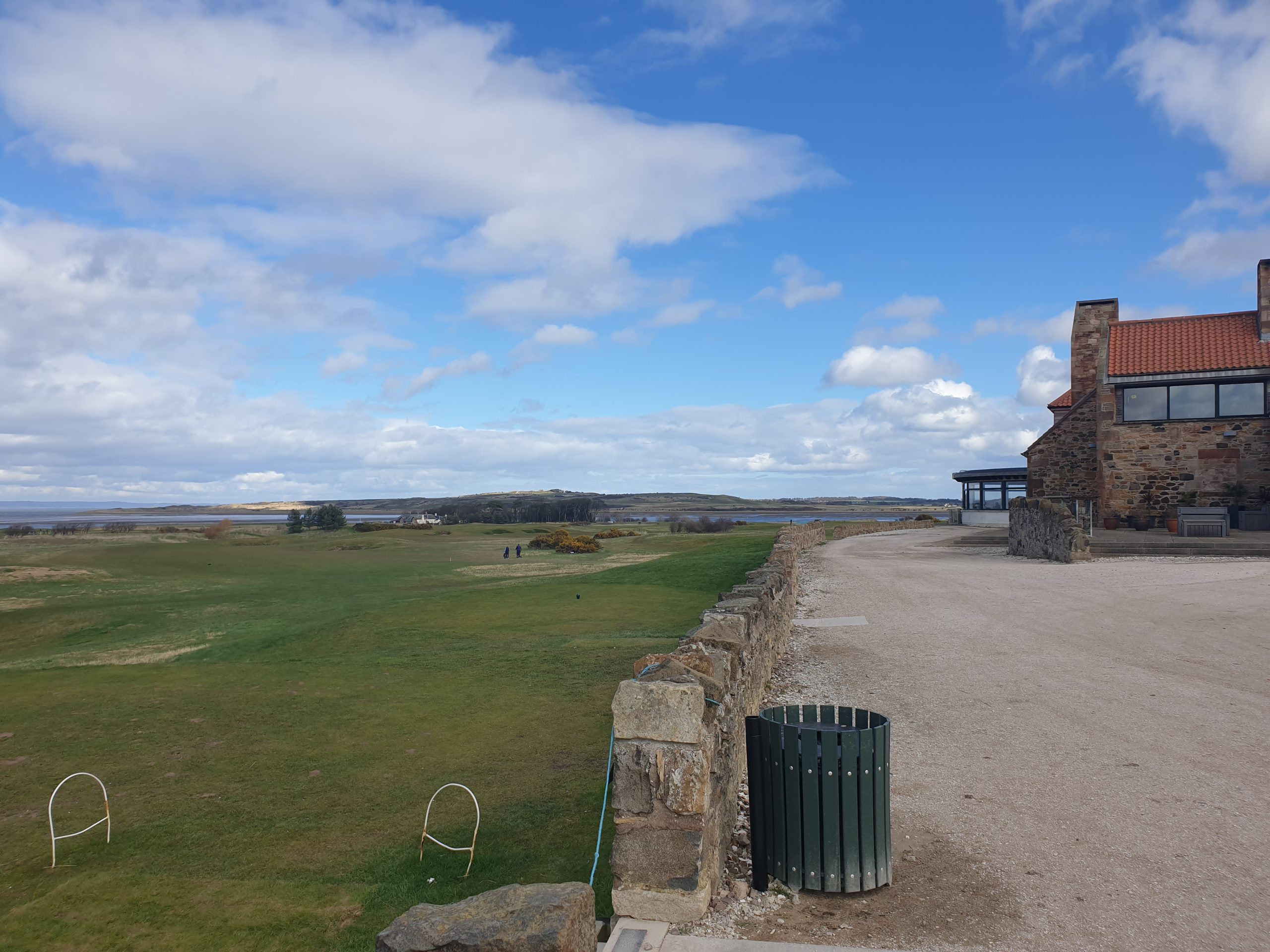
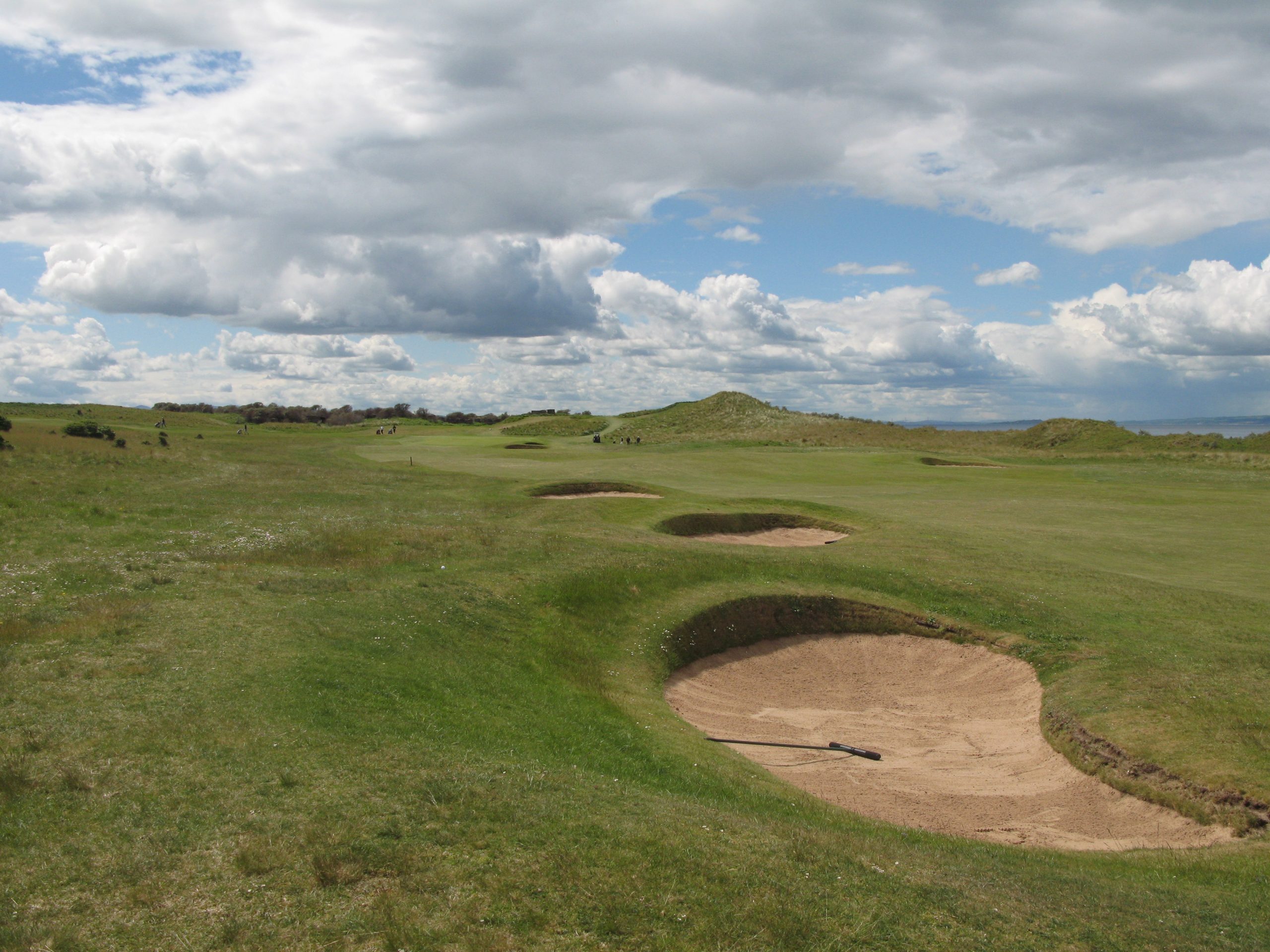
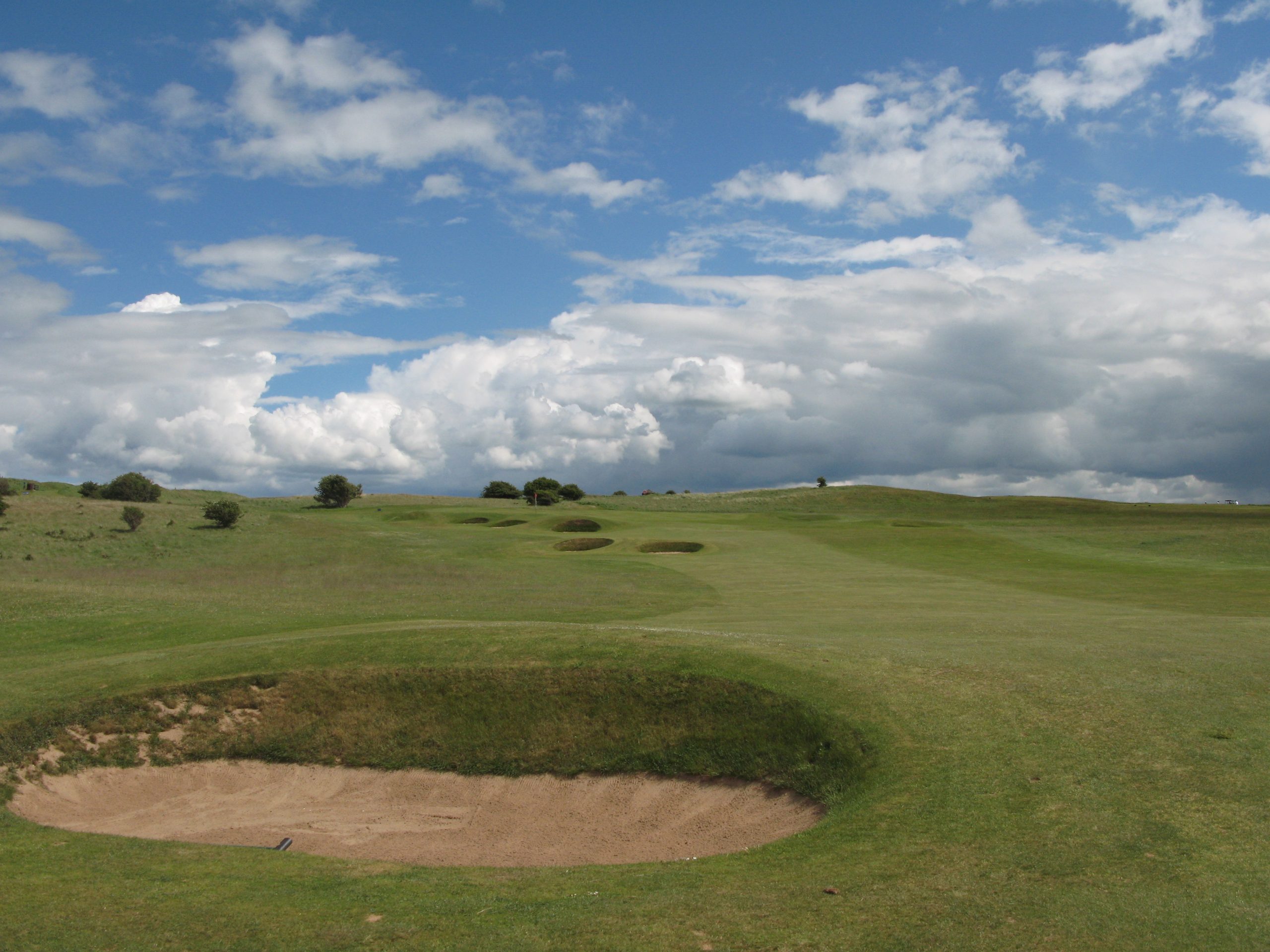
The property is well set up — impressive clubhouse, lodge accommodation, excellent practice facilities. The bunkering is Steel at his most unforgiving — cavernous, steep-faced pot bunkers with no interest whatsoever in your handicap.
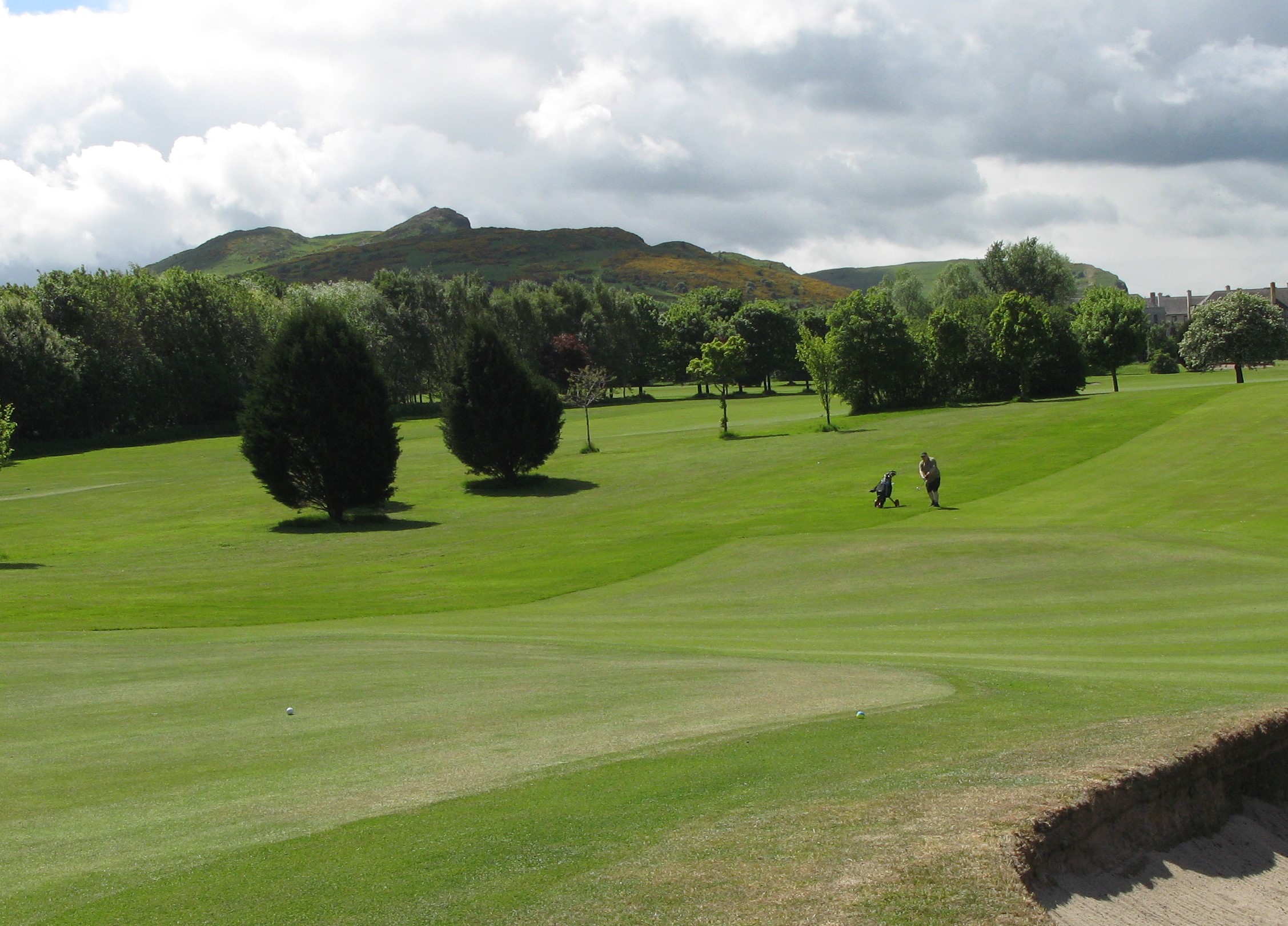
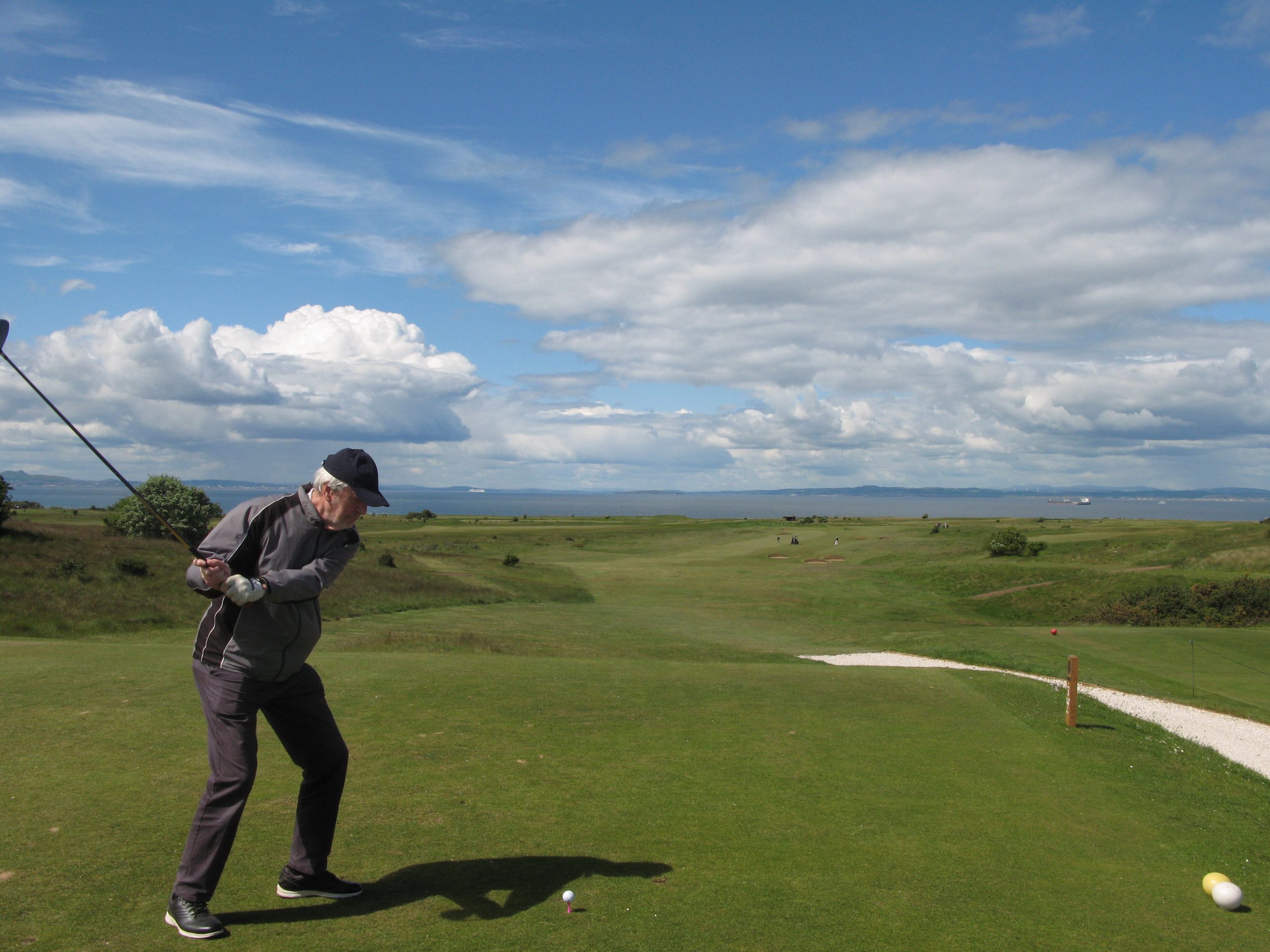
First ‘The Steading’, a drivable par 4. The Firth of Forth and Gullane Hill beyond..
The turf lacks the crisp links quality of nearby Gullane; the geology feels subtly different, more transitional than pure links. And the housing around the 10th and 11th — Gosford Park, as it happens, whose residents were central to the original dispute — briefly breaks the links illusion. The course recovers, but it’s a lapse.
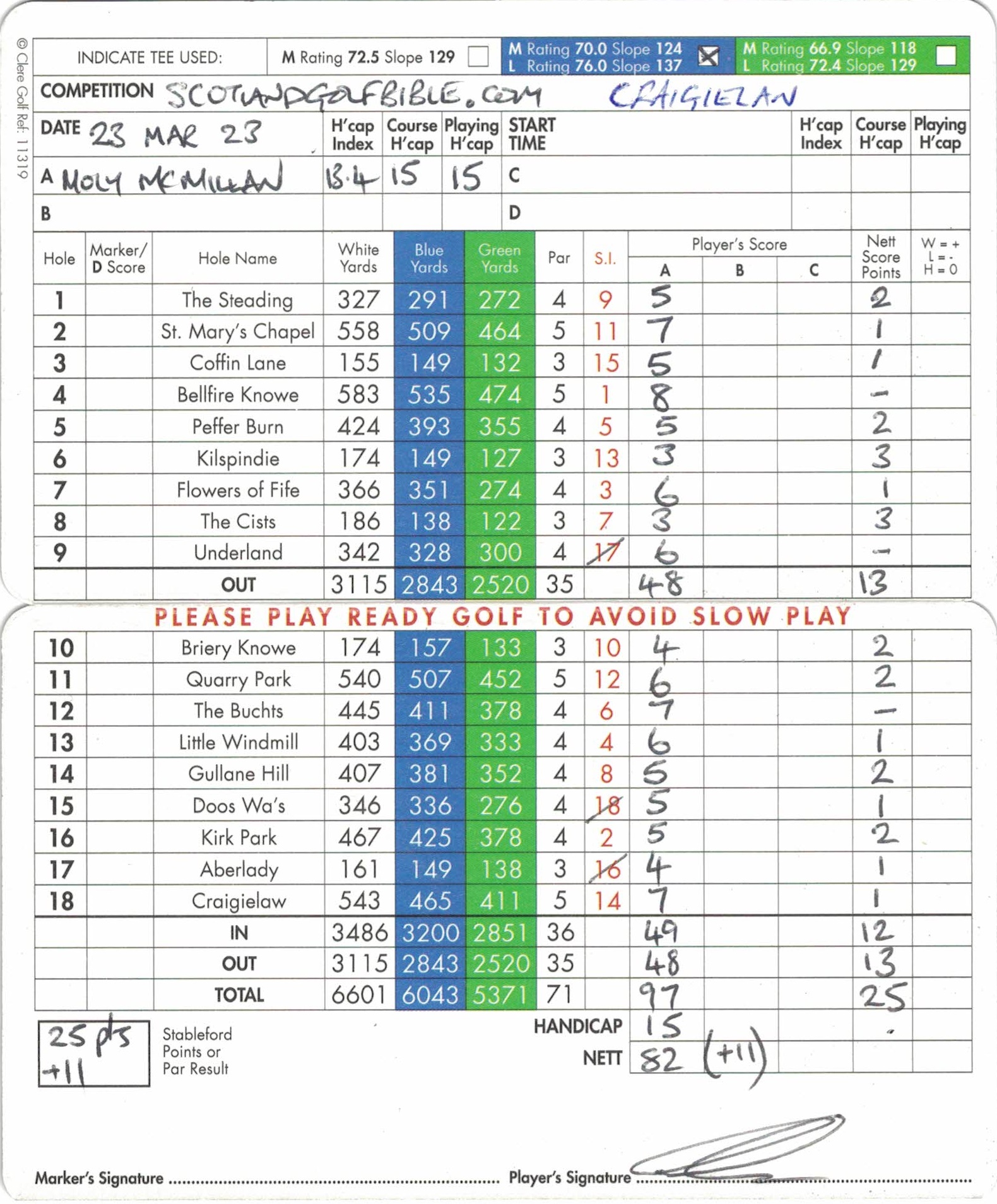
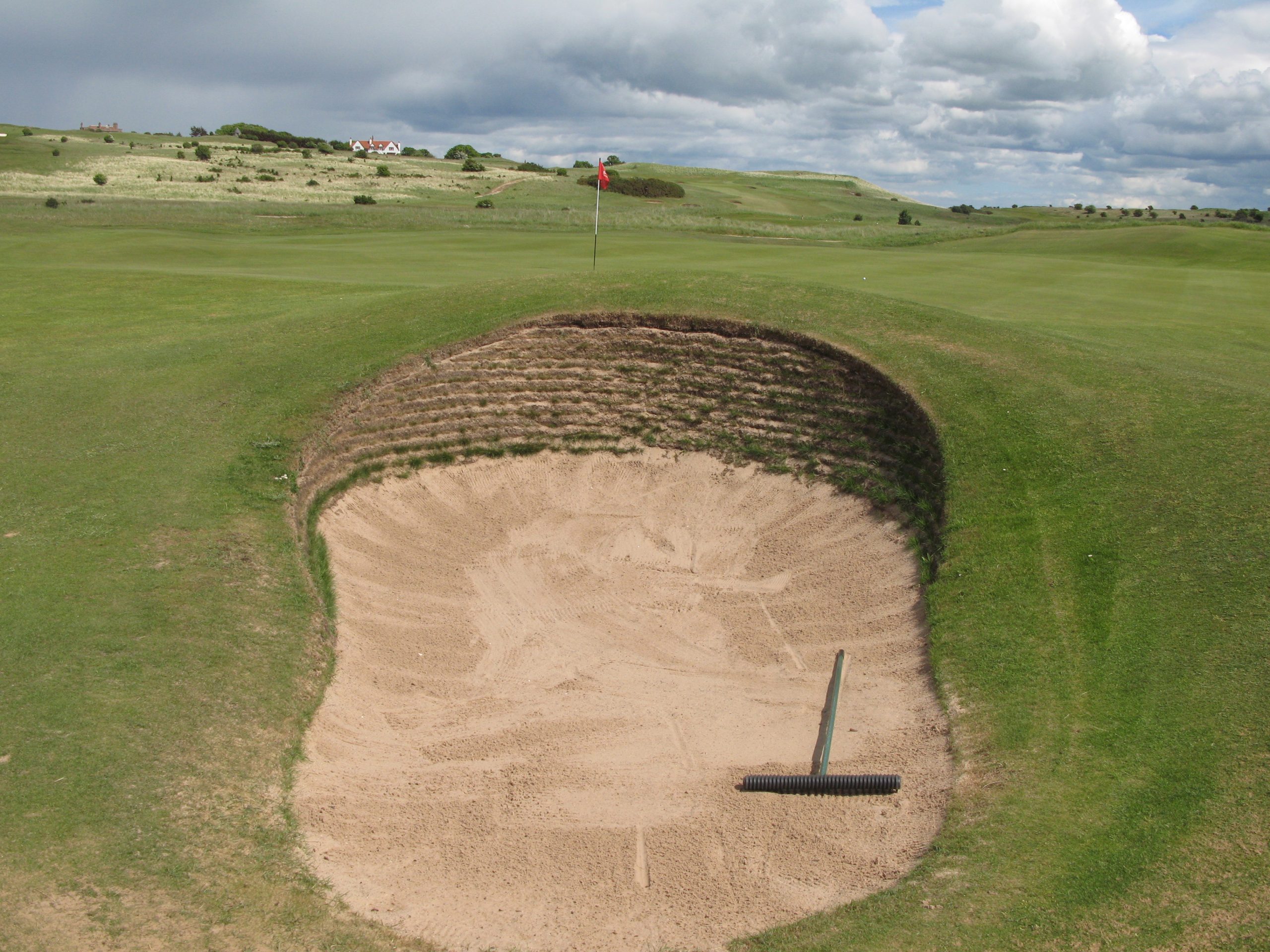
Moly at the 4th, ‘Bellfire Knowe.’ The flag is just visible over the lip. The 8 on the scorecard tells you the rest.
Value? At £125 for a summer midweek round, the price reflects the postcode — Muirfield, Gullane and Luffness New are all neighbours — more than the course itself. Good golf, honestly designed, but 3 out of 5 at full price? Not sure. However, I paid £45 through GolfNow. A Donald Steel championship links in East Lothian for £45 is 4 out of 5 without hesitation. Check GolfNow before you book.
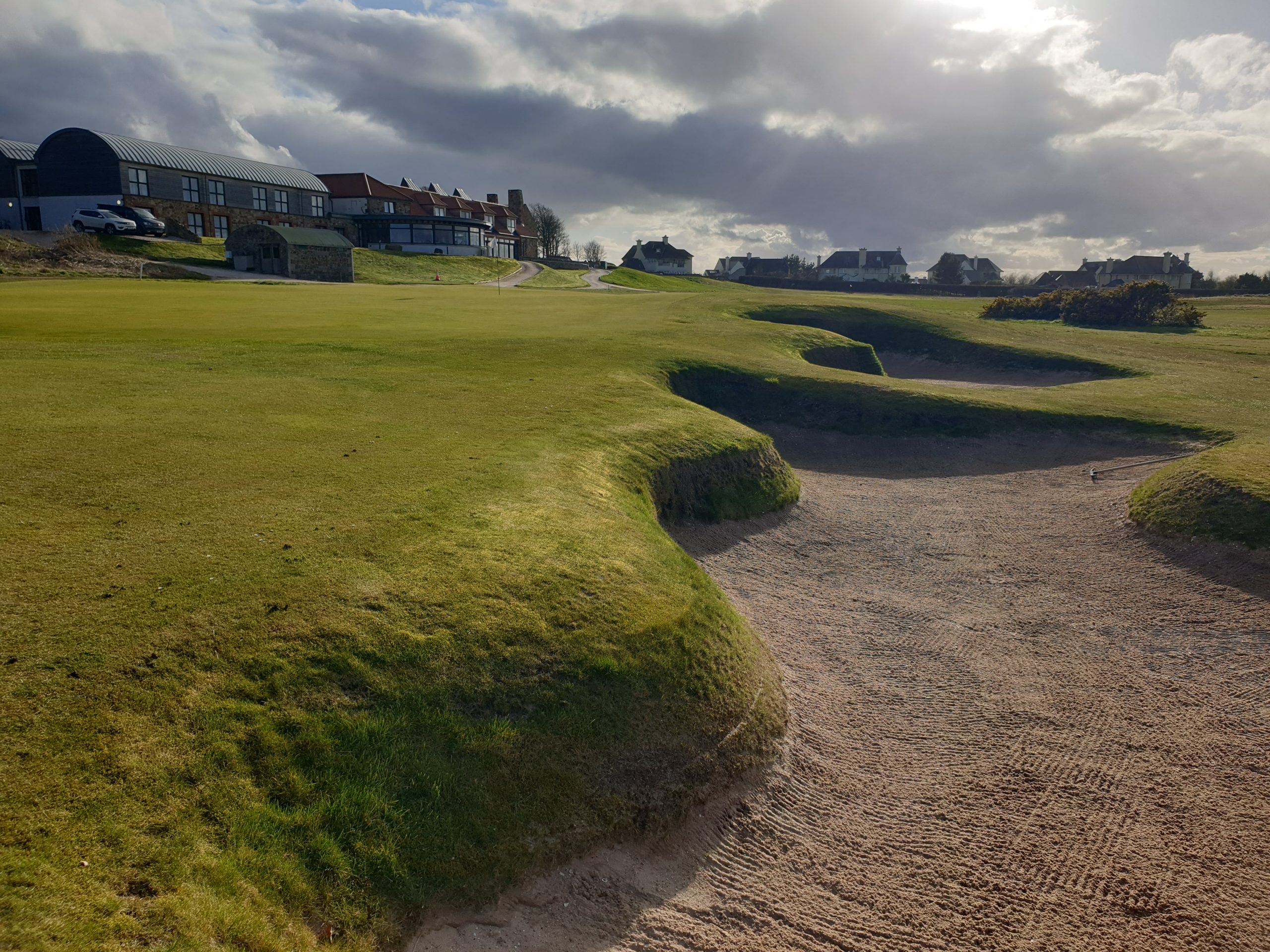
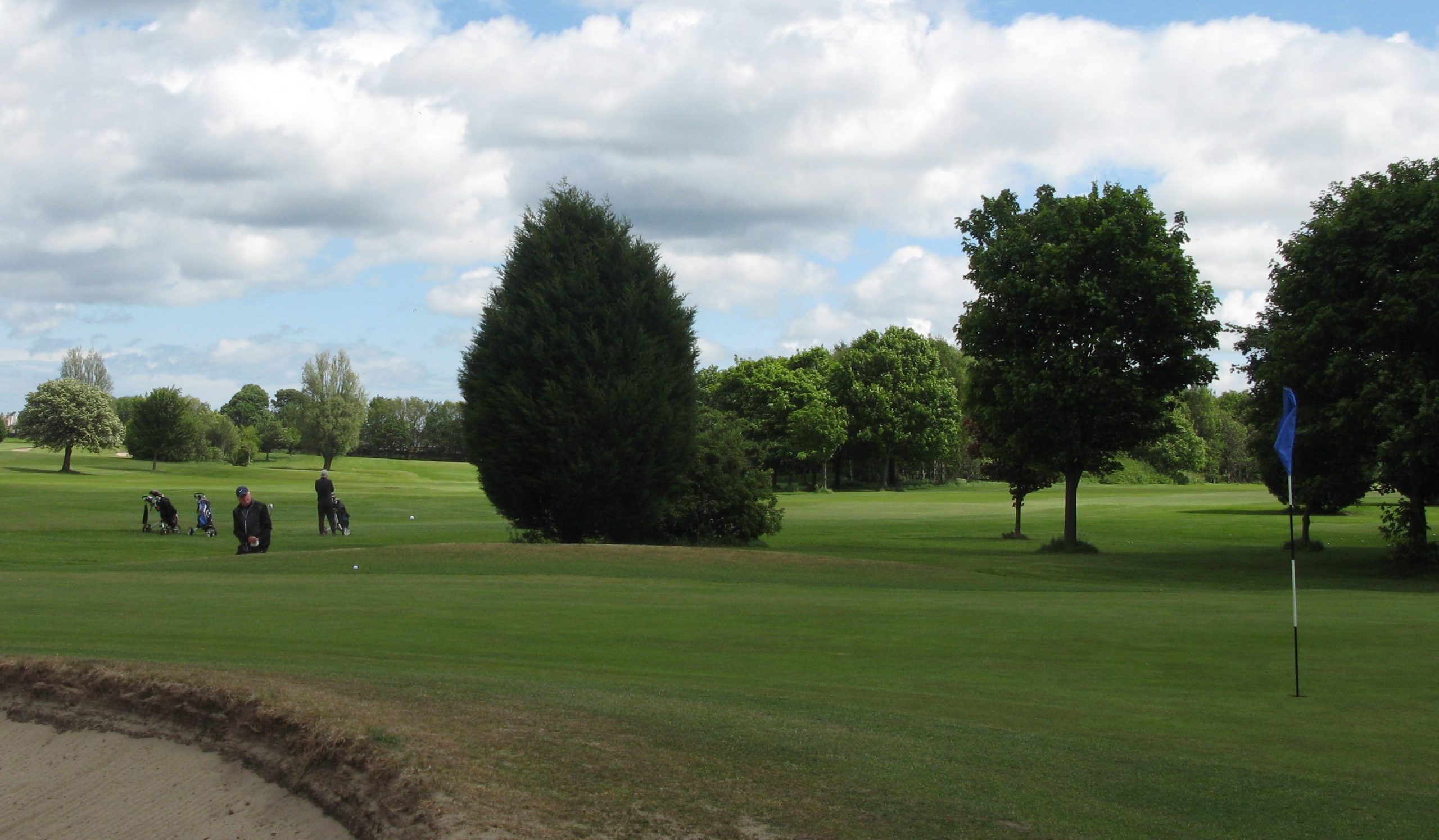
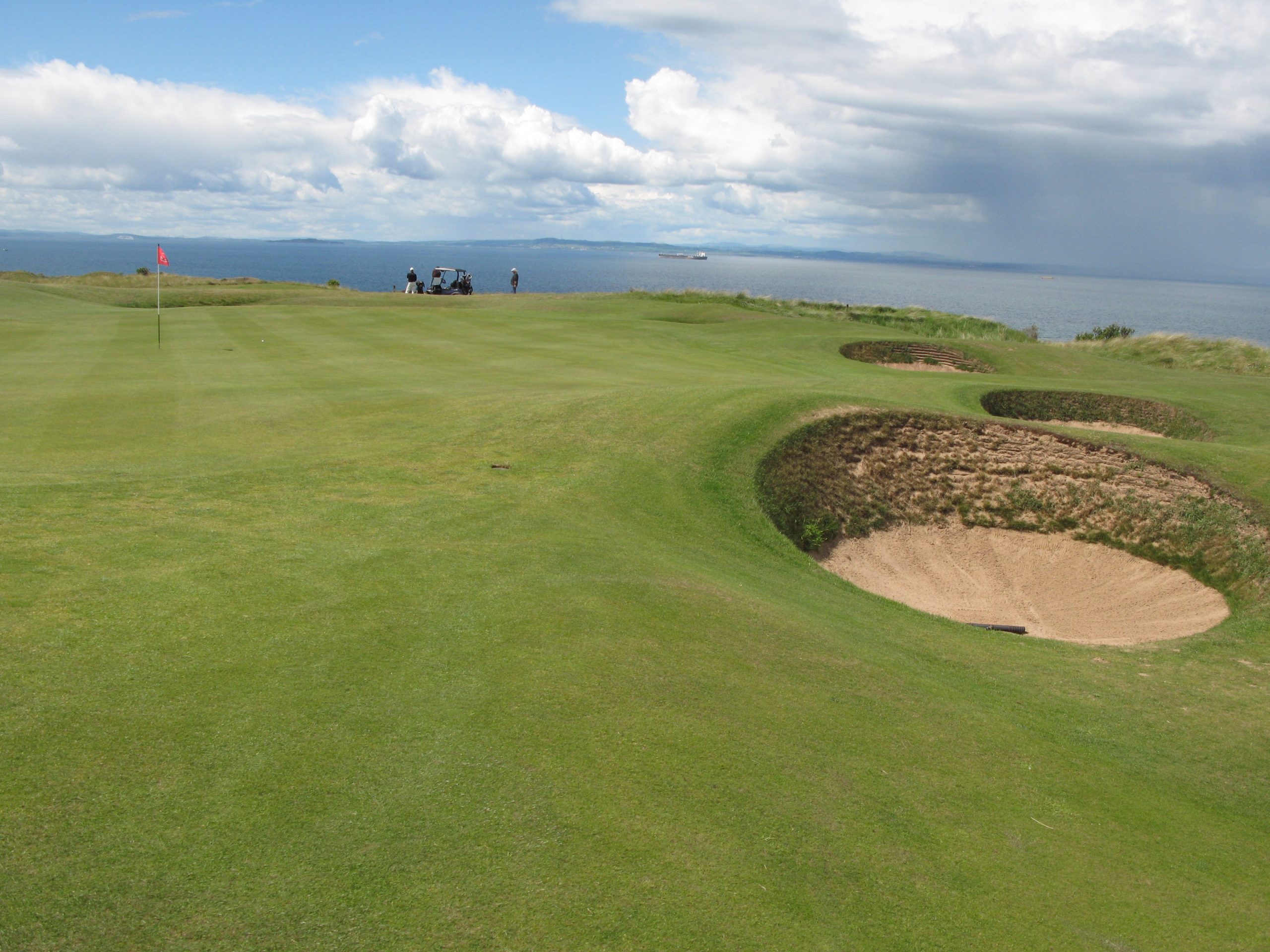
The 18th green, ‘Craigielaw’ — 465 yards, par five — with the modern clubhouse beyond. The bunkering here is the most dramatic on the course.
Facts:
Round £125. Par 71. Course/Slope Rating 70.0/124. Value3/5 (4/5 using GolfNow).
Quirky opening fairway at club with “progressive” ambitions.
Value for Money (out of 5) – 4
As a friendly Starter briefed me, I was pre-occupied by two groups of golfers only 40 yards in front of the first tee – one group on the 16th tee the other on the 2nd green. As a wayward driver, I was trying to remember if I had paid my annual golf insurance. His summarised message had been, “take great care!”.
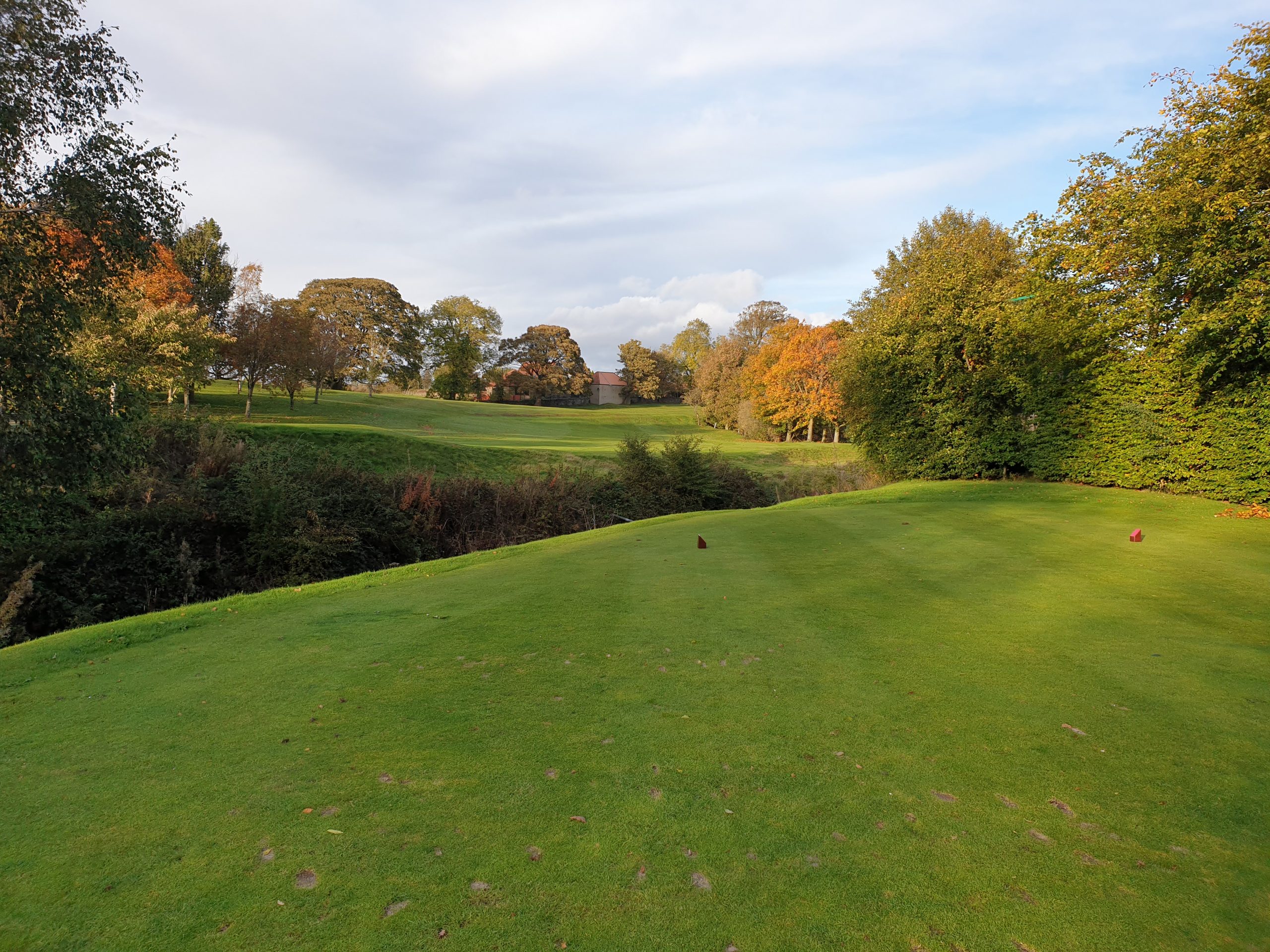
The good conditioning of Uphall seen from the 1st tee. It’s a hazardous area, with both teeing ground and greens in immediate view – take great care.
Uphall’s first and second holes share a fairway with a green at either end, which I reasoned may have been okay at the turn of the 19th century, when balls didn’t travel so far and times were less litigious. I kept musing on this somewhat dangerous layout, my feelings later reinforced when I met a long standing member who told me “someone’s going to get seriously hurt one day”.
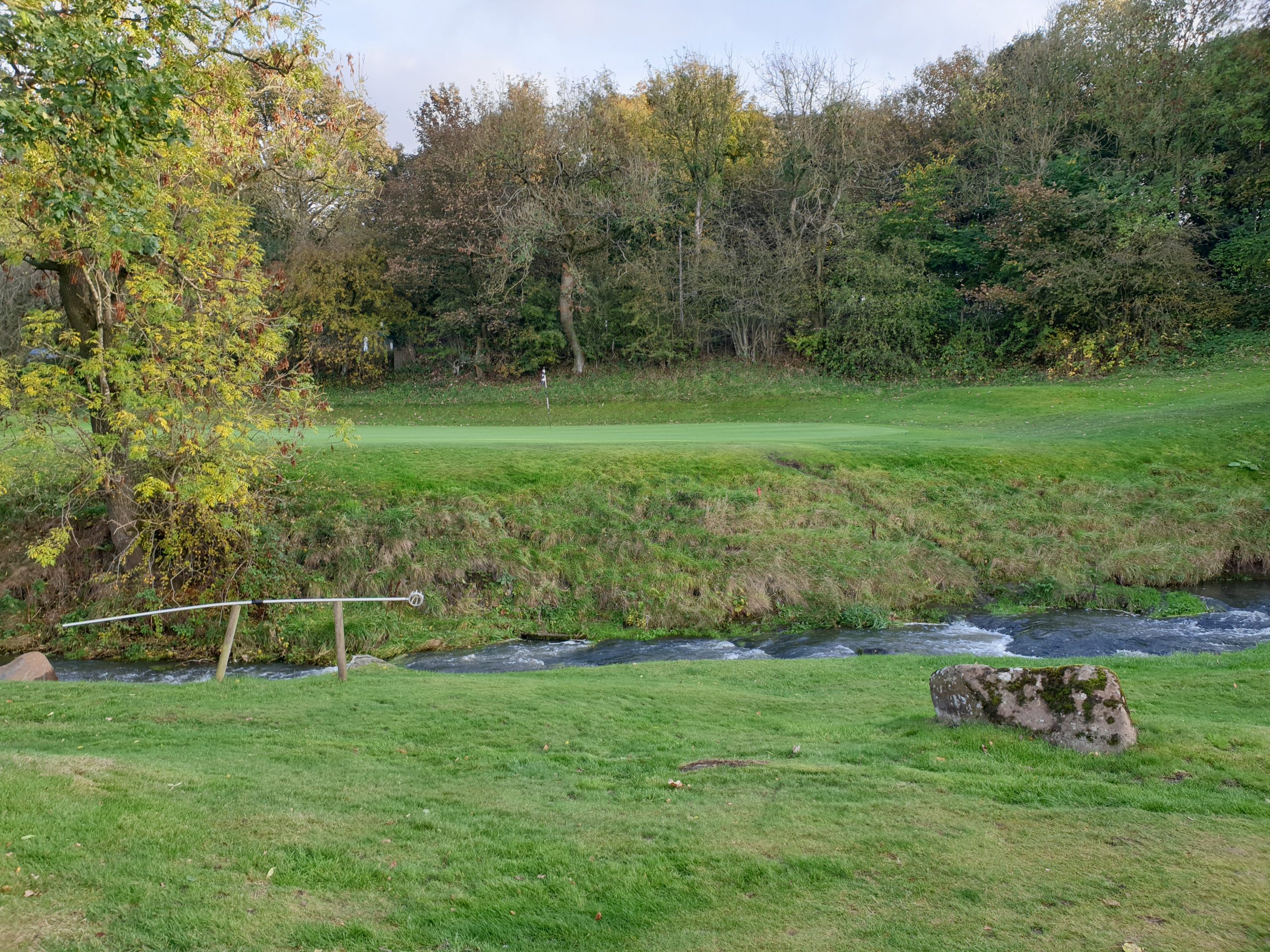
The par 3 third hole – Uphall’s best hole in my opinion, where one has to avoid the Brox Burn.
The golf course (in the village of the same name) sits either side of the A899 with holes 1 to 3, and 15 to 18 on the north side, and holes 4 through 14 on the south. It is near Junction 3 of the M8, and therefore very accessible from any direction.
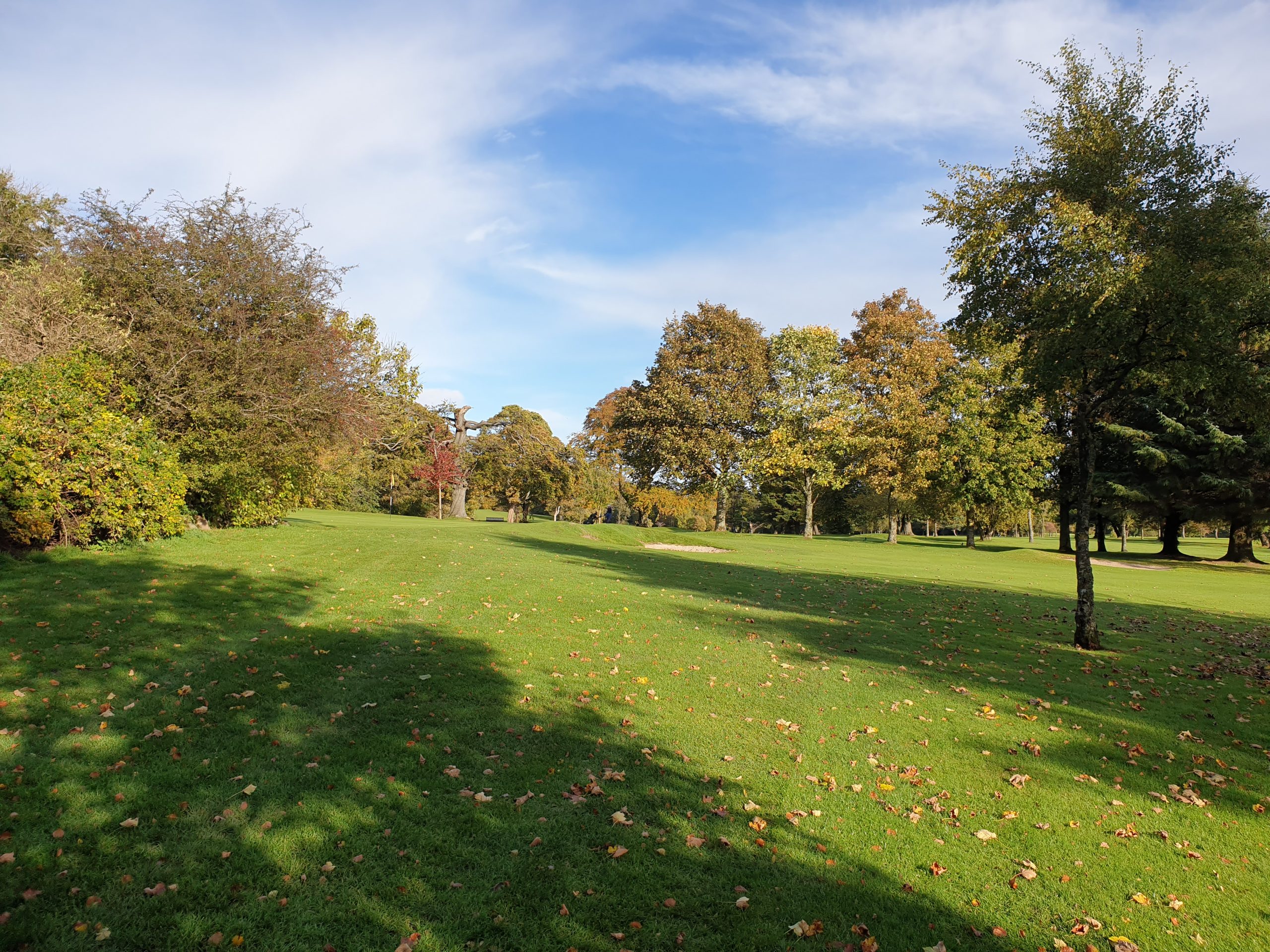
Autumn colour on display into the trickily placed 5th green, a short par 4.
This Central Scotland location, coupled with the interesting course layout makes for a good society venue, albeit at the time of writing the club are yet to rebuild the clubhouse which was sadly burnt down during the Covid Pandemic.
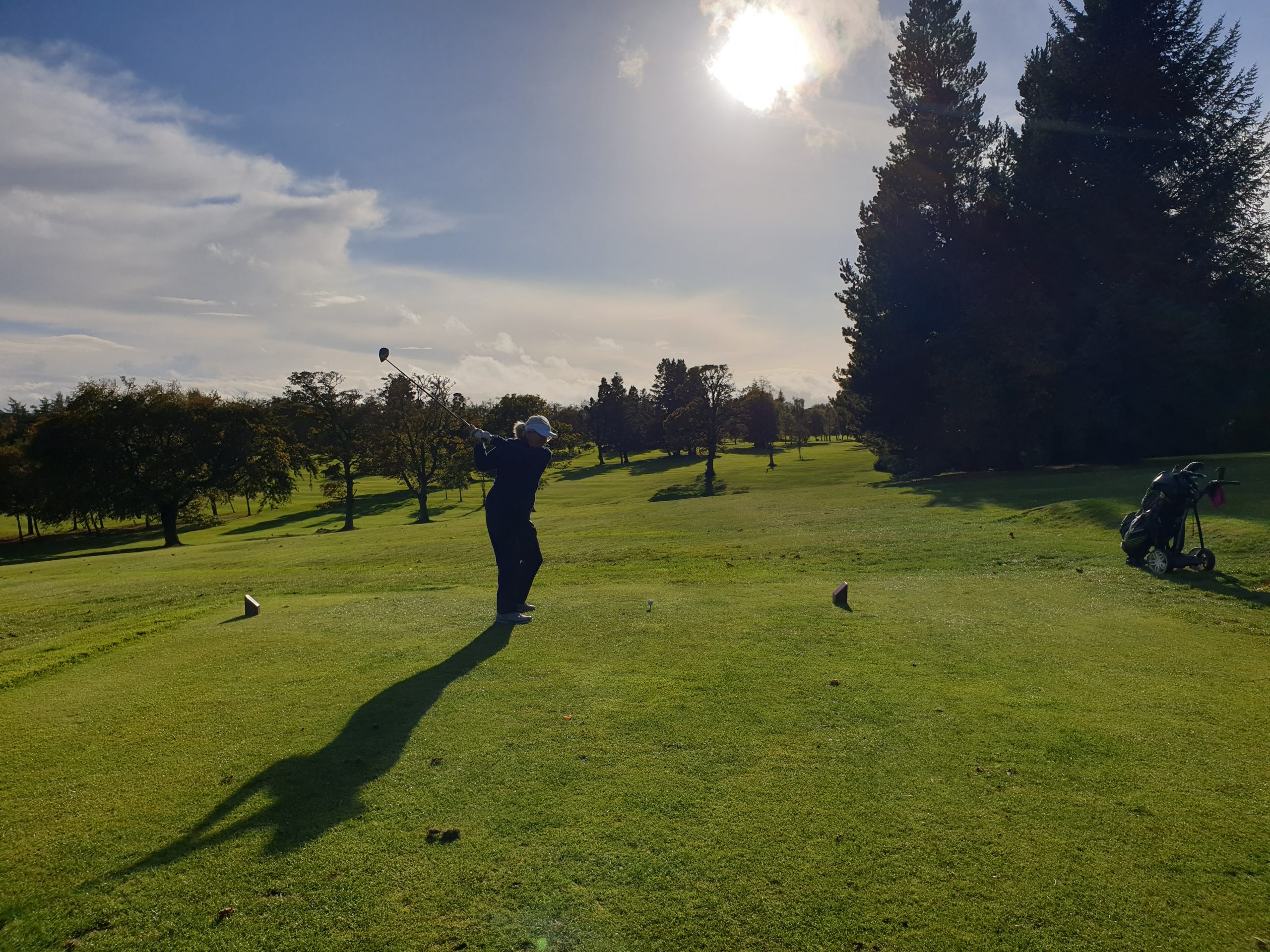
The mature Uphall parkland on view here as Fran drives at the tough par four 8th hole.
Much of the course lies amongst mature parkland, once part of the Houstoun House Estate. The estate ‘castle’, dating back to 1598, is now a MacDonald Hotel, and sits behind the 4th, 5th and 6th holes.
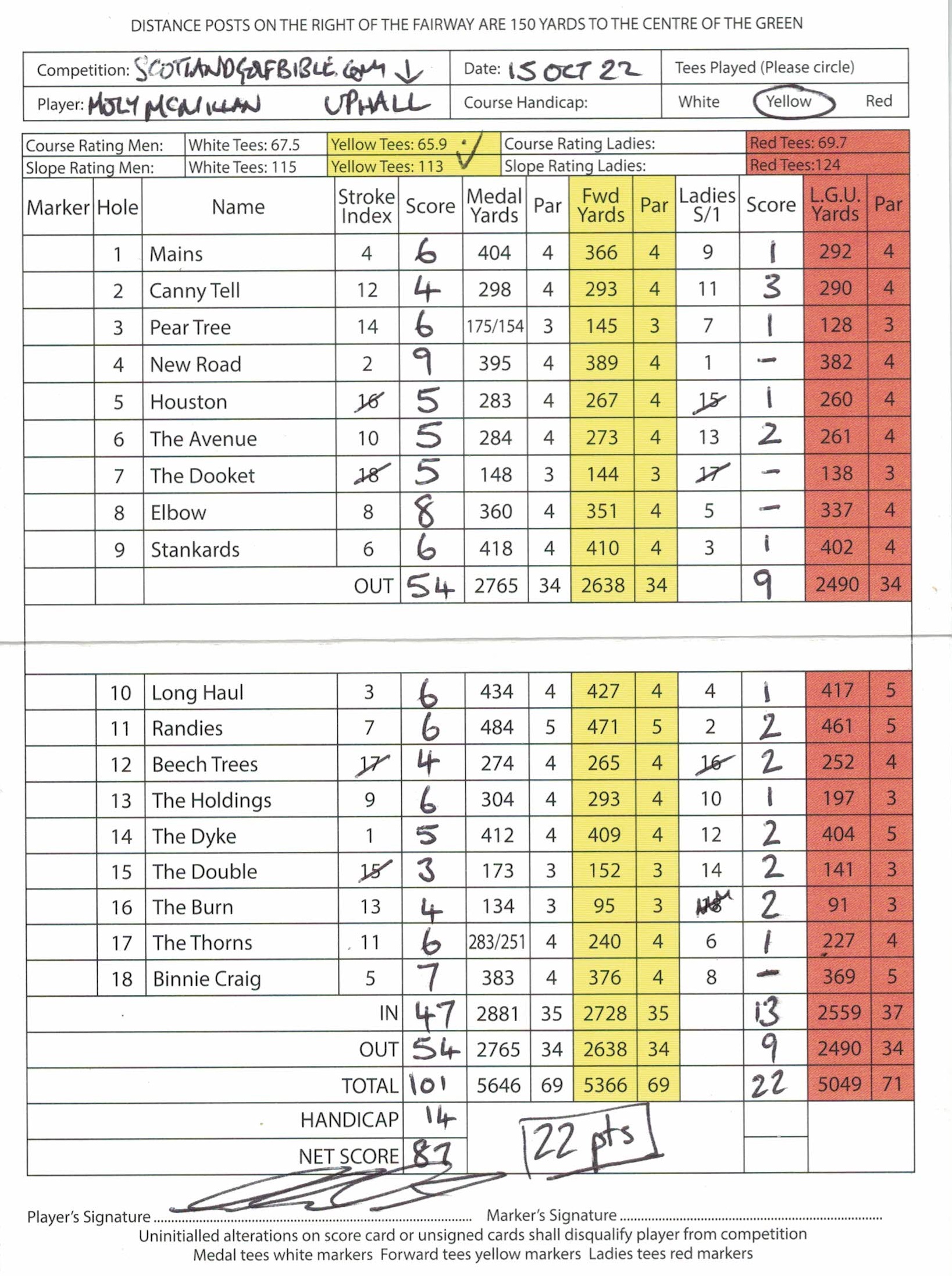
At just 5366 yards from the yellow tees, with a slope rating of 113, I should have been challenging 80, whereas I didn’t break 100 in the wet and windy autumnal conditions. My score wasn’t helped by losing 3 balls in the leaves. It was very picturesque though with the trees in good colour.
The par three 16th, “burn”, where good club selection is needed at this 95 yard hole (yellow).
With four par threes and only one par five, the courses variety was aided by a good variety of par fours, from the drivable downhill second hole of 293 yards, to the stroke index 1, 14th at over 400 yards.
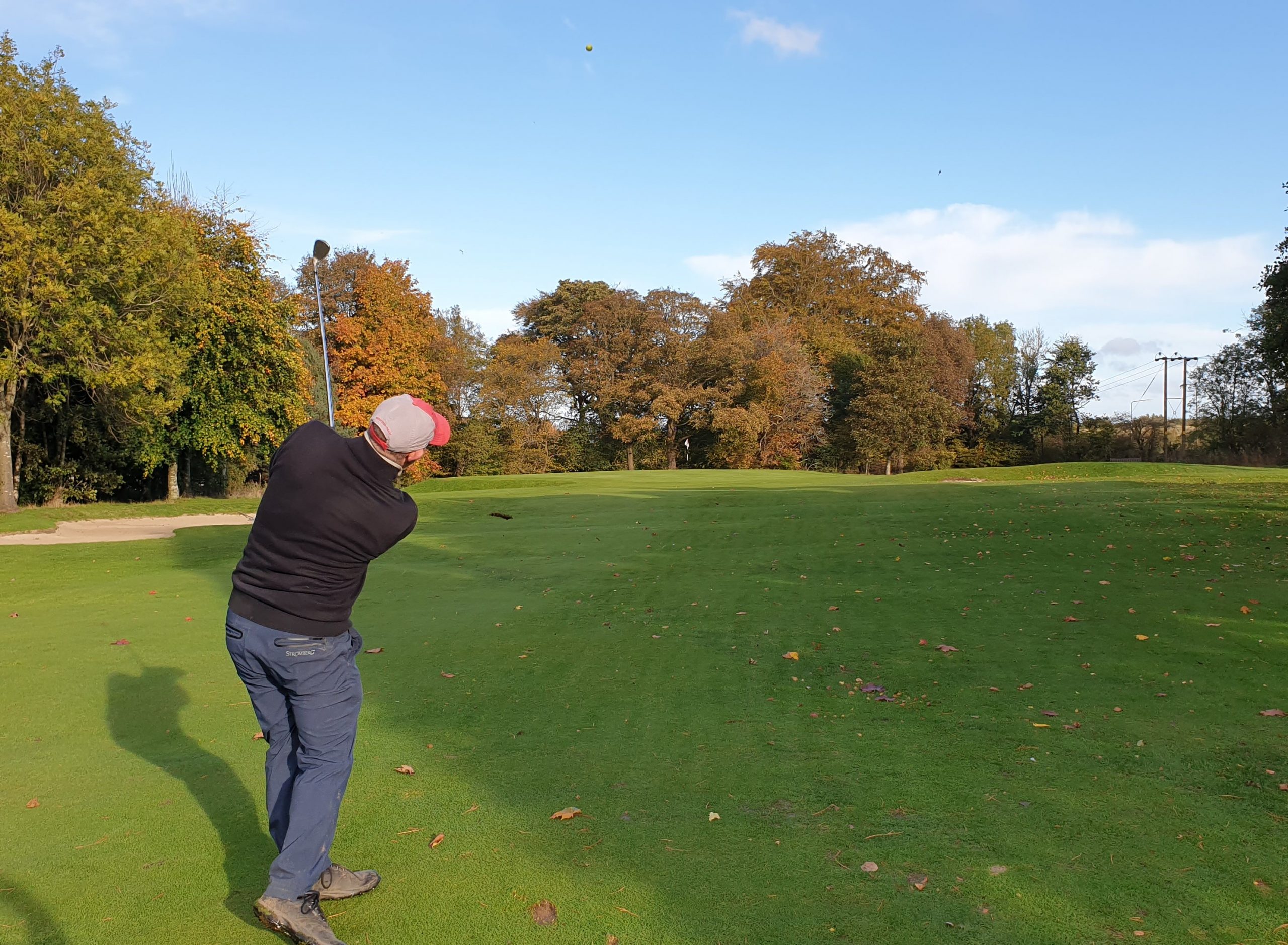
Moly’s short approach into the par five 11th at Uphall.
The course was in decent condition, with good turf, and is likely a delight on a dry Summer day. I paid only £18 through golfnow.com, a sizable discount on the £30 list price. Overall, I give this 4 out of 5 for value, and worth checking out. Just take great care on the first tee shot.
The short dog leg right par four 17th hole at only 240 yards is a good birdie chance, but be mindful not to run out of fairway like Moly did.
It’s worth noting the Club’s commitment to junior golfers, with its website declaring “a strong focus on the development of our Junior players”, well done.
Facts:
Round List Price £25.Actual Paid £18 using Golfnow.com
Course/Slope Rating (yellow) 65.9/113.
Course Type:Parkland
Par 69 (1 par 5s, 13 par 4s, 4 par 3s)
Distance (yellow): 5366 yards
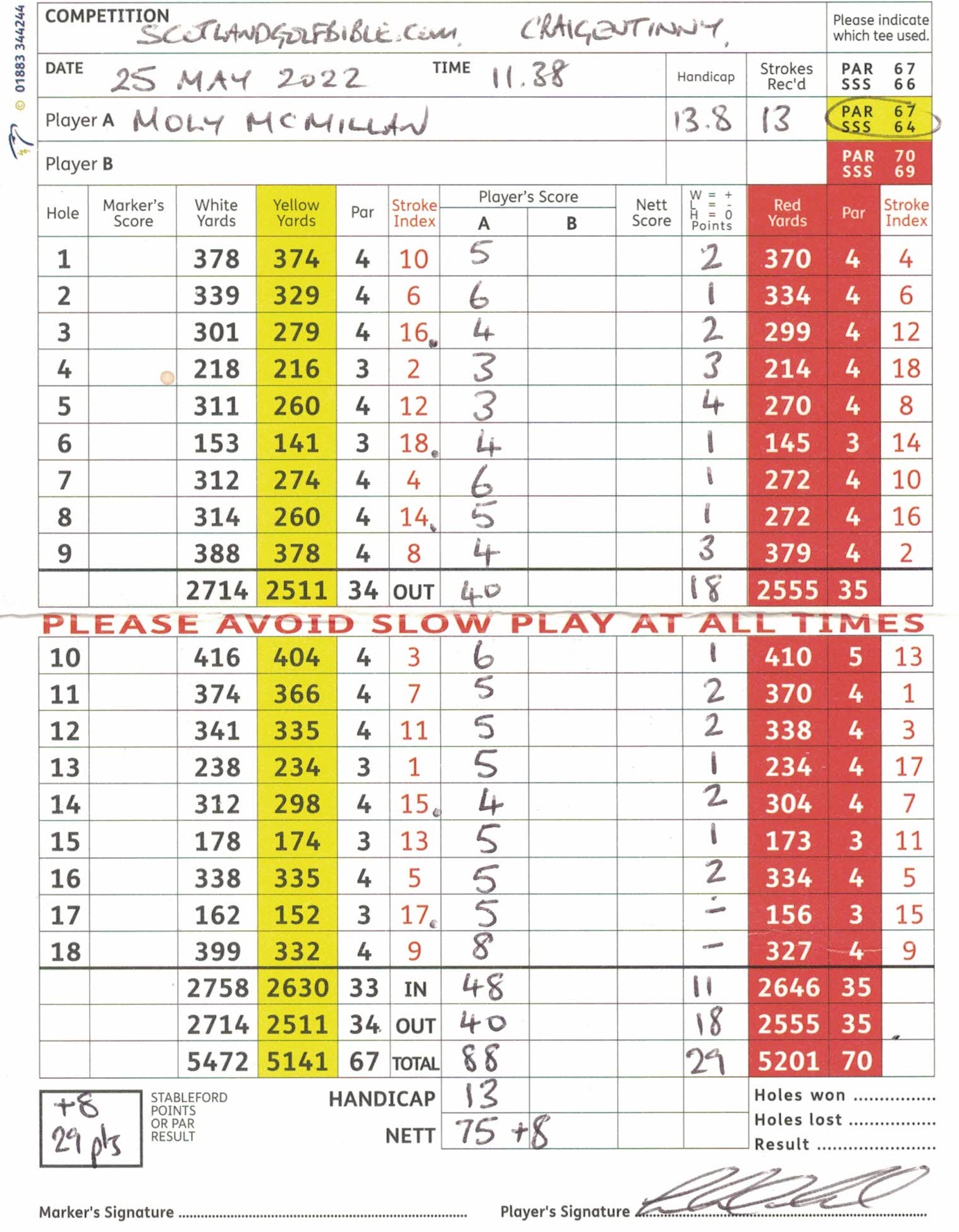
Moly’s scorecard – high winds didn’t help, but it was a poor day.
Municipal courses like ‘The Tinny’ are at risk from green fee apps
Round £27.50. Par 67. Course Rating / Slope Rating (yellow) 64/108. Value (out of 5) – 3.5
Edinburgh Leisure, runs 6 municipal golf courses across Edinburgh on behalf of the council, including Craigentinny, an 18 hole course on the east of the city between Leith and Portobello, just off the A199.
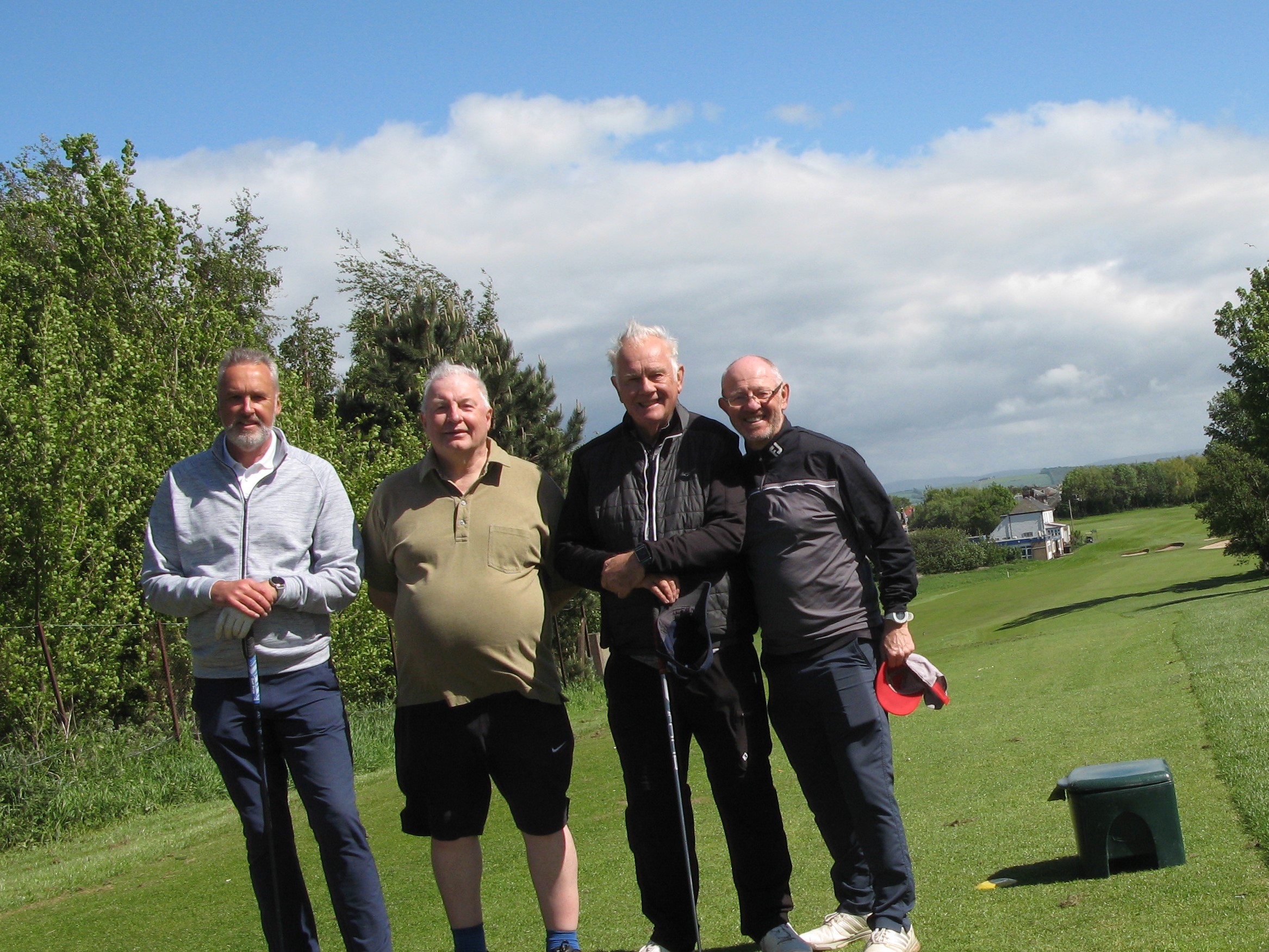
From left, Gordon, Frank, Brian and Moly at the 18th, with 40 mph winds to help put 3 OOB.
“The Tinny”, as it is known, is a decent little course at just over 5000 yards (yellow). It has no par 5s, and only one of the par 4s, the 10th, is over 400 yards. With wide open parkland, light rough and only a handful of fairway bunkers to speak of – there were signs of some bunkers having been filled in – the Slope Rating of 108 (yellow) lets you know this is ‘friendlyish’ golf.
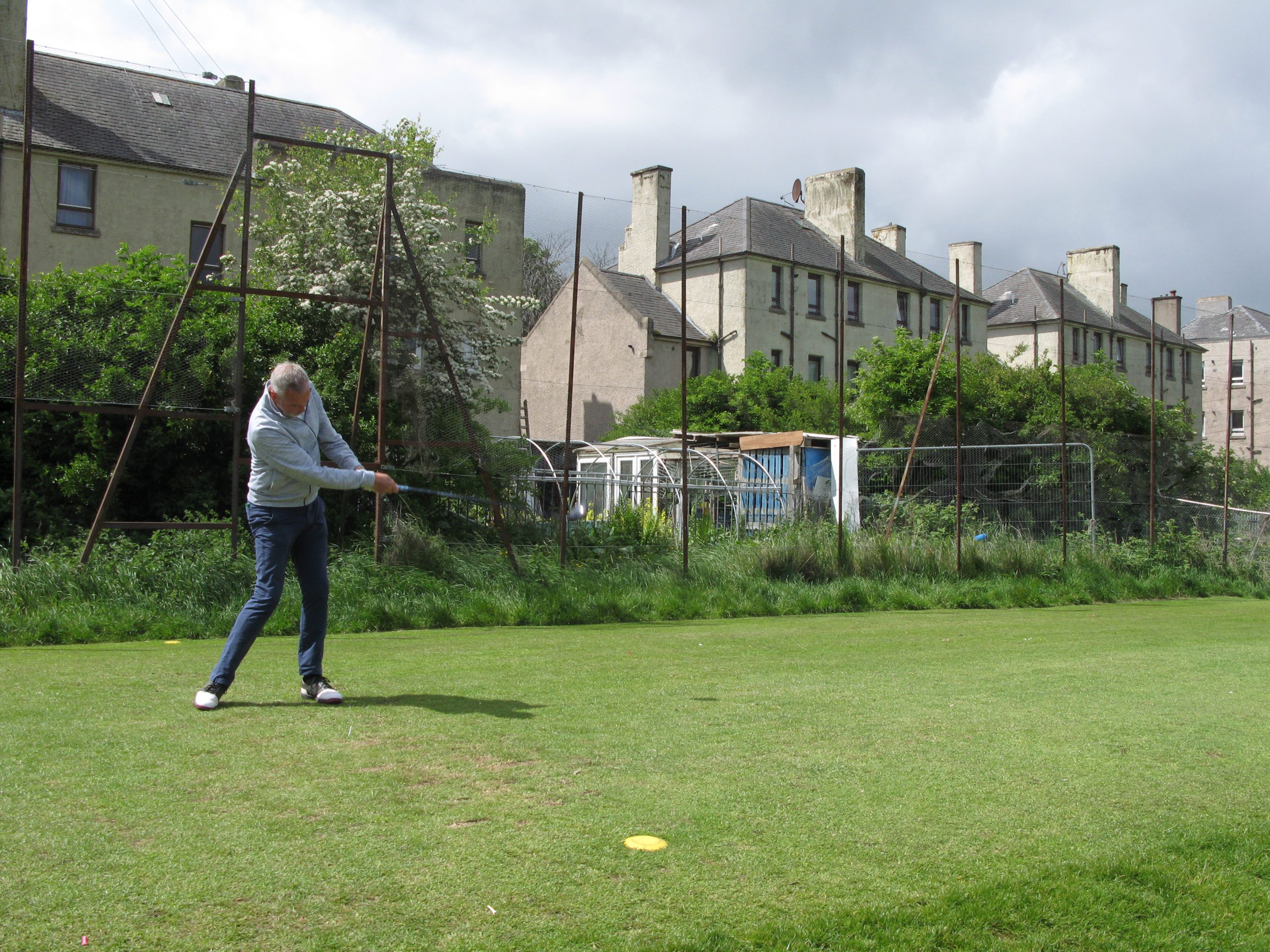
Gordon driving at the 7th, a par 4 of 274 yards, with the social housing that surrounds “The Tinny”
Perhaps uniquely, the most difficult two holes are par 3s; the long 13th (234 yards) and 4th (216 yards), being stroke index 1 and 2 respectively. I have never come across this situation with a golf course before. The five par 3s are the best of this course.
Moly at the well bunkered 6th, supposedly the easiest hole.
The course was in good condition, with the small greens being the highlight. There was potential to move on to the wrong holes, with a few long walks between green to tee and no tee box marking. Referral to the scorecard map is essential, as its easy to get waylaid looking at the fine views of Arthur’s Seat from many of the holes.
Brian played a good bunker shot at the 6th green.
I played alongside my former Apex Scotland board members. The charity continues to do sterling work supporting people with convictions back into the workplace and society.
We had a competitive game, albeit we all (bar Brian who scored a fine 32 points) suffered from the very high winds that got up to about 40 mph, especially on the back 9. No matter how easy the course is, 40 mph is going to be penal!
Frank playing one of his “Links” shots into the 9th, with Arthur’s Seat in the background.
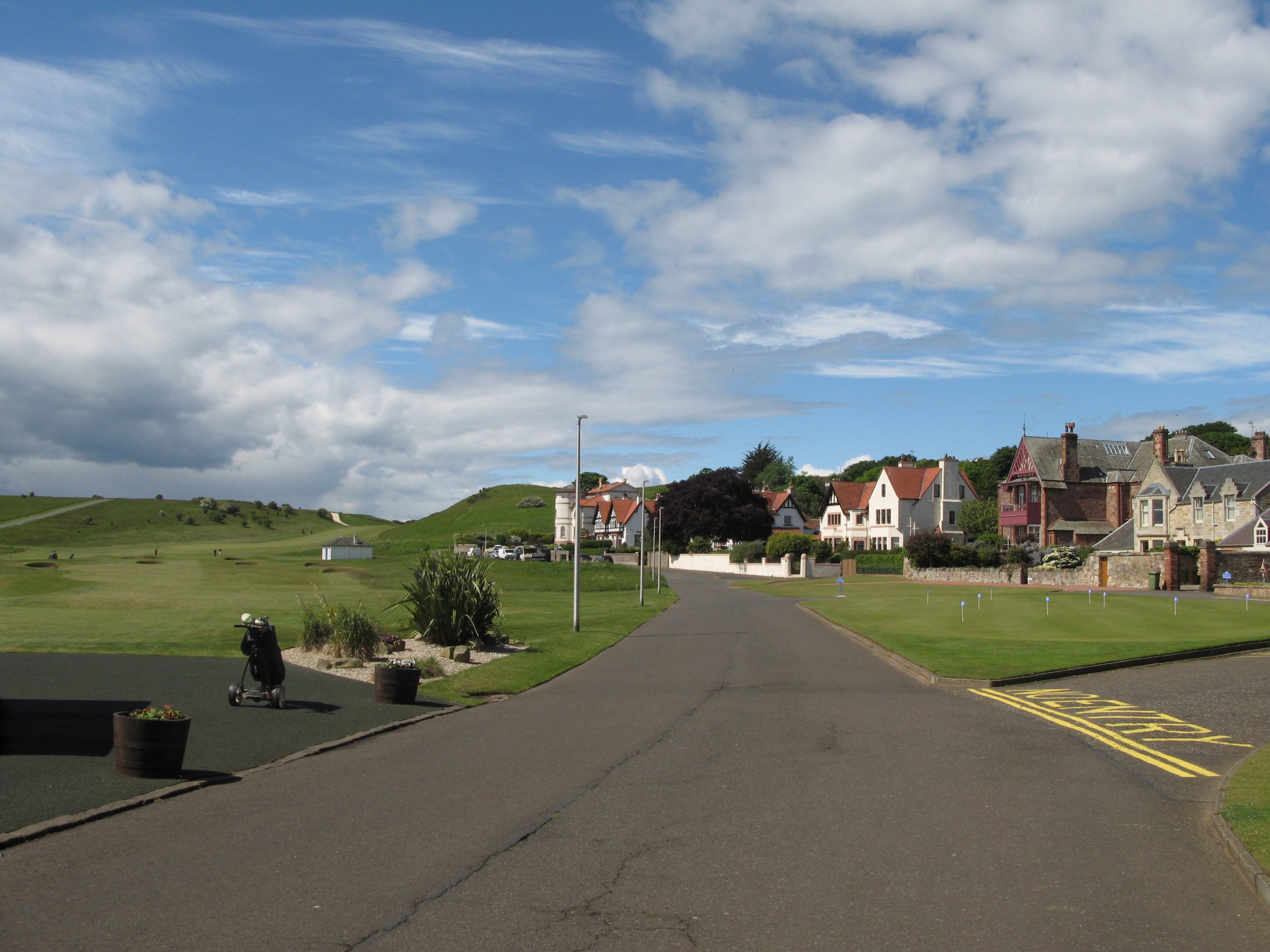
There are no specific council facilities at the course, other than a kiosk, toilet and a basic vending machine in the “pavilion” style ‘clubhouse’. There is however, a co-located clubhouse for the Lochend Golf Club, named after the nearby Lochend Loch, which play at “The Tinny”, hence the blog and course is called “Lochend Craigentinny”.
Lochend Golf Club does have a lengthy history, dating back to the 1700s, albeit they didn’t play at “The Tinny” till it opened in 1908, a few years after the Council banned golf at the then open Leith Links. The club costs an additional £177 for its annual fee, to get access to to the usual club benefits. The clubhouse was closed when we played, hence why the lack of Council provided facilities were brought into focus. Thankfully, nearby Newhaven, where we retired to afterwards, has arguably the best fish restaurant in Scotland!
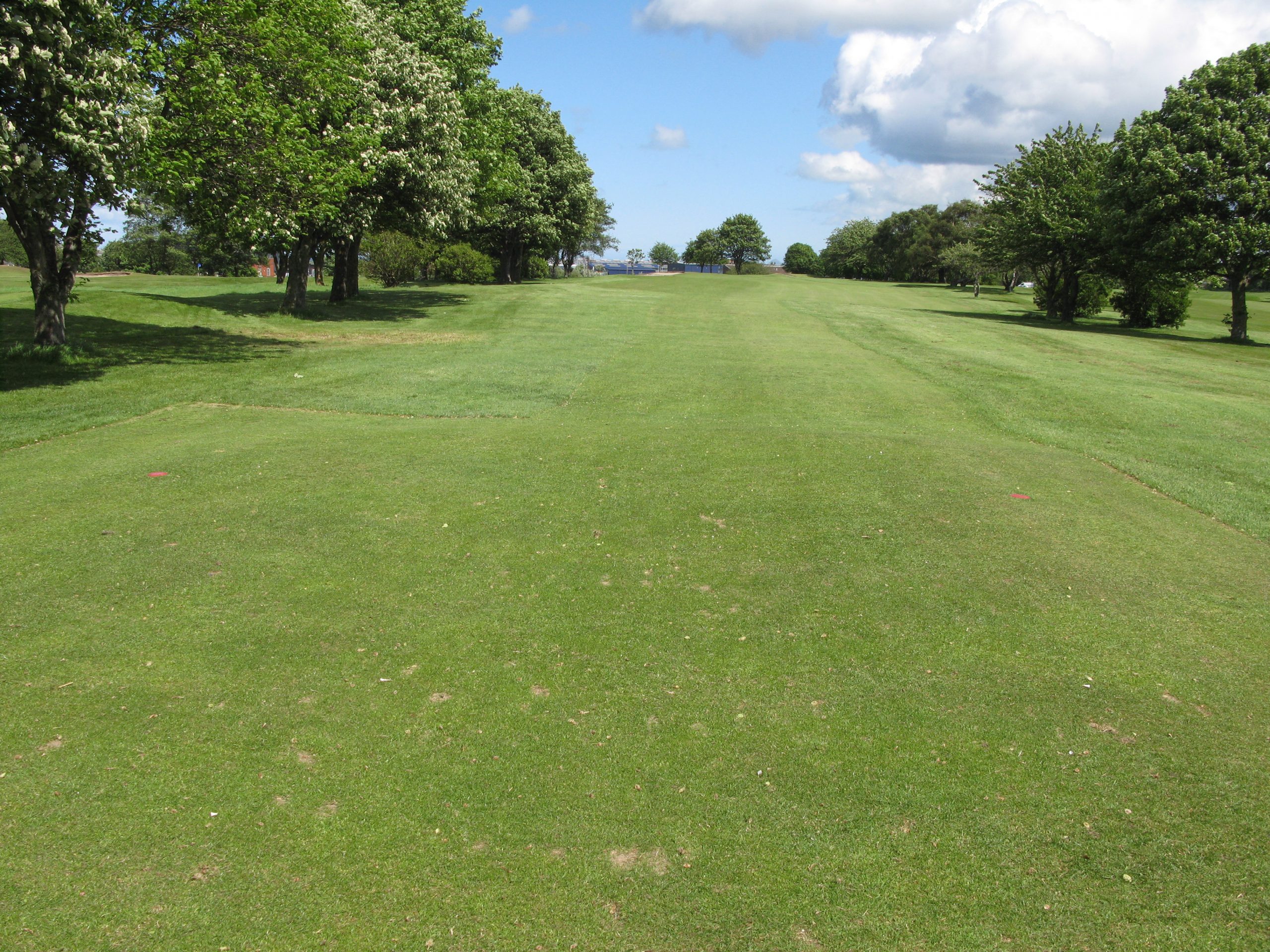
The par four 10th, over 400 yards, is the longest hole and typical of “The Tinny”
An annual 7 day ticket for the 6 municipal courses costs £500, incredible value. An individual visitor green fee on any of the 18 hole courses is £27.50, again decent value, but this pricing is starting to look relatively expensive when set alongside the offers available through golf fee apps, led by Golfnow. On any given weekday, you can play much better nearby courses than Craigentinny, at significantly lower than £27.50; including Newbattle, Baberton, Turnhouse and Royal Mussleburgh. Some Scottish Councils (such as South Ayrshire and Aberdeen) are offering discount pricing through Golfnow, and I think Edinburgh Leisure would do well to consider that.
The Stroke Index 1 hole – the long par three 13th hole, at 234 yards.
Overall, I would say this is “an average Municipal course”, and will need to keep a keen eye on visitor income, which will be an increasing challenge from apps such as Golfnow.
Facts:
Course Type:Parkland
Par 67 (0 par 5s, 13 par 4s, 5 par 3s)
Distance (yellow): 5141 yards
Moly’s Gross score: 88
Moly’s 88 at “The Tinny”, with the back 9 explained by 40 mph wind.
Arguably the epi-centric viewpoint of world links golf
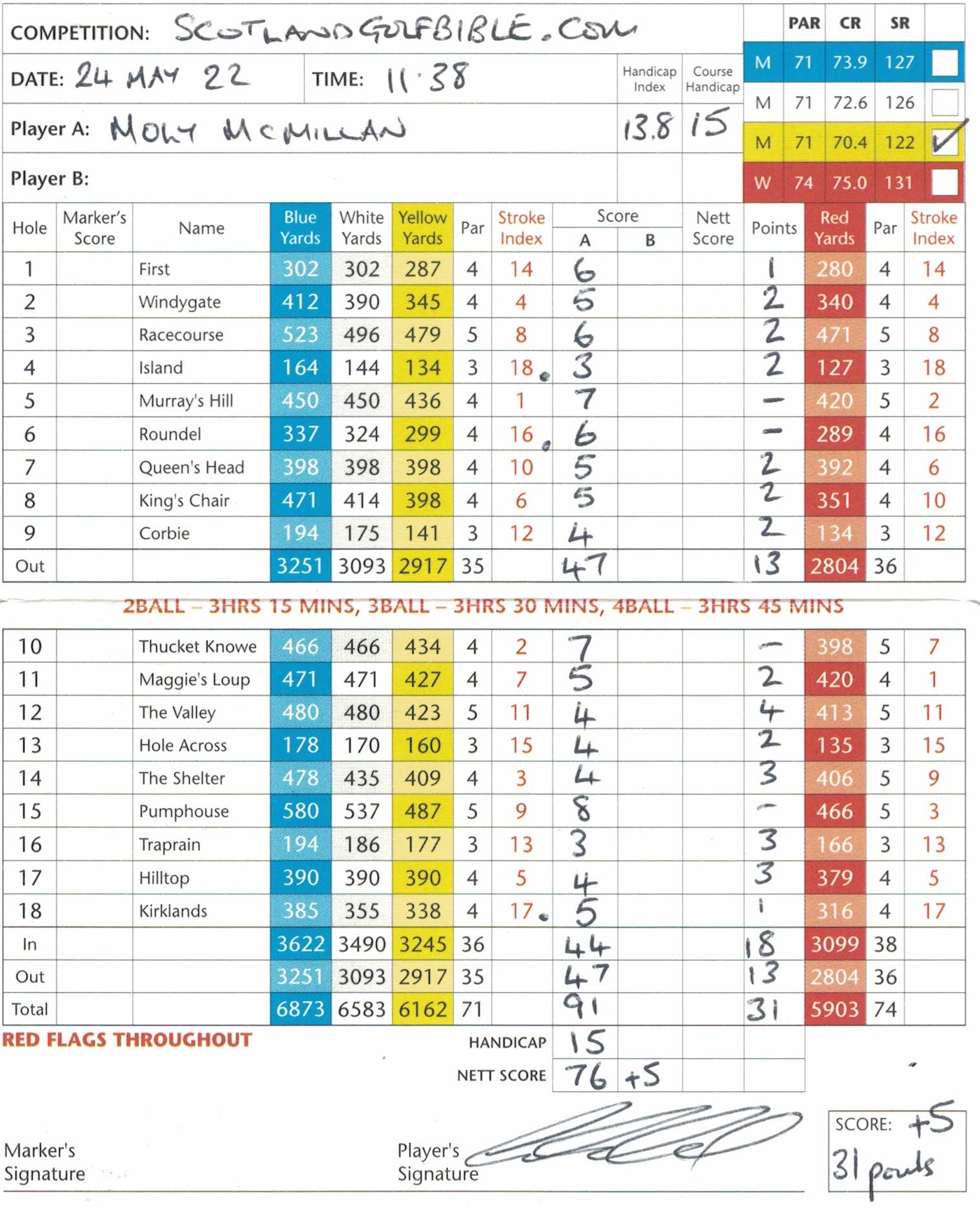
Round £195. Par 71. Course Rating / Slope Rating (yellow) 70.4/122. Value (out of 5) – 5
In Michael Murphy’s great book, “Golf in The Kingdom”, golf is eulogised in metaphysical or spiritual terms. In starting to write about Gullane, I can’t do better than Murphy’s epigraph, the Scottish golf saying:
“Golf was invented a billion years ago; don’t you remember?”
Oh, to win the lottery and live next to Gullane Number 1’s first tee.
That epigraph made complete sense as I walked onto the 7th tee at Gullane Number 1 for the first time. Set on the small Gullane Hill, it is said on a clear day you can see fourteen counties. What is without debate, I think, is that you have the greatest links land view on earth. Perched there, you are at the mid point of the East Lothian ‘golf coast’ stretching from Dunbar to the east and Musselburgh to the west, with names synonymous with world golf – Dunbar, North Berwick, Archerfield, Renaissance, Muirfield, Luffness, Kilspindie, Craigie Law and Longniddry.
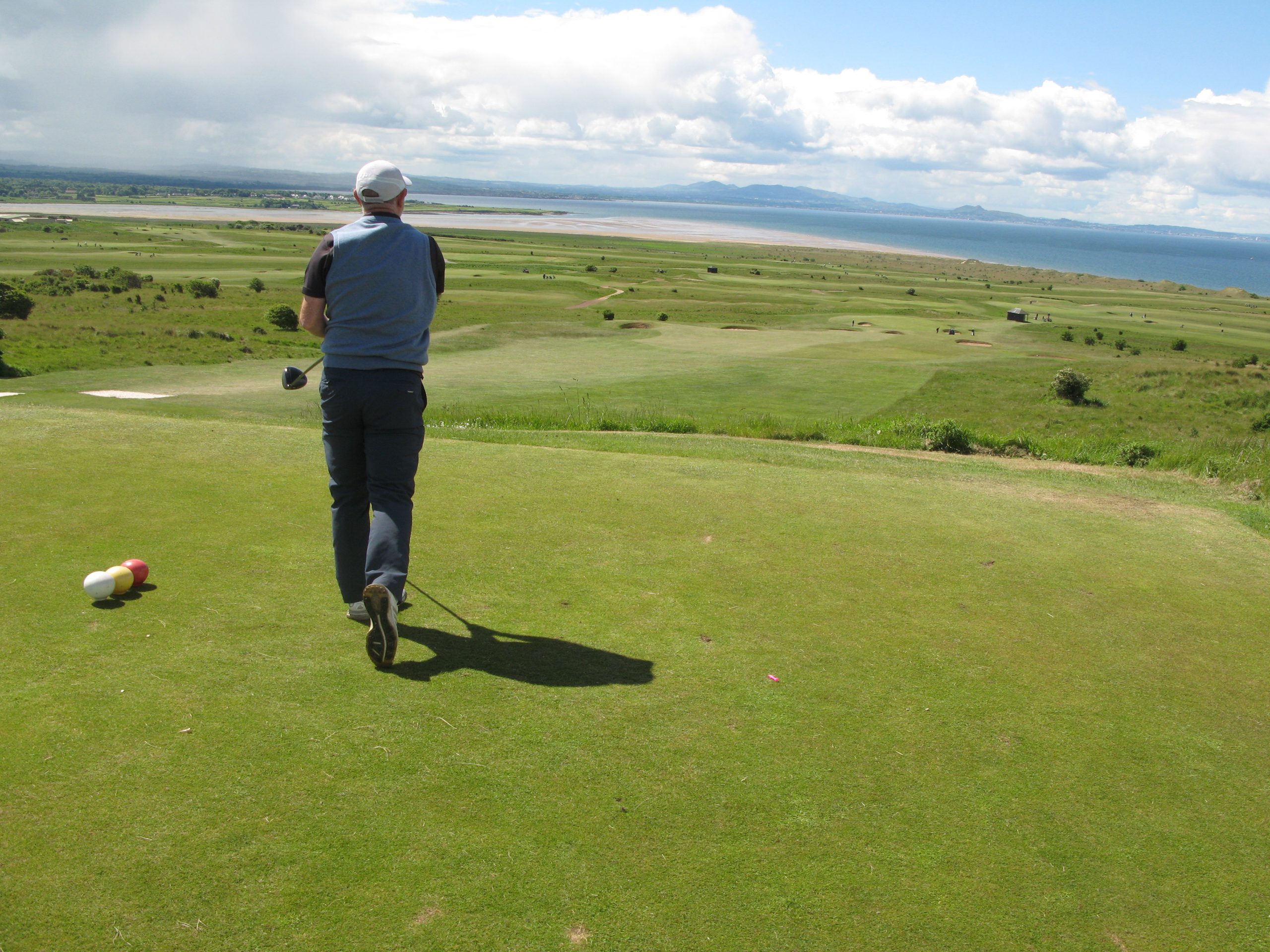
Moly on the epi-centric viewpoint of world golf – the 7th tee at Gullane No 1.
Look north across the Firth of Forth towards the Kingdom of Fife, with Leven, Crail, Elie and St Andrews; see past the Tentsmuir Forrest towards the links of Carnoustie, Montrose, Royal Aberdeen and Cruden Bay. Golf has been played on the East Coast of Scotland for hundreds of years, perhaps indeed ‘billions’. This 7th tee on Gullane Number 1 could be the epi-centric viewpoint of world golf; the Old Course is undoubtedly the “home”, but Gullane’s viewpoint is unparalleled.
The second hole at Gullane No 1, a par four “carved into the Ancient Links”
So much has been written about Gullane, including the crafted explanation of posh ‘Gillin’ versus humble ‘Gullan’ in his book, “Playing Through”, by Curtis Gillespie, that I decided to more or less tell this story mainly through pictures.
Alastair Allanach plays his low top spin drawing drive, which galloped down the “Racecourse” third; a swing honed and bartered over many years of tutelage by a South African pro. The Hill was used in bygone days by racehorses.
Accompanied by Gullane member, Alastair Allanach, a man who has played more golf courses than anyone I know, we had an absolute blast, waxing lyrical about Gullane and its history. Alastair, a great all round sportsman, and now well into his 70s, was keen to get in at least two of the three Gullane courses on the day, as he struggles to “carry my bag for three rounds nowadays!”
Gullane is one of a few nesting grounds where Larks abound, here encountered at the 8th green.
I met Alasdair a few years ago, when I helped a tiny bit in his editing of the golf book, “The Golfing Life of Jock Kirkcaldy“, the alter ego of our mutual great friend Frank Crowe. The book was forwarded by Gary Player, a friend of Alastair’s – of course!
The brilliant bunkering at the par 3, ninth hole. Although not “the turn”, as with constant directional changes on the interweaving course, it’s unlike the many “out and back” links in Scotland.
This Championship course, the first of the three Gullane courses, dates back to 1882, (the others being innovatively named Gullane 2 and Gullane 3) and it was in brilliant condition. It could have immediately held another Scottish Open without any adjustment. The greens had a little more grass than a professional tournament would have, in order to ensure they didn’t become unplayable in the wind. We had a relatively still day on the links – only a 10mph breeze. Whilst Gullane 2 and 3 were both designed by golfing royalty, Willie Park Jr, the designer of Gullane 1 remains a mystery, which seems so apt.
The bunkers at the left of the 12th fairway, a short par 5, but played slightly uphill and into the prevailing wind – a challenge.Moly’s birdie 4, was witnessed by a group of Swedish golfers, among the many international visitors Gullane gets each year.
The bunkering was exceptional. Strategically placed, penal, but not impossible, many of the new US style courses could learn from a Gullane recce. I recently played on the Ryder Cup course at the K Club and found that almost all the bunkers required a shot height and carry I no longer had in my bag. Gullane bunkers give you a chance.
The immaculate bunker at the 14th green – penal but not impossible.
I was very pleased with my 91, despite 3 triple bogies, including at the stroke indexes 1 and 2 holes, the 5th and 10th respectively. I played off the yellow tees at 6162 yards, plenty enough distance for me. I had such a great time playing Gullane. I only hope all of the very fortunate 1200 members feel as blessed as Alastair does, who was a joy to play with on a memorable day for me.
The approach at the long par 5 15th hole.
The course sits on a vast area, so expect to 3 putt some of the monstrous greens. Despite being a busy day with all tee slots taken, I was amazed to only hear one shout of “fore”, a measure of the space here.
Moly has a rare birdie chance at the uphill par 3, 17th.Note the rain in the Firth of Forth, which never arrived on the course.
Now for the assessment of value. Golfing visitor fee inflation has really impacted Scottish golf. In 2018, in my St Andrews Old Course blog, I said anything higher priced than the old course can’t be worth the money. At the time the Old Course was £180 for a high season round, this year it is £270, a compound annual rise of over 10% per year, or more than three times the retail price index over the same period. Put another way, using 2018 as the datum, the Old Course should be £205.
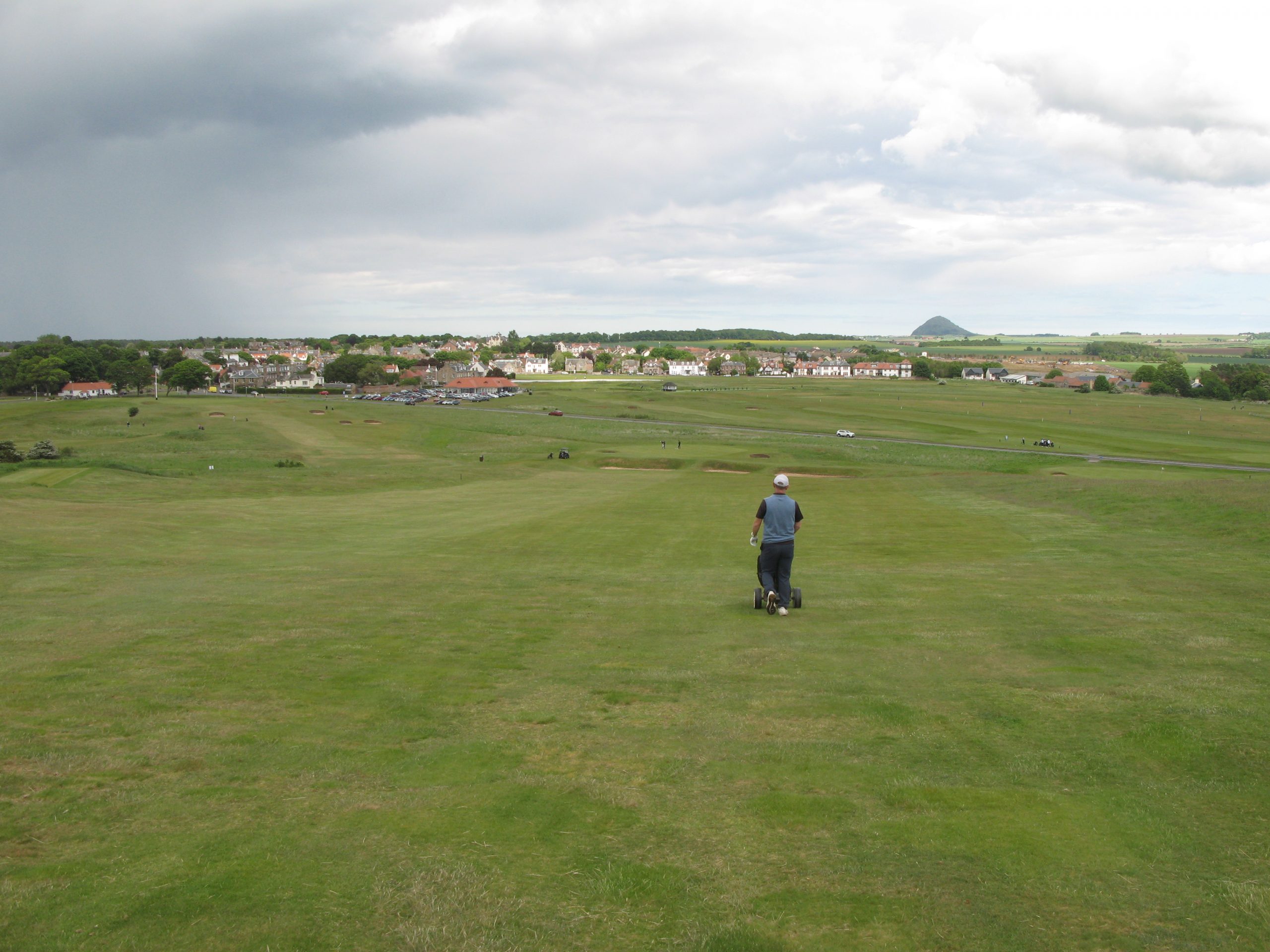
All good things come to an end – here Moly walks towards the 17th green, a deceptive par four, with the town of Gullane awaiting, watched over by Berwick Law.
No matter how much might have wanted to, in the end I couldn’t give this course anything less than 5 out of 5 for value, despite the price tag of £195. It’s a must play links golf course with unbeatable turf, bunkering, green surrounds, sea breeze, wispy rough.
Play, if for nothing else, to stand on the exact epi-centric viewpoint of world links golf. If such a thing could exist.