A guide to green fee value for money

Category: Private (Page 4 of 4)

66. Turnhouse. 10th Oct 2017

Nice layout with good greens with upside for plane spotters! 

Summary:  Round  £35.   Par 69.  Value (out of 5) – 3.5

Turnhouse golf course was laid out with 9 holes in 1897, and extended to 18 holes a few years later.  The original course designer is not known, but James Braid carried out a redesign in 1928, characteristically focused on the use of bunkers.
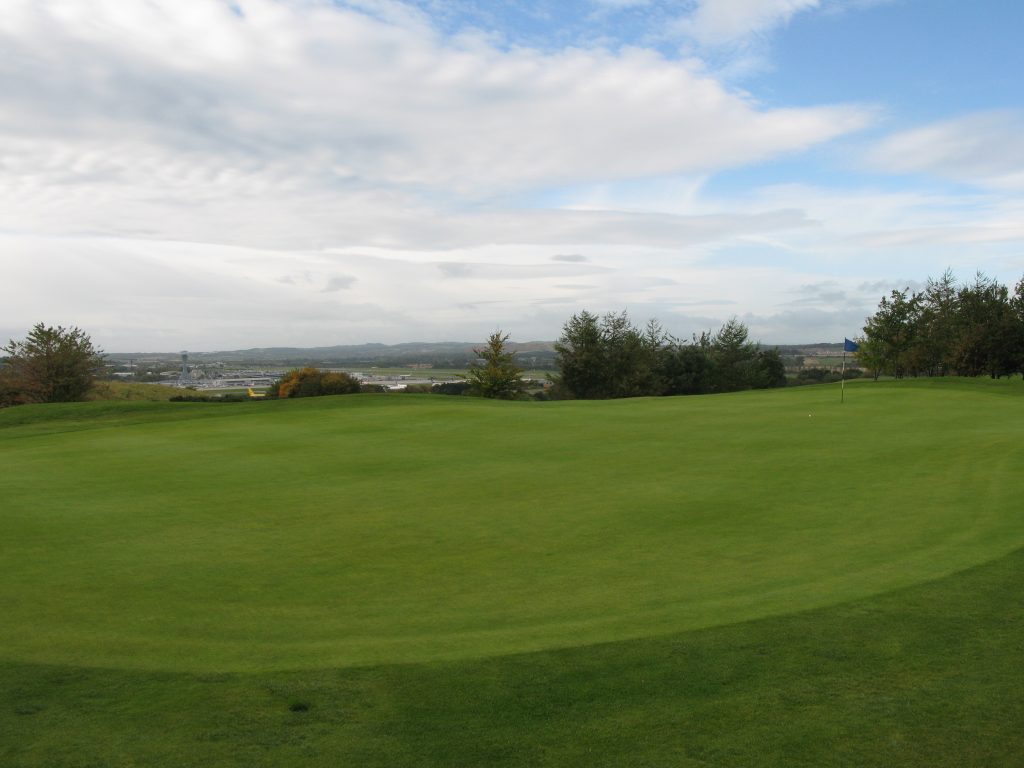
Views of Edinburgh airport from the 5th green at Turnhouse

The course sits on Lennie Hill, very close to Edinburgh airport and easily accessed by road.  There are good views of the Pentland Hills to the south and to the Fife Ochill Hills to the north.  For a parkland course designed in the 19th century it unusually has two 9 hole loops, starting at the clubhouse.
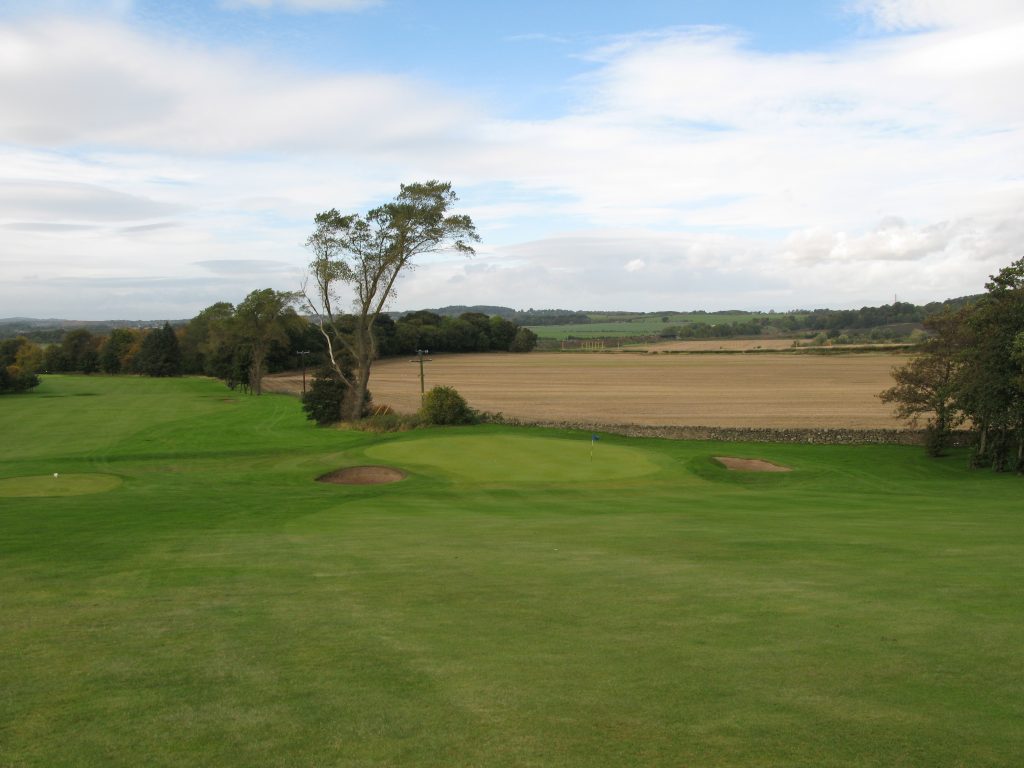
The nice par 4 6th hole at Turnhouse – where I had one of my 3 birdies

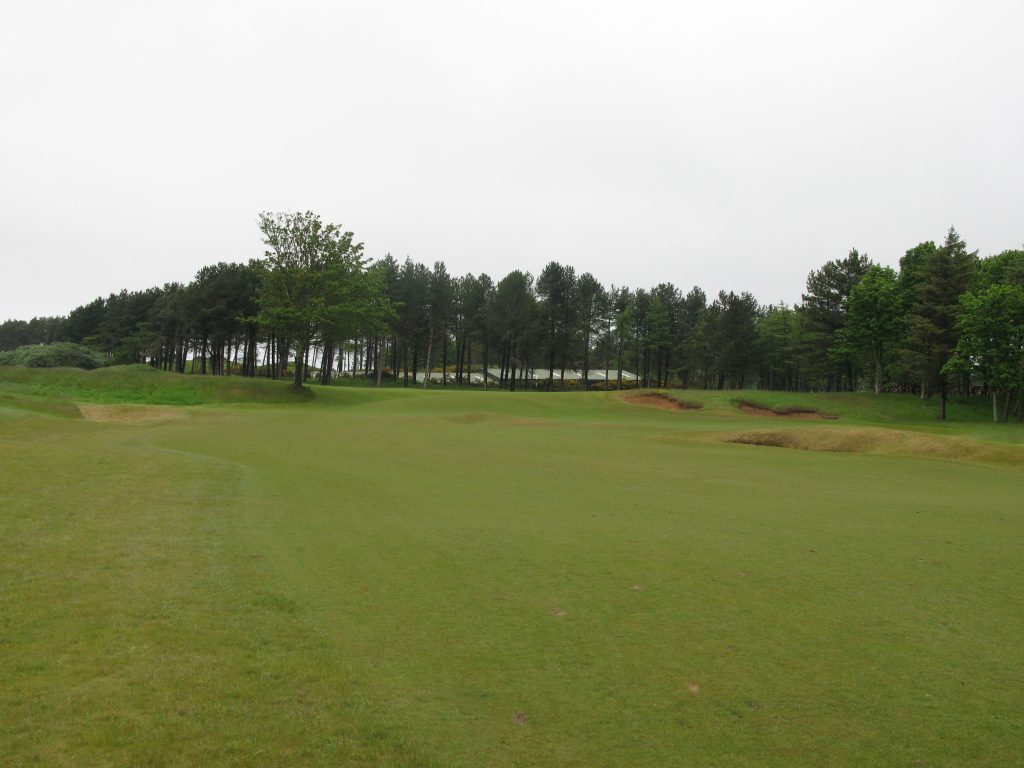
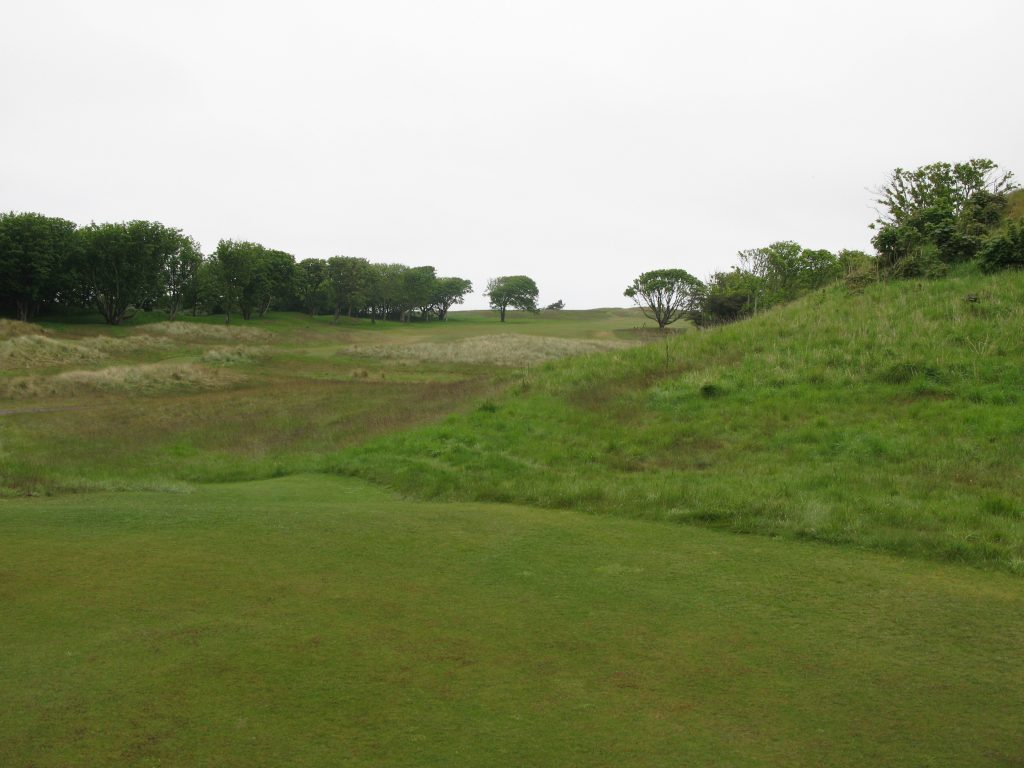
Turnhouse has a classic parkland feel and there is a good mix of some generous and some tighter fairways.  I thoroughly recommend the excellent online course planner available on the club website, especially as there are several blind tee and second shots.  A good example is the long 4th hole which has a nasty blind bunker on the right hand side of the fairway at about 430 yards awaiting a well struck second shot – bear in mind out of bounds is tight along the left of this hole.
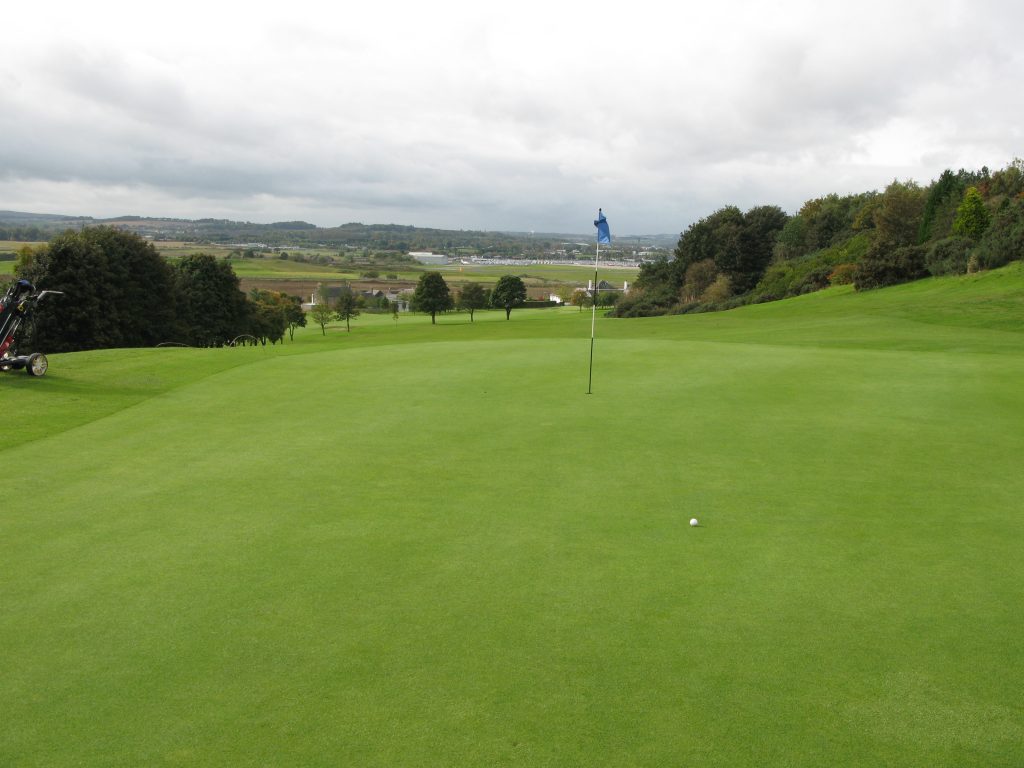
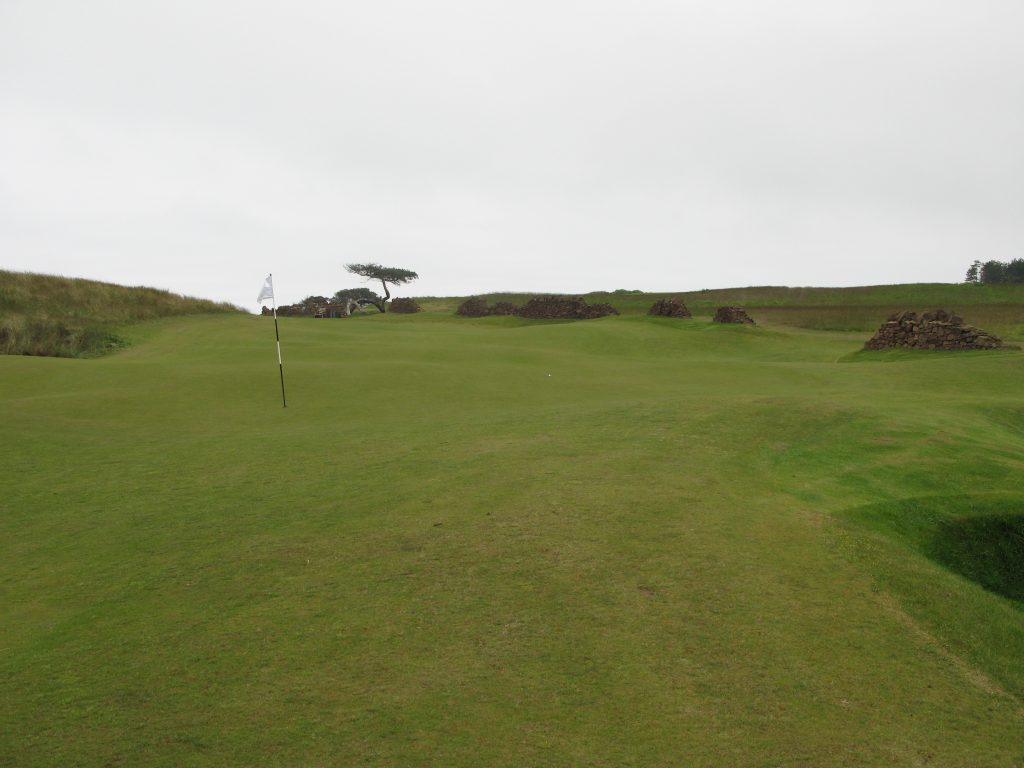
The fast Stroke Index 1 10th green at Turnhouse, a tough start to the back 9.

The planner might also help gauge driving distance on some of the tighter holes, with the formidable 13th tee shot being actually easier that it looks, with only a hybrid or fairway wood being needed at the tee, with a larger landing area being available than at first sight.

The greens were surprisingly well drained and quiet fast – I putted off  the 9th green where the pin had been placed on the right – beware!     Overall the course was in good condition, with only the tees perhaps in need of some effort.
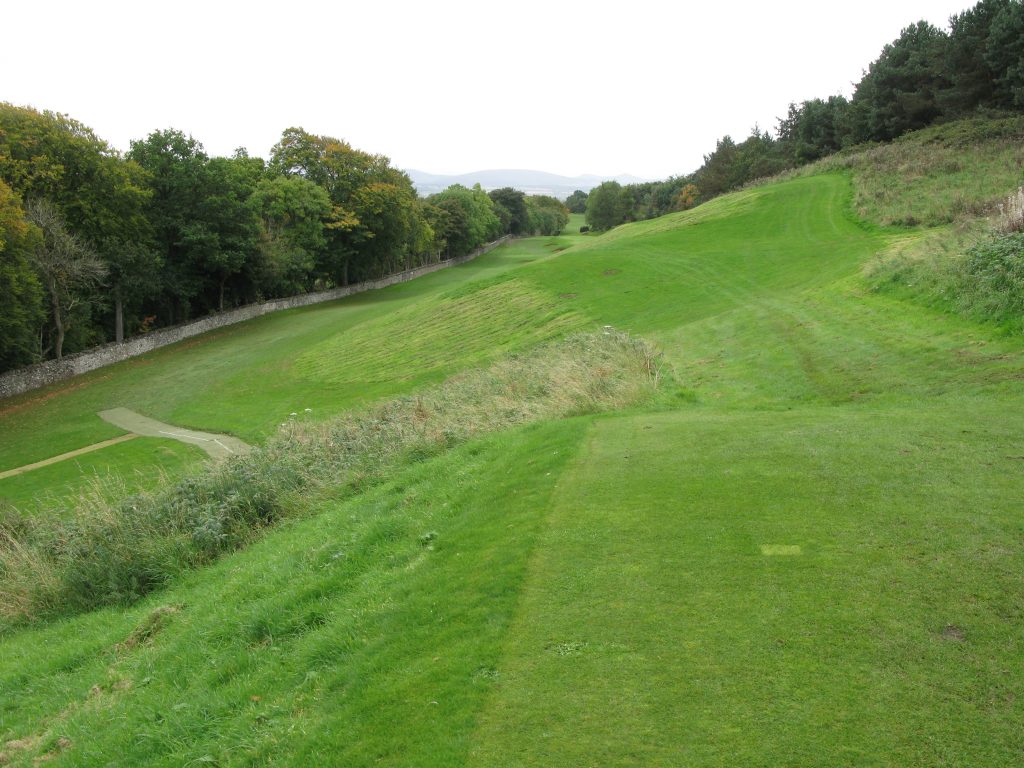
The frightening looking 13th tee shot at Turnhouse – take a hybrid to guarantee playing from the fairway.

I had a most mercurial round.  I only hit 3 greens in regulation and birdied all 3 of them! (4th, 6th and 11th)  – my stableford had three 4 pointers but no 3 pointers!

There is an interesting quote on the club web site about the hazards in the development of parkland courses around the turn of the 20th century, and worth sharing:

In those early days, golf courses were shaped by natural terrain and while links courses had sand bunkers, inland courses relied on gorse, whin and dry stone walls for hazards. At Turnhouse there is a record of turf dykes about three feet high being built forty or fifty yards from the tee across some fairways and in January 1908 an instruction was issued to remove steps over the walls and have gaps made in their place.”

Turnhouse was a most pleasant surprise and one of the lessor known Edinburgh courses well worth a visit.

Facts:

Course Type: Parkland

Par 69 (2 par 5s, 11 par 4s, 5 par 3s)

Distance (yellow): 5926

Moly’s Gross score: 91.
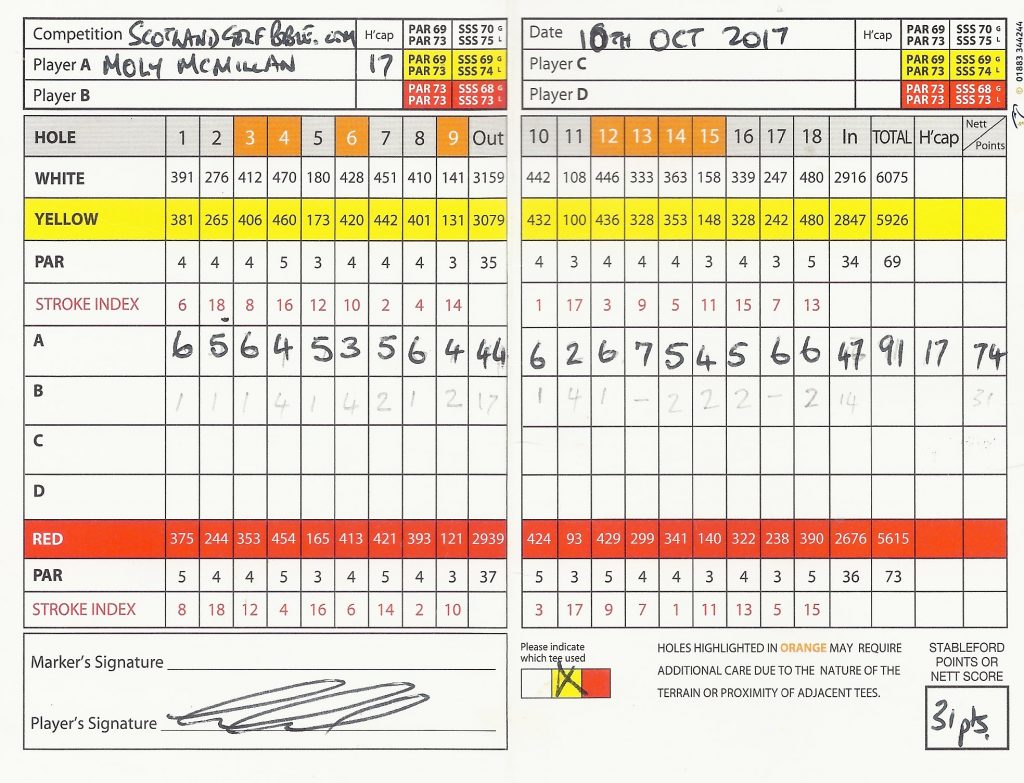
Moly’s Turnhouse scorecard: 91 for 31 points
60. Dalmahoy West. 7th May 2017

Pleasant parkland course which would be ideal for the more social of society golf days.  

Summary:  Cost “between £30 – £55”.  Par 68.  Score 88.  Value (out of 5) – 2.  

So it has taken until 7th May to blog the first course of 2017, due to various travel, work commitments and poor weather!

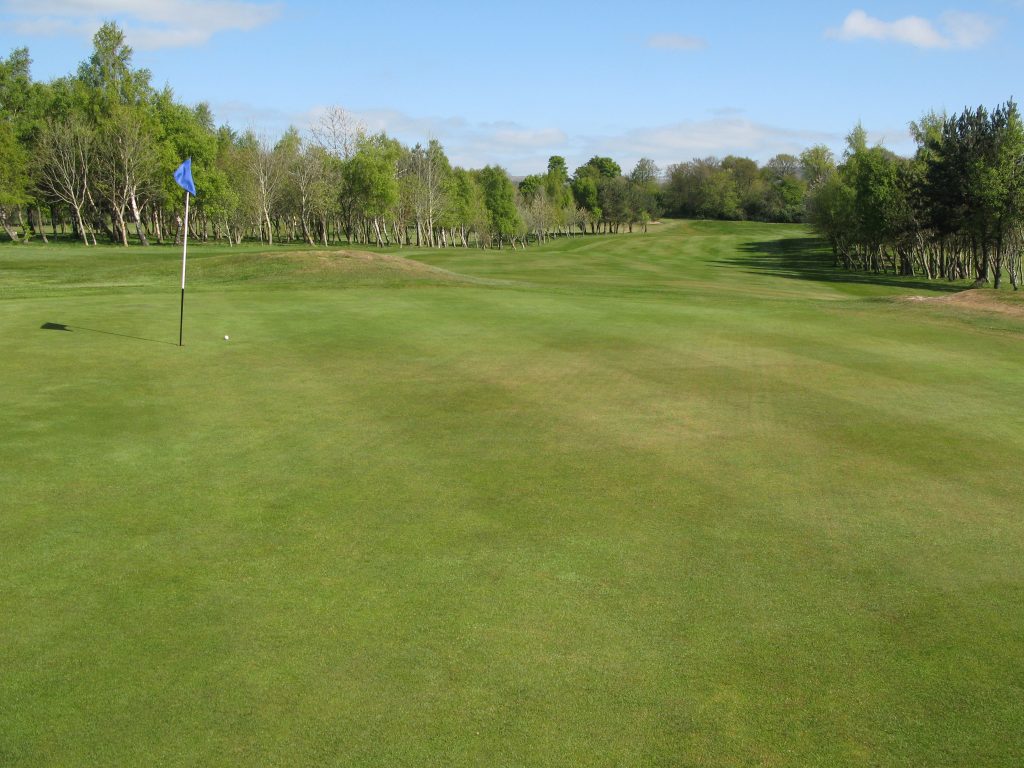
The 8th fairway at Dalmahoy West, a typically open hole on this short parkland course

Marriot Hotels run the Dalmahoy Hotel, Golf and Country Club, which is on the South East of Edinburgh about a 10 minute drive from Edinburgh Airport.   The resort has 2 courses; the East course is a championship layout designed by James Braid and hosted the Solheim Cup in 1992; I played the East course in 2014;  the West course is a much shorter later addition.   Both course are part of a 1000 acre estate surrounding Dalmahoy Manor, which was built in the 1720s and converted to a hotel and golf resort in 1927, becoming part of the Marriot organisation in the 1990s.

The Par 4 5th green at Dalmahoy West

The East course, like the West course, is an open parkland layout, where there is ample opportunity to be wild off the tee but able to recover and retain a flattering score.  If you’re like me, this will suit you, as it allows a freedom to be aggressive, especially off the tee. Additionally, there is only one of the par 4s (the stroke index two 8th) which is over 400 yards, so for all bar the shortest of hitters you are hitting short irons into most greens.

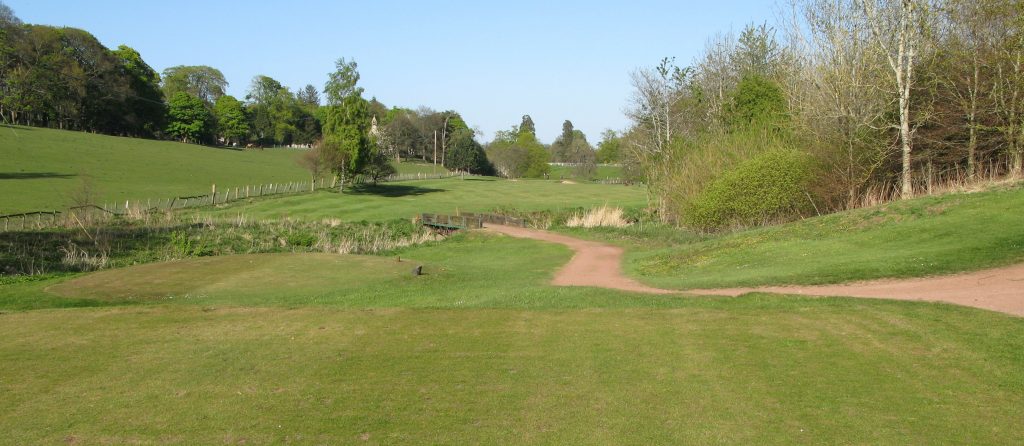
The 15th tee, at Dalmahoy West, the start of the trickiest stretch on this resort course. The church to the left of the green is a Scottish Episcopal chapel on the grounds.

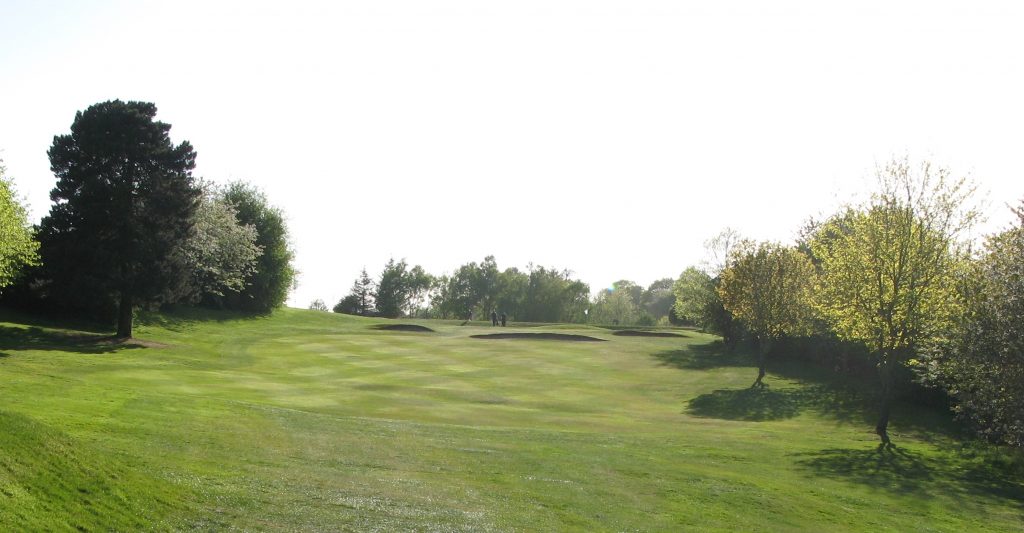
The highlight of the layout, is the 3 tricky holes staring from the 15th; water is in play to the right of the par 4 15th, and then in front of the short 16th which makes it important to play long, especially into the wind.  The 16th is another par 3, but with 3 well positioned greenside bunkers.   I suspect these 3 holes have damaged many a medal scorecard.

The well guarded par 3 17th green at Dalmahoy West

The course was in reasonable condition when I played, with nice greens, however the tees were poor.  It was not good value for the price:  I paid £23 for a twilight slot based on a price match with Teeofftimes.co.uk, although the rack rate states the price between “£30 – £55”, and it would be robbery if paying greater than £40 here.  It would nevertheless be a really good society venue, particularly for societies where golf is rather secondary to the socialising.

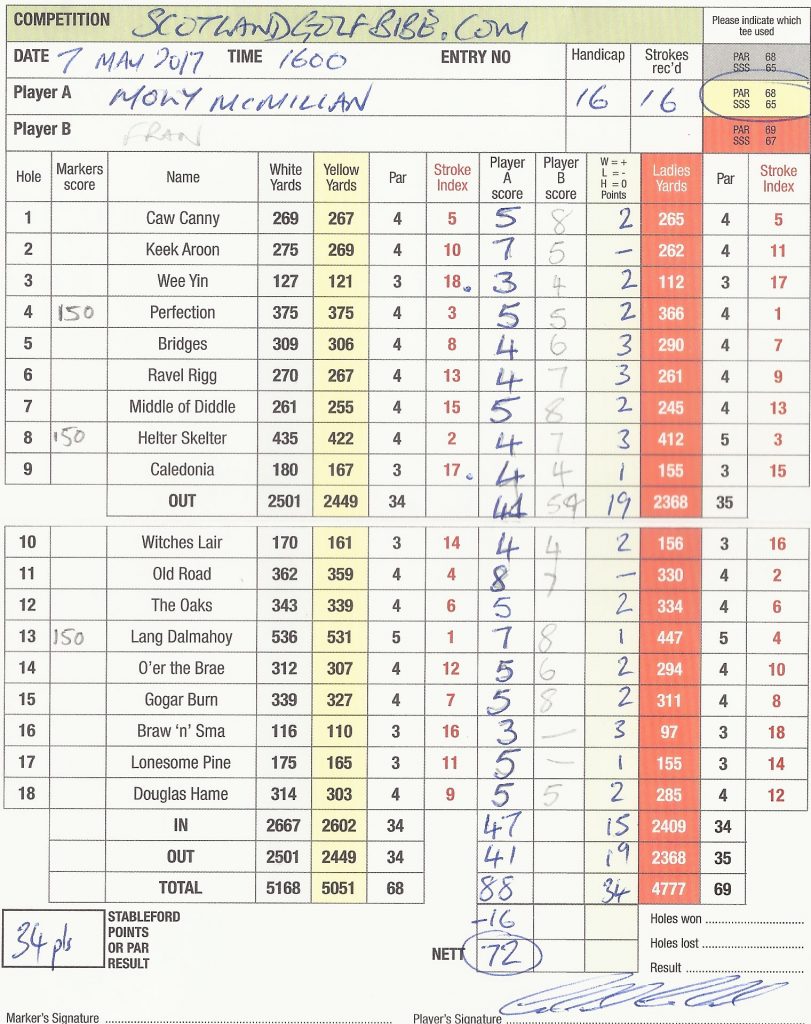
I carded an 88, for 34 points, but had a couple of disaster holes:  a 7 on the par 4 2nd and an 8 on the par 4 11th.  When will I next get a round without major error!


Key Facts

Course Type: Parkland

Par 68 (1 par 5s, 12 par 4s, 5 par 3s)

Distance (yellow): 5051

Moly’s Gross score: 88.

Dalmahoy scorecard – 88

40. The Renaissance Club. 27th May 2016

A new world class links course to rival its older neighbours   

Round by Invitation.   Par 71.  Quality (out of 5) – 4.5

The Renaissance is a work of beauty - the 10th taken on a nicer day than when I played.

The Renaissance is a work of beauty – the 9th taken on a nicer day than when I played.

The Renaissance Club is one of a small but growing number of exclusive private member golf clubs in Scotland.  It combines a world class golf course and facilities with an American style family friendly country club set up, with fine dining, although the latter type of country club is also now very common in South Africa and Australia.

The course sits just east of Muirfield, its famous neighbour, on the North Berwick coastline.

The tree enclosed 4th green - typical of some of the great links courses in Northern Scotland

The tree enclosed 4th green – typical of some of the great links courses in Northern Scotland

The architect of The Renaissance, Tom Doak, is renowned for his use of natural contours and not “bulldozing” the land and he has laid the course around several copses of existing trees;  therefore this is a course that looks much more like parts of the great links of Carnoustie, Dornoch or Nairn Dunbar, than the treeless Muirfield.

The large 8th Green at The Renaisannce

The large 8th Green at The Renaisannce

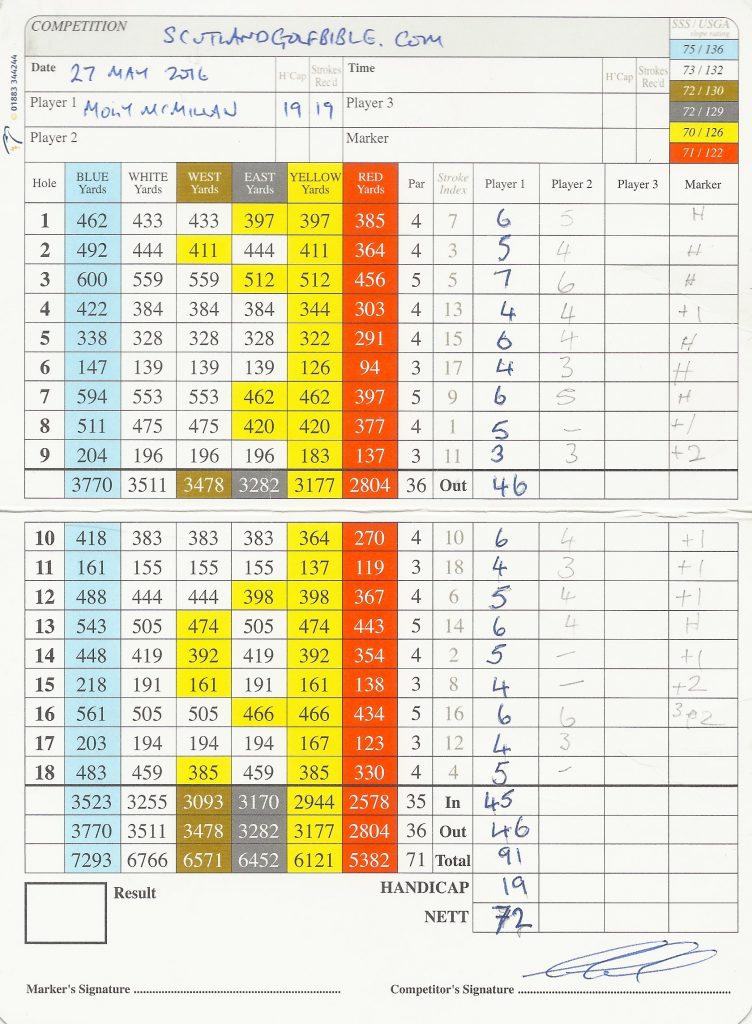
The result is a quite magnificent layout that in my opinion will stand the test of time. With widely different tee options, this can be played at 6121 yards off yellow, 6766 yards off white, and a monster 7293 yards off the professional championship blue tees.  It also has 2 very cleverly mixed white/yellow layouts of around 6500 yards, each recommended for different westerly or easterly winds  (see the scorecard below for details).  All layouts have a par of 71.

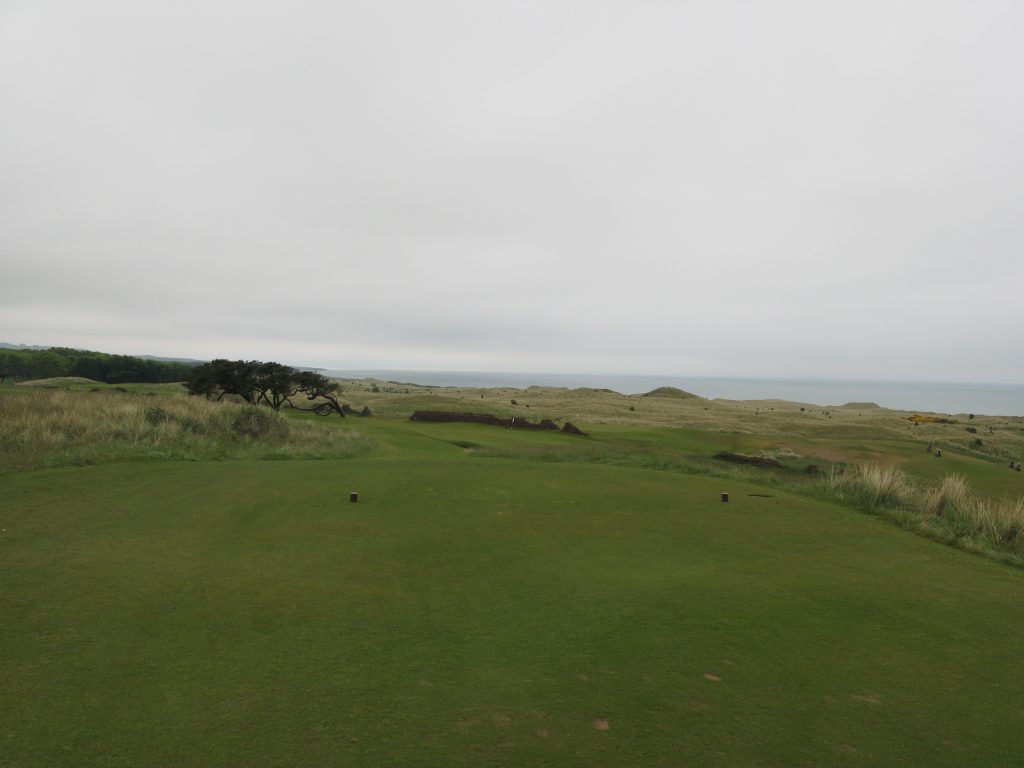
The tee view from the stroke index par 4 8th.

The tee view from the stroke index par 4 8th.

The course was in excellent condition as expected and although spread out over a much greater area than, by comparison, Muirfield, the green to tee walks were still short some almost in the St Andrews way, I suspect by design.

The highlight of the course for me was the magnificent greens which had combinations of large and subtle borrows, almost all with very tricky surrounds.  Combined with well positioned and deep bunkers, I suspect only the greatest of short game players would win a Scottish Open here.  The Renaissance would be a fine competition venue, with many locations for grandstands which would afford viewing of more than one hole.

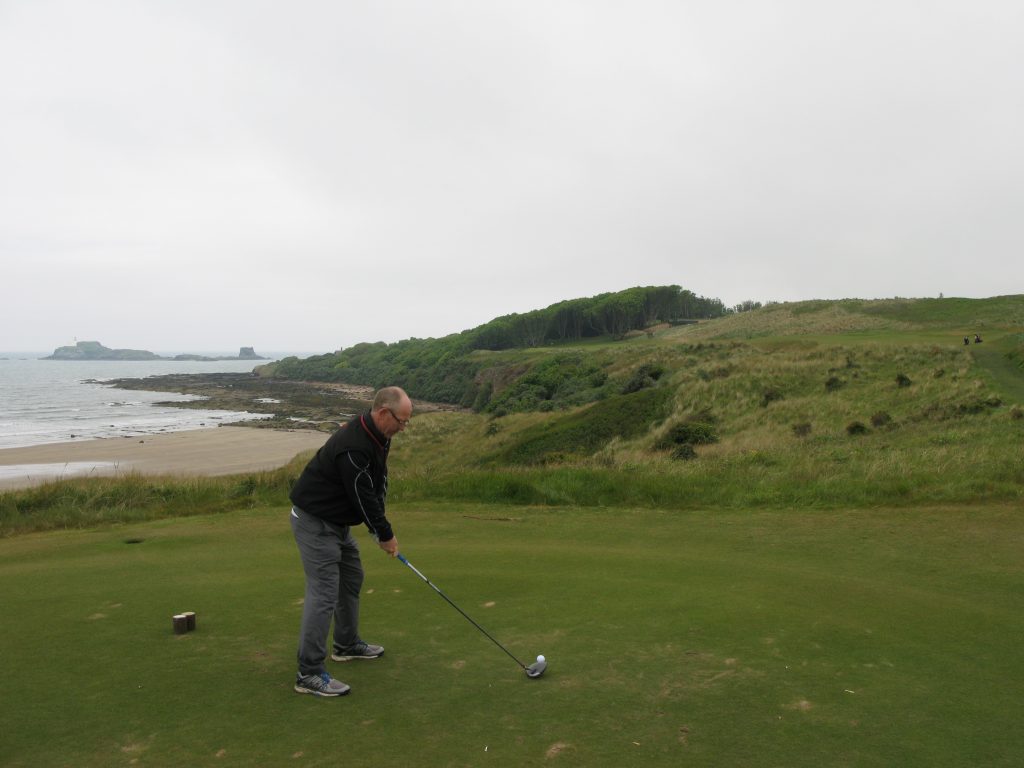
The majestic 10th tee view - I lost a ball into the left cliffs on the one occasion I failed to heed my playing partner's advice!

The majestic 10th tee view – I lost a ball into the left cliffs on the one occasion I failed to heed my playing partner’s advice!

I was hosted by the local professional Ross Dixon, whose wise on-course advice enabled me to play to within one shot of my new lower handicap of 19, which has reduced by 4 shots following a number of lessons by Ross himself, the best measure of golf teaching.

The downhill par 3 11th, with a view over the links land

The downhill par 3 11th, with a view over the links land

The Renaissance layout provides changes of direction on almost every hole, and therefore the difficulty changes likewise.  There are many great holes, but the run of 5 holes from the 7th through 11th were for me the architectural and aesthetic highlight;  a long par 5 7th, the stroke index 1 8th hole, followed by 2 excellent par 3s (the infinity greened 9th, and the downhill 11th), which sandwich the cliff hugging shortish par 4 10th.  All these holes can be viewed using the excellent interactive club website application here.

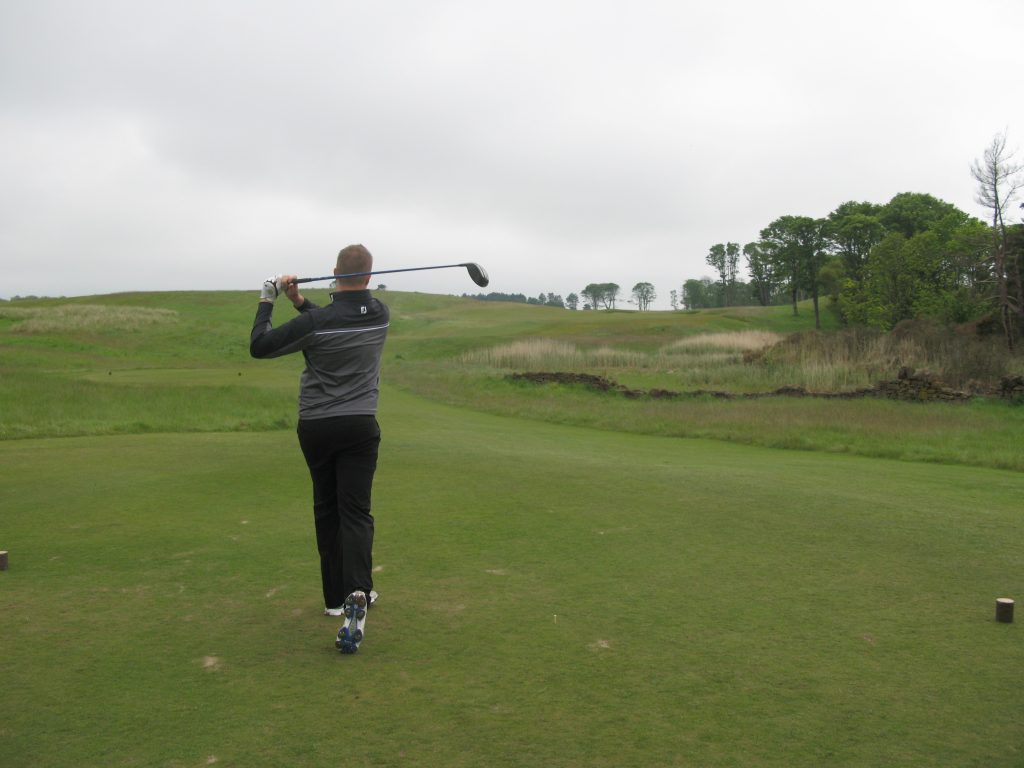
Ross Dixon, after striking another ball far down the middle.

Ross Dixon, after striking another ball far down the middle at the par 4 14th.

It was a real privilege to play The Renaissance and I hope that the venue can be used for competitions so that the wider public can see at close hand what a wonderful course it is. Although it was a private club, it was very far from stuffy, in fact I couldn’t help noticing what a wonderfully relaxing and very family oriented atmosphere existed around the club. There is a lot that the older established clubs around Scotland could learn from The Renaissance.

Some Facts

Course Type: Links

Par 71  (4 par 5s, 9 par 4s, 5 par 3s)

Distance (yellow)  6121 yards

Moly’s Gross Score  91 

Stableford (7/8th allowance) 33

Moly's scorecard at The Renaissance Club - Gross 91

Moly’s scorecard at The Renaissance Club – Gross 91

Newer posts »

© 2026 Scotland Golf Bible

Theme by Anders NorenUp ↑