A guide to green fee value for money

Category: 4 star (Page 6 of 20)

132. Grangemouth. 24 Mar 22.

Forget the industrial surround to experience Scottish golfing value at its best

Round £15. Par 70. Course Rating / Slope Rating (yellow) 69/121. Value (out of 5) – 5

As long as courses like Grangemouth remain open and accessible, Scotland will easily retain its lead in providing the best value golf worldwide. At only £10 for a ‘winter round’ or £15 for summer, this is as good value golf as you can get.
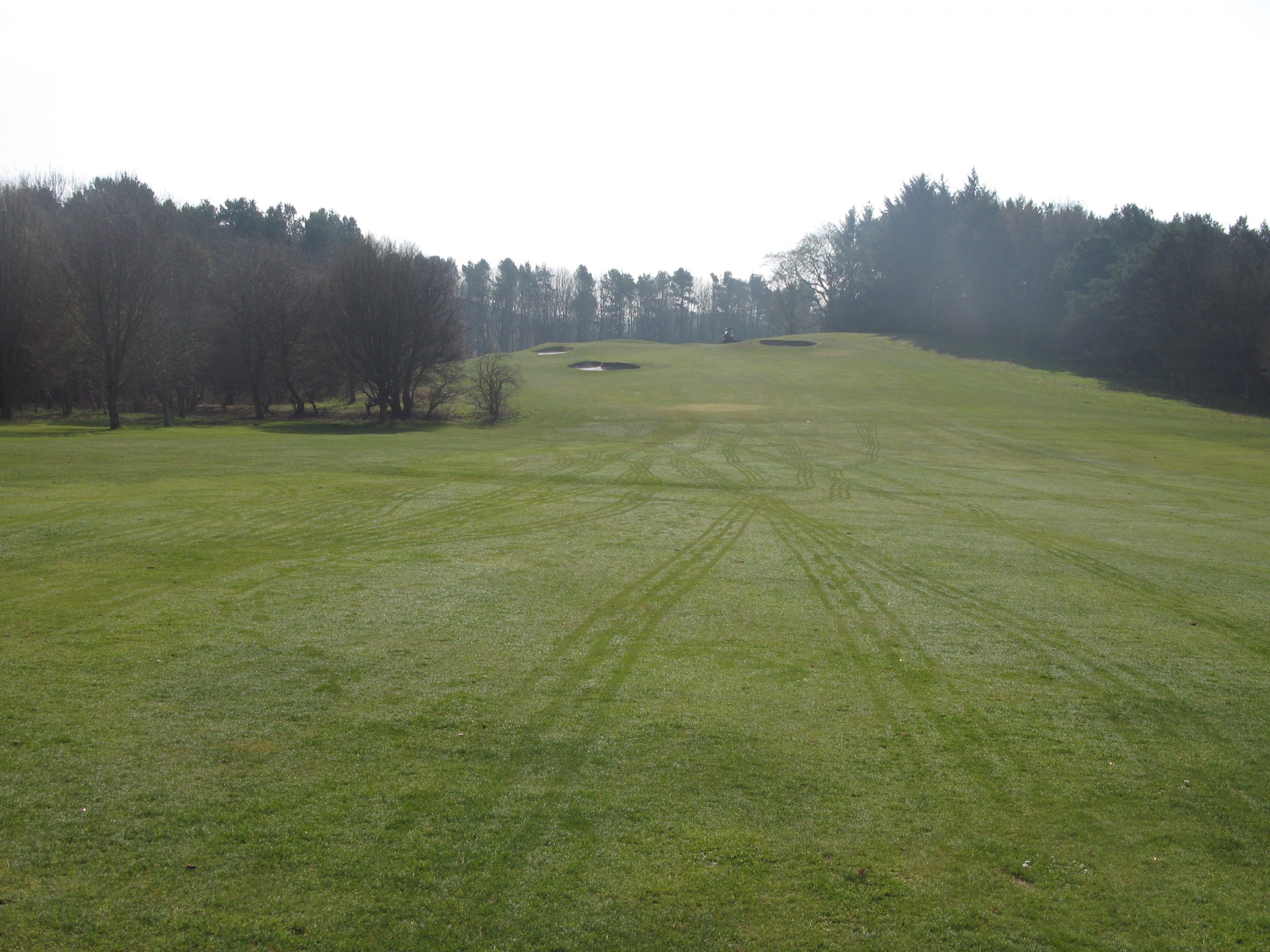
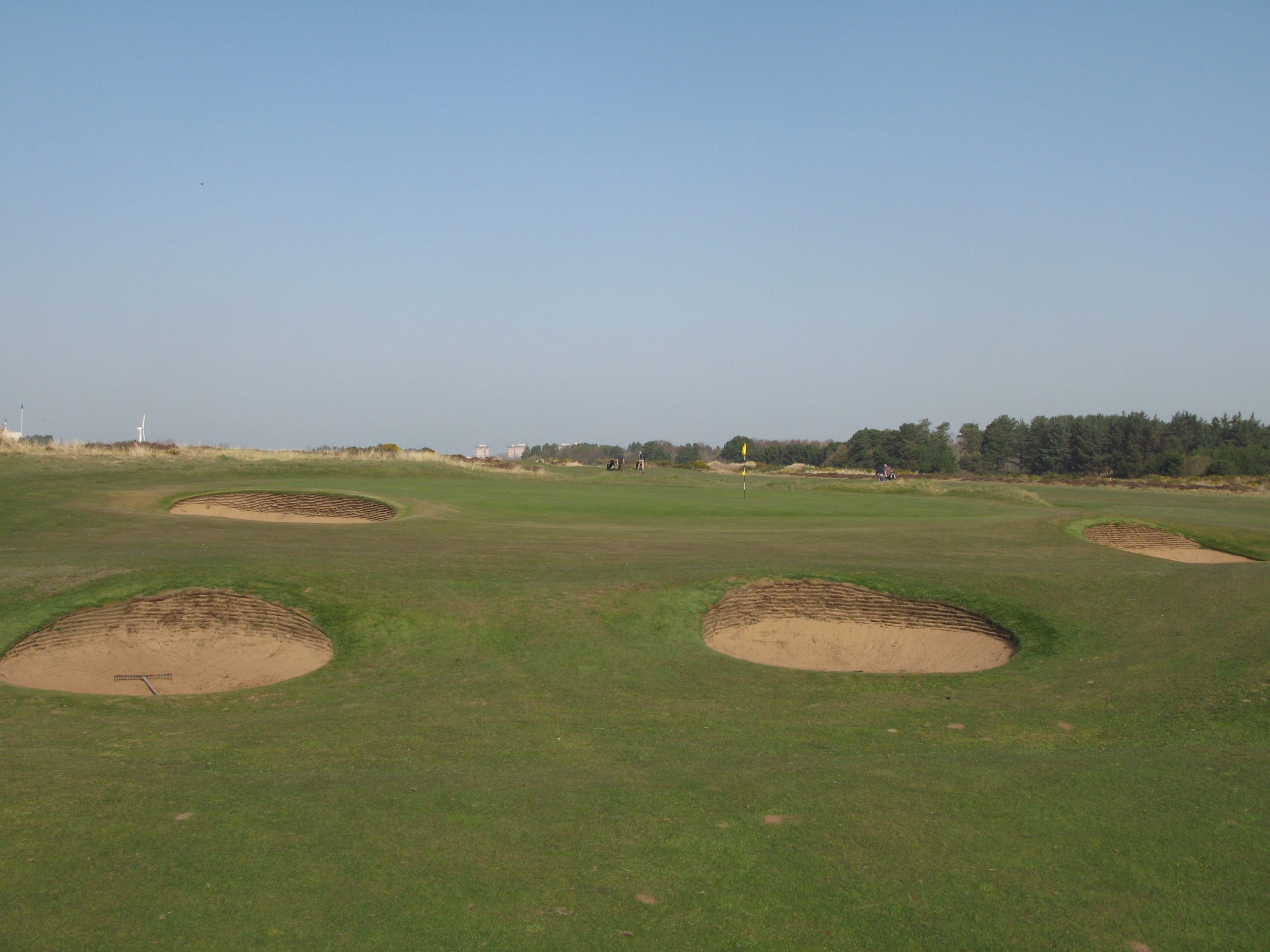
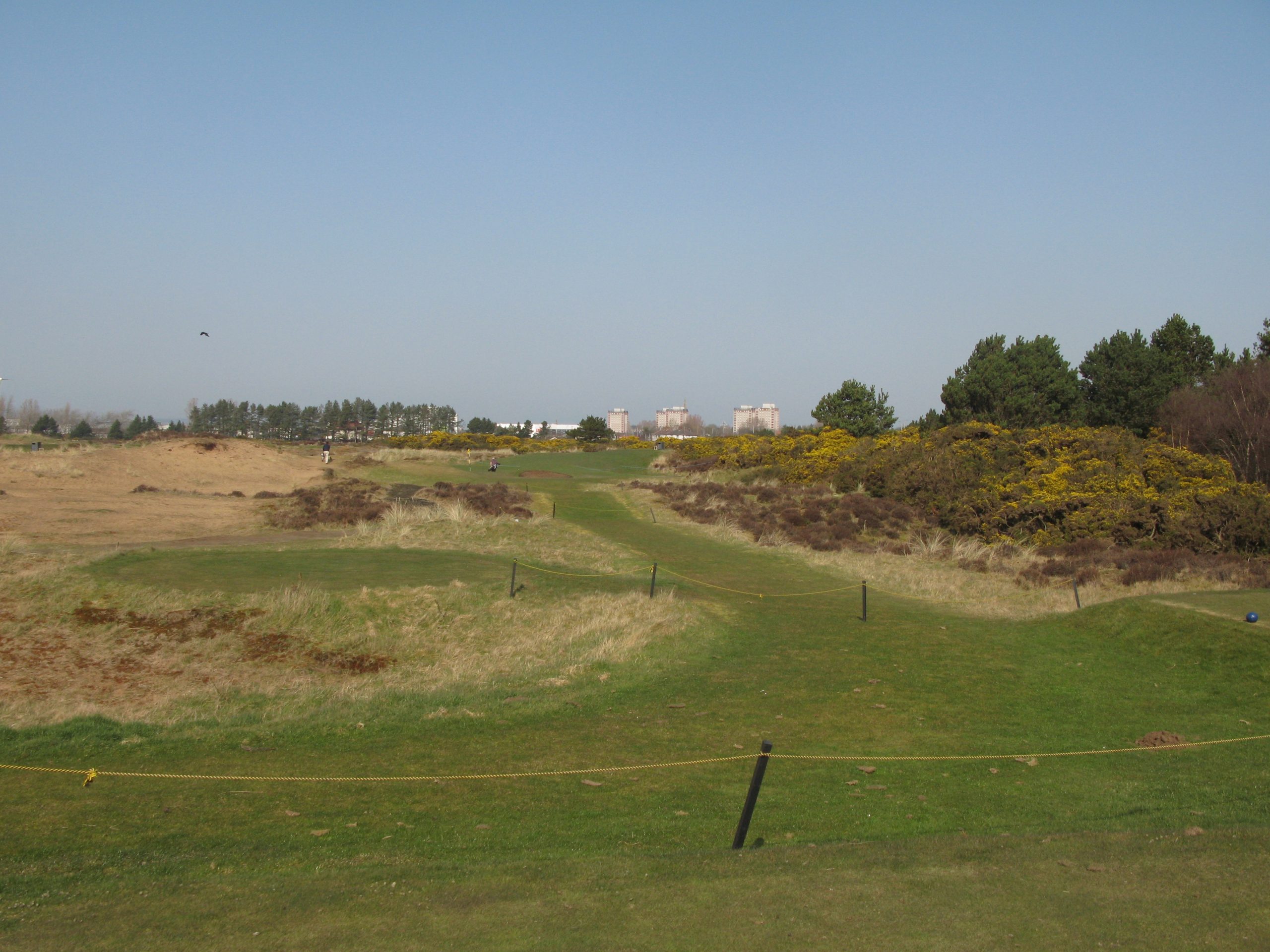
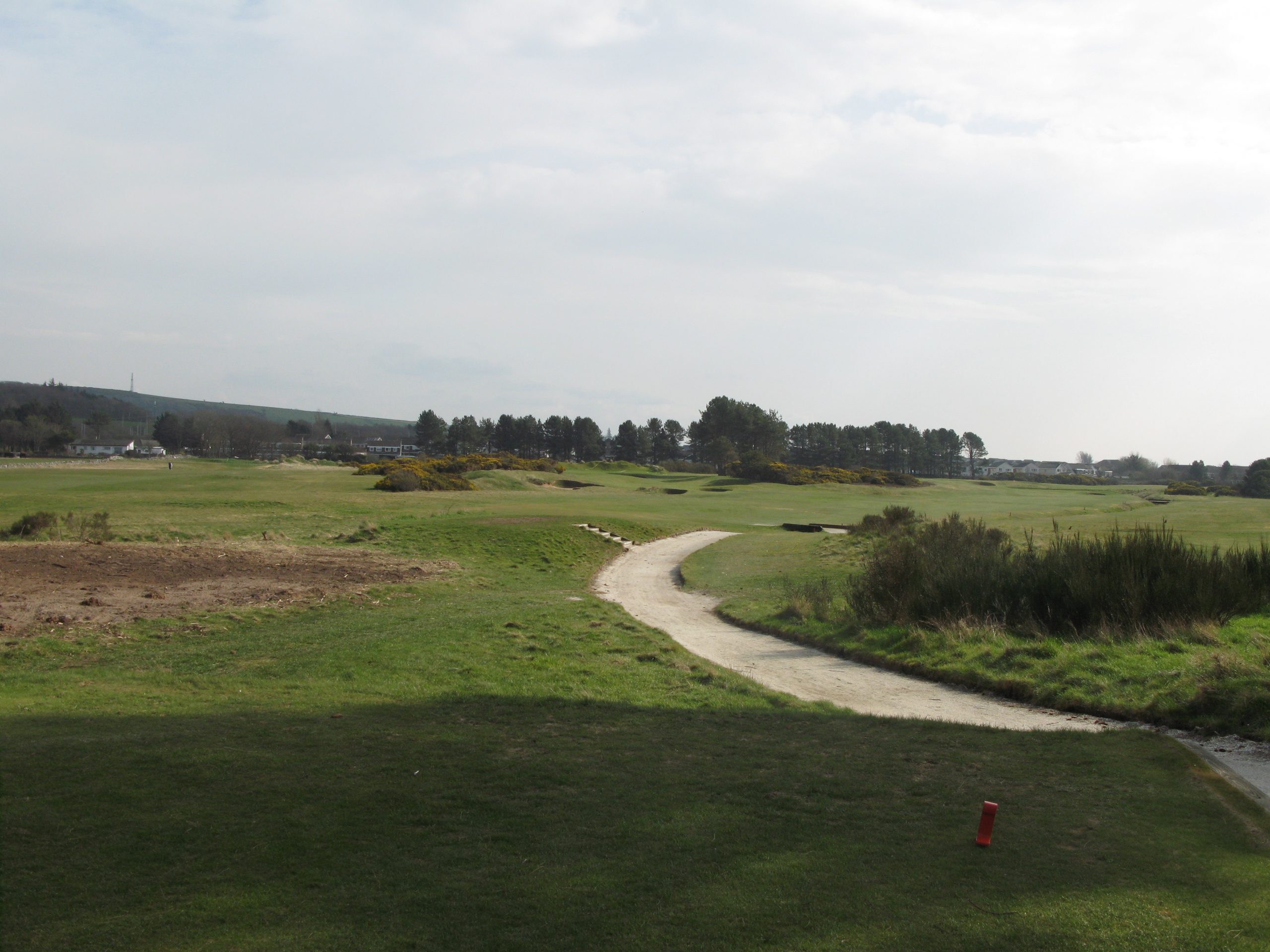
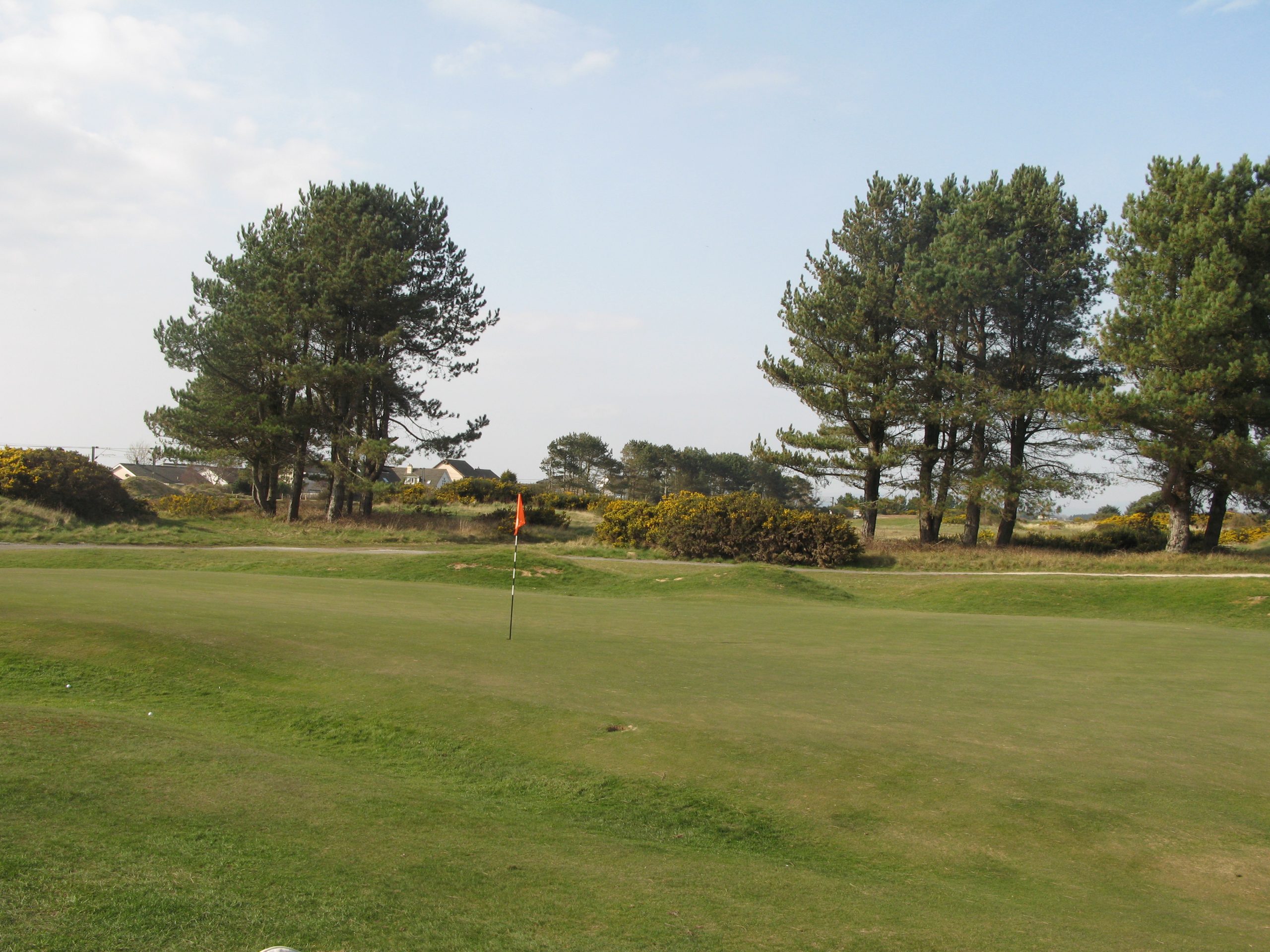
You quickly realise the quality on offer at Grangemouth, with the approach at the first hole.

But Grangemouth Golf Club and it’s courses, have not always had a guaranteed existence and the Scottish golfing community can’t take venues like Grangemouth for granted – its history is worth dwelling on.

The current parkland municipal course, opened in 1974 by the local council, is just outside the village of Polmont and close to junction 4 of the M9 motorway. However, the first Grangemouth golf course can be traced back to the mid 1890s, and its growth and decline are charted on the excellent web site “Forgotten Greens of Scotland”. After a few false starts, a 9 hole course opened in 1908 at Abottsgrange, including greens created through “beating, rolling, sanding, cutting”. A “small shelter was built to protect against the ‘Sudden Blast'”. Initially there were 113 men and 67 lady members, highlighting the non sexist nature of golf in Scotland. A clubhouse was soon built but burned down in 1924, with the most informative comment being the sad loss of 200 sets of clubs, “only those few who took clubs away at the weekend were saved”.
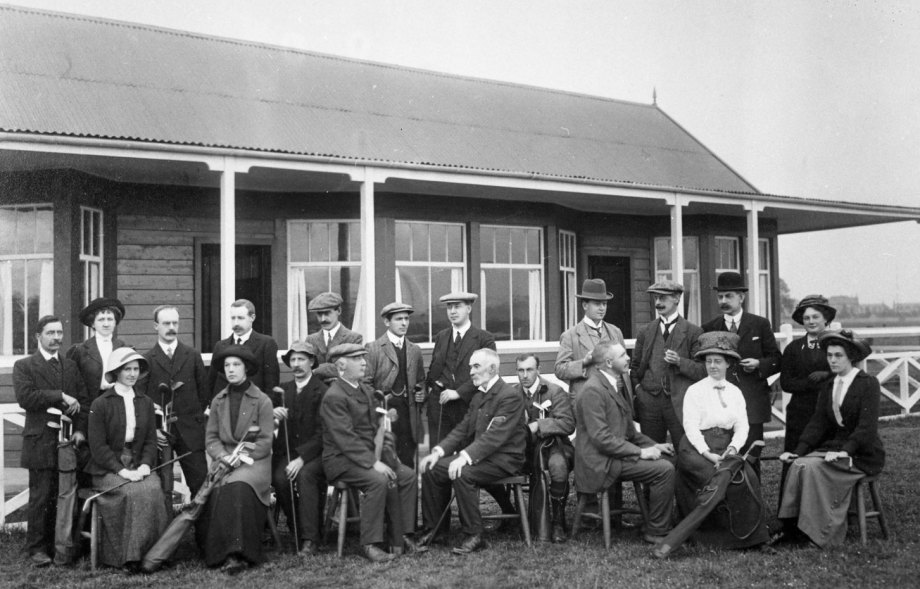
The original Grangemouth members. We should never take the longevity of courses for granted.

By the early 1950s the course, now with 18 holes, became a victim of a mix of expanding urban growth, the building of a new Scottish Central airfield and political wrangling within Stirling County and the local Town councils. This led to the closure of that course in 1954, now the sight of a school and housing estate, with the political promise of a new replacement course on Polmonthill. It was finally established 30 years later! Politics.
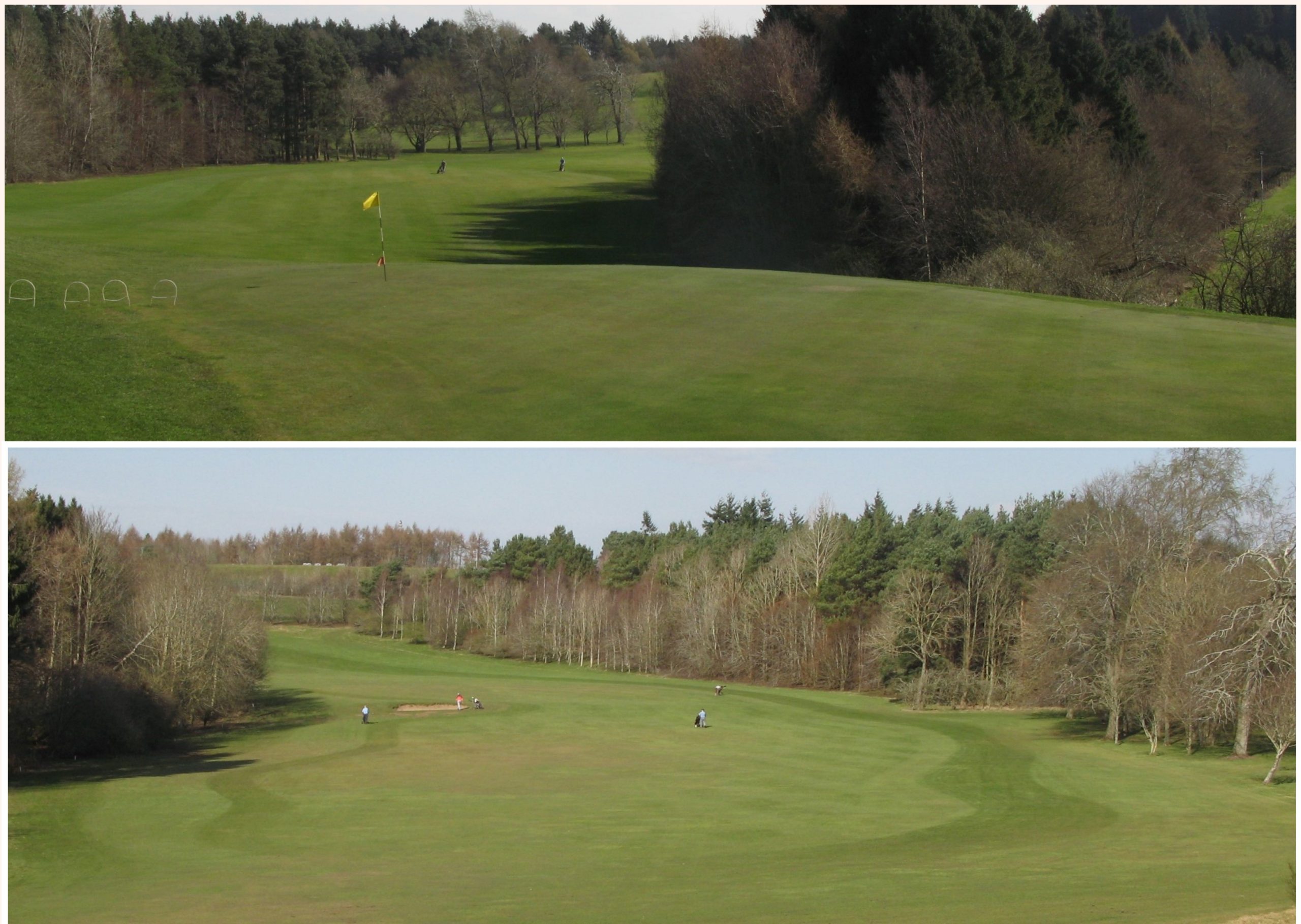
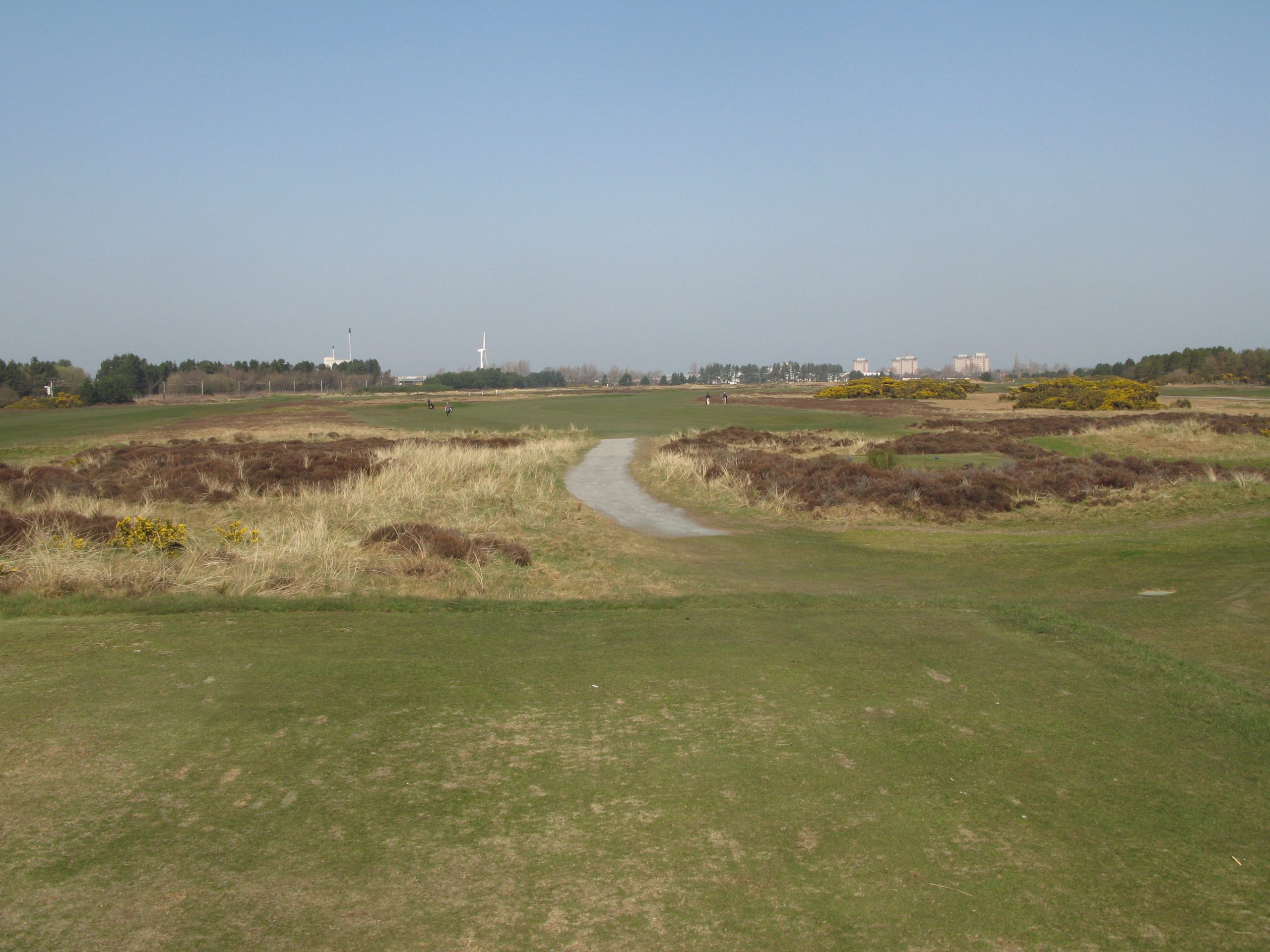
The long par four 8th, “Gambler’s Gap” (you can see it), the most difficult hole.

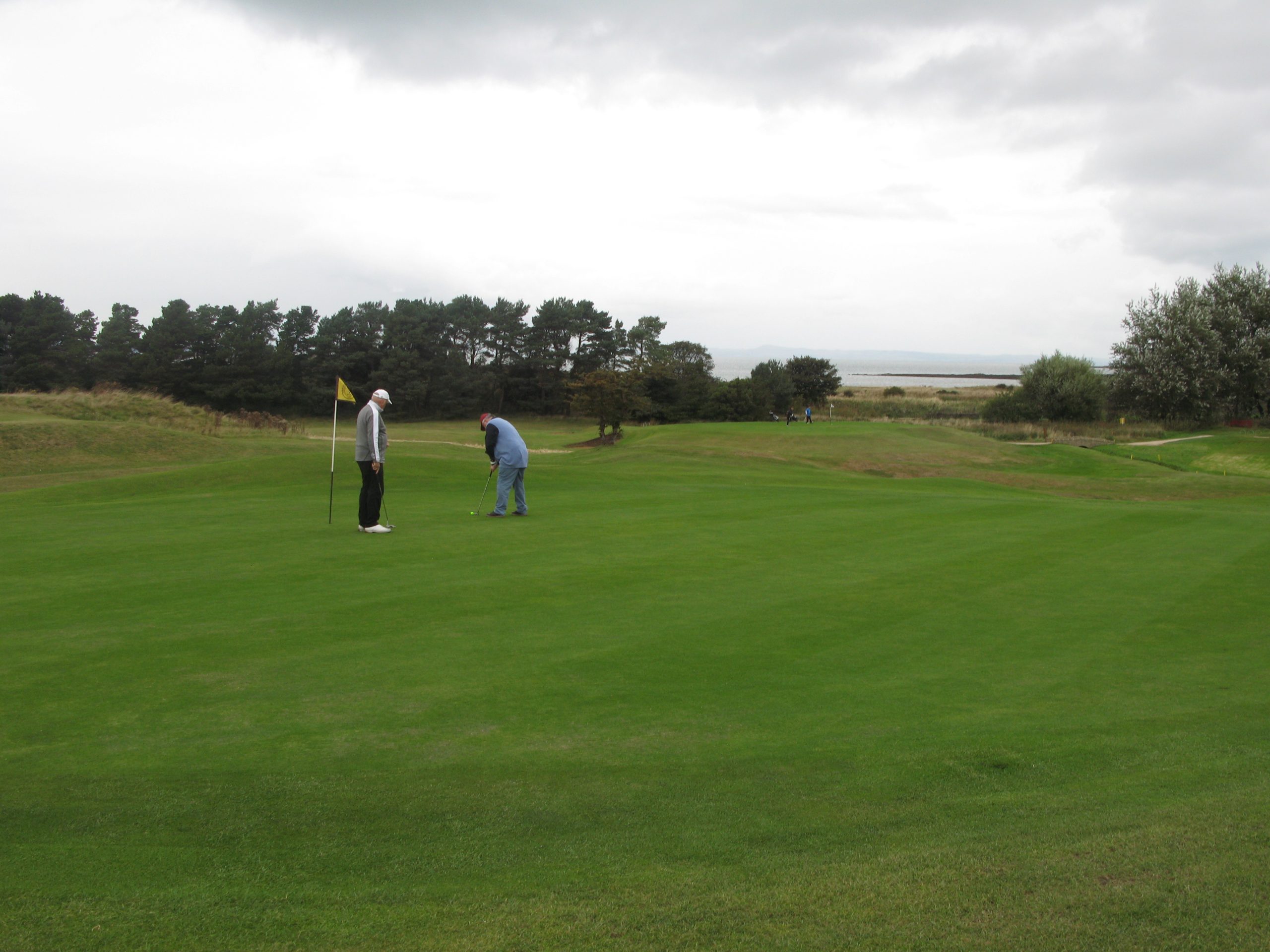
Arguably, the current course was worth the wait. At well over 6000 yards, this undulating layout, bordering Polmont Woods, is very challenging. When I played, on a fine March day, along with my old friend Frank Crowe and two of his friends, Colin Campbell (a local member) and Ian Ponton, it was in remarkable condition. It beggared belief that it is maintained by only two greenkeepers; the greens were first class.
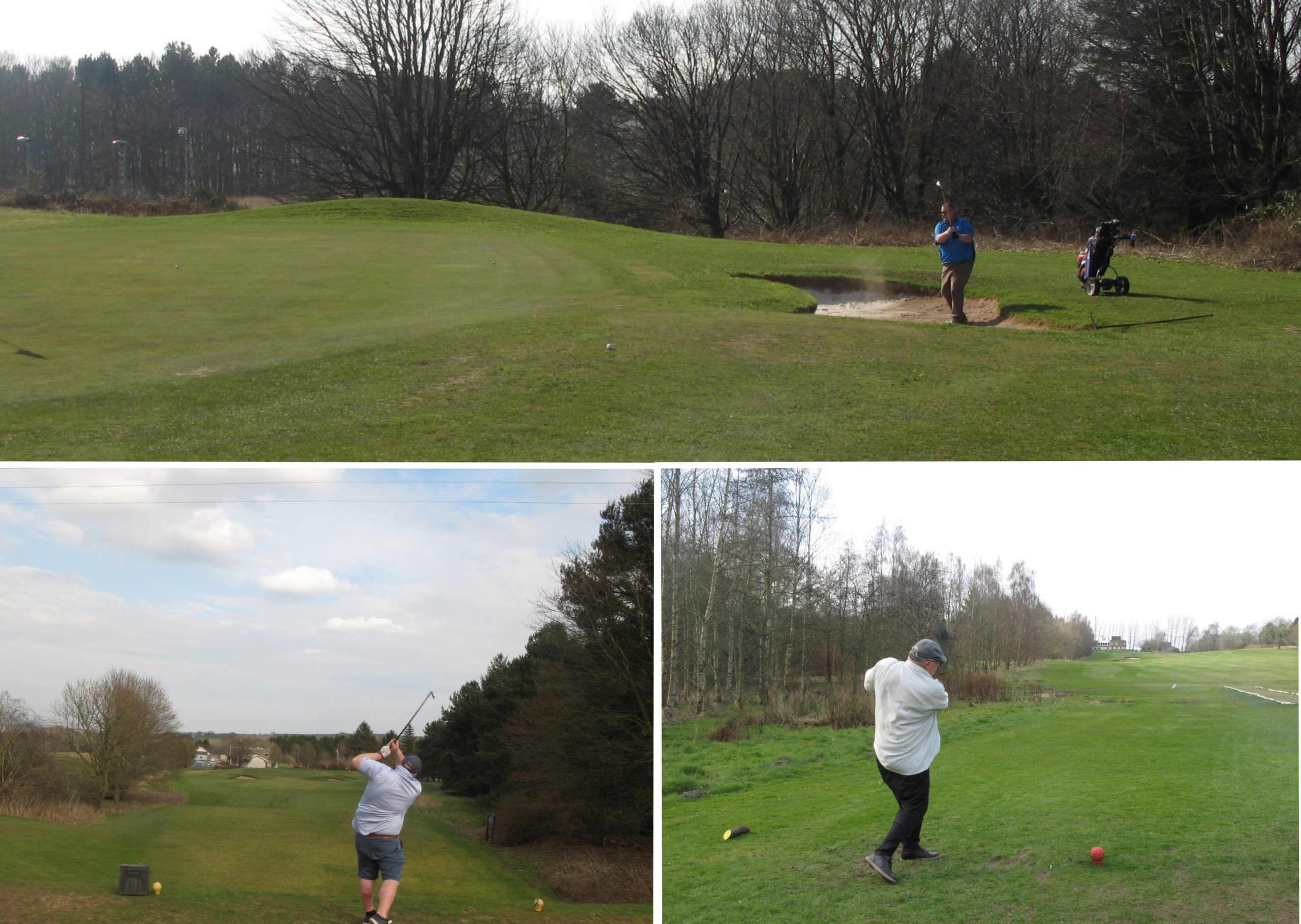
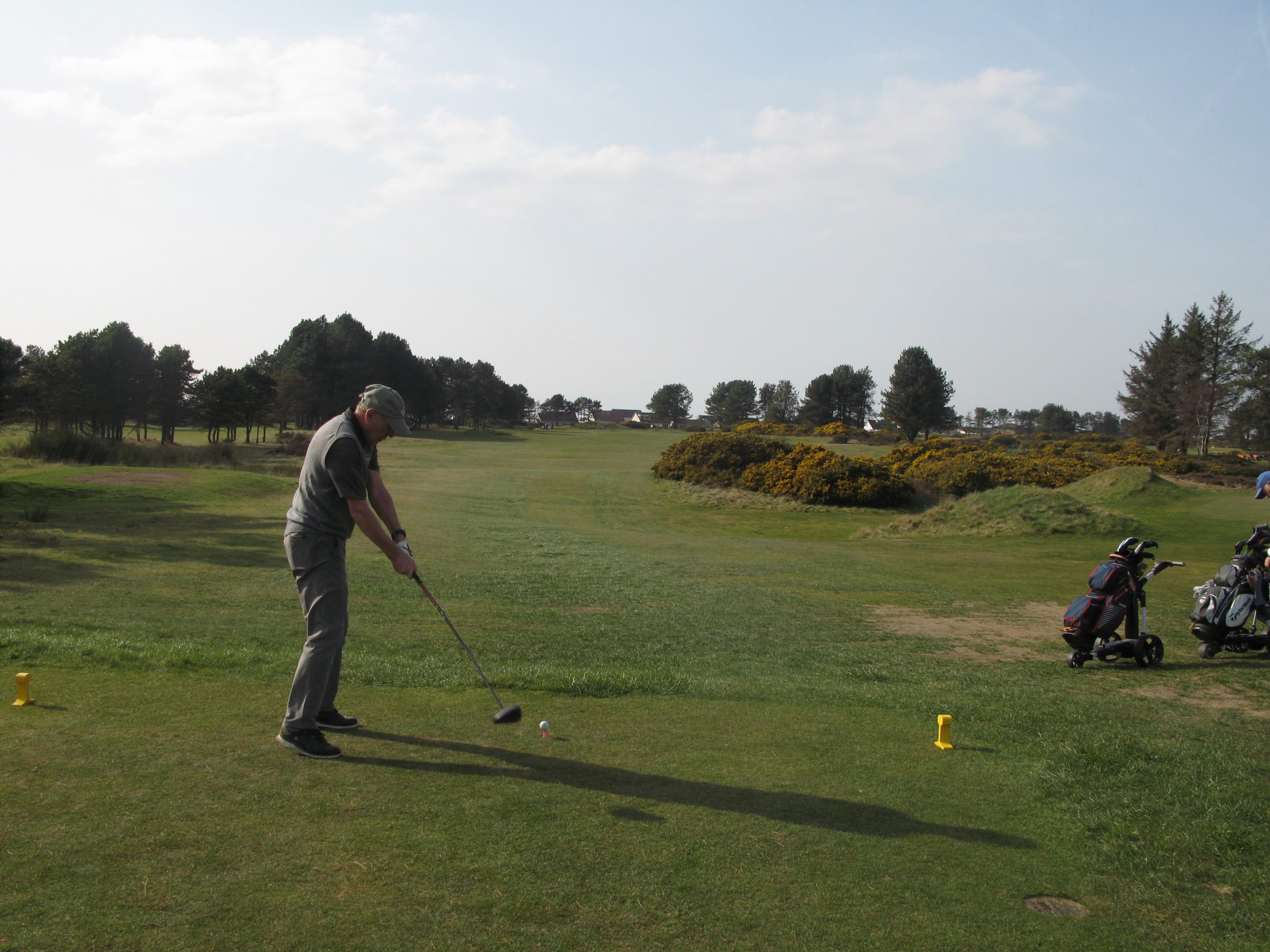
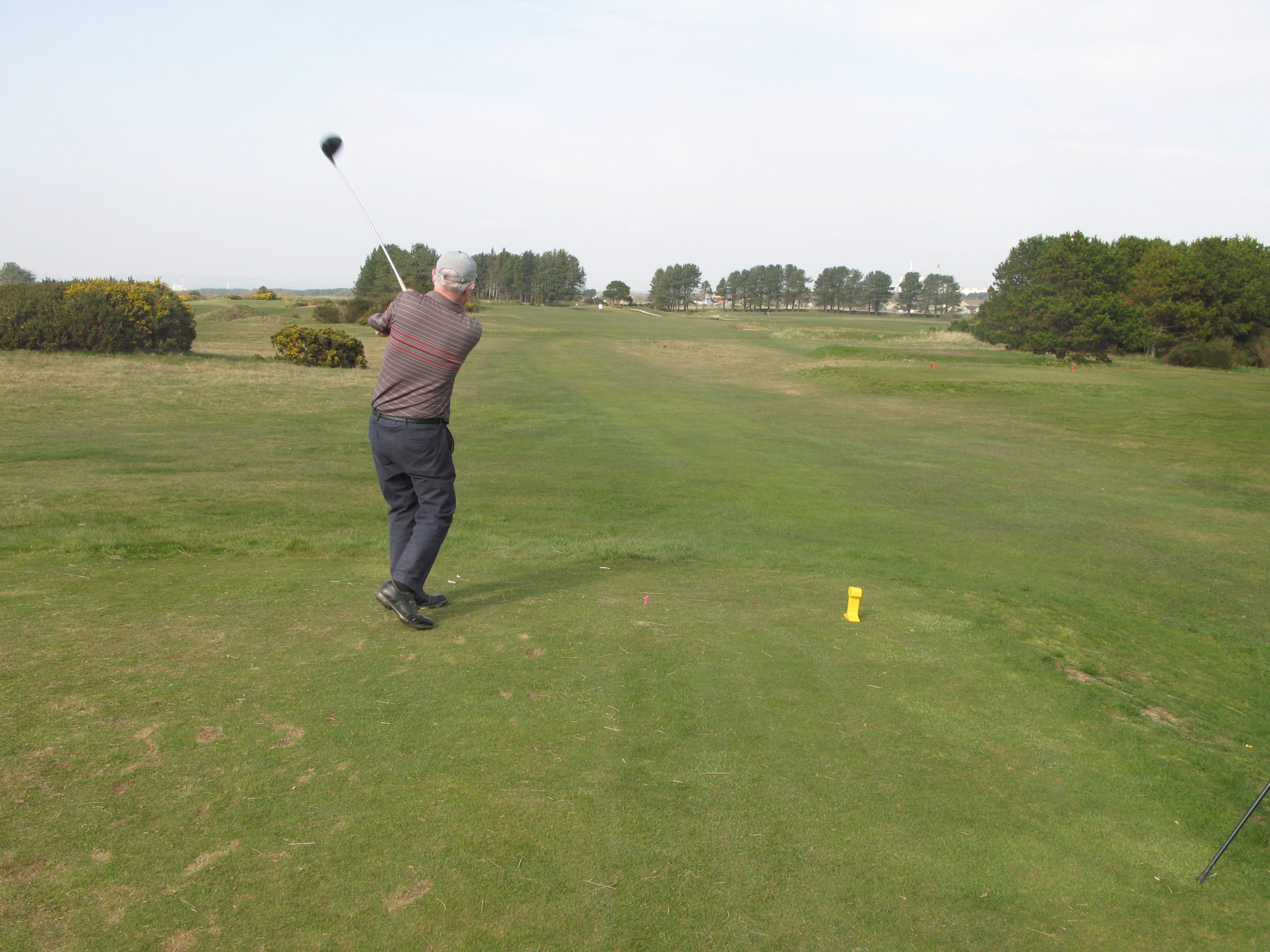
My playing partners in action.
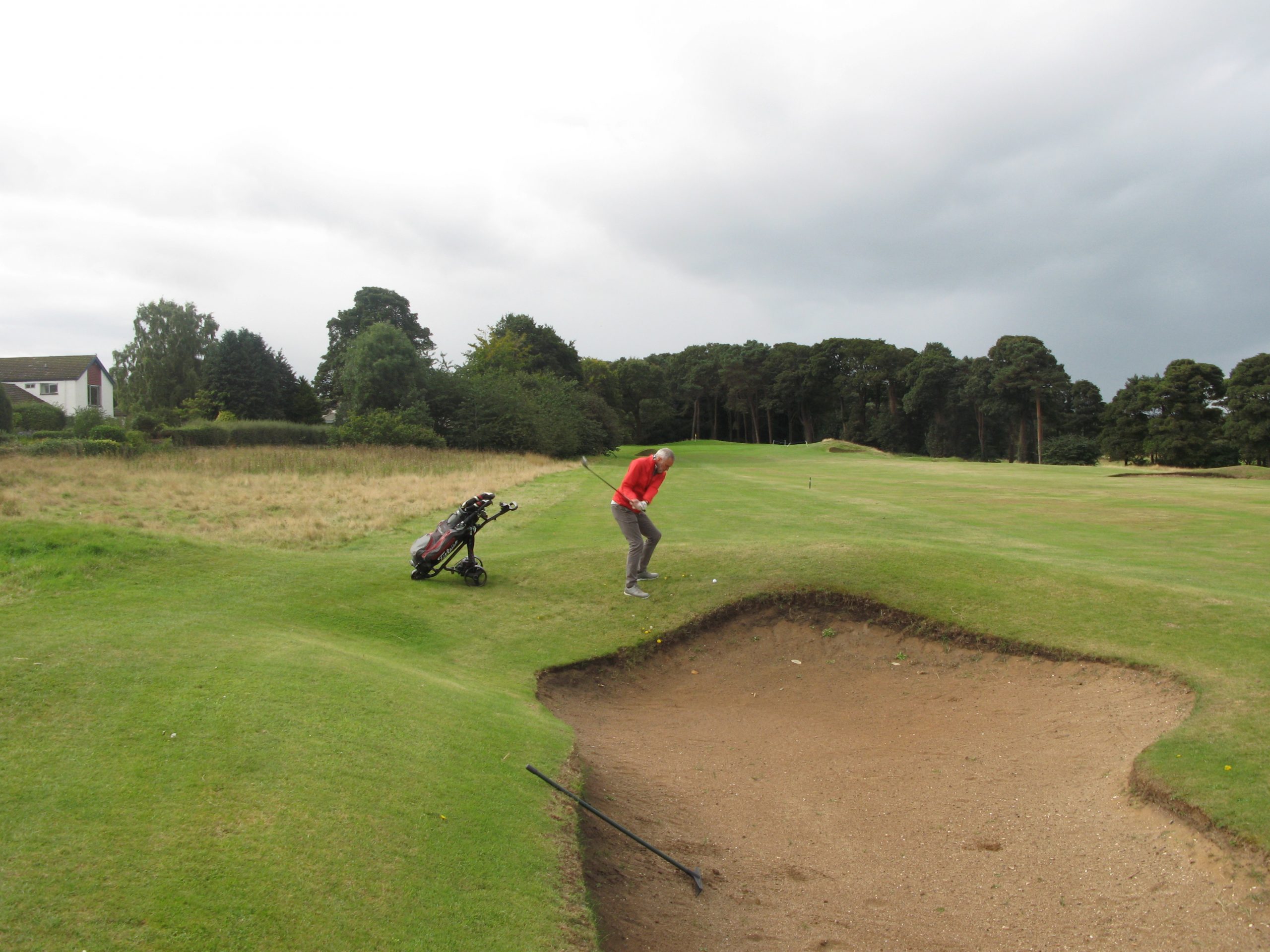
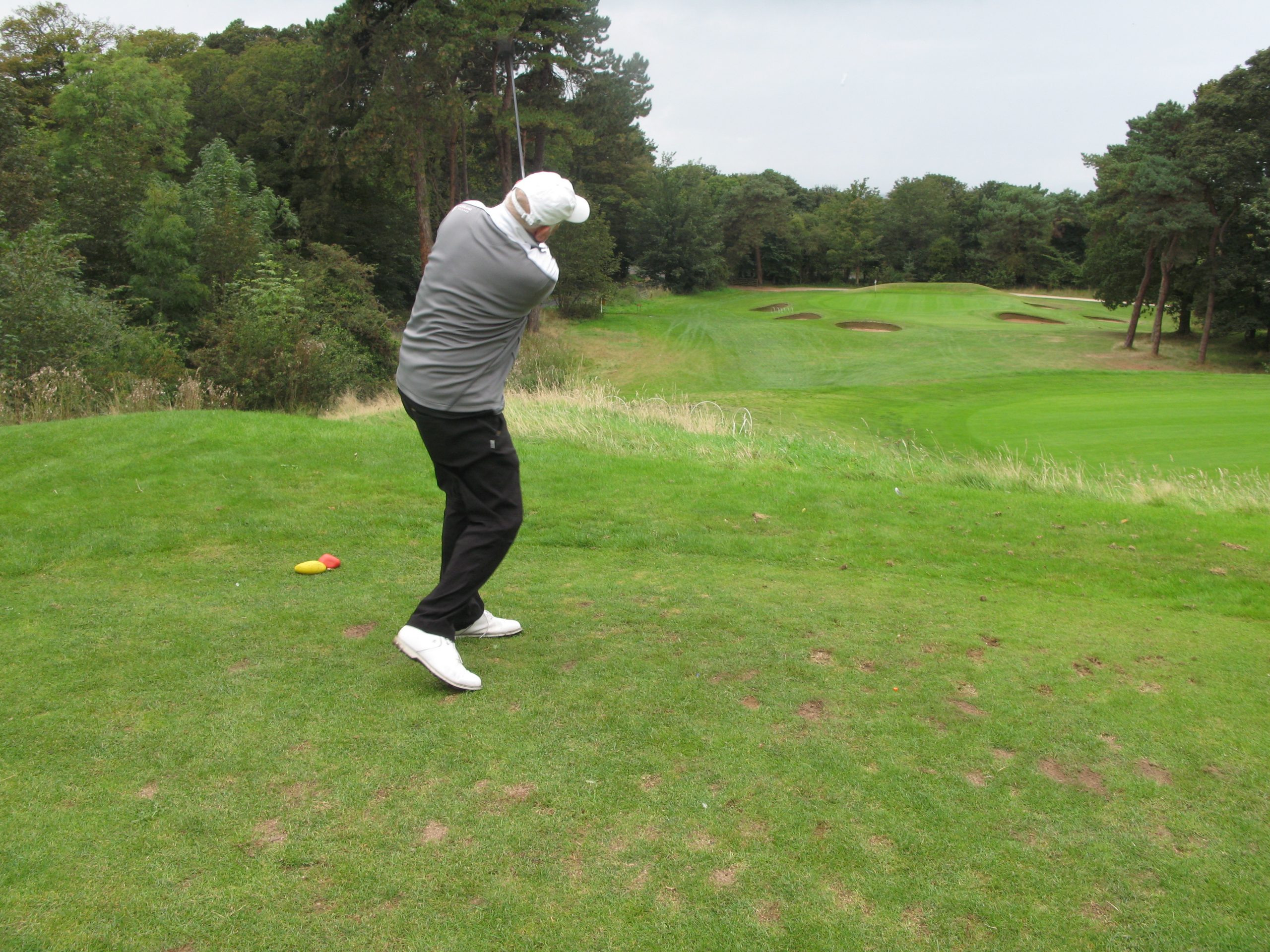
Top – Ian Ponton at the 2nd; Bottom left Colin at the 15th; Frank at the 18th.

The course has won a “Scottish Municipal Course of the Year” award in the past, and you could see why. The bunkers, where admittedly more rakes were needed, and tees, could have been a bit sprucer; but this was golf costing about the same as two pints of beer, with high summer rates still being well short of £20. If any international tourists wanted to see what is on offer elsewhere in Scotland, other than the heady courses in nearby Fife or East Lothian costing over 10 times the green fee, this would be a great course to play.

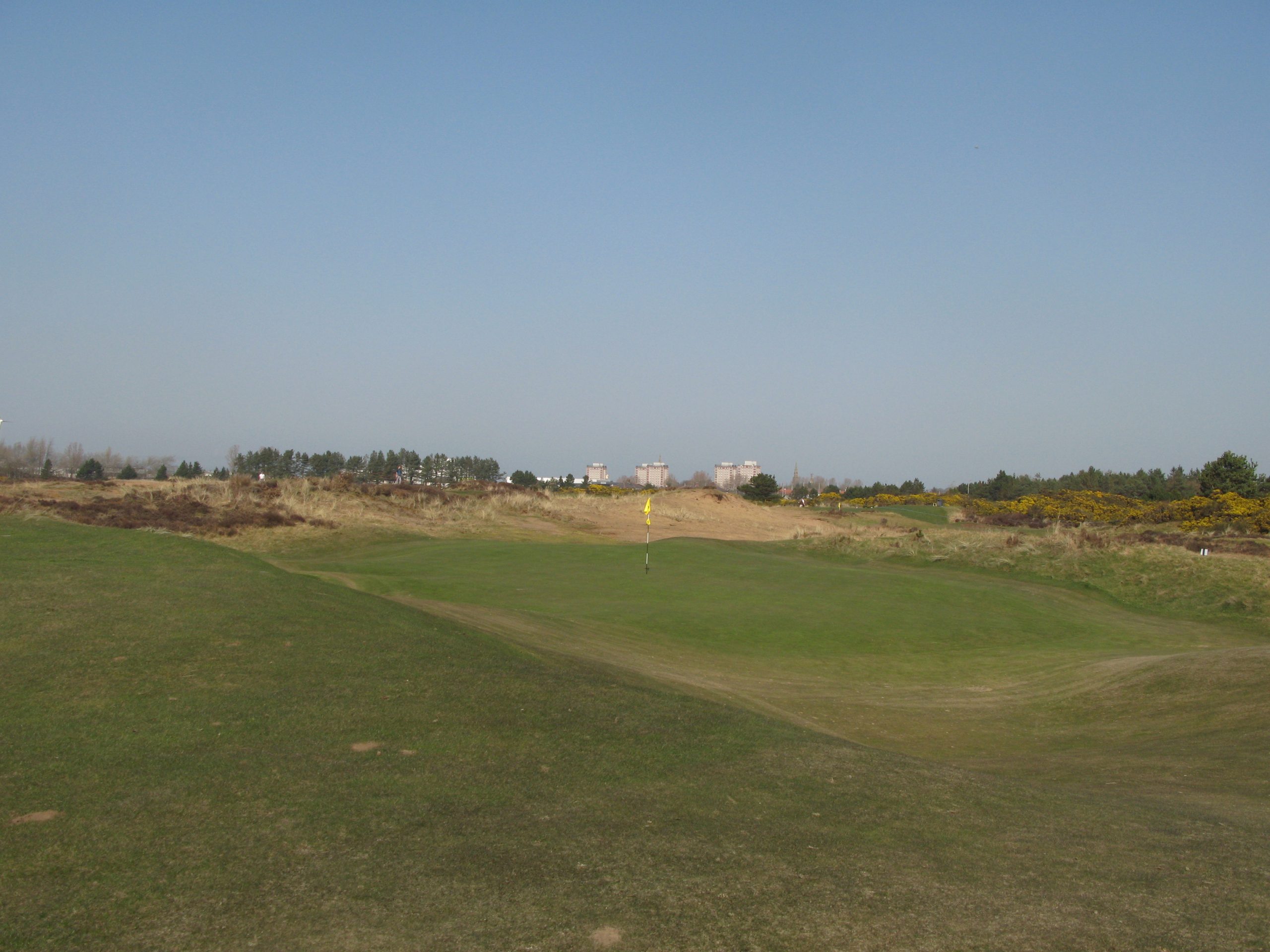
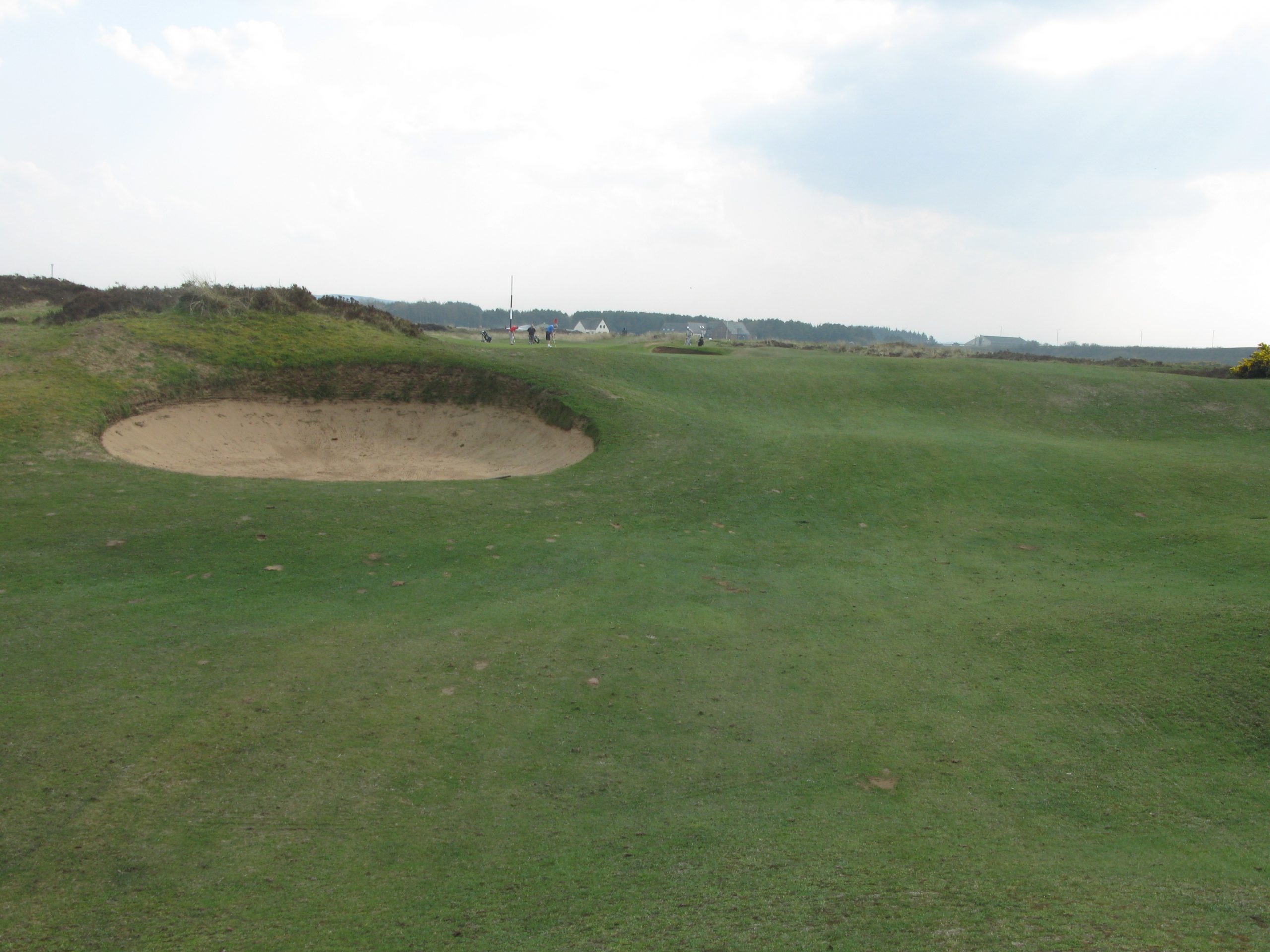
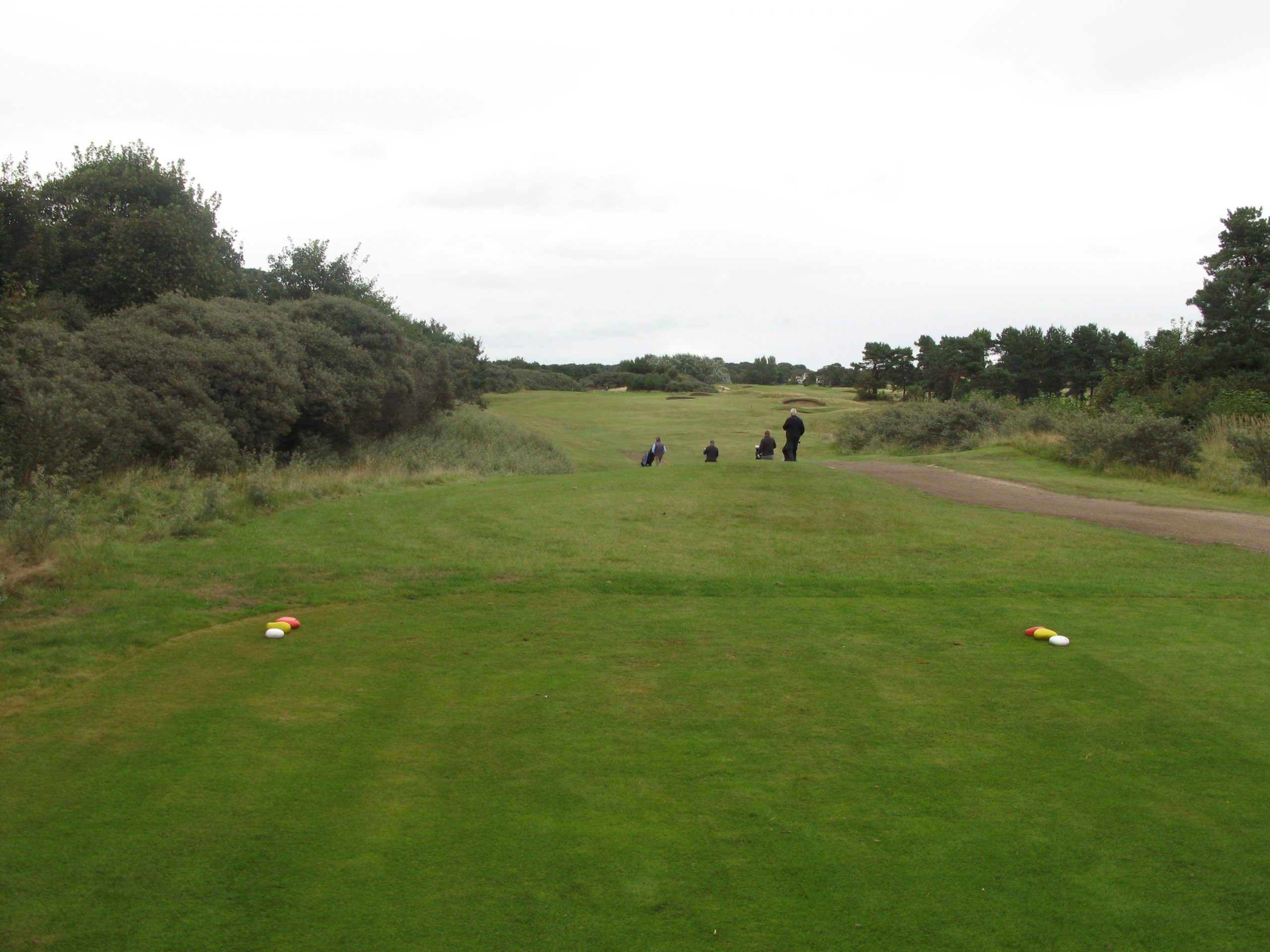
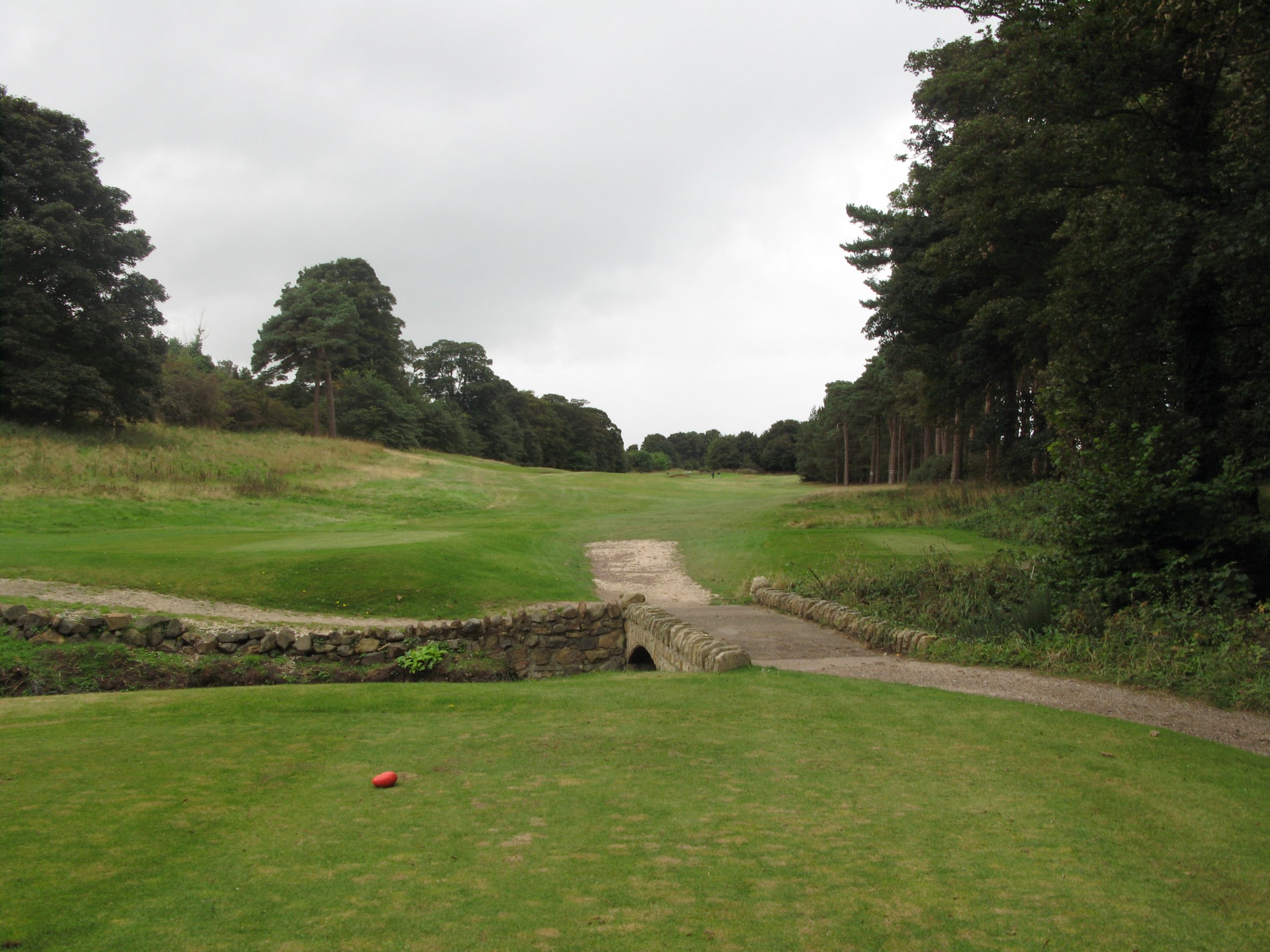
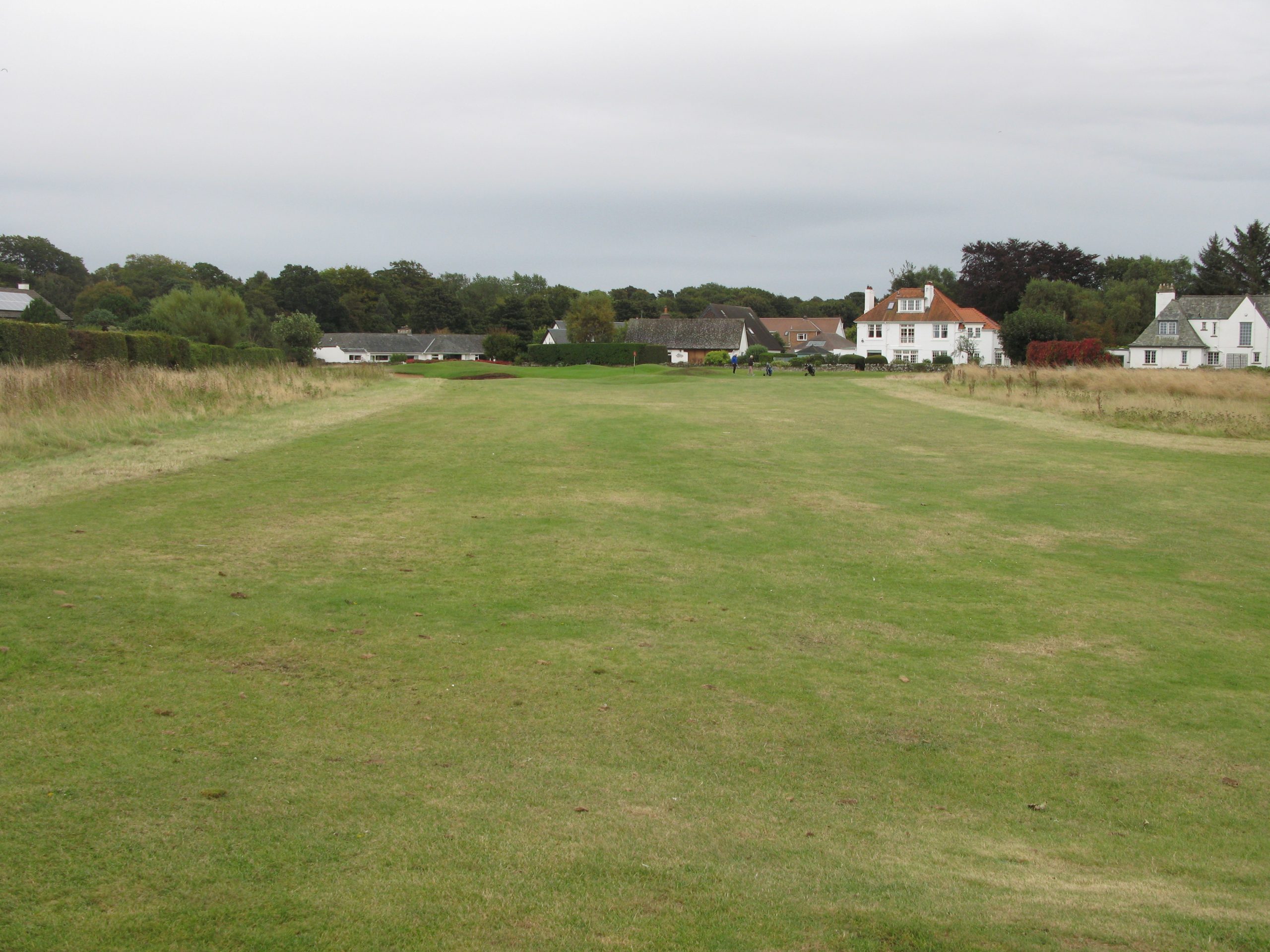
There are some memorable holes, not least the brilliantly framed par fours first and fourth holes, both played uphill into well bunkered greens. The signature hole, “Reflections”, the par three seventh at 178 yards, played over a resevoir, left me ‘reflecting’ how I racked up a 7, including my first ball finding the water.
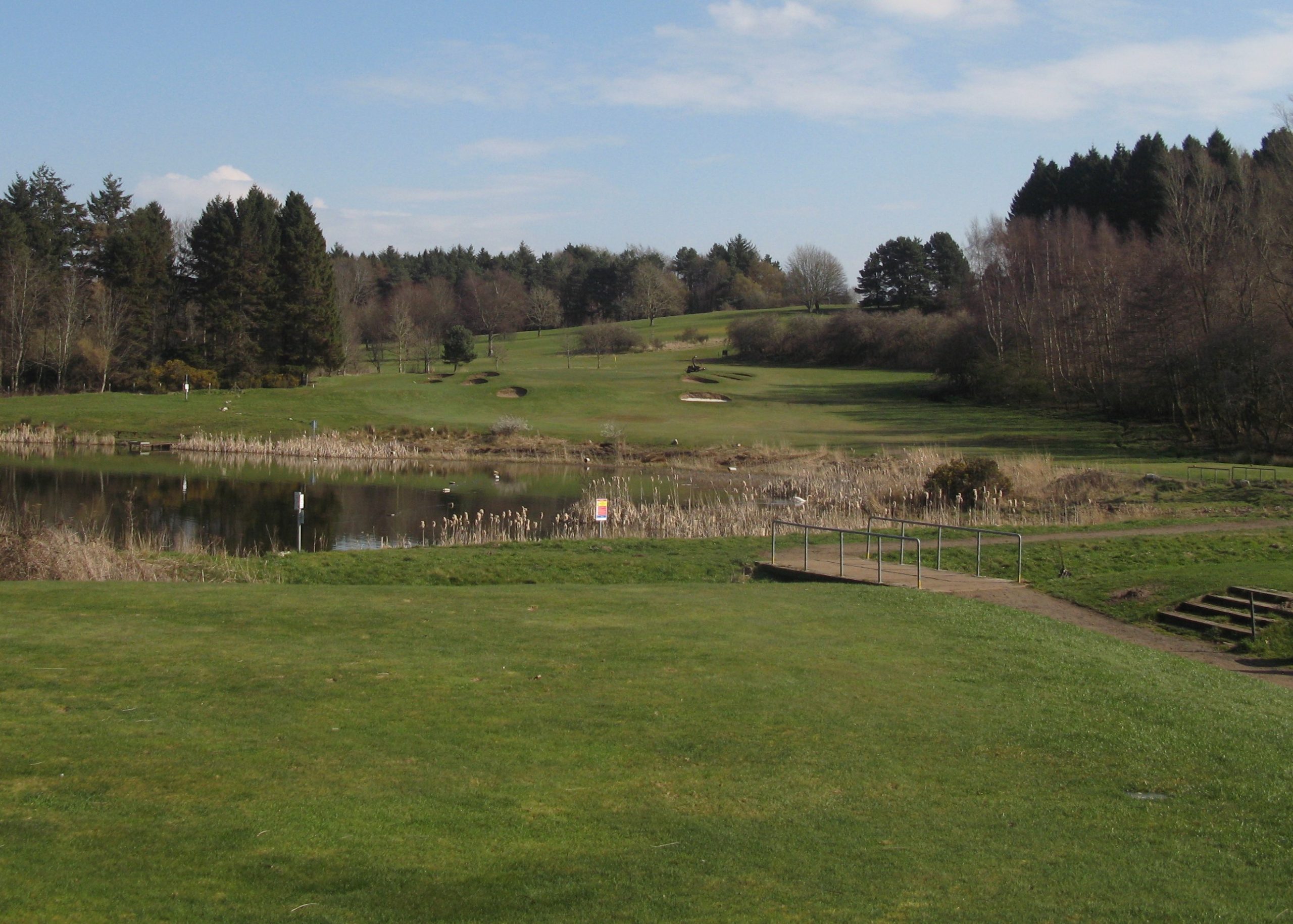
The par three 7th. Is there a finer visual par three on any other UK municipal course?

The greens were very tricky, as my seven 3 putts attest; this was due to the large and sloping nature of them, not the surfaces which were true. My gross 90, therefore, indicting my otherwise decent ball striking.

The overall layout has a nice variety of dog leg holes, blind shots, and some easier respite holes to catch the odd birdie or par. The four par 3s, collectively, are the course highlight for me.
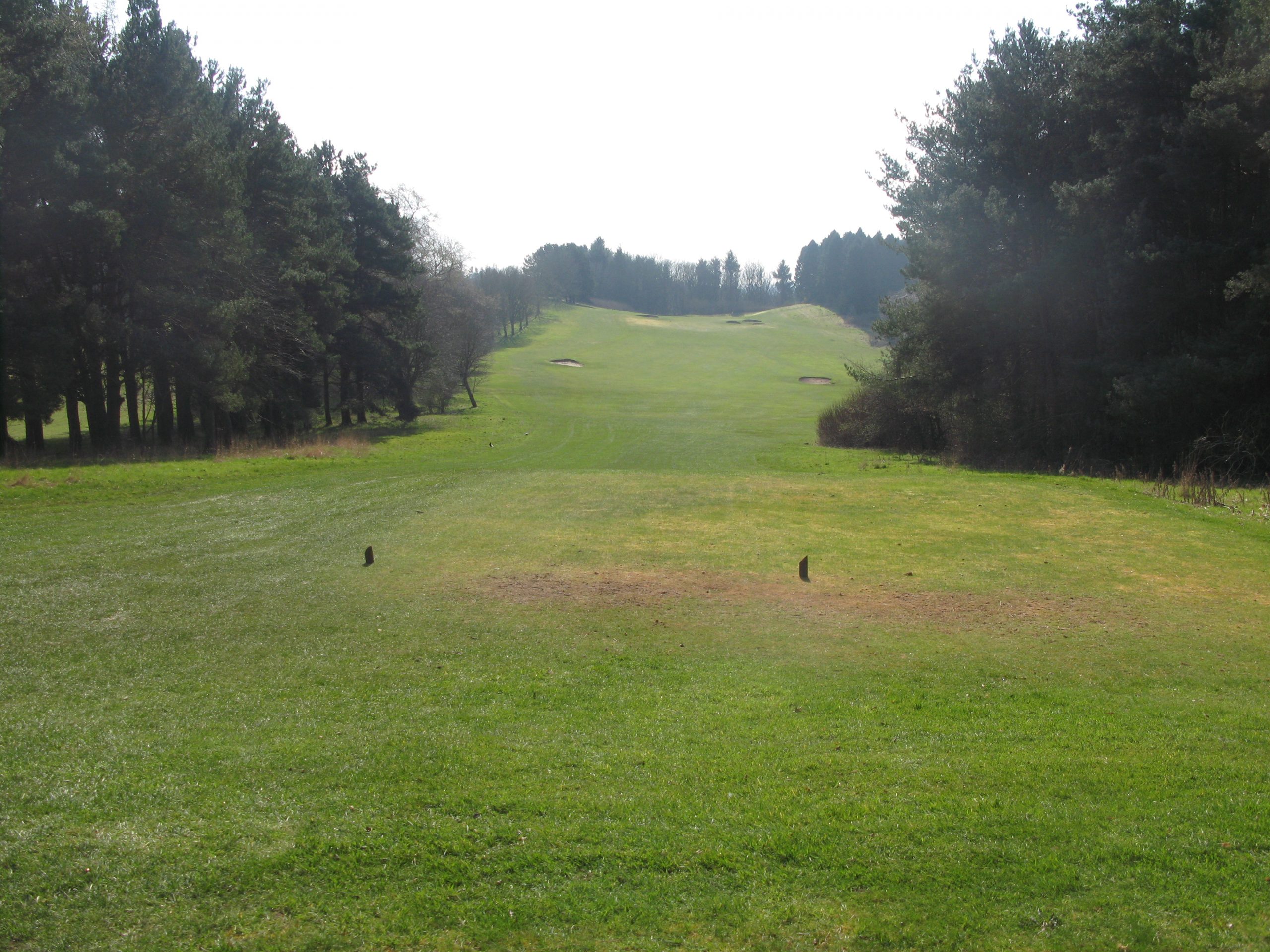
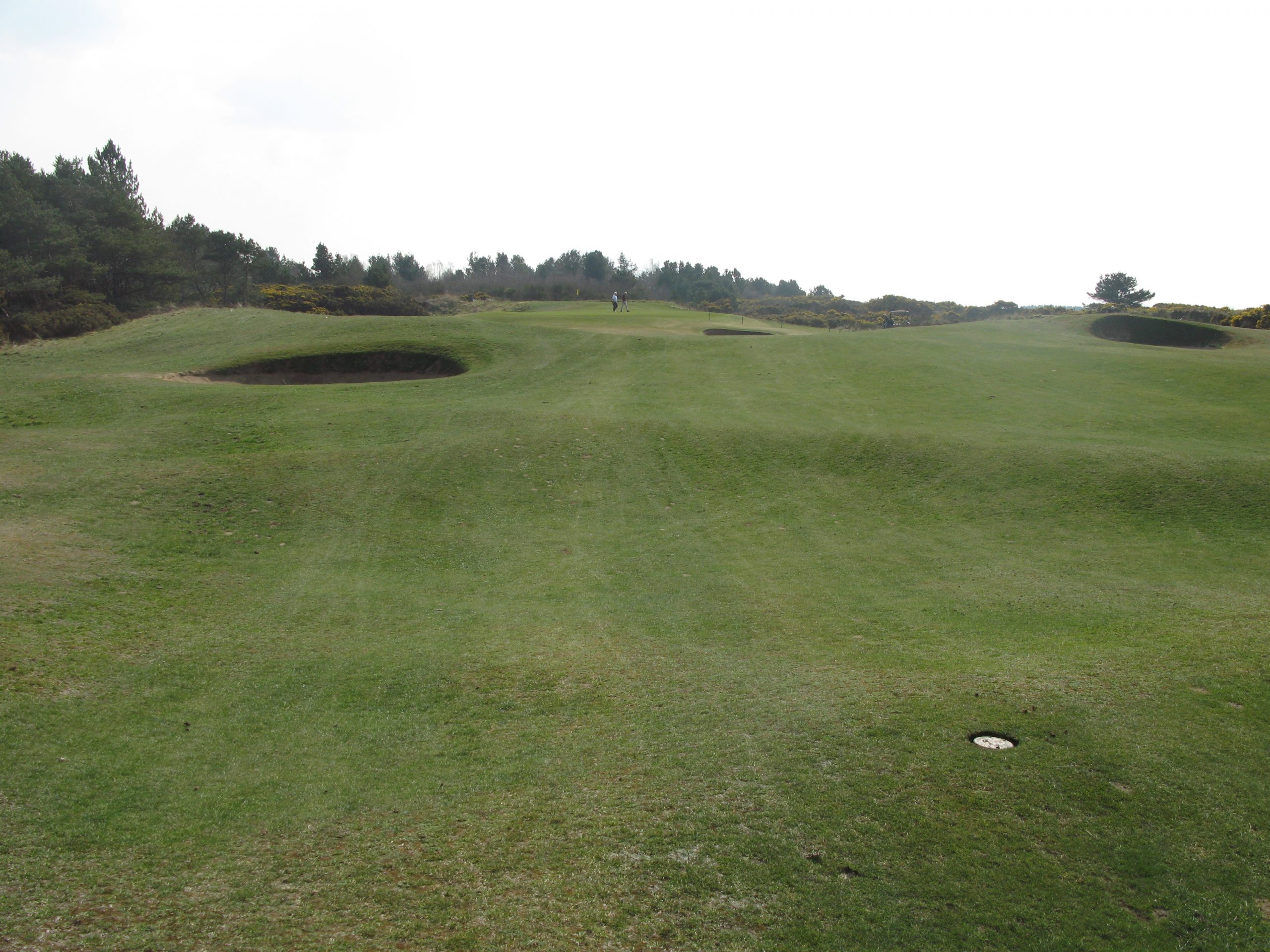
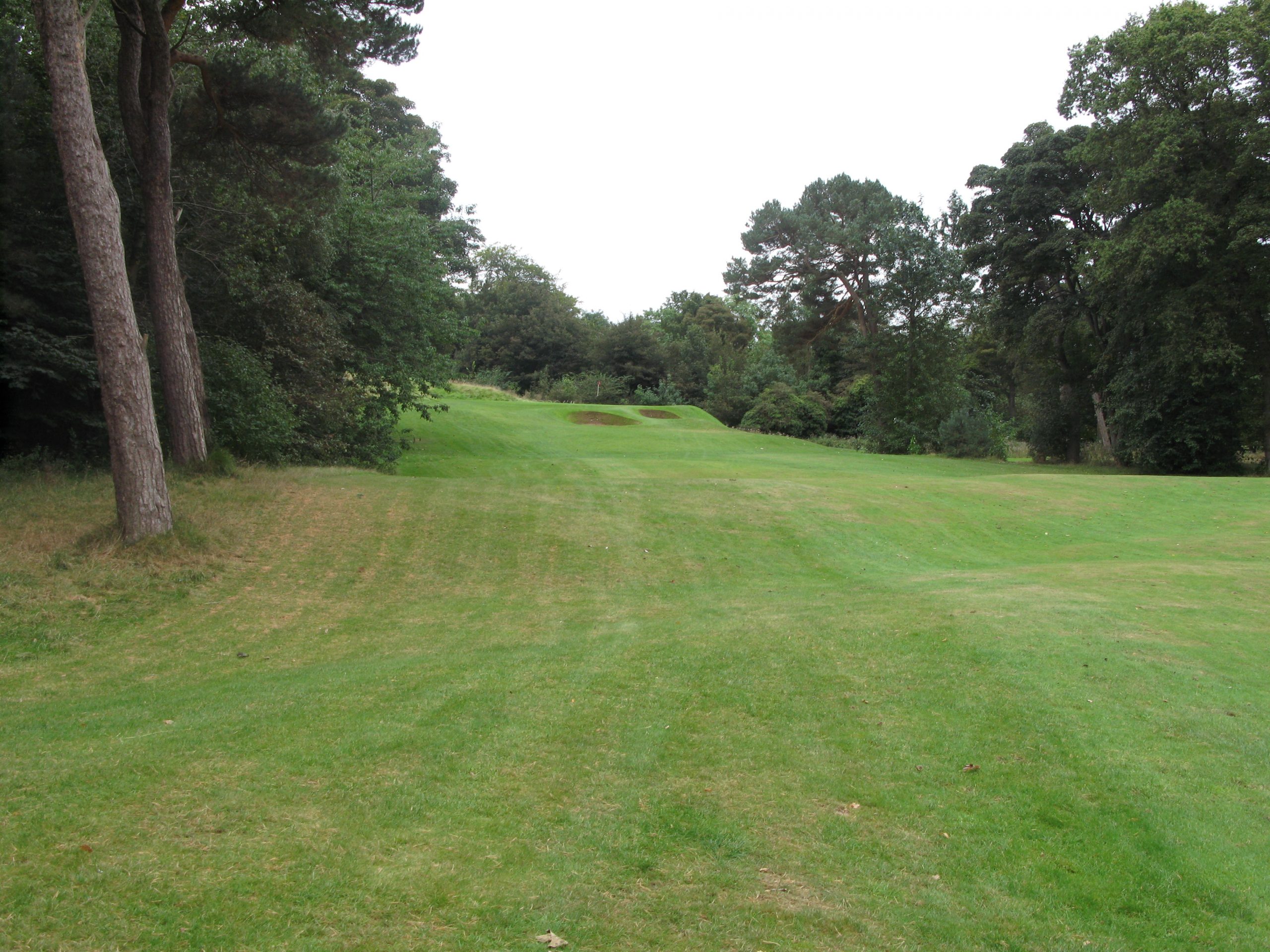
The great framing on the par four 4th hole. A tough challenge to reach the green in two here.

It is worth getting ready for the industrial views of the refinery, which only comes into view on a few holes, most notably at the 11th and 12th. Also nearby is one of the largest land fill sites in Scotland, but local member Colin commented that there was never any impact from smells. I would not let the local industrial surround put you off playing Grangemouth, it’s actually a reason to go.
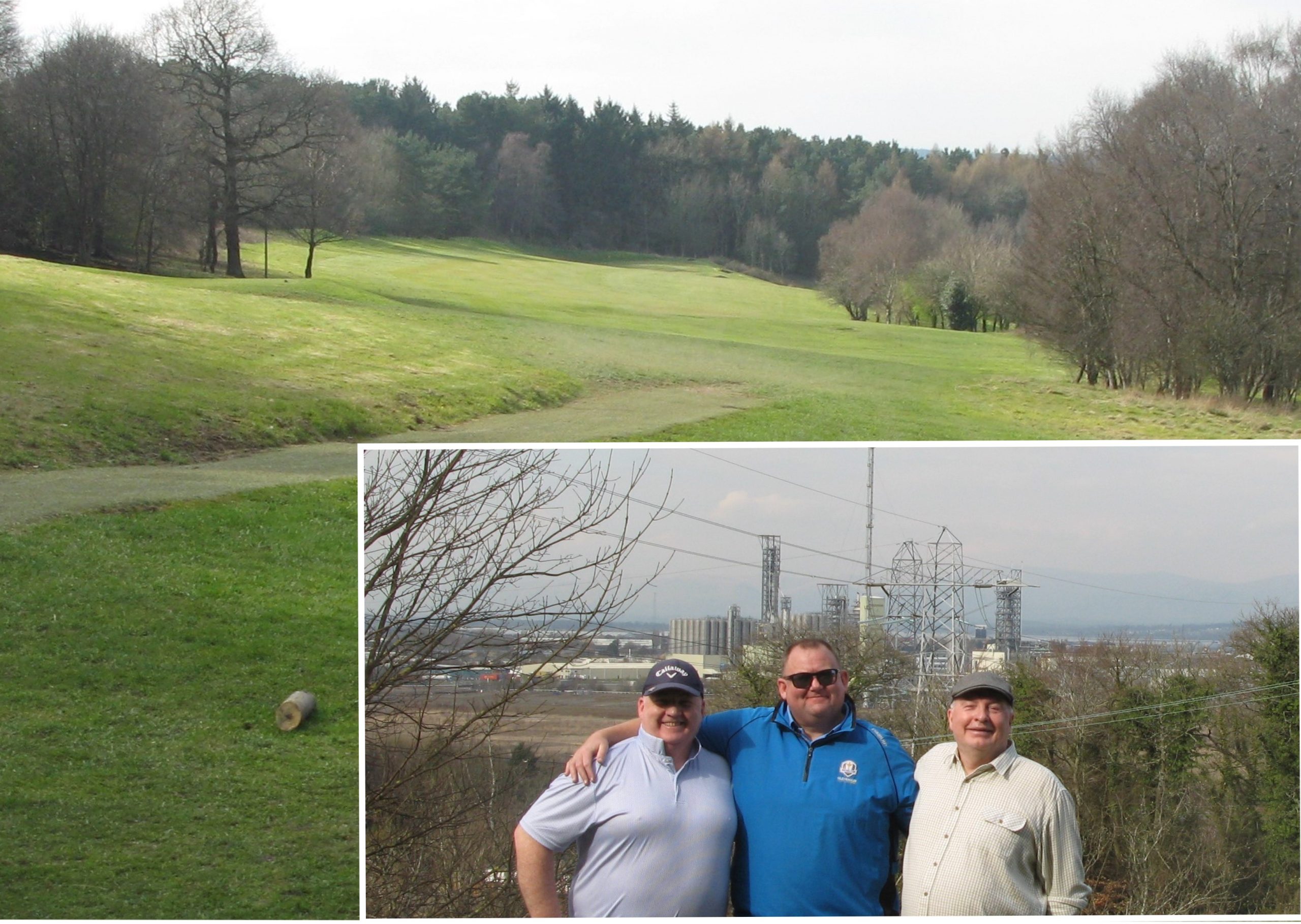
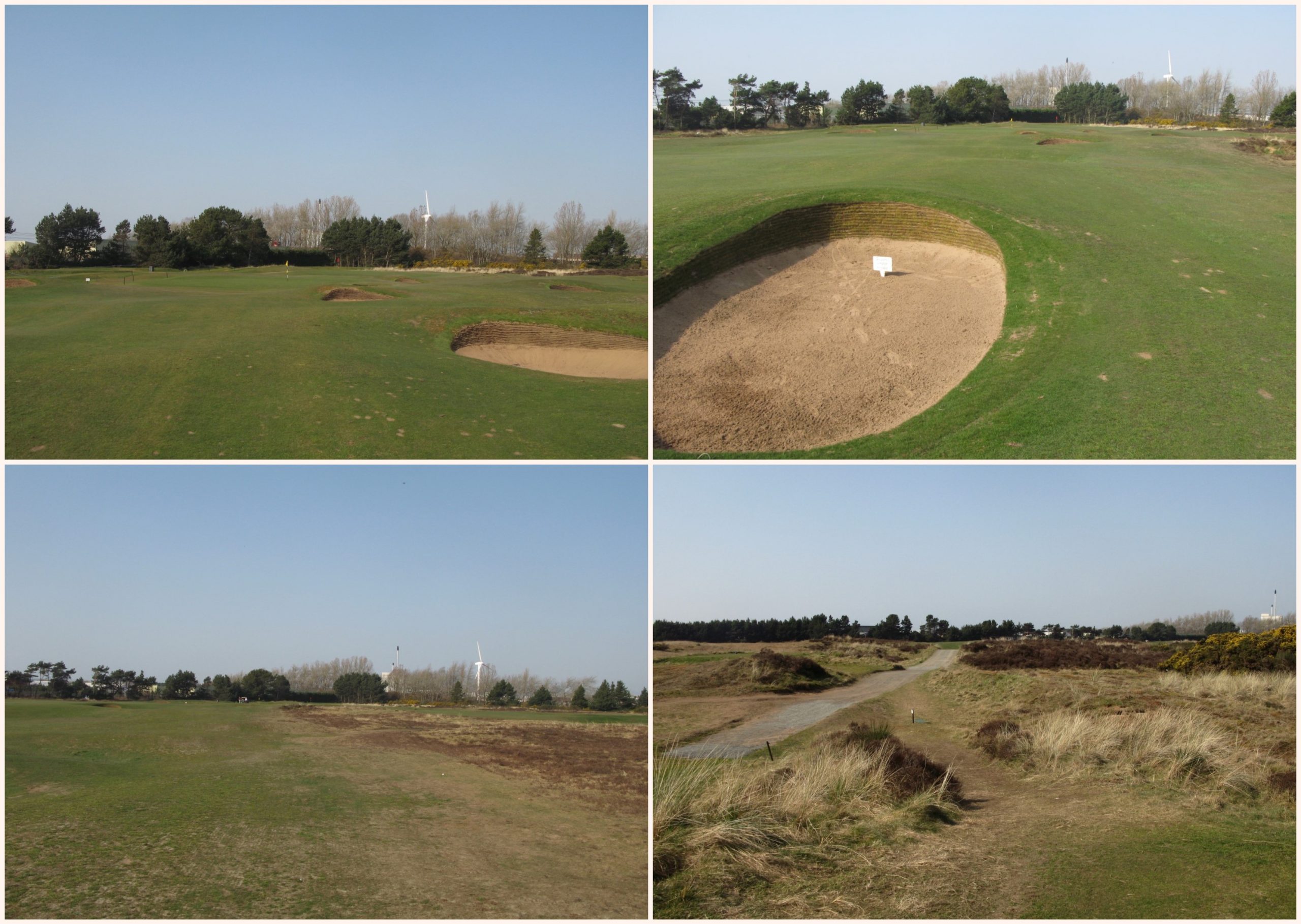
The very difficult long par four 11th (a par five from the white tees), with the inset showing the view at the tee of Colin, Ian and Frank (L to R) with the Grangemouth refinery in the background

The course, laid out as 4 loops of holes, makes it easy to just play a few holes, or cut out some of the track. As I was leaving, I saw a local member, taking advantage by jumping onto the back nine. He was a old guy, in jeans and t-shirt, whose clubs looked like they could have survived the 1924 fire. “Could be the Algarve” I said, commenting on the unseasonal weather. “Aye, yer right, ma five pals have gone tae Turkey and its pissing down and four o’ them have caught that ‘covee’, ****ing brilliant eh!”

Frank and I, played Colin and Ian, in a tightly contested four ball game that went to the last. Well played everyone, a memorable day’s golf on one of the finest municipal courses in the world. Now that is “****ing brilliant”.

Play Grangemouth. Its currently going through a change from municipal to private management, so you never know how long it might be there.

Course Type: Parkland

Par 70 (2 par 5s, 12 par 4s, 4 par 3s)

Distance: 6077 (yellow)

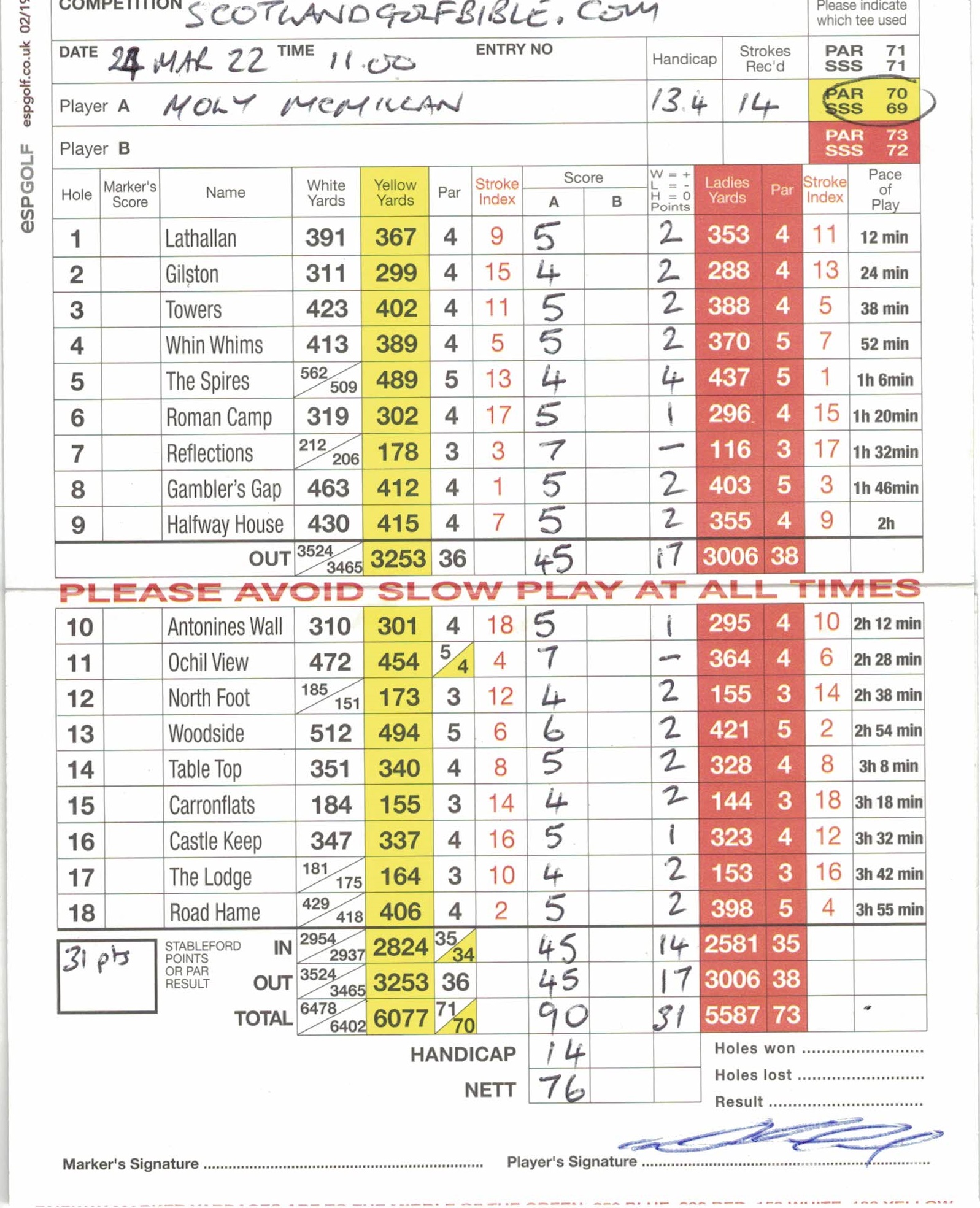
Moly’s Gross score90

Moly’s 90 scorecard at Grangemouth, for 31 stableford points, on this brilliant value golf course.

131. (Glasgow) Gailes Links. 23 Mar 22.

I wonder how many visitors drive to Killermont to uncover this true links test?

Round £110. Par 71. Course Rating / Slope Rating (yellow) 71.5/130. Value (out of 5) – 3

I probably know more than most about Scotland’s golf courses, plus I also lived in Glasgow; one of my son’s attended school in Killermont. Despite this, I find a geography lesson is needed for ‘Glasgow’ Gailes as I almost ended up back in Glasgow to play at the Gailes Links. That would have been a big mistake!

The bunkers at the first hole, a par four of 341 yards, serves notice of what lies ahead at Gailes Links.

Glasgow Golf Club was established in 1787 by the wealthy men of Glasgow making it the first club in the West of Scotland, and the ‘9th oldest club in the world’. It retains an exclusive air and its main headquarter club, based in Killermont in Glasgow, is not open for visitors, other than as a members’ guest. In 1892, the club built the Gailes Links course, initially designed by Willie Fernie, just south of the town of Irvine on the North Ayrshire coast. It is the most northerly of the great set of Ayrshire links courses, starting from Turnberry about 30 miles south. Since its inauguration the Gailes Links has been called ‘Glasgow’ Gailes, in part to distinguish itself from Western Gailes which it adjoins. Hence the confusion about its location. The Glasgow Golf Club might hold the record for the biggest distance between two club courses.

The ‘gorsy’ remains, where trees used to be, on full display at the 3rd, the challenging par 4, stroke index 1 hole, at Gailes Links.

The layout as it exists today, required a redesign by Willie Park Junior in 1912. Furthermore, and controversially, the course has undergone a complete transformation in the last few years, having uprooted tens of thousands of trees. I got mixed feedback from some members about the ‘carnage’ of the trees, which I understand is the reason that the Gailes Links course has been removed from the Open Qualifying rota.

The delightful fifth green complex at Gailes Links, with the social housing of Irvine in the background. A beautiful contrast.

One of the members said the resulting treeless course is much easier, as it has become a wide open links course. On at least two occasions I played from where trees would have been, likely saving me 4 shots. The courses main defense is now through clever and some severe bunkering – other than the westerly prevailing wind of course! This bunkering became sharply evident to me when, after a sound opening 5 holes, being called through by a 4 ball grouping, who then witnessed my 6, including 4 bunker shots, at a short par 3!

The 6th, the first of only three par 3 holes at ‘Glasgow’ Gailes.

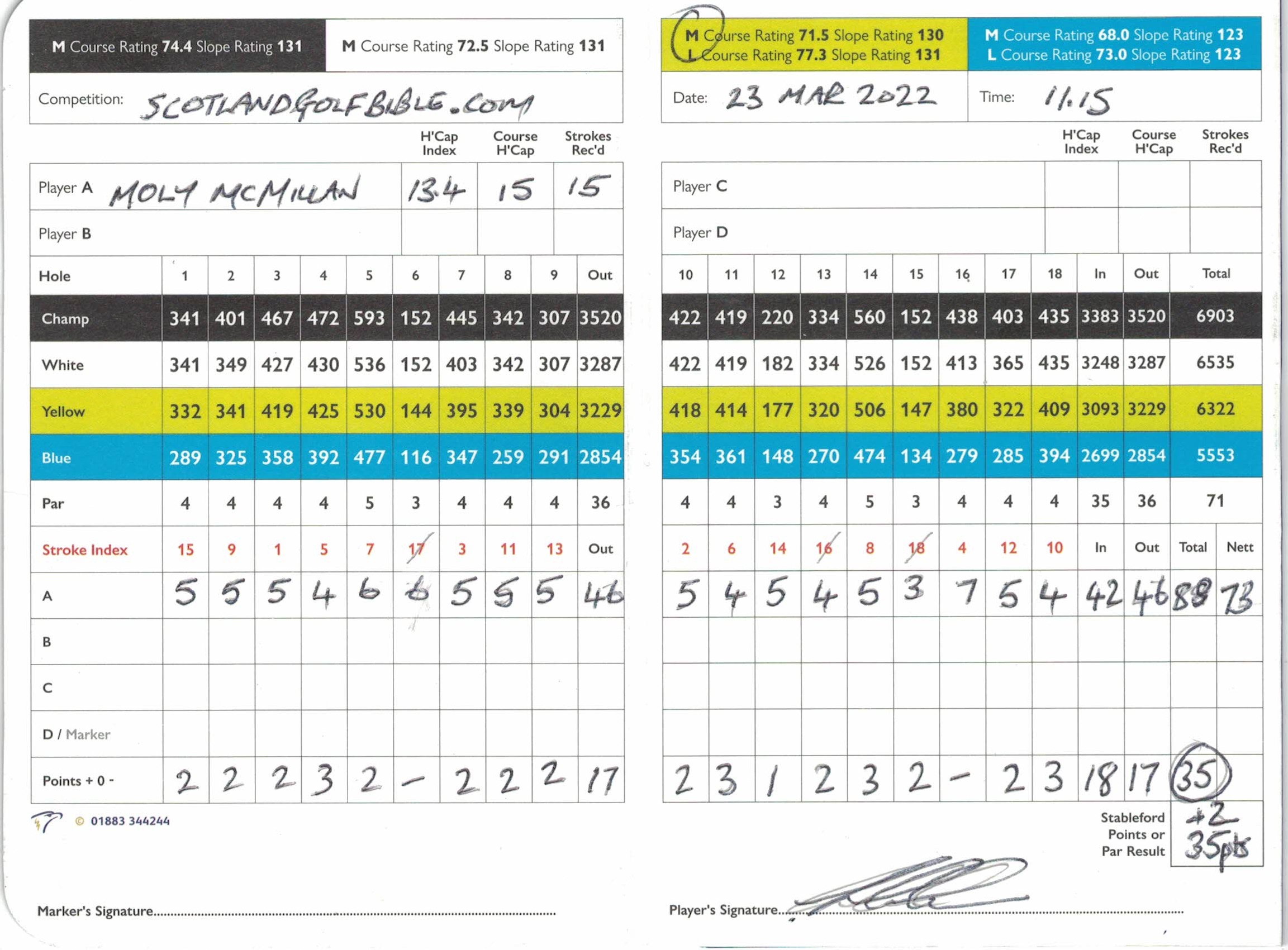
My six at the 6th, provides a lesson how to score well at Gailes. Study the course guide and stay away from the bunkers, some of which are out of sight. I actually played well for my gross 88, albeit the course was playing short due to the very dry March weather. Along with no wind and sunny weather it felt more like the Algarve for the time of year.

The only blind tee shot at Gailes Links is at the 7th (bottom right of the collage). There is much more space right of the ‘eye’ line, especially with the large scale tree removal.

The course is long at over 6300 yards from the yellow tees, and comprises a zig-zagged ‘north/south out and back’ layout, with about 4 transverse holes. The resulting layout provides a great many subtle changes of direction, which must be very challenging when the wind gets up.

The 9th is the shortest par 4 at Gailes Links, at 304 yards, but well bunkered at a typical driving length for most players, who might be best to play a longish iron off the tee, to avoid the sand.

Without the trees, being wayward off the tees is not penalised, especially as there is only one ‘blind’ tee shot (par four 7th), and only one ‘blind’ approach, at the 14th, one of only two par 5s on the course. Along with only three par 3s, this makes the main challenge to score well, being your long iron/hybrid game being up to the challenge of the several par 4s over 400 yards. The resulting par is 71, although the yellow course rating is 71.5, with white being one more.

The approach at the 14th, a short but good par 5, where the long hitters will be tempted to reach the green in two, but will require to avoid a narrow bunker filled gap (above) about 100 yards short of the putting surface.

On the day I played, several of the bunkers were GUR, although not the ones I found at the 6th (my only bunkers of the day). I felt the winter rate I paid of £60 a little steep, with a few winter tees still in play, and despite the dry weather there was surprising indications of muddy locations – I wondered if that was a legacy of the tree removal, and impact on the drainage?

The local pro “Arthur” was really friendly and very welcoming, and therefore worth a mention.

If you get lucky with a winter rate in dry conditions, its fairish value, but the main fee of £110 for a mid week summer round, is not great value and getting out of range of affordability for most.

Course Type: Links

Par 72 (2 par 5s, 13 par 4s, 3 par 3s)

Distance: 6322 (yellow)

Moly’s Gross score88

Moly’s Gailes Links scorecard – 88, best round in a while.

130. Kilmarnock (Barrassie). 22 Mar 22

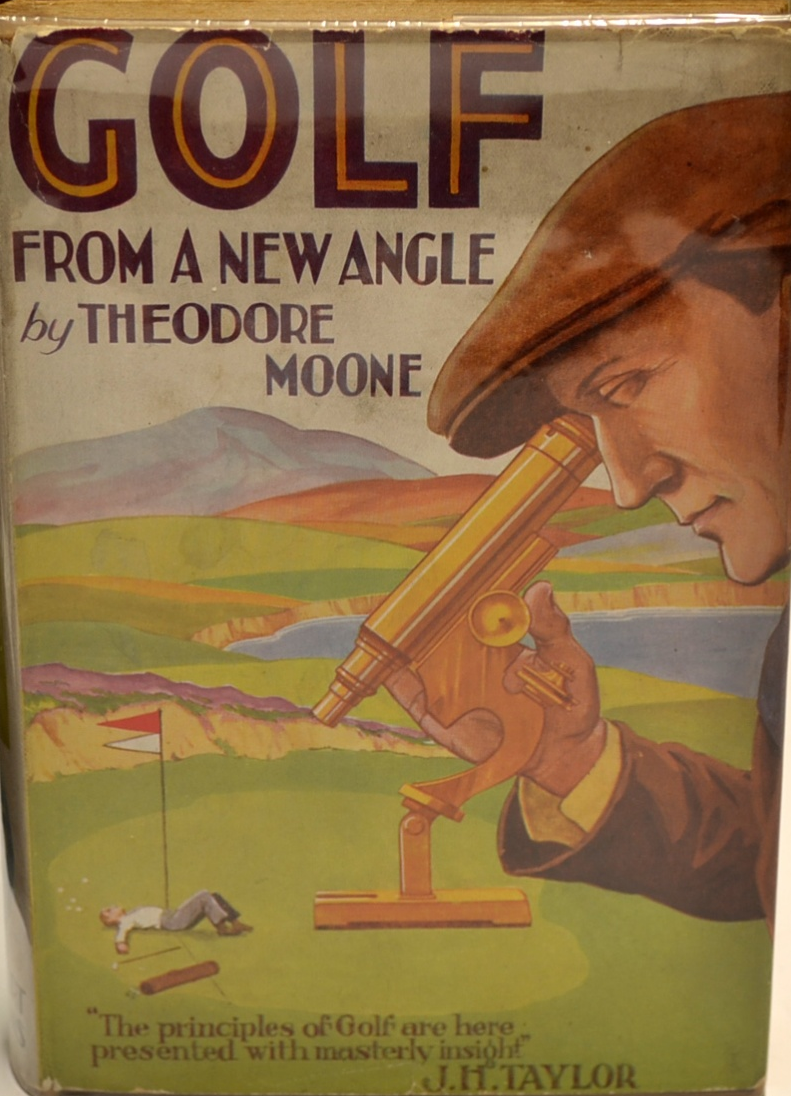
A course to play to help appreciate “Golf; from a new angle”

Round £95. Par 72. Course Rating / Slope Rating (yellow) 71.9/125. Value (out of 5) – 3.5

The Ayrshire coast is home to some of the finest golf Scotland has to offer. Barrassie used to be a village in its own right, but is now considered part of the town of Troon. Ironically, it was the ‘long’ distance from Troon golf course, that caused the locals of Barrassie to establish a course in 1894, designed by the Prestwick professional, John Allan.

It was in the early 1930s that a new 18 holes course was designed by Matthew M Monie, who was an author who wrote under the pseudonym ‘Theodore Moone’. As for the course in play today, it comprises nine holes from Moone’s 1930s design and nine new holes built in 1997. Nine of Moone’s original holes are retained as a 9 hole course called ‘Hillhouse’.

The scientist, golfer and author, Theodore Moone, proved that golf course architecture was also one of his numerous talents, with Barrassie being one of only a few courses he designed. I suspect we all recognise the subject of the book’s cover!

Search for Moone on the internet and you will be presented with opportunities to buy his book, “Golf from a New Angle”, based around fictional letters about the fundamentals of golf. Look a little deeper and his scientific approach to golf, may have been way ahead of his time – I suspect Bryson DeChambeau may be a fan.

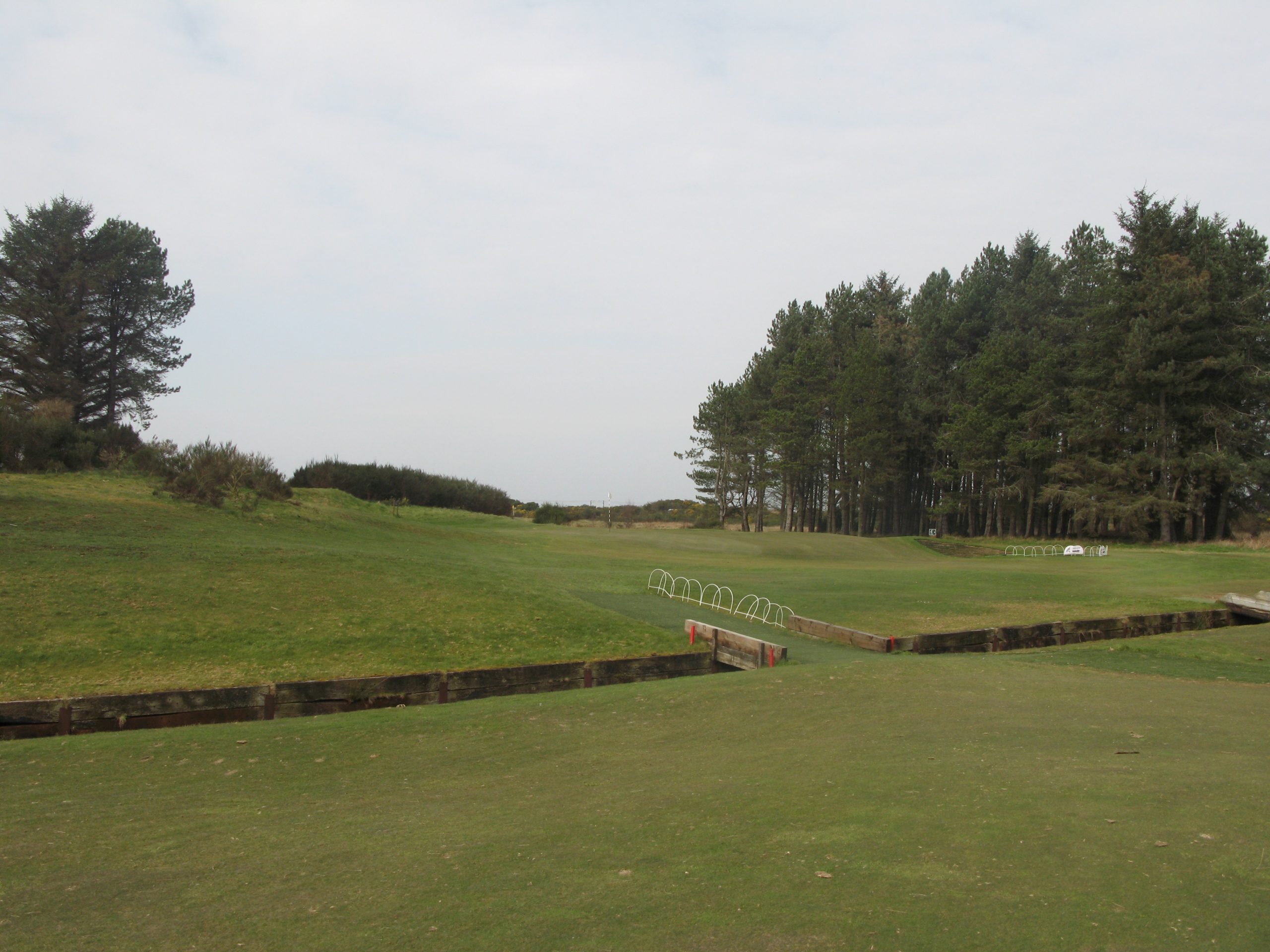
The brilliantly designed approach at the par four 3rd, the stroke index 3 hole. Note the obscured view to the left hand side of the green and the sharp left to right slope towards the front right bunker; coupled with the burn 40 yards short of the green, this is a great hole, typifying Barrassie’s architectural guile. It is stroke index 1 on the Ladies card.

Although no sea is in sight, this is unquestionably a classic links course of a high standard. Playing at almost 6500 yards from the yellow tees, and with several dog leg holes and semi-blind approaches, this is also a course with plenty of guile. It was handy that I played in a group that included a long term member, who was on hand to offer advice when needed.

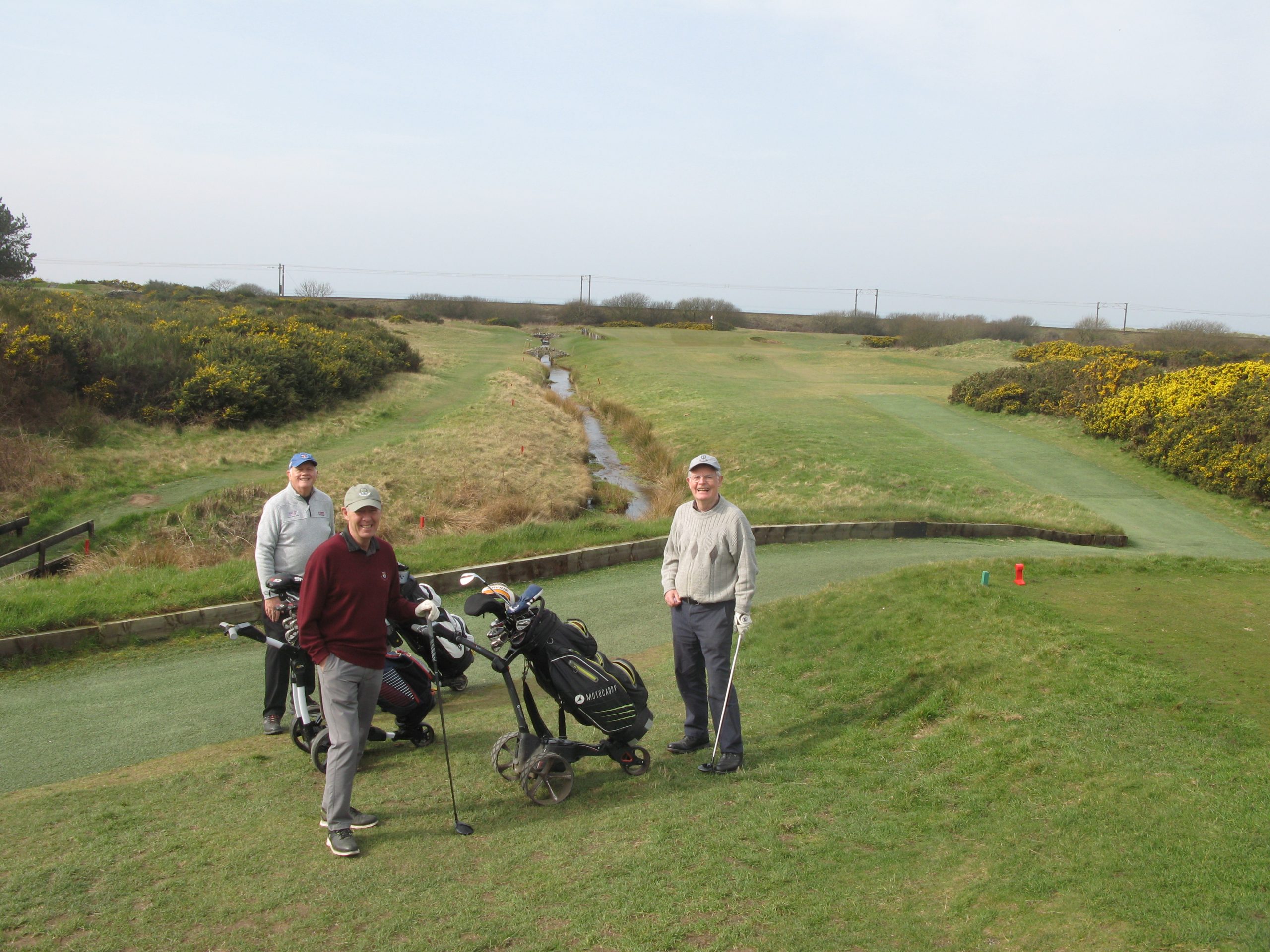
The aesthetic, or terrifying, view of the par three 4th hole, at 150 yards. Here, old pals, from left to right, Brian, Douglas (our host) and Stephen, look happy – before teeing off! I think this might be one of the most obvious “lateral hazards” in Scotland?

Nevertheless, I suspect you need to play Barrassie a great many times to appreciate which sides of the greens to play into, as there are often ‘hidden’ gullies and slopes which make getting up and down impossible for all, but the most gifted players, if you are “short sided”. The club has a delightful video on it’s website here – once viewed, it is clear why Barrassie has hosted many top amateur competitions and is also an Open Final Qualifying venue.

The majestic framing around the newly re-built par four 13th hole.

The course was in magnificent condition for a mid March day, with the fairways and greens playing as if it were already June. The bunker conditioning was the only thing I would criticise, but even that was likely down to the legacy of the pandemic which was just easing off.

Barrassie member Douglas driving at the 401 yard par four 17th hole.

We all played about the same with respect to our handicaps and my partner, Brian, and I, halved a closely fought 4BBB game against Douglas and Stephen, having come back from 3 down (well played Brian!). It is always nice for a ‘friendly matchplay’ (although an oxymoron for some) to be in the balance until the very last putt is holed.

Stephen eyeing another fine drive down the middle – almost right through the eye of a needle.

One thing about Barrassie worth mentioning; the winter golf rate of £45 is brilliant value, especially when compared with the £95 summer fee, an amount reflecting the significant recent price growth I’ve witnessed across Scotland. I think this has been driven by both the increased demand for golf due to the pandemic and also the ongoing tussle between clubs’ loyalty to their membership versus serving the needs of the peripatetic golfer, for whom membership is not desired. The latter conflict is a matter of fierce debate within the Scottish Golf Union organisation.

The 17th green, showing the great conditioning of the course in mid March, and the little gully left being a treacherous ‘leave’, for two of us.

I once heard the great football manager Bill Shankly describing a Stallworth player as “honest” meaning they always gave their all and could be completely relied upon. That’s how I felt when playing Barrassie – it is an “honest” links golf course, if such a thing is possible.

Course Type: Links

Par 72 (3 par 5s, 12 par 4s, 3 par 3s)

Distance: 6460 (yellow)

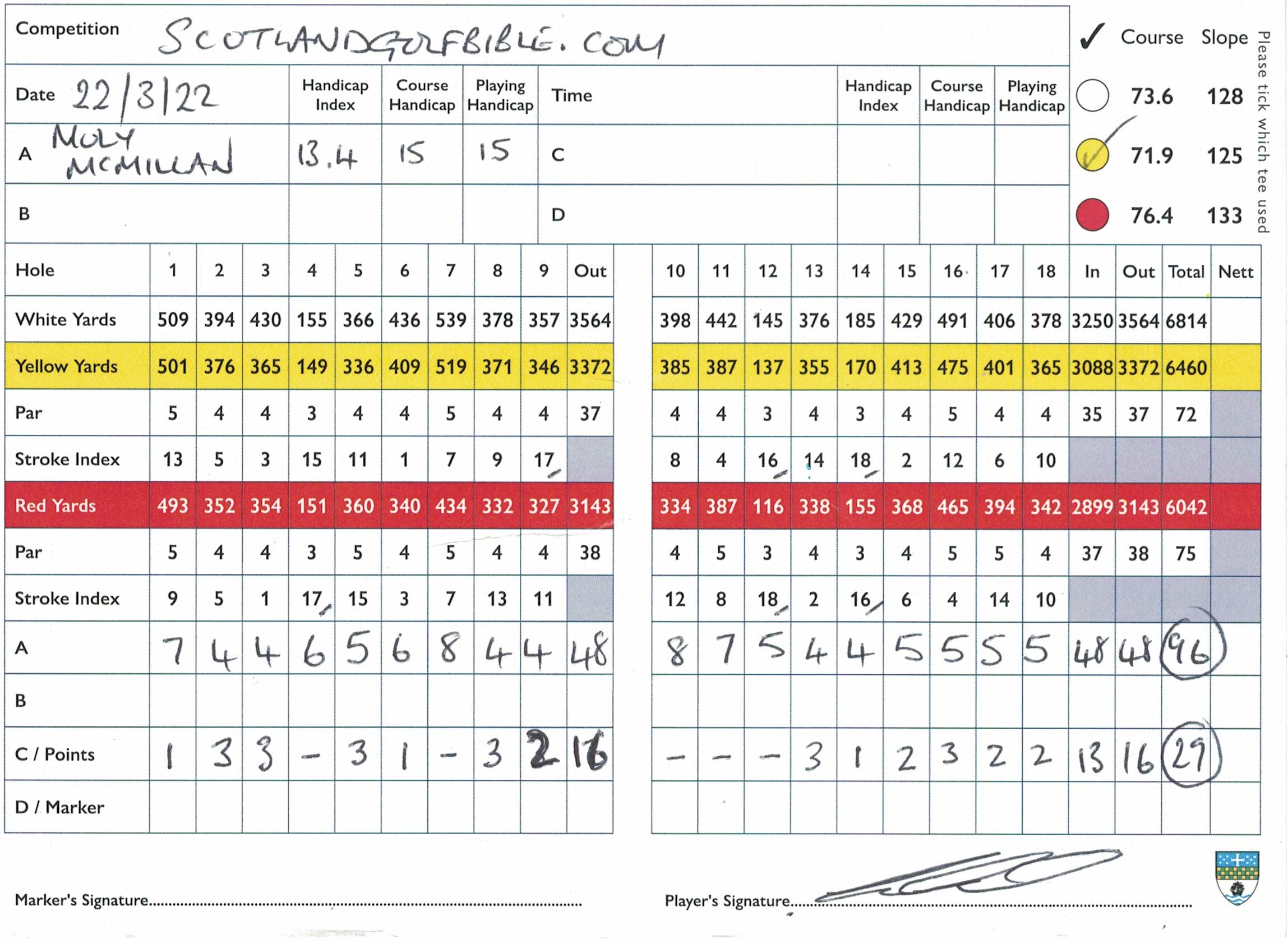
Moly’s Gross score96

Up and down round of golf. Gross 96, but still 29 stableford points.

128. Longniddry. 28 Sep 21.

High architectural pedigree at this well rated, but over priced, course that is a tale of two very different surrounds. Is this a camel I wonder?

Round £75. Par 68. Course Rating / Slope Rating (yellow) 69.8/119. Value (out of 5) – 3

Sometimes expectation can get the better of you. I’d read that Longniddry, one of the courses along the so called “golf coast” of East Lothian, had been designed through its evolution by no less than four of the worlds best course architects.

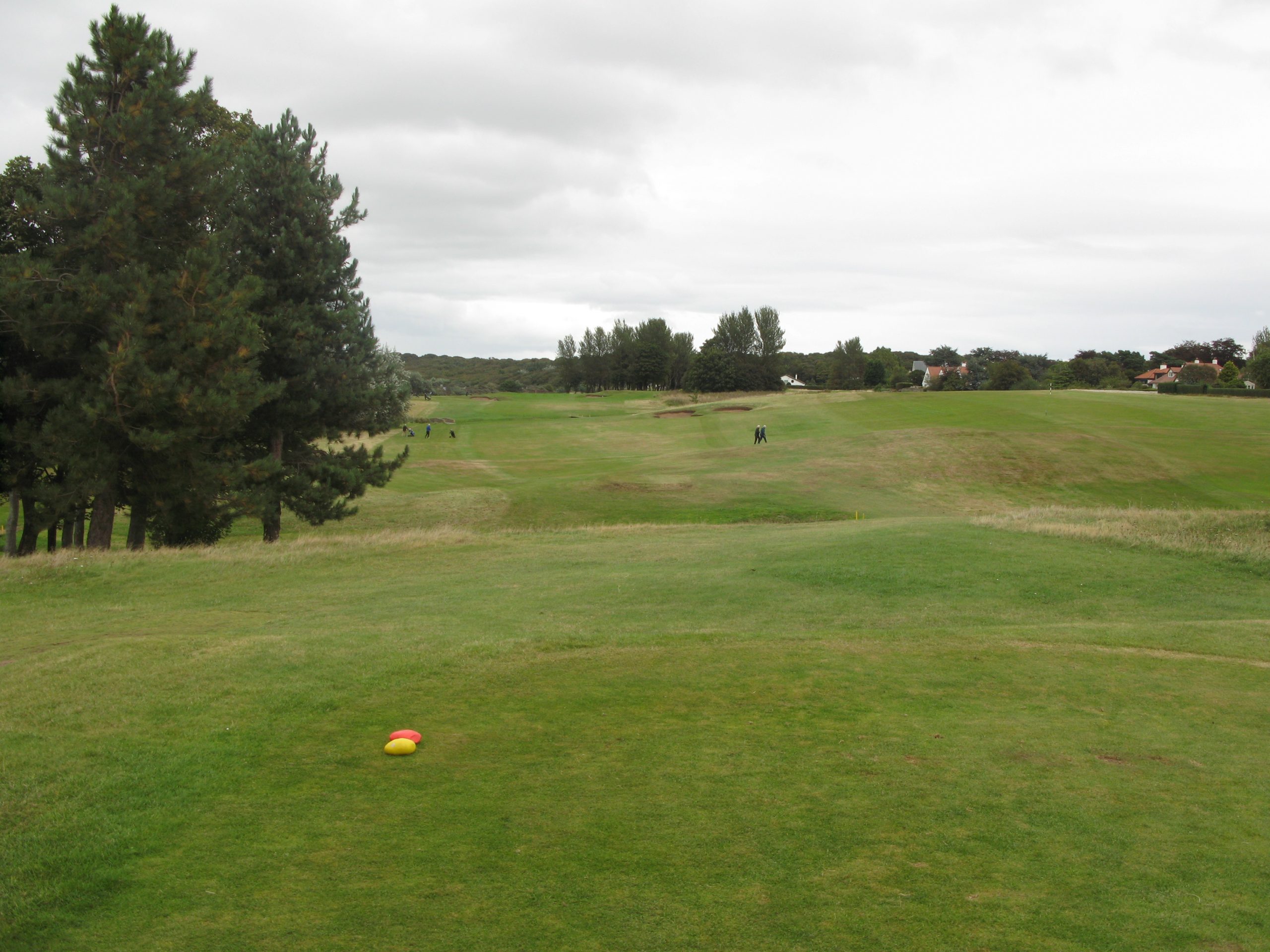
Gordon at the first. Lucky to miss the bunker off the tee, he sadly played his second into trouble to the left (see the bushes!). Always a great start:(

Harry Colt laid out the initial design in 1921, with subsequent adjustments by James Braid, Philip Mackenzie Ross and, finally, Donald Steele. That’s quite a pedigree.

Sir Alec Issigonis, designer of the original Mini motorcar, said, “a camel is a horse designed by committee.” The meaning was intended to convey how groups can be an ineffective method of development. Alternatively, “Too many cooks..” could also be used, in the same context.

Brian, again displaying his well coached follow through, here at the par three 6th hole, surrounded by greenside bunkers. I think all 4 of us might have been bunkered here – teamwork:).

These comments came to the fore of my mind when playing Longniddry, along with three good friends with whom I had worked with at Apex Scotland, a not for profit organisation dedicated to supporting people with convictions find work and improve their lives.

The plateaued 5th green, with bunkering awaiting the misjudged approach shots.

Set in the affluent village of Longniddry, only 20 minutes by commuter train to Edinburgh, the course occupies a relatively contained acreage, and has many £1m++ houses adorning several fairways. It is a heavenly place to reside for golfers. But the impression is that Longniddry is not a stuffy place, and one of the few “Golf Coast” upper rated courses that allow booking and discounts through the Golfnow app. That is to be applauded, but it can backfire a little; after booking a round at £75 a head with the clubhouse, I found out about a week before that tee times very close to ours were available at only £50 – on phoning up to challenge our fees, it must be said the club responded well. I do recognise the difficulty for clubs, especially when third party marketing app tee time pricing is sometimes controlled by the club, sometimes by the app marketers direct.

Frank putts out on the 173 yard uphill par three 13th, with backdrop of the Firth of Forth.

The course is very interesting. It has wide fairways, making for a relatively straight forward game off the tees, especially as the fairway bunkering is not as penal as some of its Lothian neighbours. The green surrounds are at times a real challenge, especially at the four par threes, where I lost count of the number of greenside bunkers. Unfortunately, the bunkers were still suffering (sic) from the Pandemic, like much of the population. If you plan to play Longniddry, spend a bit of time practicing your bunker play.

The par four 11th hole at Longniddry the start of the more ‘links’ feeling holes.

The fairways were fairly decent when we played on a lovely late September day. But the teeing grounds needed a little more care. The greens were good and clearly well watered.

The layout is a tale of two quite different environs. The course was created largely by carving out an area from the Boghill Wood, and holes 5 through 10, in particular feel like a woodland course. From 11 onwards the course opens out into a much more traditional links land layout with most holes with gorse in play.

The tough par four 7th hole at Longniddry, in the tree lined section of the course – stroke index 1.

The course is quite long at over 6000 yards from the yellow tees, given that it is a par 68. The real question I have, architecturally, is why none of the renowned architects after Colt said, “what about extending a couple of longer par 4s to make par 5s”, getting the par to (say) 70. Without this, you are left with 14 par 4s, with precious few birdie opportunities for the higher handicappers. The 17th/18th, both challenging par 4s of well over 400 yards, could relatively easily be altered, as could the long par four 3rd at 450 yards. I’m certain it must have been a debate down the years.

The short 16th hole with some of the residences of the well heeled in the background – I suspect that’s envy on my part?

The stoke indices also seemed to not reflect the difficulty. For example, the well bunkered par 3s, being labeled as the 4 easiest holes (not so, surely!), and the last, a long par 4 at 420 yards (yellow) being only stroke index 12? It would be intriguing to get the membership views on this.

There were two stand out holes for me:

> The 5th, a dog leg left par four of only 320 yards, with the approach played to a green on a plateau fronted by two mass grave like bunkers. Stay well right with the drive, and commit to at least one extra club on the approach. Its the most un ‘links’ like hole.

The cleverly designed par four 14th hole, where the burn comes into play for all but the longest off the tee. Good green complex.

> The 14th, a difficult par four, where only the long hitters can confidently drive over a ditch at around 200 yards, but the downhill fairway means that even a hybrid might run into the ditch. Then the approach is uphill to a carefully set green with difficult slopes.

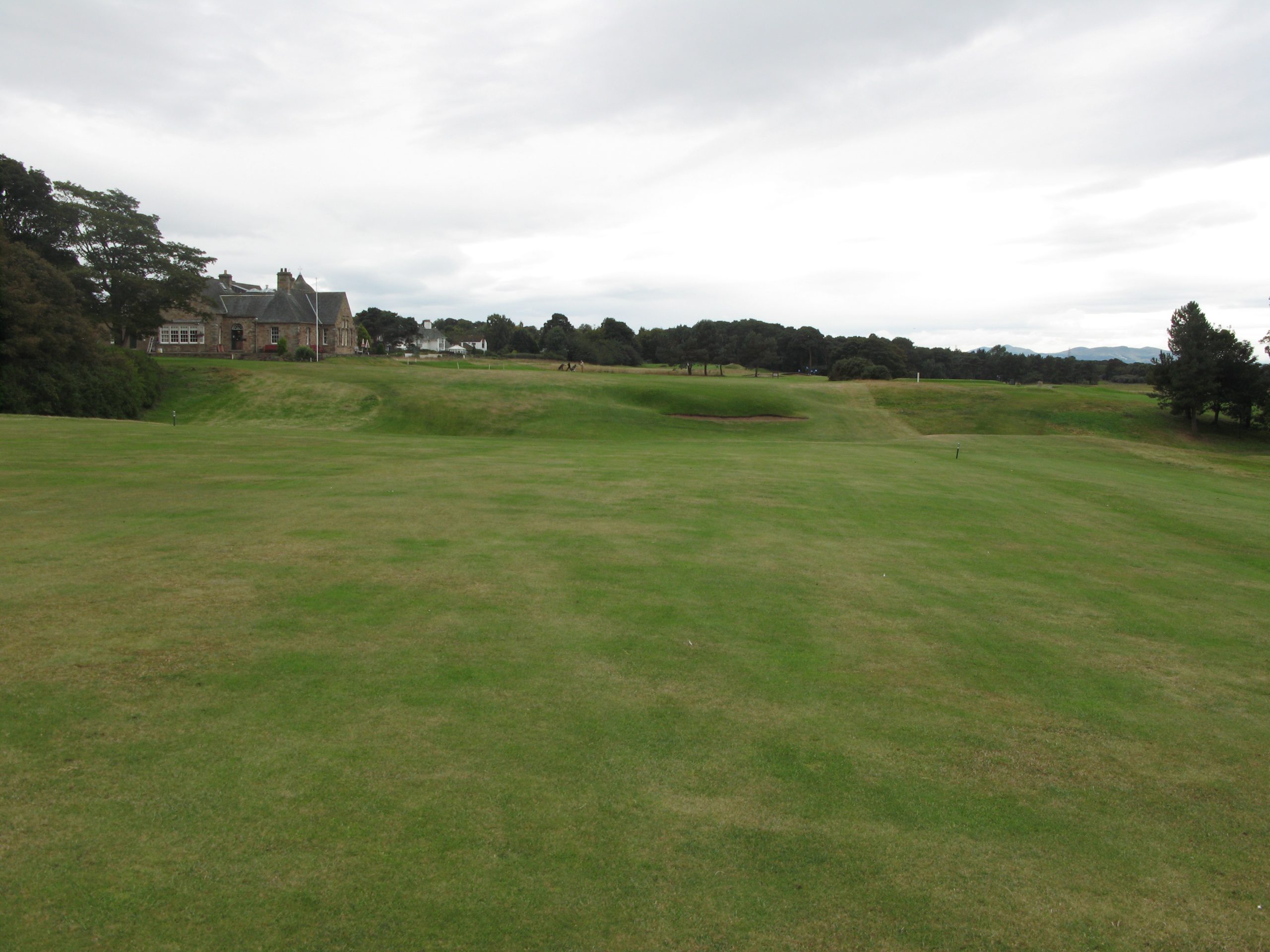
The nice clubhouse awaits at the 18th – a demanding finish, more difficult than the SI of 12, in my opinion.

I played pretty well. After a 10 at the ninth, having been in trouble on both sides of the fairway, I came back in 41 (7 over), to actually win our small stableford competition. The winner was meant to get their meal paid for after by the other 3, but a number of my colleagues had to rush off, quashing my opportunity to milk any praise. But I’ve not forgotten!

Finally, going back to the camel proverb. A camel is actually a highly efficient design for its environment, in which horses would soon die. You can make your own mind up about the course being a camel or not.

Finally, finally. It is reported that Mary Queen of Scots played in the area of Longniddry. But how so, I say, when the location of the course was previously the Boghill Wood?

Course Type: Parkland/Links

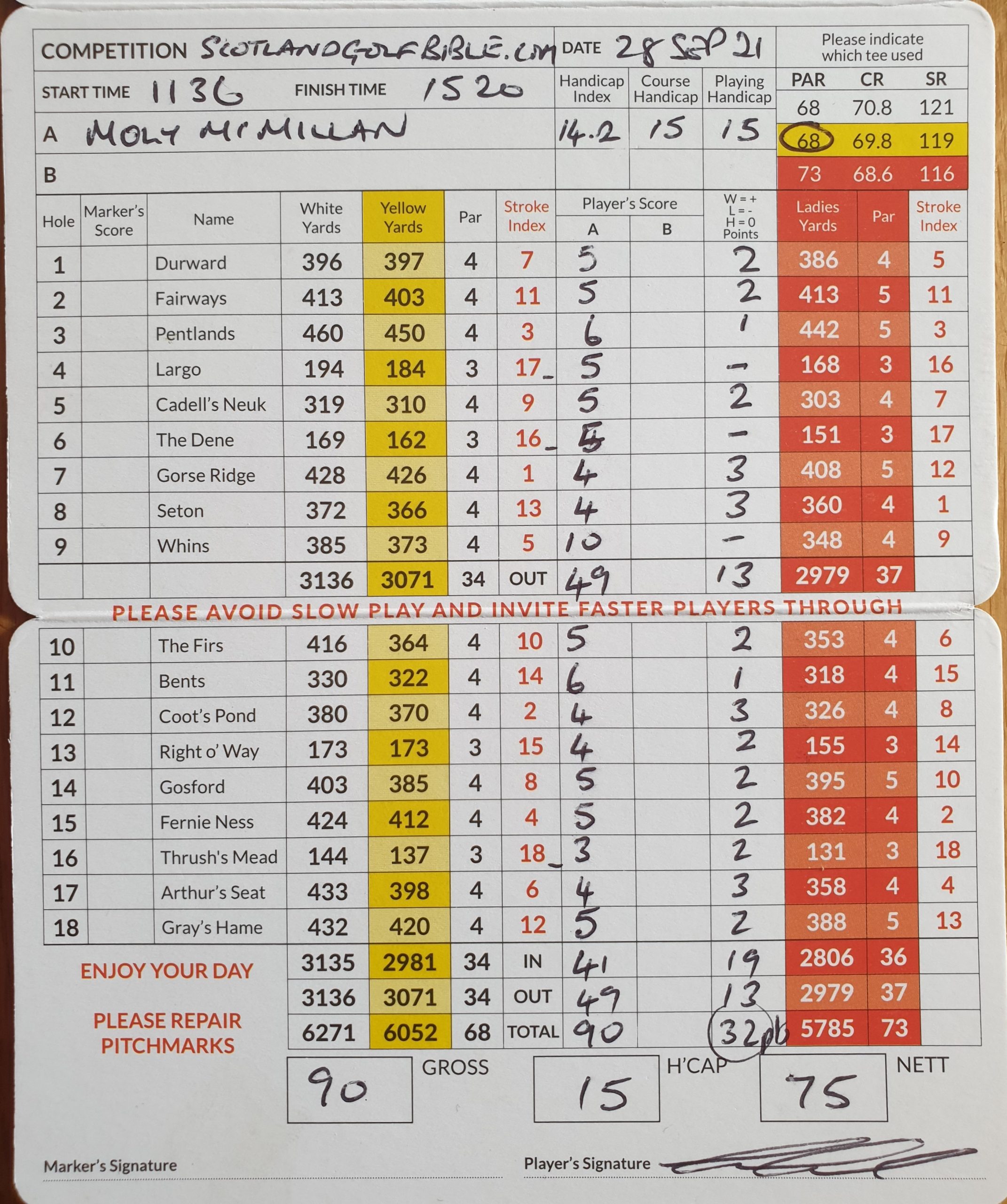
Par 68 (0 par 5s, 14 par 4s, 4 par 3s)

Distance: 6052 (yellow)

Moly’s Gross score90

Moly’s Longniddry scorecard – a 90 with an excellent 41 on the back 9; but, a 10 on the 9th!.
« Older posts Newer posts »

© 2025 Scotland Golf Bible

Theme by Anders NorenUp ↑