A guide to green fee value for money

Category: Course Owned By (Page 35 of 45)

42. Murrayshall Lynedoch. 6th June 2016.

The “junior” Murrayshall course provides a surprisingly outstanding challenge  

Round  £30 ( variable on-line).   Par 68.  Value (out of 5) – 4

The Murrayshall estate, first built in 1664, was established as a commercially successful Country House hotel in the early 1970s, following the sale of the estate by the Norrie-Millar family, of whom Francis Norrie-Millar was one of the key instrumentalists in building the General Accident insurance company in nearby Perth, only 3 miles to the west of Murrayshall.
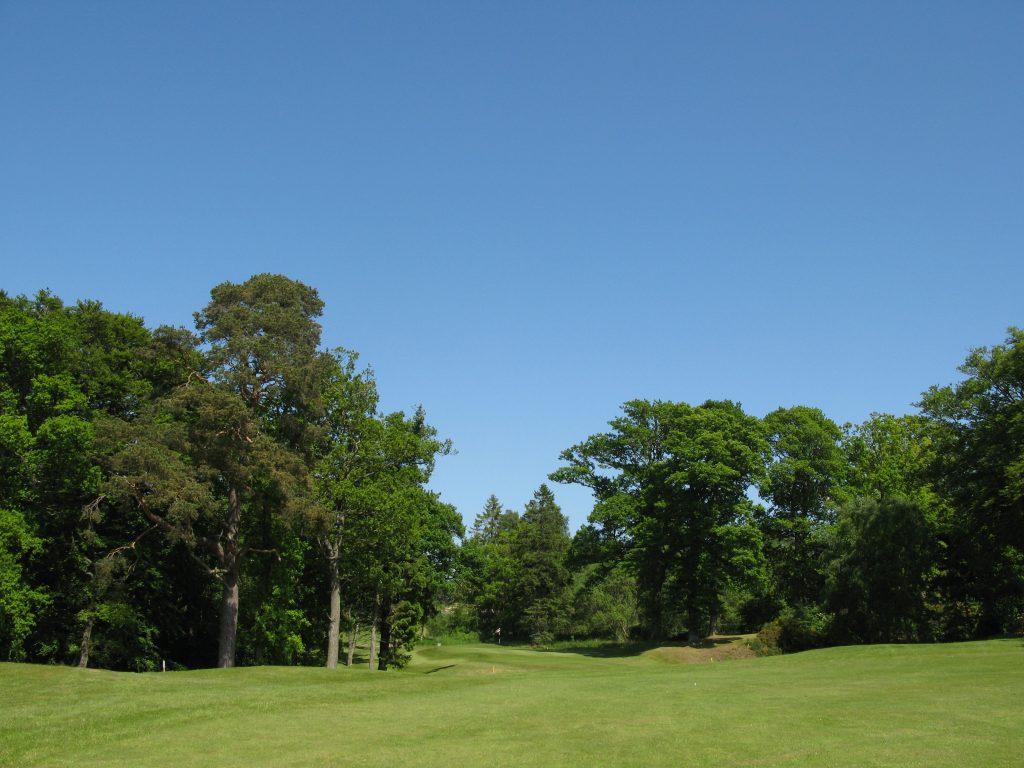
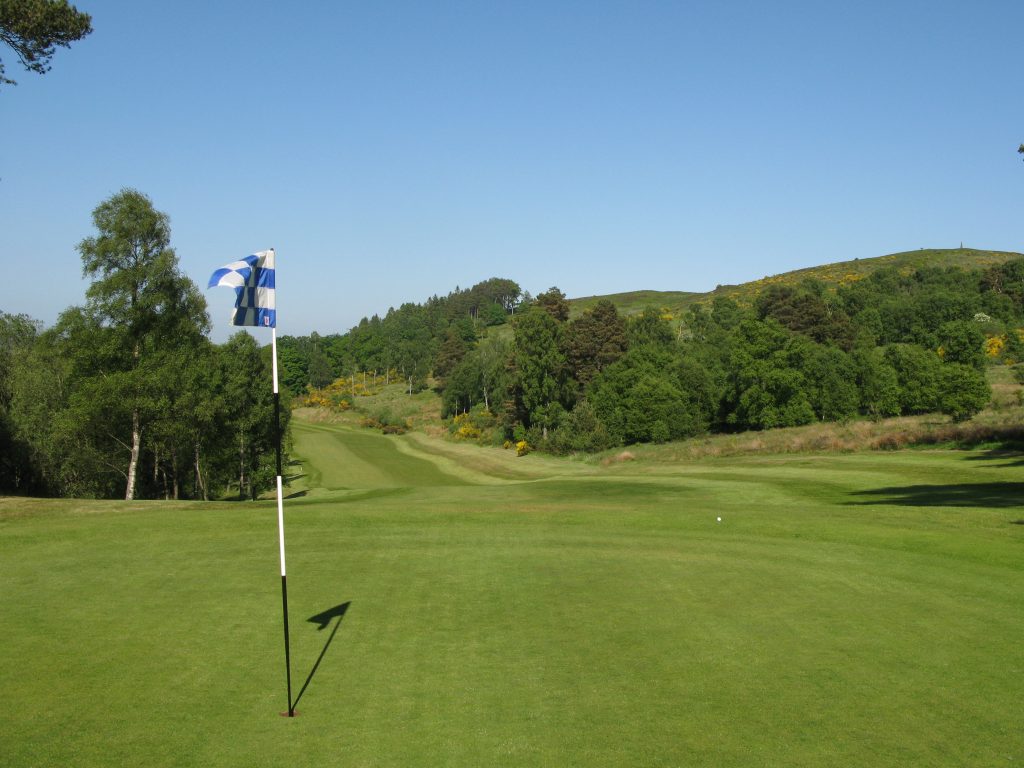
Approach to the par 4 second - requiring a well placed tee shot, into a narrow green over a deep ditch.

Approach to the par 4 2nd – requiring a well placed tee shot, into a narrow green over a deep ditch.

The esteemed golf architect Hamilton J Strutt (grandson of James Braid’s foreman) designed the original Championship course in the 70s, and returned to design the Lynedoch course which opened in 2000.  The latter course is named after Thomas Graham, aka Lord Lynedoch, who became second in command to the Duke of Wellinton’s Armies in the early 1800s.

Playing the Lynedoch actually reminds you of the Duke of Wellington when importalised in song for “marching them up to the top of the hill, and marching them down again!” There’s plenty of hills to march up and down on the Lynedoch course, which feels longer than its 5279 yards off the white tees.   I wouldn’t recommend carrying a full bag!
The demanding SI 1, par 5 14th hole on The Lynedoch

The demanding SI 1, narrow par 5 14th hole on The Lynedoch

The Lynedoch Course really surprised me for both its quality and character, given that it is very much the junior course at Murrayshall.  It is very difficult to give a single course type categorisation, and is a mix of woodland and parkland/medow, and has some wonderful highland views to the north.  It also has a fair amount of bracken, ditch/water hazards and Disney sized bunkers on some holes.

Given its all round quality and design, it’s arguably better value than the longer Championship course.  It has many memorable holes, starting on the first, a dog leg right par 4, which is much harder than the stroke index of 10 would suggest.  The second, a shorter par 4, starts to lay out the need for accuracy needed here.  Then the 3rd is the first of 6 delighful par 3s, with a hugh amount of variety.
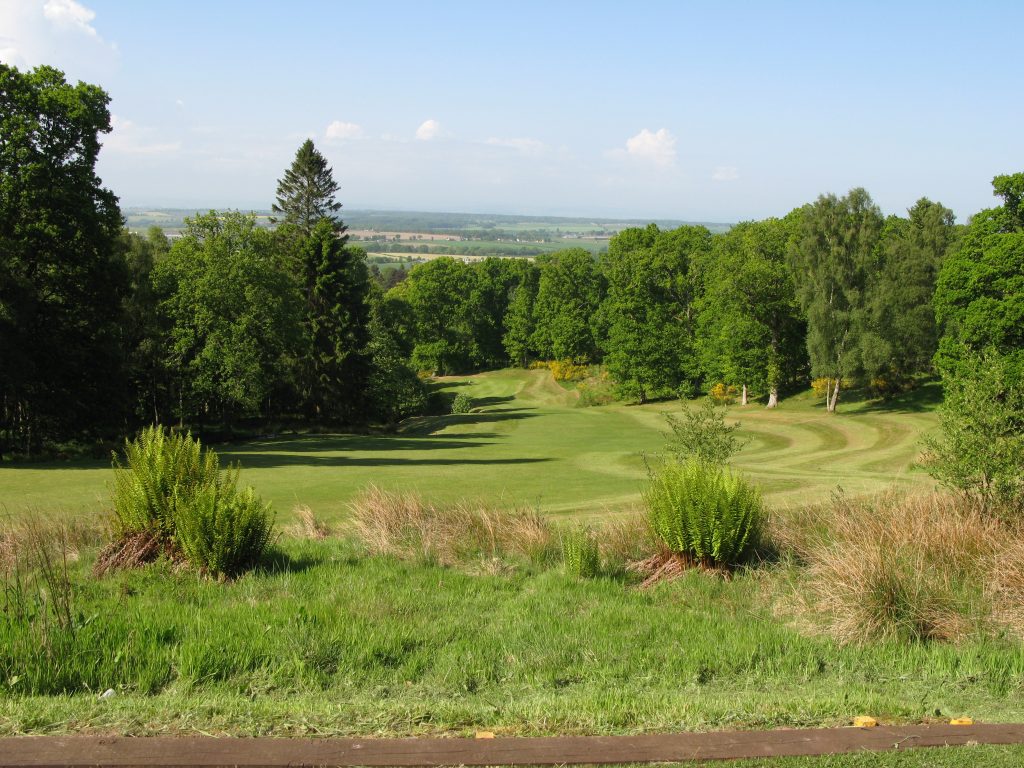
The long par 3 15th tee on The Lynedoch, with deep ditch just visible on the left - cant impagine many 2s here!

The long par 3 15th tee on The Lynedoch, with deep ditch just visible on the left – can’t imagine many 2s here!

My favourite holes were the 14th, 15th and 16th, with stroke indexes 1, 5 and 3 repectively – I rather suspect these holes have defined many match play games here.  The 15th is particularly interesting played as a long par 3 (212 yards) off white but as a short par 4 (294 yards) off yellow.  It requires the most accurate tee shot, due to a right to left sloping fairway into a deep ravine/ditch – which I had to chip out of!
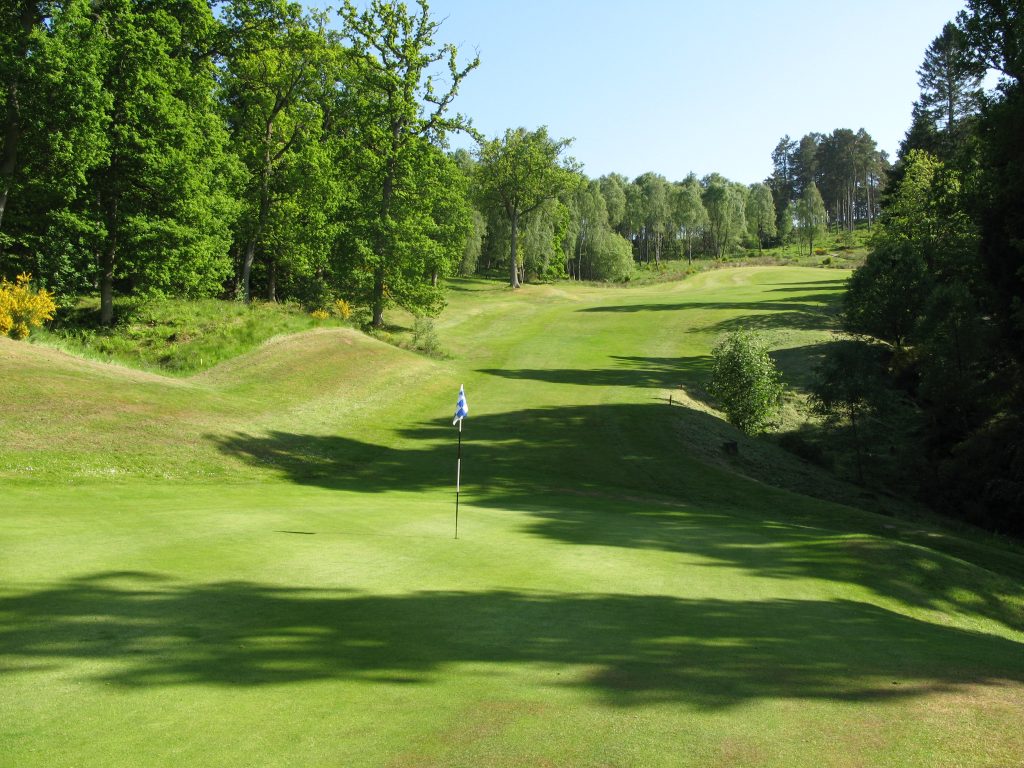
View from green at the par 3 15th (although par 4 from yellow tees)

View from green at the par 3 15th (although par 4 from yellow tees)

The course was in excellent all round condition when I played and I had a very mercurial round of 88 (net 2 over), including 3 birdies for the second time in my life, but unfortunately 2 quadruple and 1 triple bogie!  I think this scorecard rather sums up the Lynedoch course – lots of opportunity and hazard, but very true greens!

I highly recommend playing here.

Some Facts

Course Type: Parkland/Woodland

Par 68 (2 par 5s, 10 par 4s, 6 par 3s)

Distance (white)   5279 yards

Moly’s Gross Score  88
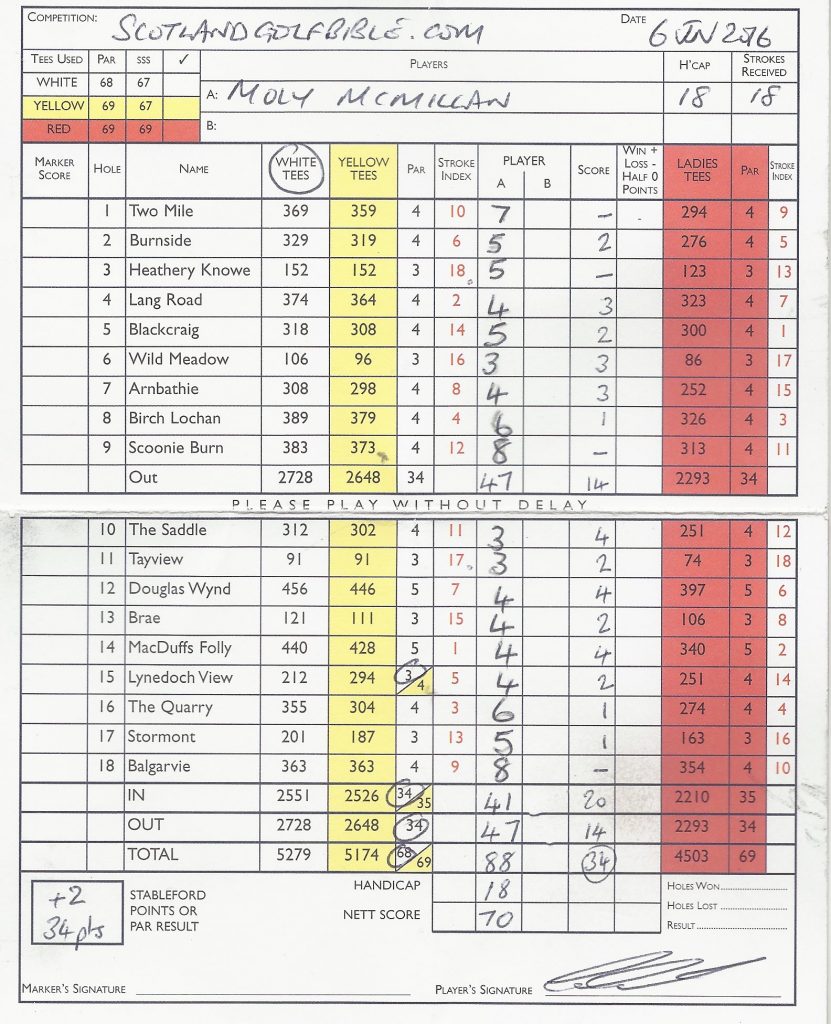
A mercurial 88, with 3 birdies and 2 quadruple bogies!
A mercurial 88, with 3 birdies and 2 quadruple bogies!
41. Letham Grange Glens. 3rd Jun 2016. CLOSED

Mainly open parkland course, with a tough finishing stretch

Round  £30 ( variable on-line).   Par 68.  Value (out of 5) – 2.5

Letham Grange, on the outskirts of Arbroath, has likely had more written about it in court proceedings than in golfing magazines! It is one of the failed attempts in Scotland to create an American style Golf & Country Club Estate similar to Gleneagles, or Wentworth in Surrey.  Opened in 1987 as a full resort, the hotel and many facilities are long since closed.

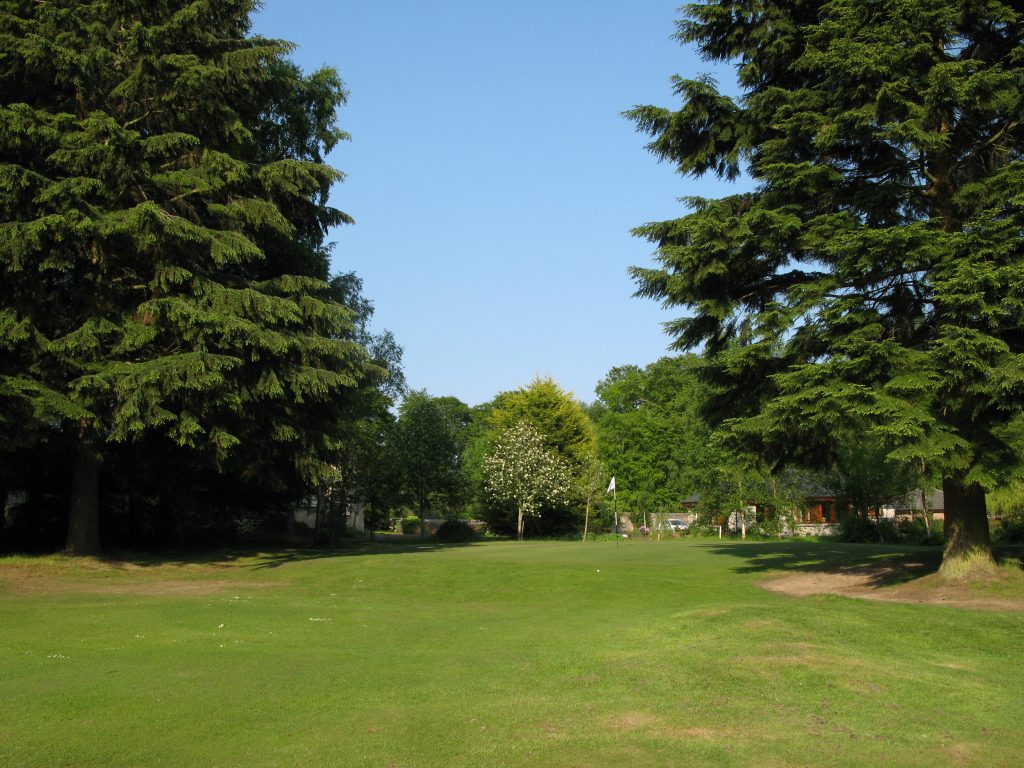
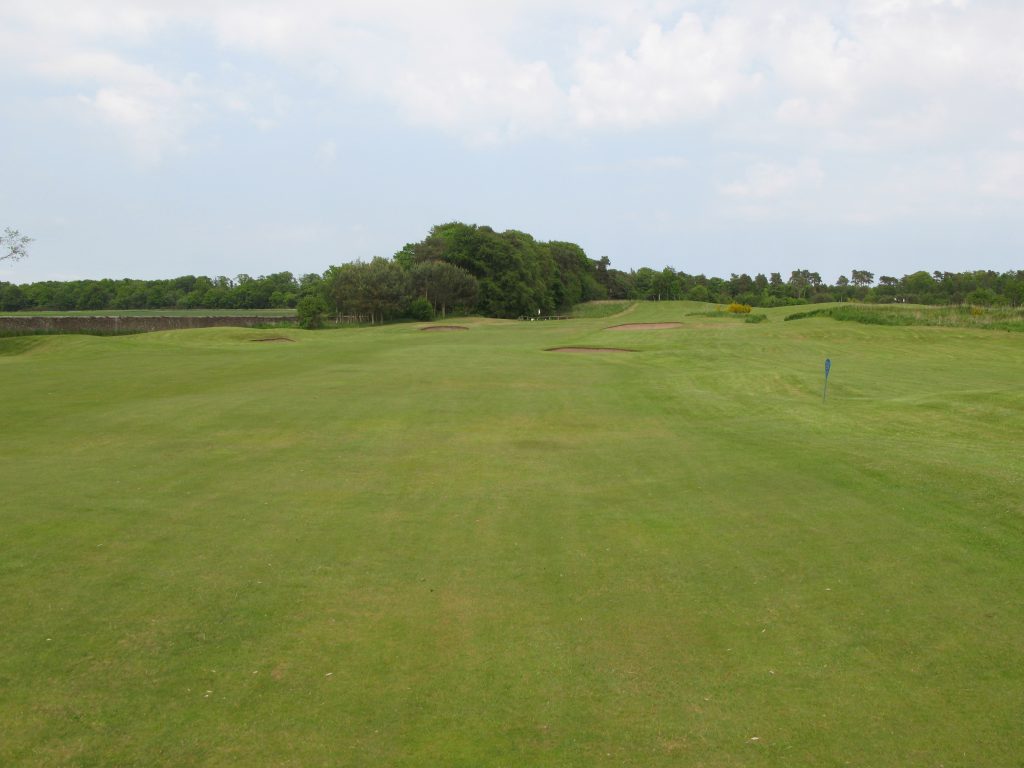
Approach to the 2nd on the Glens at Letham Grange, a typical open parkland hole.

Approach to the 2nd on the Glens at Letham Grange, a typical open parkland hole.

The club members, several living in the many fine houses which still adorn the fairways, now do a great job at keeping the Old course and the smaller Glens course open.

The Glens Course opened in 1992 and is at 5528 yards, much shorter and less demanding than the Old course. The parkland layout is very open for the first 12 holes, but the stretch from the 13th to 17th is much more challenging and will dictate your scorecard.

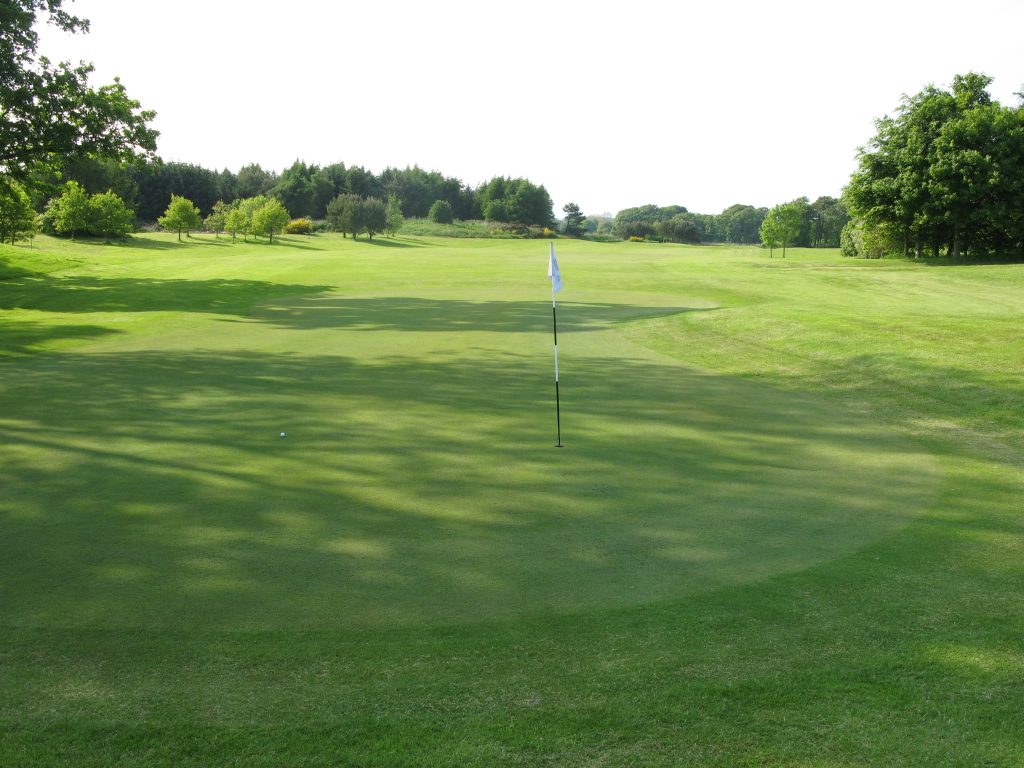
The 9th green at Letham Grange Glens course

The 9th green at Letham Grange Glens course

In particular the short par 4 14th requires a very acurate tee shot; the dog leg 15th needs a straight shot of about 200 yards to the tree lined dog-leg; and the 17th is a pretty scary drive down an avenue of trees about 40 yards wide.

The condition of the course was pretty reasonable, with the highlight being the very well maintained teeing grounds.  However, the bunkers though were actually terrible, with a thin covering of grainy sand over hard packed earth – unfortunately I found several bunkers eventually realising the only way to play them was to chip the ball cleanly off the sand.

The difficult to find small 15th green, part of the difficult stretch of 5 holes from 13 to 17 on the Glens course

The difficult to find small 15th green, part of the difficult stretch of 5 holes from 13 to 17 on the Glens course

The price of the Glens is £30 per round and I was able to play on the Carnoustie Country offer, and paid only £15.  At the full price its not the best value by any means in Angus.

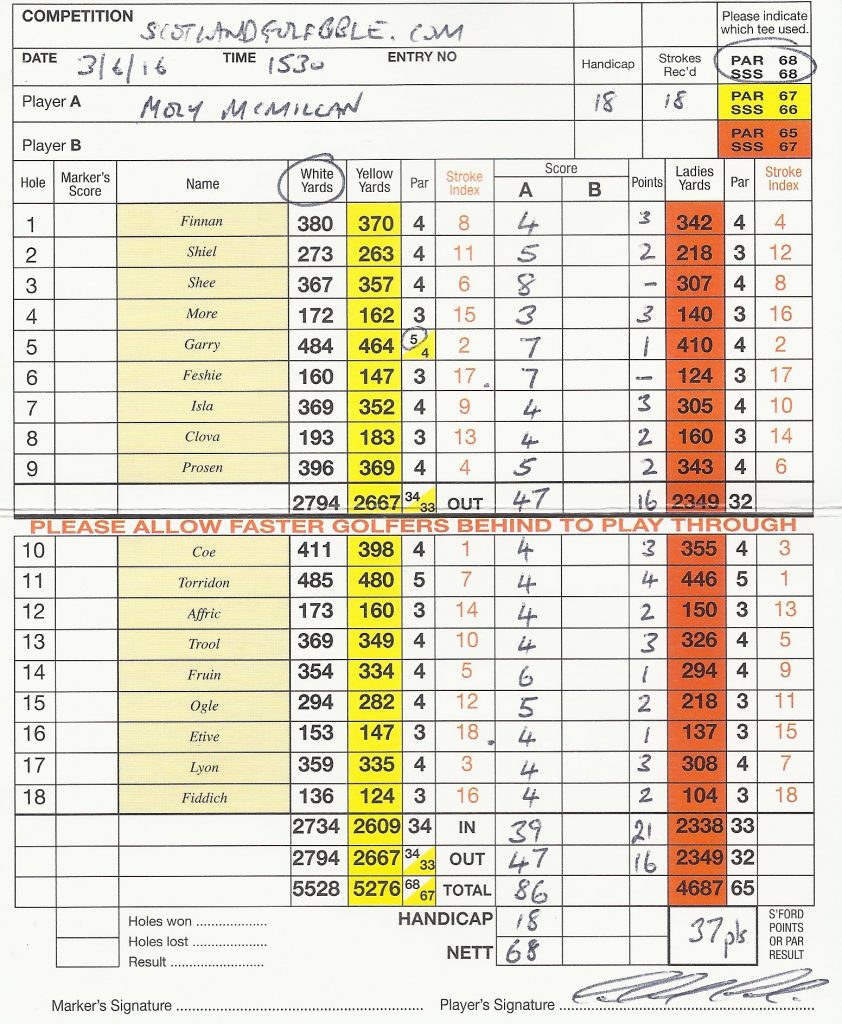
I had a good round with 37 stableford points (using the new 9/10s allowance), and played to my new handicap of 18, which included an 8 on the par 4 3rd, needing to take 2 shots to get out of a greenside bunker.

Some Facts

Course Type: Parkland

Par 68 (2 par 5s, 10 par 4s, 6 par 3s)

Distance (white)   5528 yards

Moly’s Gross Score  86

Moly's Letham Grange Glens Scorecard - 86 (net par off 18)

Moly’s Letham Grange Glens Scorecard – 86 (net par off 18)

40. The Renaissance Club. 27th May 2016

A new world class links course to rival its older neighbours   

Round by Invitation.   Par 71.  Quality (out of 5) – 4.5

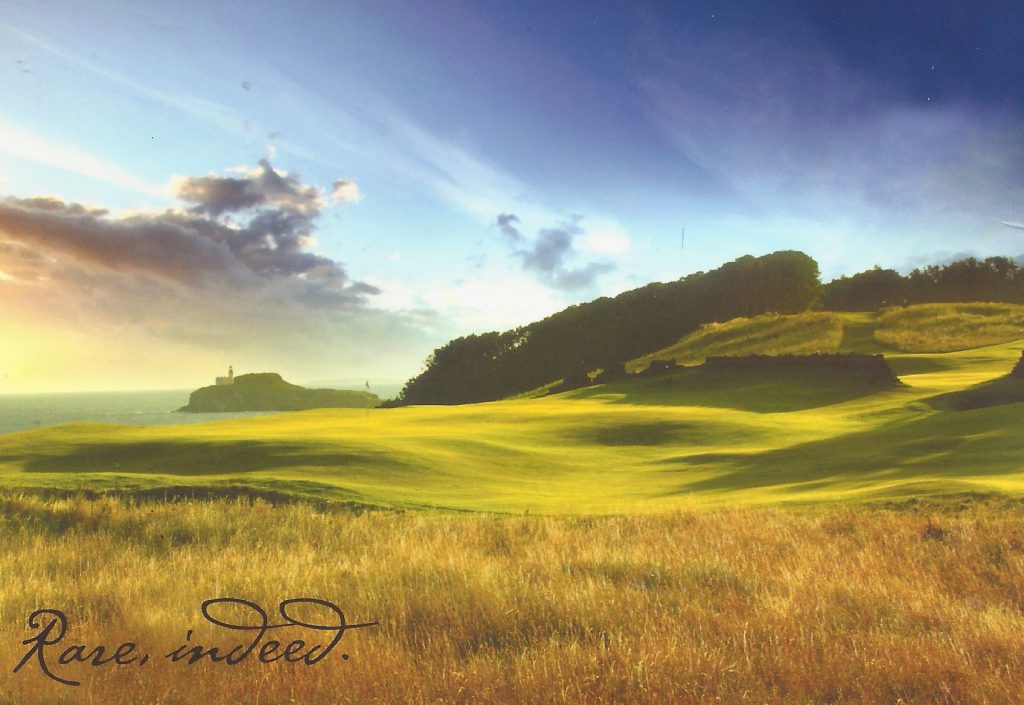
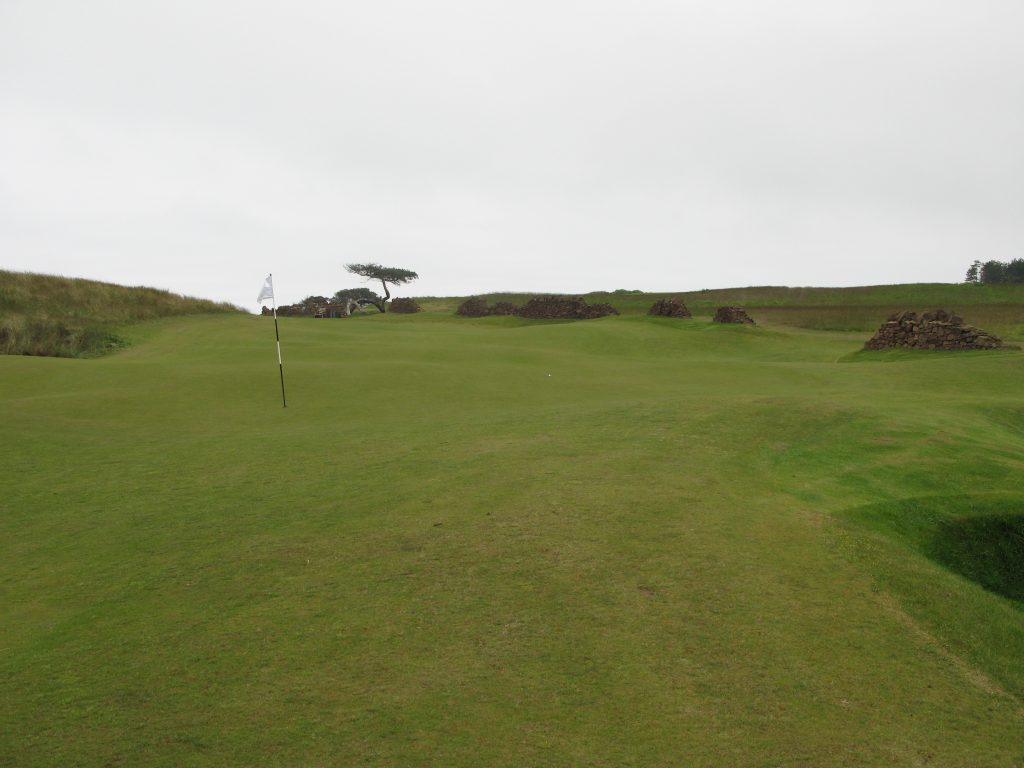
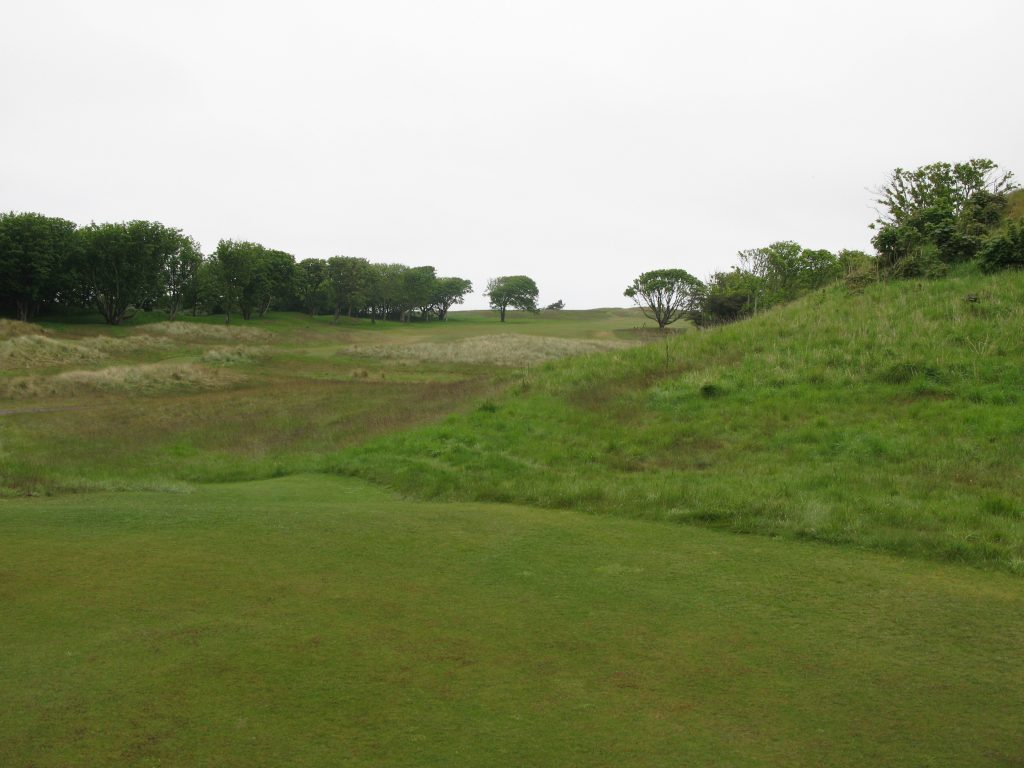
The Renaissance is a work of beauty - the 10th taken on a nicer day than when I played.

The Renaissance is a work of beauty – the 9th taken on a nicer day than when I played.

The Renaissance Club is one of a small but growing number of exclusive private member golf clubs in Scotland.  It combines a world class golf course and facilities with an American style family friendly country club set up, with fine dining, although the latter type of country club is also now very common in South Africa and Australia.

The course sits just east of Muirfield, its famous neighbour, on the North Berwick coastline.

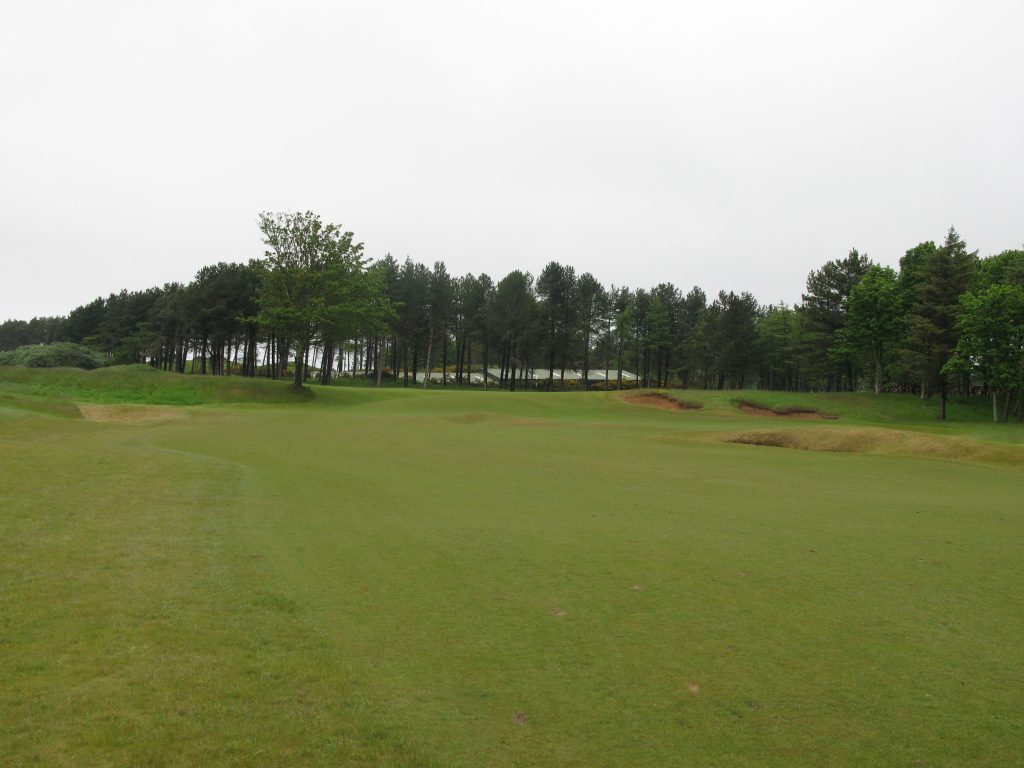
The tree enclosed 4th green - typical of some of the great links courses in Northern Scotland

The tree enclosed 4th green – typical of some of the great links courses in Northern Scotland

The architect of The Renaissance, Tom Doak, is renowned for his use of natural contours and not “bulldozing” the land and he has laid the course around several copses of existing trees;  therefore this is a course that looks much more like parts of the great links of Carnoustie, Dornoch or Nairn Dunbar, than the treeless Muirfield.

The large 8th Green at The Renaisannce

The large 8th Green at The Renaisannce

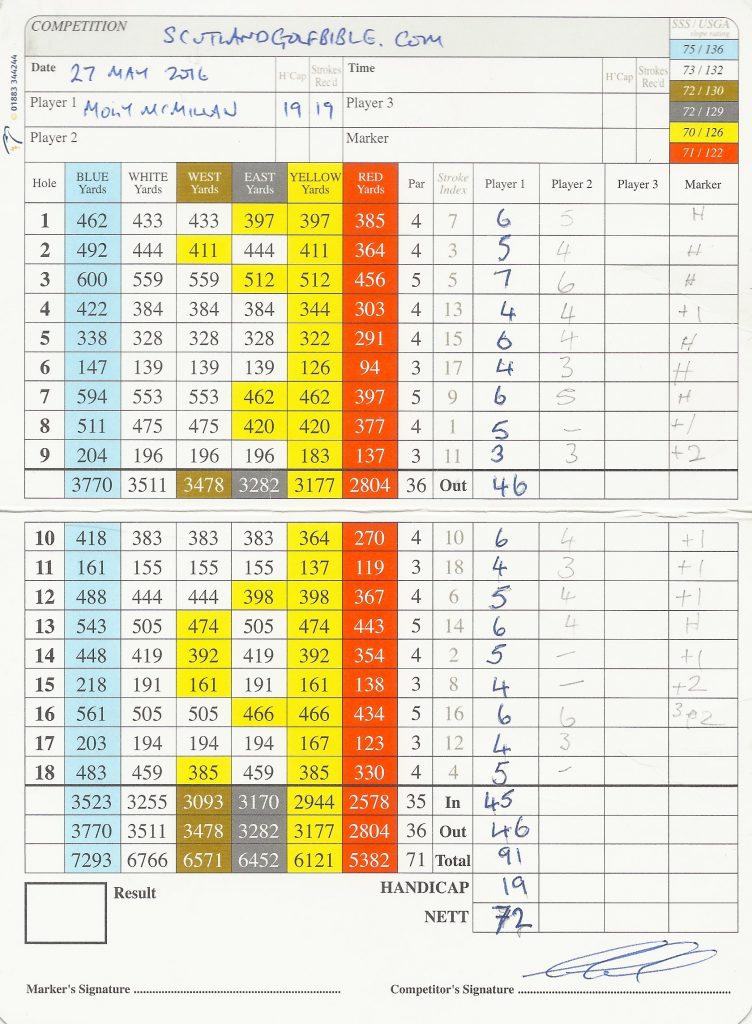
The result is a quite magnificent layout that in my opinion will stand the test of time. With widely different tee options, this can be played at 6121 yards off yellow, 6766 yards off white, and a monster 7293 yards off the professional championship blue tees.  It also has 2 very cleverly mixed white/yellow layouts of around 6500 yards, each recommended for different westerly or easterly winds  (see the scorecard below for details).  All layouts have a par of 71.

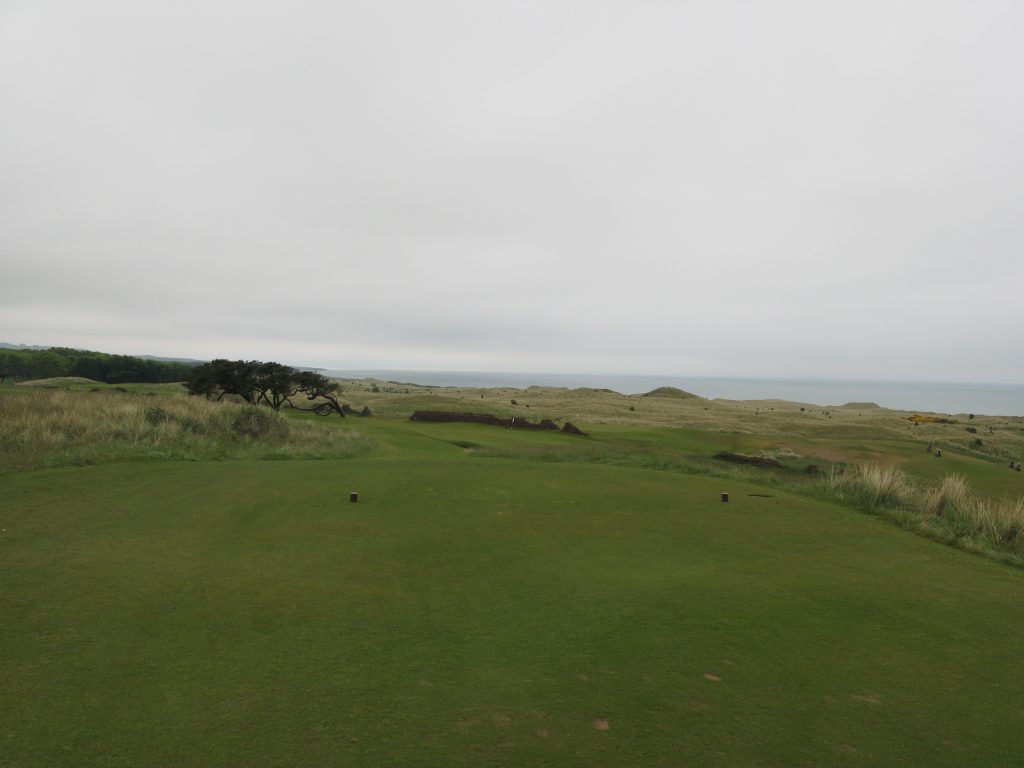
The tee view from the stroke index par 4 8th.

The tee view from the stroke index par 4 8th.

The course was in excellent condition as expected and although spread out over a much greater area than, by comparison, Muirfield, the green to tee walks were still short some almost in the St Andrews way, I suspect by design.

The highlight of the course for me was the magnificent greens which had combinations of large and subtle borrows, almost all with very tricky surrounds.  Combined with well positioned and deep bunkers, I suspect only the greatest of short game players would win a Scottish Open here.  The Renaissance would be a fine competition venue, with many locations for grandstands which would afford viewing of more than one hole.

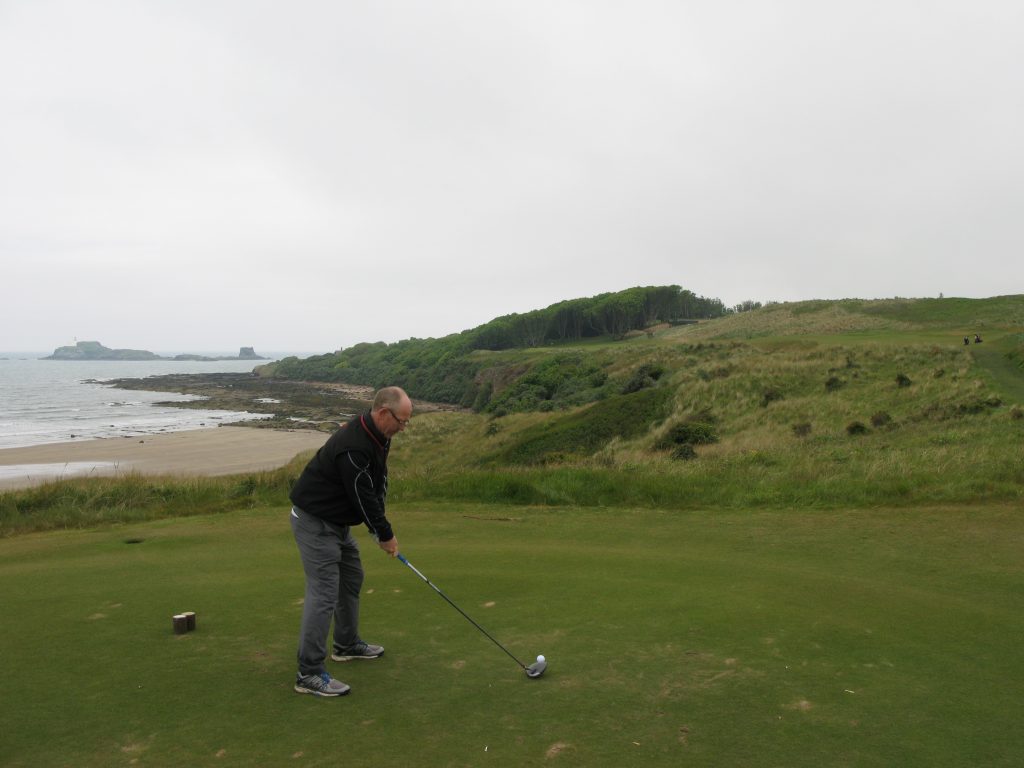
The majestic 10th tee view - I lost a ball into the left cliffs on the one occasion I failed to heed my playing partner's advice!

The majestic 10th tee view – I lost a ball into the left cliffs on the one occasion I failed to heed my playing partner’s advice!

I was hosted by the local professional Ross Dixon, whose wise on-course advice enabled me to play to within one shot of my new lower handicap of 19, which has reduced by 4 shots following a number of lessons by Ross himself, the best measure of golf teaching.

The downhill par 3 11th, with a view over the links land

The downhill par 3 11th, with a view over the links land

The Renaissance layout provides changes of direction on almost every hole, and therefore the difficulty changes likewise.  There are many great holes, but the run of 5 holes from the 7th through 11th were for me the architectural and aesthetic highlight;  a long par 5 7th, the stroke index 1 8th hole, followed by 2 excellent par 3s (the infinity greened 9th, and the downhill 11th), which sandwich the cliff hugging shortish par 4 10th.  All these holes can be viewed using the excellent interactive club website application here.

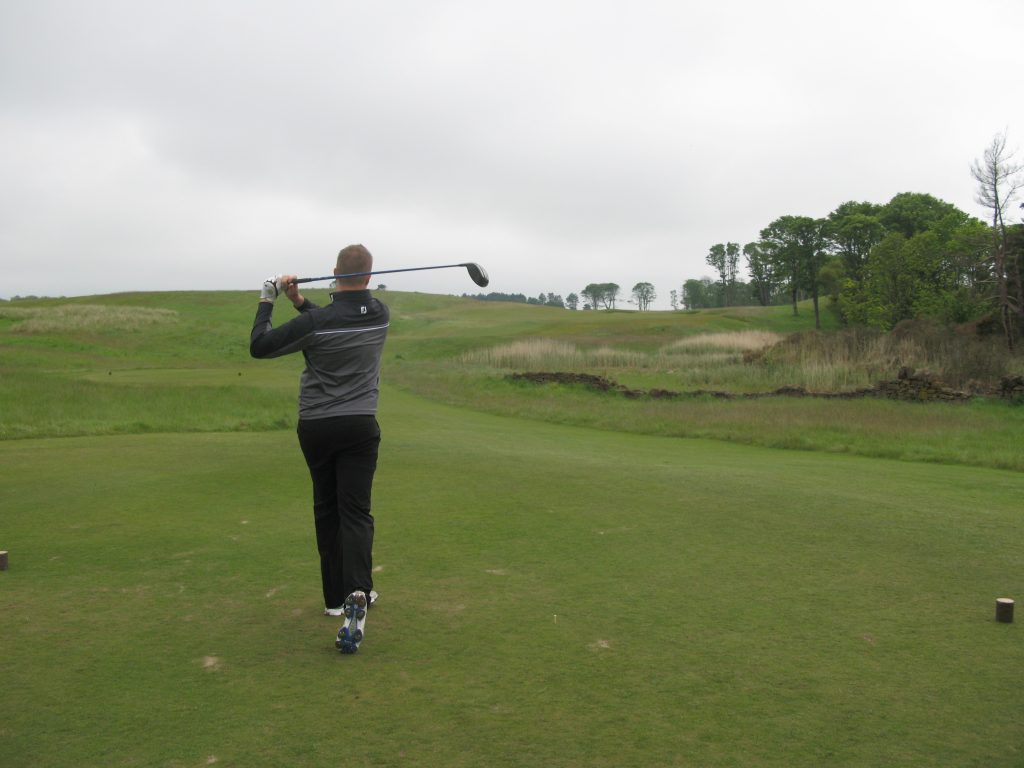
Ross Dixon, after striking another ball far down the middle.

Ross Dixon, after striking another ball far down the middle at the par 4 14th.

It was a real privilege to play The Renaissance and I hope that the venue can be used for competitions so that the wider public can see at close hand what a wonderful course it is. Although it was a private club, it was very far from stuffy, in fact I couldn’t help noticing what a wonderfully relaxing and very family oriented atmosphere existed around the club. There is a lot that the older established clubs around Scotland could learn from The Renaissance.

Some Facts

Course Type: Links

Par 71  (4 par 5s, 9 par 4s, 5 par 3s)

Distance (yellow)  6121 yards

Moly’s Gross Score  91 

Stableford (7/8th allowance) 33

Moly's scorecard at The Renaissance Club - Gross 91

Moly’s scorecard at The Renaissance Club – Gross 91

39. Dalmunzie. 18th May 2016

Enjoy the great views but don’t bother playing the course  

Round  £15.   Par 30.  Value (out of 5) – 1.5

Dalmunzie golf course is situated on the Dalmunzie Estate located at the Spital of Glenshee, mid way between Blairgowrie and Braemar, just south of the Glenshee skiing centre.

Long 235 yards Par 3 first hole at Dalmunzie

Long 235 yards Par 3 first hole at Dalmunzie

The course was designed by Tom Simpson in the 1920s as a private course for Sir Archibald Birkmyre, who was from a family line of “Jute Barons” based in India.

The views from the course are pretty spectacular.  However, the estate and the course have long since past their glory days, and show signs of a lack of maintenance.  This is a shame as the architect created some really challenging holes.

The 1st, 4th, 5th and 7th in my view are all really tough par 3s, all with very different challenges.

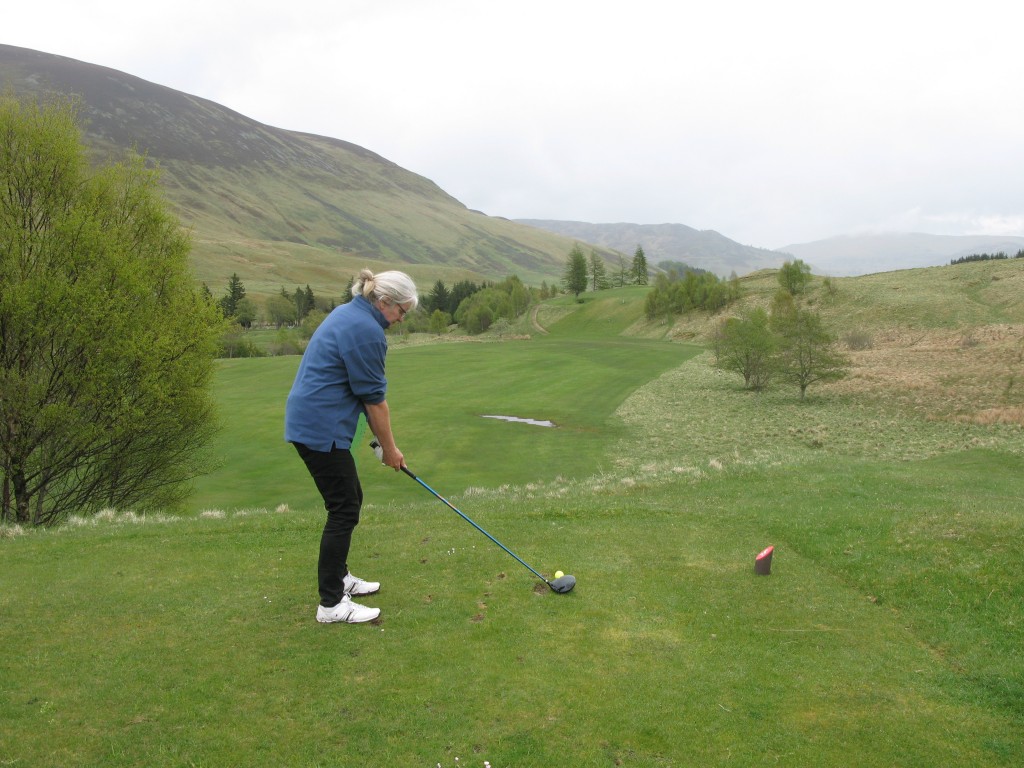
Fran on 3rd tee at Dalmunzie

Fran on 3rd tee at Dalmunzie

The opening hole plays like a short par 4, judgement of distance is difficult on both the mid-iron 4th and 5th holes, and the short 7th plays over the “Shee Water” burn to a very small “front to back” target.  Play well on these holes and you’ll likely score well overall.  The long par 4 6th at 450 yards is also a challenge.

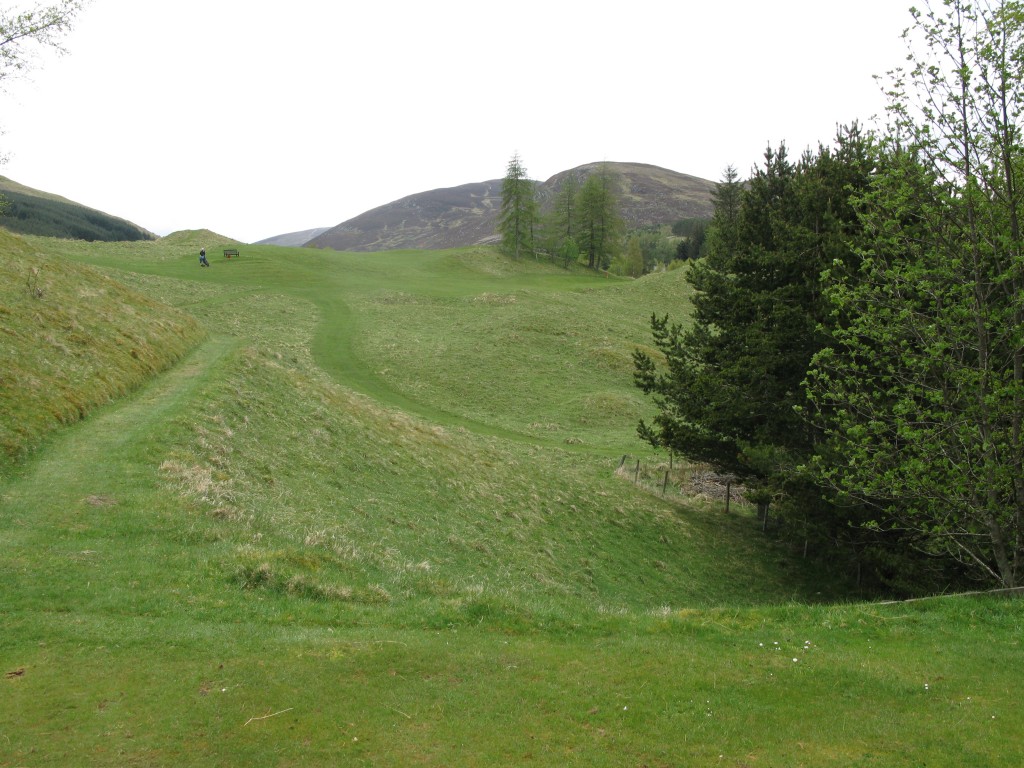
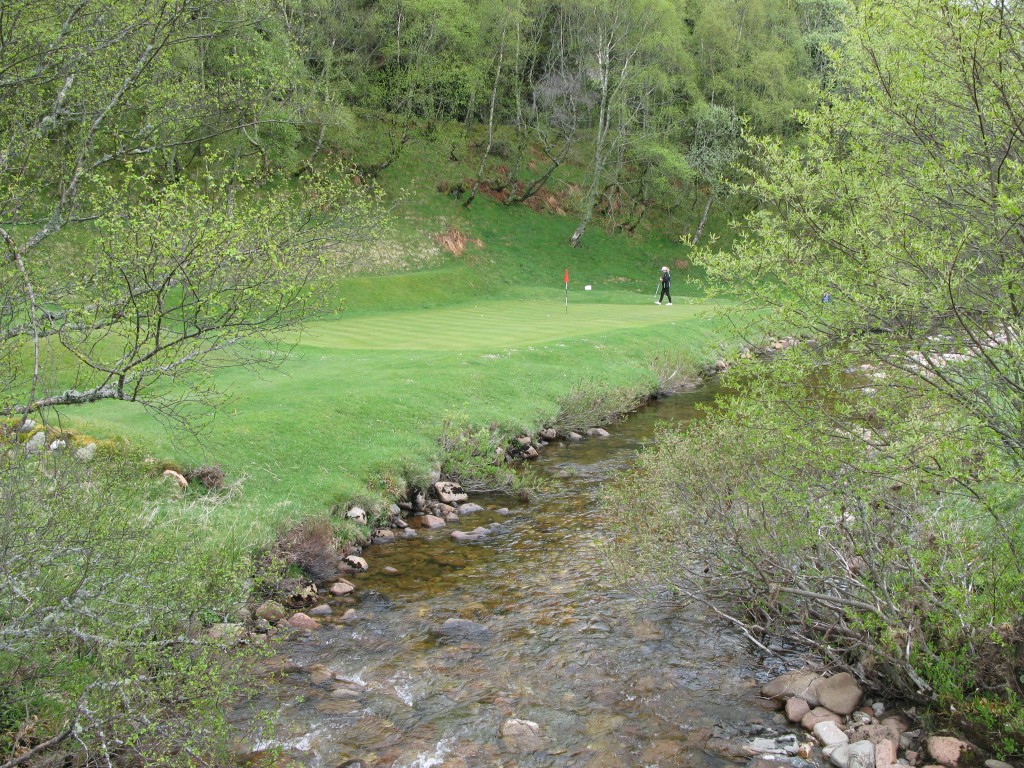
Difficult 5th hole

Difficult 5th hole with Green tucked on the plateau on the right


The course was in poor condition when we played, in particular the greens were badly in need of cutting.  The general condition of the course was “tired”.

Critical to get distance right on the par 3 7th hole.

Critical to get distance right on the par 3 7th hole.

On the day, I played to one over handicap, which given that the greens were so poor I was pretty happy with – I also hit it in the water in front of the 7th green but at least found 3 others in the water waiting to be found!

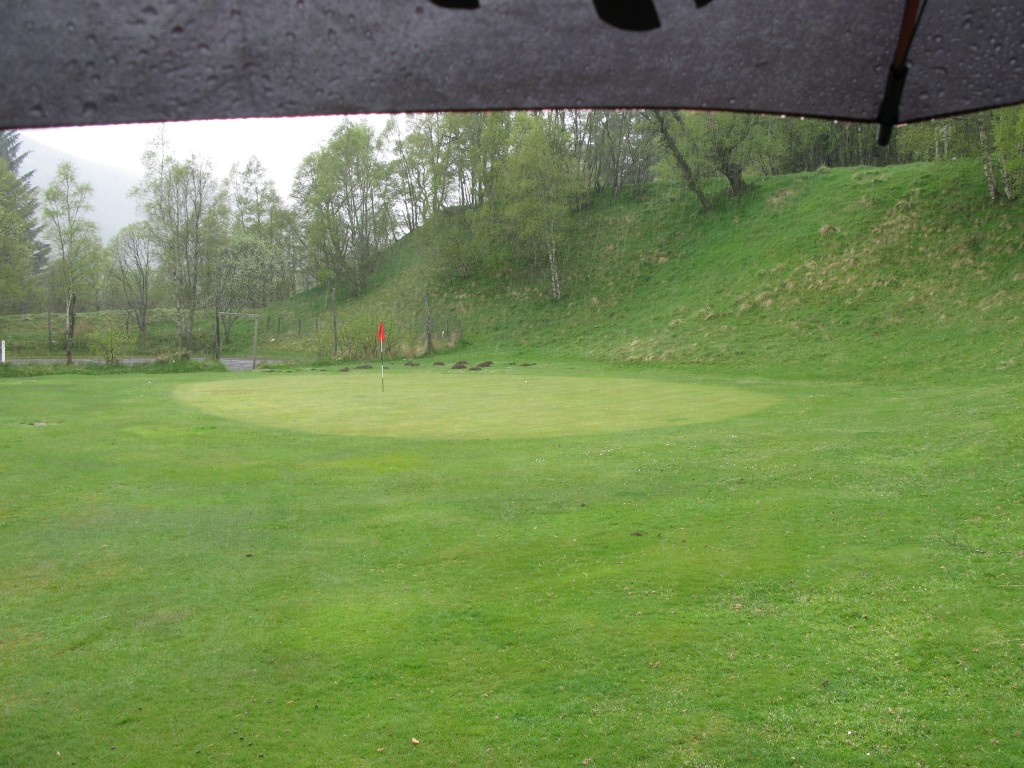
9th green at Dalmuzie with dilapidated tennis courts in the background - an apt finishing hole at Dalmunzie

The mole surrounded 9th green at Dalmuzie with dilapidated tennis courts in the background – an apt finishing hole sadly at Dalmunzie

Some Facts

Course Type: Highland

Par 30  (3 par 4s, 6 par 3s)

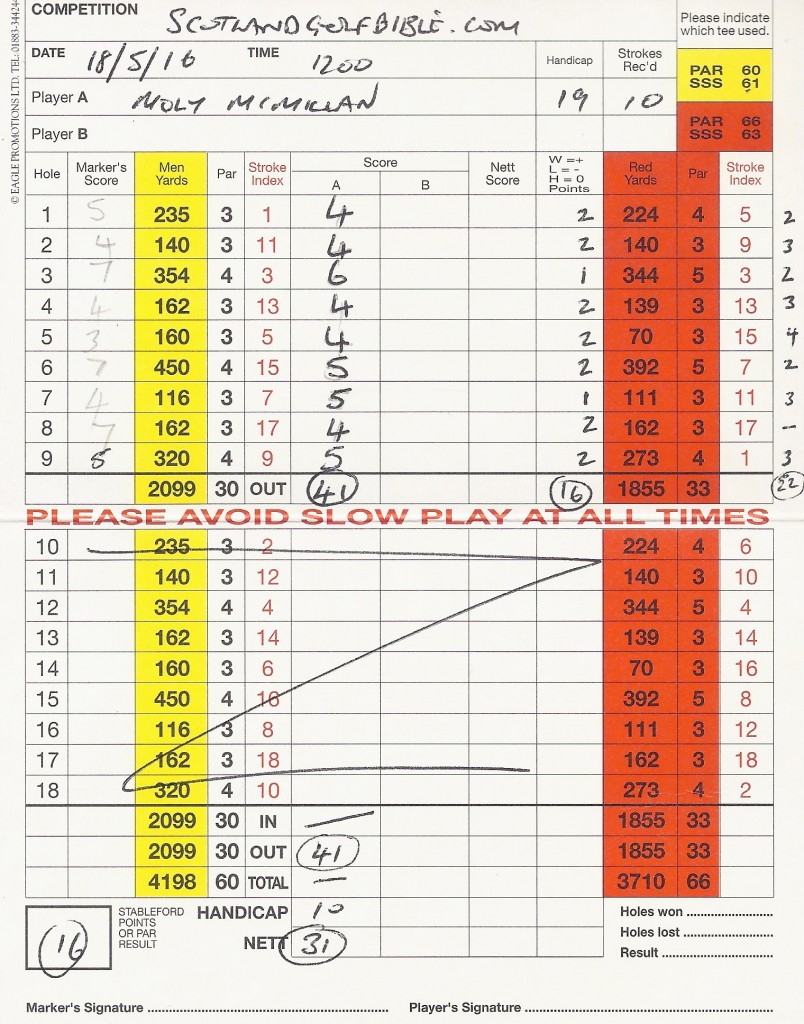
Distance   2099 yards

Moly’s Gross Score  41 

Stableford 16

Moly's Dalmunzie Scorecard - 40

Moly’s Dalmunzie Scorecard – 40

« Older posts Newer posts »

© 2025 Scotland Golf Bible

Theme by Anders NorenUp ↑