A guide to green fee value for money

Category: Region (Page 29 of 45)

The 15 regions are as defined by the visitscotland website, the Nation Tourism Organisation; http://www.visitscotland.com/destinations-maps/

65. Lochore Meadows. 1st Sep 2017

Good value 9 hole course managed by Fife Golf Trust 

Summary:  Round  £12.   Par 36.  Value (out of 5) – 3.5

Lochore Meadows is one of 7 courses managed by the Fife Golf Trust which was established in 2011 to take over Fife Council’s directly managed courses. This is becoming a common practice by Local Authorities in Scotland to manage golf courses.  The golf club is private, like many Scottish clubs associated with public courses.

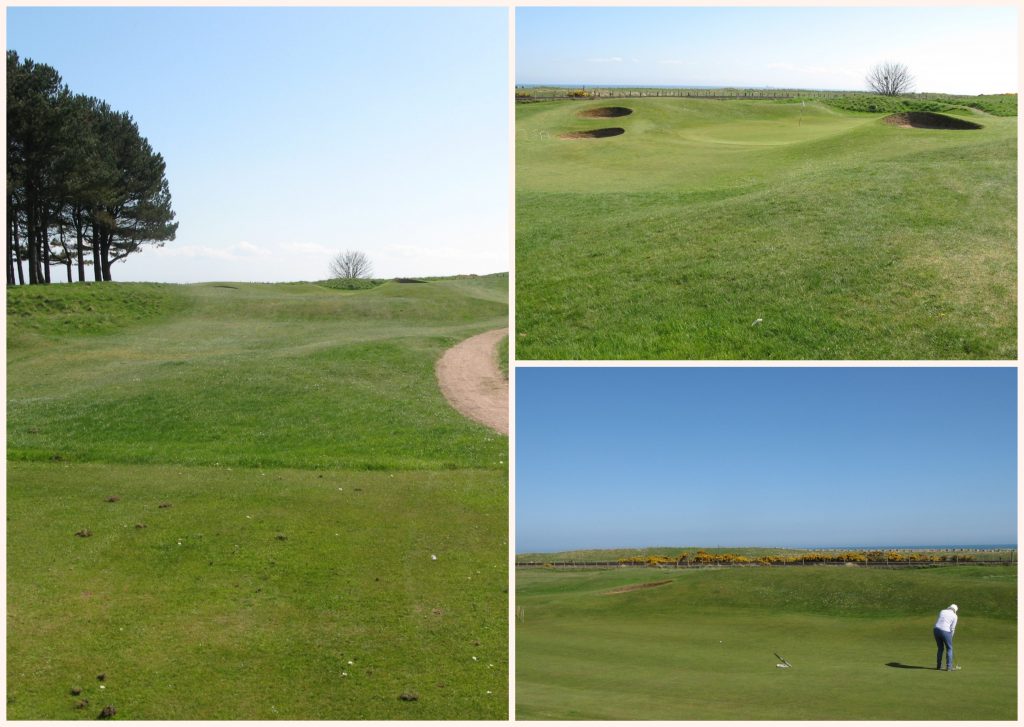
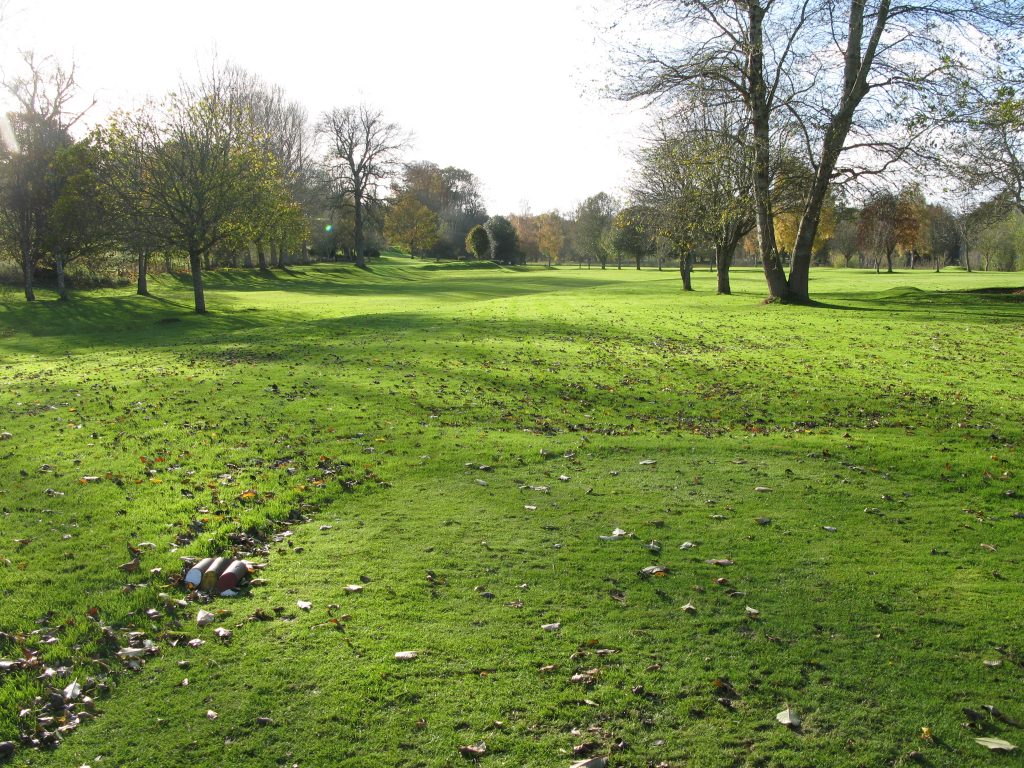
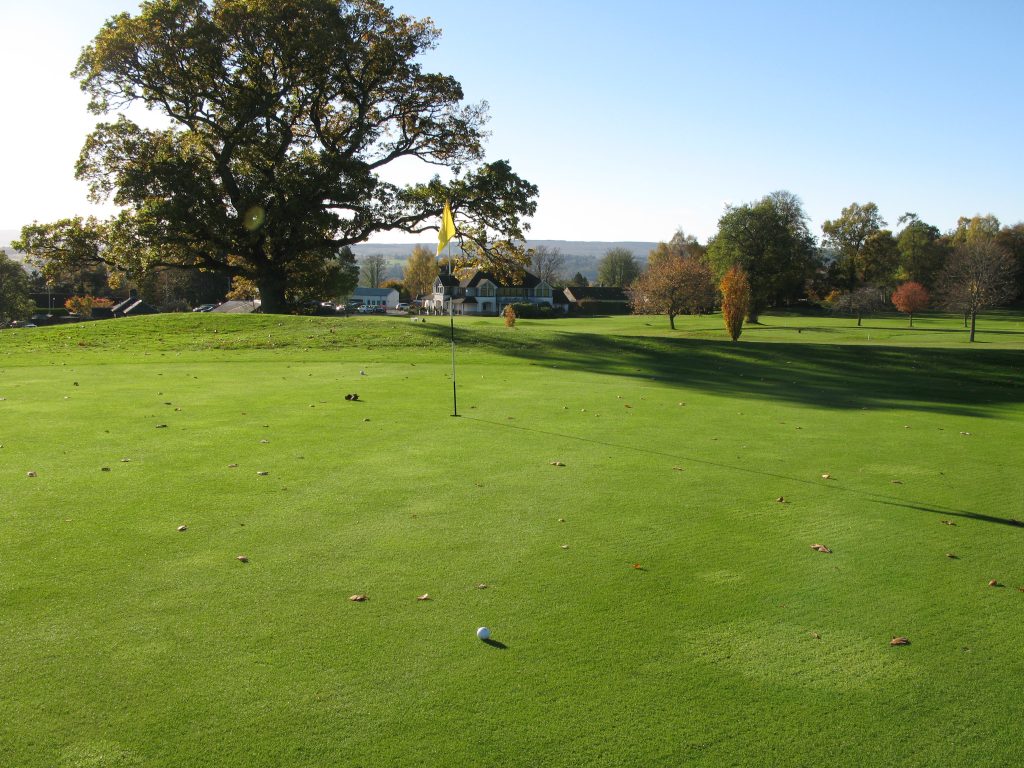
The 1st at Lochore Meadows, with a mine shaft a reminder of better times for this poor area.

Lochore Meadows Golf Course, located within Lochore Meadows Country Park, was formerly called Ballingry Golf Course.   It was founded in 1981.

The country park is just north of Lochgelly, in the Benarty area, comprising the separate villages of Ballingry, Lochore, Crosshill, and Glencraig; this is a poor part of Scotland still in need of economic regeneration following the demise of the coal mining industry – a former mine shaft being a major feature to the left of the first hole.

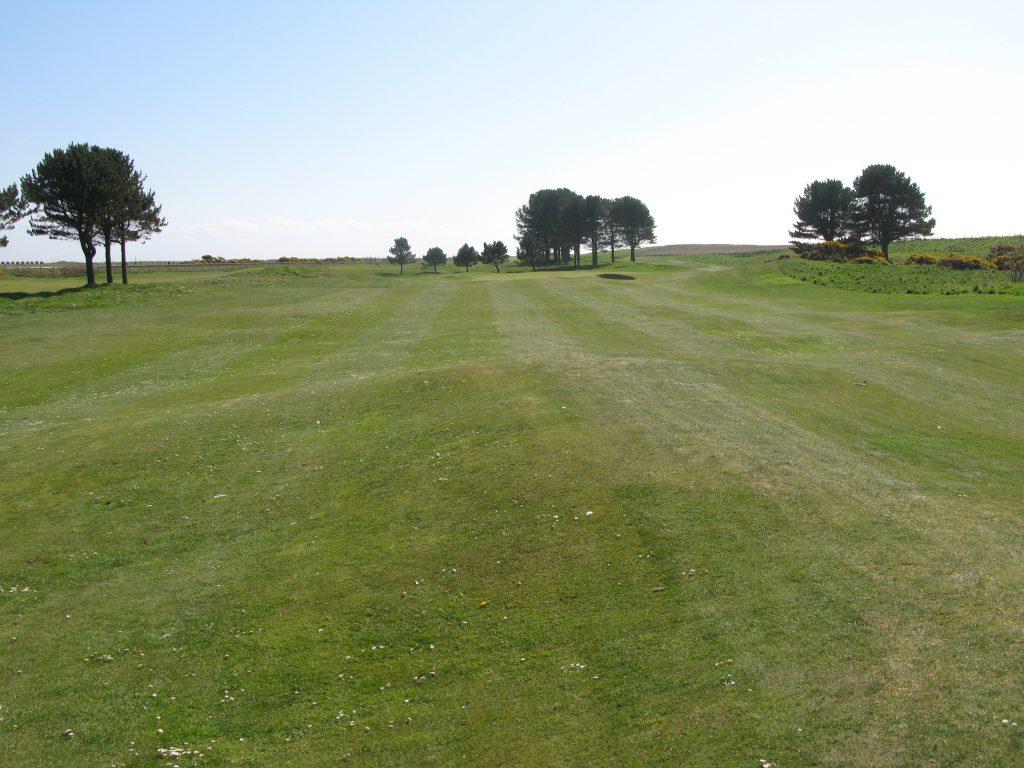
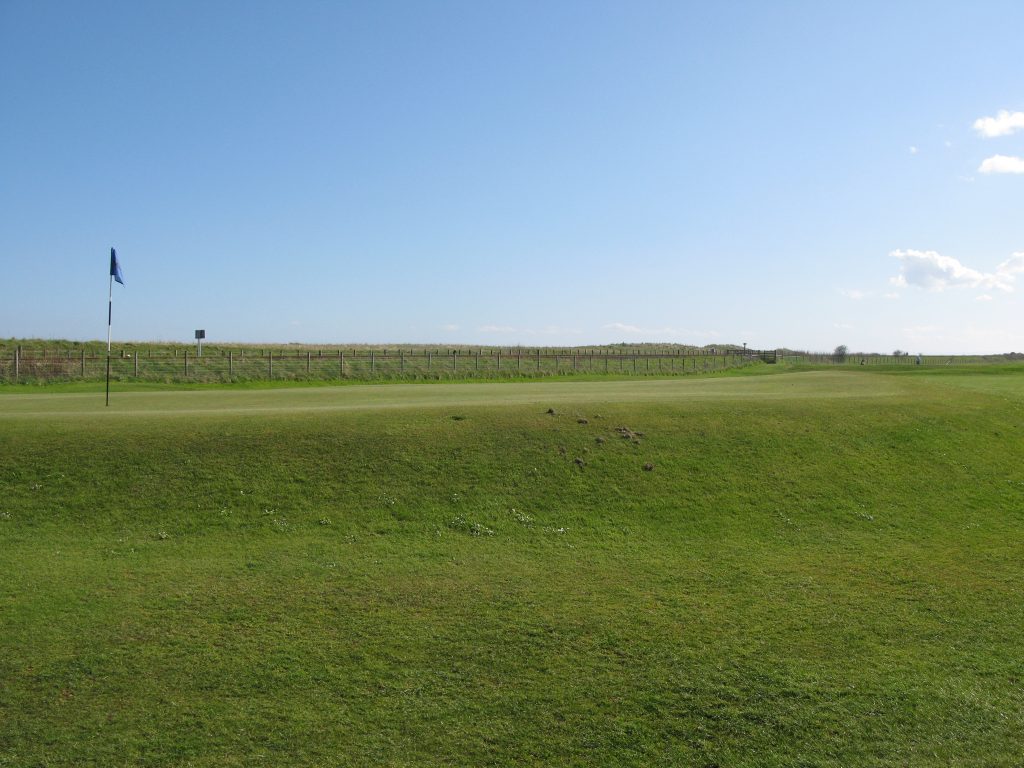
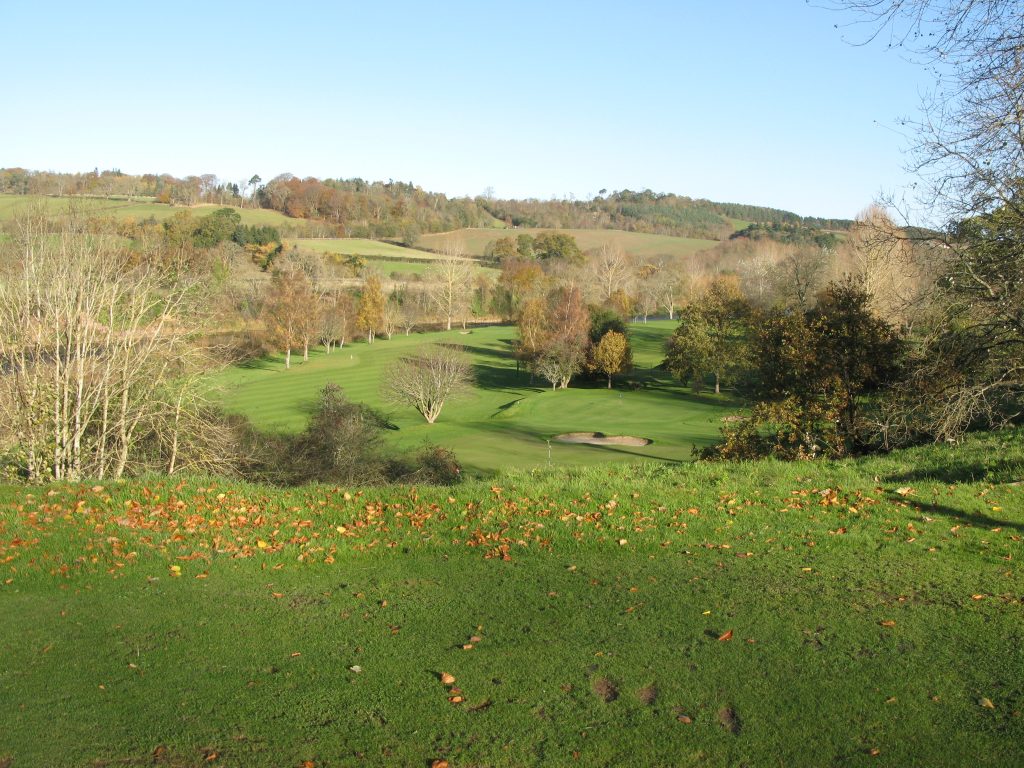
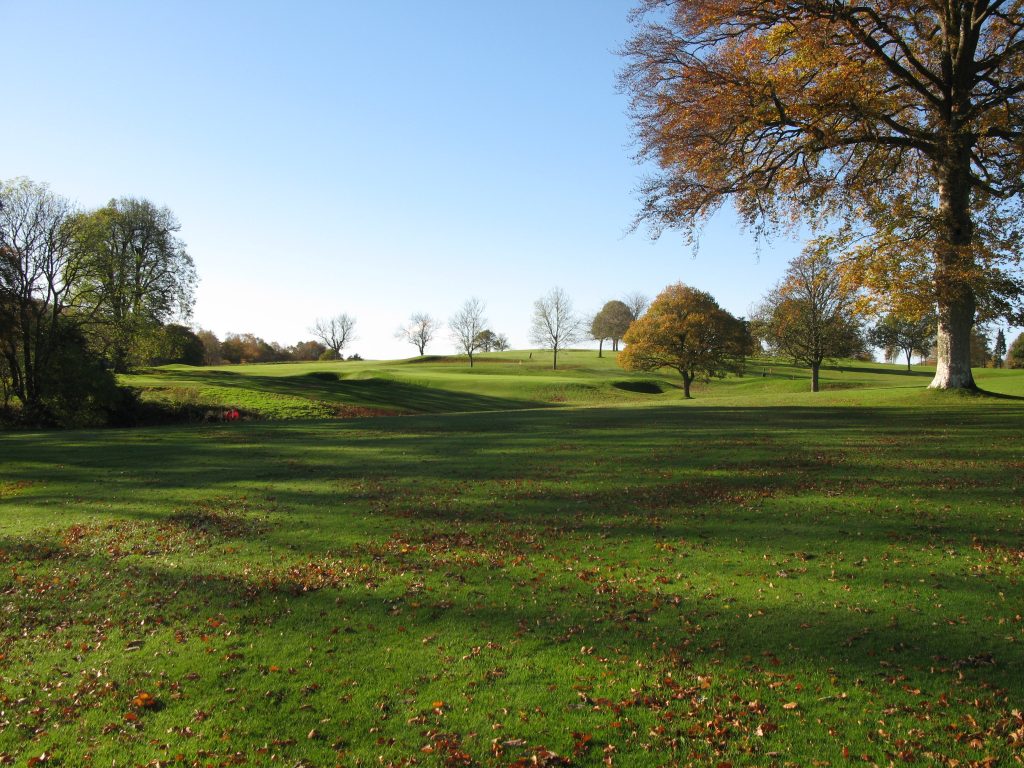
The 3rd green at Lochore Meadows.

The 9 hole golf course is really good value.  It has a very traditional layout with 2 par 3s and 2 par 5s, and at over 3000 yards, from the yellow tees, is a full length course.  It was also in very good condition when I played, with the medal tees looking like they would have been at home on a much more prestigious Fife course.

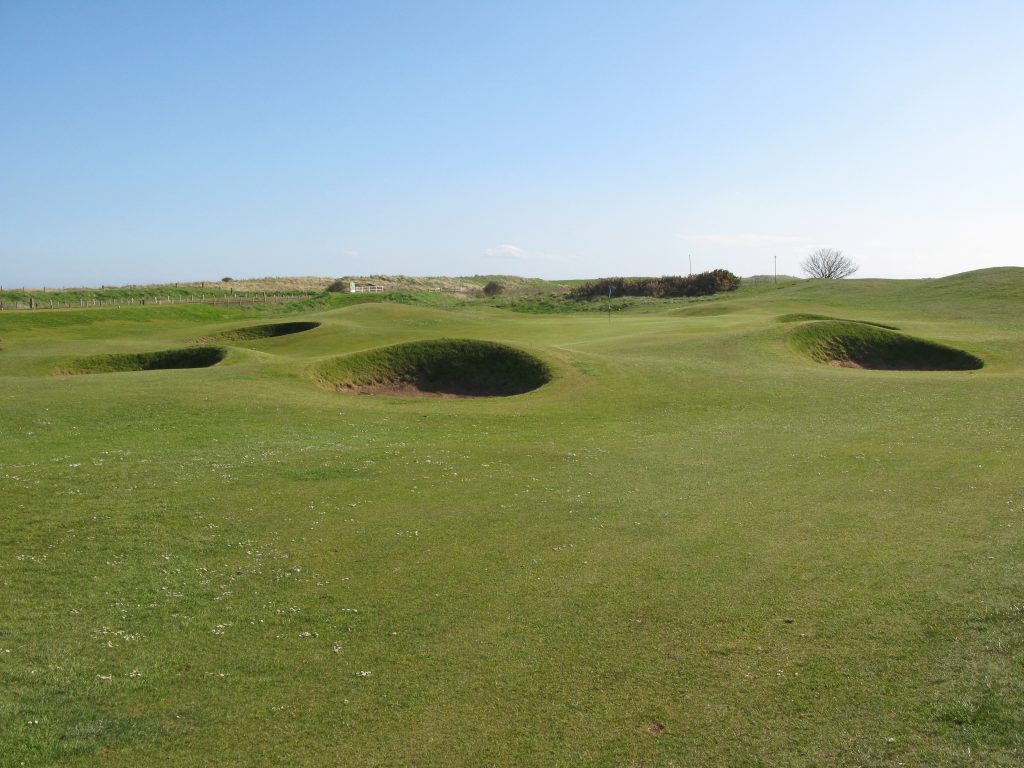
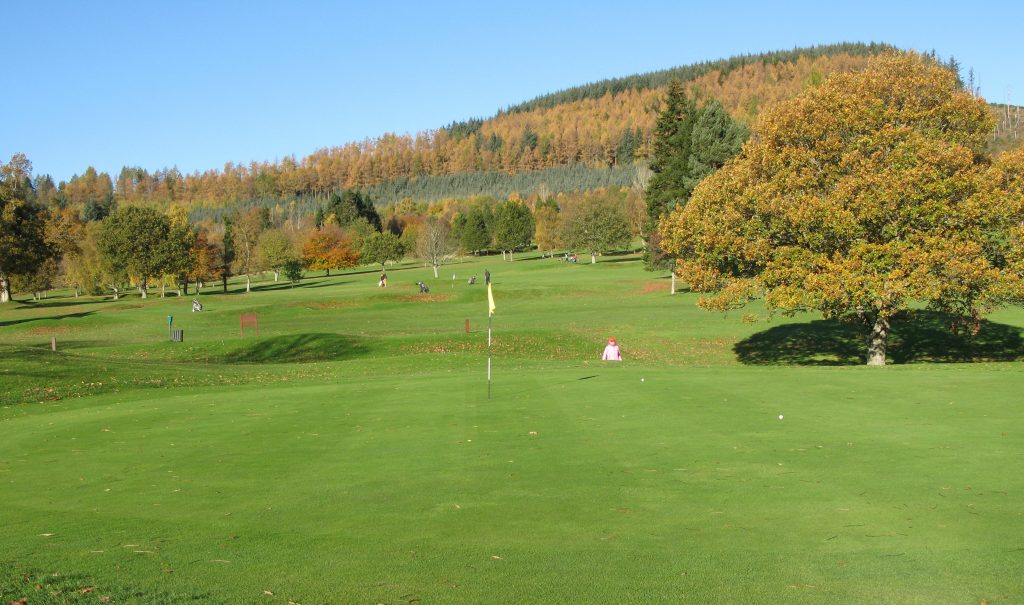
The par 5 8th hole at Lochore Meadows with the hazard in play for the second shot.

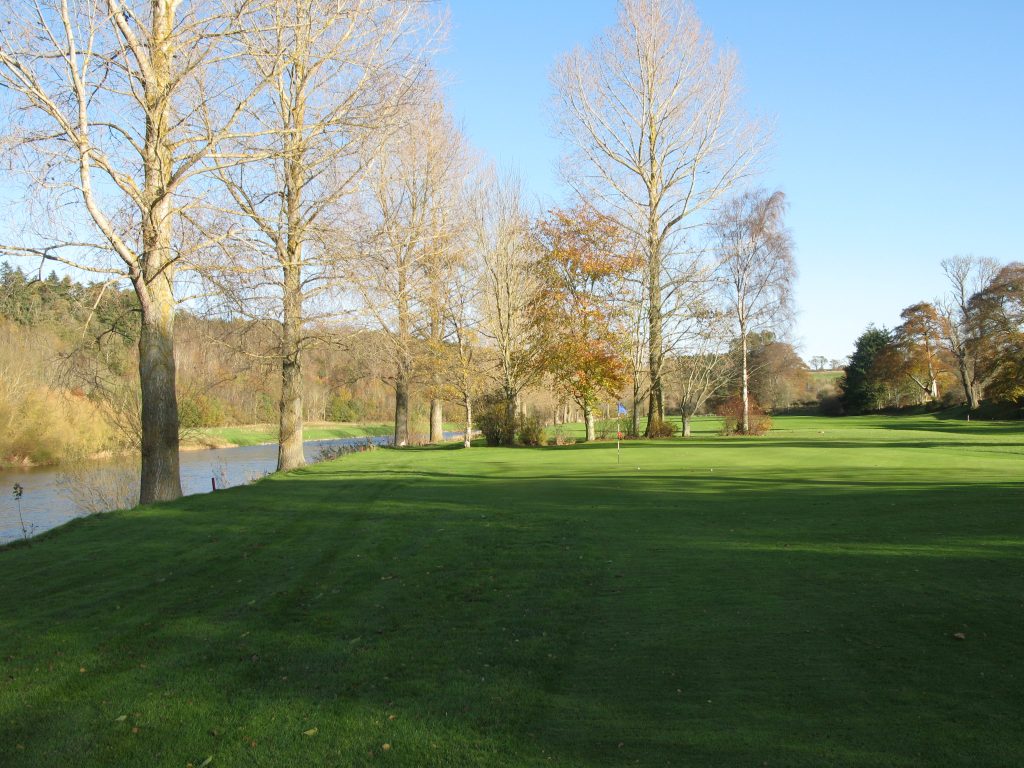
The fairways are very generous so you can take driver on most holes.  There is also a stream running across the course which comes into play on the 1st, 8th and 9th. The large greens were also in great condition when I played.

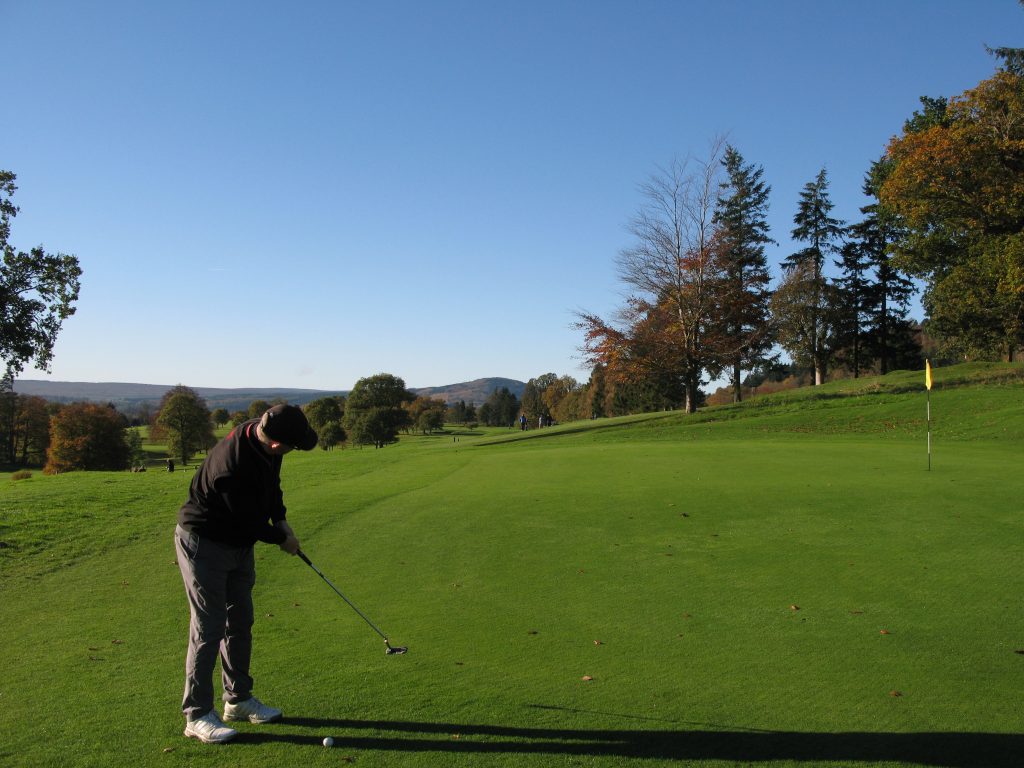
There are some lovely views of the surrounding hillsides, which coupled with the good course, means that it is worth travelling to play Lochore Meadows.

Key Facts:

Course Type: Parkland

Par 36 (2 par 5s, 5 par 4s, 2 par 3s)

Distance (yellow):3010

Moly’s Gross score48.

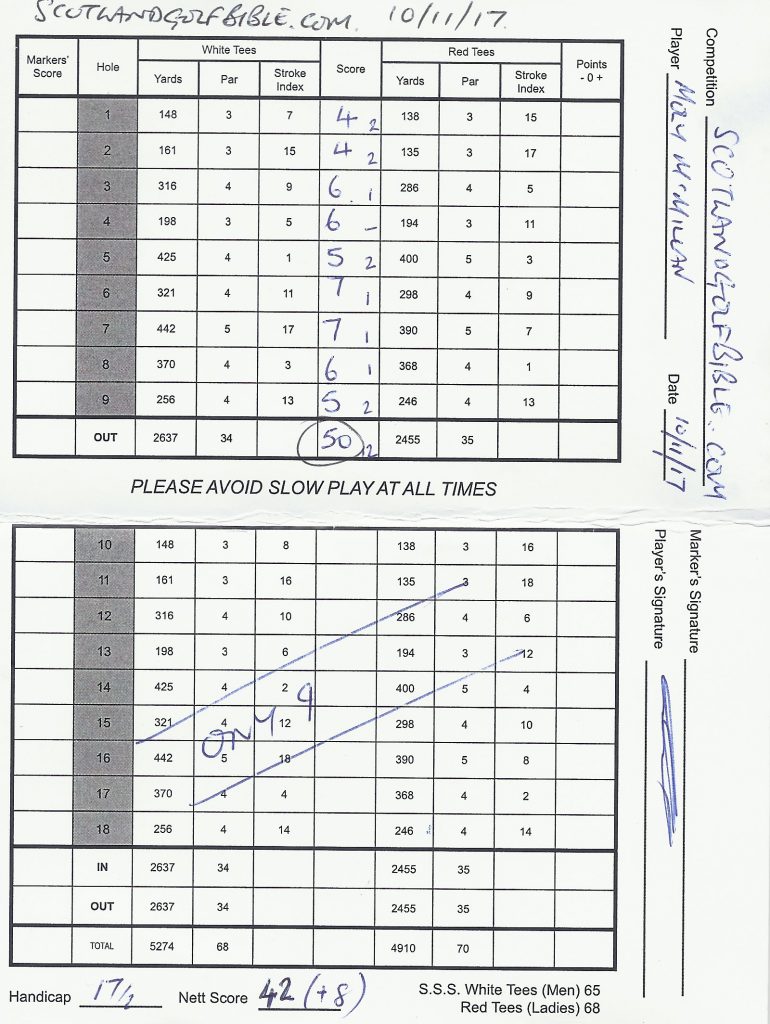
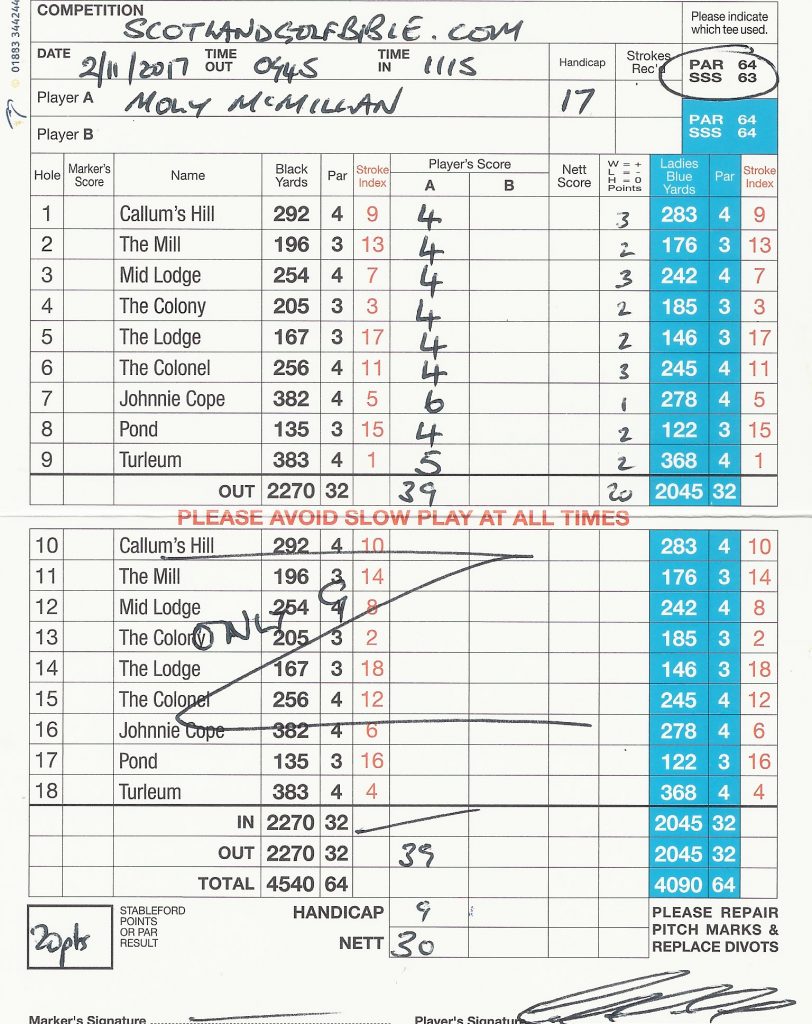
Moly’s Lochore Meadows scorecard – 48 for 16 points (off 17 hcp)

64. King James VI. 29th Aug 2017.

Easy walking freshwater “island” course on the River Tay in Perth ideal if you are a trainspotter!

Summary:  Cost £25.  Par 68.  Score 95. Value (out of 5) – 2.5.

The “King Jimmy” golf club was founded in 1858 and initially played on North Inch; it was named because King James VI had played golf on the “Inches”, the public land for common use along the River Tay.  Golf can actually be traced back 500 years in Perth and this in covered in an earlier blog here.

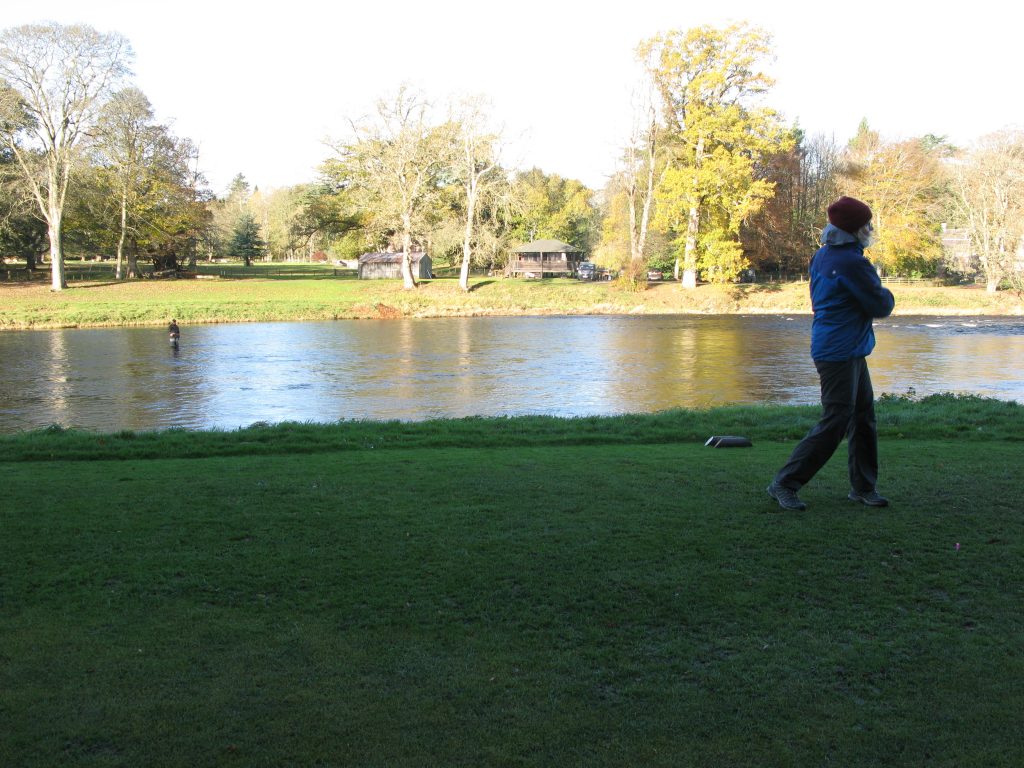
Moncreiffe island, home of the “King Jimmy” golf club

The club relocated to Moncreiffe Island in  1897, to a course designed by ‘Old’ Tom Morris, and is believed to be the only freshwater island course in the UK.

 This presents a challenge for any visiting golfer, as the only access to the course is by using the narrow walkway across the railway bridge, accessed by steep stairs on either side of the bridge.    The walk from the nearest public car park is around 500m.

The double green on the 1st/4th with King James VI club house in the background.

The course is very flat and its lack of undulation makes for a fairly repetitive round with many holes looking the same.  Although I played in late August after a relatively dry spell the course was very soft and preferred lies would have been appropriate.  I understand that the course is impacted significantly after rainfall.  This softness made the course play much longer than its stated yardage.

Moly driving at the tree lined short par 4 12th hole

The very lush grass also meant that balls were easily lost in the short semi rough, in fact I found 3 balls sitting in the open;  make sure you get a good line on the ball after each shot.

The greens were the best feature of the course, closely followed by the lush fairways. The tees would benefit from some work. The main hazards are the course boundaries and some majestic tree lines. 

The 8th green, typical of the scenery at King James VI in Perth

The most memorable holes were those played over a grassy dyke built into the 11th and 13th holes, where it’s important to know your yardages.  The dyke is almost 50 yards in front of the 11th green, so make sure you take enough club.

Fran, my playing partner, at the par 3 5th hole.

I played with Fran and we both had good and bad patches in our round.  My highlight was reaching the 423 yard par 4 18th green in 2 blows.  Pity about much of the rest.

If you do plan to play here, I strongly recommend using a half set carry bag and hiring a trolley from the club.

Key Facts

Course Type: Links

Par 68 (1 par 5s, 12 par 4s, 5 par 3s)

Distance (yellow): 5684

Moly’s Gross score95.

Moly’s King James VI scorecard – 95 for 27 points (off 17 hcp)

63. Leven Links. 24th Aug 2017.

Check the wind forecast and prepare accordingly on this historic links!

Summary:  Cost £50.  Par 71.  Score 97. Value (out of 5) – 3.5.

Leven Links golf course lies on a beautiful piece of links land running almost exactly in the south-westerly prevailing wind direction between the towns of Leven and Lundin Links on the north bank of the Firth of Forth.  Many a round here will be strongly influenced by the prevailing conditions; I was level bogies over the 9 holes played with the wind and 18 over for the nine holes played into the wind, which was only about 10 mph!

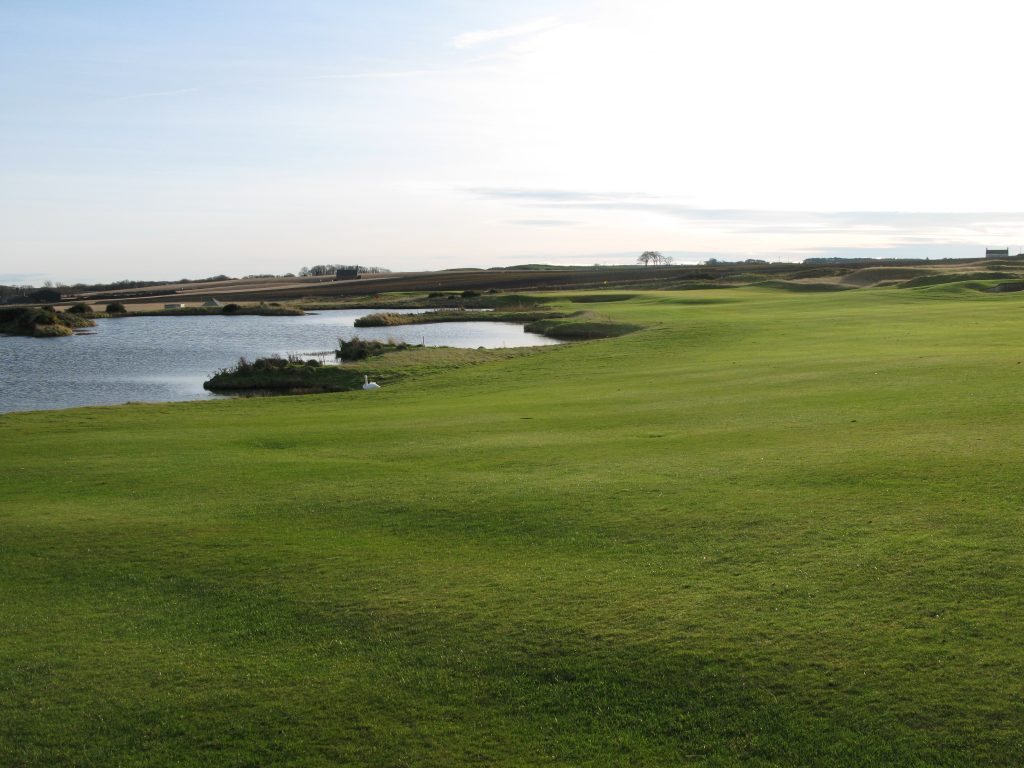
The Scoonie burn in front of the huge 18th green at Leven Links – a magnificent final hole.


The course has a key place in golfing history, tied strongly with its “Siamese Twin” neighbour, Lundin golf course, and well documented in the History of Scottish Golf web site.   A 9 hole golf course was laid out in 1846 by Old Tom Morris in the ground between Leven and the course’s current eastern boundary marked by the Mile Dyke. The most significant part of the history though is that in 1868 this original course was extended by laying another 9 holes to the east of the Mile Dyke towards the town of Lundin Links;  as the resulting layout had no double greens, this was arguably the first “modern” 18 hole links golf course in the world.

The 4th green at Leven Links, with the boundary of Mile Dyke and Lundin Links in the background

This historic 18 hole course lasted until 1909 when the volume of players forced a division at the Mile Dyke with Lundin G.C, thereby creating twin 18 hole courses; Lundin and Leven Links.   Of the current Leven Links course, the opening 5 holes and also the incredibly challenging 13th and 18th holes are part of that original 18 holes.

Like a number of the links courses on the east coast of Scotland, Leven Links is managed separately from the 2 golf clubs using it, Leven Golfing Society and Leven Thistle Golf Club.  Both clubs welcome visting golfers.

The golf course is laid out around the natural dunes and grasses of the links land and this makes for a very interesting first few holes especially for those new to this format of the game.  I suspect many people will find that their approach shots end up through the green at the short par 4 2nd and 3rd holes.  Many of the greens call for pitch and run shots running onto the green.

The wonderful links approach at the par 4 2nd at Leven Links

After a relatively straight forward start the short par 3 5th green can be very difficult to find played through the prevailing left to right wind.  Then comes the small matter of the 6th, a par 5 of 555 yards off the yellow tees – as the pro said to me before my game “it’s normally a drive, two 3 woods and then an iron to the green!”.  I was actually in a greenside bunker in 5, but finished with a 30 foot putt – I cannot remember feeling happier with a 7!  The 6th also has another characteristic of Leven Links – very large greens.

The difficult par 3 15th normally played into the prevailing wind.

The stretch from the 13th to 18th, where all bar the 17th are into the wind, offers some great challenges, however the best is kept till last.  The 18th is a par 4 of over 450 yards, with the dominating Scoonie burn laying in wait for the approach shots, which for almost all average players will be their 3rd shot.  I met up with a local member who said it was statistically the second hardest par 4 in Scotland.  This was quite believable, however the course stroke indexes are not and are the most strange I have encountered, best exemplified by the short par 5 12th, at 504 yards, played normally with the wind being SI 1, but the 18th, the “second hardest par 4 in Scotland”, being SI 9…..go figure?

The town of Leven behind the par 3 9th green.

Due to location and historical interest Leven Links is a very heavily played course and I think this was the main reason the course being a little bit worn in condition when I played, in particularly several fairways were chewed a bit and the bunkers needed a bit of care.  Due to this, it was very difficult to assess a value rating at the stated green fee of £50 for a weekday round;  historically the course demands a 4+, but the condition and price merited only 3.5. It is really worth playing though as its a really great layout.

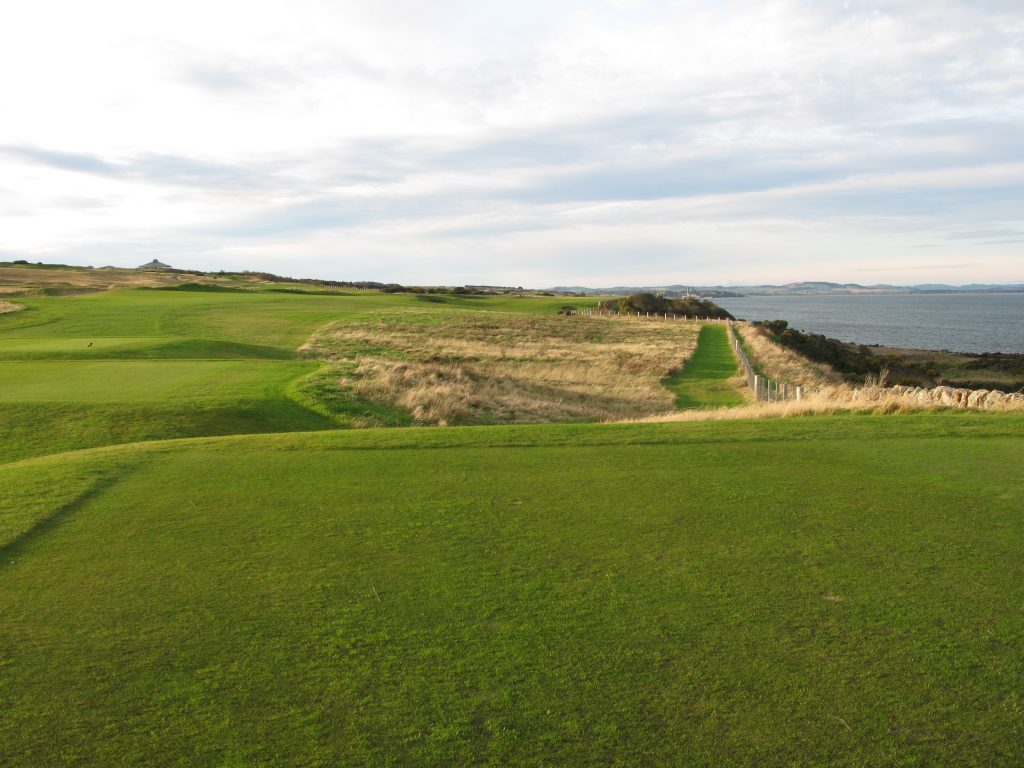
The 4th tee at Leven with the Firth of Forth coast line to the right.

Leven Links has hosted many national and international competitions as well as hosting local final qualifying many time when St Andrews hosts The Open.

I thought I played pretty well for a gross 97 and 30 stableford points (off current 17 hcp).

Key Facts

Course Type: Links

Par 70 (2 par 5s, 12 par 4s, 4 par 3s)

Distance (yellow): 6309

Moly’s Gross score97.

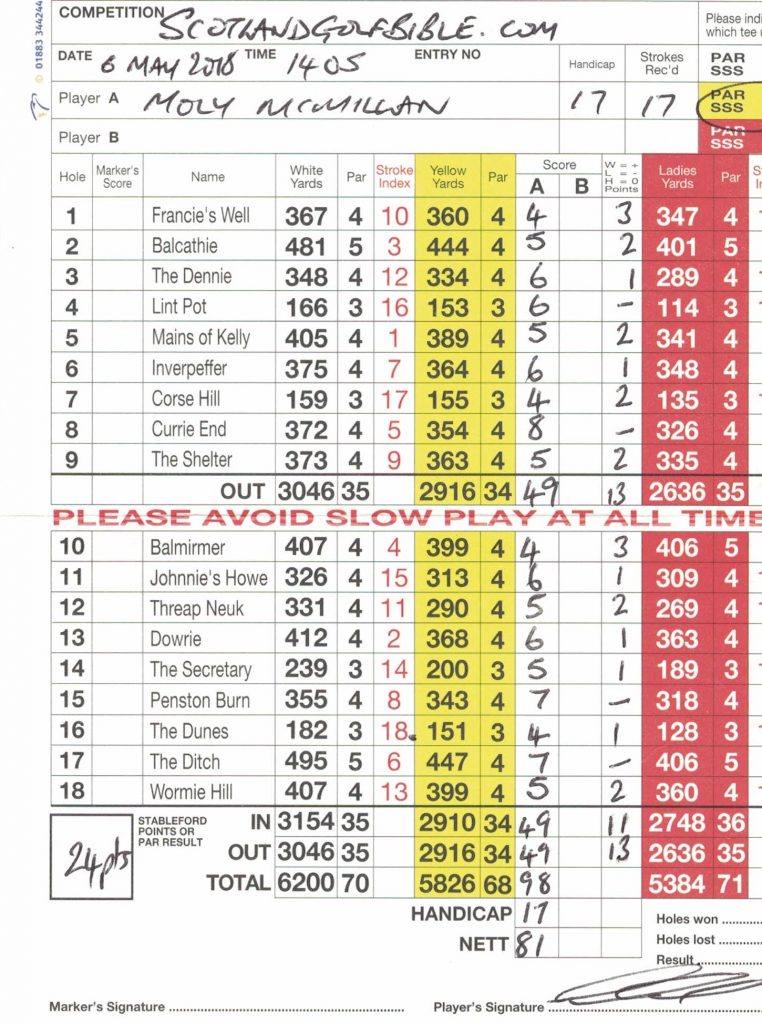
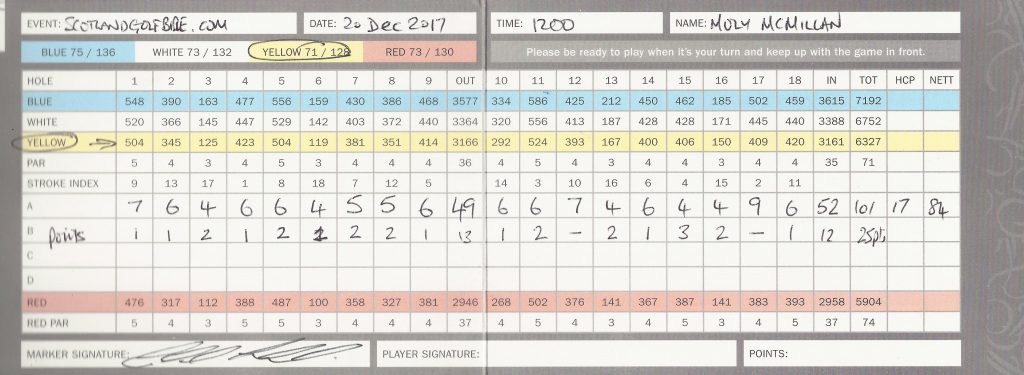
Moly’s Leven Links scorecard – 97 for 30 points

62. Carnoustie Burnside. 9th Aug 2017.

Treading on possibly the very origins of links golf

Summary: Cost £46. Par 68.  Score 85. Value (out of 5) – 4.5.

The Burnside course, or more correctly the Carnoustie Burnside course, is eclipsed by its magnificent Championship course neighbour, but that’s only because the Championship course is one of the greatest courses in the world!  Do not play the Championship course without also trying The Burnside, which is a great naturally laid out links course.

The wonderful links land view from the 15th tee of The Burnside

Golf on the “Barry Links” was recorded as early as 1527, nearly 50 years earlier than St Andrews, making this the area that “Links” golf was first played.  The Scottish Golf History web site lays out a strong case that these first games of links golf were most likely played on the land between the Barry Burn (more of that later) and the railway line currently where holes 1 to 5 of the Burnside course are.

Therefore, arguably, “The Burner” is the most historical of all links golf courses!  You are truly walking among the ghosts of golf’s distant past playing here.

The 3rd hole, the first of 5 wonderful par 3s, the highlight of Burnside – the Barry Burn awaits!

Of course, there are more recent historical stories worth telling.  It’s largely forgotten that when Ben Hogan famously won his 1953 Open at Carnoustie he qualified on The Burnside course.  It was therefore very apt that I played The Burnside with my brother-in-law, Colin Macqueen, since his fascination with golf started during the same summer of 1953 when he and his elder brothers were mesmerised by the large crowds watching Ben Hogan outside the window of their home, “Lismore House”, which overlooks the Burnside’s 18th green.

Hogan playing the Burnside; Colin Macqueen’s “Lismore House” bedroom highlighted.

Colin has dined in Australia, his home of 50 years now, on the true story of him falling out of the upper floor bay window nearly causing Ben to miss a crucial putt!

The Burnside was designed by James Braid and opened in 1934, not long after Braid had redesigned the Championship course in 1926.  Although a relatively short golf course at just under 6000 yards, many of the holes would easily be at home on an Open venue.  The 5th, 9th and 14th are par 3s of the highest calibre, each with a very different challenge.

The beautifully difficult par 3 9th green.

The 5th is surrounded by the Barry Burn (that of Jean van de Velde fame) where it’s virtually impossible to get close to a right-hand pin. The large plateau green at the 9th makes it imperative to hit the green with the tee shot. The long 14th is stoke index 1 for a good reason, and is a magnificent test.

Bunkers sprinkle the 6th fairway at The Burnside

The 17th, a par 4 of about 450 yards, needs to be played with a 3-shot strategy for all bar the very long hitters.   I could also get into details on many other holes, the course is that good.  To cap it all, the greens have very subtle borrows, so putting needs extra concentration.  It is one of the great small James Braid courses.

The Barry Burn (of Jean van de Velde fame) at the long par 4 17th – a card wrecker

With the large green keeping staff at Carnoustie, it was no surprise that the course was in such fine condition.  The tees, fairways, bunkers, rough and greens were all superb, and to have the sun shine made for a quite memorable round.  I scored 85 for a net level par score off my new handicap of 17; this was enough to beat Colin 3 and 1, which at least meant he could focus on the 18th green photograph, close to the site of Hogan’s zenith and also Colin’s boyhood fall.

My playing partner, Colin Macqueen, on the 18th with his bedroom highlighted in the background, where he fell in 1953 during Hogan’s Open!

A quite magnificent days’ golf.

Key Facts

Course Type: Links

Par 68 (1 par 5, 12 par 4s, 5 par 3s)

Distance (blue): 5740

Moly’s Gross score: 85

Moly’s Burnside scorecard – 85 for 36 points (off 17)

« Older posts Newer posts »

© 2025 Scotland Golf Bible

Theme by Anders NorenUp ↑