A guide to green fee value for money

Category: Parkland (Page 15 of 25)

76. Meldrum House. 19 June 2018.

Aberdeenshire’s “exclusive golf experience” is untypically Scottish and fails to deliver value   

Round £85 + hotel residency.   Par 70.  Value (out of 5) – 2

Let’s get something clear – Meldrum House is a beautifully crafted parkland golf course cut among the agricultural heartland of Aberdeenshire.  The quality and design, by Graham Webster, is of a very high standard.  However (yes, there is a big one), in establishing the course as “the exclusive golf experience”, Meldrum House feels so untypically Scottish.  It felt much more like playing, for example, the AA Golf Club in Epsom, than a Scottish golf course.

Perhaps that’s why there was a need to stock some Highland Cattle between the 17th fairway and the manufactured lawns of the Country House hotel of the same name, otherwise one might think you were playing the very many lookalike late 1900s courses developed in the southern counties of Surrey or Hampshire.

The rare Highland Cattle compliment the surroundings at Meldrum House – 17th hole behind.

The only way to play a single round is to stay at the 4-star Meldrum House hotel, which allows guests to play the course for a fee of £85.   Therefore, with dinner, bed and breakfast, a round here is going to cost at least £250+.  Hence why I’ve assessed its value rating as 2.

Meldrum House hotel provides great accommodation and the estate of the same name has a long heralded history, with the Barony of Meldrum dating back to the 13th Century.  So, if you were looking for an Aberdeenshire short break with a bit of golf and good food, it’s a great option.

For the record, individual membership (2018 prices) of Meldrum House golf club is £1,895, although for that the club does consider it “our privilege to have our members”.  Unsurprisingly, business memberships are available, and start at over £5,000.   Of course, there lies the likely clue to the golf course’s existence, which seems to rest on the wealthy oil industry of the North East.  I’ll wager that this course will not be around in it’s current format, once the North Sea oil is long gone.  Why pay these Meldrum House fees when membership of one of the world’s best courses, Cruden Bay, is £680, and only about 22 miles away?

Par 3 10th hole, one of the 7 water feature holes in the first 10 at Meldrum House.

The course has a headline length of over 7000 yards from the black tees, but I suspect most will play from the White (6203) or Yellow (5867) tees, the latter which I used while playing with my wife Fran who used the Red (5492).

There is water genuinely in play at 11 of the 18 holes, and at 7 of the first 10.   There is also many very deep bunkers.  To score well, you need to play strategically around here and pay close attention to the course planner (included in the fee!).  I did this pretty well other than at the 8th, the aptly named “The Lochans”, and the 18th (more of later);  the 8th fairway slopes left to right towards the water hazard, which I surprisingly found after a well struck drive;  the smart play is a hybrid from the tee to the left side of the fairway.

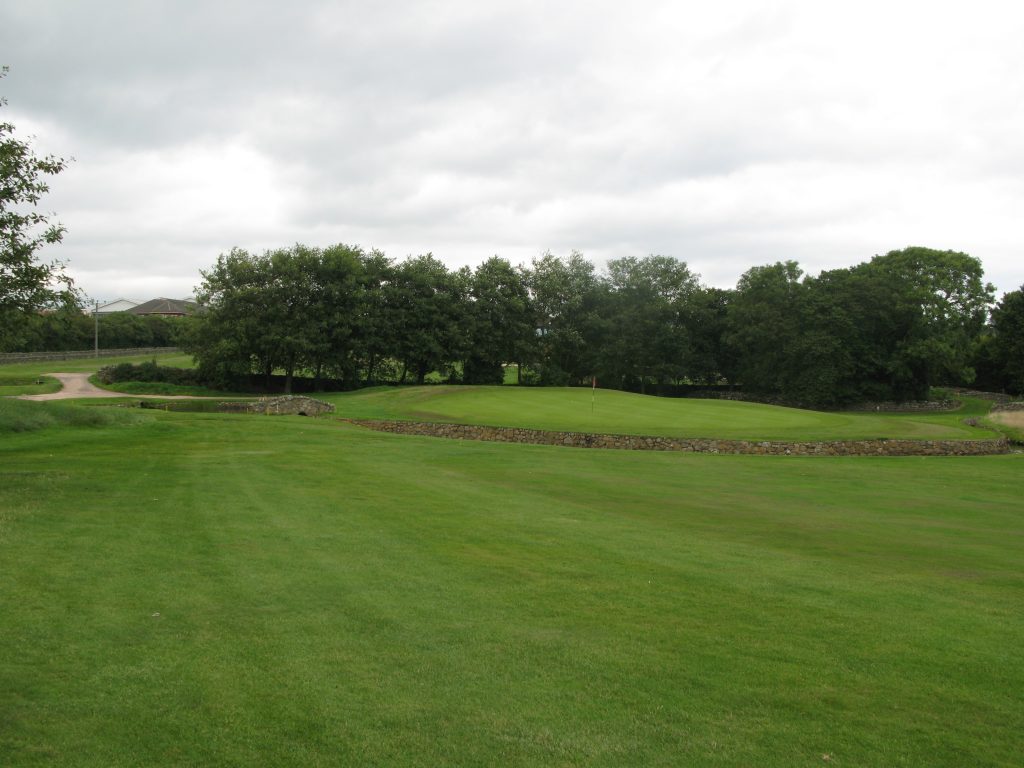
The beautiful 16th hole at Meldrum House, characteristic of the course.

Holes 11 through 15 play on the higher part of the course, with no water hazards, but the stretch starts with what can be described as a “gimmicky” 11th hole which has a disaster of 15 (yes 15) bunkers in front of the green approach.  I couldn’t help wondering what the record is for the most, separate, bunkers ever played from on a single hole??

The “gimmicky” long par 5 11th, with bunkers covering 70 yards of the green approach.


The course was in very good condition when I played other than one fairway (9th) which was poor.  The greens were beautiful, the tees and bunkers well kept and manicured.  It was also a very pleasant walk and, of course, there was hardly any other players!

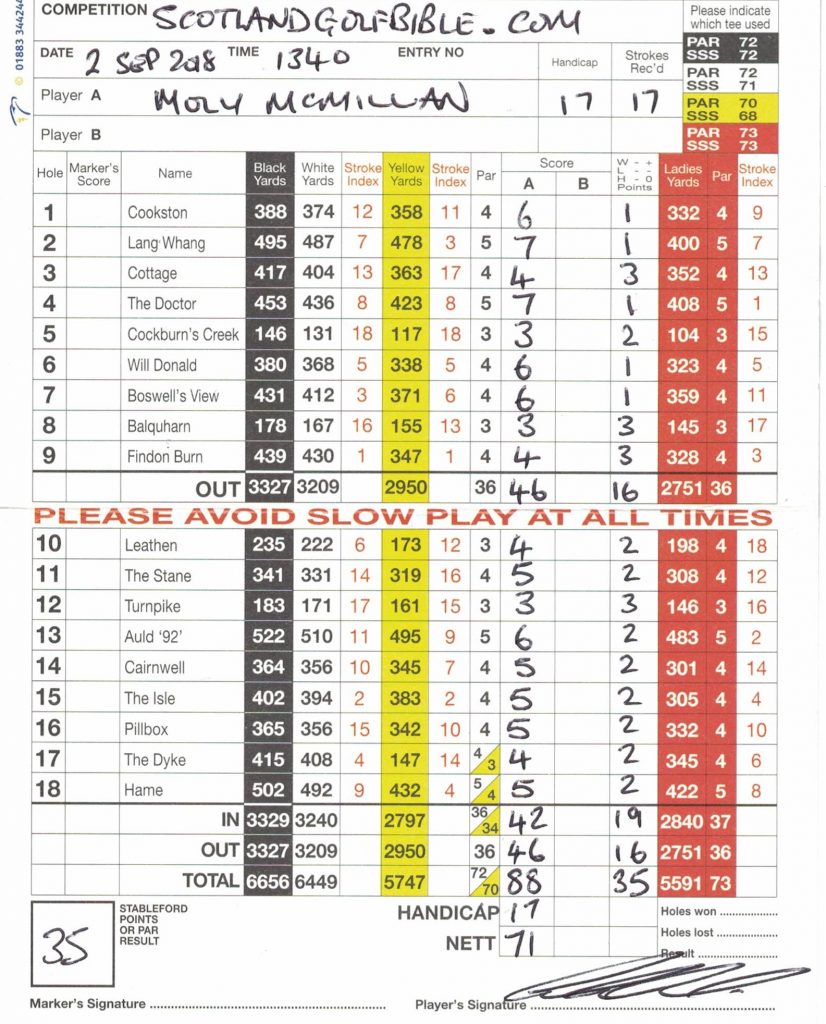
The 18th, unusually, was a short to medium iron, par 3, played over 2 sets of marshy water hazards.  Unfortunately, I found both hazards for a 7, my second quadruple bogie of the day, along with the 9th, which ruined an otherwise impressive card.  I still shot 90 for 35 points.

13th green, site of my only birdie of the day at Meldrum House

Oh, I nearly forgot to mention – coffee & tee were “free” in the clubhouse;)

Facts:

Course Type: Parkland

Par 70 (3 par 5s, 10 par 4s, 5 par 3s)

Distance (yellow): 5867

Moly’s Gross score90

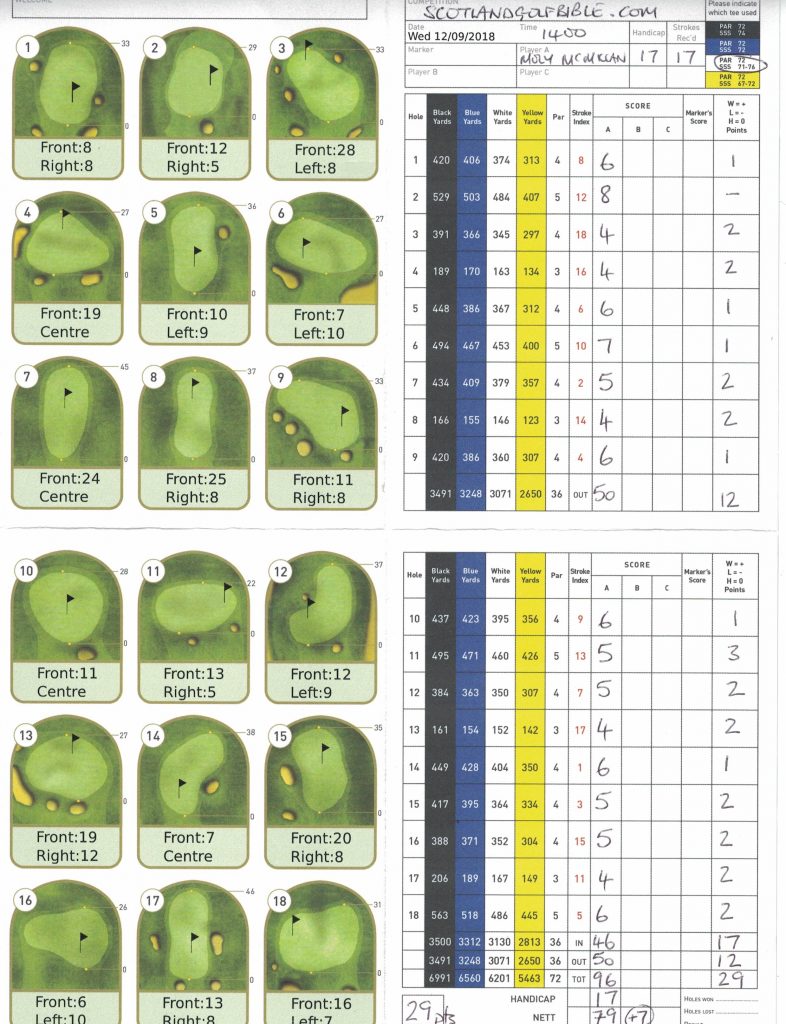
Moly’s Meldrum House Scorecard – 90 for 35 points

73. St Boswells. 10 Nov 2017.

Picturesque 9 hole course along the bank of the River Tweed      

Round £15.   Par 35.  Value (out of 5) – 3.5

St Boswells golf course is delightfully laid out on the bank of the River Tweed, which is  classed a “lateral water hazard”, in the village of the same name just off the A68 1 mile south of Newtown St Boswells in the Scottish Borders.   It is so close to the river that it might be appropriate to have a local rule forbidding the shouting of “fore”, which must on occasion disturb the many salmon fishermen on the river.

My playing partner Fran drives at the 3rd at St Boswells with the fisherman in the background a common sight on the Tweed.

The course was initially laid out by Open Champion William Park, who wrote ‘the turf resembles that found on seaside courses’.  Indeed, the course does have a slight heathland feel to the surroundings.

The 9th at St Boswells., a short par 4 of 256 yards to finish.

The course was in fact abandoned for 10 years between 1948 – 1958 due to a major river flood, and I couldn’t find out in what way the new layout the differs from the original Willie Park design.

Other than the slight uphill par 3 first hole, followed by the significant drop down to the signature par 3 second green, the course is very flat, unlike many of the courses in the Borders.

The signature 161 yard par 3 second hole, with the beautiful Borders countryside in the background.

This makes for an easy and most picturesque walk for holes 3 through 9.  The course is very favourable to a slicer of the ball, with the river tight along the left for holes 3 to 6, with trees lining the left for the return to the clubhouse from 7 to 9.   The greens were in good condition, albeit they are quite flat other than the 7th, a short par 5 hole, with a basin or saddle type green.

The 5th green at St Boswells with River Tweed awaiting!

The course was very soft when we played despite the high wind on the day, which meant plenty cleaning of muddy balls.  Overall the course had held up well to the recent weather with all greens still in play.

We only paid £5 for 9 holes, but the £15 summer green fee for 9 holes represents good value especially given the beautiful surroundings.   I had a fairly difficult day due to high winds, scoring 50 for only 12 stableford points – including 4 single putts (at 4, 7 and 9)!

Facts:

Course Type: Parkland

Par 35 (1 par 5, 5 par 4s, 3 par 3s)

Distance (white): 2637

Moly’s Gross score50

Moly’s St Boswells scorecard – 50 for 12 points!

72. Crieff Dornock. 2nd Nov 2017.

Pleasant 9 hole course well suited to holiday or “warm up” golf     

Summary:  Round £12.   Par 32.  Value (out of 5) – 4

Crieff Golf Club’s main course, Ferntower, is one of Scotland’s highly regarded inland courses.  The other course, the 9 hole Dornock layout, benefits from the same fine clubhouse and facilities, green keeping staff and well stocked pro-shop, making this a first rate choice for a holiday round of golf if you have a couple of hours to spare.

The 9th green at Crieff’s Dornock course, with the clubhouse in the background.

The club was established in 1891, and Old Tom Morris designed the main course, but the Dornock course only opened in 1980.  The open and beautiful Perthshire parkland on which both courses sit was part of the Victorian Spa ground of the well known Crieff Hydro.  Crieff is the gateway town to The Trossacks and both manicured courses are just what one might expect to find here, a destination well worth visiting.

The par 3 8th hole, one of the more challenging holes on Crieff Dornock

The Dornock course is short, and other than the first hole where out of bounds encroaches on the right, the fairways are very generous, so there is no need to carry too many balls.  The greens are firm and very true and better than most 9 hole courses I’ve played.   The course runs along side the Ferntower course, with some adjoining fairways.

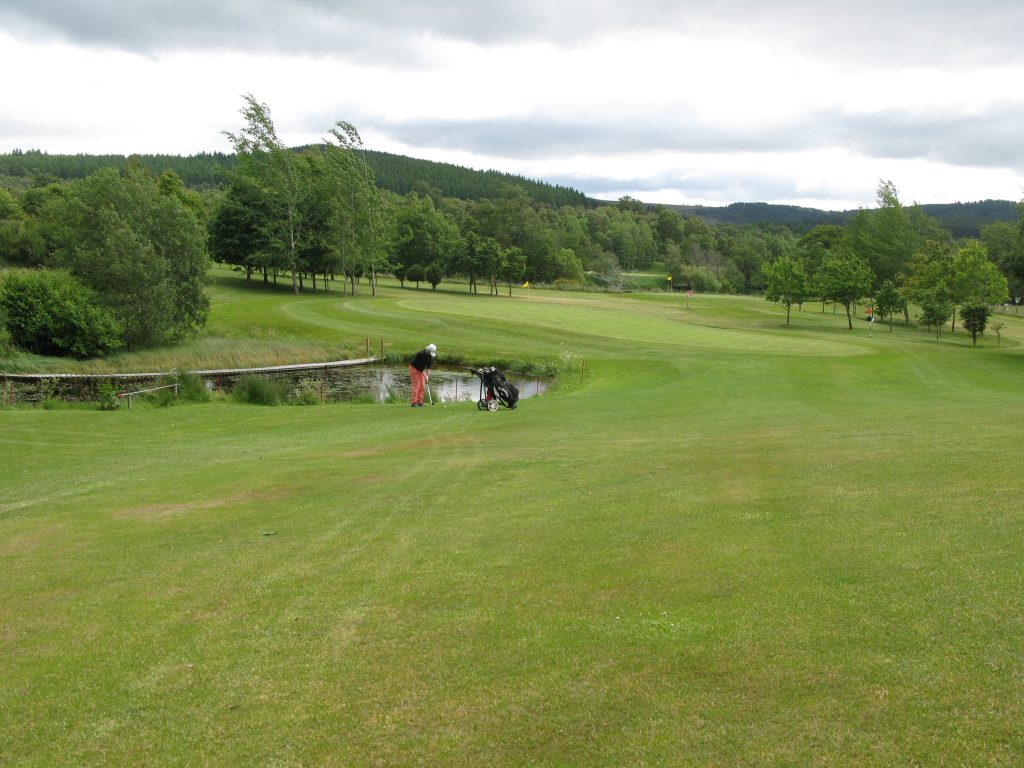
Fran getting out of the bunker at the 8th at Crieff Dornock

The course is made up of 5 par 4s and 4 par 3s, and it’s the latter holes that are the most challenging, since the par 4s are short and prove good par or birdie opportunities.  This was very welcome for me after my difficulties playing at Tain last week.  On the day, I shot 39, +7, and that included a lost ball (under leaves!) on the fairway at 7.

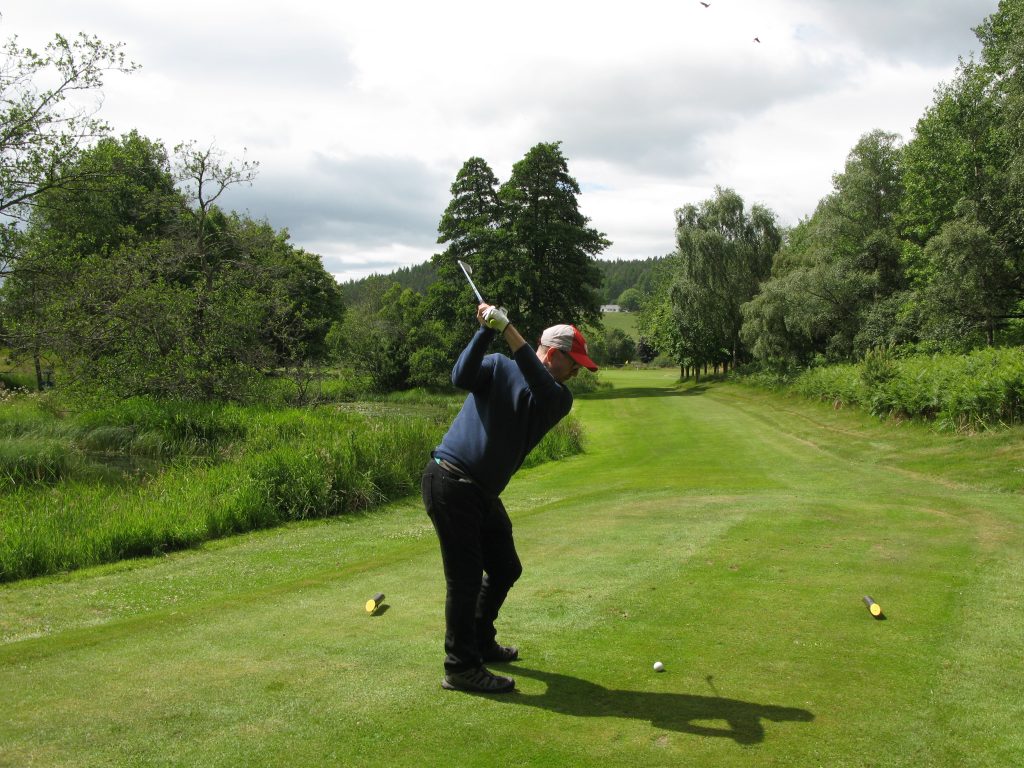
Moly on the 6th green at Crieff Dornock, with the typical beautiful parkland surrounding.

Dornock was in very good condition when I played, plus dowsed in glorious winter sunshine, with zero wind, which always helps keep the score down.

This course is highly recommended – it was only £5 for a winter 9 holes, and still good value at £12 for 9 holes in Summer.

Facts:

Course Type: Parkland

Par 32 (5 par 4s, 4 par 3s)

Distance (black): 2270

Moly’s Gross score39

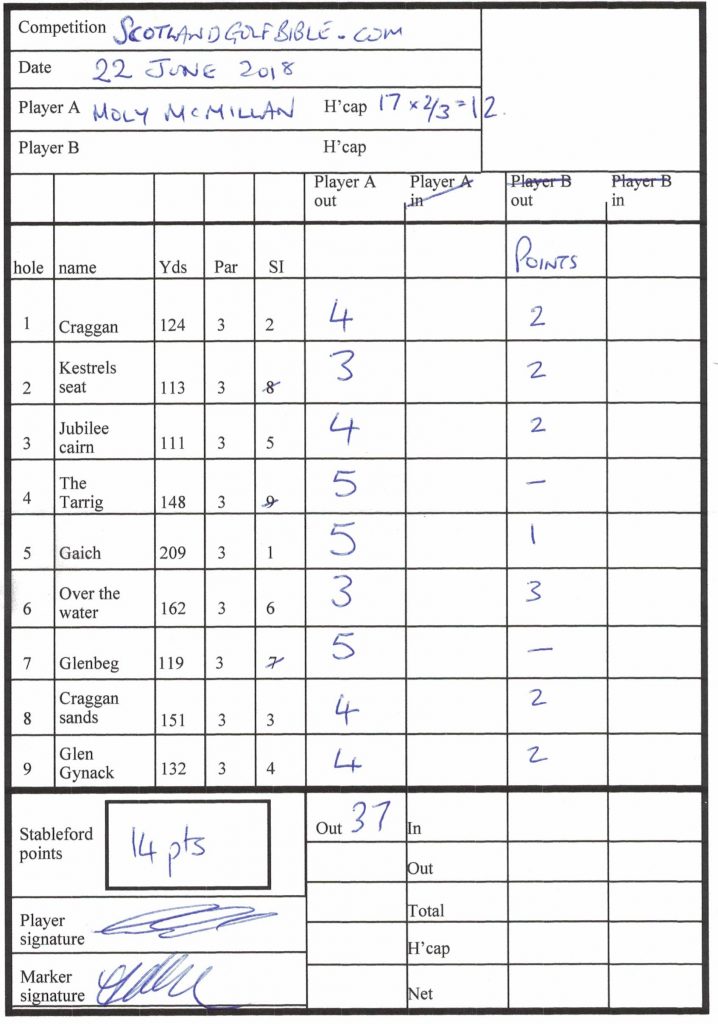
Moly’s Crieff Dornock scorecard – 39 (7 over)

67. Bridge of Allan. 11th Oct 2017.

A 9 hole course from bygone days worth experiencing. 

Summary:  Round  £20.   Par 33.  Value (out of 5) – 4

There can’t be many golfers who play Bridge of Allan for the first time that find the par 3 1st green with their tee shot; less than 5% I suspect, probably much lower.  It’s not that it’s the most difficult par 3 ever, it’s just also so unusual.  It’s 223 yards up a steep slope (40% they say!), with a blind plateau green that has a dry stone dyke across the fairway about 30 yards in front of the green.  Welcome to one of Old Tom Morris’ famous holes.  Thankfully not all of Old Tom’s holes are as demanding as this, otherwise golf in Scotland may not be as popular as it is!

The very demanding first shot at Bridge of Allan – the long par 3.

Old Tom Morris designed this nine-hole golf course in 1895, in the affluent Victorian spa town of Bridge of Allan and the course has commanding views of the surrounding hills and countryside, including Ben Lomond, and also Stirling Castle which is only a few miles away.

According to the golf historian, Robert Kroeger, in his book ‘ The Golf Courses of Old Tom Morris’, Bridge of Allan is “the best preserved in that the layout and length of holes and greens are exactly the same as they were in 1895”.  So for historical reasons alone, it’s worthwhile playing here, and that is why I’ve said this is a 4/5 for value.

Fine views from the 1st, which also shows the typical flat greens

However, I suspect the course will not be to everyone’s taste.  Most of the holes have out of bounds (OOB) in play, mainly for the right handed hooker.  OOB areas are also tight behind some greens, especially the 4th which also has a dyke in front of the green.  There are hardly any flat lies as the course is so hilly.  The greens are however pretty flat, which meant that when I played 2 greens were out of action due to being waterlogged.  Of course, Old Tom mainly designed links greens, which naturally drain much better than parkland.

The semi-blind par 4 7th at Bridge of Allan

Old Tom makes much use of existing dykes which are in play on several holes and also blind tee shots by carefully using existing tree lines – this is especially true on the 6th and 7th holes, which need to be played more than once to get a feel for the line from the tee.

I had a difficult time on the day, including three 7s in my 13 over for 9 holes.  My day was typified by hitting a magnificent drive (probably about 240 yards) at the 7th, but I never found my ball as it was very likely plugged.

The difficult par 4 8th, another uphill hole at Bridge of Allan

The course was very wet when I played which was a pity, but the fairways were in good condition.  I think that it must take several rounds here to get used to the tricky layout.  The highlight holes for me in addition to the 1st were the 4th, 5th and 7th.

Facts:

Course Type: Parkland

Par 33 (0 par 5s, 6 par 4s, 3 par 3s)

Distance (yellow): 2517 (9 holes)

Moly’s Gross score46.

Moly’s Bridge of Allan Scorecard – 46

« Older posts Newer posts »

© 2025 Scotland Golf Bible

Theme by Anders NorenUp ↑