Scotland Golf Bible

A guide to green fee value for money

Page 12 of 48

145. The Royal Burgess Golfing Society. 26 May 22.

Golfing grandeur nestled out of sight – just like Augusta National – with azaleas and other mysteries thrown in.

Round £175. Par 68. Course Rating / Slope Rating (yellow) 67.4/113. Value (out of 5) – 2.5

As I played Royal Burgess, close by a busy traffic junction in Edinburgh, I had a nagging thought; this venue has parallels to Bobby Jones’ Augusta National, an oasis of golfing perfection just off a nondescript highway.
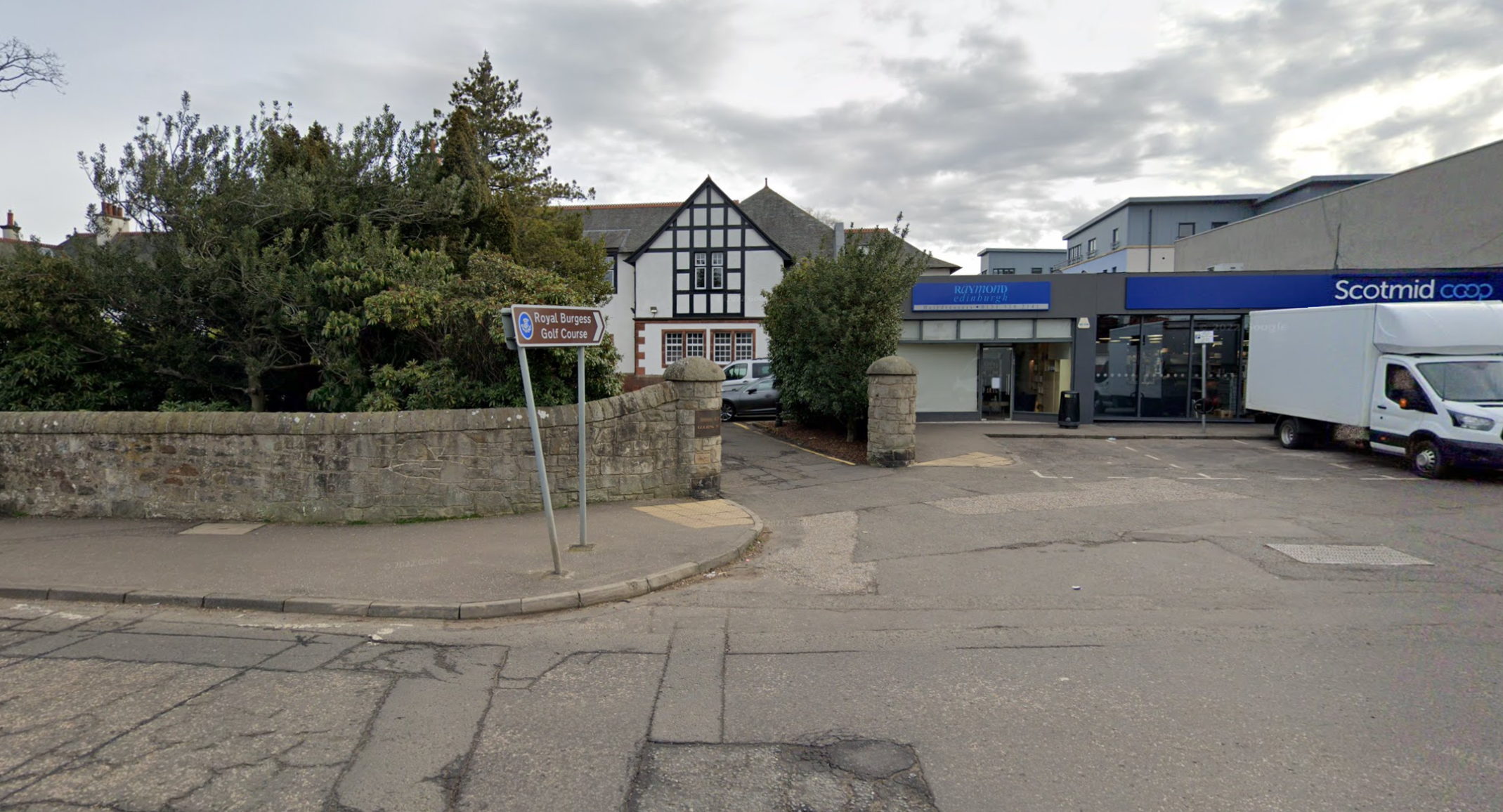
The humble Burgess entrance, belying the wonderful parkland beyond, had me musing of Augusta.

This is not a ‘Golf Club’ though, but the more grander ‘Golfing Society’, a term dating back to 1735, some 150 years before the creation of the current golf course at Barnton.
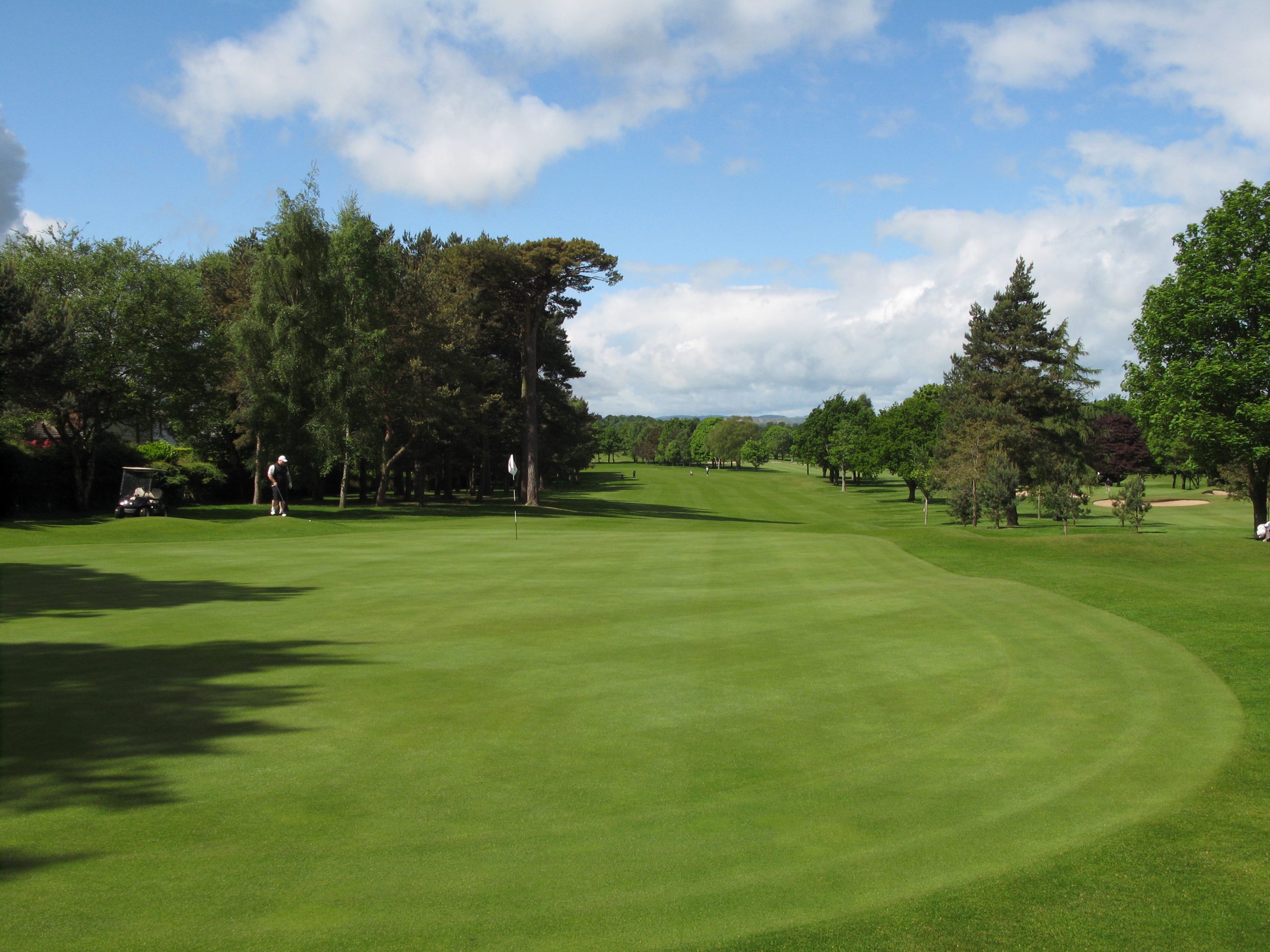
The difficult par 4, fourth hole, one of the best at Royal Burgess.

A ‘Burgess’ is a term used differently in different countries. In Scotland in 1735, the year of the Societies origin making it the oldest golf club in the world, ‘burgesses’ were city freemen with exclusive trading rights and members of trade guilds. In a sense, they were the Scottish Bourgeoisie. The men would also, probably without exception, have been Freemasons, as Scotland was the birthplace of post middle-age freemasonry. There is a very interesting article “How freemasons invented golf” in the www.scottishgolfhistory.org website which also covers how the Burgess Society was involved.
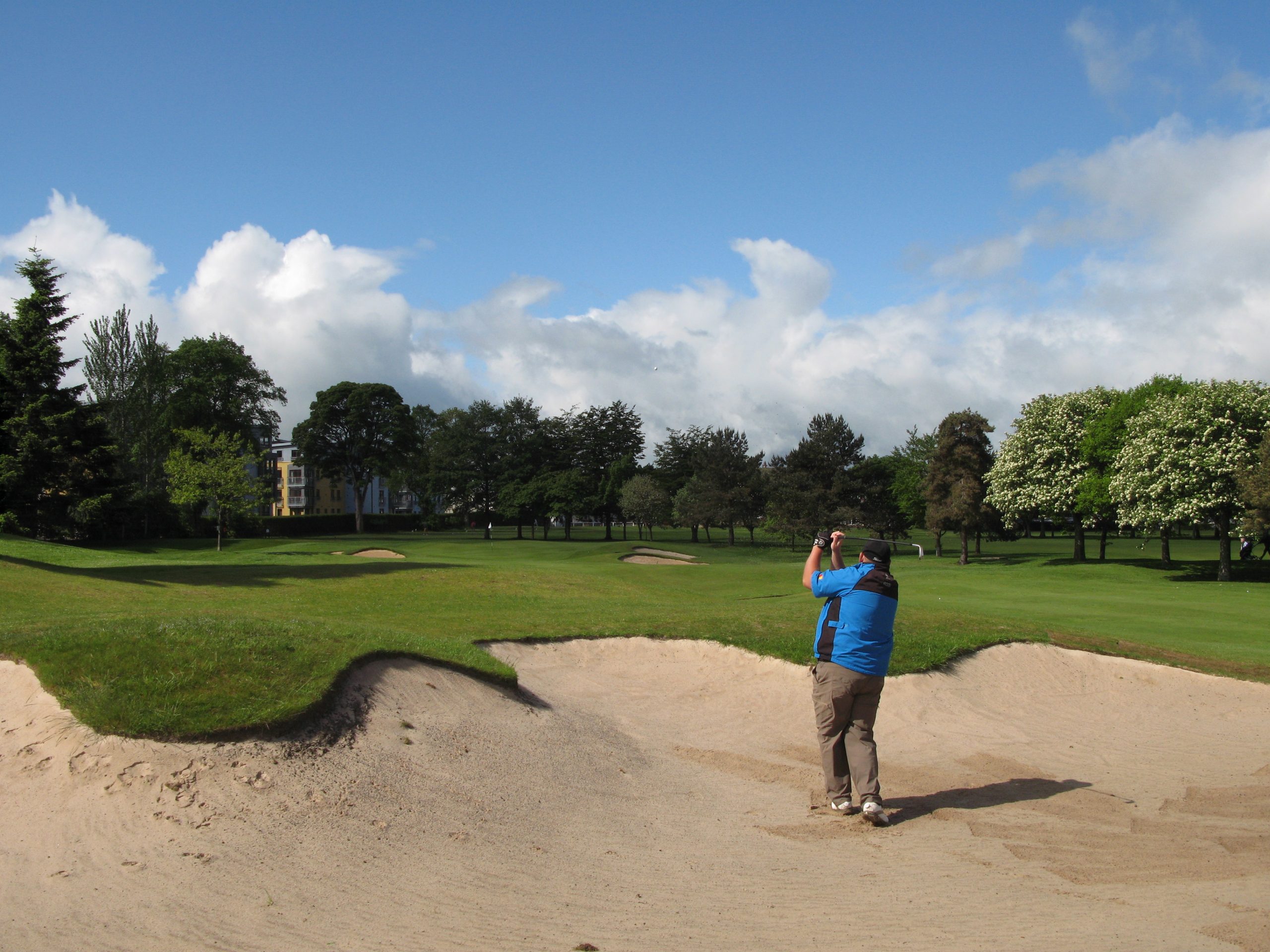
Ian Ponton plays from a typically well manicured bunker, here at the 2nd, a short par 4.

There is also a lovely Burgess history here on the clubs website, and covered in fine detail on the walls of the impressive 1897 “Arts and Crafts” clubhouse, which is well worth visiting when you play.
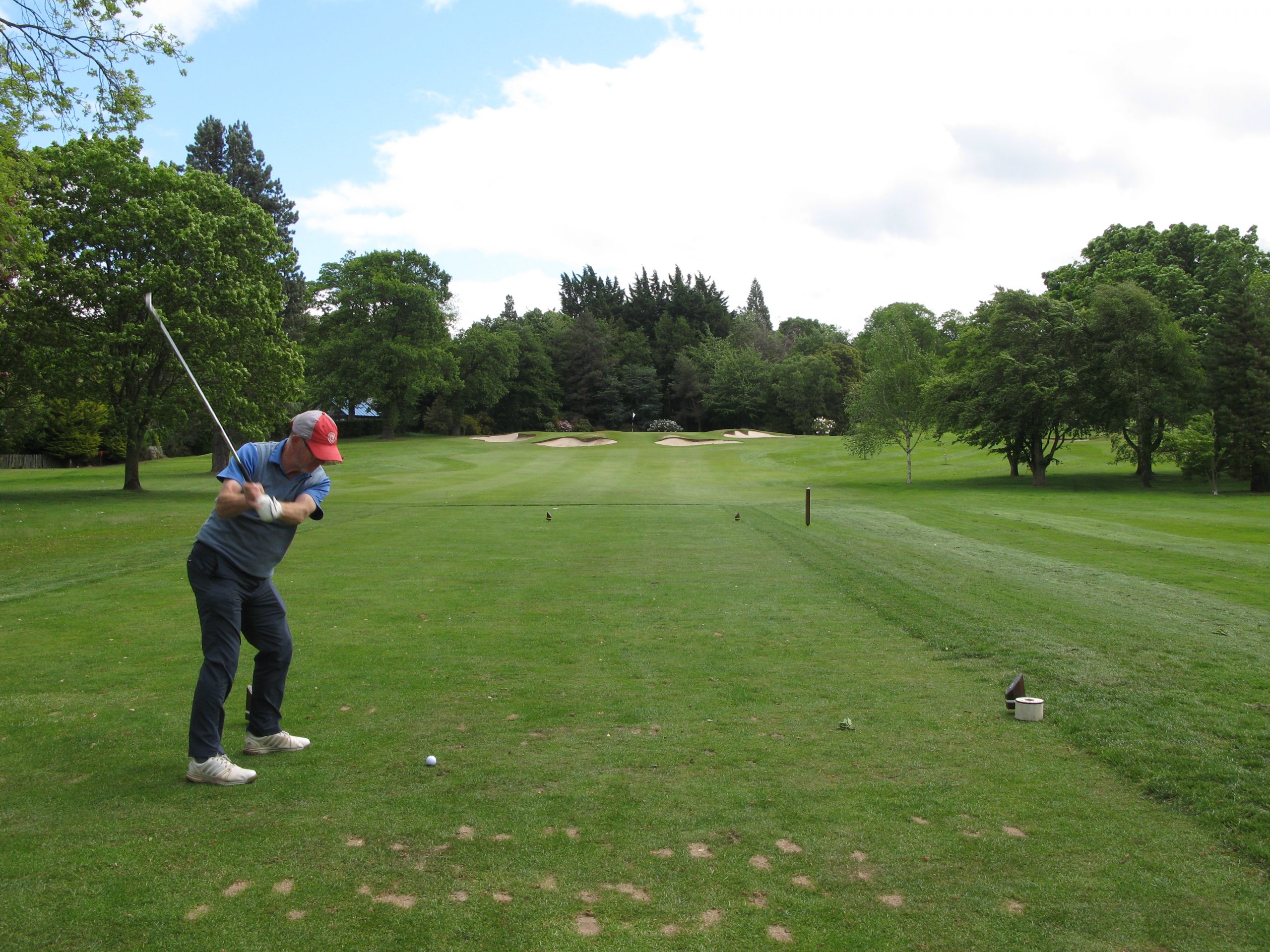
Moly’s tee shot at the 121 yard par three 8th hole, with a typically aesthetic surround.

The society originally played over 6 holes at Bruntsfield Links near Edinburgh Castle, then at Musselburgh from 1874 along with some rival societies (you may be able to guess them?). The Burgess finally came to its current location in 1895 on land that had been the private course of a wealthy businessman, Robert Clark. It was an ideal location in its day, with the current starters hut, adjacent the first tee, formerly being the ticket office for the Barnton railway station of the Caledonian line.
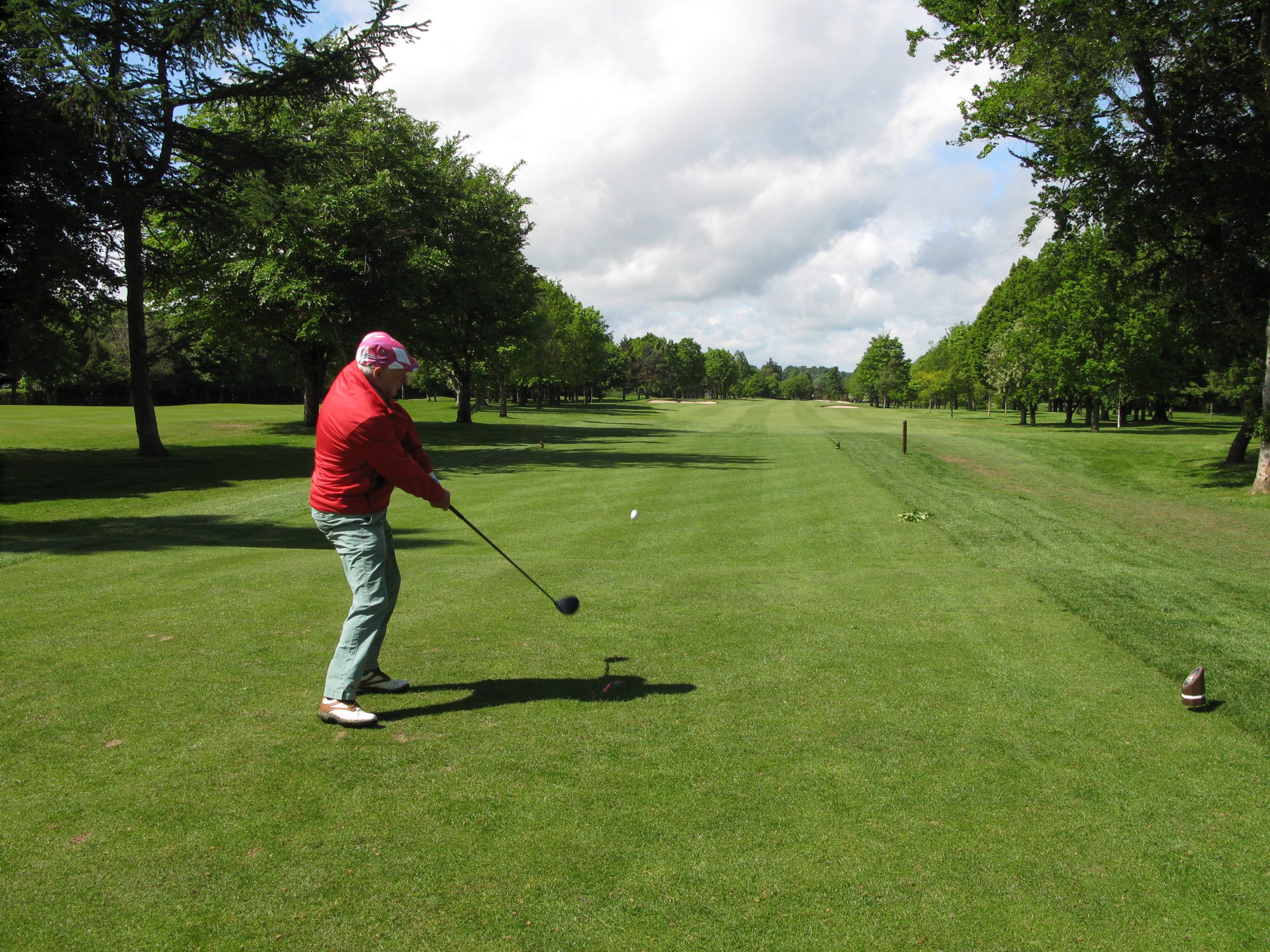
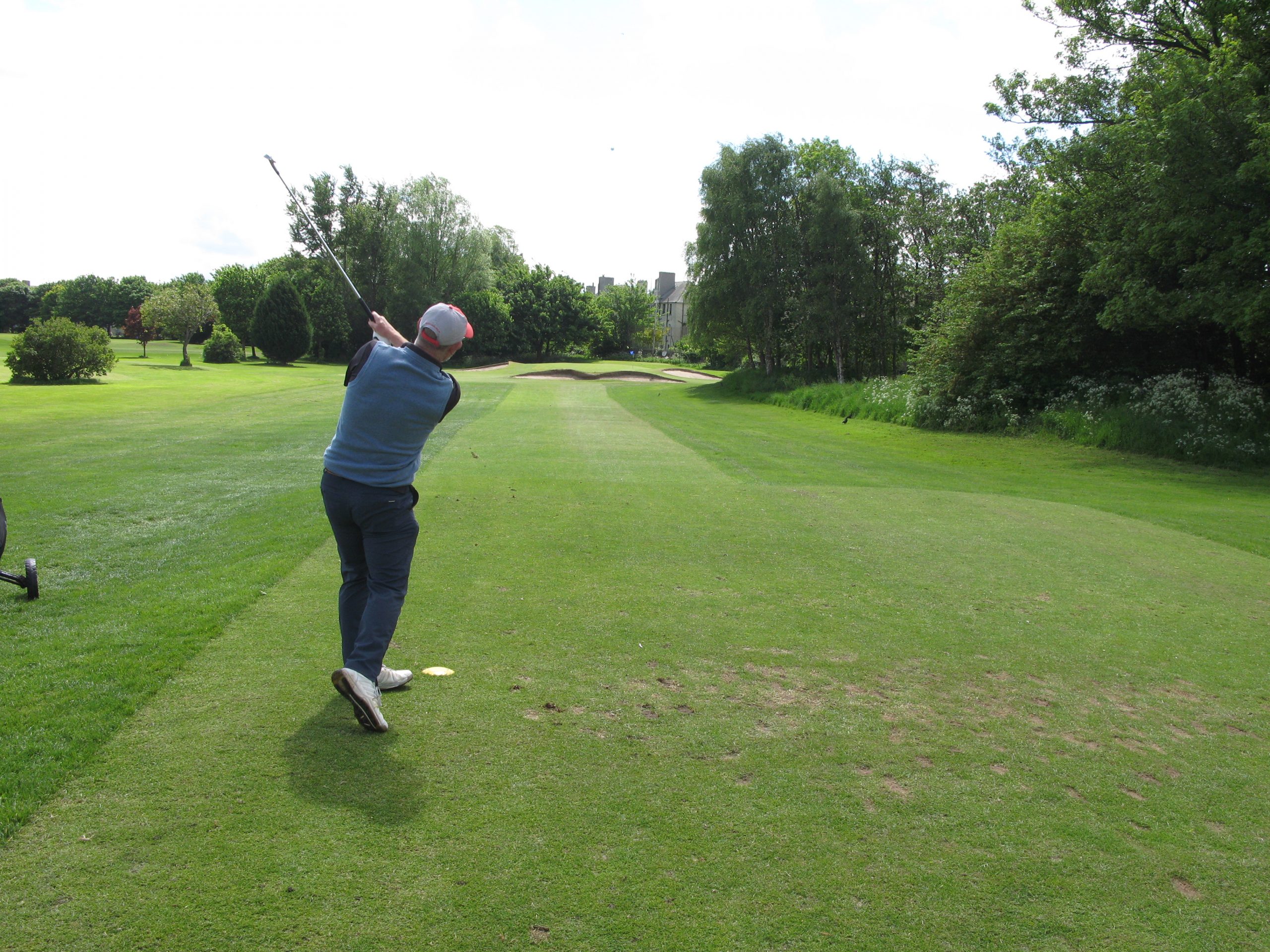
Bob Tait, demonstrating a full extension through the ball, at the 437 yard par four 6th hole. Royal Burgess is a good course to use in any debate for advocating different stroke indexes for each tee box.

Since 1895, no lesser than Old Tom Morris, Willie Park Jnr (main designer), James Braid and Philip MacKenzie Ross have developed the course – that’s quite an architectural pedigree.

The course sits in a beautifully manicured arboretum with a wide variety of trees and plants, including azaleas and rhododendron. Although not a long course and constrained by the tight parkland surrounding, the ‘yellow’ course feels longer than its 5700 yards, comprising several long par 4s and no yellow par 5s. There are many large and deceptive greens making three putts a constant hazard. An anomaly in yardages means that the 210 yard par three 18th, is stroke index 18, due to the championship tee designating it a par four. I imagine most matchplay games reaching the 18th, strongly favour a lower handicapper.
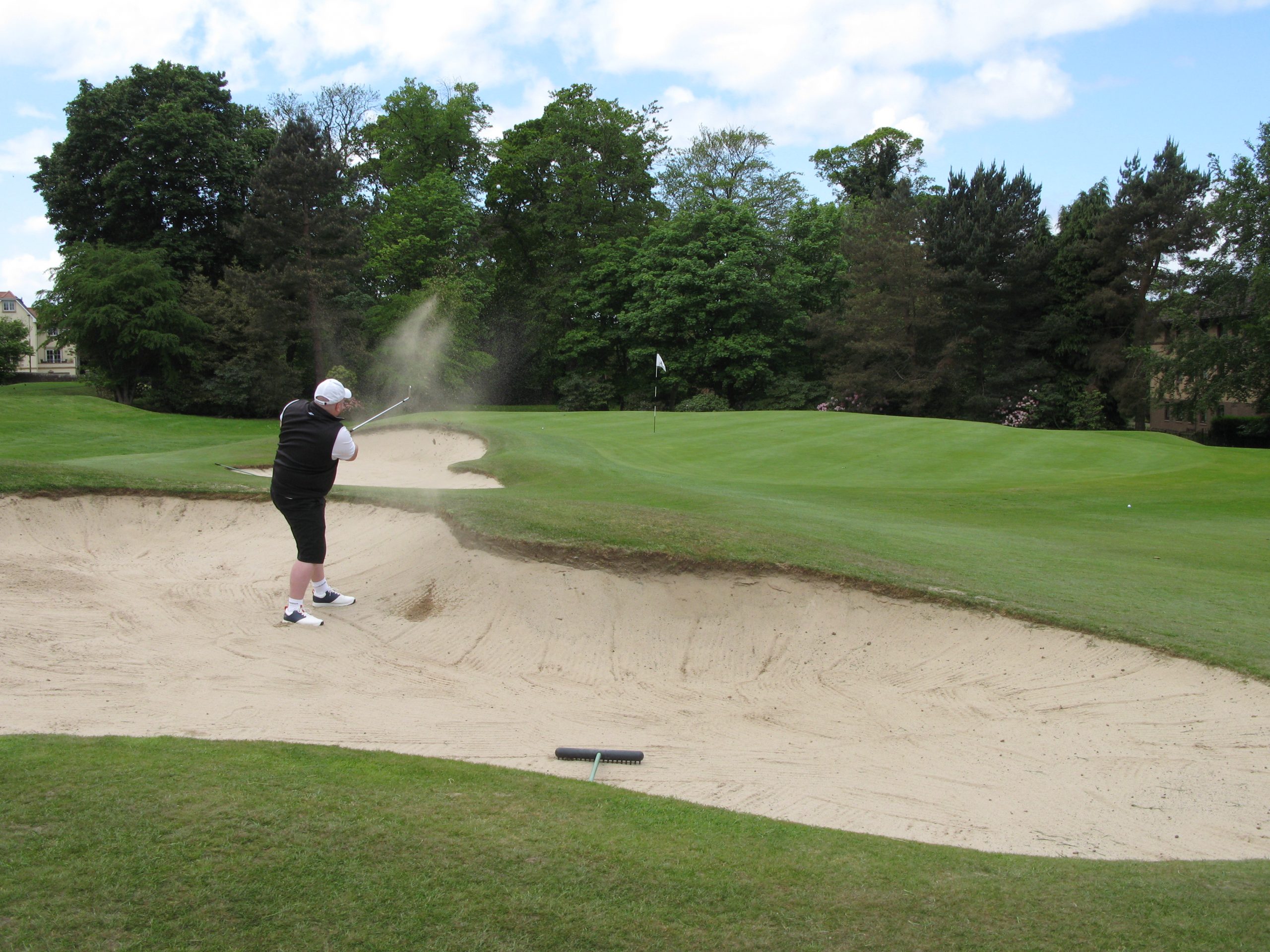
Jamie Snedon playing from the greenside bunker at the 15th, a tough par four.

The course was in great condition when I played, hosted by the affable Ian Ponton, owner of the Oz Bar in Candlemaker Row in Edinburgh, along with his great friends Bob Tait and Jamie Snedon. Jamie played by far the best golf on a very windy day, but thankfully we hadn’t made a wager as we started off in a bit of Scottish drizzle.
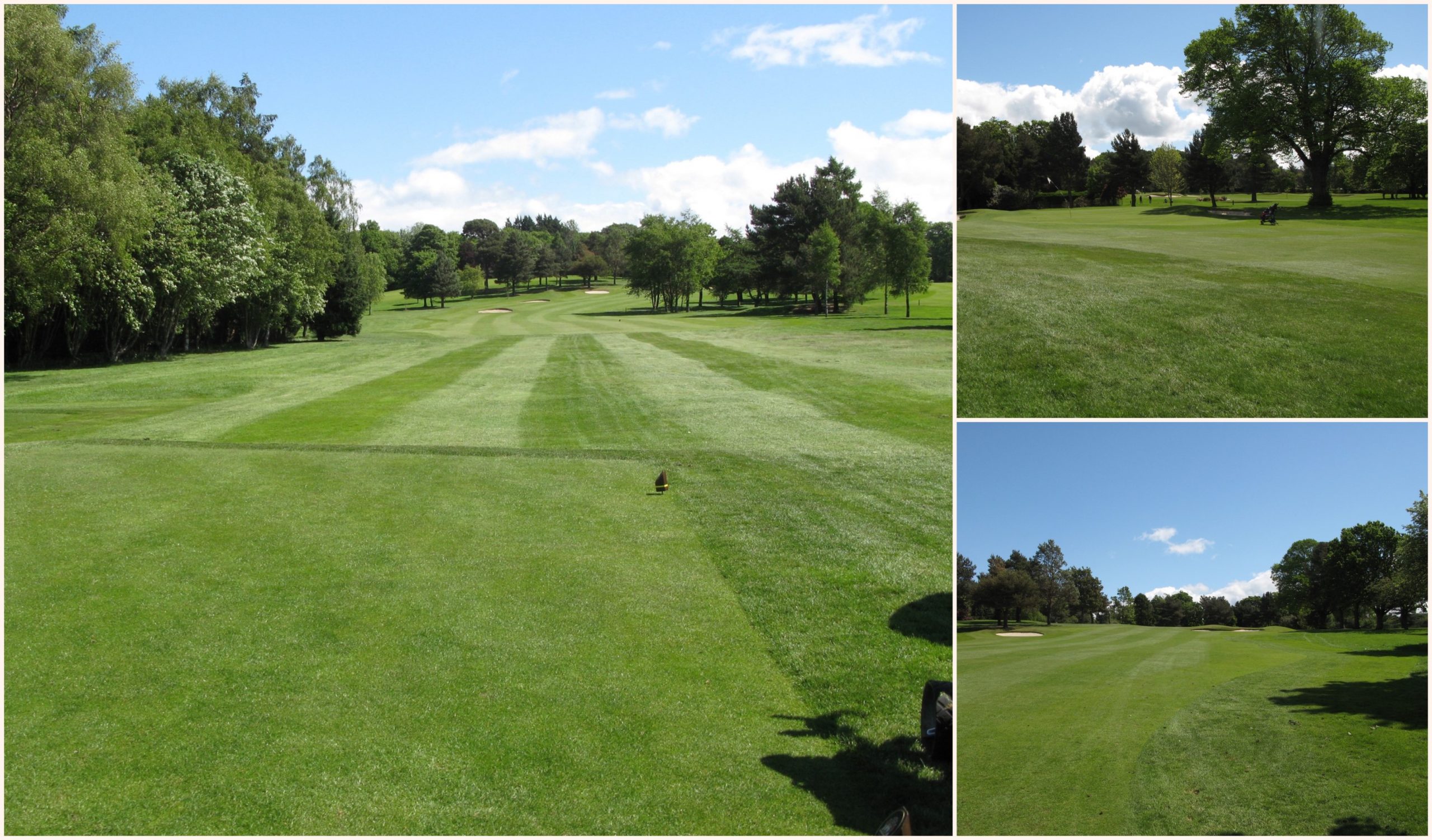
The 10th, a testing dog leg par four and a very characteristic Burgess hole

The wind didn’t hamper our enjoyment and one could really appreciate the course design, where many large fairway and greenside bunkers were of the highest order, with perfect sand. Many bunkers have been added over the years, some recently. The course sets up better for a fader of the ball (such as Jamie), with all bar one (the 14th) of the many dog leg holes being left to right.

The par threes were well bunkered albeit, other than the 18th, they were short to mid length iron shots for most players.
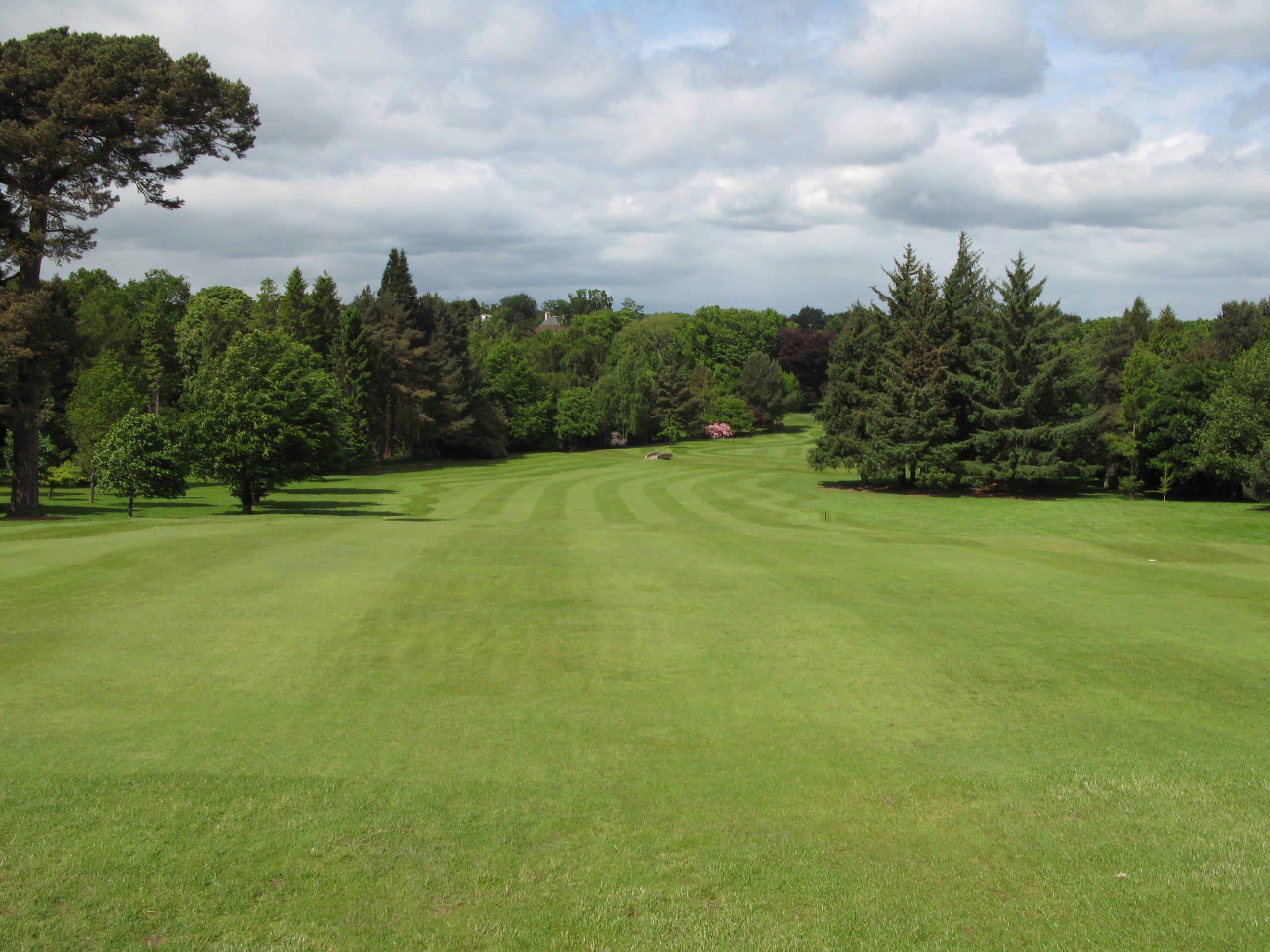
The approach at the 11th, the signature hole at The Burgess

I struggled to a score of 95, which can’t all be attributed to the wind and my recently developed fade was turned into a monstrous slice on several occasions. It’s important to avoid the bunkers to score well at Burgess, something I failed to do.

I can’t imagine anyone not liking Royal Burgess, a place of genuine history in the developing of the game. It’s beautiful condition, makes it a four for value at its current price.
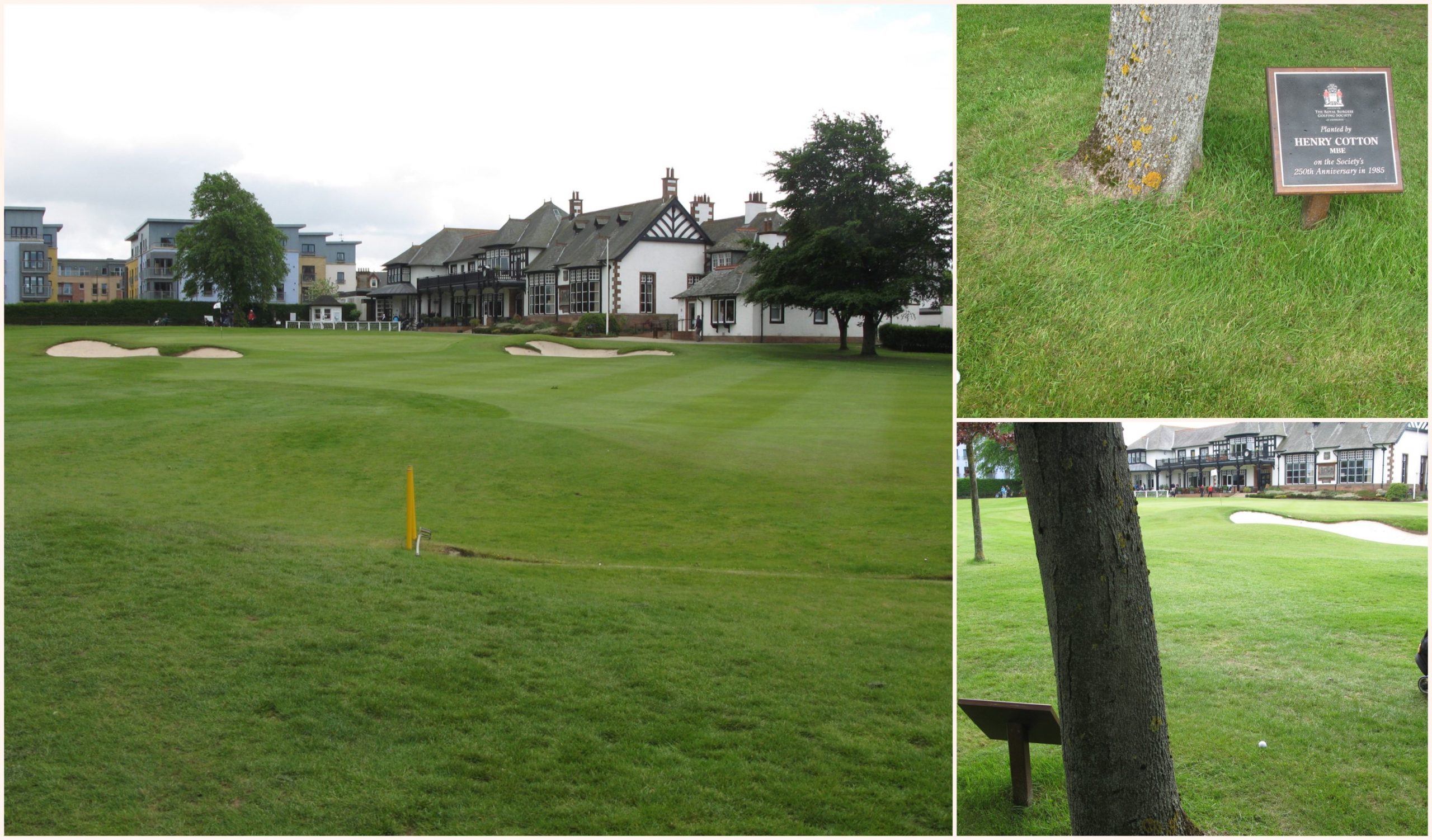
The clubhouse is the backdrop to the 18th, with a plaque commemorating Henry Cotton’s visit to Royal Burgess, where I conveniently located my tee shot!

The “Royal” patronage was bestowed on the club in 1929, due to a friendship between Robert Boothby, a Burgess member, and the Prince of Wales, later King Edward VIII (he who abdicated). Boothby was knighted the same year the club became Royal Burgess.

Finally, lets return to my Augusta National ‘gut feeling’ comparison. In looking for a comparable Augusta picture to the Royal Burgess entrance photograph, I stumbled upon a quite remarkable thing. Directly opposite the unobtrusive entranceway to The Masters venue, is the headquarters of the Ancient Scottish Rite Freemasonry organisation. Dig only a little deeper and you find that none other than Augusta hero Brother Arnold Palmer was a Grand Great 33 degree Freemason of the Scottish Rite.
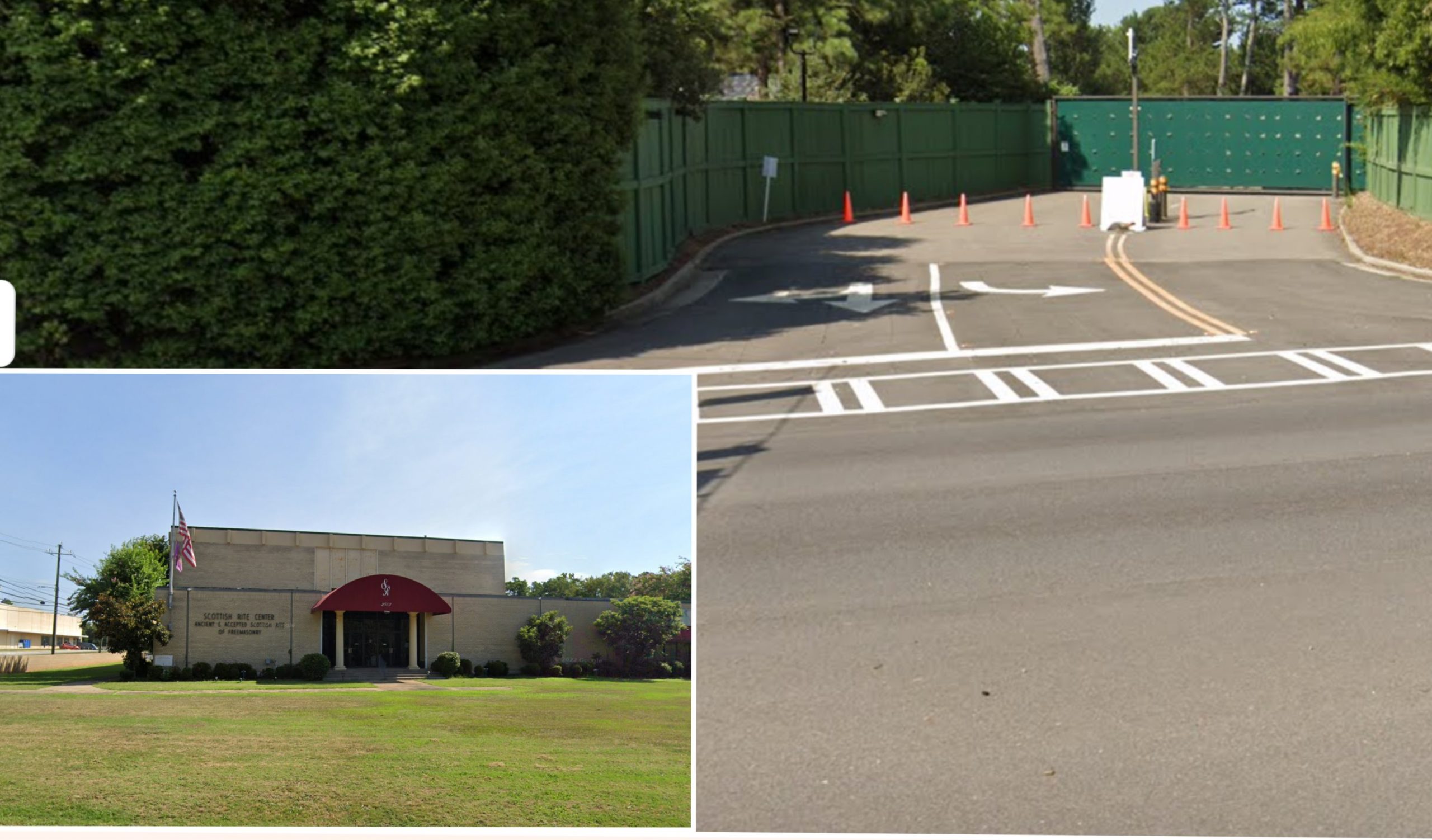
Augusta National entrance with inset of the building opposite – the HQ of Scottish Rite Freemasonry

Plenty of mystery and history to ponder in playing this recommended, but overly priced, course.

Facts:

Course Type: Parkland

Par 70 (0 par 5s, 14 par 4s,  4 par 3s)

Distance (yellow): 5704 yards

Moly’s Gross score: 95
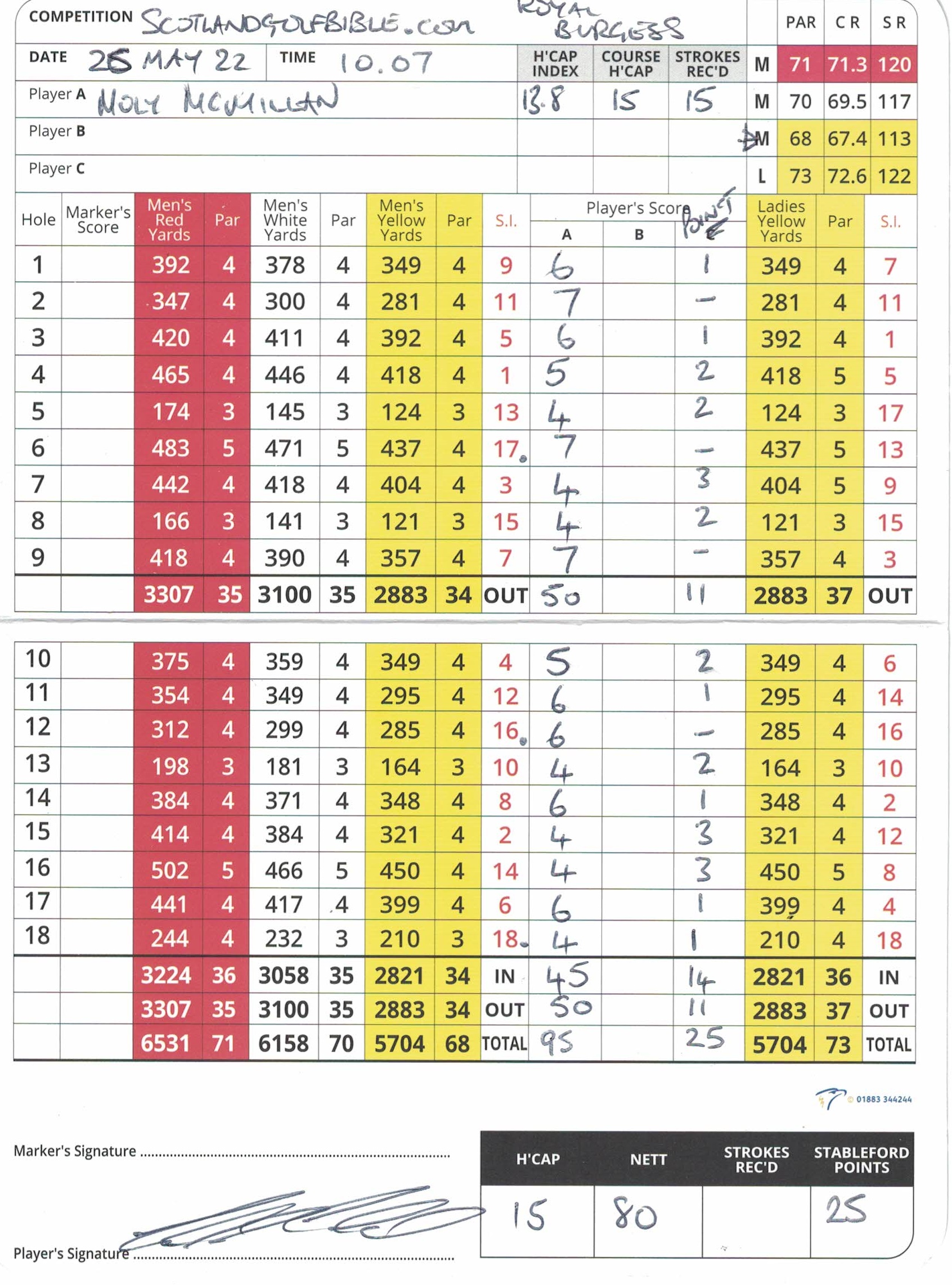
Moly’s Royal Burgess scorecard – 95 – dominated by up to 40 mph wind.

144. Lochend Craigentinny. 25 May 22.

Municipal courses like ‘The Tinny’ are at risk from green fee apps

Round £27.50. Par 67. Course Rating / Slope Rating (yellow) 64/108. Value (out of 5) – 3.5

Edinburgh Leisure, runs 6 municipal golf courses across Edinburgh on behalf of the council, including Craigentinny, an 18 hole course on the east of the city between Leith and Portobello, just off the A199.

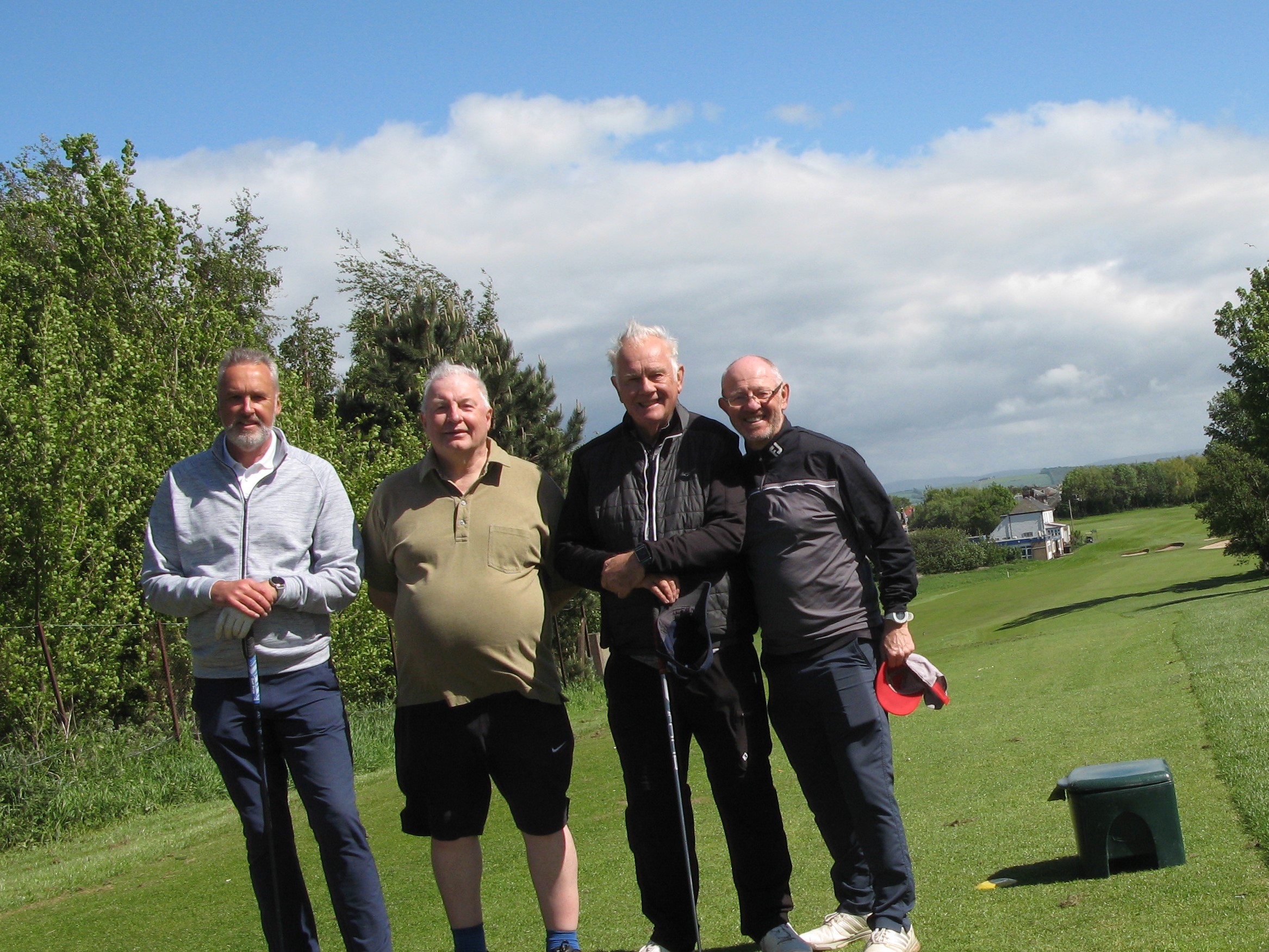
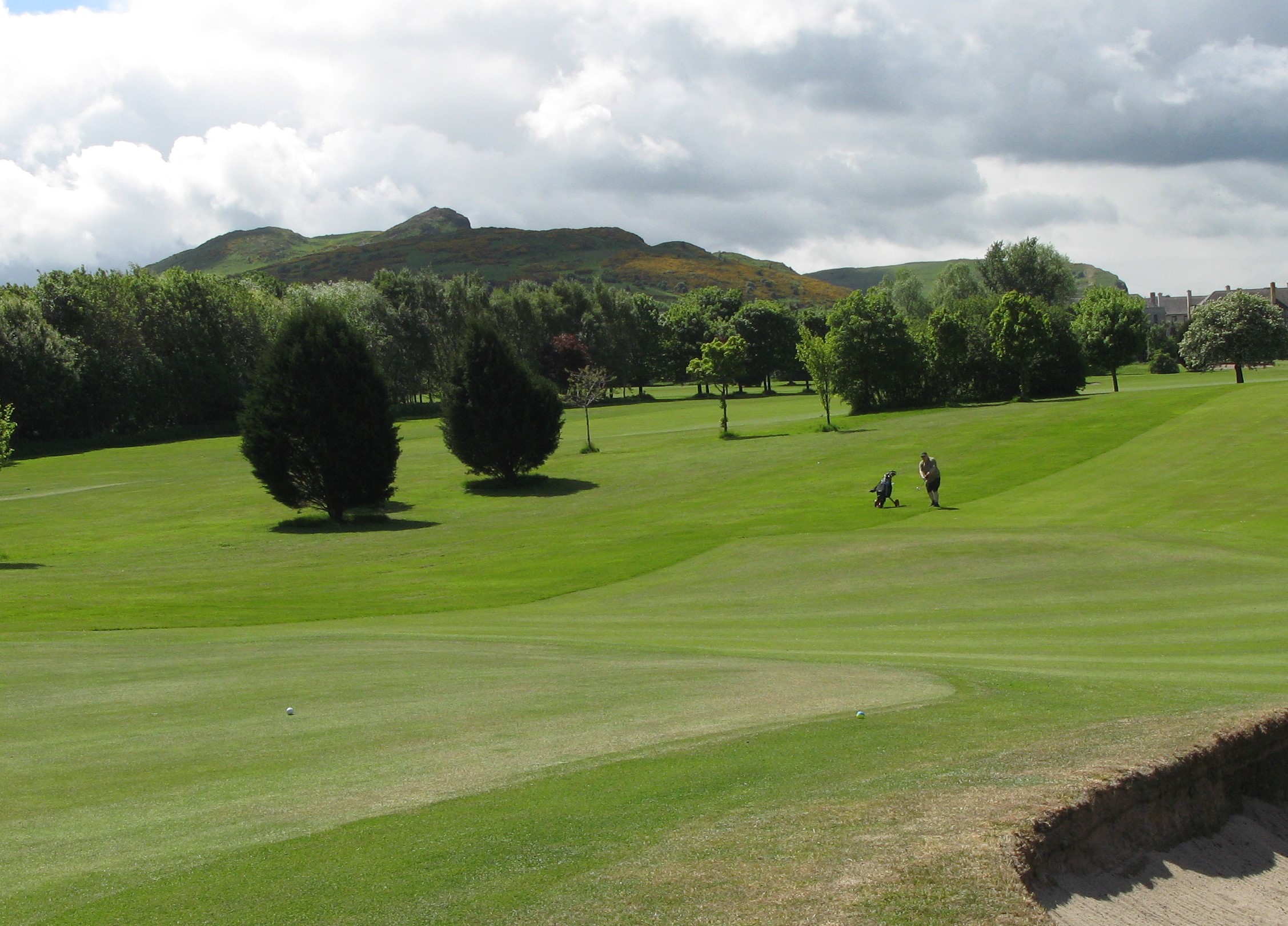
From left, Gordon, Frank, Brian and Moly at the 18th, with 40 mph winds to help put 3 OOB.

“The Tinny”, as it is known, is a decent little course at just over 5000 yards (yellow). It has no par 5s, and only one of the par 4s, the 10th, is over 400 yards. With wide open parkland, light rough and only a handful of fairway bunkers to speak of – there were signs of some bunkers having been filled in – the Slope Rating of 108 (yellow) lets you know this is ‘friendlyish’ golf.

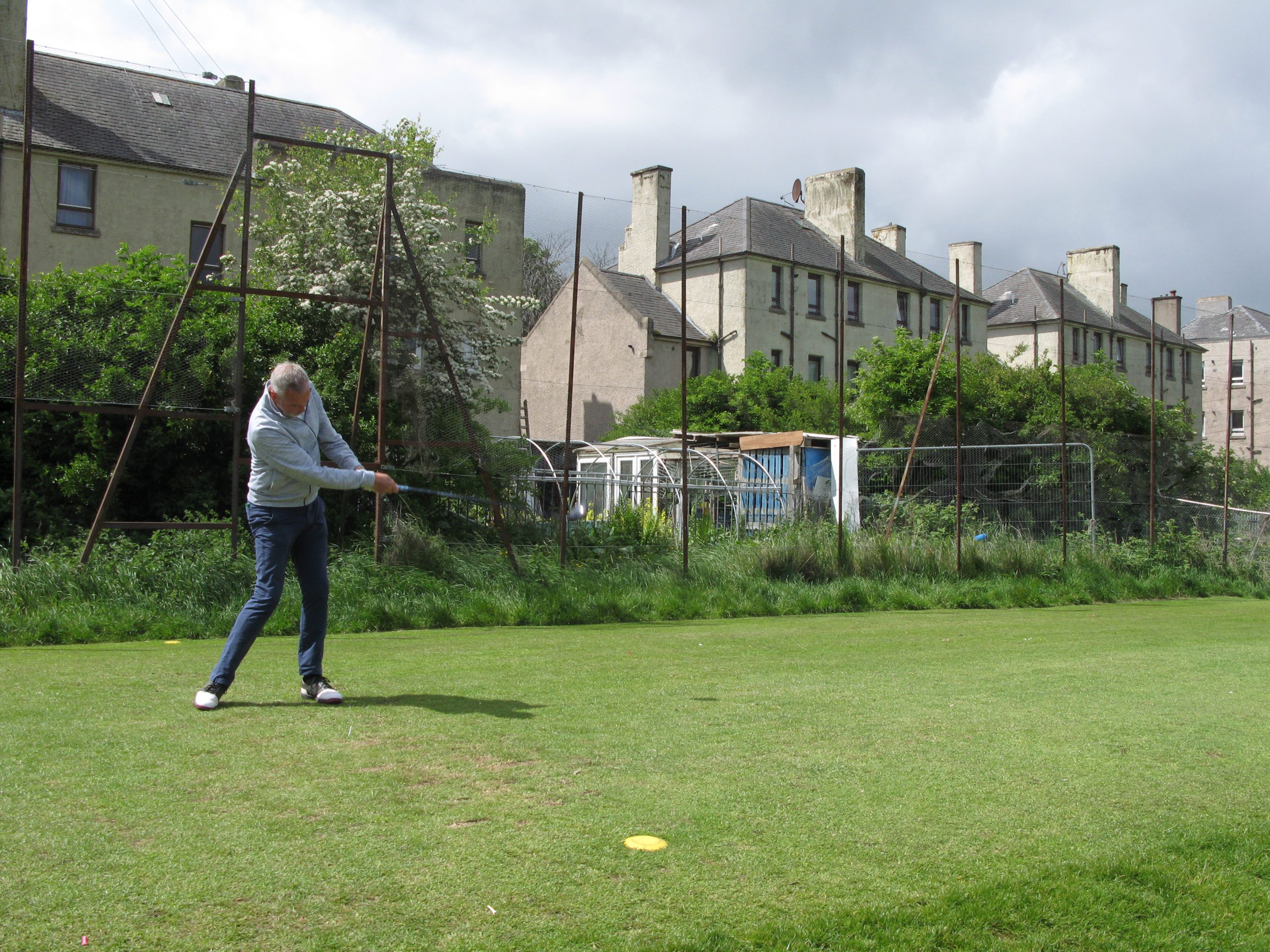
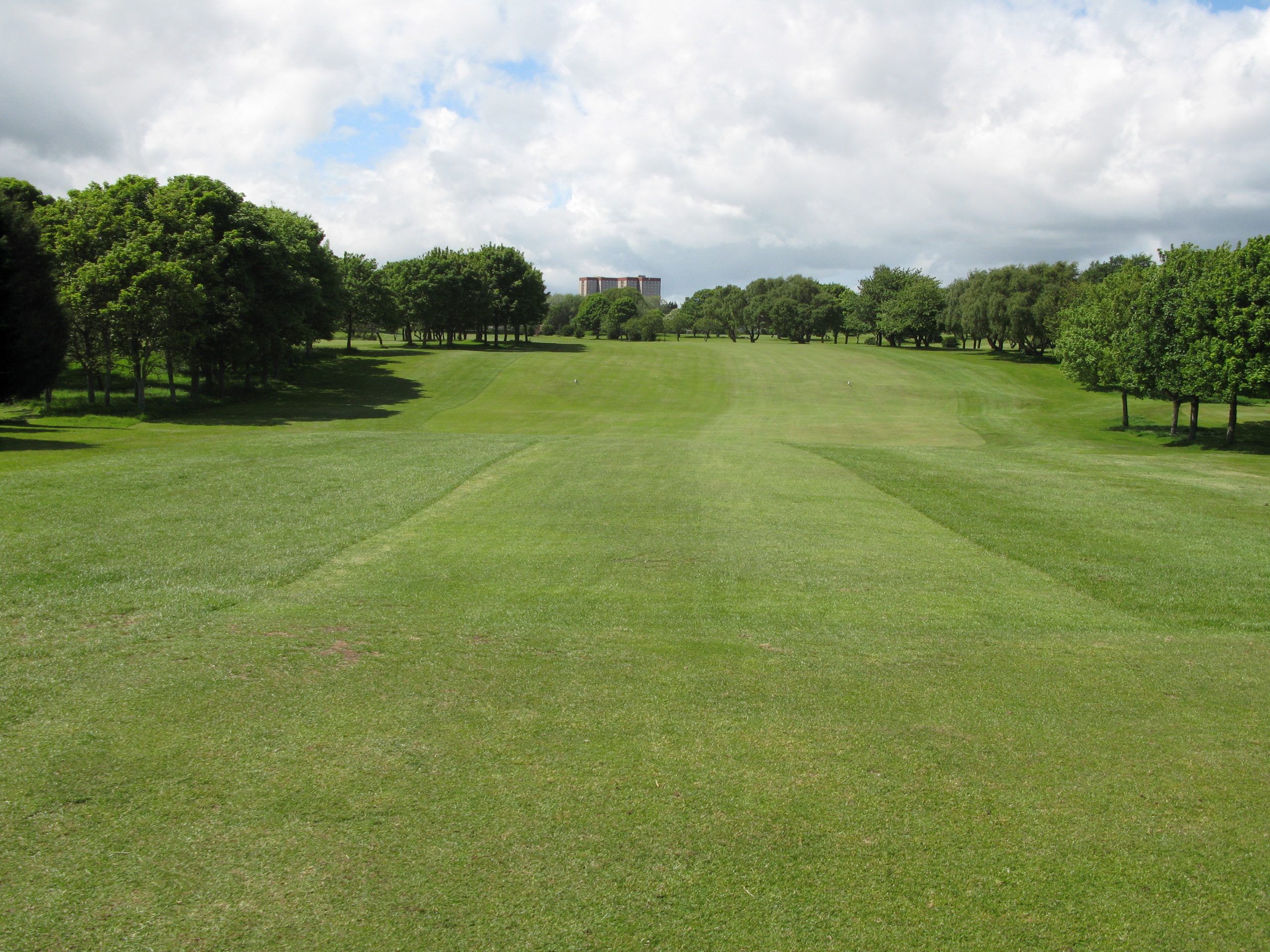
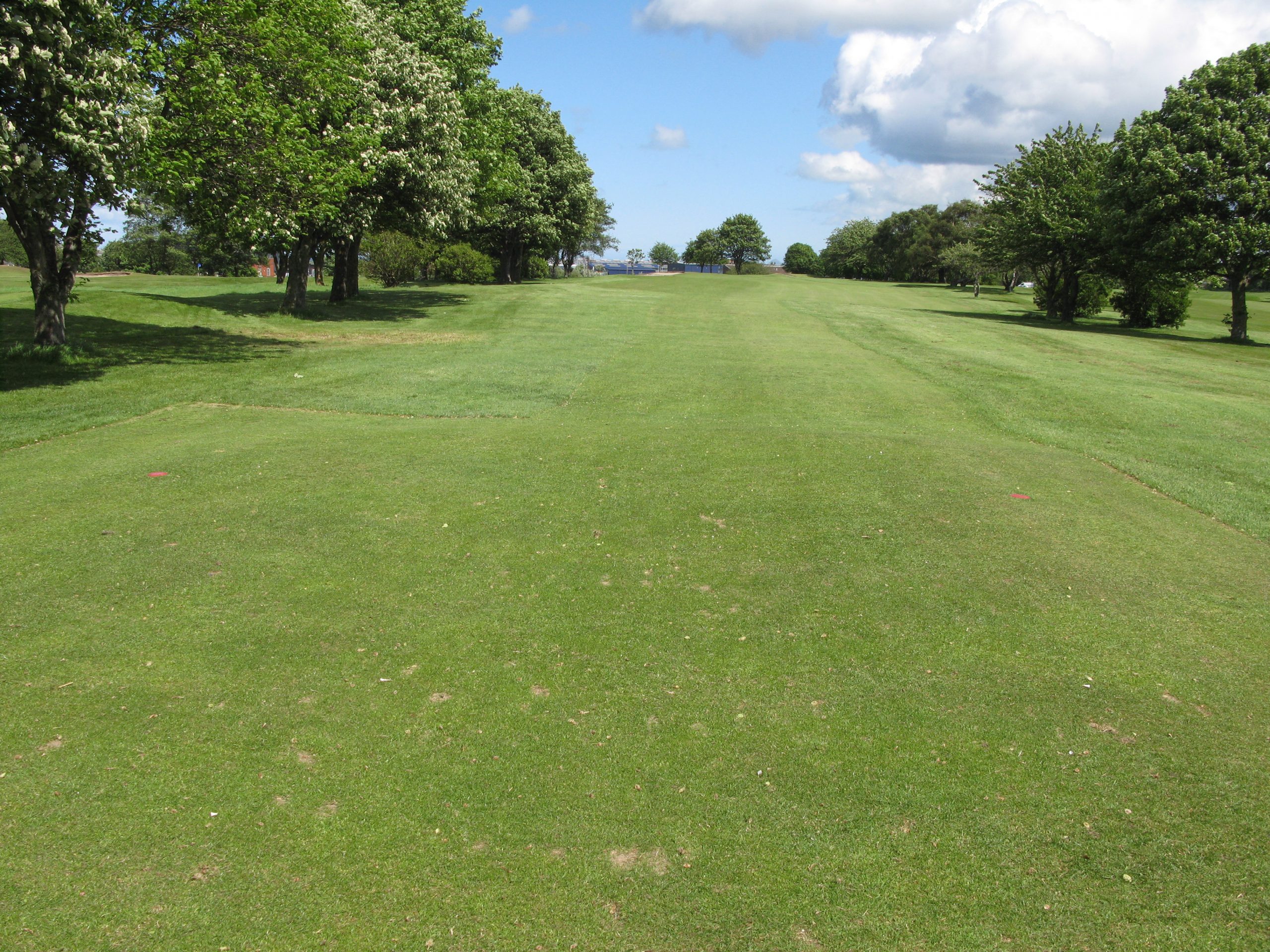
Gordon driving at the 7th, a par 4 of 274 yards, with the social housing that surrounds “The Tinny”

Perhaps uniquely, the most difficult two holes are par 3s; the long 13th (234 yards) and 4th (216 yards), being stroke index 1 and 2 respectively. I have never come across this situation with a golf course before. The five par 3s are the best of this course.

Moly at the well bunkered 6th, supposedly the easiest hole.

The course was in good condition, with the small greens being the highlight. There was potential to move on to the wrong holes, with a few long walks between green to tee and no tee box marking. Referral to the scorecard map is essential, as its easy to get waylaid looking at the fine views of Arthur’s Seat from many of the holes.

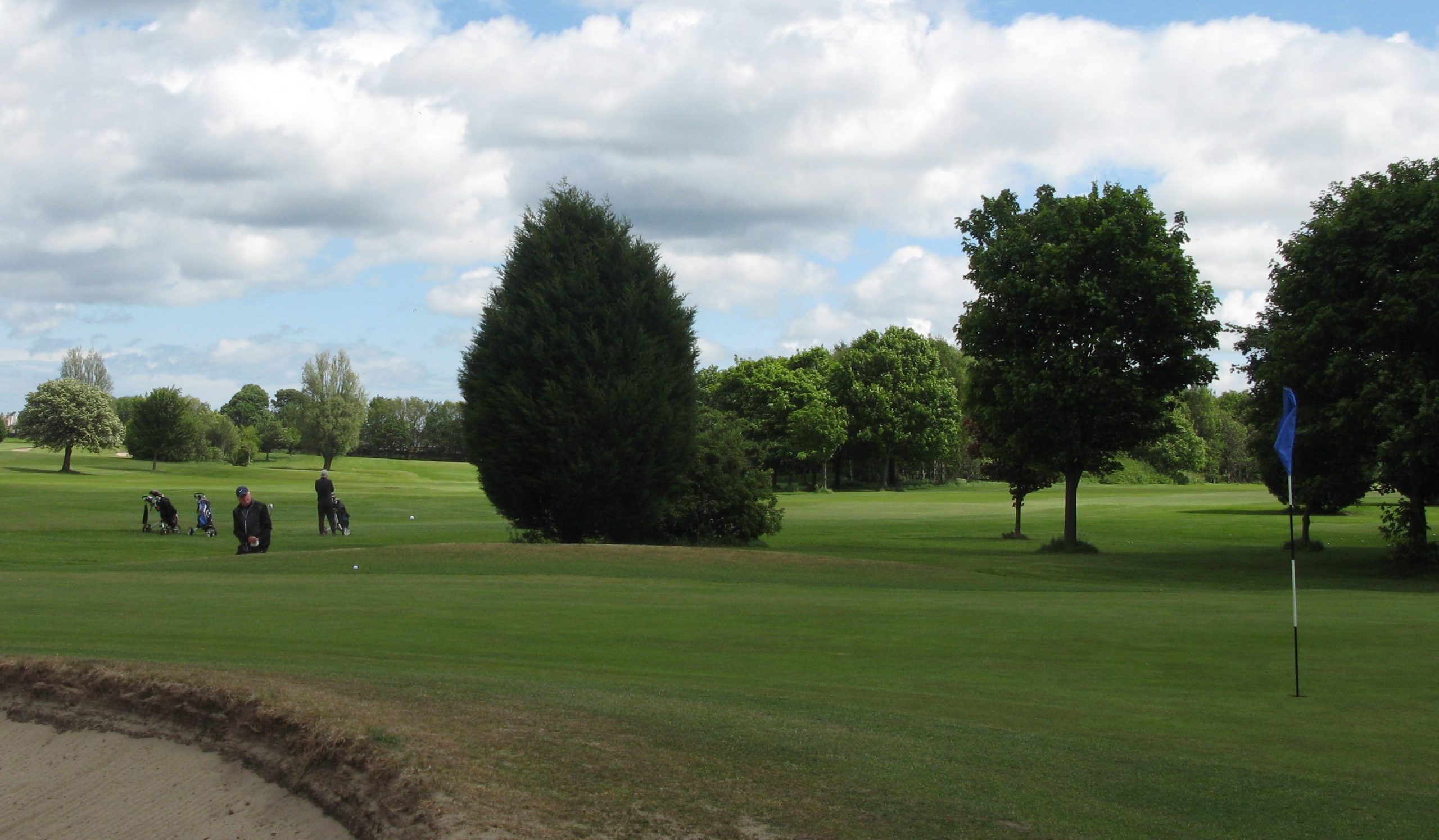
Brian played a good bunker shot at the 6th green.

I played alongside my former Apex Scotland board members. The charity continues to do sterling work supporting people with convictions back into the workplace and society.

We had a competitive game, albeit we all (bar Brian who scored a fine 32 points) suffered from the very high winds that got up to about 40 mph, especially on the back 9. No matter how easy the course is, 40 mph is going to be penal!

Frank playing one of his “Links” shots into the 9th, with Arthur’s Seat in the background.

There are no specific council facilities at the course, other than a kiosk, toilet and a basic vending machine in the “pavilion” style ‘clubhouse’. There is however, a co-located clubhouse for the Lochend Golf Club, named after the nearby Lochend Loch, which play at “The Tinny”, hence the blog and course is called “Lochend Craigentinny”.

Lochend Golf Club does have a lengthy history, dating back to the 1700s, albeit they didn’t play at “The Tinny” till it opened in 1908, a few years after the Council banned golf at the then open Leith Links. The club costs an additional £177 for its annual fee, to get access to to the usual club benefits. The clubhouse was closed when we played, hence why the lack of Council provided facilities were brought into focus. Thankfully, nearby Newhaven, where we retired to afterwards, has arguably the best fish restaurant in Scotland!

The par four 10th, over 400 yards, is the longest hole and typical of “The Tinny”

An annual 7 day ticket for the 6 municipal courses costs £500, incredible value. An individual visitor green fee on any of the 18 hole courses is £27.50, again decent value, but this pricing is starting to look relatively expensive when set alongside the offers available through golf fee apps, led by Golfnow. On any given weekday, you can play much better nearby courses than Craigentinny, at significantly lower than £27.50; including Newbattle, Baberton, Turnhouse and Royal Mussleburgh. Some Scottish Councils (such as South Ayrshire and Aberdeen) are offering discount pricing through Golfnow, and I think Edinburgh Leisure would do well to consider that.

The Stroke Index 1 hole – the long par three 13th hole, at 234 yards.

Overall, I would say this is “an average Municipal course”, and will need to keep a keen eye on visitor income, which will be an increasing challenge from apps such as Golfnow.

Facts:

Course Type: Parkland

Par 67 (0 par 5s, 13 par 4s,  5 par 3s)

Distance (yellow): 5141 yards

Moly’s Gross score: 88

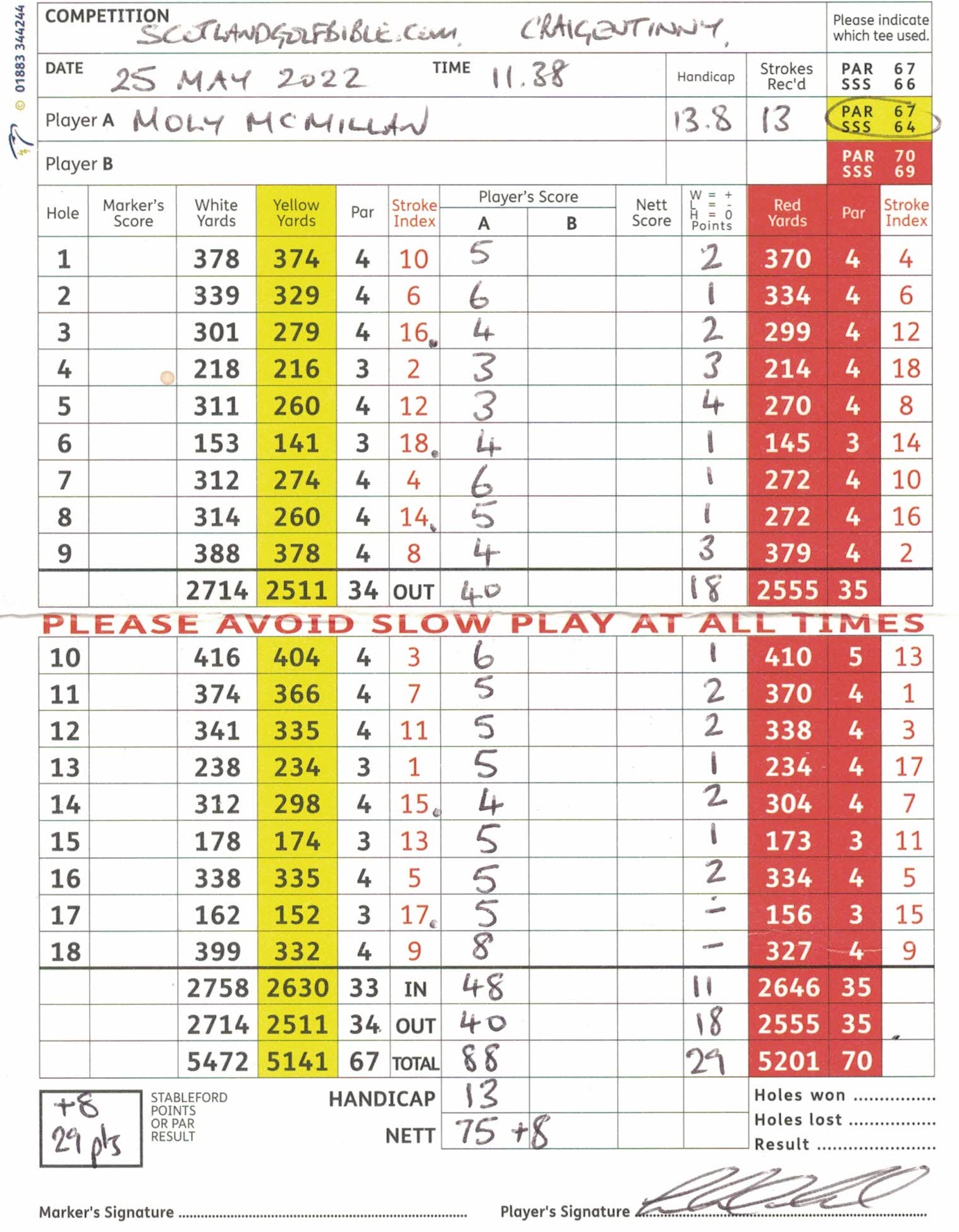
Moly’s 88 at “The Tinny”, with the back 9 explained by 40 mph wind.

143. Gullane Number 1. 24 May 2022.

Arguably the epi-centric viewpoint of world links golf

Round £195. Par 71. Course Rating / Slope Rating (yellow) 70.4/122. Value (out of 5) – 5

In Michael Murphy’s great book, “Golf in The Kingdom”, golf is eulogised in metaphysical or spiritual terms. In starting to write about Gullane, I can’t do better than Murphy’s epigraph, the Scottish golf saying:

“Golf was invented a billion years ago; don’t you remember?”

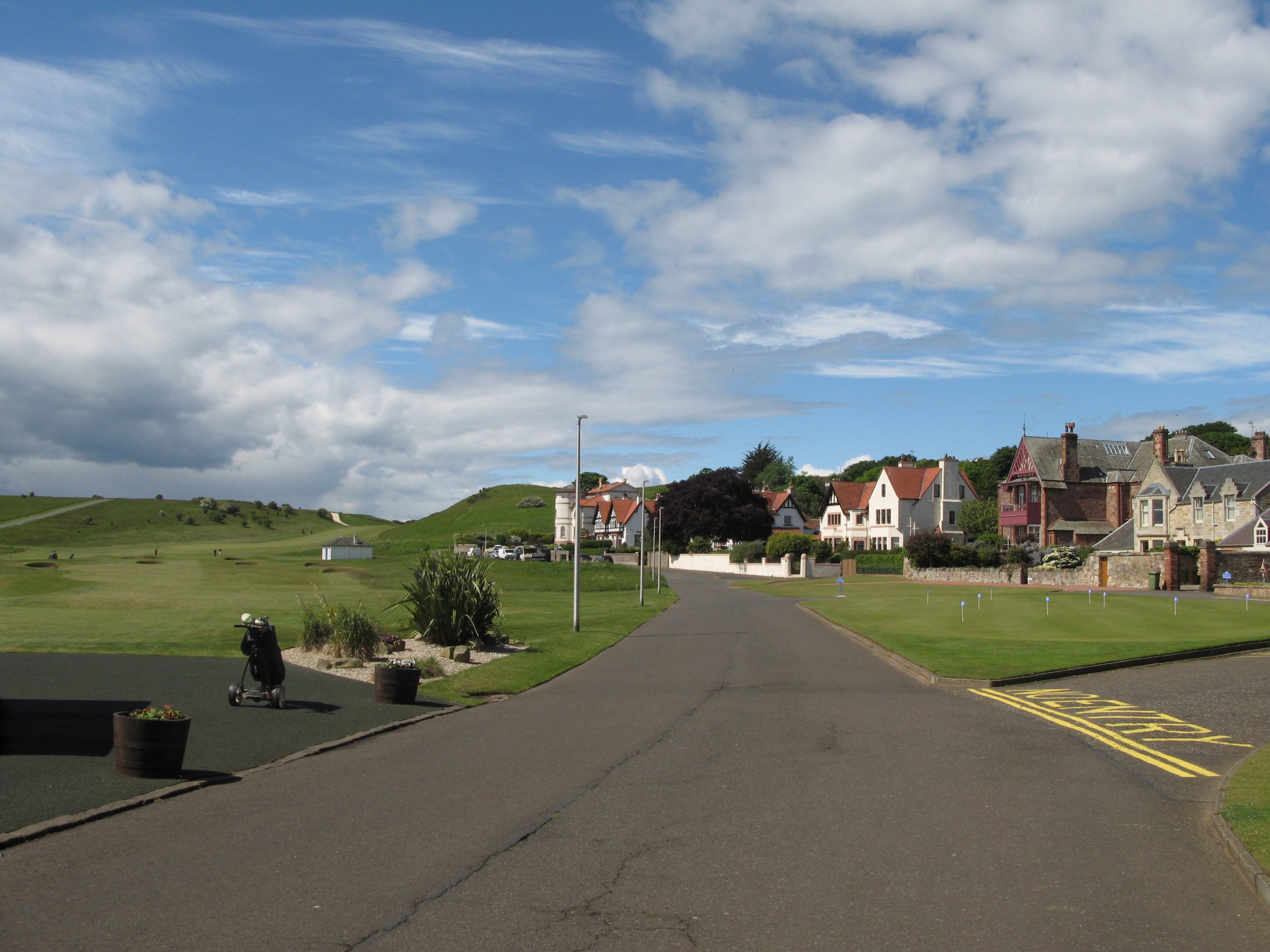
Oh, to win the lottery and live next to Gullane Number 1’s first tee.

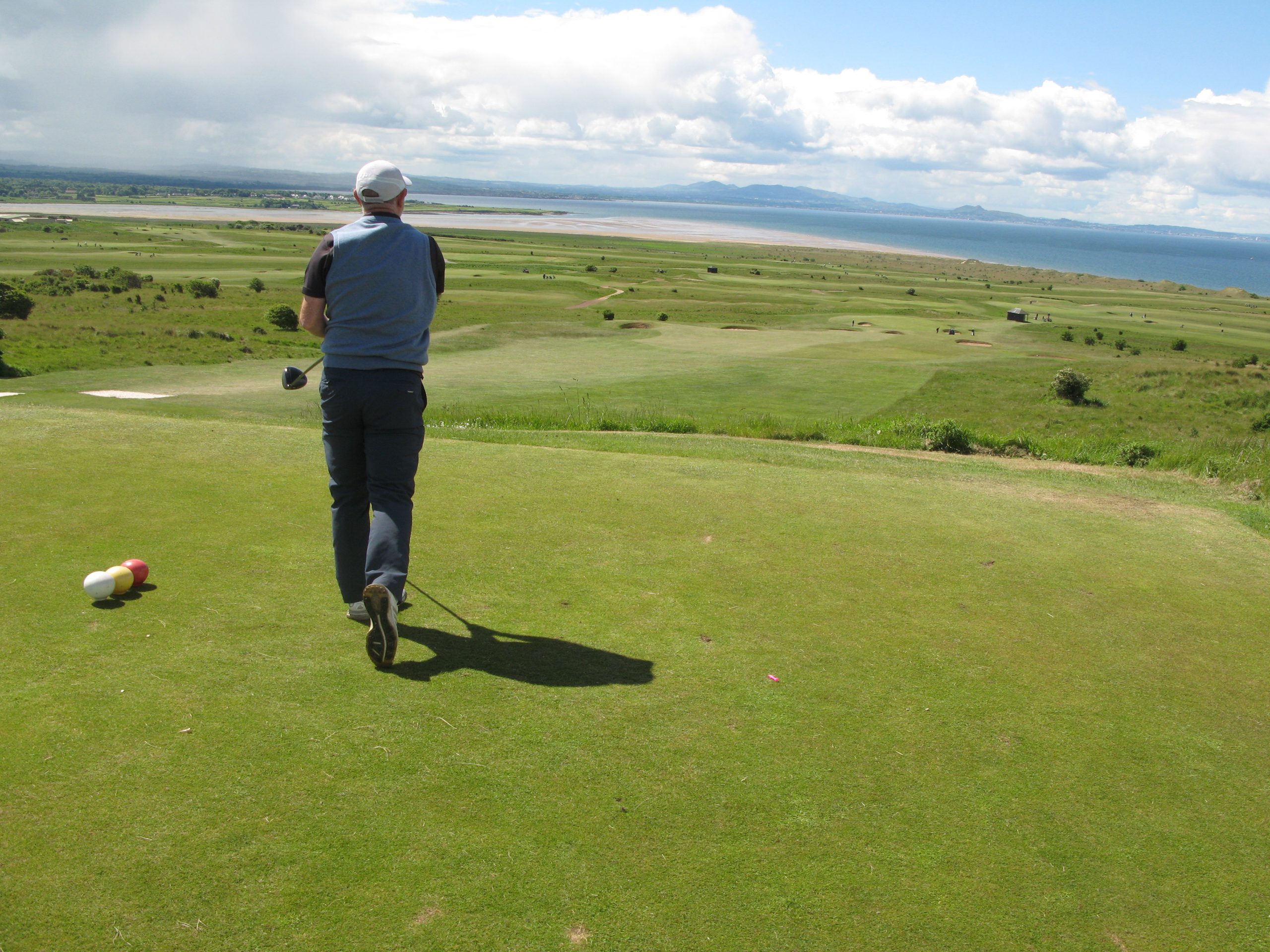
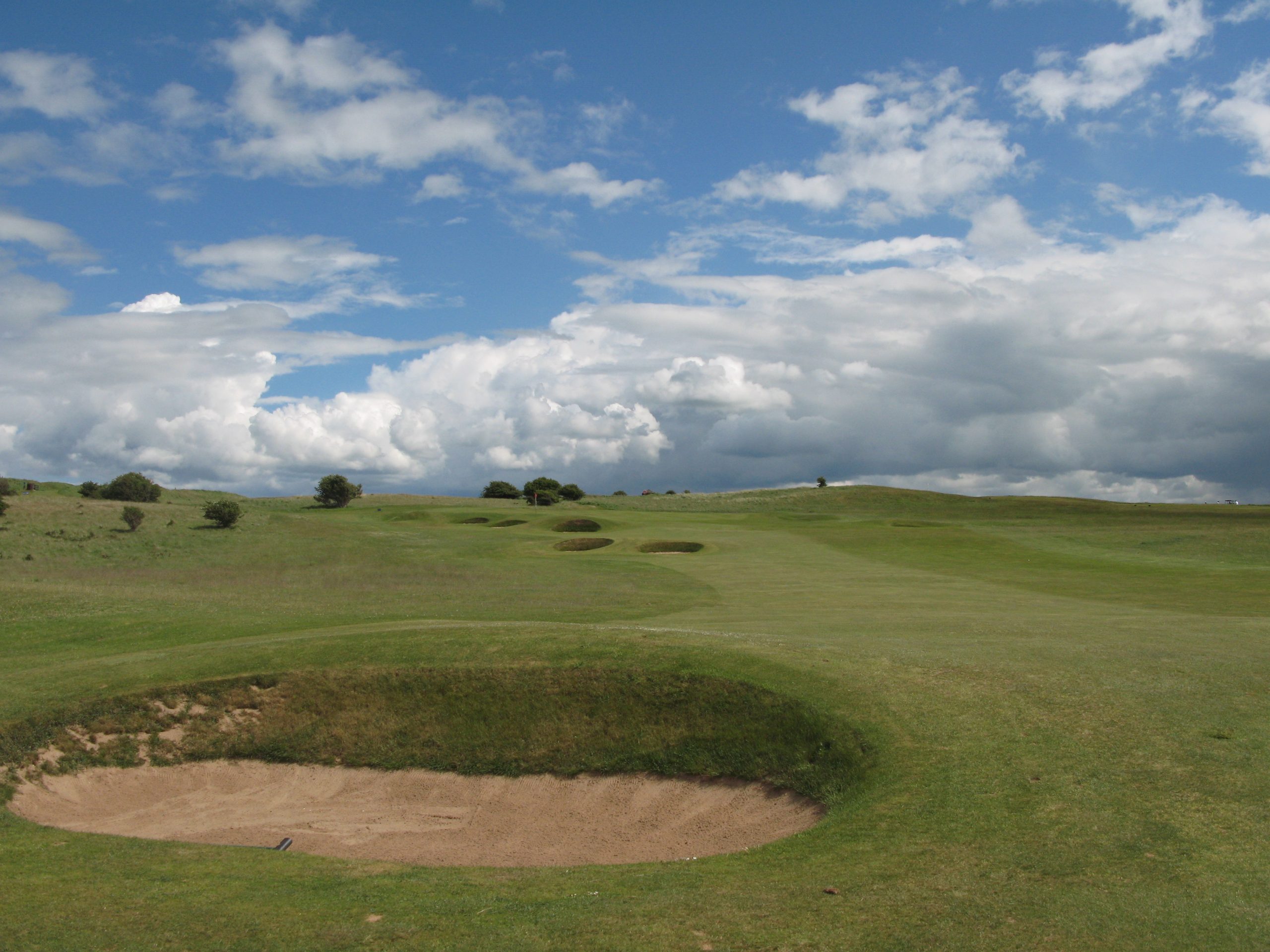
That epigraph made complete sense as I walked onto the 7th tee at Gullane Number 1 for the first time. Set on the small Gullane Hill, it is said on a clear day you can see fourteen counties. What is without debate, I think, is that you have the greatest links land view on earth. Perched there, you are at the mid point of the East Lothian ‘golf coast’ stretching from Dunbar to the east and Musselburgh to the west, with names synonymous with world golf – Dunbar, North Berwick, Archerfield, Renaissance, Muirfield, Luffness, Kilspindie, Craigie Law and Longniddry.

Moly on the epi-centric viewpoint of world golf – the 7th tee at Gullane No 1.

Look north across the Firth of Forth towards the Kingdom of Fife, with Leven, Crail, Elie and St Andrews; see past the Tentsmuir Forrest towards the links of Carnoustie, Montrose, Royal Aberdeen and Cruden Bay. Golf has been played on the East Coast of Scotland for hundreds of years, perhaps indeed ‘billions’. This 7th tee on Gullane Number 1 could be the epi-centric viewpoint of world golf; the Old Course is undoubtedly the “home”, but Gullane’s viewpoint is unparalleled.

The second hole at Gullane No 1, a par four “carved into the Ancient Links”

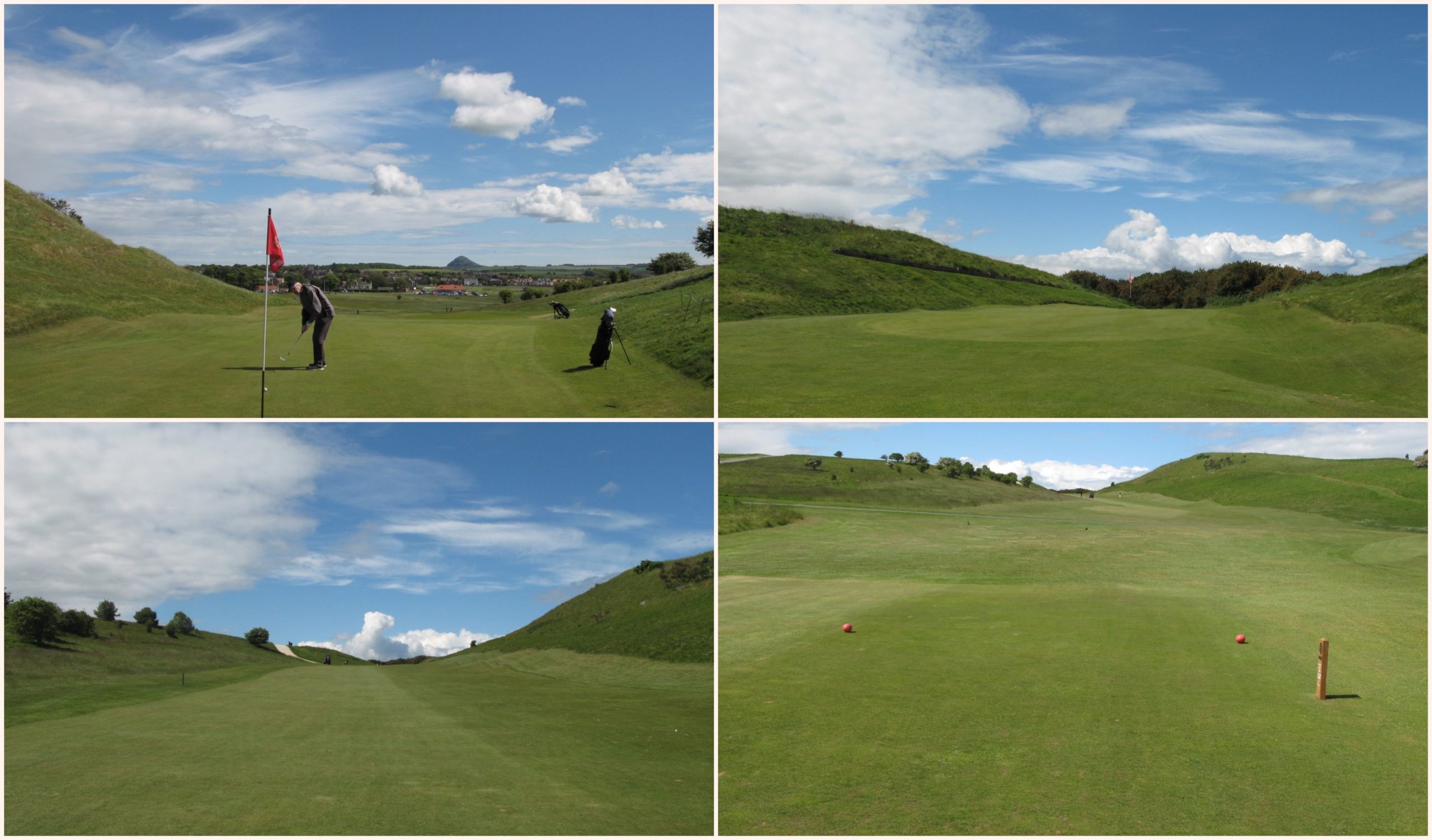
So much has been written about Gullane, including the crafted explanation of posh ‘Gillin’ versus humble ‘Gullan’ in his book, “Playing Through”, by Curtis Gillespie, that I decided to more or less tell this story mainly through pictures.

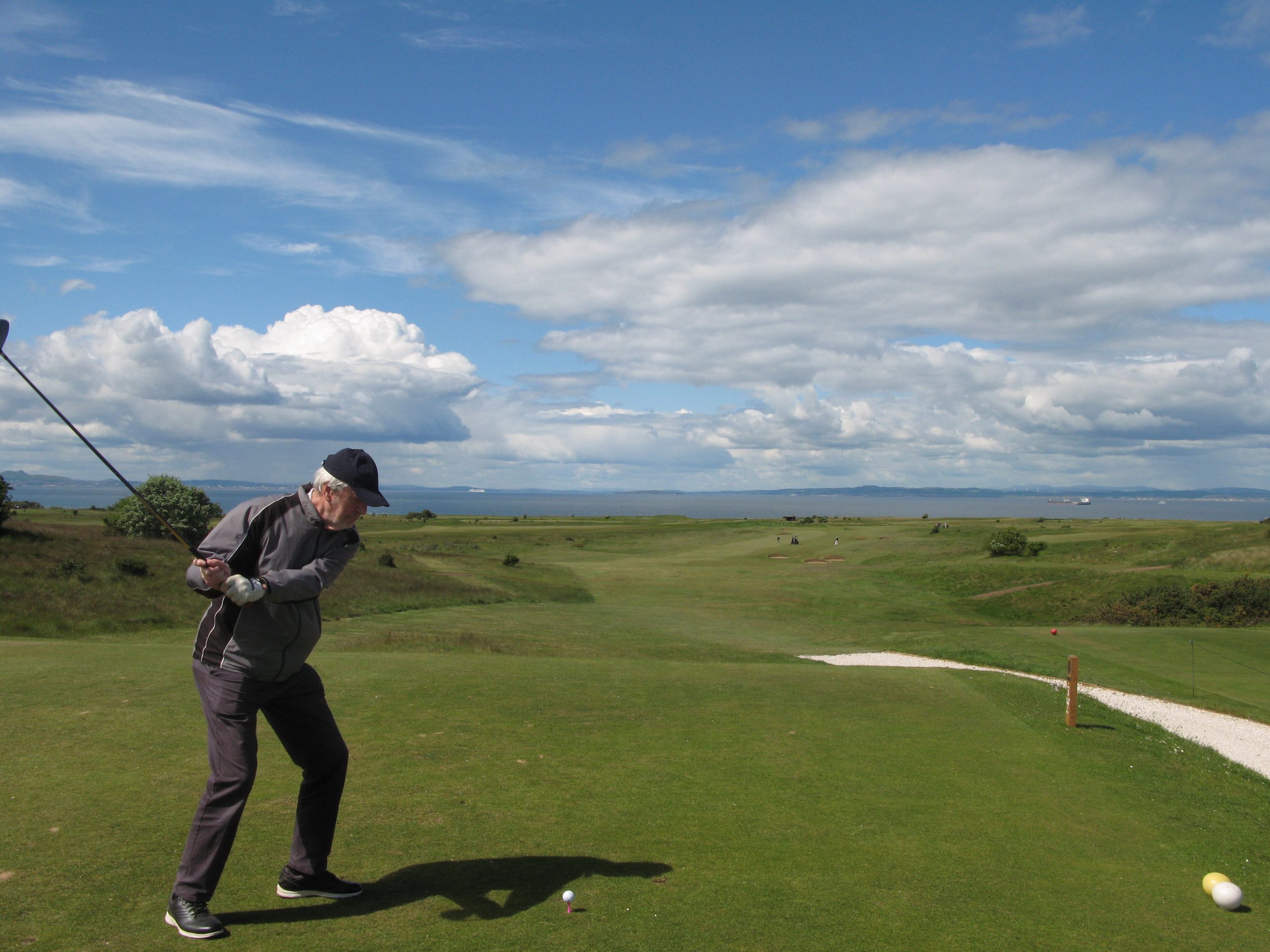
Alastair Allanach plays his low top spin drawing drive, which galloped down the “Racecourse” third; a swing honed and bartered over many years of tutelage by a South African pro. The Hill was used in bygone days by racehorses.

Accompanied by Gullane member, Alastair Allanach, a man who has played more golf courses than anyone I know, we had an absolute blast, waxing lyrical about Gullane and its history. Alastair, a great all round sportsman, and now well into his 70s, was keen to get in at least two of the three Gullane courses on the day, as he struggles to “carry my bag for three rounds nowadays!”

Gullane is one of a few nesting grounds where Larks abound, here encountered at the 8th green.

I met Alasdair a few years ago, when I helped a tiny bit in his editing of the golf book, “The Golfing Life of Jock Kirkcaldy“, the alter ego of our mutual great friend Frank Crowe. The book was forwarded by Gary Player, a friend of Alastair’s – of course!

The brilliant bunkering at the par 3, ninth hole. Although not “the turn”, as with constant directional changes on the interweaving course, it’s unlike the many “out and back” links in Scotland.

This Championship course, the first of the three Gullane courses, dates back to 1882, (the others being innovatively named Gullane 2 and Gullane 3) and it was in brilliant condition. It could have immediately held another Scottish Open without any adjustment. The greens had a little more grass than a professional tournament would have, in order to ensure they didn’t become unplayable in the wind. We had a relatively still day on the links – only a 10mph breeze. Whilst Gullane 2 and 3 were both designed by golfing royalty, Willie Park Jr, the designer of Gullane 1 remains a mystery, which seems so apt.

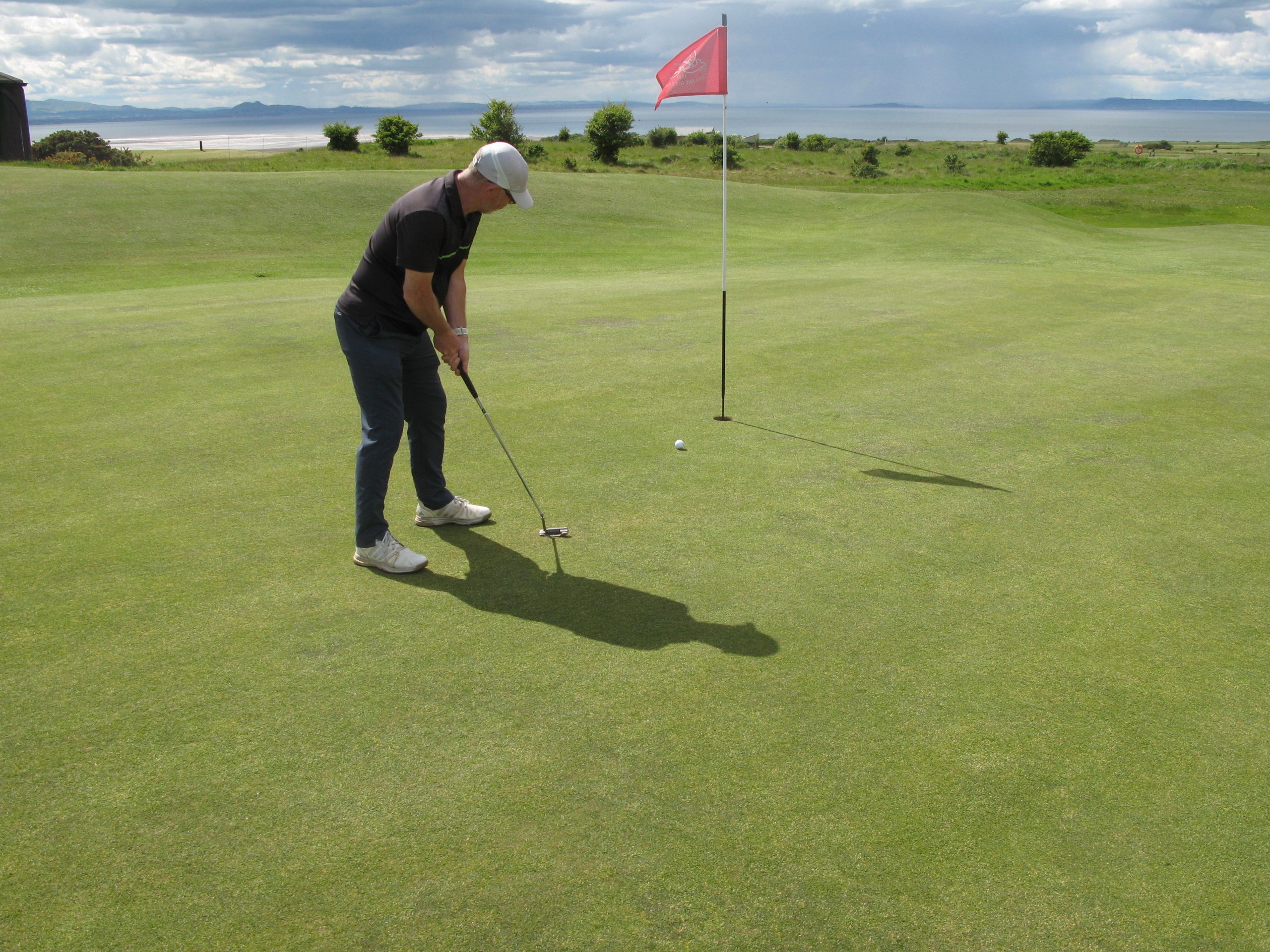
The bunkers at the left of the 12th fairway, a short par 5, but played slightly uphill and into the prevailing wind – a challenge. Moly’s birdie 4, was witnessed by a group of Swedish golfers, among the many international visitors Gullane gets each year.

The bunkering was exceptional. Strategically placed, penal, but not impossible, many of the new US style courses could learn from a Gullane recce. I recently played on the Ryder Cup course at the K Club and found that almost all the bunkers required a shot height and carry I no longer had in my bag. Gullane bunkers give you a chance.

The immaculate bunker at the 14th green – penal but not impossible.

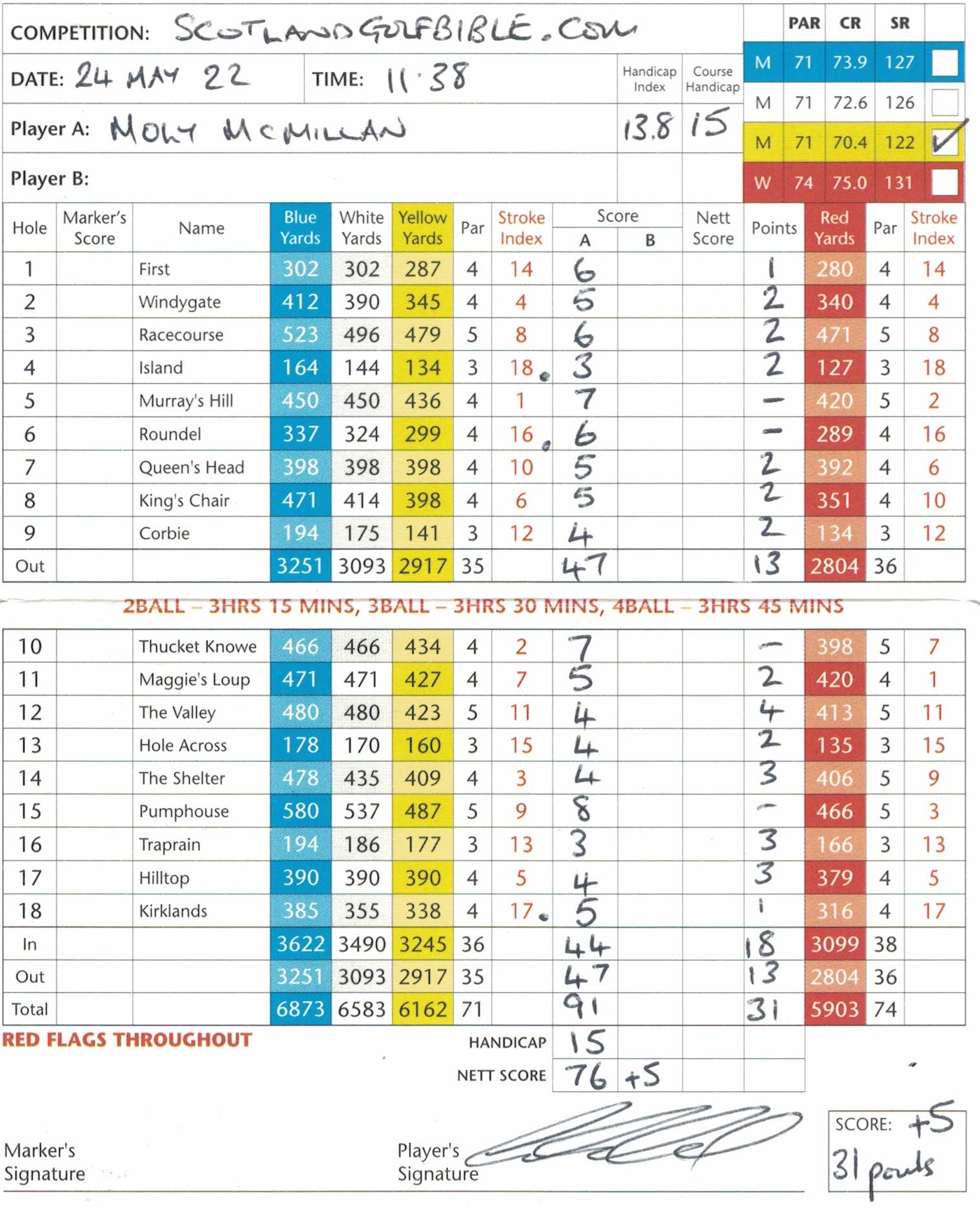
I was very pleased with my 91, despite 3 triple bogies, including at the stroke indexes 1 and 2 holes, the 5th and 10th respectively. I played off the yellow tees at 6162 yards, plenty enough distance for me. I had such a great time playing Gullane. I only hope all of the very fortunate 1200 members feel as blessed as Alastair does, who was a joy to play with on a memorable day for me.

The approach at the long par 5 15th hole.

The course sits on a vast area, so expect to 3 putt some of the monstrous greens. Despite being a busy day with all tee slots taken, I was amazed to only hear one shout of “fore”, a measure of the space here.

Moly has a rare birdie chance at the uphill par 3, 17th. Note the rain in the Firth of Forth, which never arrived on the course.

Now for the assessment of value. Golfing visitor fee inflation has really impacted Scottish golf. In 2018, in my St Andrews Old Course blog, I said anything higher priced than the old course can’t be worth the money. At the time the Old Course was £180 for a high season round, this year it is £270, a compound annual rise of over 10% per year, or more than three times the retail price index over the same period. Put another way, using 2018 as the datum, the Old Course should be £205.

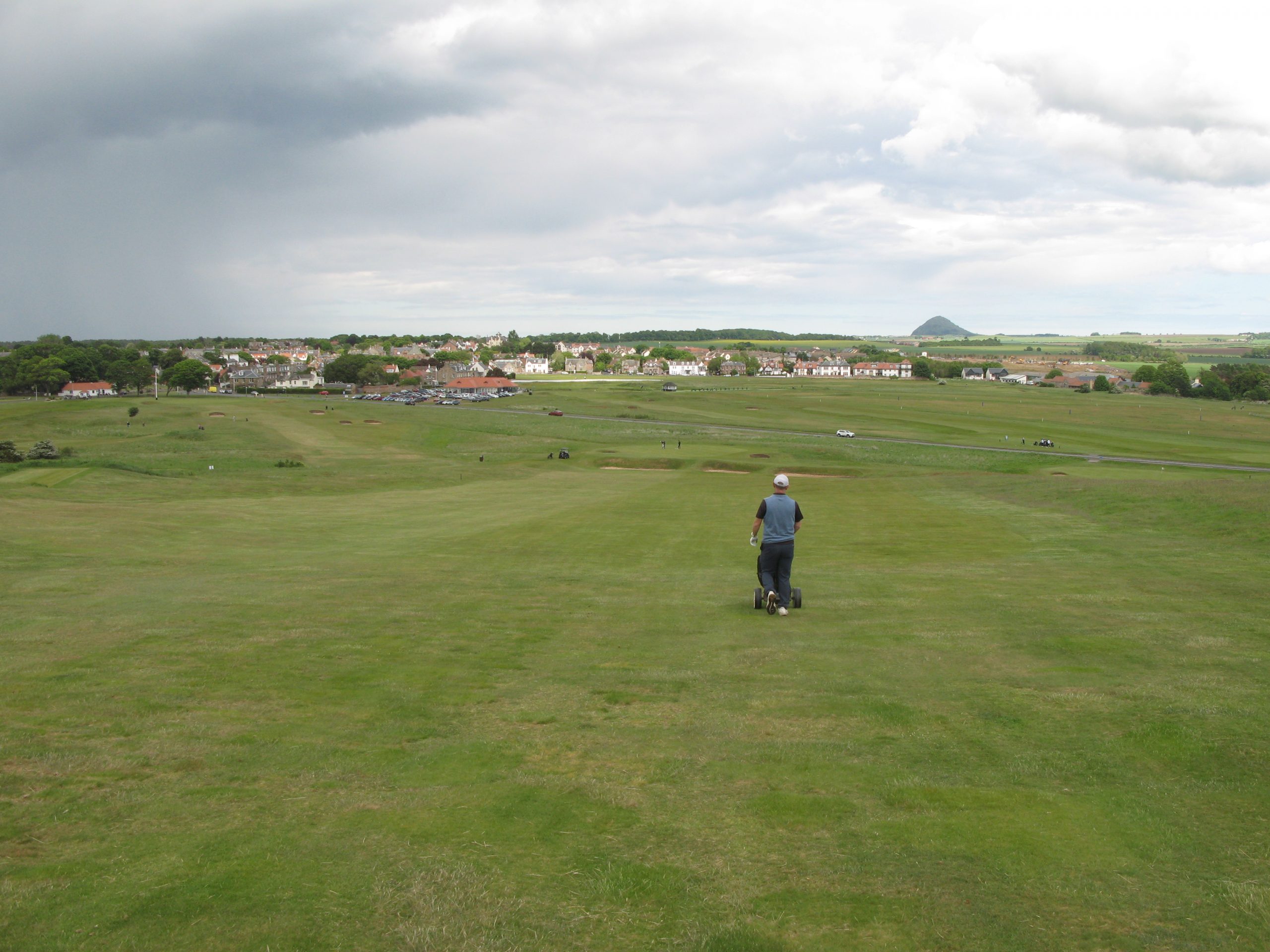
All good things come to an end – here Moly walks towards the 17th green, a deceptive par four, with the town of Gullane awaiting, watched over by Berwick Law.

No matter how much might have wanted to, in the end I couldn’t give this course anything less than 5 out of 5 for value, despite the price tag of £195. It’s a must play links golf course with unbeatable turf, bunkering, green surrounds, sea breeze, wispy rough.

Play, if for nothing else, to stand on the exact epi-centric viewpoint of world links golf. If such a thing could exist.

Facts:

Course Type: Links

Par 71 (3 par 5s, 11 par 4s,  4 par 3s)

Distance (yellow): 6162 yards

Moly’s Gross score: 91

Moly’s Gullane Number 1 scorecard – 91

142. Kingsknowe. 23 May 22.

Brilliantly priced golf course with divergence of views

Round £35. Par 69. Course Rating / Slope Rating (yellow) 68/113. Value (out of 5) – 4.5

When I played Kingsknowe, pronounced Kings-NOW, on a magnificent May day, with clear skies and beautiful views, I was struck by how much the surroundings of the golf course must have changed over the last 100 years, since its foundation in 1908. It has literally ‘lived’ amongst the great social changes of the 20th Century.

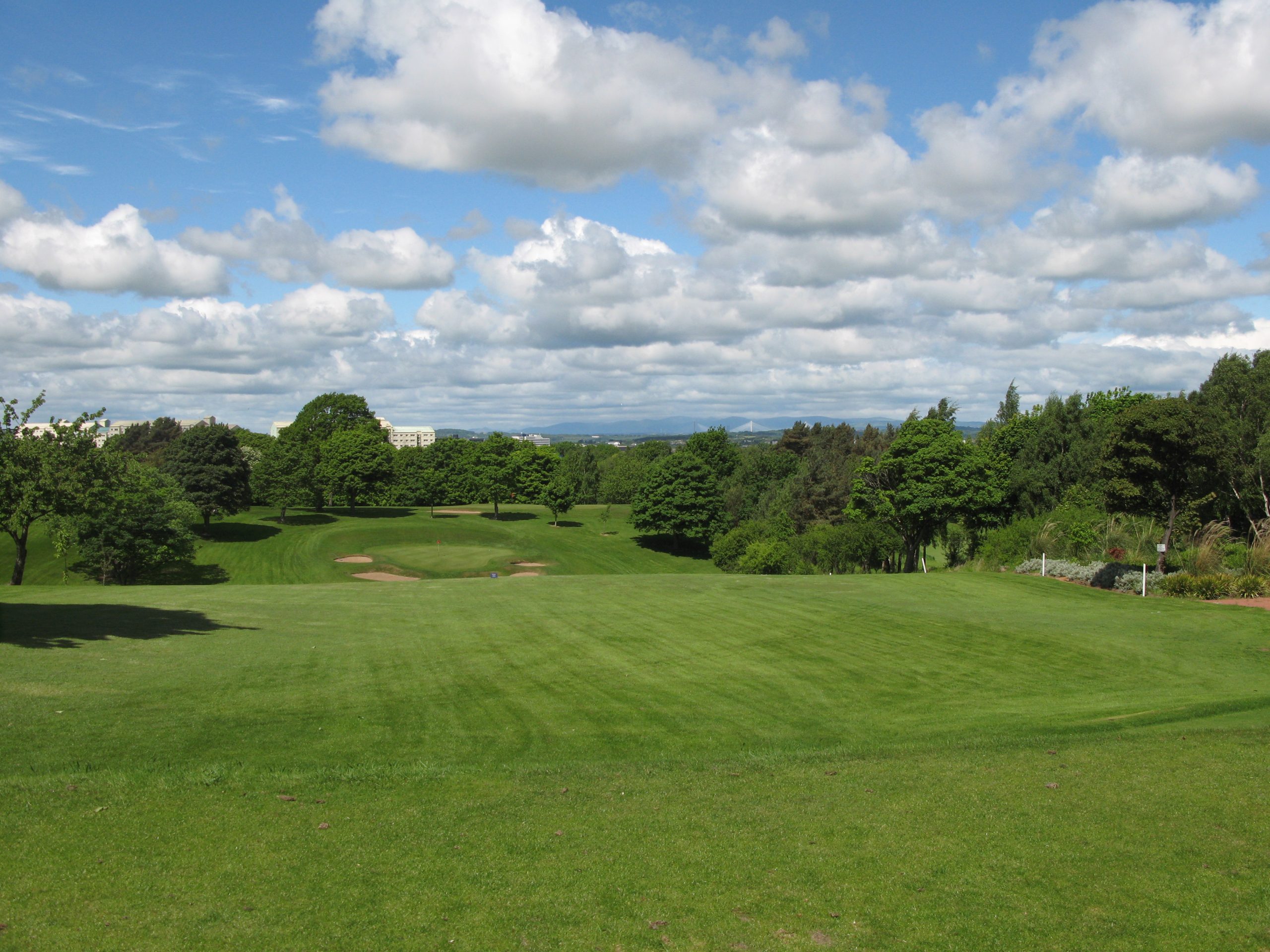
Great downhill par three first of 167 yards, a tough par to start, with longstanding views towards the Queensferry Crossing, the Tillicoultry Mountains and Ochil Hills

Sitting on the western side of Edinburgh, Kingsknowe is only 4 miles from Edinburgh Castle, obviously well within the city boundary. However, go back over 100 years, and the course would have been surrounded by countryside. At the time, the nearby Union Canal, was one of the main traffic routes near the course.

The long third hole, 470 yards, into the prevailing wind, with Arthurs Seat in the background.

Initially laid out by the 1902 ‘Champion golfer of the year’ Alec Herd, the first major impact the club suffered was the loss, during WWI, of 27 of its members, commemorated by a plaque in the clubhouse and recorded on the Imperial War Museum website here. During the second world war, by which time James Braid had been commissioned to implement some architectural changes, some of his changes were turned to farming use to support the war effort.

The justifiably chosen stroke index 1, par four, 5th hole, at well over 400 yards.

The course opens with a tricky par three, very untypical of a Braid Course, which normally has a straight forward short par four to get things going. The course character is further reinforced with the dog leg right 2nd, then a long par five into the prevailing wind. Playing to handicap through the first three is a challenge.

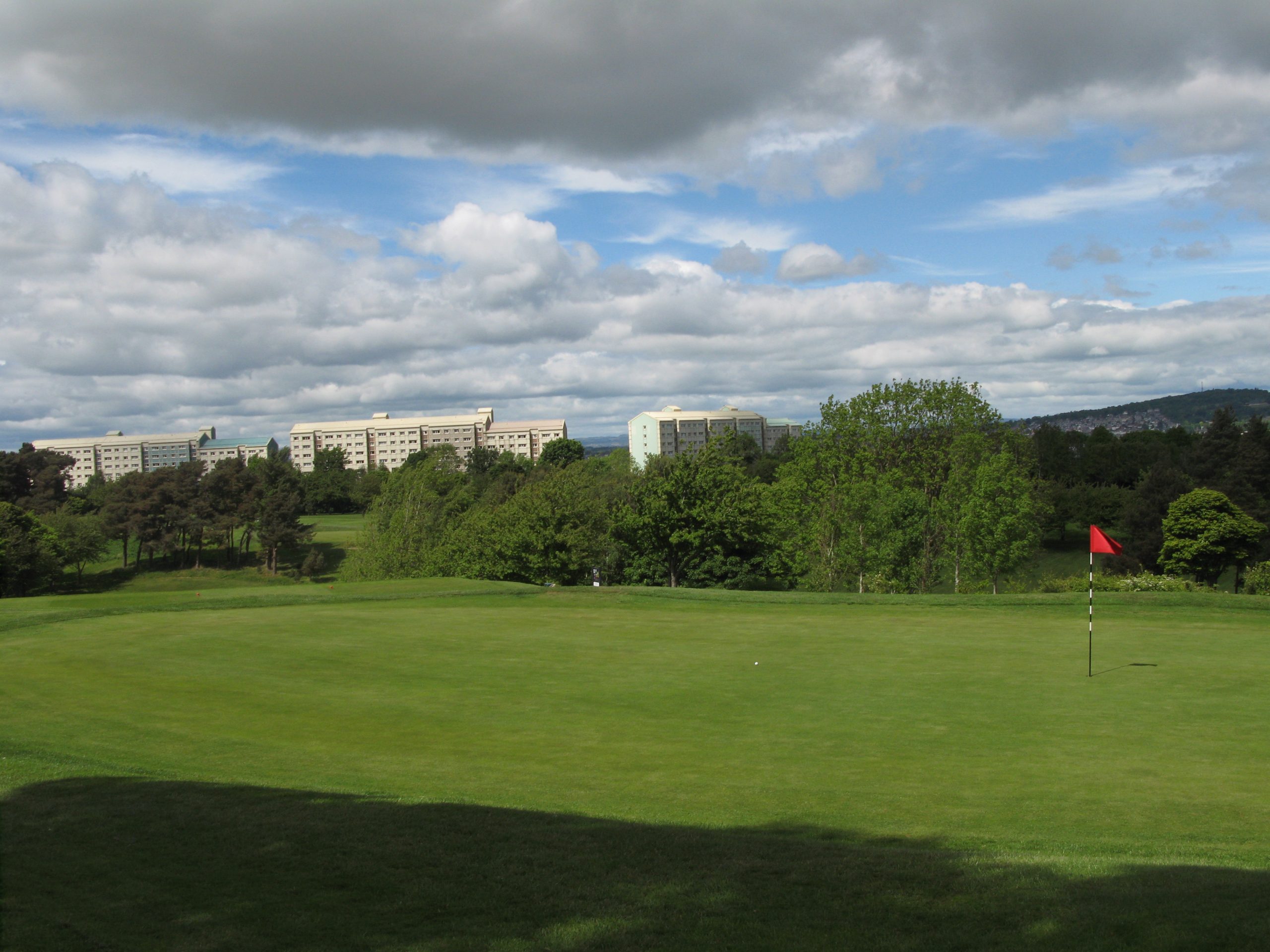
The 10th green, with the dominating views of Wester Hailes housing estate. Many of the holes could be named “Wester Hailes”

With several more undulating and dog legs, I was very surprised by the Slope Rating of only 113 (yellow), but I guessed this may be due to its relatively short length and the fact that there are no – yes zero – fairway bunkers. This bunker situation makes me question the validity of Braid’s involvement in the design, as he placed so much emphasis on this element of architecture. If anyone knows of his exact involvement, that would be interesting.

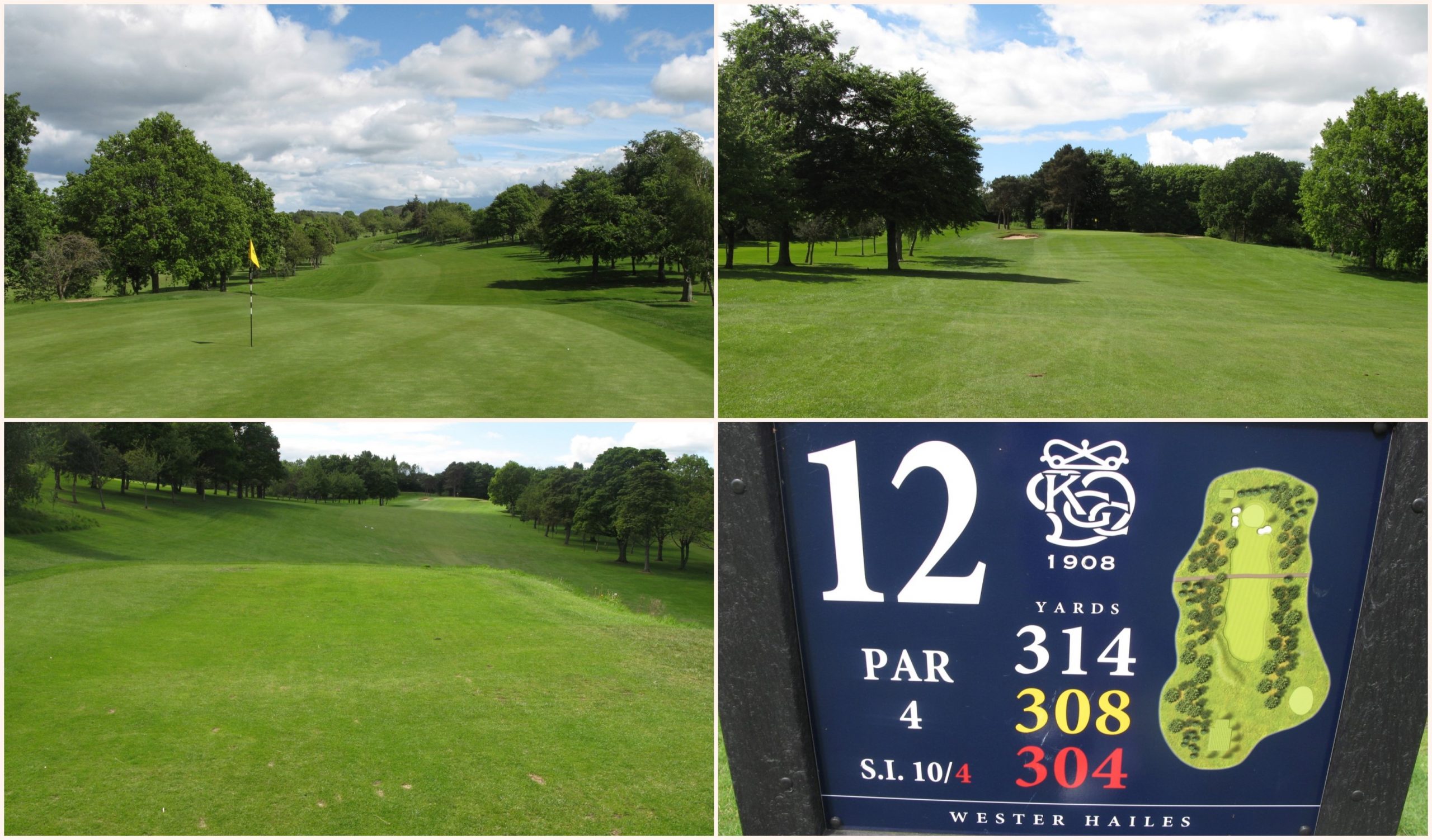
The actual “Wester Hailes” hole, 12th par 4, surprisingly not the one with most views of the estate.

Another great social change, is highlighted at the 12th, “Wester Hailes”, a mid length par 4. Named after the revolutionary housing development immediately to the north of the course, the social housing is actually visible on a great number of the holes. The large and formidable wrought iron boundary fence, tells only a fraction of the story.

Following slum closures elsewhere in Edinburgh, in the 60s, Wester Hailes, a development of over 4000 homes was to be one of the most ambitious housing projects in Europe. It transpired within 20 years into a haven of crime in which parts of the development were referred to as “Vietnam”. The Edinburgh News writes about “How a field of Dreams turned into a Concrete Jungle“. The building of the housing required the culverting of the Union Canal.

Whilst the ‘polis’ were dealing with major crime one side of the golf course, just over the fairways sits Merchiston Castle, the last all male boarding school in Scotland. Such a contrasting start to life, so close to each other. I wonder what percentage of the membership is from Wester Hailes?

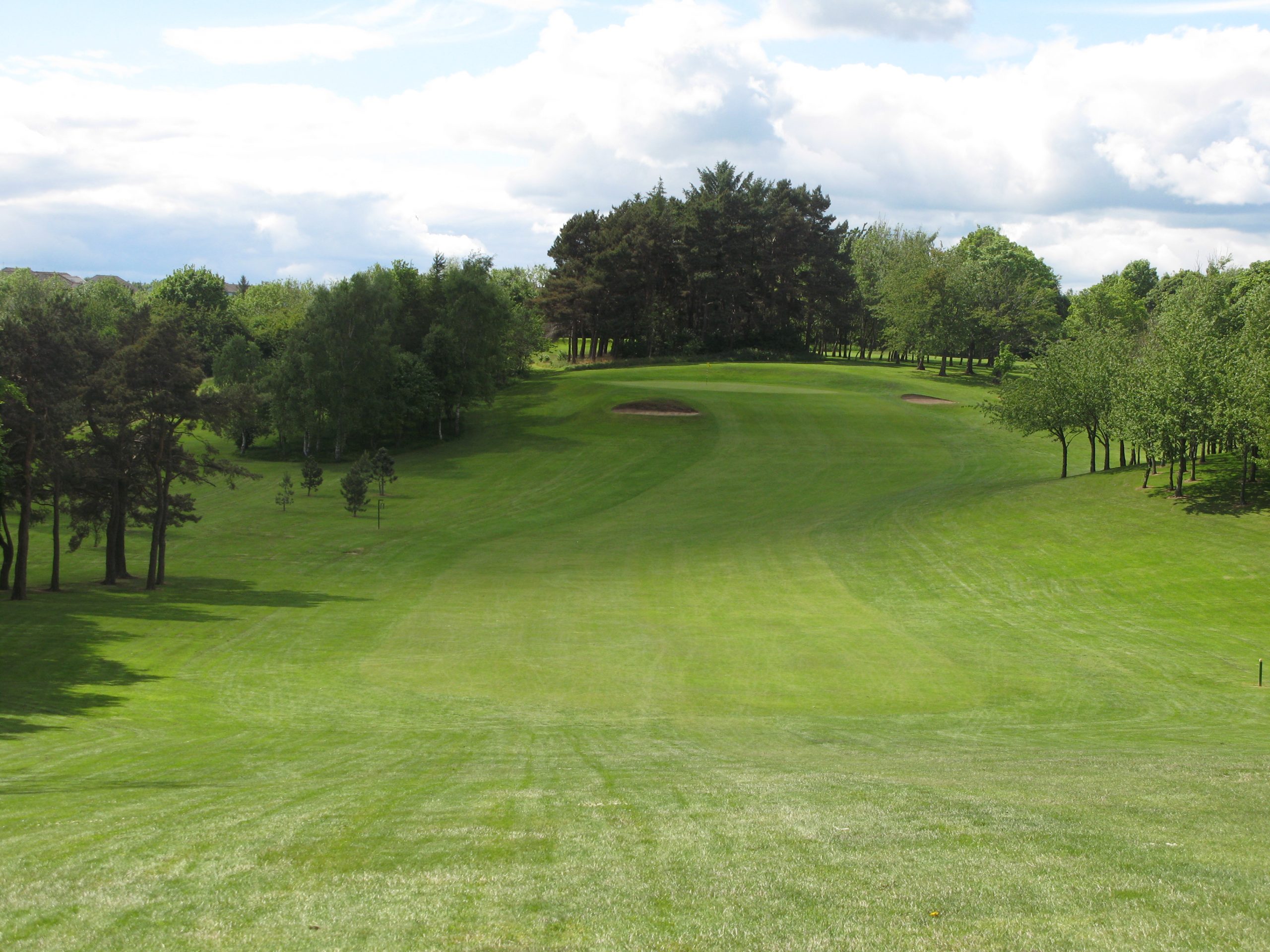
17th, “Plateau”, a short par 4, where like many I suspect I grossly under-clubbed with my second shot. Take 3 more clubs.

Back to the golf – tree lined, but not interfering too much, Kingsknowe, with its fine clubhouse, serves as a excellent society day. It’s is very well priced for visitors, I got a rate of only £22 through Golfnow, but the full summer fee of £35 still represents excellent value.

The course was in excellent condition, especially the teeing grounds. The greenside bunkers were great, highlighting the lack of fairway bunkers hadn’t diminished the green keeping skills.

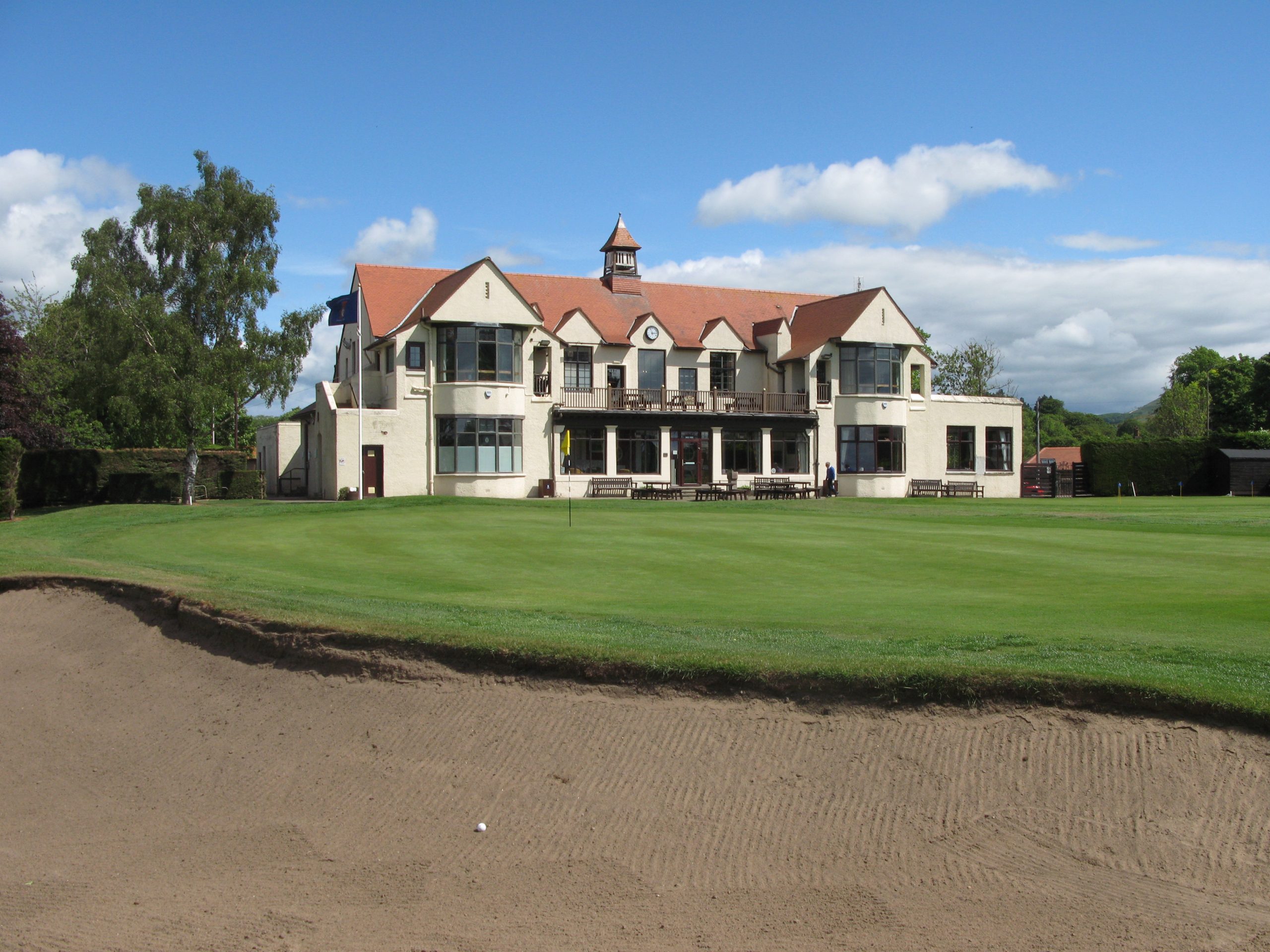
The magnificent clubhouse as a backdrop to the welcoming 18th green.

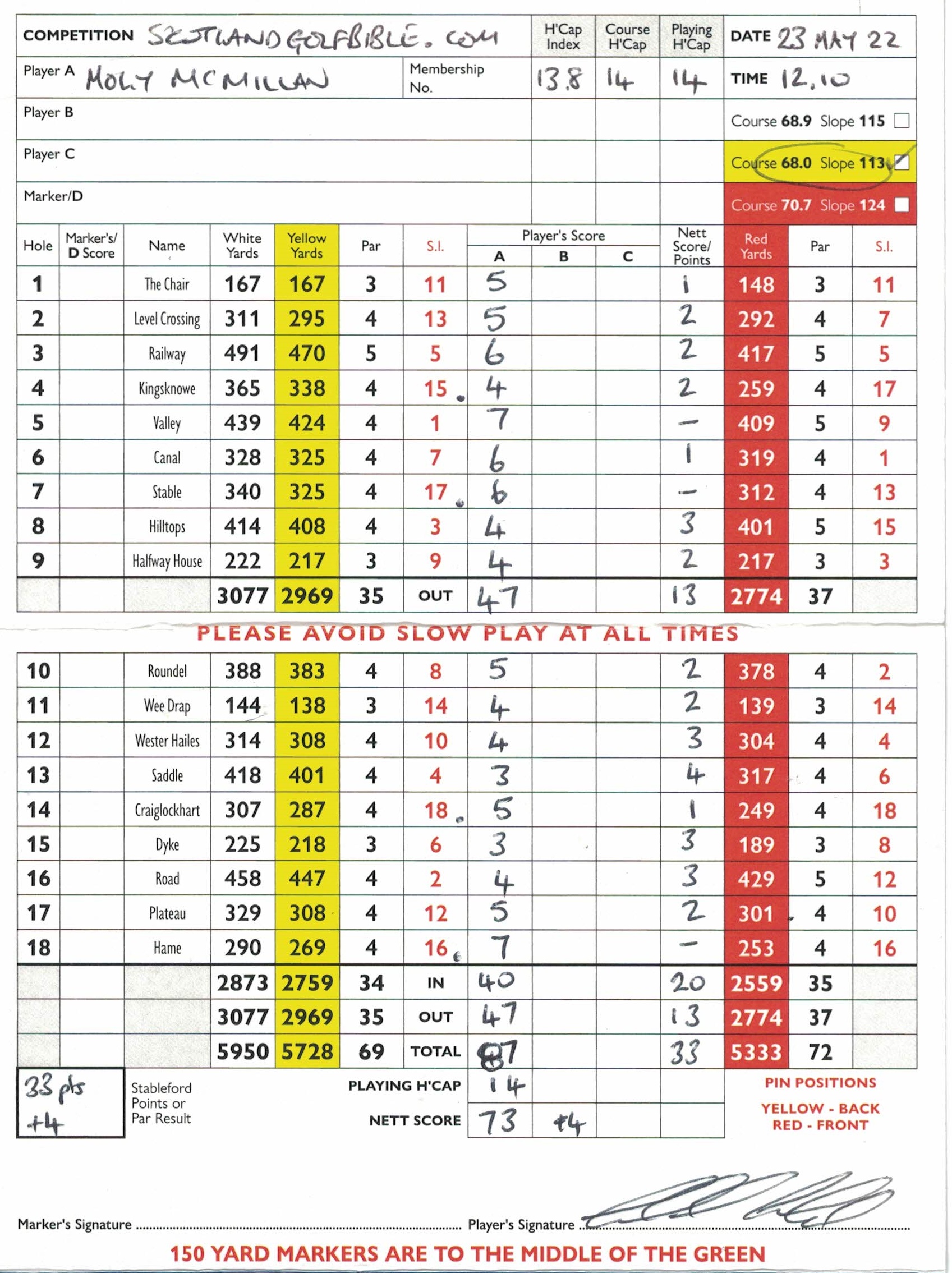
In a very high wind, up to 30 mph, I shot 87, four over net. This included almost driving the short par 4 finishing hole, but ending in a small copse left of the green. I won’t describe the rest of my play in recording a 7, but still came back in 40 shots.

Well worth playing at this well manicured and highly enjoyable course, where the hole names are also worth taking note with their clues – “Wee Drap”!

Course Type: Parkland

Par 69 (1 par 5s, 13 par 4s, 4 par 3s)

Distance: 5728 (yellow)

Moly’s Gross score87

Moly’s Kingsknowe scorecard, 87. Good back nine of 40, including a tripple bogie on 18th!
« Older posts Newer posts »

© 2026 Scotland Golf Bible

Theme by Anders NorenUp ↑