The course that broke Kilspindie’s heart — a story for another blog.
Value 3/5 (4/5 using GolfNow)
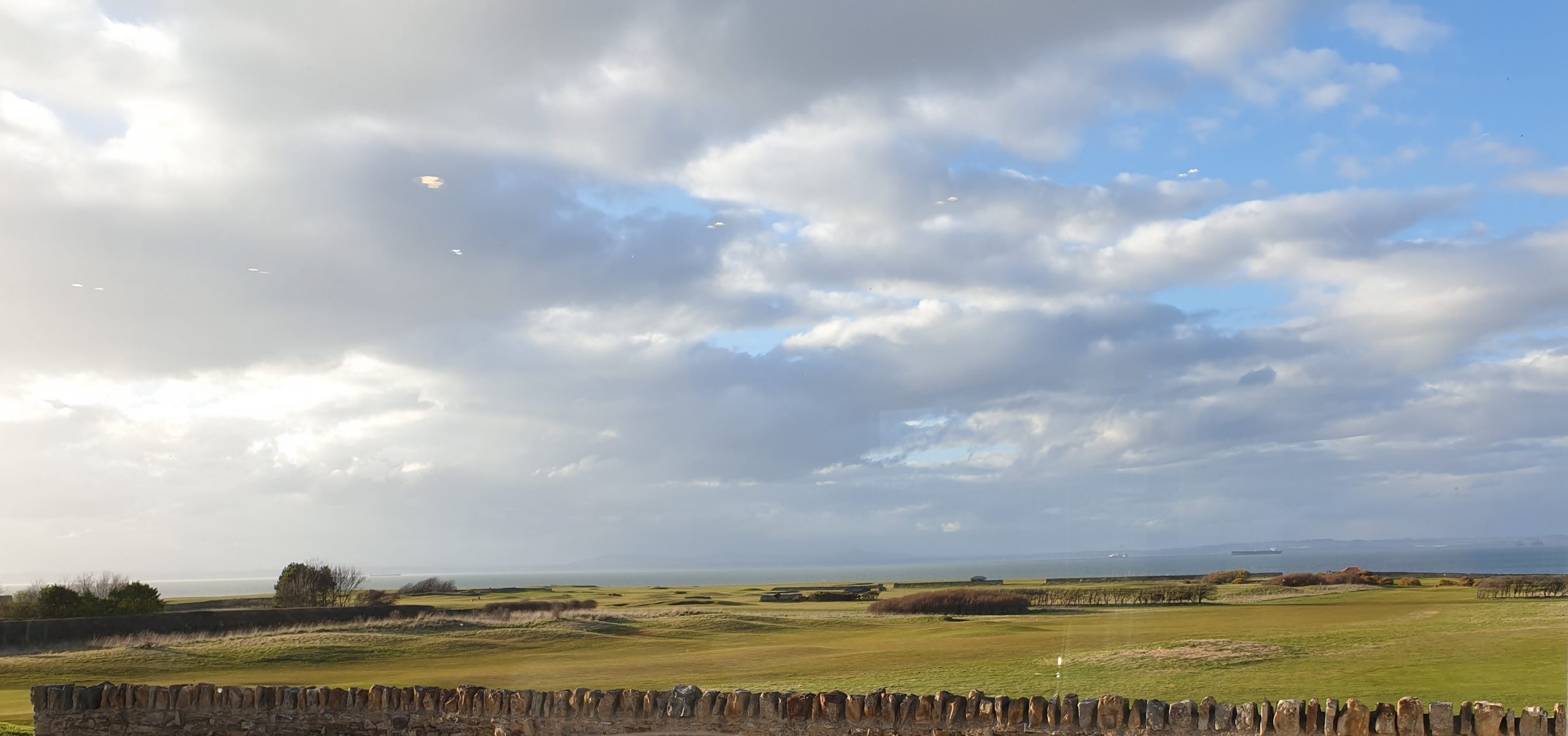
The panoramic clubhouse view back over Craigielaw links towards the Firth of Forth. On a clear day, as good as East Lothian gets.
Craigielaw Golf Club is on Wemyss and March Estates land – the same Estate that has leased its land to neighbouring Kilspindie Golf Club since 1867. In 2001, after two years of fractious negotiations, the Estate cancelled a deal that would have allowed Kilspindie to operate a second course and announced they themselves would build and run Craigielaw Golf Club. Kilspindie’s members, who had already paid handsomely for the privilege of playing ‘their’ second course, were left short changed — that story will feature in Kilspindie’s blog.
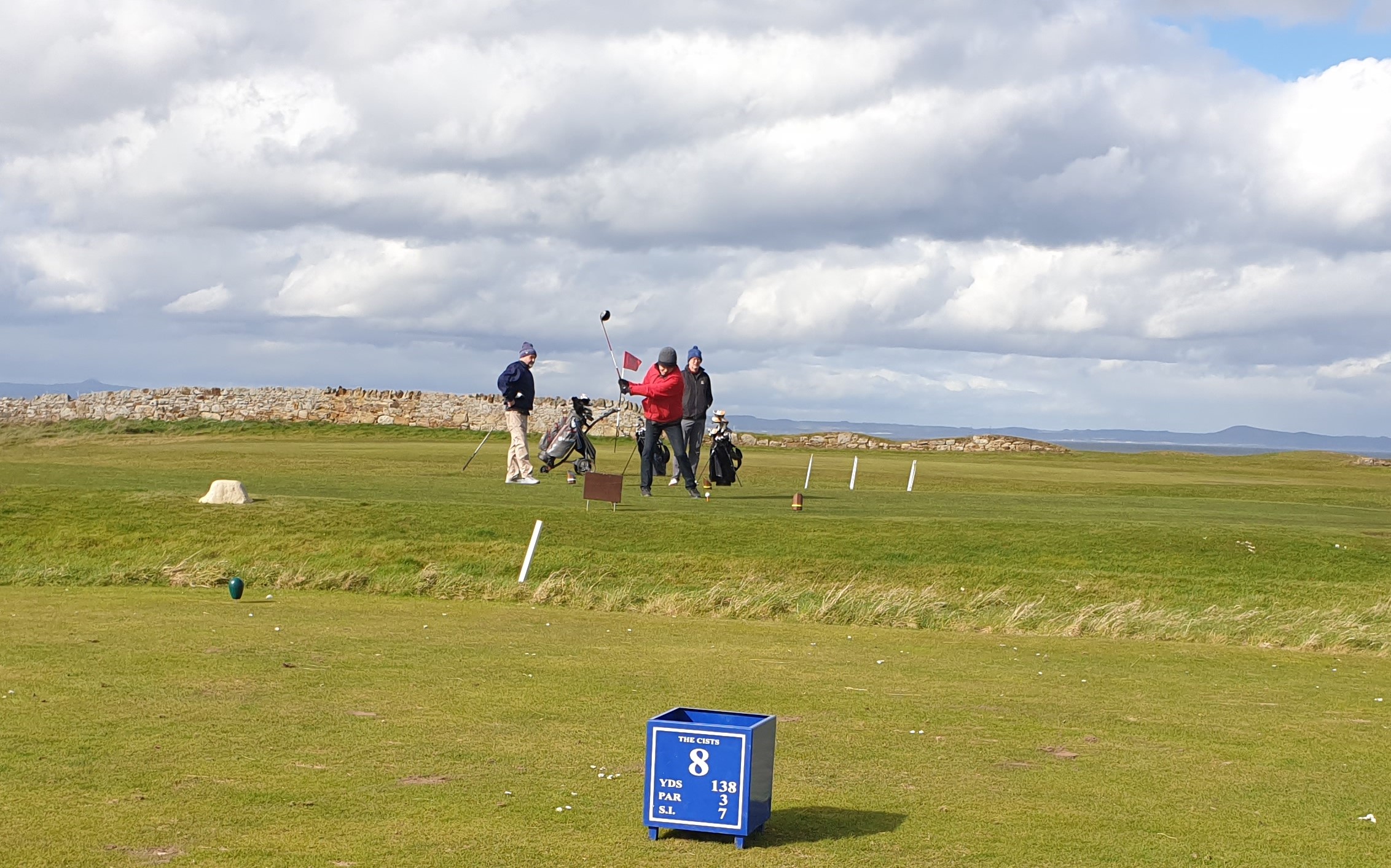
The 8th tee — a short par 3. The golfers here are not playing Craigielaw, they are on the 18th hole of the entirely separate Kilspindie Golf Club. Possibly the two closest tees from independent clubs anywhere? If you know of closer, let me know.
What elevates this origin story beyond a mere property dispute is who, at the time, was the Countess of Wemyss and March (see picture below). In 1995, James Charteris, 13th Earl of Wemyss, had married Amanda Feilding — an English aristocrat, artist, drug policy reformer, and the world’s most committed advocate of trepanation, the practice of drilling a hole in the skull to enhance consciousness and cerebral blood flow.
Amanda Feilding, Countess of Wemyss, with her pet pigeon Birdie, and a human skull, a tribute to her belief in trepanning. [Credit: Beckley Foundation — permission pending]
In 1970, Amanda had drilled a hole in her own forehead with a dentist’s drill, filmed the entire procedure, and called the resulting short film Heartbeat in the Brain. Audiences at early New York screenings were reportedly seen dropping from their seats. She stood for Parliament twice — in 1979 and 1983 — on the sole platform of free trepanation on the NHS, receiving 40 votes and then 139. She later founded the Beckley Foundation, dedicated to psychedelic research, and lived to see much of that work vindicated by mainstream science before her death in May 2025, aged 82.
So when the Wemyss and March Estates Directors, including Lady Wemyss, decided on the use of the land, it might have been fitting if anyone said “We need to operate a golf course like we need a hole in the head!”.
Back to golf. Designed by Donald Steel, Craigielaw is a thoughtful layout. The hole names are a delight — Coffin Lane, Bellfire Knowe, Doos Wa’s.
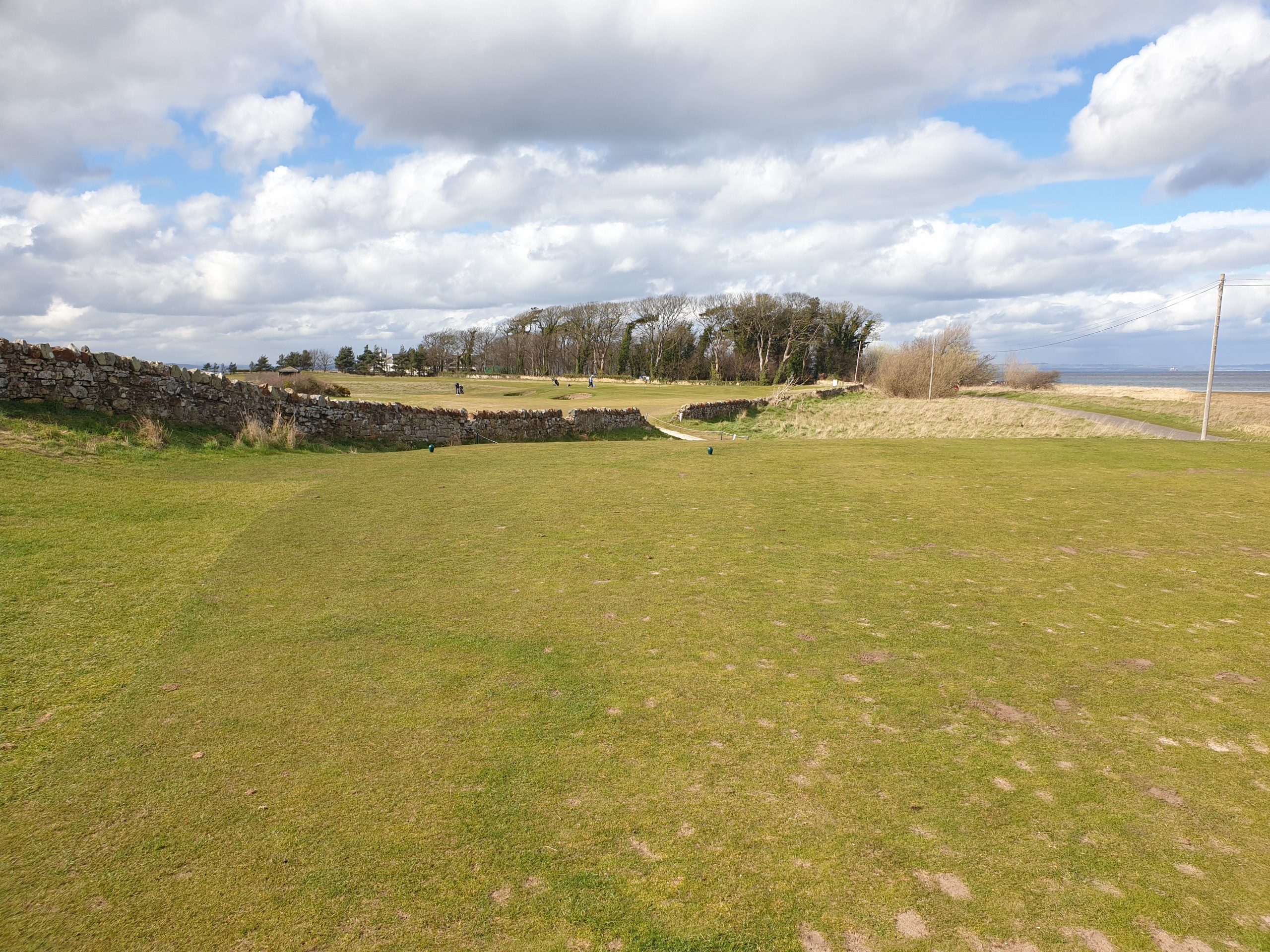
The sixth, ‘Kilspindie’, a respectful but perhaps pointed name, a tough par 3 where the prevailing wind will challenge the out of bound right.
The property is well set up — impressive clubhouse, lodge accommodation, excellent practice facilities. The bunkering is Steel at his most unforgiving — cavernous, steep-faced pot bunkers with no interest whatsoever in your handicap.
First ‘The Steading’, a drivable par 4. The Firth of Forth and Gullane Hill beyond..
The turf lacks the crisp links quality of nearby Gullane; the geology feels subtly different, more transitional than pure links. And the housing around the 10th and 11th — Gosford Park, as it happens, whose residents were central to the original dispute — briefly breaks the links illusion. The course recovers, but it’s a lapse.
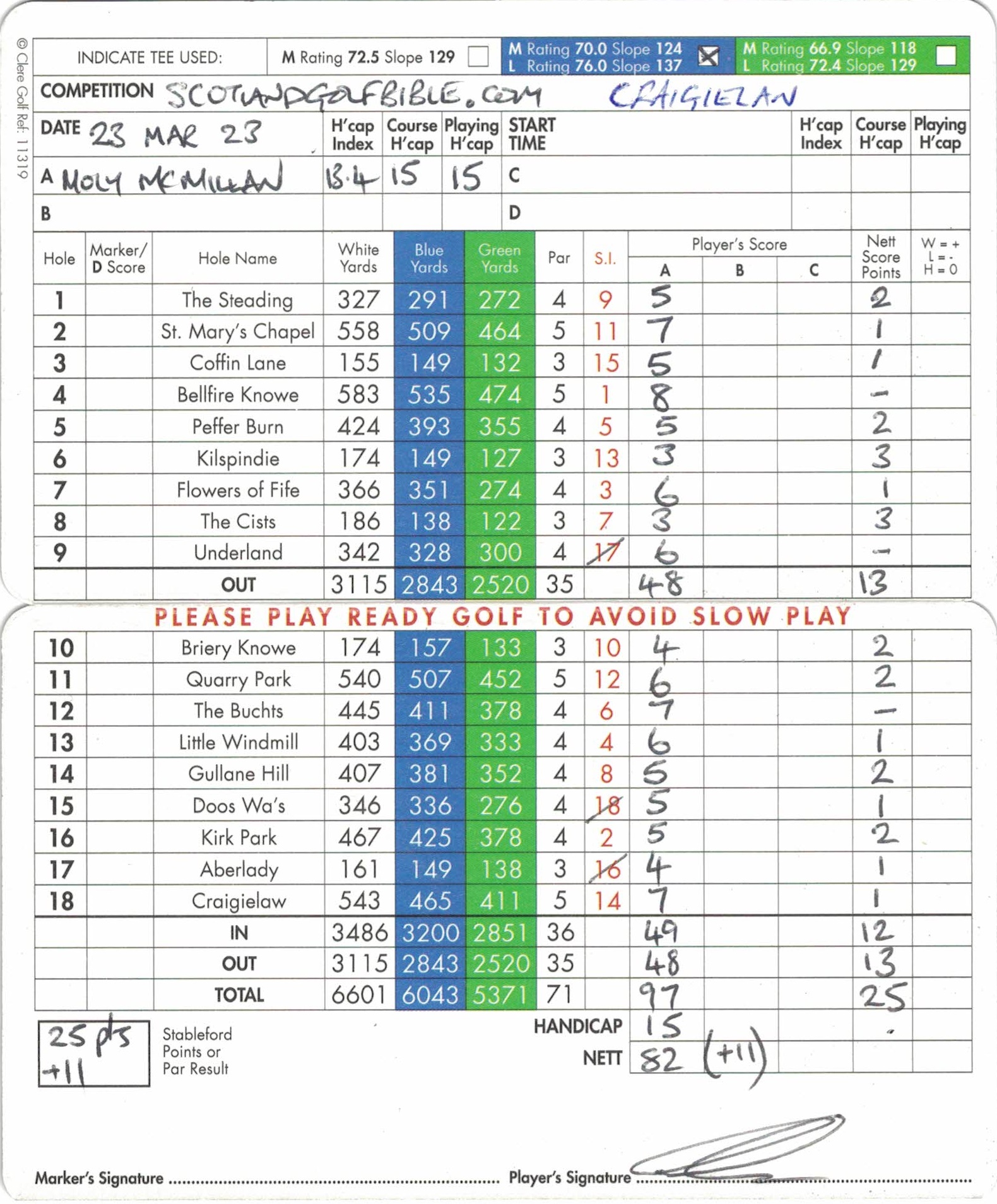
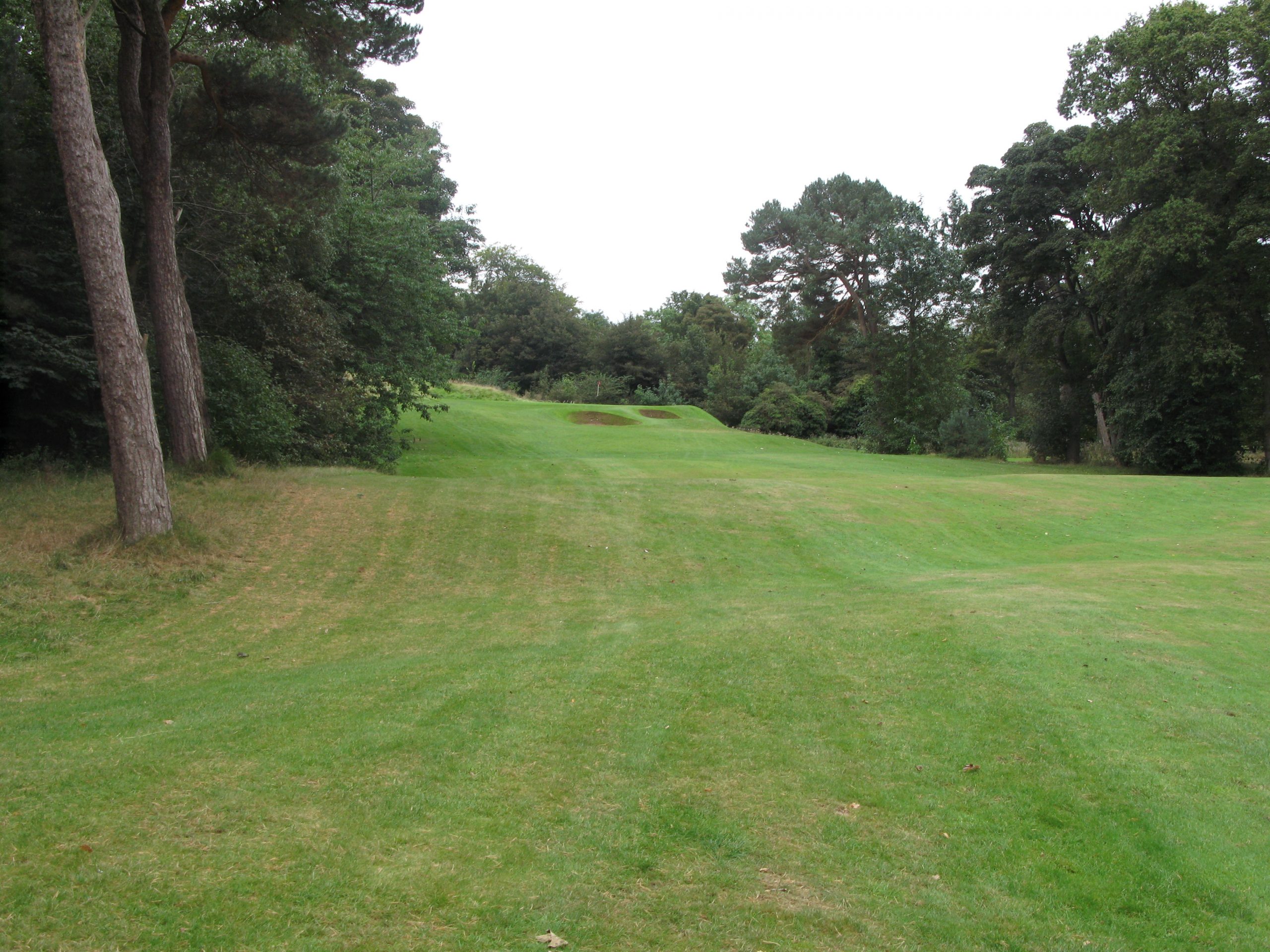
Moly at the 4th, ‘Bellfire Knowe.’ The flag is just visible over the lip. The 8 on the scorecard tells you the rest.
Value? At £125 for a summer midweek round, the price reflects the postcode — Muirfield, Gullane and Luffness New are all neighbours — more than the course itself. Good golf, honestly designed, but 3 out of 5 at full price? Not sure. However, I paid £45 through GolfNow. A Donald Steel championship links in East Lothian for £45 is 4 out of 5 without hesitation. Check GolfNow before you book.
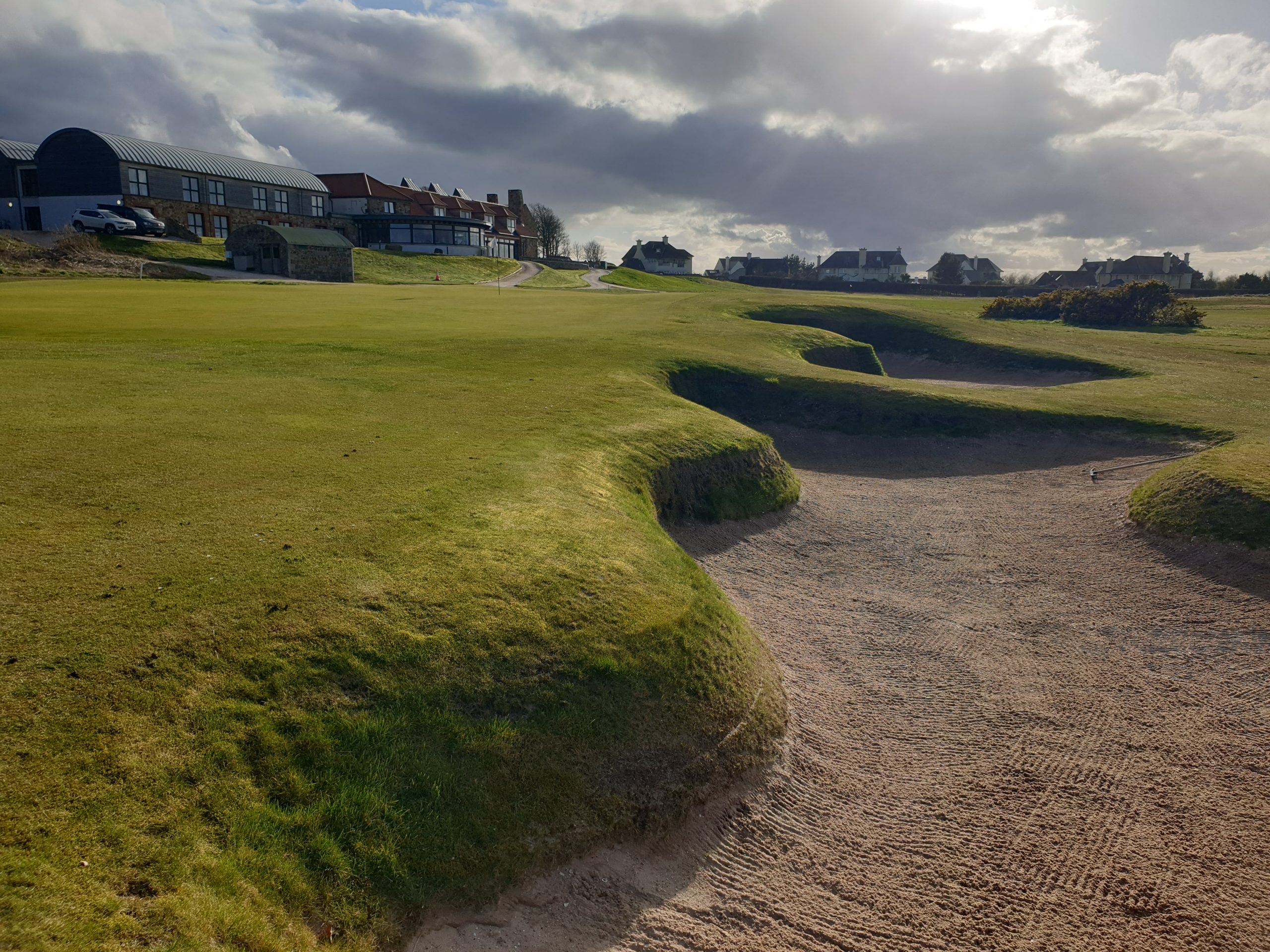
The 18th green, ‘Craigielaw’ — 465 yards, par five — with the modern clubhouse beyond. The bunkering here is the most dramatic on the course.
Facts:
Round £125. Par 71. Course/Slope Rating 70.0/124. Value3/5 (4/5 using GolfNow).
High architectural pedigree at this well rated, but over priced, course that is a tale of two very different surrounds. Is this a camel I wonder?
Round £75. Par 68. Course Rating / Slope Rating (yellow) 69.8/119. Value (out of 5) – 3
Sometimes expectation can get the better of you. I’d read that Longniddry, one of the courses along the so called “golf coast” of East Lothian, had been designed through its evolution by no less than four of the worlds best course architects.
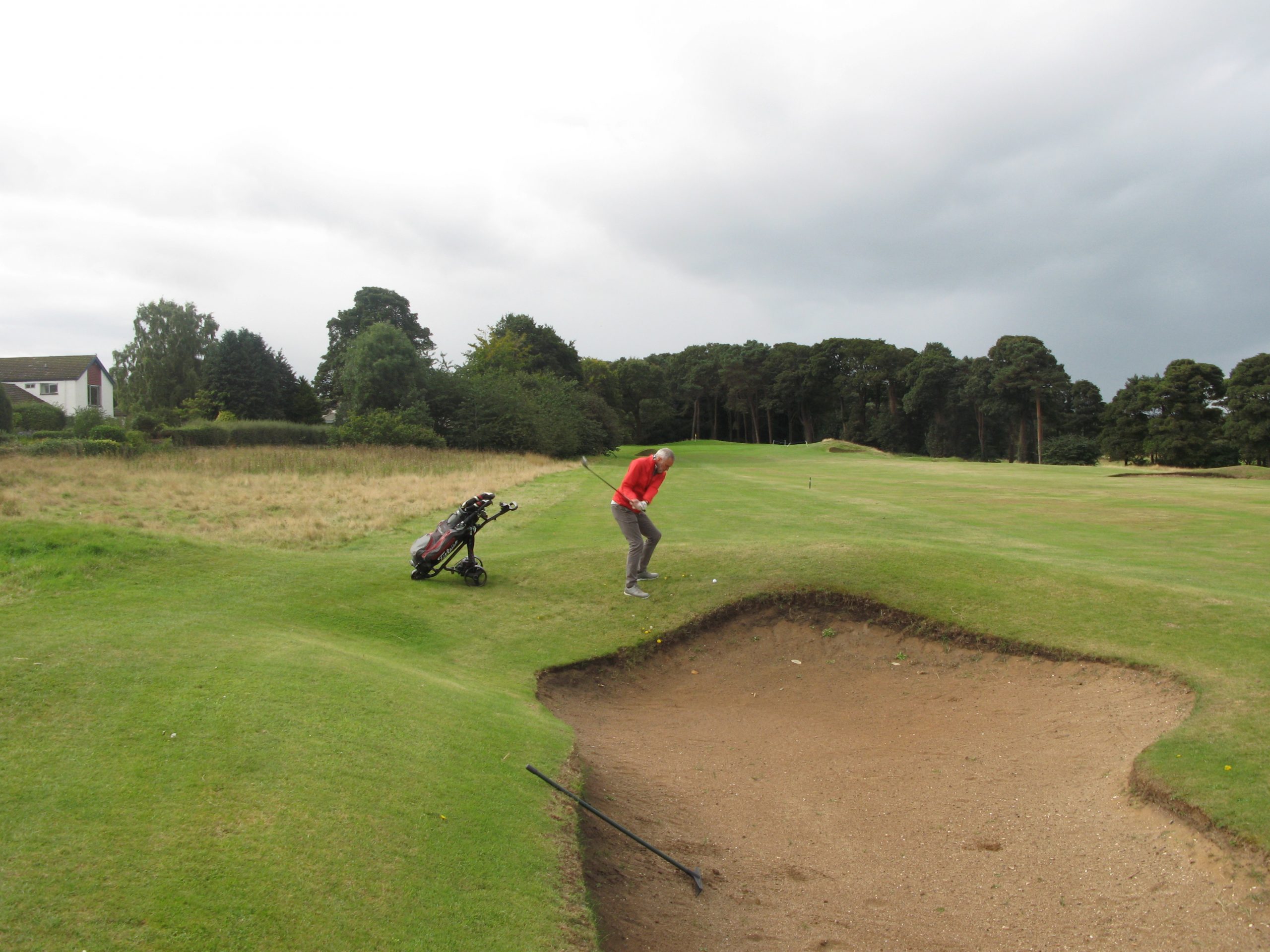
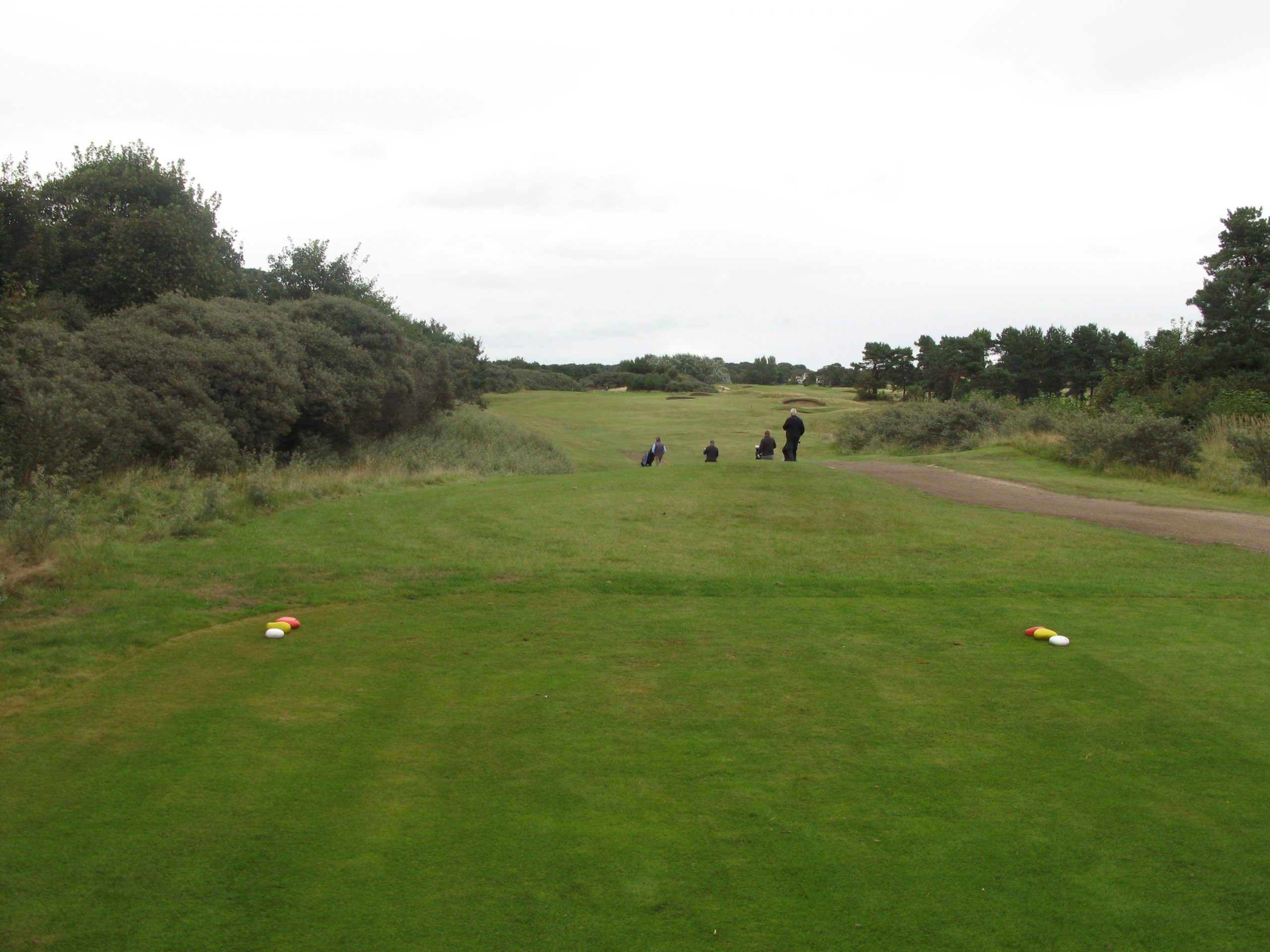
Gordon at the first. Lucky to miss the bunker off the tee, he sadly played his second into trouble to the left (see the bushes!). Always a great start:(
Harry Colt laid out the initial design in 1921, with subsequent adjustments by James Braid, Philip Mackenzie Ross and, finally, Donald Steele. That’s quite a pedigree.
Sir Alec Issigonis, designer of the original Mini motorcar, said, “a camel is a horse designed by committee.” The meaning was intended to convey how groups can be an ineffective method of development. Alternatively, “Too many cooks..” could also be used, in the same context.
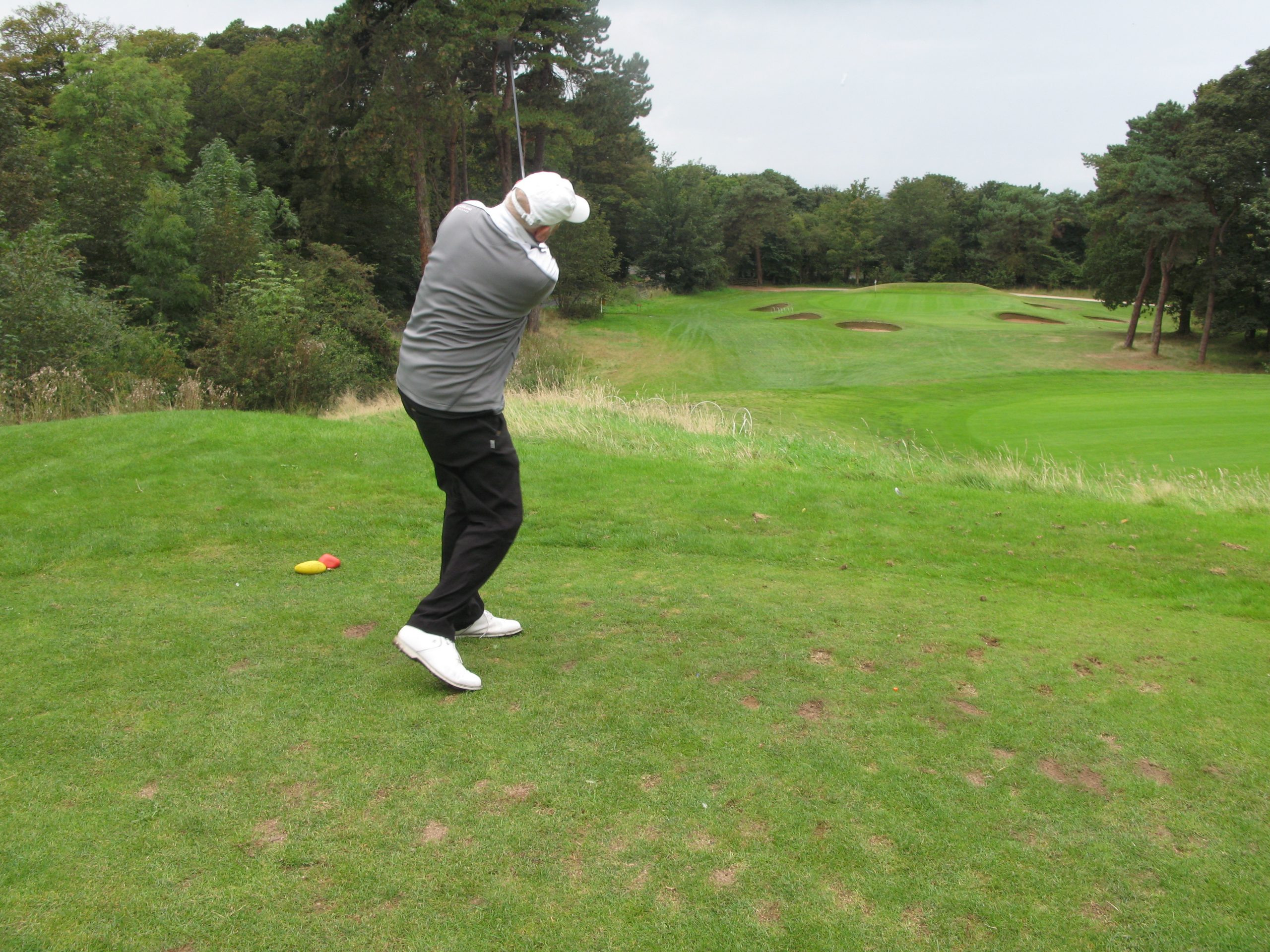
Brian, again displaying his well coached follow through, here at the par three 6th hole, surrounded by greenside bunkers. I think all 4 of us might have been bunkered here – teamwork:).
These comments came to the fore of my mind when playing Longniddry, along with three good friends with whom I had worked with at Apex Scotland, a not for profit organisation dedicated to supporting people with convictions find work and improve their lives.
The plateaued 5th green, with bunkering awaiting the misjudged approach shots.
Set in the affluent village of Longniddry, only 20 minutes by commuter train to Edinburgh, the course occupies a relatively contained acreage, and has many £1m++ houses adorning several fairways. It is a heavenly place to reside for golfers. But the impression is that Longniddry is not a stuffy place, and one of the few “Golf Coast” upper rated courses that allow booking and discounts through the Golfnow app. That is to be applauded, but it can backfire a little; after booking a round at £75 a head with the clubhouse, I found out about a week before that tee times very close to ours were available at only£50 – on phoning up to challenge our fees, it must be said the club responded well. I do recognise the difficulty for clubs, especially when third party marketing app tee time pricing is sometimes controlled by the club, sometimes by the app marketers direct.
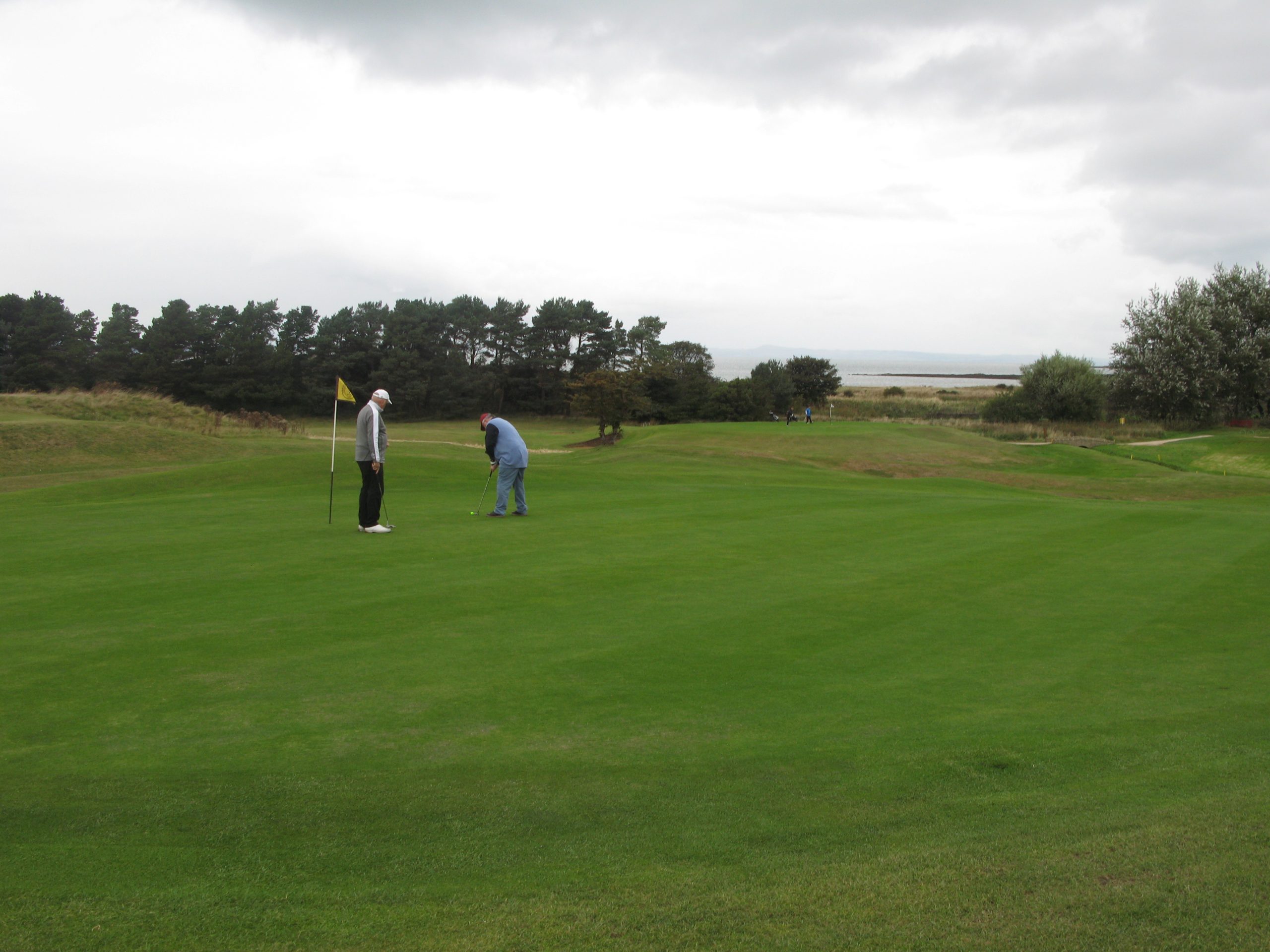
Frank putts out on the 173 yard uphill par three 13th, with backdrop of the Firth of Forth.
The course is very interesting. It has wide fairways, making for a relatively straight forward game off the tees, especially as the fairway bunkering is not as penal as some of its Lothian neighbours. The green surrounds are at times a real challenge, especially at the four par threes, where I lost count of the number of greenside bunkers. Unfortunately, the bunkers were still suffering (sic) from the Pandemic, like much of the population. If you plan to play Longniddry, spend a bit of time practicing your bunker play.
The par four 11th hole at Longniddry the start of the more ‘links’ feeling holes.
The fairways were fairly decent when we played on a lovely late September day. But the teeing grounds needed a little more care. The greens were good and clearly well watered.
The layout is a tale of two quite different environs. The course was created largely by carving out an area from the Boghill Wood, and holes 5 through 10, in particular feel like a woodland course. From 11 onwards the course opens out into a much more traditional links land layout with most holes with gorse in play.
The tough par four 7th hole at Longniddry, in the tree lined section of the course – stroke index 1.
The course is quite long at over 6000 yards from the yellow tees, given that it is a par 68. The real question I have, architecturally, is why none of the renowned architects after Colt said, “what about extending a couple of longer par 4s to make par 5s”, getting the par to (say) 70. Without this, you are left with 14 par 4s, with precious few birdie opportunities for the higher handicappers. The 17th/18th, both challenging par 4s of well over 400 yards, could relatively easily be altered, as could the long par four 3rd at 450 yards. I’m certain it must have been a debate down the years.
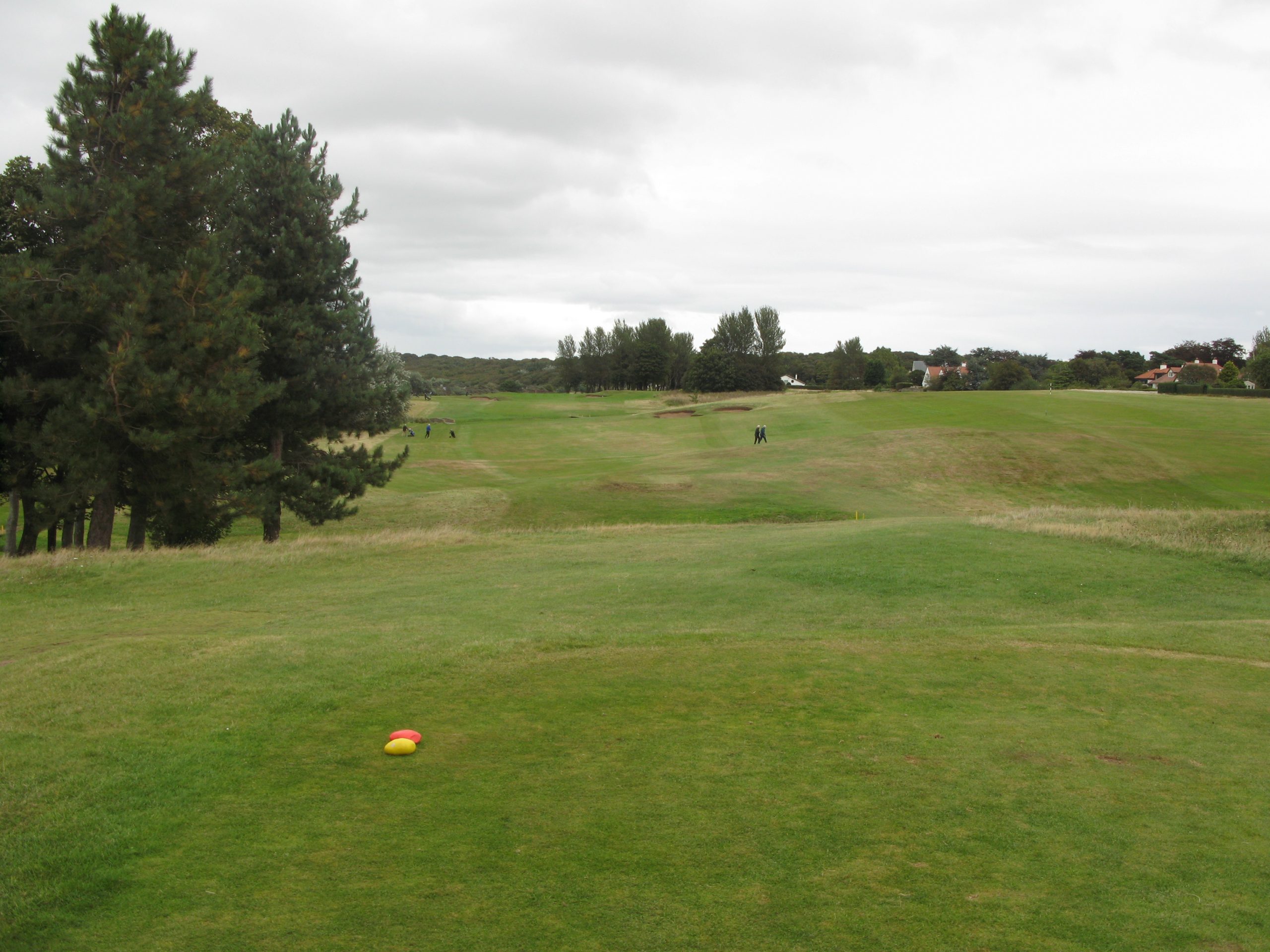
The short 16th hole with some of the residences of the well heeled in the background – I suspect that’s envy on my part?
The stoke indices also seemed to not reflect the difficulty. For example, the well bunkered par 3s, being labeled as the 4 easiest holes (not so, surely!), and the last, a long par 4 at 420 yards (yellow) being only stroke index 12? It would be intriguing to get the membership views on this.
There were two stand out holes for me:
> The 5th, a dog leg left par four of only 320 yards, with the approach played to a green on a plateau fronted by two mass grave like bunkers. Stay well right with the drive, and commit to at least one extra club on the approach. Its the most un ‘links’ like hole.
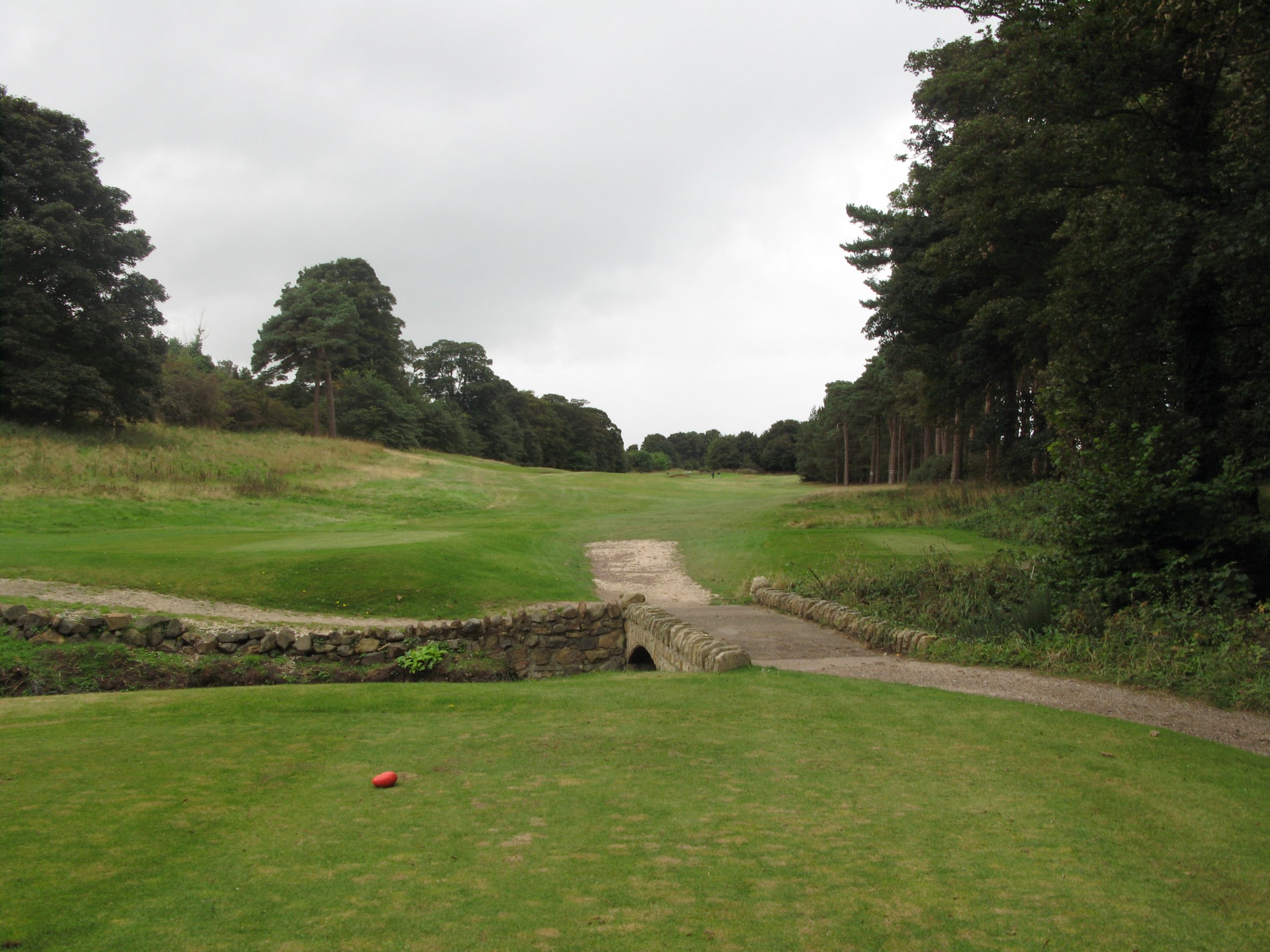
The cleverly designed par four 14th hole, where the burn comes into play for all but the longest off the tee. Good green complex.
> The 14th, a difficult par four, where only the long hitters can confidently drive over a ditch at around 200 yards, but the downhill fairway means that even a hybrid might run into the ditch. Then the approach is uphill to a carefully set green with difficult slopes.
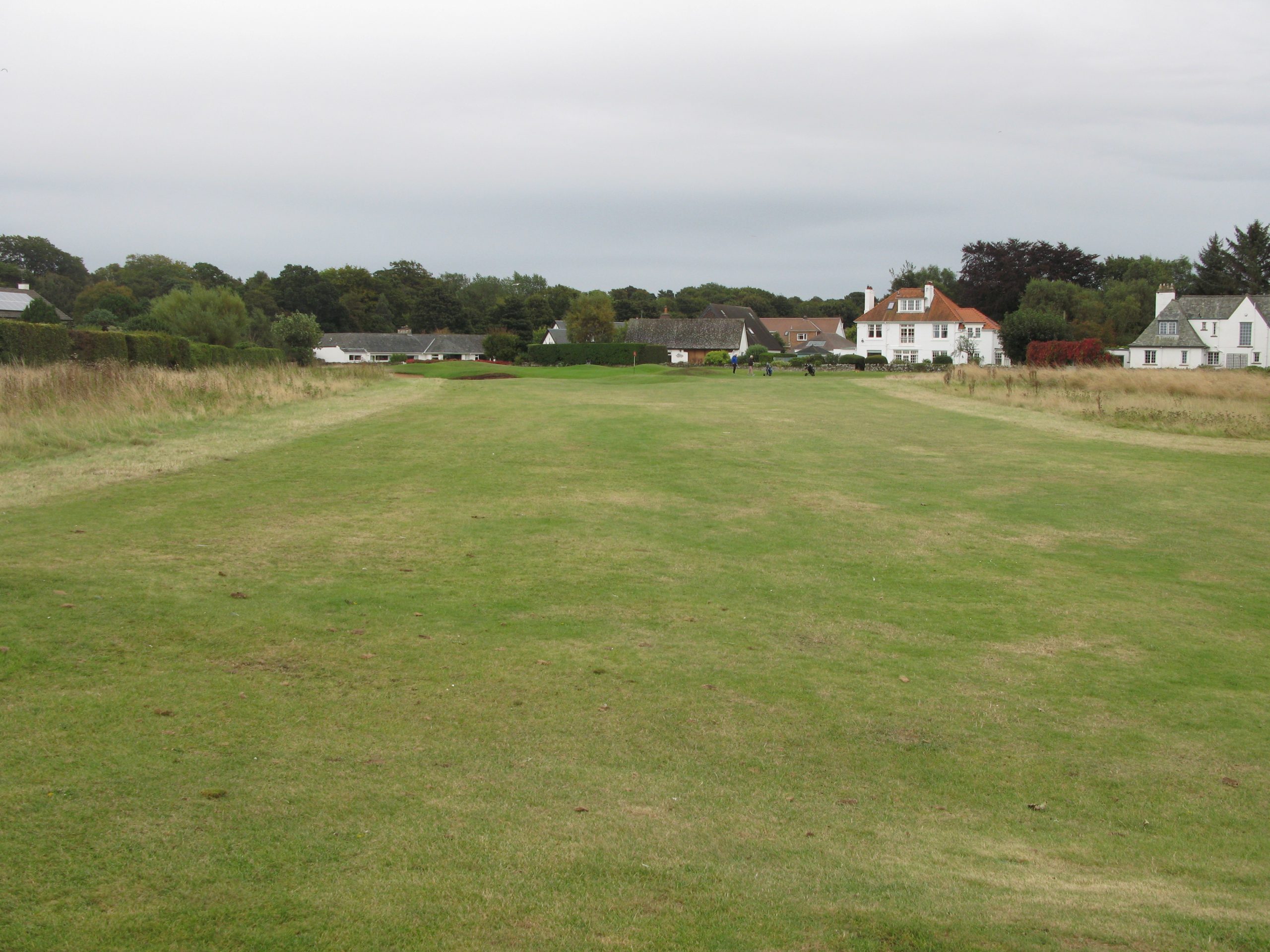
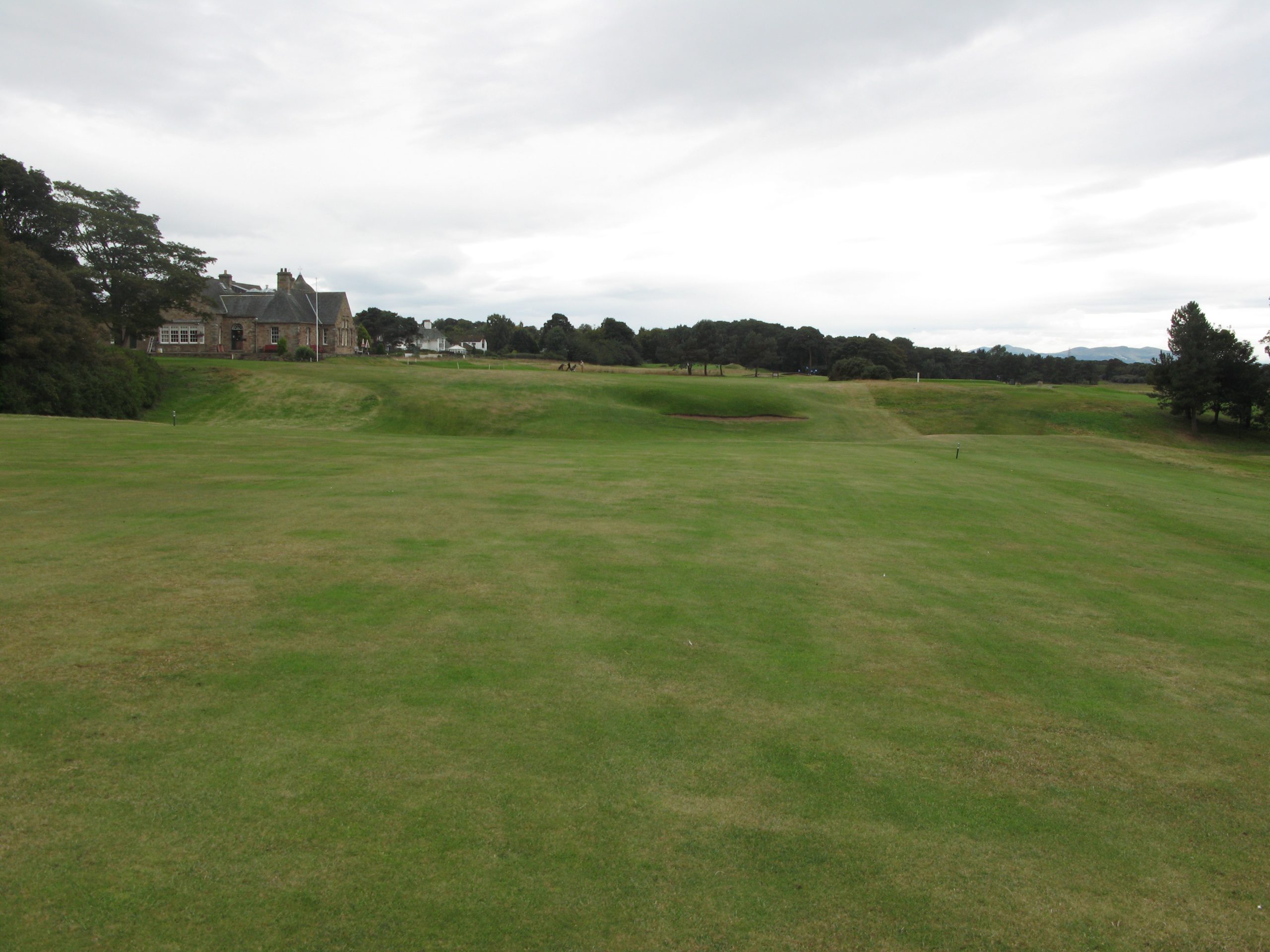
The nice clubhouse awaits at the 18th – a demanding finish, more difficult than the SI of 12, in my opinion.
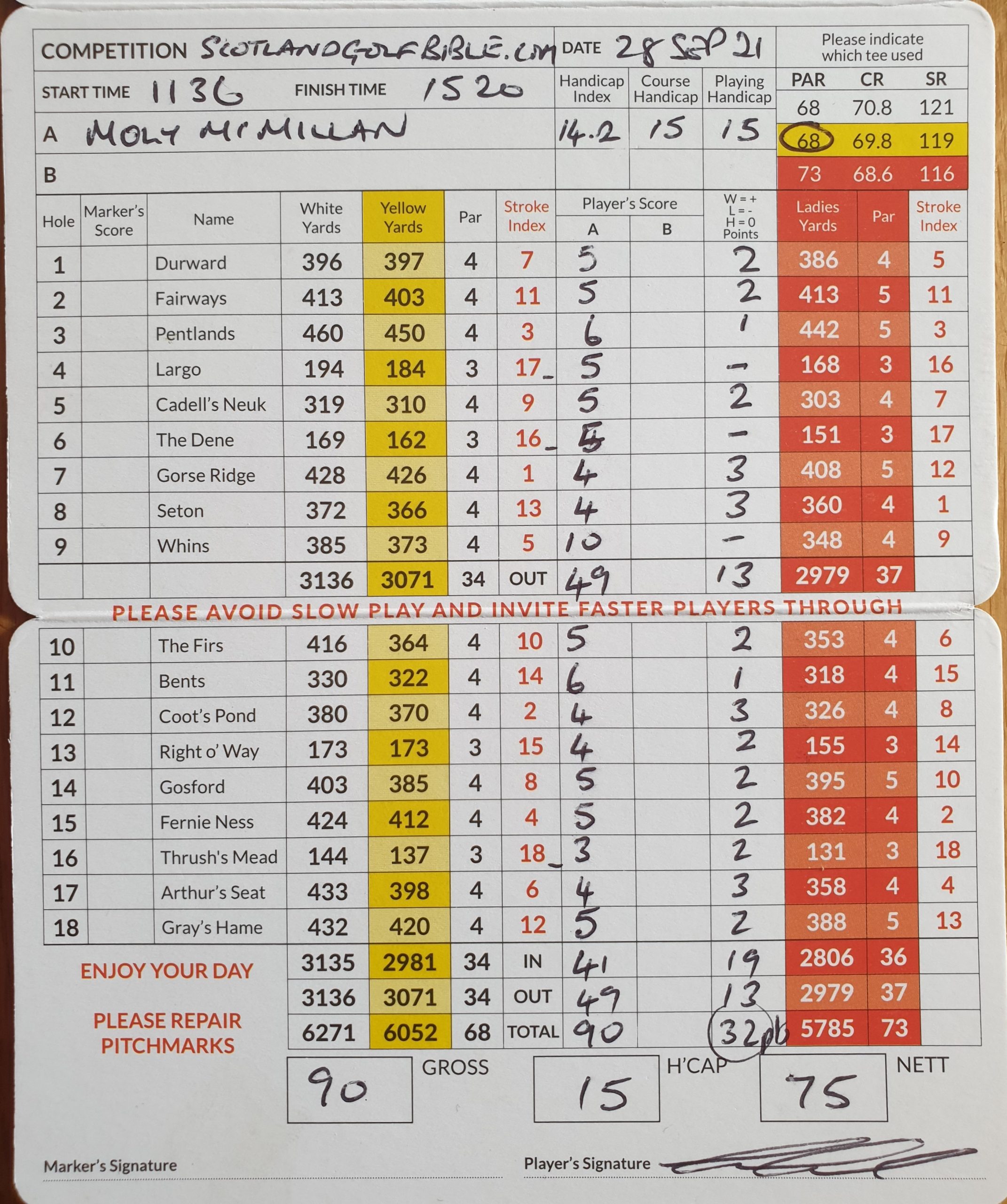
I played pretty well. After a 10 at the ninth, having been in trouble on both sides of the fairway, I came back in 41 (7 over), to actually win our small stableford competition. The winner was meant to get their meal paid for after by the other 3, but a number of my colleagues had to rush off, quashing my opportunity to milk any praise. But I’ve not forgotten!
Finally, going back to the camel proverb. A camel is actually a highly efficient design for its environment, in which horses would soon die. You can make your own mind up about the course being a camel or not.
Finally, finally. It is reported that Mary Queen of Scots played in the area of Longniddry. But how so, I say, when the location of the course was previously the Boghill Wood?
Course Type:Parkland/Links
Par 68 (0 par 5s, 14 par 4s, 4 par 3s)
Distance: 6052 (yellow)
Moly’s Gross score: 90
Moly’s Longniddry scorecard – a 90 with an excellent 41 on the back 9; but, a 10 on the 9th!.
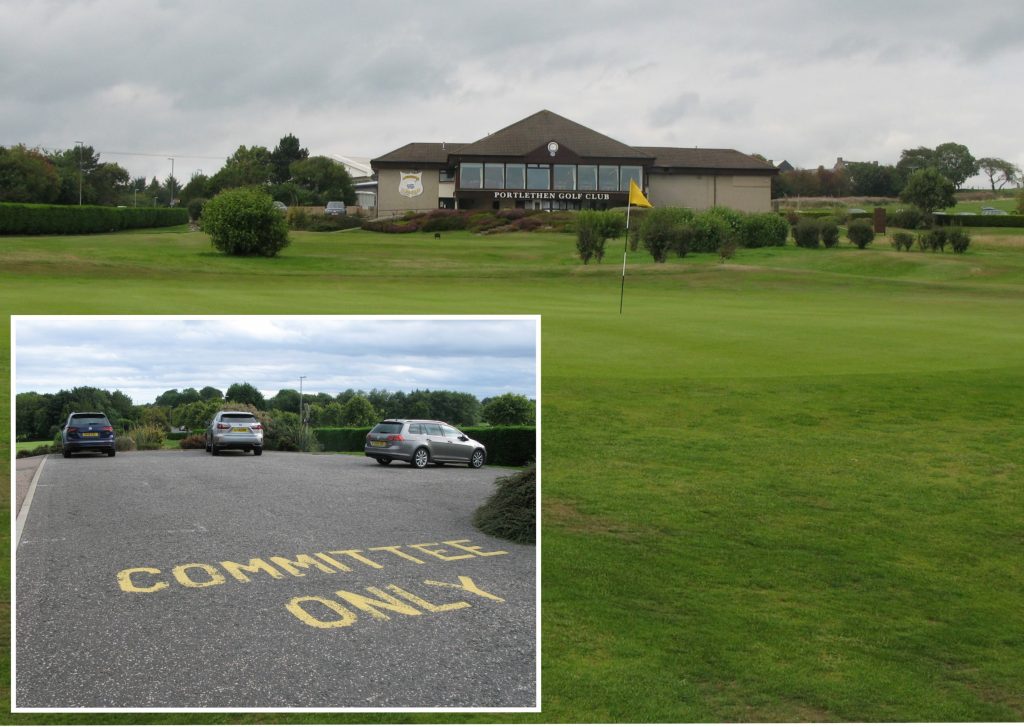
The “Committee Only” Car Park sums up why Golf has to change to survive.
Round £45. Par 70. Value (out of 5) – 3
Portlethen, about 7 miles south of Aberdeen, on the A90, is one of the fastest growing areas in Scotland over the last 30 years. When the golf course was opened in 1989 the population was recorded as 1500, yet in 2011 it was over 7000 – no doubt driven by the North Sea oil boom. With the opening of the substantial Aberdeen bypass imminent, Portlethen continues to grow, albeit the area is also suffering from the collapse in oil prices in 2015.
The welcome wasn’t warm at Portlethen – Beware of any clubs with “Committee Only” anything. No wonder some clubs are struggling.
The course, designed by the renowned Donald Steel, along with the substantial clubhouse, seems apt testimony to the ambitions of the area. Yet somehow, for me, the course fails to deliver on the initial optimism demonstrated by the designer chosen. When asked what I thought of Portlethen, my answer was “It’s OK”, which sums up my experience.
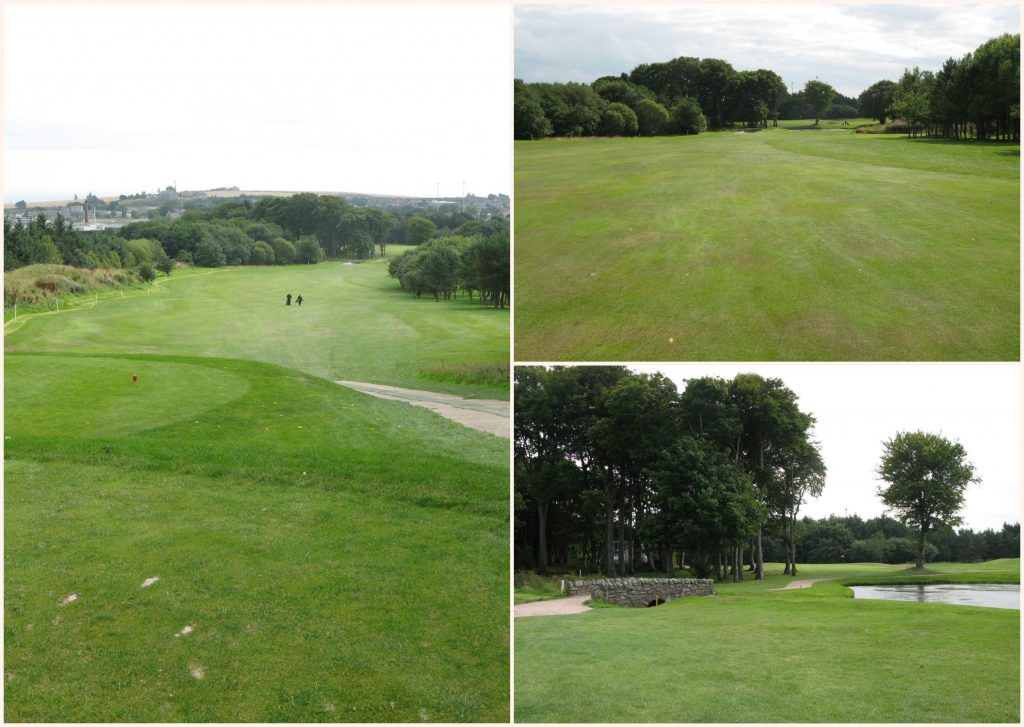
The 4th at Portlethen, one of the best holes.
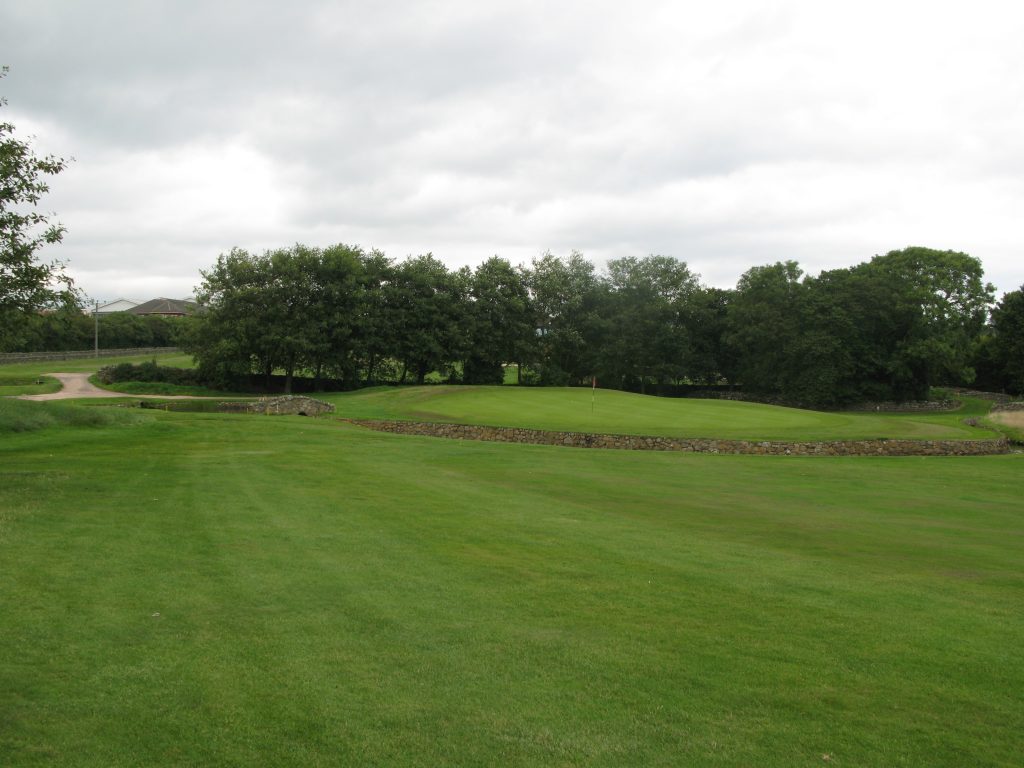
It’s a generous parkland setting, and after a few ordinary holes, the 4th tee provides an excellent view of the par 5 signature hole; after a good drive I hit an excellent 3 wood over the pond guarding the green – my best strike of the day – which caught the top of a large tree and ended in the water. The 5th is also a picturesque water featured par 3. After those highlights, I thought the course somewhat fell away in quality, other than the superb 15th, the SI 2 par 4, which also had a green fronted by water.
The difficult par 4 15th at Portlethen.
The course was in reasonably good condition. But it was the lack of welcome which stuck with me. As a www.teeofftimes.co.uk customer I was advised I would be paired together – not a problem, but expressed in a manner that made me feel a second class citizen. However, shortly thereafter, I was advised I could play on my own as there was space on the tee! Nevertheless, my round was very slow, and it was clear that people in front of me were determined not to let me through, even when there was space in front.
The aesthetic 5th at Portlethen, a short iron par 3.
This seemingly unfriendly approach by a couple of players cannot, of course, be judged representative – however, when I saw the size of the “Committee Only” car park, this seemed so representative of the welcome I’d received.
My overall assessment was that Portlethen was about a 3 for value. The club’s website makes a big sell of “The Portlethen Experience” – but I must say, for me, it just felt a little bit pretentious overall.
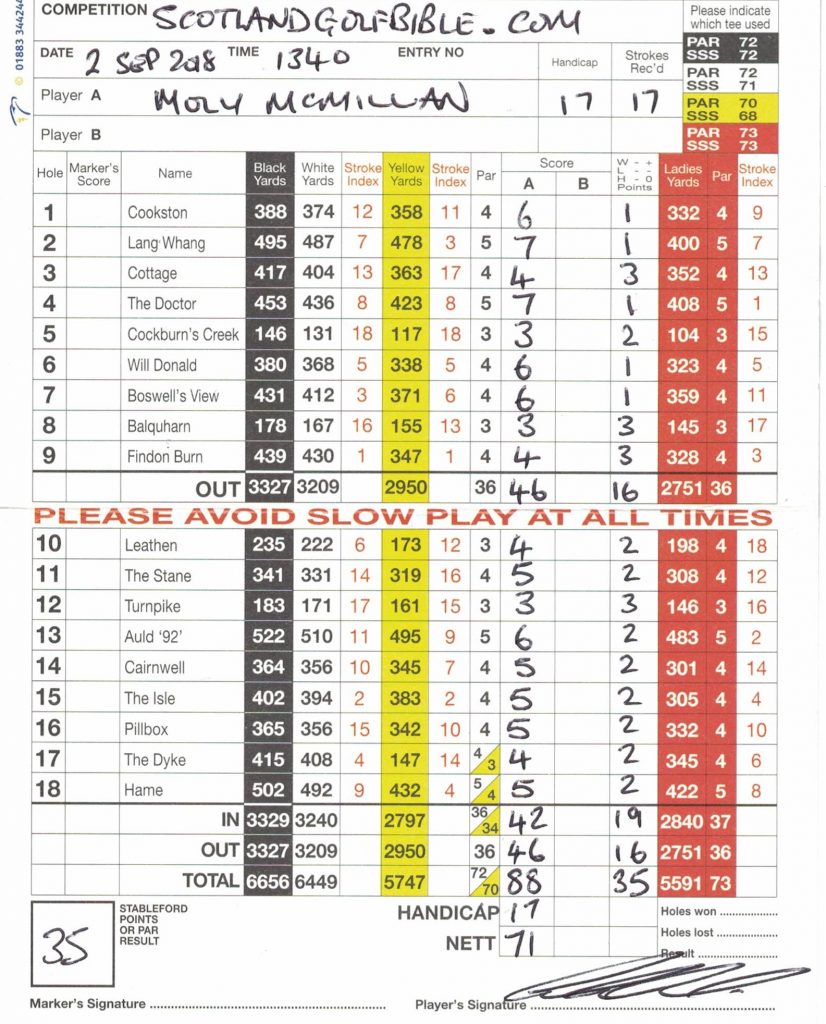
On the day I played well for my net 71.
Facts:
Course Type:Parkland
Par 70 (3 par 5s, 10 par 4s, 5 par 3s)
Distance (yellow): 5747 Yards
Moly’s Gross score: 88
Moly’s Portlethen 88, with only 1 lost ball – which was the best strike of the day, including direction!
Creatively ambitious Highland Estate course with single malt 19th hole
Round £15(9)/£25(18). Par 36(72). Value (out of 5) 4.
Ballindalloch Castle golf course is 14 miles north east of Grantown on Spey and sits alongside the River Avon not far from it’s confluence with the River Spey. The Castle has been the home of the Macpherson-Grant family since it was finished in 1546; the golf course is a little younger, having been designed by 2 of the more prestigious designers around, Donald Steel and Tom MacKenzie, in 2002-3. They obviously work well together, having also designed the well regarded Carnegie layout at Skibo Castle – maybe they just like castles?
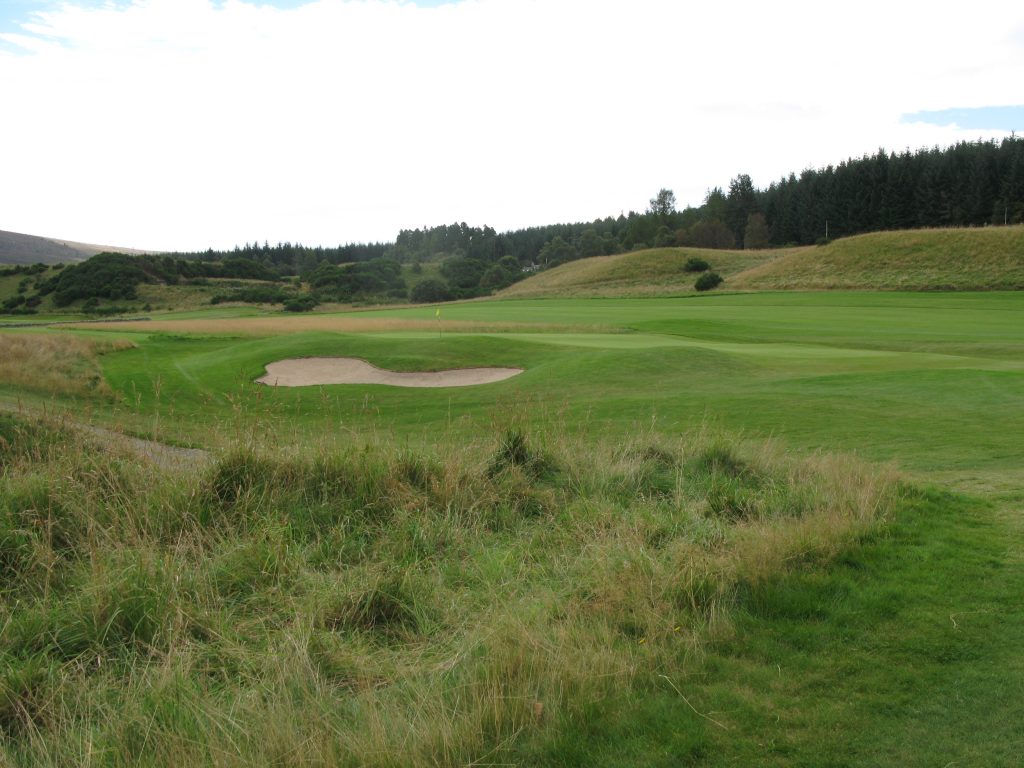
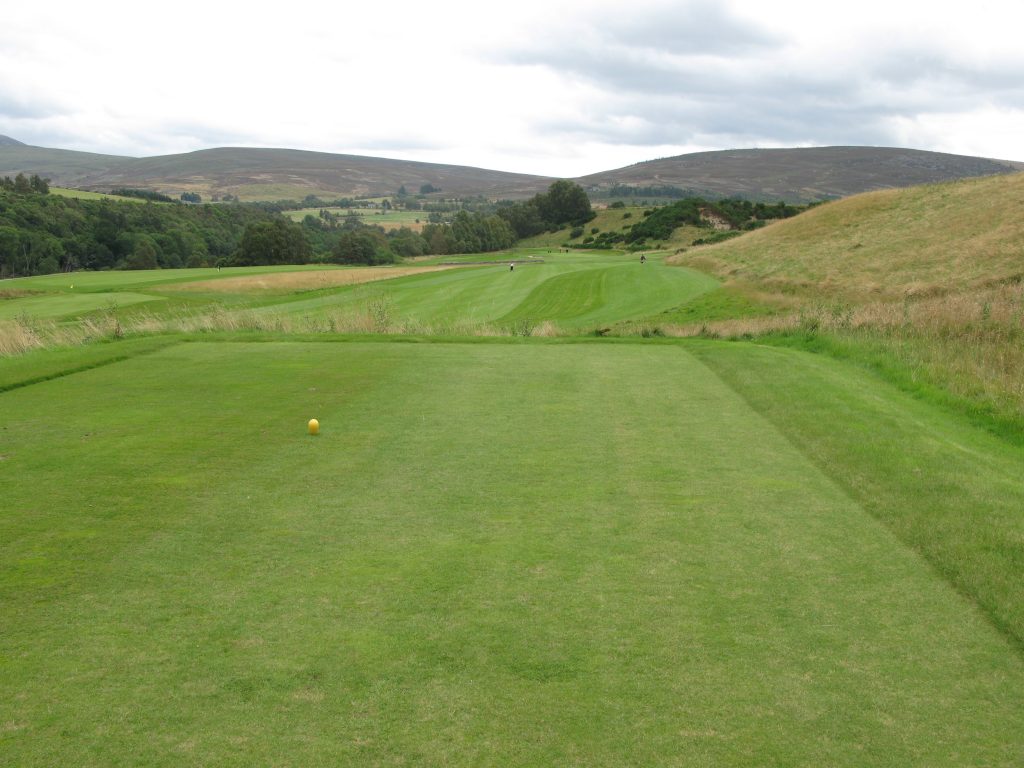
Approach to the 1st (Par 5) or 10th (Par 4) – a difficult green to reach in regulation.
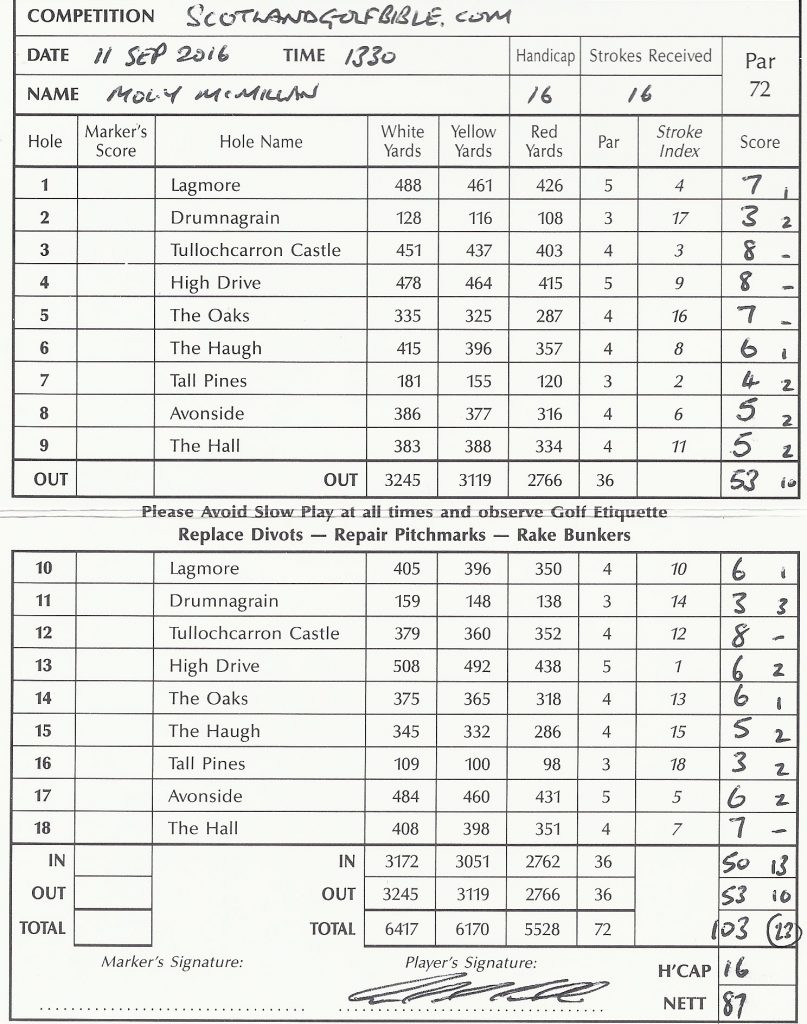
The resulting golf course, with views of hills and birch woods, is a rather marvelous and pleasantly surprising layout at 6417 yards from the white tees. Although a “9 hole” course, there are 18 tees, with many of the tee combinations significantly altering the front and back 9s – I would strongly recommend playing 18 holes to appreciate the architectural cleverness of this Steel and MacKenzie design.
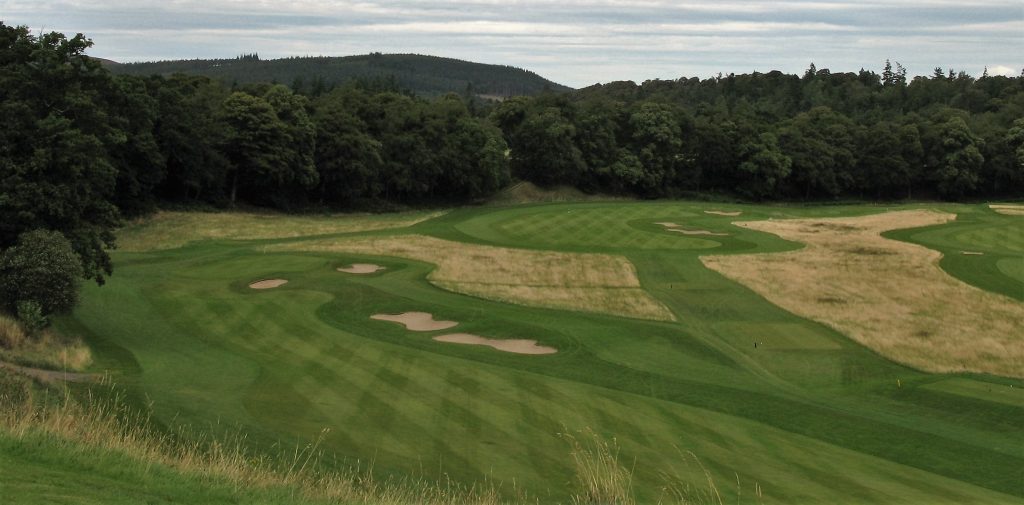
The magnificent 4th / 13th at Ballindalloch Castle – here showing the 2nd shot view.
The effect of the different tees, is exemplified straight away with the 1st playing as a par 5 at 488 yards, but the 10th as a par 4 at 405 yards – however, the westerly prevailing wind make both holes very difficult. The tees at the 5th/14th are 100 yards apart, with the 14th playing as a near 90 degree dog leg right. Arguably most stark is the par 3 7th/16th, where I suspect most players need at least a rescue club on the 7th, but only a wedge on 16th; the holes are 70 yards different in length.
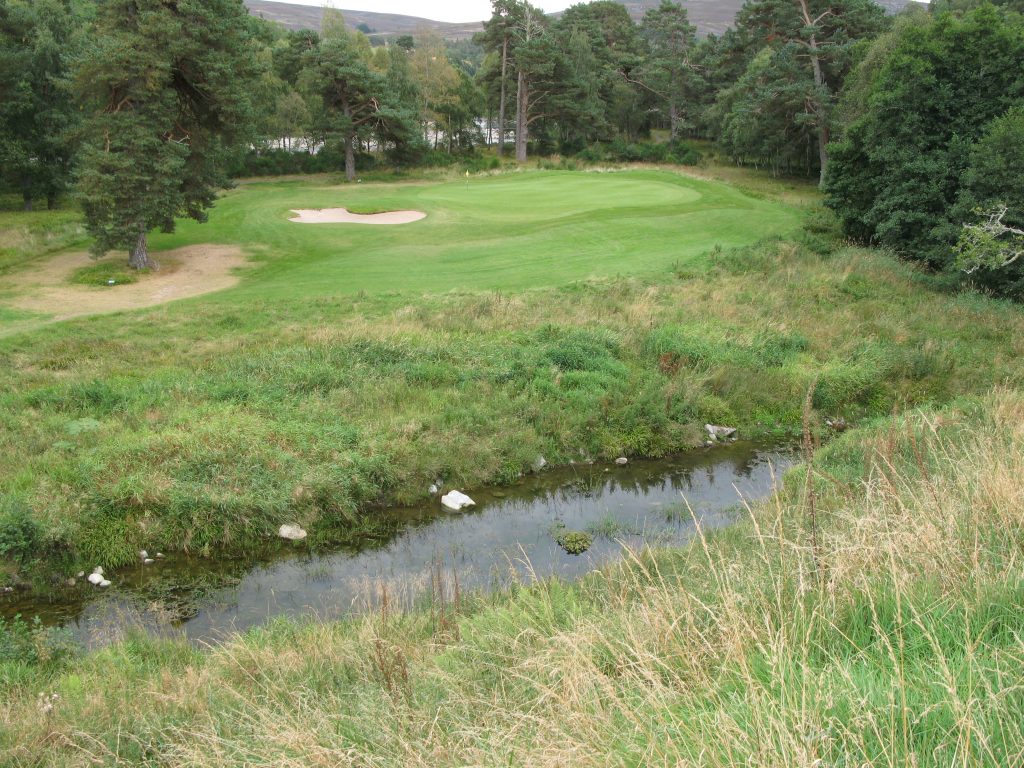
The 7th/16th green (here showing the 16th tee view)
As I played around this very ambitious project for a highland estate, I was struck with how fitting the course adds to the colourful history of the castle, which is the original home of the Black Watch, the oldest of the Highland regiments, and also the place where Captain W.E. Johns wrote many of his Biggles stories.
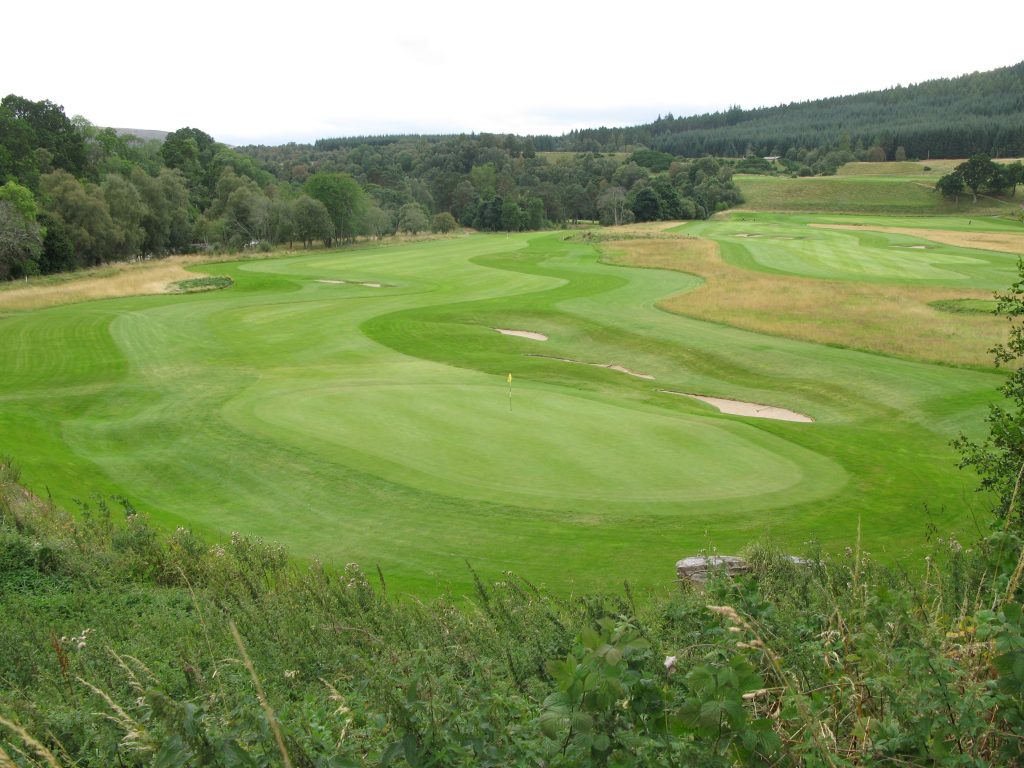
View from behind the 8th/17th green at Ballindalloch
The course was in excellent condition when I played, which I suspect might be helped by the relatively small number of members and players the course attracts. I guess it’s because not many people want to travel too far “just for 9 holes”. I think they are making a big mistake – this must be one of the best 9 hole courses in Scotland, and it is very competitively priced against its Strathspey and Baddenoch neighbours.
The 12th tee at Ballindalloch
On the day, I played pretty poorly, scoring 103 for 23 points, although I was only 1 over for the 4 par 3s.
Finally, there is plenty to keep non golfing family members busy on the estate, which has also recently opened a whisky distillery right next door to the golf course, again reinforcing this highland estate’s ambition.
I highly recommend playing at Ballindalloch Castle.
Some Facts
Course Type: Highland
Par 72(4 par 5s, 10 par 4s, 4 par 3s)
Distance Yards 6170 (yellow)
Moly’s Gross Score: 103
Moly’s Ballindalloch scorecard – 103, for 23 points!