A guide to green fee value for money

Category: 4.5 star (Page 4 of 5)

79. Fortrose & Rosemarkie. 24 June 2018.

Possibly the best located Scottish golf course, with evidence that James Braid’s bunkering came pretty cheap!      

Round £55.   Par 69.  Value (out of 5) – 4.5

“The Black Isle?”  Well, it’s not an isle and it’s not particularly black!  But it is a 10 mile wide by 20 mile long peninsular just north of Inverness, which also has a further very small peninsular on it’s southern Moray Firth coastline which is the heavenly location of Fortrose & Rosemarkie golf course.
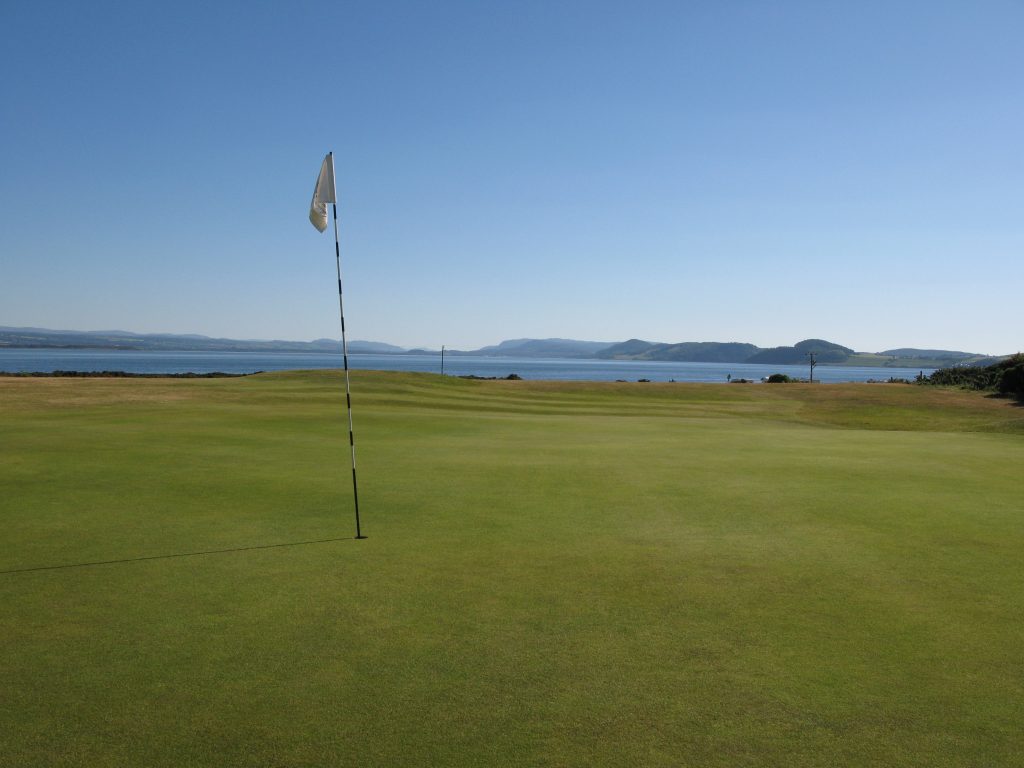
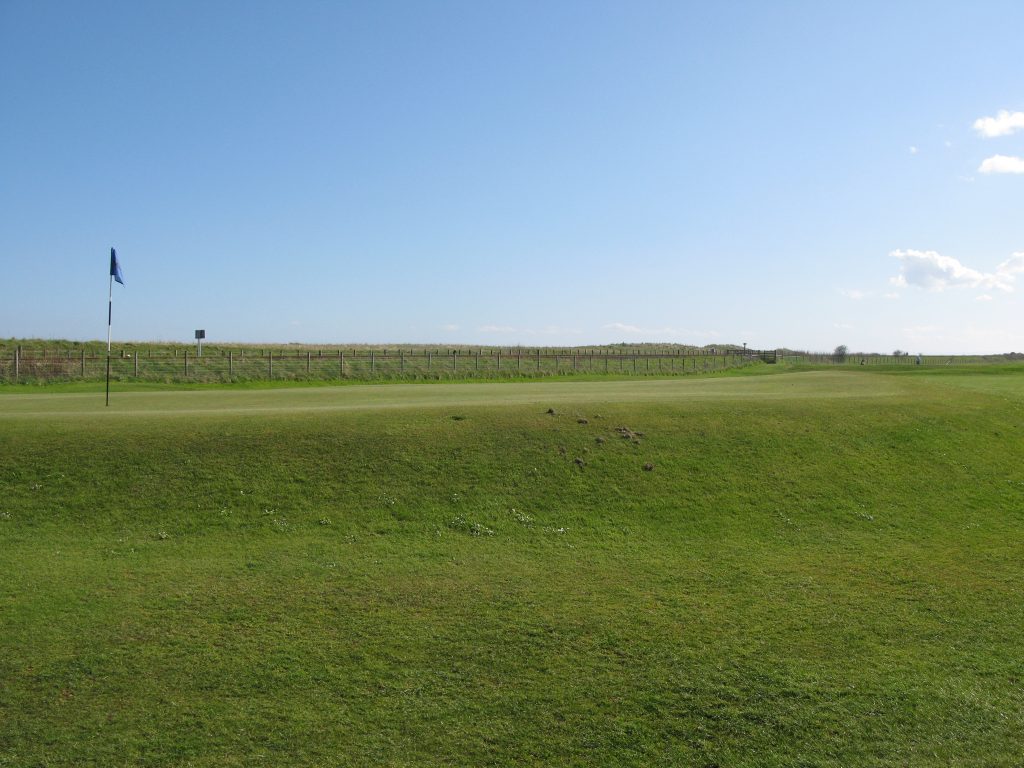
The 9th green looking back to the tee with the Moray and Beauly Firths in the background.

Scots sometimes refer (tongue in cheek) to being “from God’s own country”.  If that were the case, it might just be that God chose the Fortrose & Rosemarkie peninsular for his (or her!) own personal golf course.  I played the course on a wonderfully warm and sunny late midsummer evening for a twilight fee of only £30, shot 39 (4 over) on the back 9, including 2 birdies, and seriously thought that maybe I should just stop played with that golfing memory etched on my brain.  It really can’t get much better…can it?

The Black Isle has recently become a popular destination with the creation of the North Coast 500  but has long been a destination to play some of the cream of Scottish Links, with Royal Dornoch, Nairn and Tain all close by, plus the recent addition of Castle Stuart. Fortrose & Rosemarkie has actually been attracting golfing visitors in high numbers since the expansion of the railways in the late 19th century and golf in the course location is traceable back to 1702.  Established in 1793, is the Club is the 15th oldest in the world, of which they are very proud.
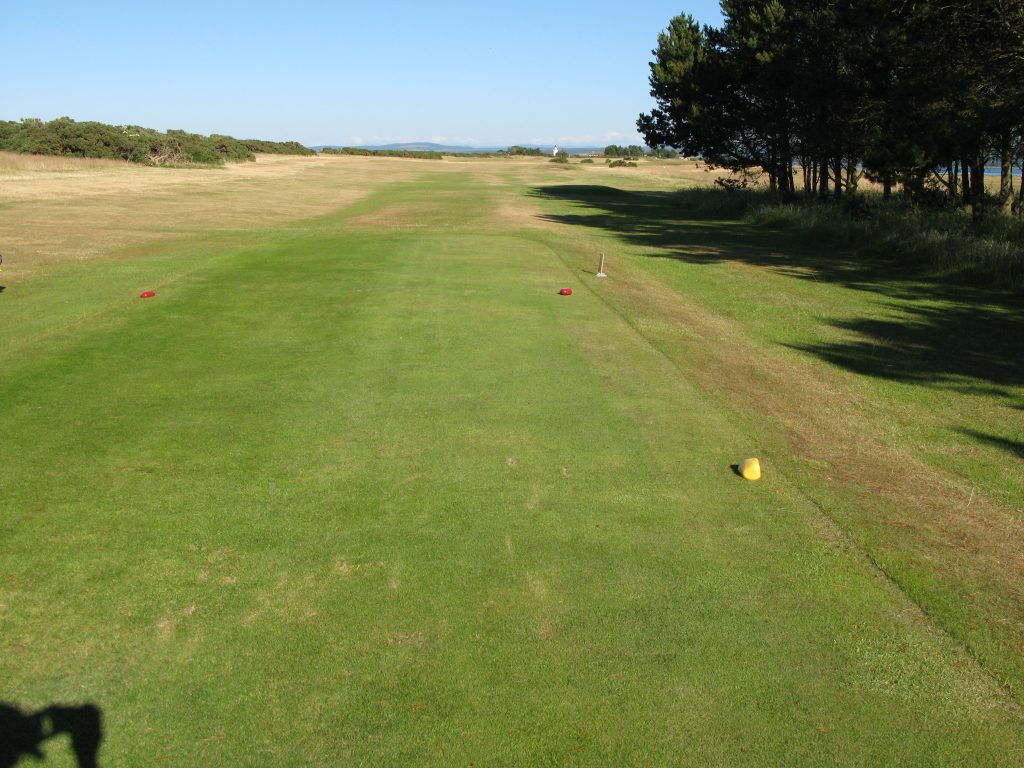
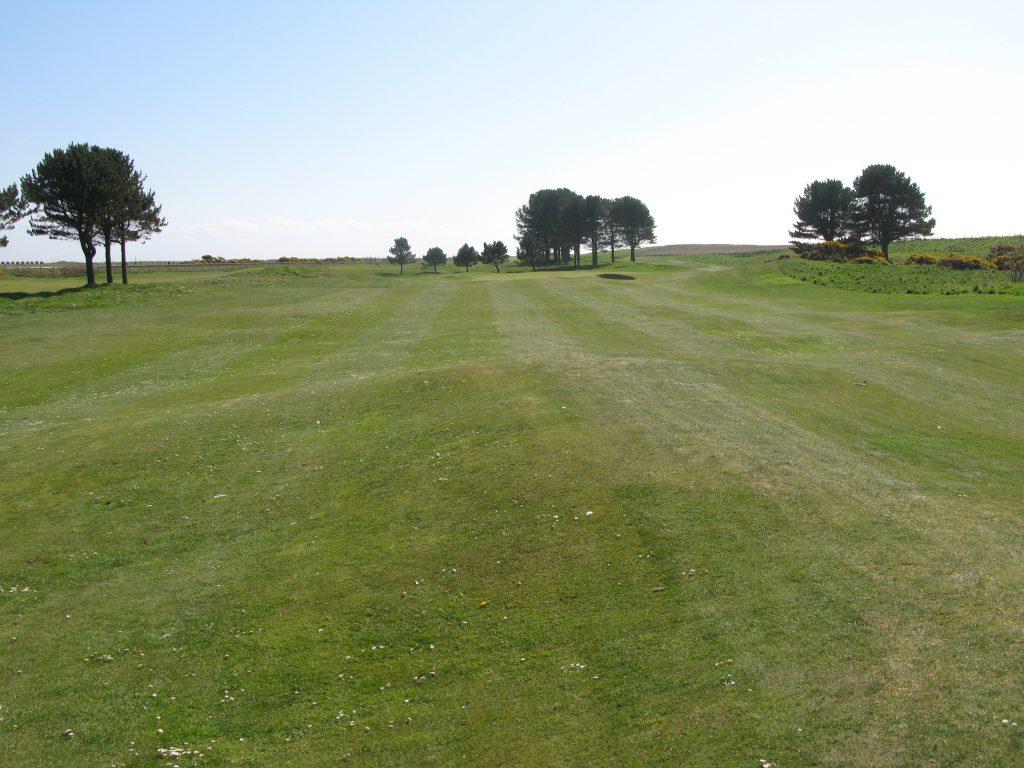
The 11th tee, which is one of several arguably bland holes around the turn at Fortrose and Rosemarkie.

The course is quite short, at only 5893 yards from white tees and 5594 yards from yellow tees which I used.   It is essentially 2 horseshoe loops with the outer loop played clockwise with sea (only in play at a few holes) on your left , then an inner smaller loop played in opposite direction.  The difficulty will be dominated by the weather, but the bunkering and greens are tricky and provide protection when the wind is down.    Originally a 9 hole layout, it was extended to 18 in 1924 and in both 1932 and 1934 James Braid was engaged to advise on layout and bunkering – his 1934 fee was £12.10/  which ended in the course in its current layout.   That is only about  £1000 in current value!
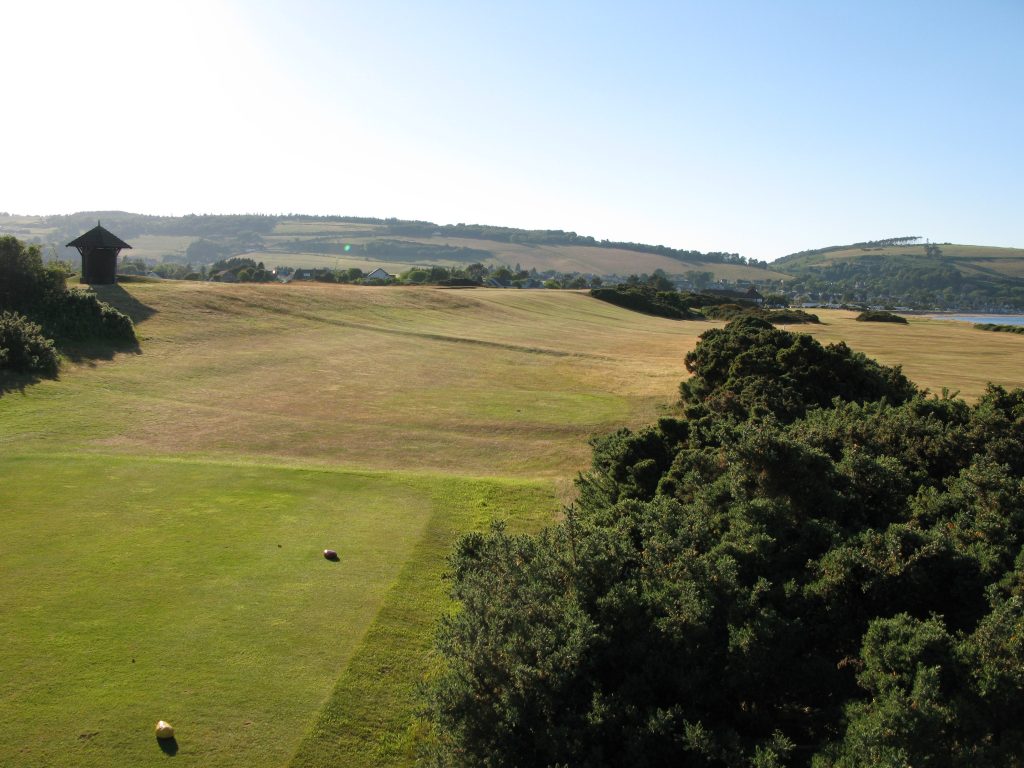
The 17th at Fortrose & Rosemarkie; play left to ensure reaching to the plateau fairway.

There are some majestic holes, most notably the long par 4 4th, played towards the lighthouse at Chanonry Point, which protects the small channel through the Moray Firth towards Inverness, which is a popular viewpoint to see the many dolphins which inhabit the area.  I have spoken to people who have played the course many times and never parred the 4th.
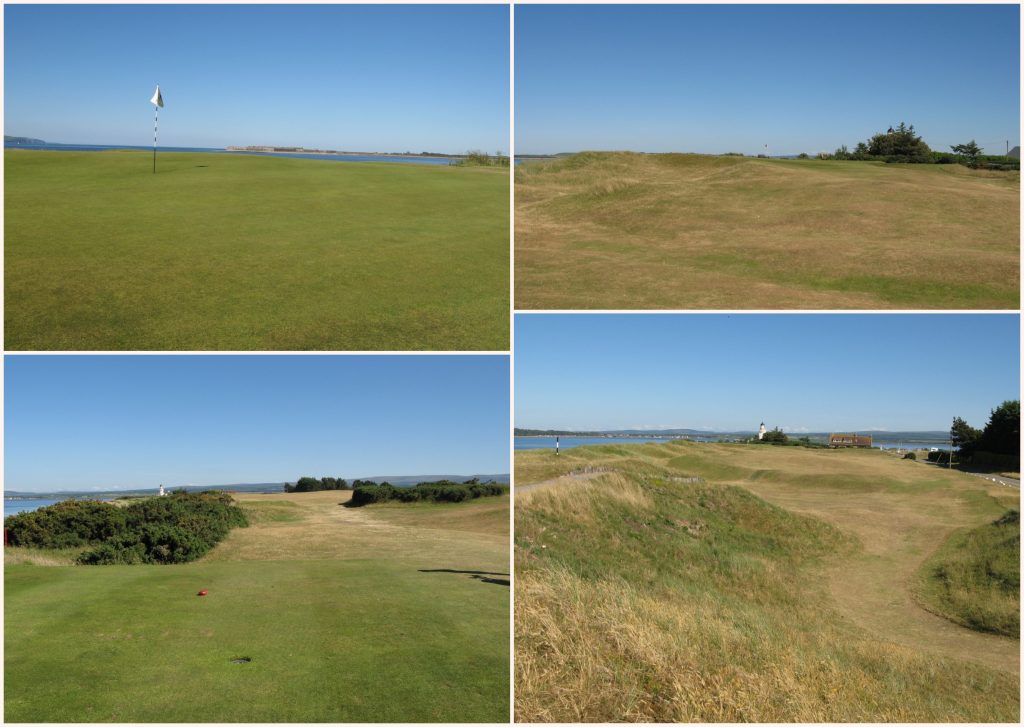
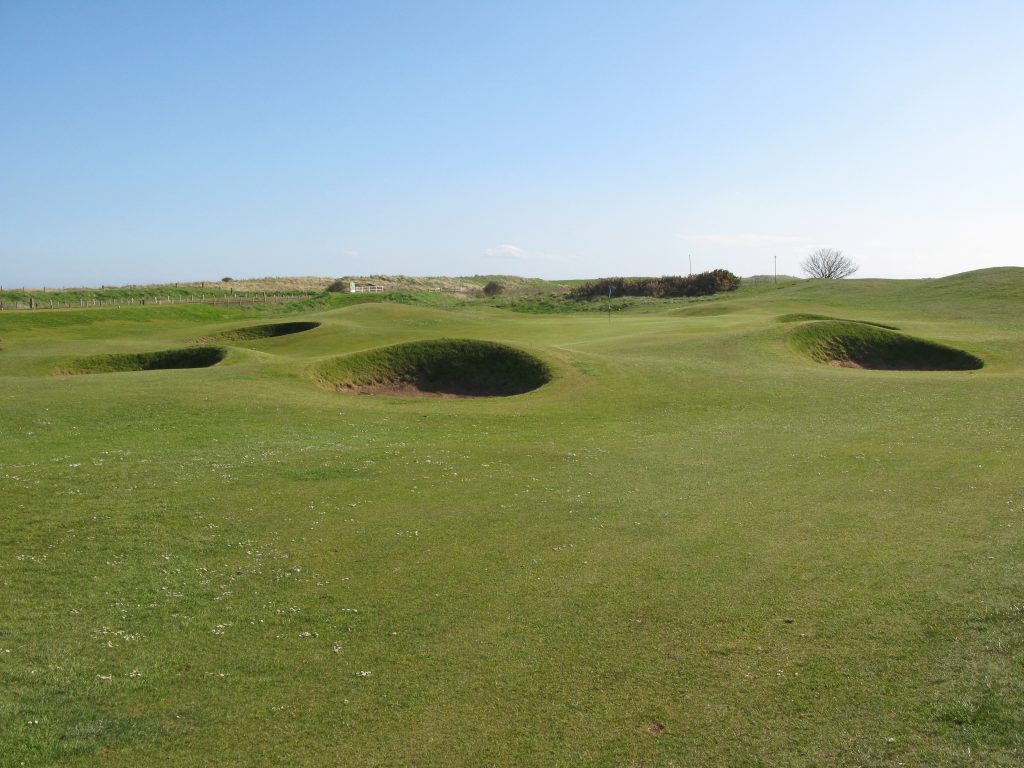
Mission Impossible – the long par 4 4th hole at Fortrose and Rosemarkie, with Lighthouse and Fort George in view.

The 13th is also a great example of visible links architecture and Braid’s bunkers.  A hole with many options from the tee box.
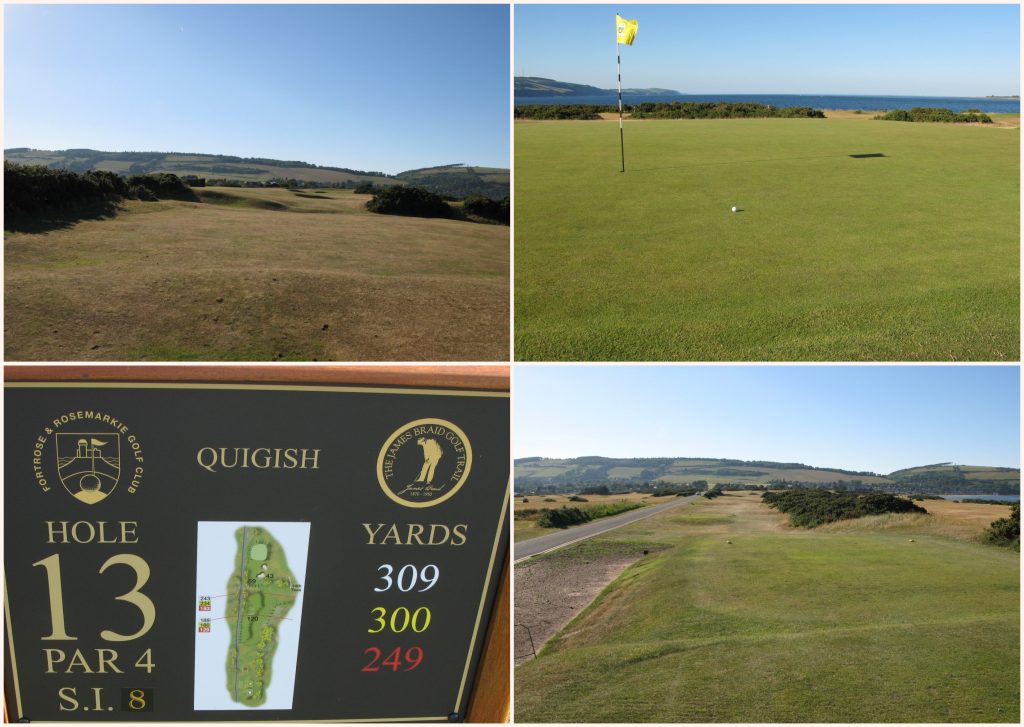
The 13th – a magnificent short par 4.

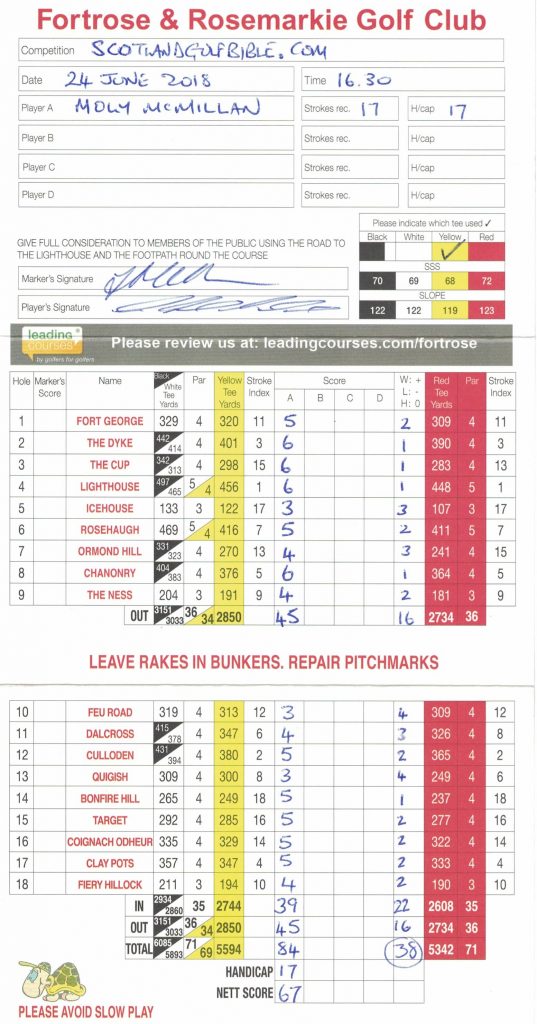
The course was in all round excellent condition when I played and the club are happy for visitors to use any of the tee boxes.    In the benign conditions I shot gross 84 (net 2 under), including 4 double bogies – inevitably one of these was at the 4th!.

This is a must play course, with a twilight fee at only £30 being especially great value.

Facts:

Course Type: Links

Par 69 (yellow; 15 par 4s,  3 par 3s)

Distance: 5594 yards

Moly’s Gross score84

Moly’s scorecard – 84 with only 39 on the back 9.
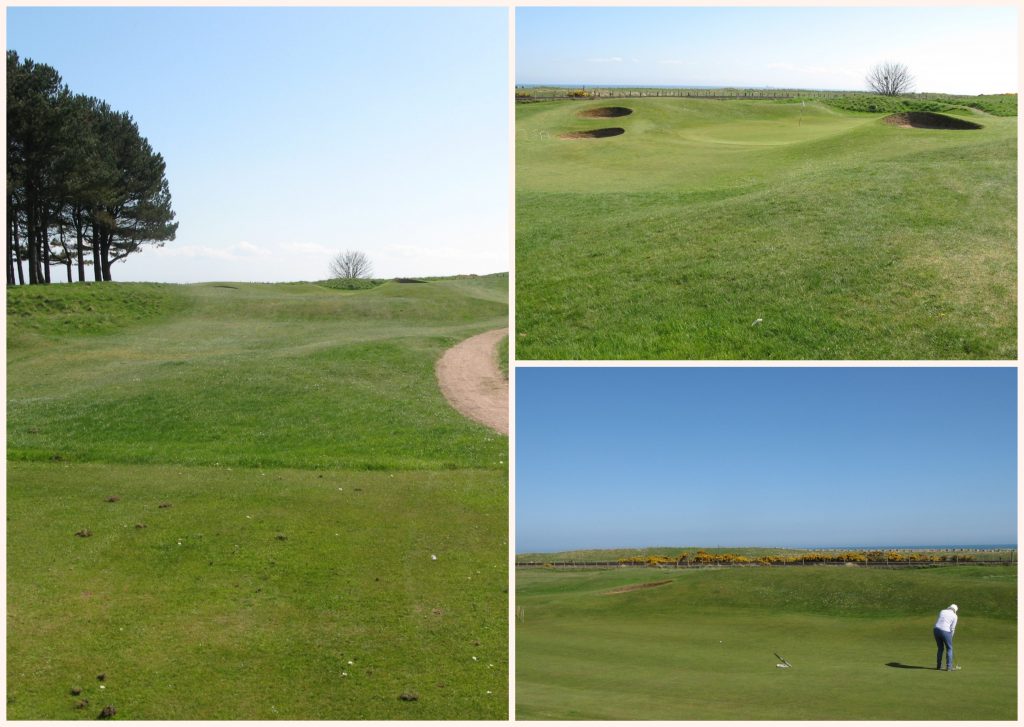
75. Arbroath. 6 May 2018.

A must visit course for US Historians, fish lovers and record book chasers!       

Round £40.   Par 70.  Value (out of 5) – 4

Arbroath is the largest town in Angus and it’s golf course sits about 2 miles to the east of the town and only 6 miles from Carnoustie.  It probably gets bypassed by many visiting golfers moving north from Carnoustie towards the wonderful links courses in Aberdeenshire – this would be a wasted opportunity.

Arbroath has a remarkable claim for it’s influence on the modern world.  The “Declaration of Arbroath”, a Scottish declaration of independence of 1320, is regarded by several historians as the model for the American Declaration of Independence.

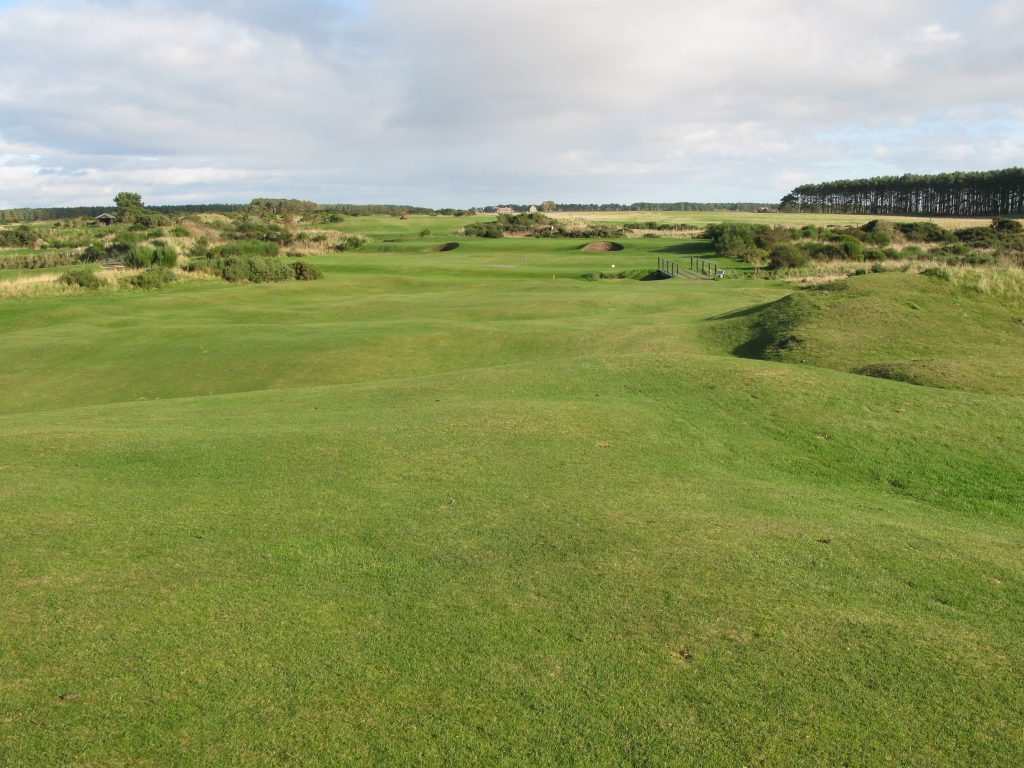
The delightful par 3 7th hole at Arbroath (159 yards)

The golf course can also argue a potentially unrivaled and rich architectural history.  Designed by Old Tom Morris, it opened in 1878,  was redesigned by the Troon professional Willie Fernie about 30 years later, then James Braid remodeled the tees, to add length, and bunkers in 1931.  That’s a strong golfing pedigree.

The course is predominantly an out and back layout.  The first 7 holes are played westward into the, normally very strong and cold, prevailing wind, before turning back for the 8th to 10th;  westward again for the 11th and 12th, then with 5 of the last 6 holes played eastward downwind back to the clubhouse.  Strategically, 11 of the holes have reachable out of bounds to the right, so right handed slicers may wish to consider their options off the tee.

The Stroke Index 7, 375 yard 6th hole at Arbroath, a typically difficult par 4 on the opening stretch of holes.

Viewed from the tees, Arbroath seems at times flat and innocuous, but it has been very cleverly bunkered by Braid, and I’m sure the locals will have many advisory comments on where to miss the greens.  The greens were also very hard when I played and difficult to hold (for all I guess other than very good golfers).  Playing off the yellow tees didn’t give  much respite either, as the 2nd and 17th both played as long par 4s, rather than par 5s from the white tees.  There are also 3 ditches that cross the course, and these need to be carefully considered, especially as the flat terrain makes them invisible to the eye.

I rather suspect first time visitors rarely score much above 30 stableford points.

The very difficult green to find in 2 at the 13th at Arbroath, with the railway OOB on the right

The highlights for me were the par 3s, all of which had good surrounds, with the two on the back 9, the 14th at 200 yards (white at 232) and the 16th, being especially difficult.

It’s a well kept course, with good tees, greens, fairways and bunkers.  The clubhouse has a friendly staff and good food, where you can try the Arbroath Smokie, the local smoked haddock delicacy protected by EU Trade regulations.

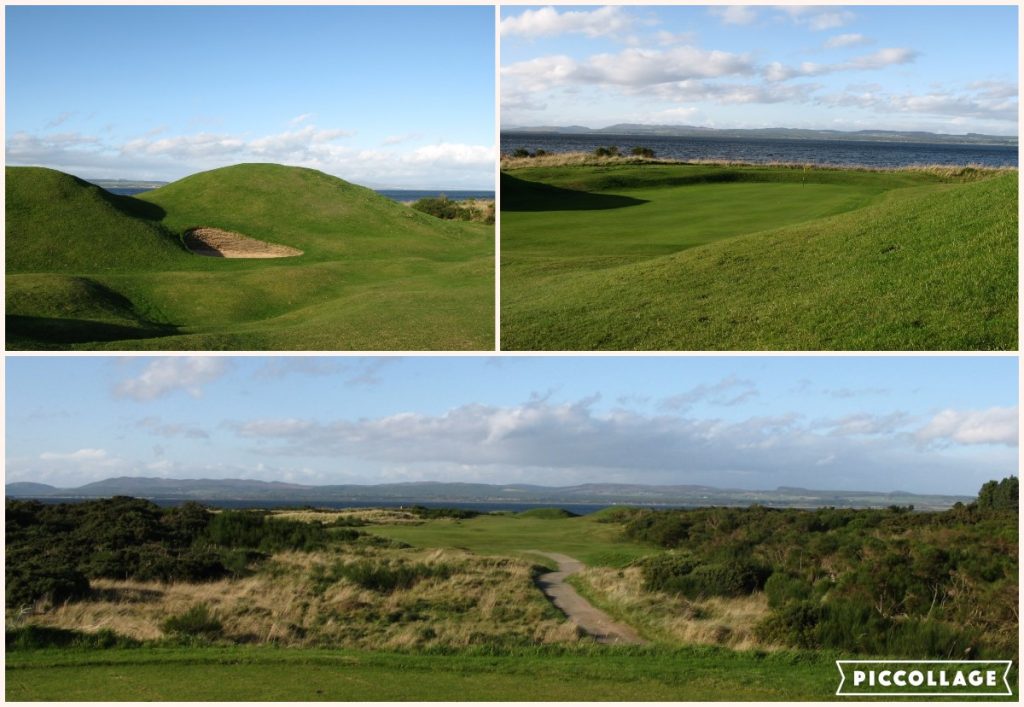
The wonderfully bunkered par 3 16th green at Arbroath

The other Arbroath claim to fame is the local Football Club, which holds 2 world records – the highest professional scoring record (winning 36-0), and their ground, Gayfield Park, being the closest to the sea in the world – only 5 and 1/2 yards away!  Apparently, one famous game was abandoned after all balls were “lost at sea!”.

Not a great day for me, I lost 3 balls (6 shots) and 3 putted 7 times!  I suppose that explains completely my 13 over par net!  Oh, and yes, the greens are rather large and difficult!

Well worth a visit.

Facts:

Course Type: Links

Par 68 (14 par 4s, 4 par 3s)

Distance (yellow): 5826

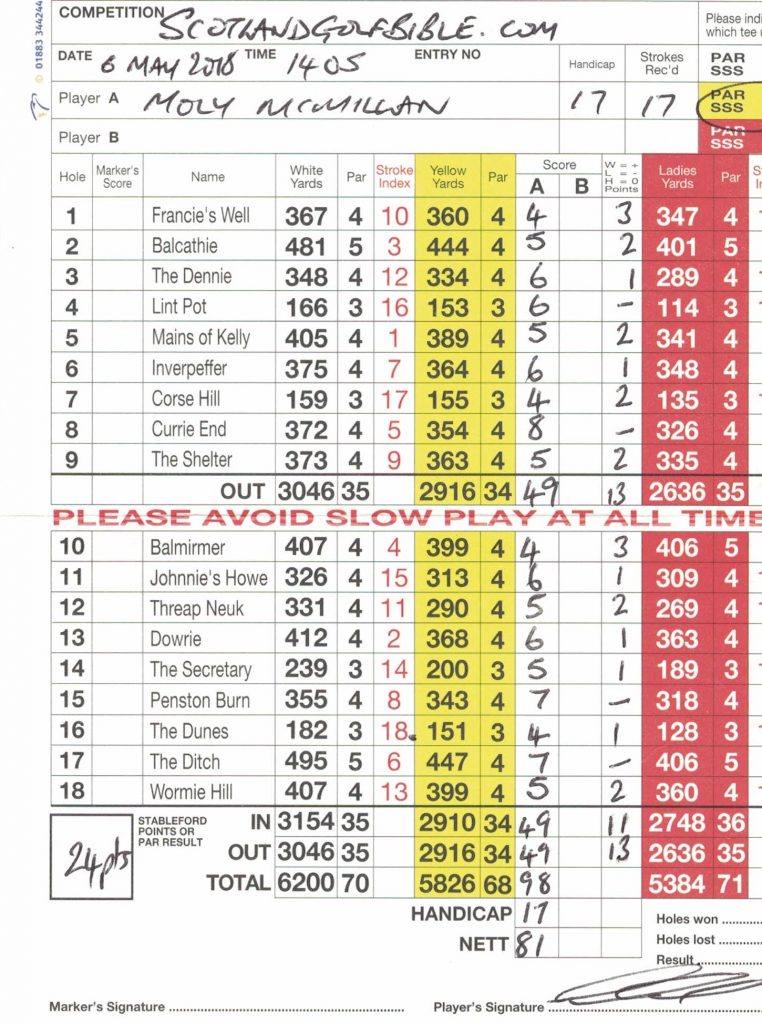
Moly’s Gross score98

Moly’s Arbroath scorecard – 98

70. Tain. 25th Oct 2017.

Old Tom Morris’ creation is a “must play” if you head North.    

Summary:  Round up to £60.   Par 70.  Value (out of 5) –4.5

Standing on the innocuous looking first tee at Tain, visitors will most likely think “is this it?”;  fast forward 3 holes they may well be thinking “I can’t cope with this!”  The second shot into the 1st is blind over a fenced road with a well placed green side bunker; the approach at the 2nd (SI 4) is also blind with a ditch and engulfing bunker awaiting; and the long par 4 3rd (SI 2) requires a drawing approach shot to have any chance of being close to a left sided or even centre pin – thankfully these holes are assisted by the prevailing wind!  Given the old hickories and gutty balls used in 1890 when the course was opened, Old Tom must have been an incredible golfer.  Welcome to Old Tom’s “Northern Jewel”.

The signature 11th “Alps” – for obvious reasons!

Tain is situated on the Dornoch Firth, 34 miles north of Inverness and 9 miles south of Dornoch.  There is record of 6 holes existing from around 1870, prior to Old Tom Morris designing a 15 hole course which finally extended to 18 in 1894.  Initially called St. Duthus Golf Club, after the patron saint of the town, the name evolved to “Tain” during the 1900s.

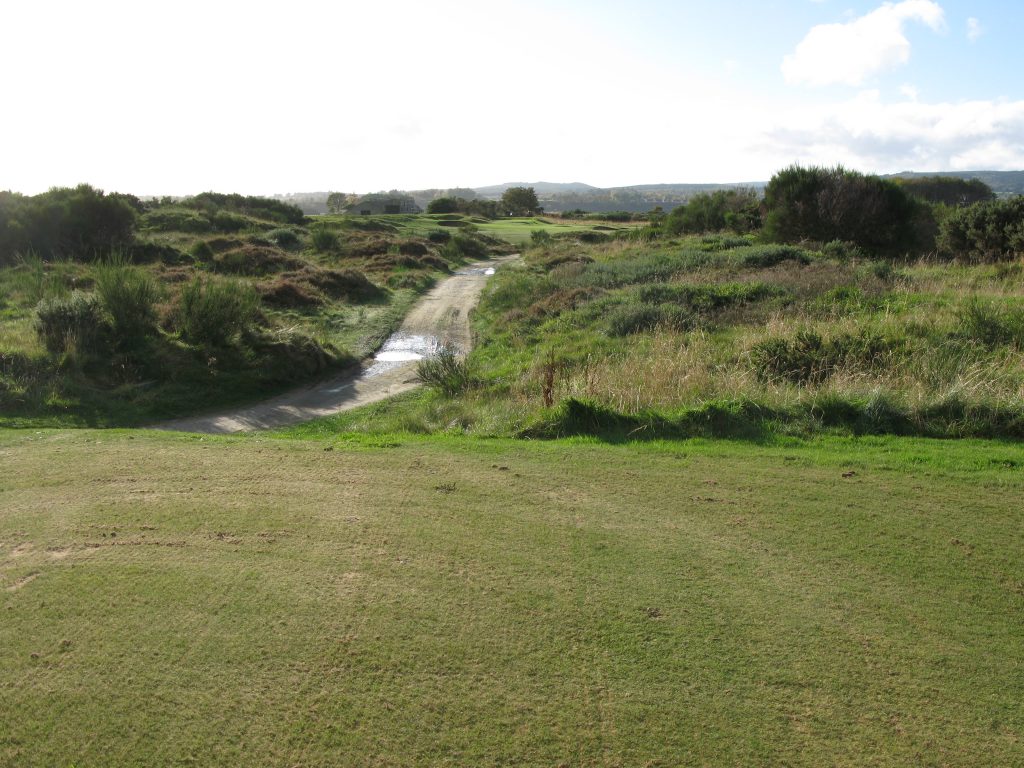
The difficult par 4 2nd hole, with this approach being blind for most average golfers – the ditch is deep!

In assessing Tain’s layout, it’s interesting to consider the originality of the course design and what remains today.   There are several detailed maps on the club’s excellent website – in truth, although the general layout remains similar, due to many adjustments and lengthening over the years, only a few holes, the present 9th (still playing to the original green), 10th, 14th and 15th, remain as Old Tom Morris designed them.   In contrast, Bridge of Allen ,is almost untouched from Old Tom’s original design.

After the opening 3 holes, you are then faced with the long par 5 4th, actually a respite, then a mid iron par 3 5th, with deep pot bunkers, then turning partly back into the prevailing wind to play the par 4 6th hole, which worryingly has the name “Bunker”.   By which time on the day I was 13 over par!

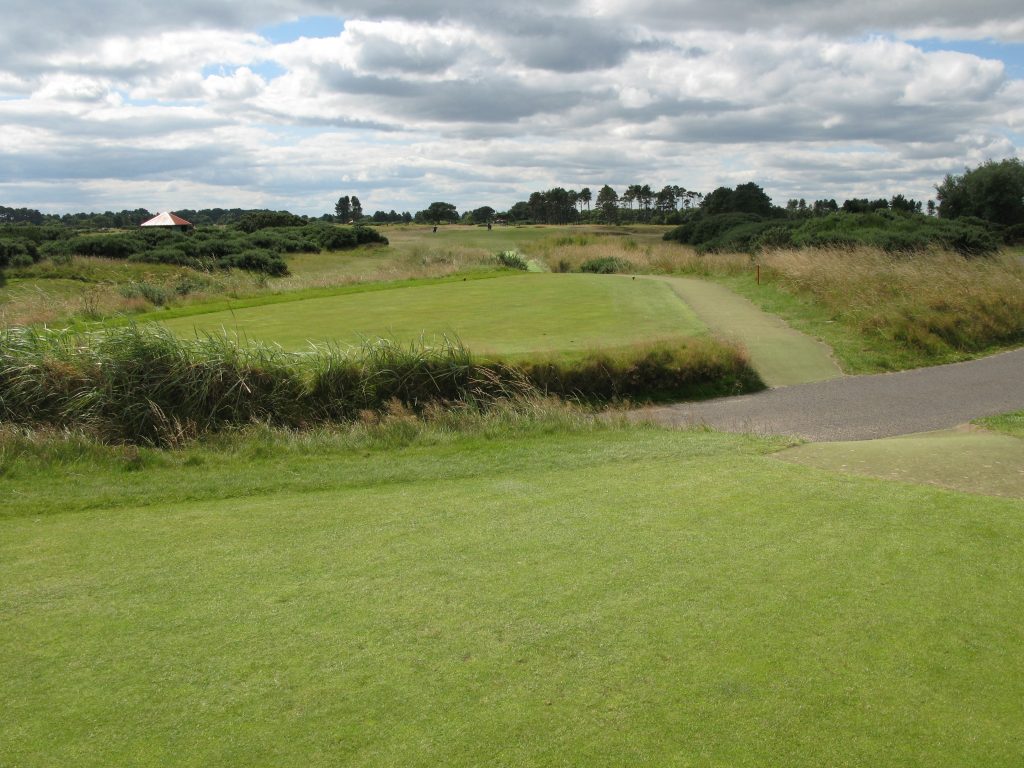
The mid iron par 3 8th hole at Tain

After some holes that then feel more like highland golf (trees, turf, ‘feel’), the signature 11th hole, “Alps”, takes you closest to the shore, followed immediately by the aptly named “Glenmorangie”, 12th, with views to the distillery.

By which time, if you’ve still got a card going, beware the SI 1 14th, played into the prevailing wind, then an interesting pair of back to back par 3s, at 16 and 17, both with water in play.

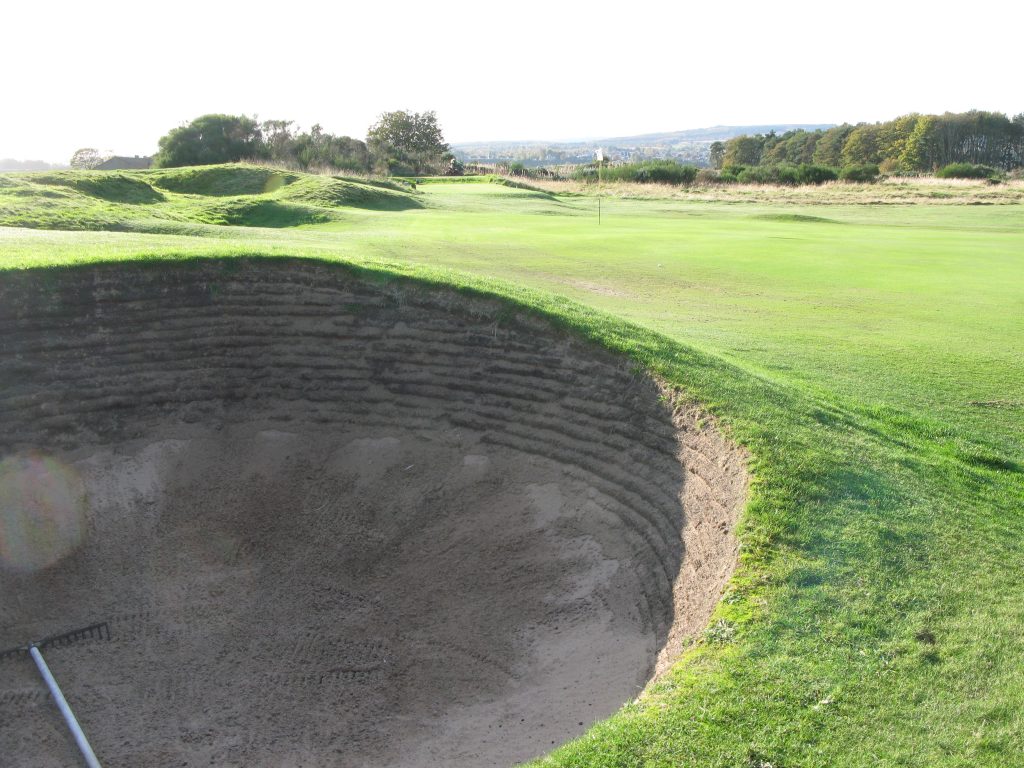
A typical well placed Tain bunker at the 8th.

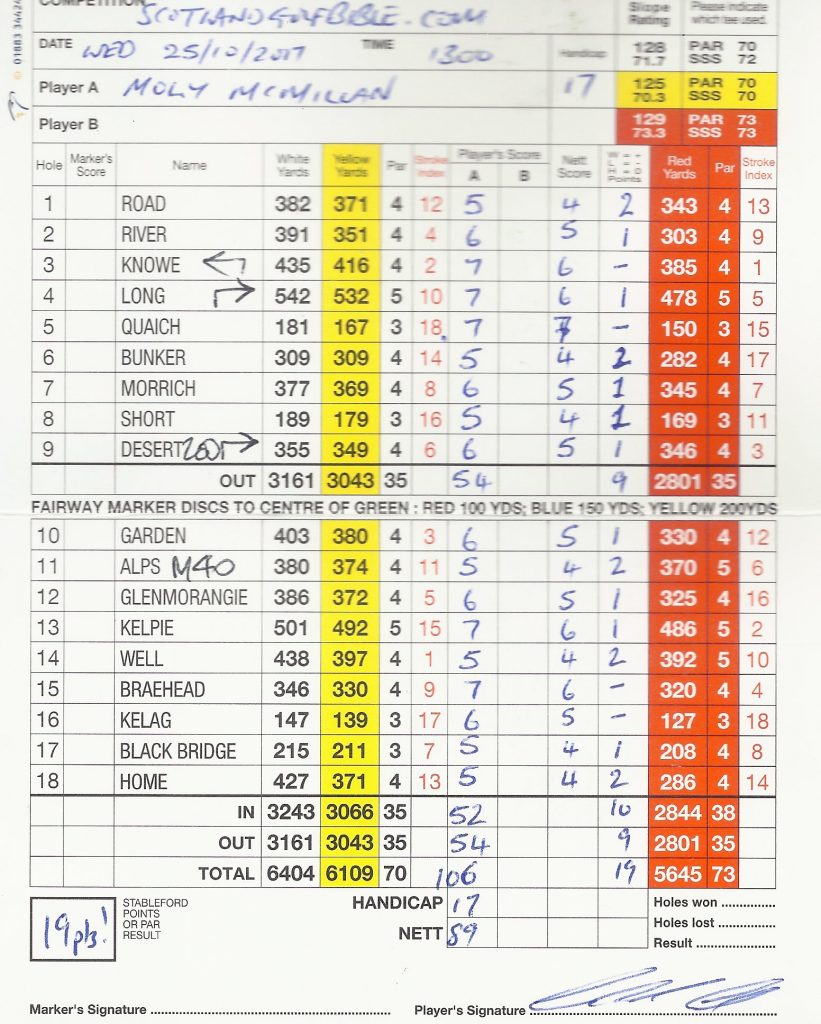
After a very friendly and helpful discussion before my game with the pro, Stuart Morrison,  in the end I shot 106 (Aaagh), completely down to my very poor play, albeit the wind blew up to 30 mph.  The course was in very good condition with play still on full tees and greens.

It must be said that Tain has very many characteristics of a links course (layout, location, pot bunkers, hillocks) but the turf in many places is distinctly more arable and I suspect Tain will play longer in the summer months than the more harder fairwayed links courses.

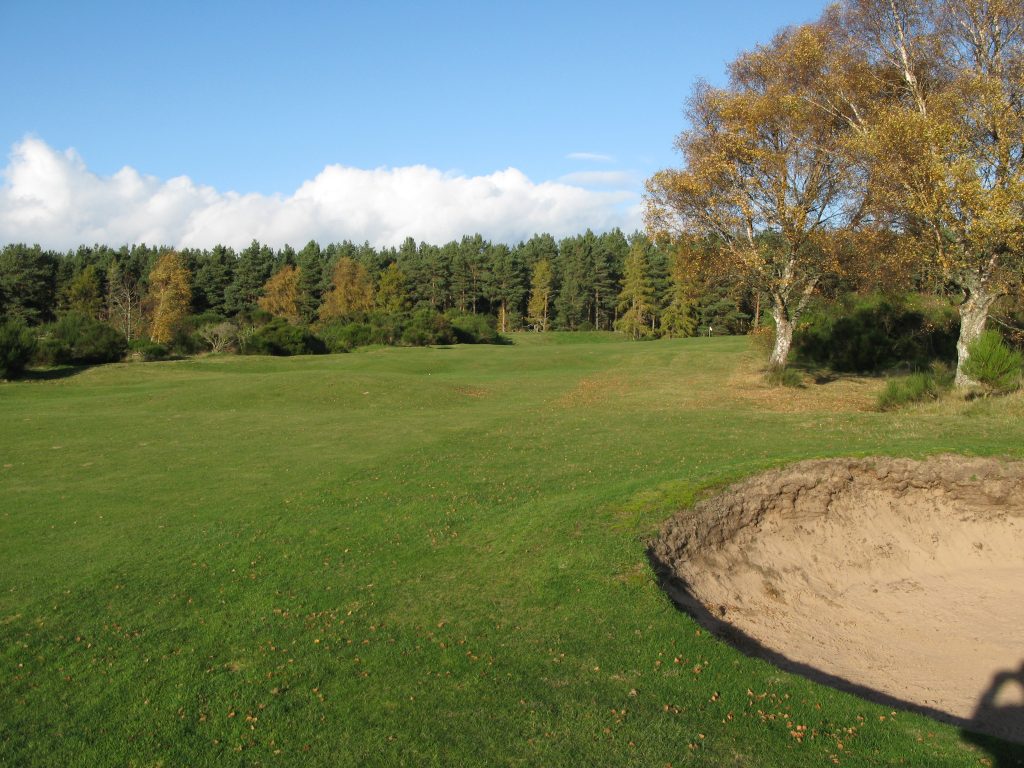
A more highland feel at the dog leg par 4 9th at Tain.

This is rightly regarded as a “must play” links course, and I would urge anyone venturing north to play Royal Dornoch, its more prestigious neighbour, to play Tain, which could be argued is better value.

Facts:

Course Type: Links

Par 70 (2 par 5s, 12 par 4s, 4 par 3s)

Distance (yellow): 6109

Moly’s Gross score: 106

Moly’s 106 card at Tain!

62. Carnoustie Burnside. 9th Aug 2017.

Treading on possibly the very origins of links golf

Summary: Cost £46. Par 68.  Score 85. Value (out of 5) – 4.5.

The Burnside course, or more correctly the Carnoustie Burnside course, is eclipsed by its magnificent Championship course neighbour, but that’s only because the Championship course is one of the greatest courses in the world!  Do not play the Championship course without also trying The Burnside, which is a great naturally laid out links course.

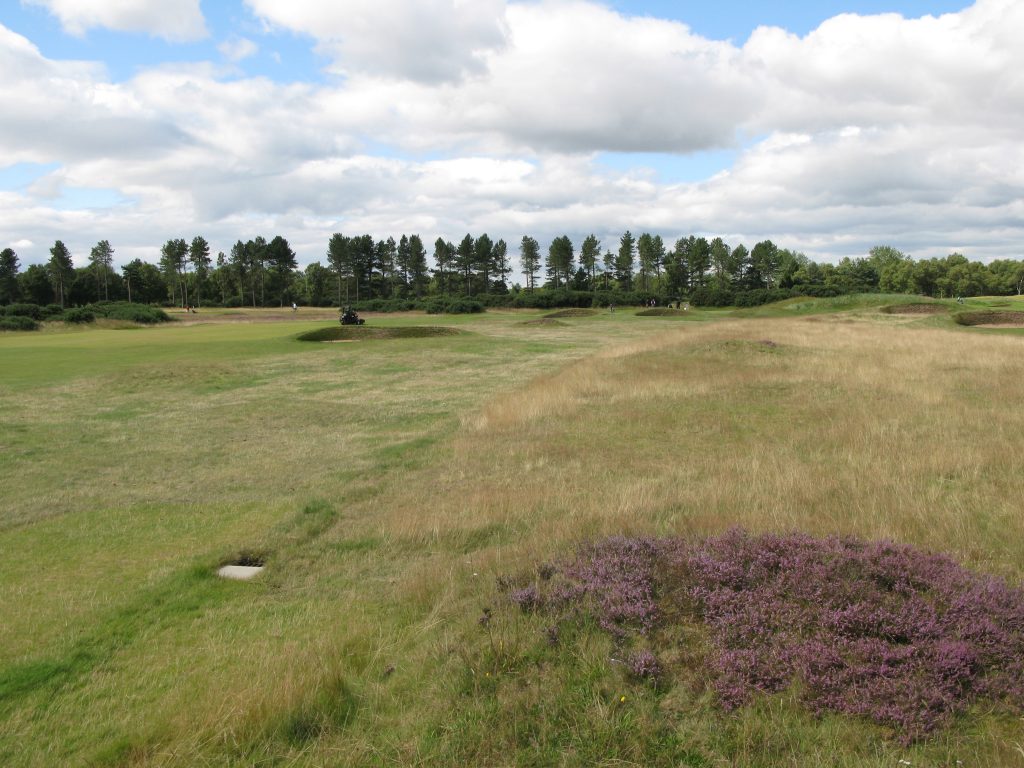
The wonderful links land view from the 15th tee of The Burnside

Golf on the “Barry Links” was recorded as early as 1527, nearly 50 years earlier than St Andrews, making this the area that “Links” golf was first played.  The Scottish Golf History web site lays out a strong case that these first games of links golf were most likely played on the land between the Barry Burn (more of that later) and the railway line currently where holes 1 to 5 of the Burnside course are.

Therefore, arguably, “The Burner” is the most historical of all links golf courses!  You are truly walking among the ghosts of golf’s distant past playing here.

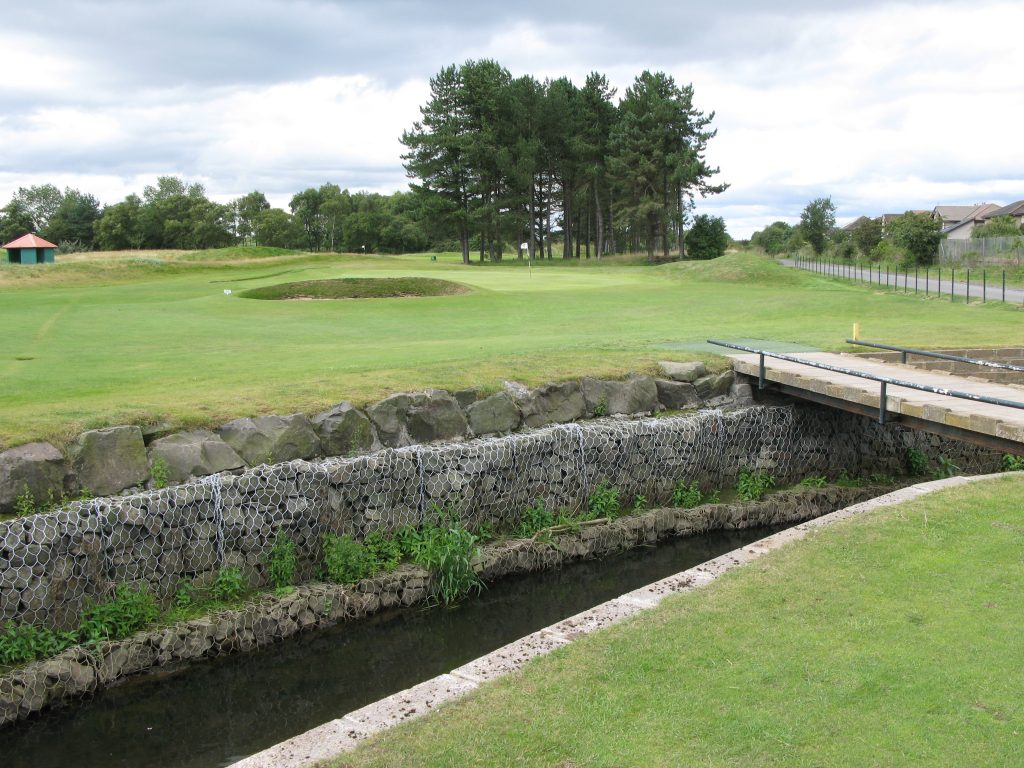
The 3rd hole, the first of 5 wonderful par 3s, the highlight of Burnside – the Barry Burn awaits!

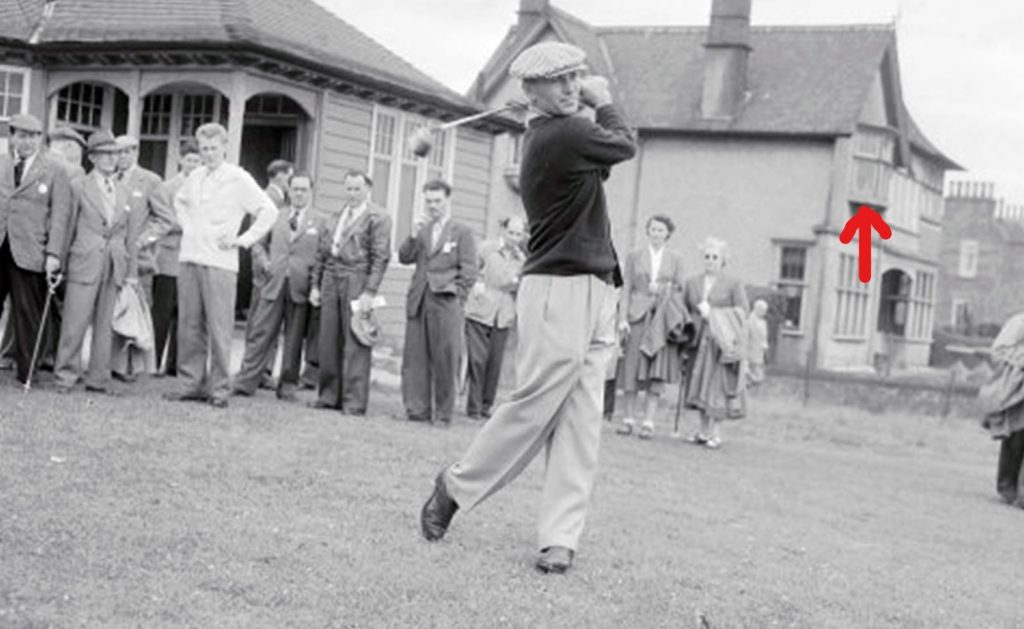
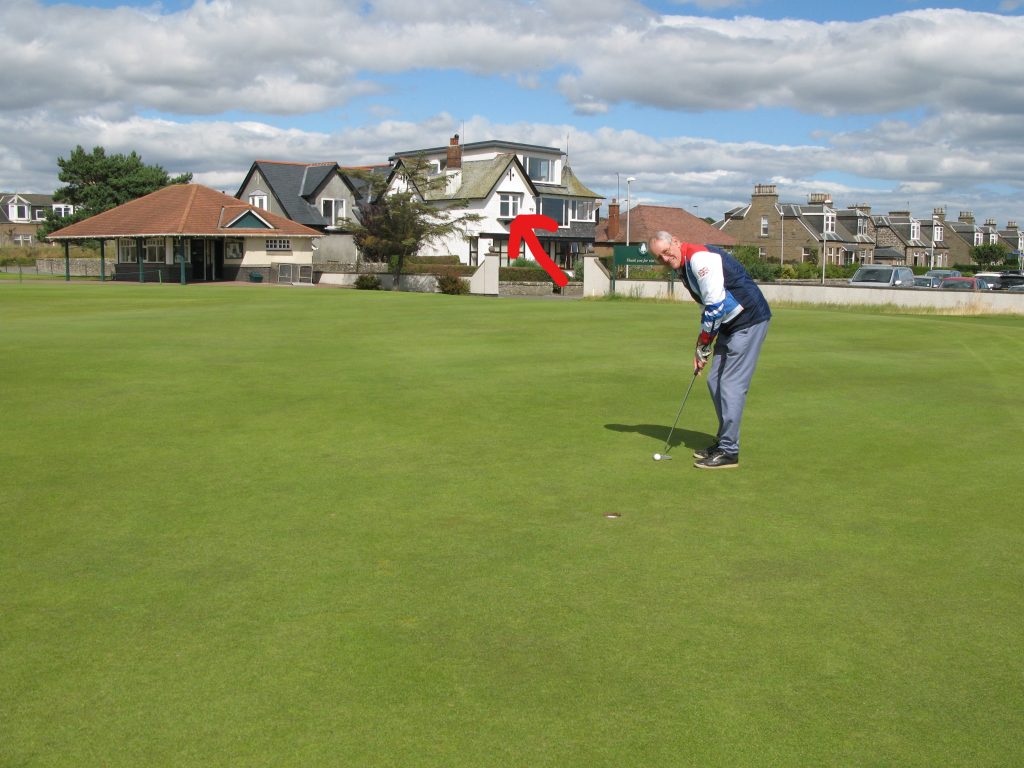
Of course, there are more recent historical stories worth telling.  It’s largely forgotten that when Ben Hogan famously won his 1953 Open at Carnoustie he qualified on The Burnside course.  It was therefore very apt that I played The Burnside with my brother-in-law, Colin Macqueen, since his fascination with golf started during the same summer of 1953 when he and his elder brothers were mesmerised by the large crowds watching Ben Hogan outside the window of their home, “Lismore House”, which overlooks the Burnside’s 18th green.

Hogan playing the Burnside; Colin Macqueen’s “Lismore House” bedroom highlighted.

Colin has dined in Australia, his home of 50 years now, on the true story of him falling out of the upper floor bay window nearly causing Ben to miss a crucial putt!

The Burnside was designed by James Braid and opened in 1934, not long after Braid had redesigned the Championship course in 1926.  Although a relatively short golf course at just under 6000 yards, many of the holes would easily be at home on an Open venue.  The 5th, 9th and 14th are par 3s of the highest calibre, each with a very different challenge.

The beautifully difficult par 3 9th green.

The 5th is surrounded by the Barry Burn (that of Jean van de Velde fame) where it’s virtually impossible to get close to a right-hand pin. The large plateau green at the 9th makes it imperative to hit the green with the tee shot. The long 14th is stoke index 1 for a good reason, and is a magnificent test.

Bunkers sprinkle the 6th fairway at The Burnside

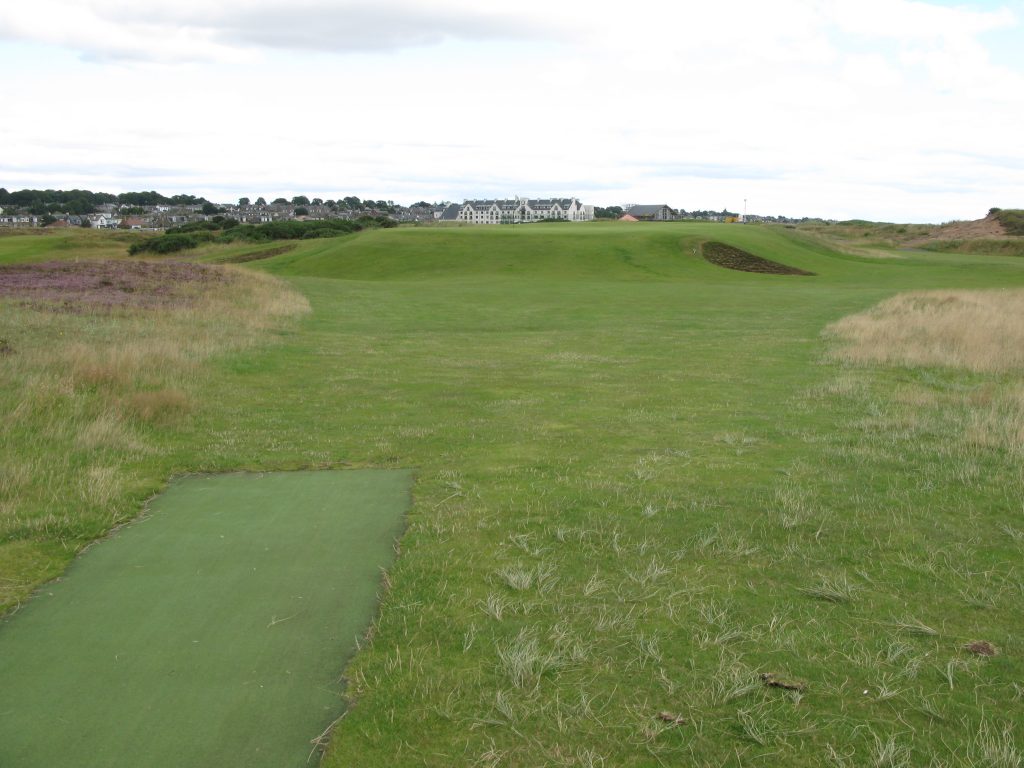
The 17th, a par 4 of about 450 yards, needs to be played with a 3-shot strategy for all bar the very long hitters.   I could also get into details on many other holes, the course is that good.  To cap it all, the greens have very subtle borrows, so putting needs extra concentration.  It is one of the great small James Braid courses.

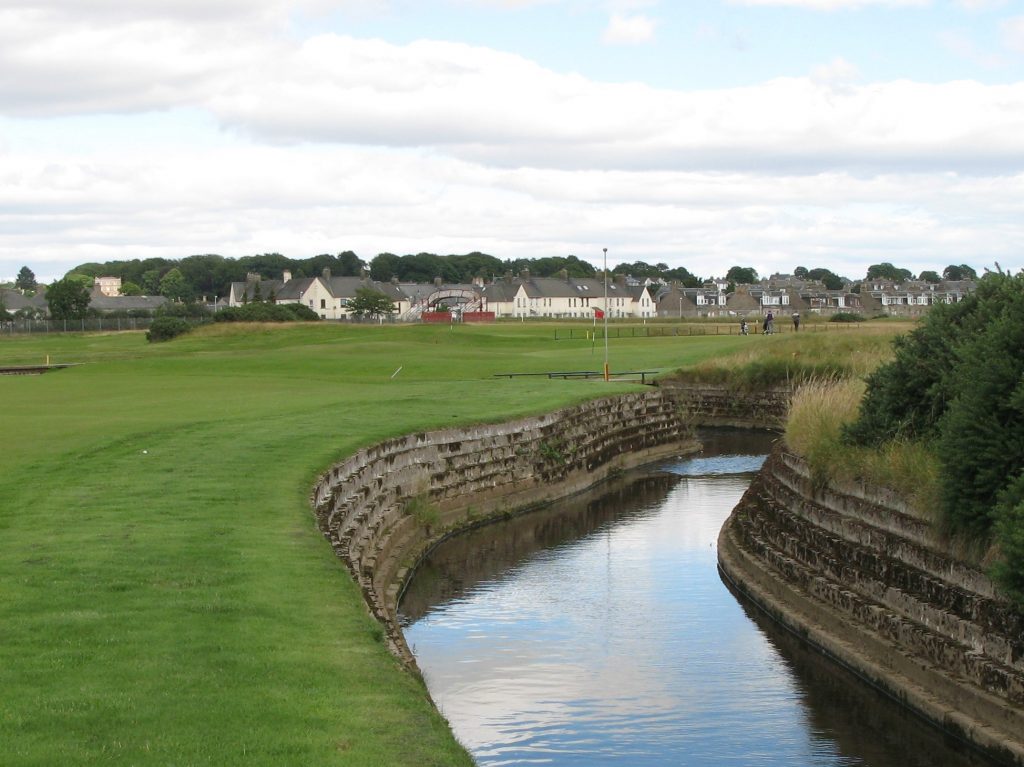
The Barry Burn (of Jean van de Velde fame) at the long par 4 17th – a card wrecker

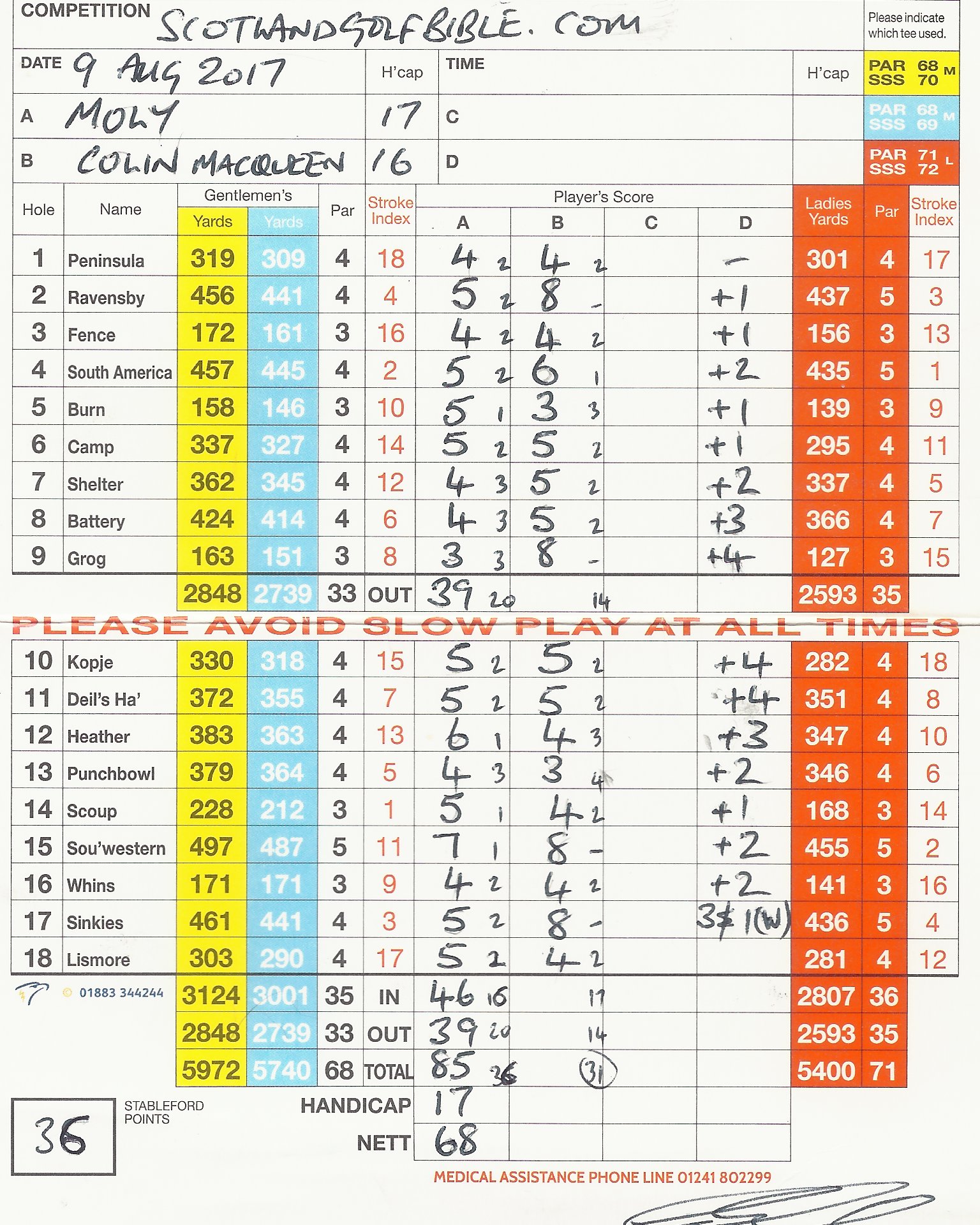
With the large green keeping staff at Carnoustie, it was no surprise that the course was in such fine condition.  The tees, fairways, bunkers, rough and greens were all superb, and to have the sun shine made for a quite memorable round.  I scored 85 for a net level par score off my new handicap of 17; this was enough to beat Colin 3 and 1, which at least meant he could focus on the 18th green photograph, close to the site of Hogan’s zenith and also Colin’s boyhood fall.

My playing partner, Colin Macqueen, on the 18th with his bedroom highlighted in the background, where he fell in 1953 during Hogan’s Open!

A quite magnificent days’ golf.

Key Facts

Course Type: Links

Par 68 (1 par 5, 12 par 4s, 5 par 3s)

Distance (blue): 5740

Moly’s Gross score: 85

Moly’s Burnside scorecard – 85 for 36 points (off 17)

« Older posts Newer posts »

© 2026 Scotland Golf Bible

Theme by Anders NorenUp ↑