A guide to green fee value for money

Category: 4.5 star (Page 3 of 5)

121. Newbattle. 22 June 2021.

This oasis might be the cheapest Harry Colt course in the world?

Round £40. Par 69. Course Rating / Slope Rating (yellow) 68.1/127. Value (out of 5) – 5

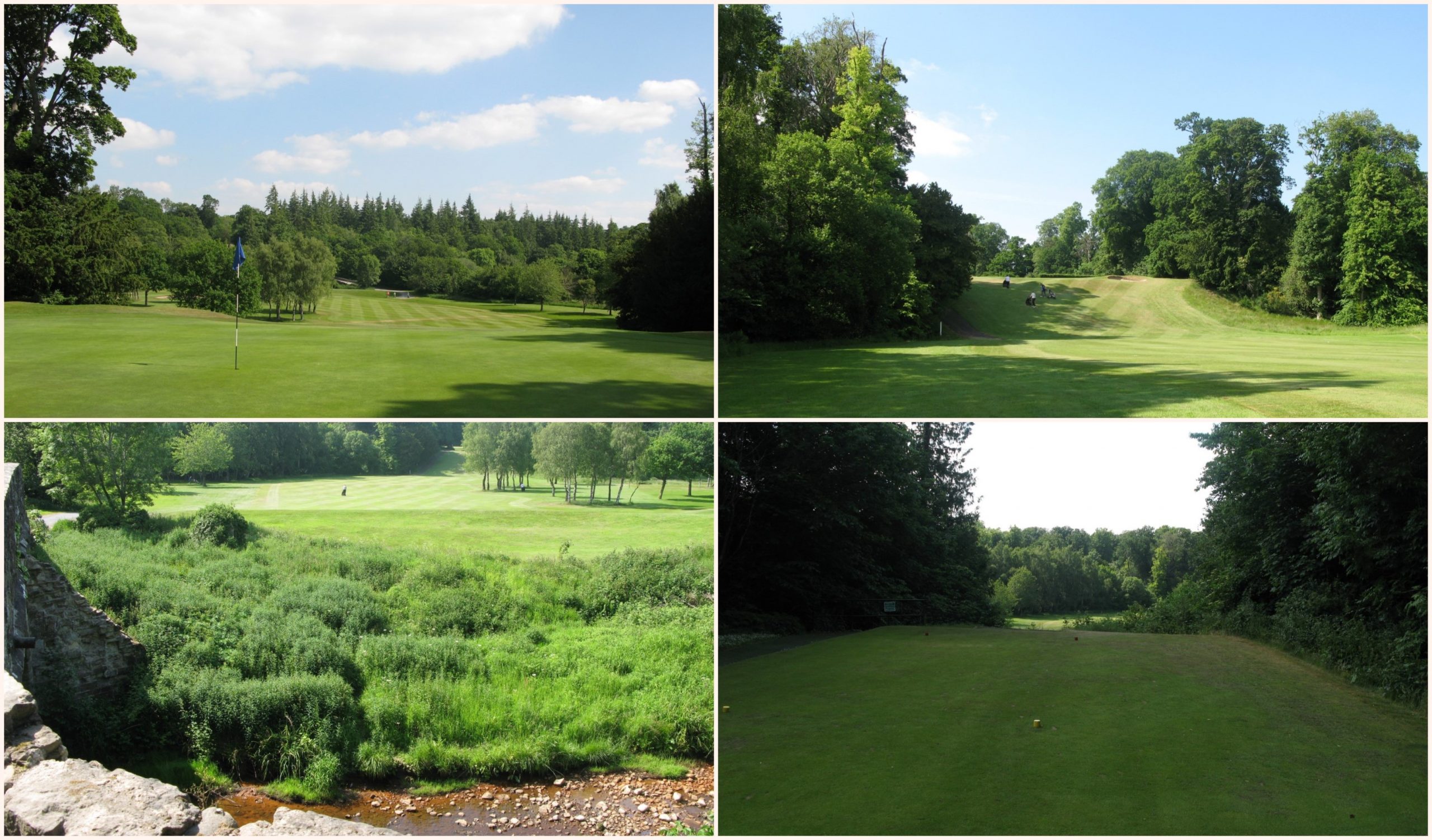
Drive through Dalkeith, which might appear a bit drab, and through the car park of Newbattle GC and you are met with a graceful parkland layout, with many magnificent trees, that just seems so unexpected. The course is an easy walking affair, other that the 2 holes (2nd and 17th) that play across the river esk valley that sits between the opening and closing holes and the rest of the course. With a substantial club house, this makes Newbattle a great venue for a group or society day out.

The delightful 17th at Newbattle, a par 4, stroke index 4, which must be a formidable match play hole. The River Esk is just visible, and never comes into play.

We know about the genius of some golf course design; the majestic Augusta of Alister McKenzie, the natural beauty and guile of The Old Course, the brutal nature of Pete Dye’s Ocean Course at Kiawah Island. Sometimes though, great golf course design is difficult to put your finger on.

When I played Newbattle, in Dalkeith near Edinburgh, it felt great, not because I played well, not because the weather was nice, but because ‘it just did’. It was almost indescribable why the course flowed so well and that I think is real genius. That was what Harry Colt design can be.

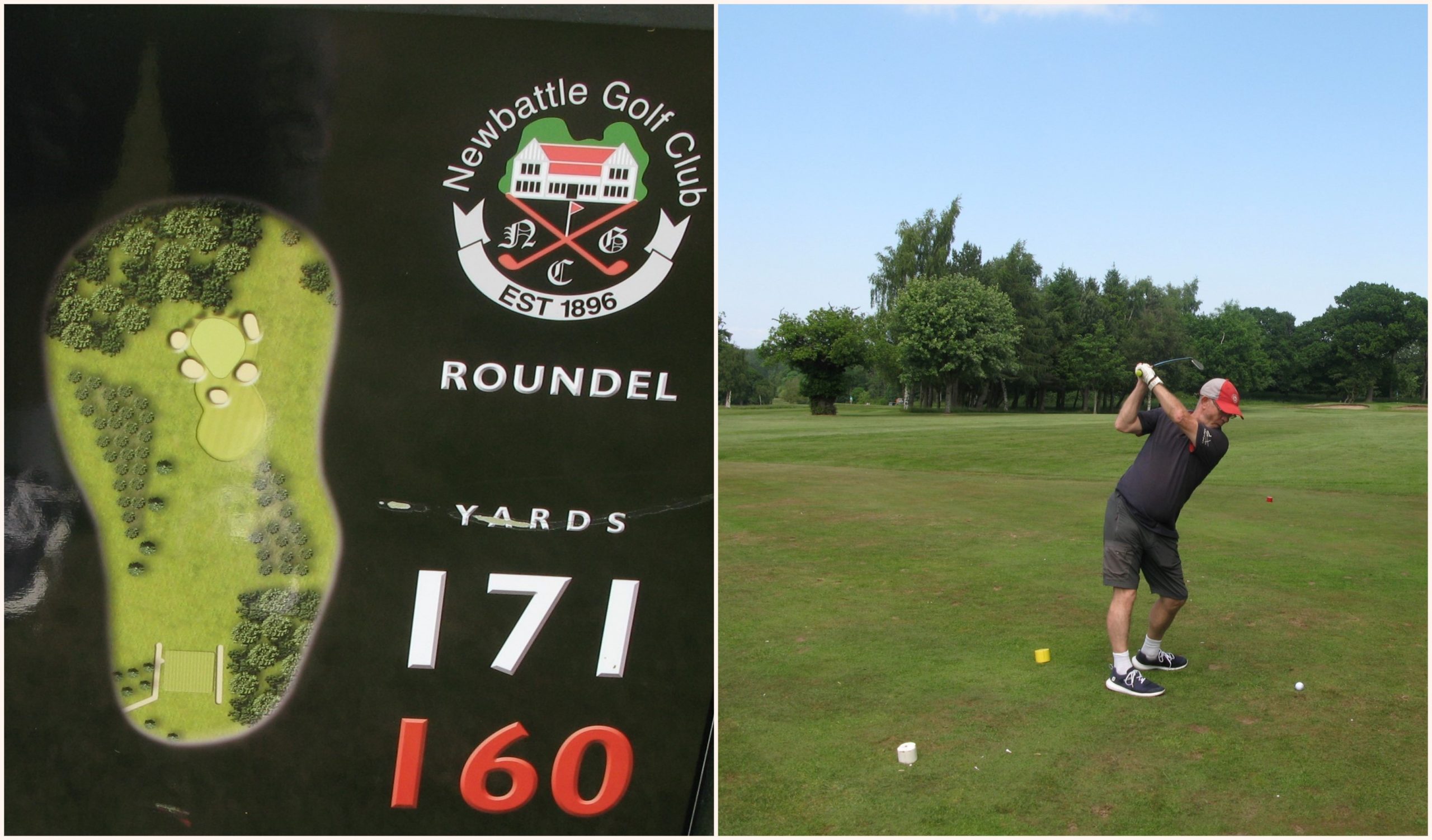
The very well bunkered par three 11th hole, ‘Roundel’, at Newbattle.

Although the Newbattle club was formed in 1896, the current full 18 hole course, the Colt legacy, was built in Dalkeith in 1934. Originally linked to Dalkeith Golf Club (1880), it’s called Newbattle as it’s within the historic boundary of Newbattle Abbey, a Roman Catholic monastery, and a key part of the Scottish religious story.

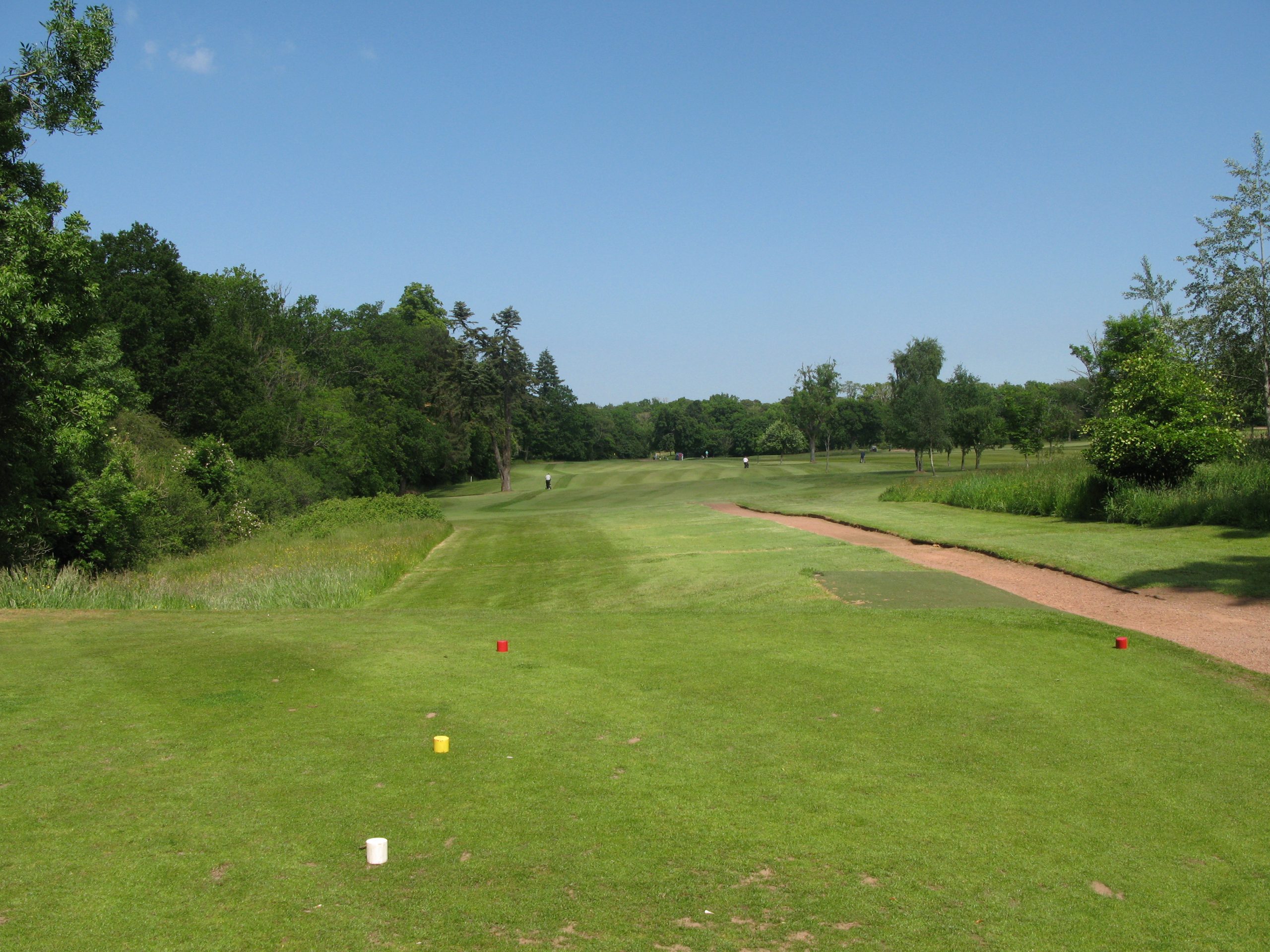
The tee markers, here at the 9th, are typical of the small yardage differences at Newbattle

When Fran and I played on a delightful mid summer day, the course was very busy, but never seemed to get back logged. The tees, fairways and greens were immaculate, with the bunkers still unraked due to the ongoing Covid Pandemic.

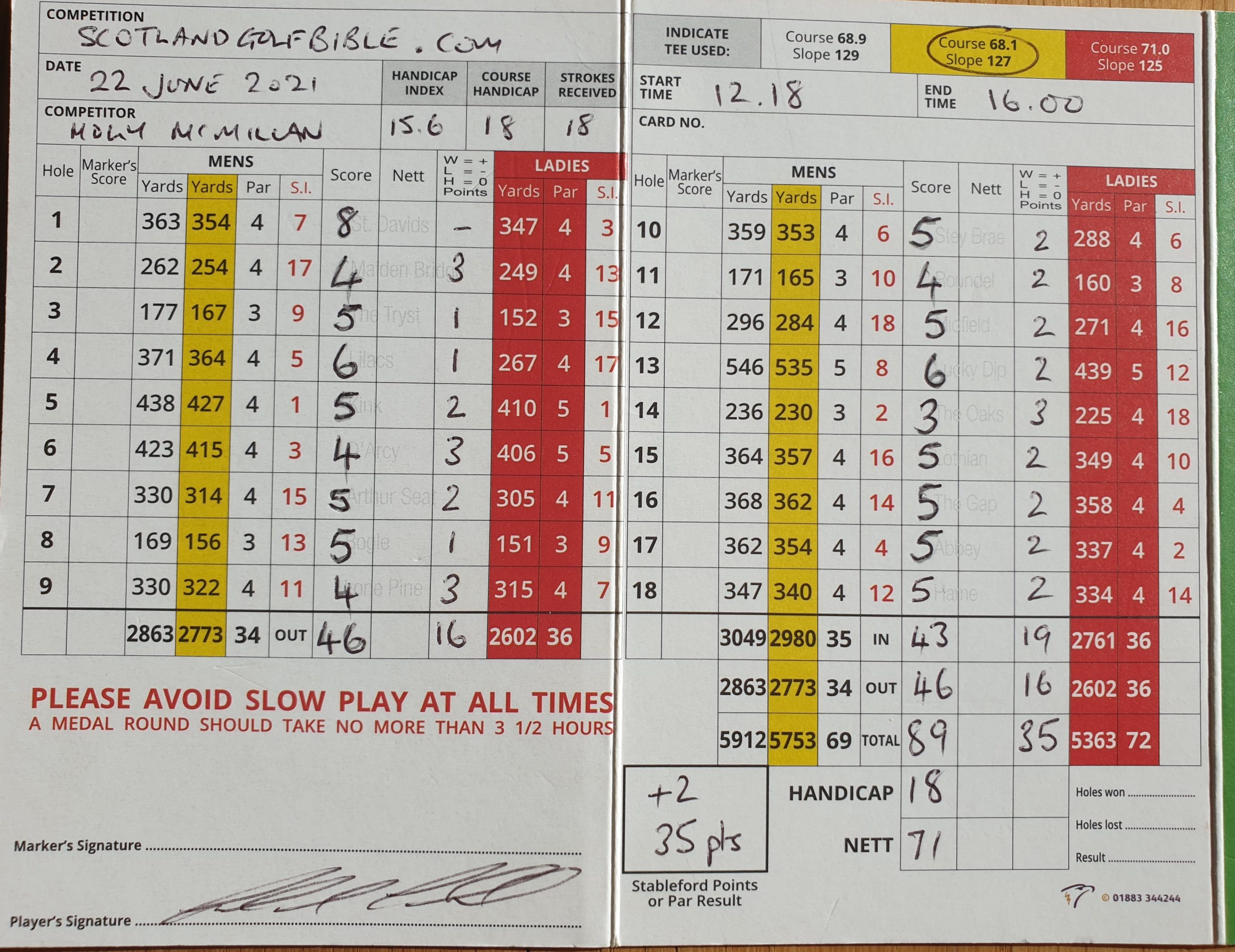
After pulling my opening drive about 2 yards out of bounds left, then hitting my second ball over the back of the first green, that turned out to be my only ‘blob’ in returning an 89, for 35 stableford points. If it were a competition though, it wouldn’t have troubled the scorers on this ideal day for golf.

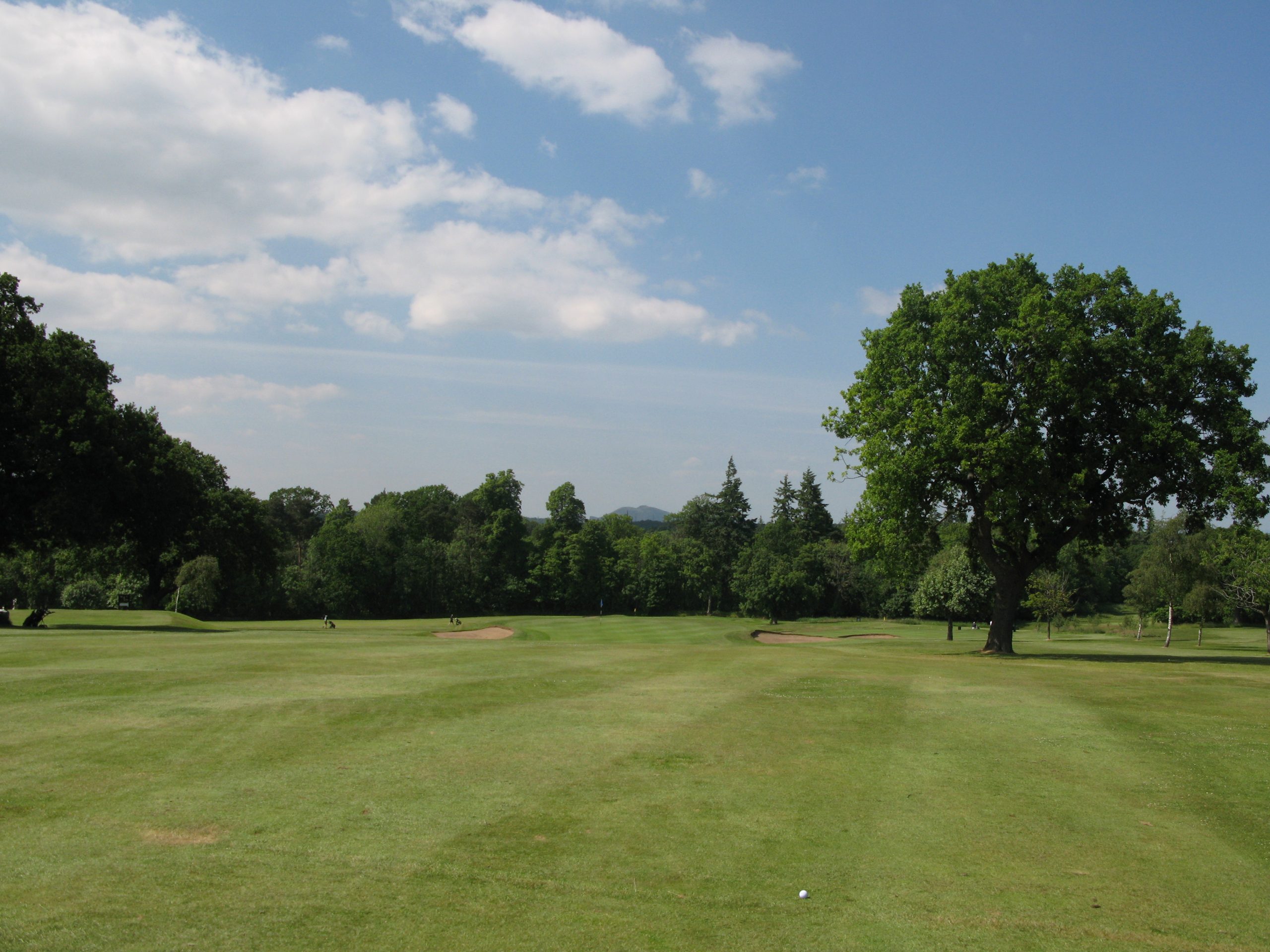
The approach to the 13th at Newbattle, with Arthur’s Seat in the background

Play aside, this is a great little course well worth playing as part of an East Lothian tour. In terms of East Lothian value for money, it must be near the top of the pile. It’s certainly underrated in my opinion. The stand out holes for me, were the 5th, a long par 4, and easily the Stroke Index 1 hole and the long par 3 14th hole. To score well though, you need to avoid the clever and penalising bunkers.

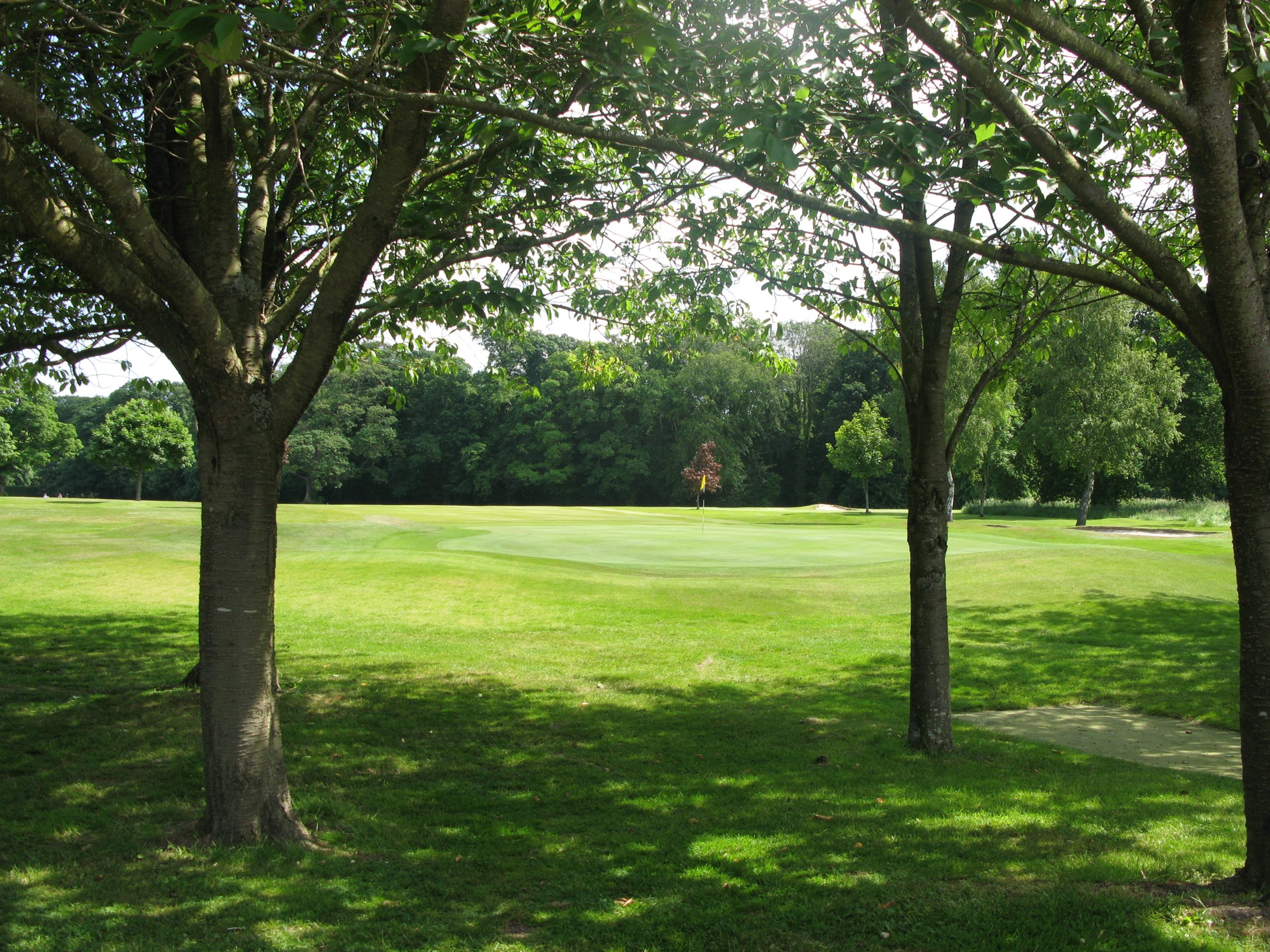
The relatively easy finish at Newbattle, except if you find the copse of trees beside the green

There is an argument to say Harry Colt, the main contributor to many of the world’s great courses, including 3 on the Open Championship rota (Muirfield, Royal Liverpool, Royal Portrush), is the foremost designer of his age. I think Newbattle might just be the cheapest green fee of the more than 100 courses designed in whole or part by Colt.

Course Type: Parkland

Par 69 (1 par 5s, 13 par 4s, 4 par 3s)

Distance: 5753

Moly’s Gross score89

Moly’s scorecard – a very decent 89

117. Earl of Mar. 30 Oct 2020.

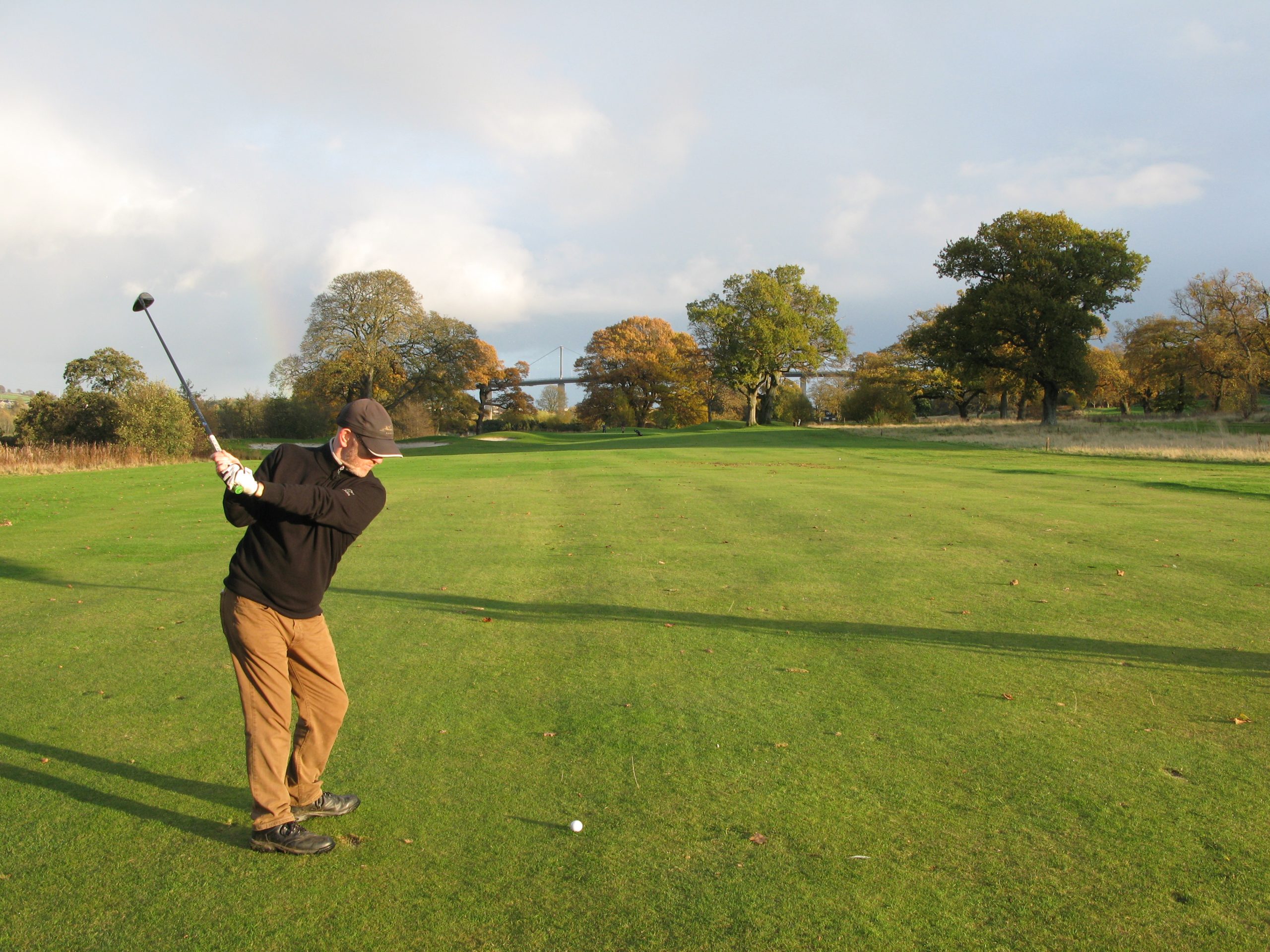
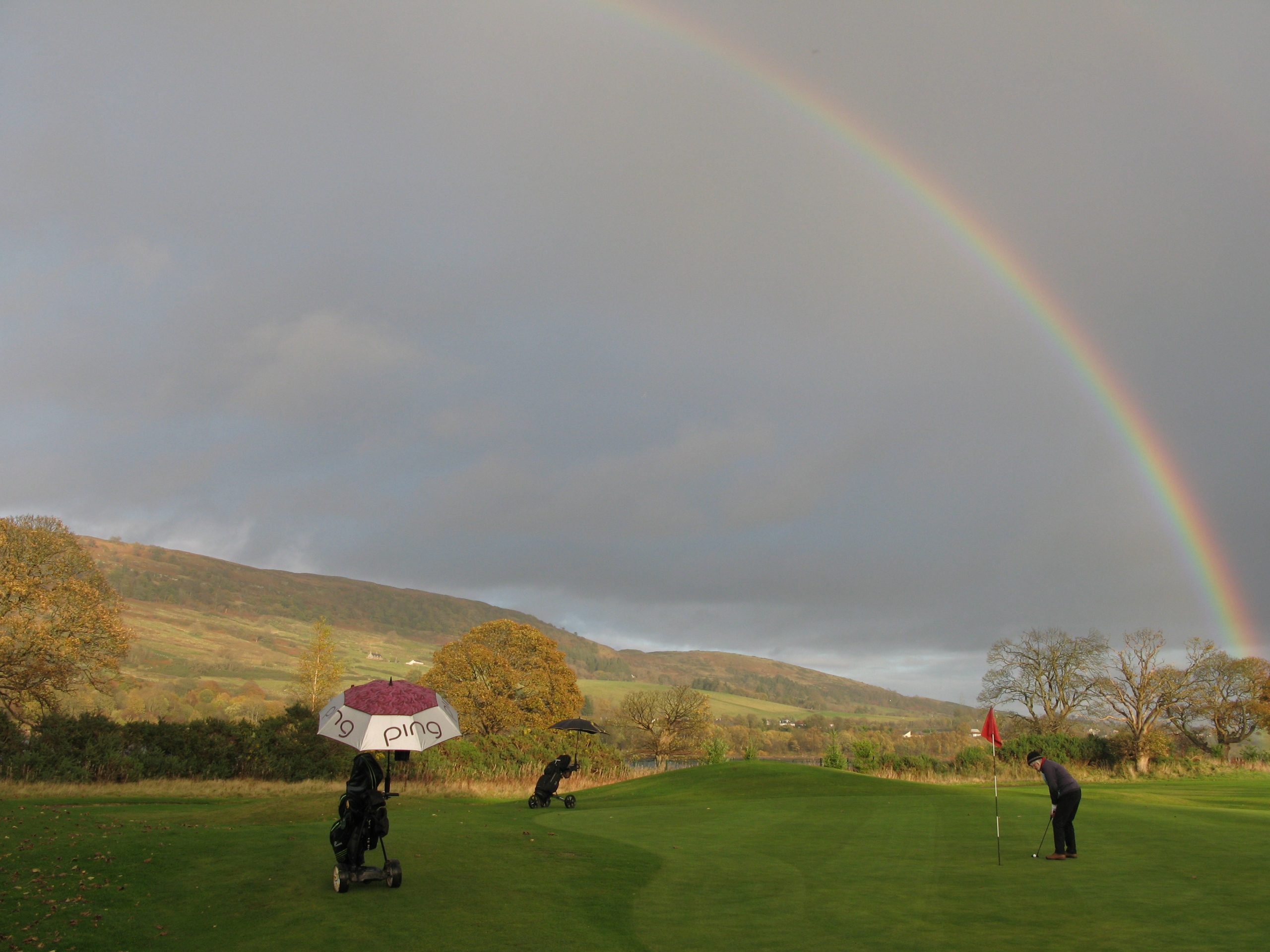
Rainbows and Celebs are potential hazards at this excellent new course

Round £60. Par 70. Course Rating / Slope Rating (yellow) 70.8/129. Value (out of 5) – 4.5

The official name of this golf course is the ‘Earl of Mar’, but I’ve entitled the blog ‘Mar Hall’ ,the name of the hotel, which opened 2004, as that is what the course is more commonly listed as.

Moly at the par five 15th hole, with the Erskine Bridge on the horizon. One of only two par 5s on the course.

The course itself was designed by the renowned Dave Thomas and founded in 2010 ; and what a great golf course he has created, making full use of the available land – albeit it does feel a little compact in places with several holes adjoining in an ‘up and down’ fashion, making it play wider than perhaps intended. However, with USGA style bunkers, in both fairway and greenside, this course requires accuracy off the tee and especially into the greens, where knowledge of your yardage will pay dividends.

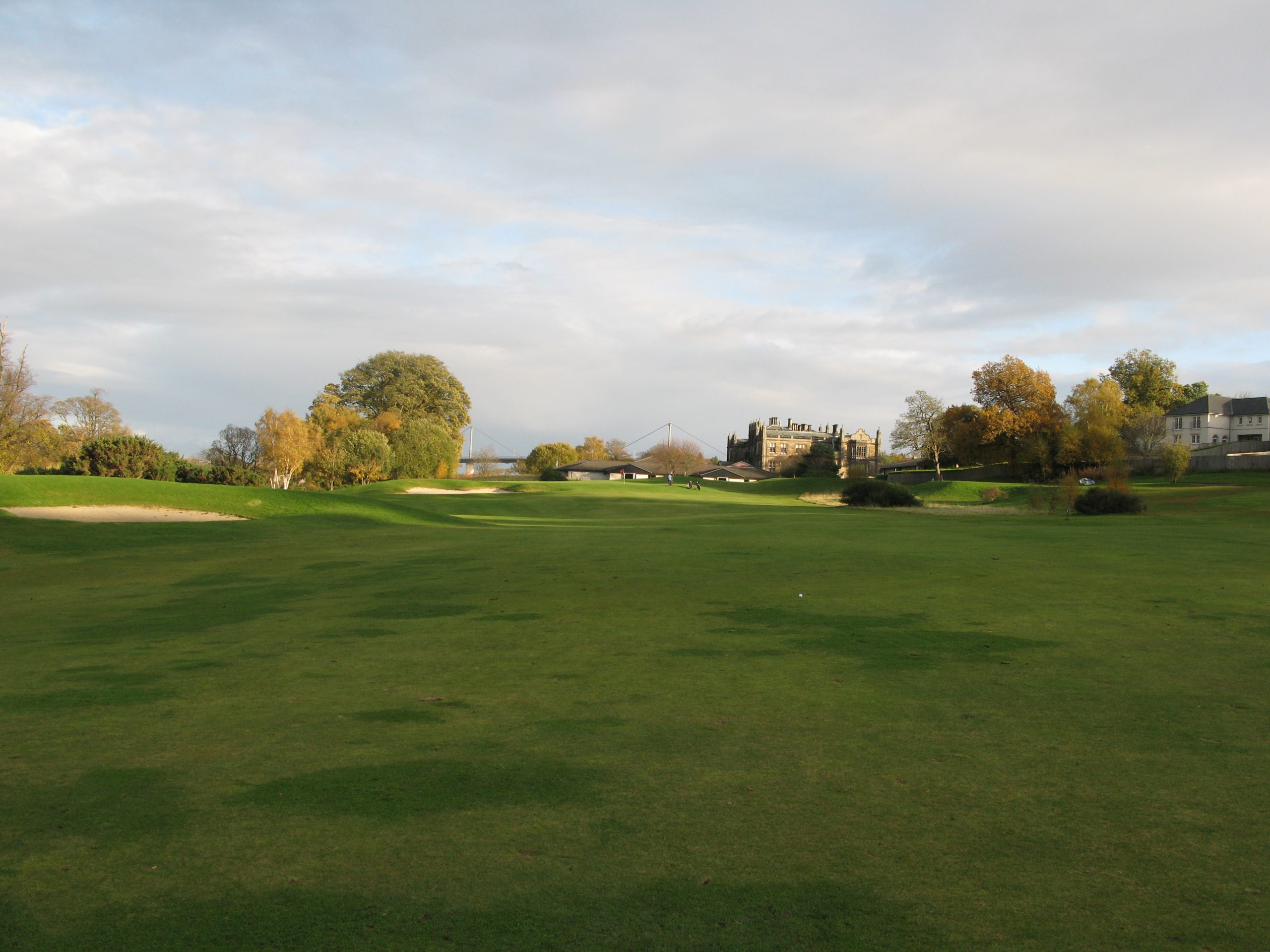
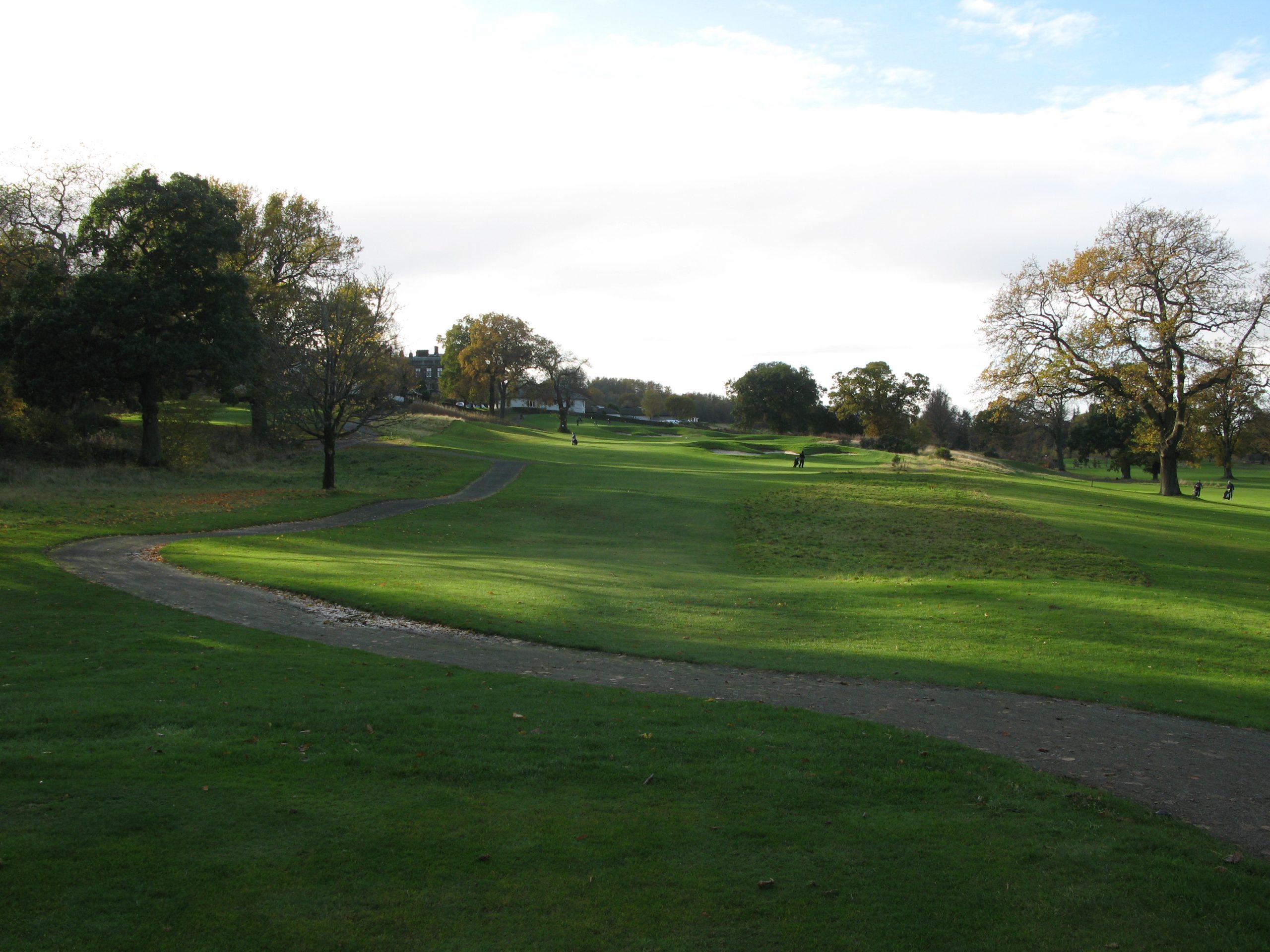
The approach at the 12th at Mar Hall, with the Baronial 18th Century Manor, now hotel, in the background. The fairways had held up to recent torrential rain, but were a little mossy.

Coupled with a stay in the collocated 5 star hotel, the former Erskine Estate and House make for an excellent golfing break, especially with its proximity to Glasgow and its airport. The Erskine bridge, which crosses the River Clyde, dominates the skyline, especially at the downhill dog-leg left second hole, where you feel you are playing under the bridge. Although set along the south bank of the Clyde, the river doesn’t come into play, which is a pity.

The excellent 13th hole, a dog-leg right, par 4, where you need to keep well left of the fairway bunkers, to give a par opportunity.

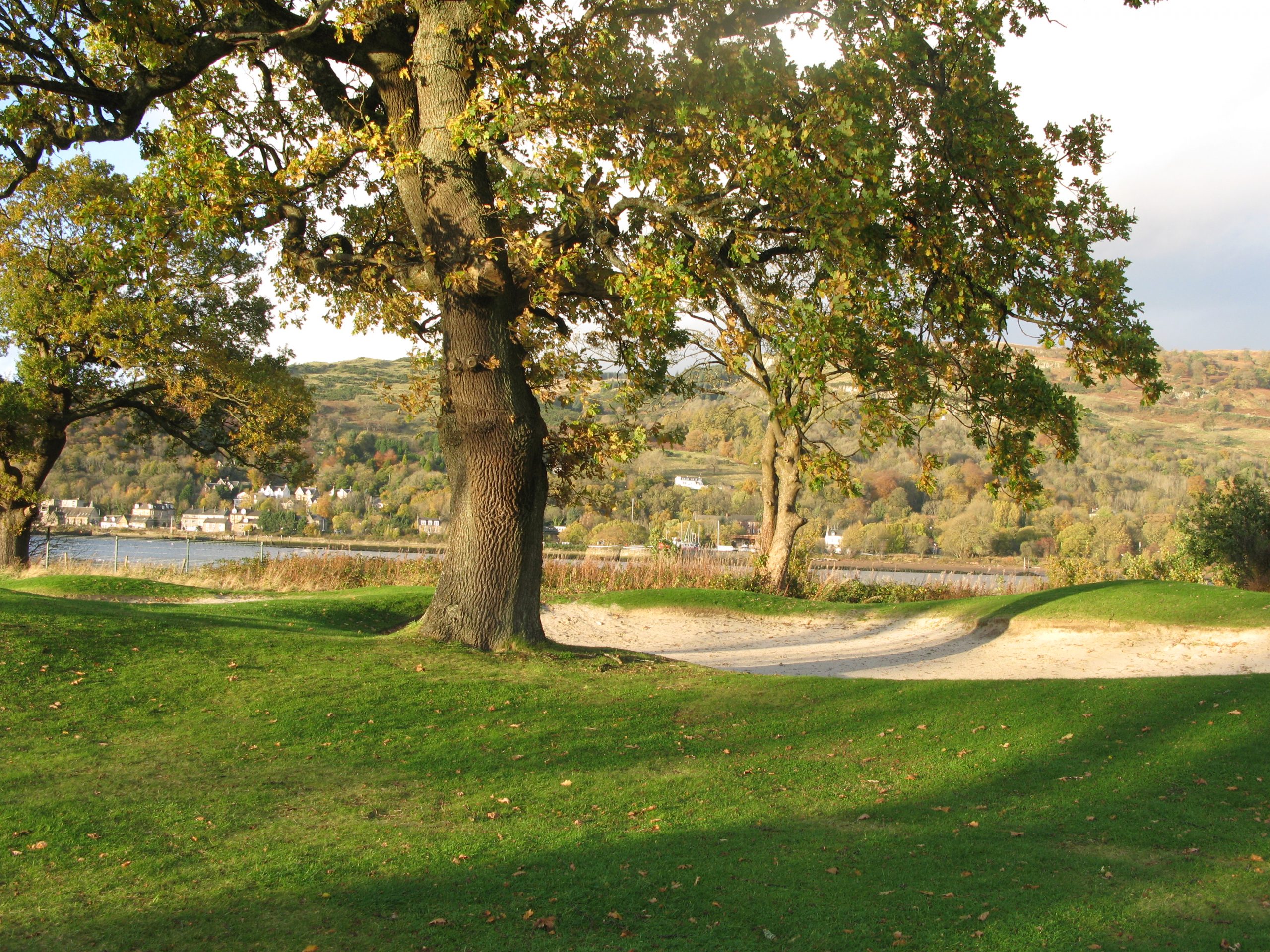
Other than the river, there are outstanding views of the hills to the north and some magnificent trees, which Thomas has carefully utilised in the design.

At over 6200 yards from the yellow tees, at par 70, this is a challenging course for all bar the single figure golfer. Some of the shorter par 4s, such as the delightful 9th hole, play slightly uphill into the prevailing wind and will require 2 decent shots to reach in regulation.

Fran puts at the 14th, with the Rainbow and the Old Kirkpatrick hills in the background.

When I played in late October, there had been several days of very heavy rain, but the course was in remarkably good condition, testament to the build quality and green keeping. The greens were all in play, they are generally very large, with devilish surrounds, including large bunkers, so keeping a 3 putt off the card, or scrambling, will also be a challenge.

The 9th makes for a robust end to the front 9, a short but tough par 4, normally played into the prevailing wind.

Nevertheless, its a delightful walking course, and as said, there is ample room from many tees, so makes for a good society day.

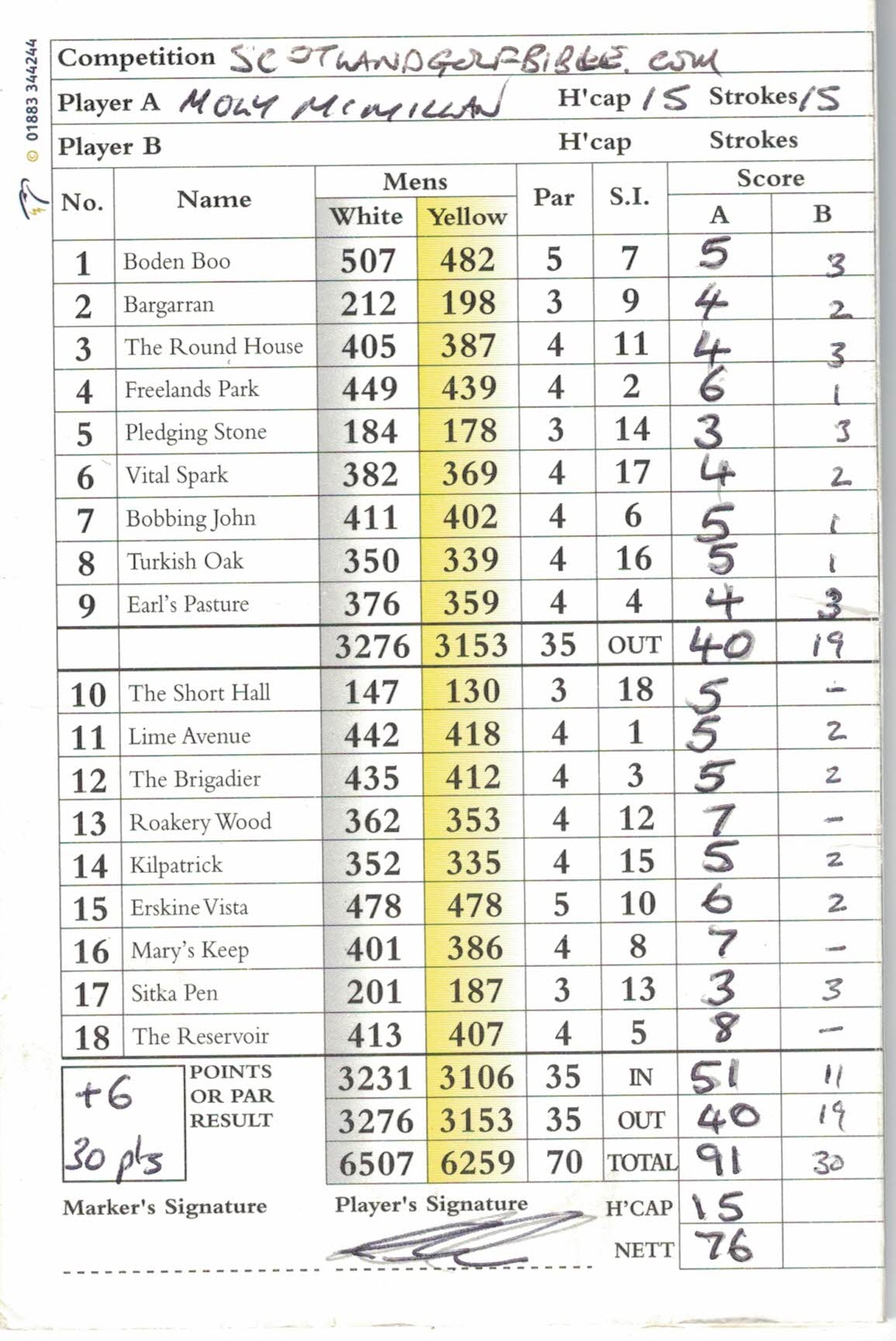
On the day, I played very well to get round in 91, for 30 stableford points, the latter number I always think is acceptable playing a course for the first time.

The trees are carefully crafted into the course, as here at the 15th fairway, with the view over the River Clyde.

The hotel has apparently hosted many celebs during its short existence, which I thought was quite appropriate given that, according to the barman, the river and hills make for ideal conditions for rainbows – although I didn’t find any pots of gold.

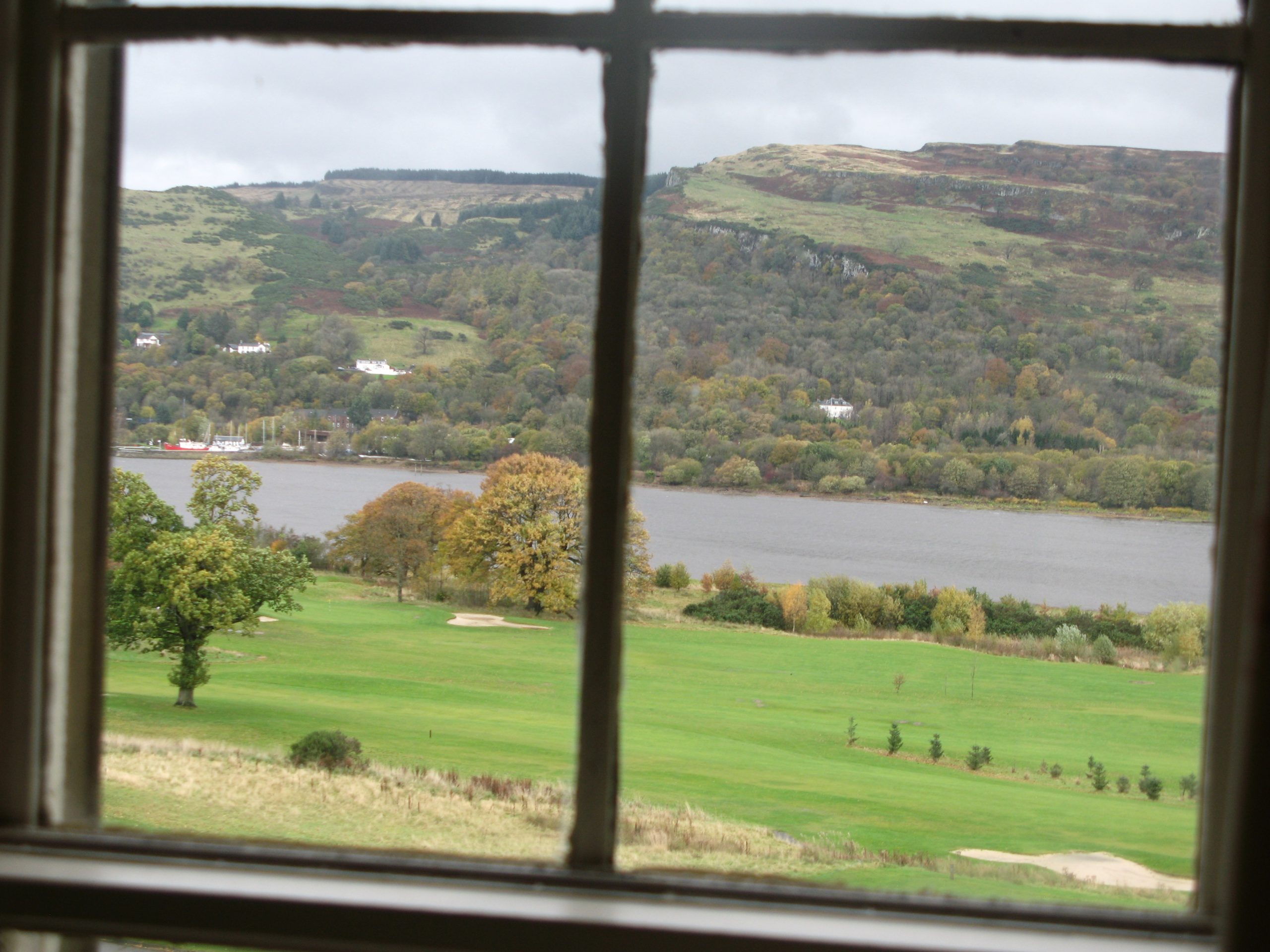
The view over the course from the hotel at Mar Hall – well worth a short golfing break here.

The course is the star here though. Well worth playing.

Course Type: Parkland

Par 70 (2 par 5, 12 par 4s, 4 par 3s)

Distance: 6259

Moly’s Gross score91

Played well for a 91 on this compact and challenging course

111. Powfoot. 23 Sep 2020.

Great value James Braid course well worth playing

Round £50. Par 71. Course Rating / Slope Rating (yellow) 69.5/126. Value (out of 5) – 4.5

If I were to list 5 courses, of varying price points and quality, to encapsulate Scottish golf, Powfoot might fit the bill for ‘great course taken for granted’. It would never make the cut of the top 50 Scottish Courses, perhaps even the top 100 courses; however, in many ways, playing Powfoot at under £50, using the typical offers abounding, makes you realise what great value golf exists in Scotland.

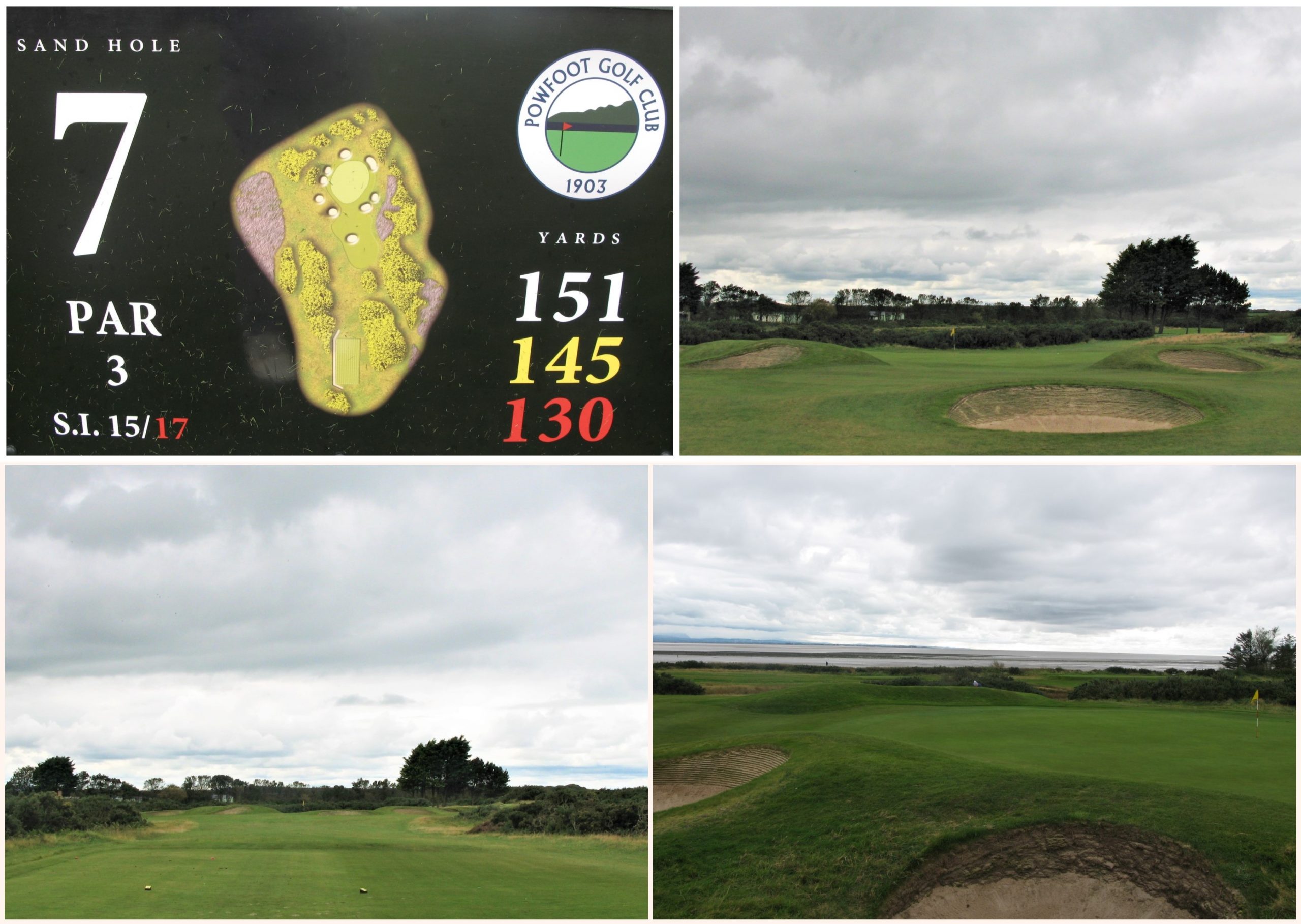
The brilliant par three 7th hole at Powfoot, with 9 greenside bunkers!

Powfoot, which takes the name from the village, sits on the north of the Solway Firth, in Dumfries & Galloway, not far from Annan. Overshadowed by the nearby Southerness course, I suspect a great many golfers bypass Powfoot – that would be a mistake in my opinion.

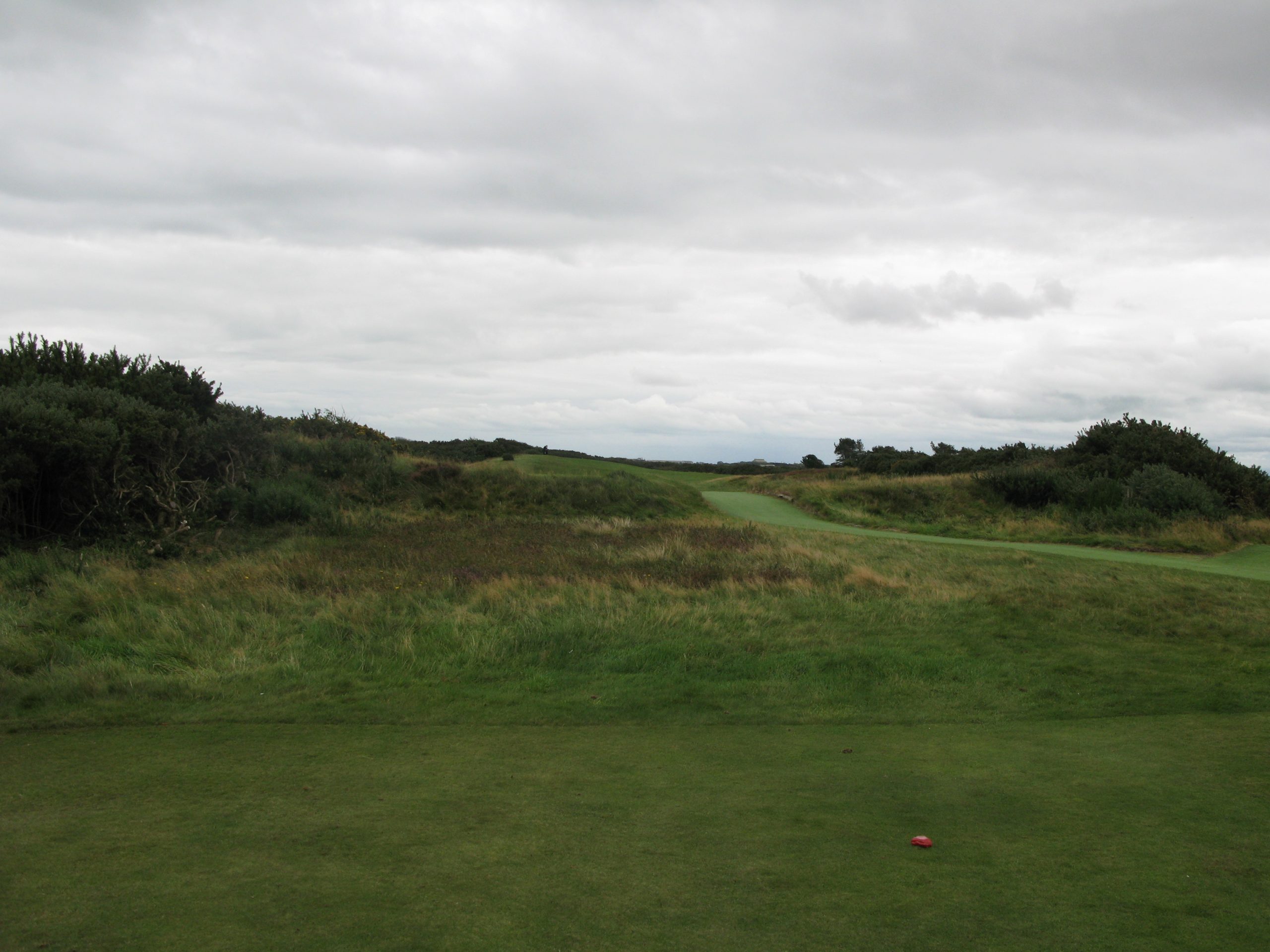
The blind tee shot at Powfoot’s tricky 8th hole, a tough and typical links hole.

Founded in 1903 with 9 holes, it was extended to 18 holes in 1911, then improved on by James Braid in 1923. At over 6200 yards from the white tees, it is a good challenge, especially I suspect when the wind gets up.

It plays and feels like a traditional links course; firm turf, good bunkering, aesthetically framed holes and greens, surrounded by thick gorse bushes. However, the last few holes are really parkland holes, with more trees bordering and sheltering the holes and on arable land.

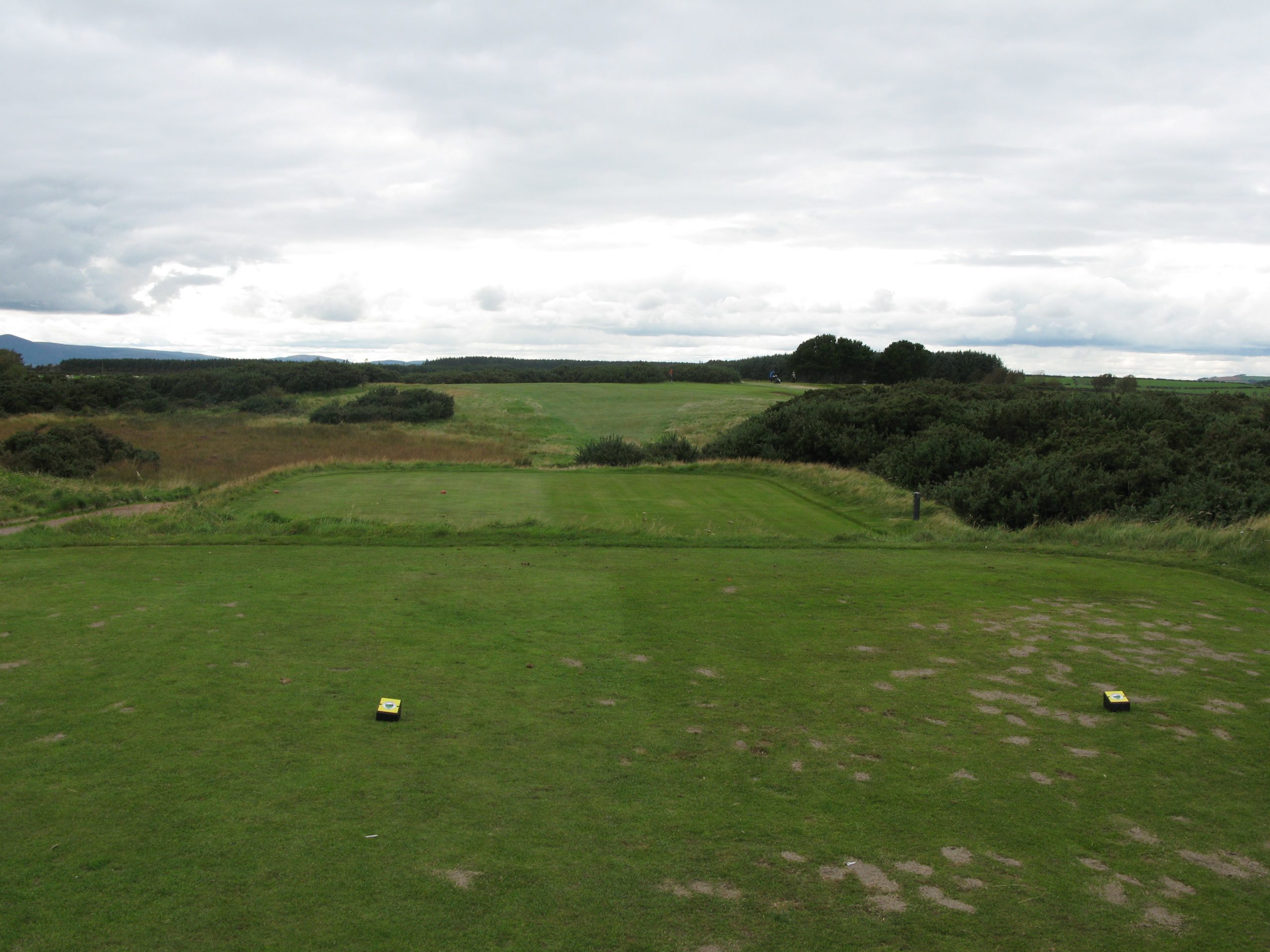
The well framed 12th hole, a devilish par 3, showing the gorse that abounds on this course. Pay short to be safe. I didn’t and the wheels came off, with a quadruple bogie:(

Dominated by a range of good par 4s (13 of them), there are only 2 par 5s and 3 par 3s. There are quite a few memorable holes. The stroke index par 4 third hole is the first great hole; called ‘shore’ it plays south towards the firth and would be very difficult to reach in 2 shots when the prevailing south westerly wind blows. The seventh is a short par 3 that has nine greenside bunkers – aim for dead centre of the green here. The 8th, a tough par 4, has a blind tee shot and a sloping green that could be approached using the full array of links shots. Likewise the short par four 11th hole demands respect where shots need to be played cautiously to avoid being wrong sided on the right of the fairway and green.

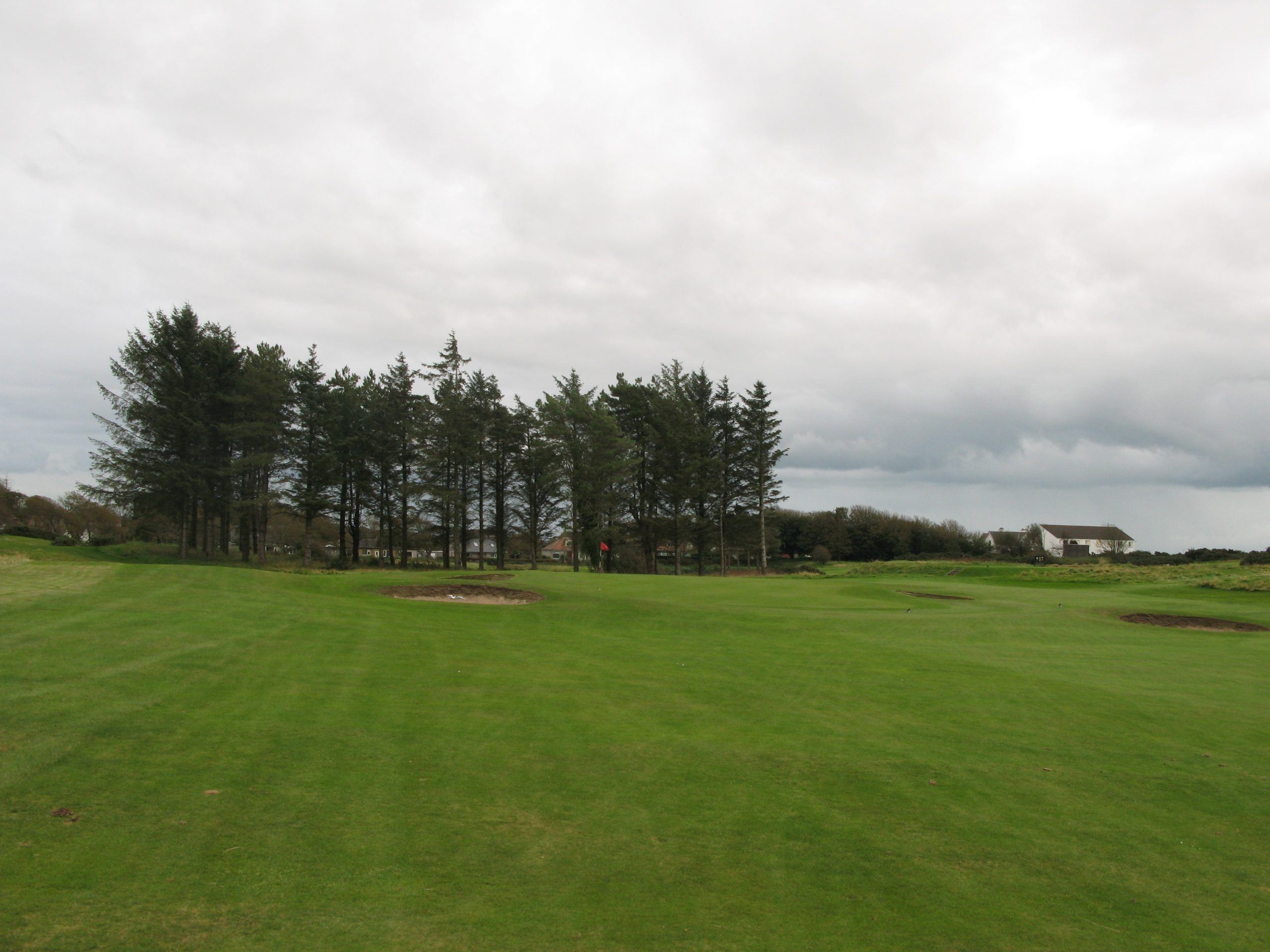
The 17th green, with the copse in the background, on the parkland part of the course.

Despite being in the pandemic the green keepers had presented the course in excellent condition when I played. The bunkers were particularly good and well maintained.

The golfing gods decided to give me a reminder on the cruelty of the game. Playing incredibly well, I was level par for the front 9 and only 1 over after 11 holes. I then played the last 7 holes in 13 over par! Ouch! Nevertheless, it was only the second time in my life I had been level par after 9 holes on a ‘proper’ golf course!

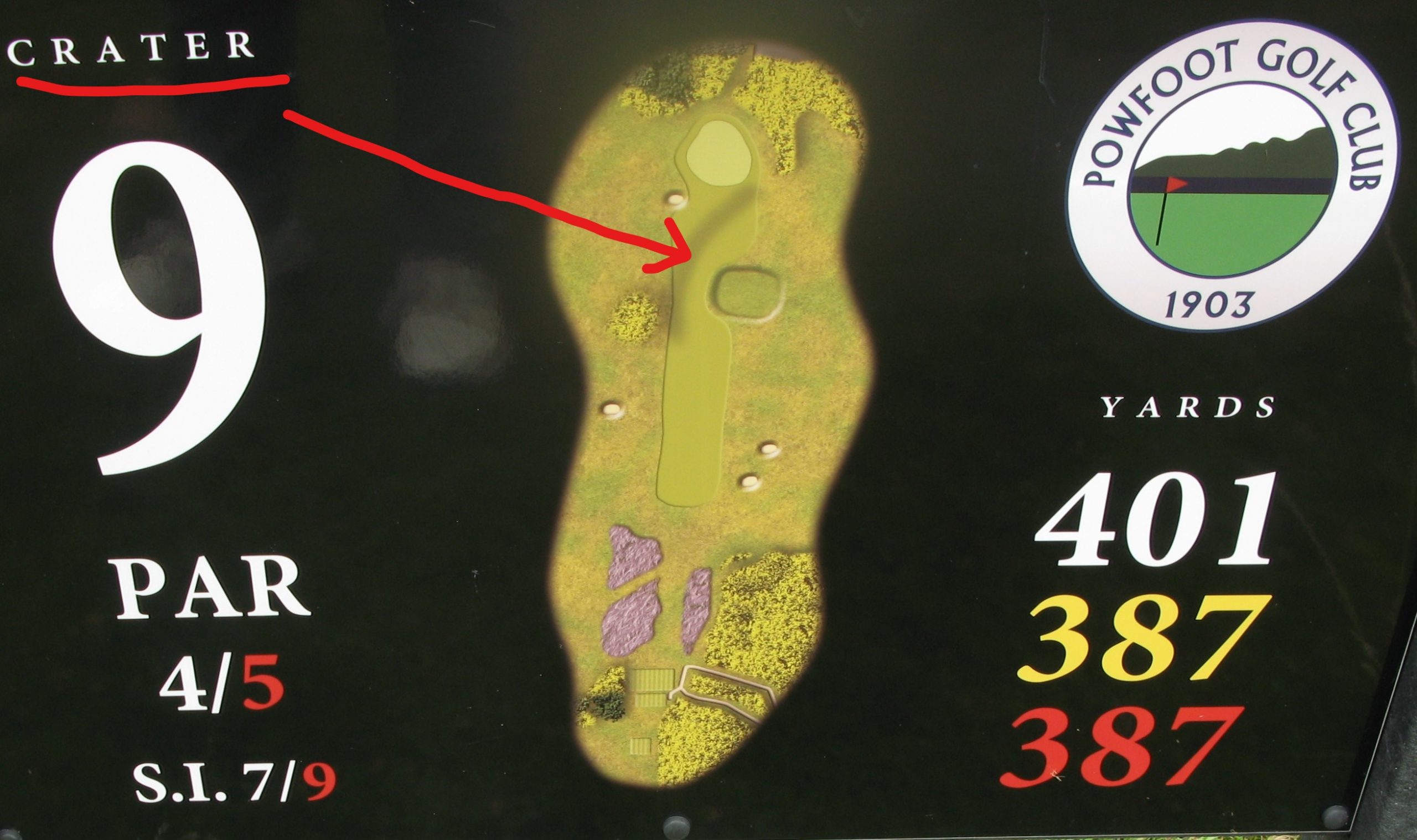
WWII created an unusual hazard at the 9th – with the course guide showing the crater made by a German bomb.

Go out of your way to play Powfoot, highly recommended

Facts:

Course Type: Links

Par 71 (2 par 5, 13 par 4s, 3 par 3s)

Distance: 5990

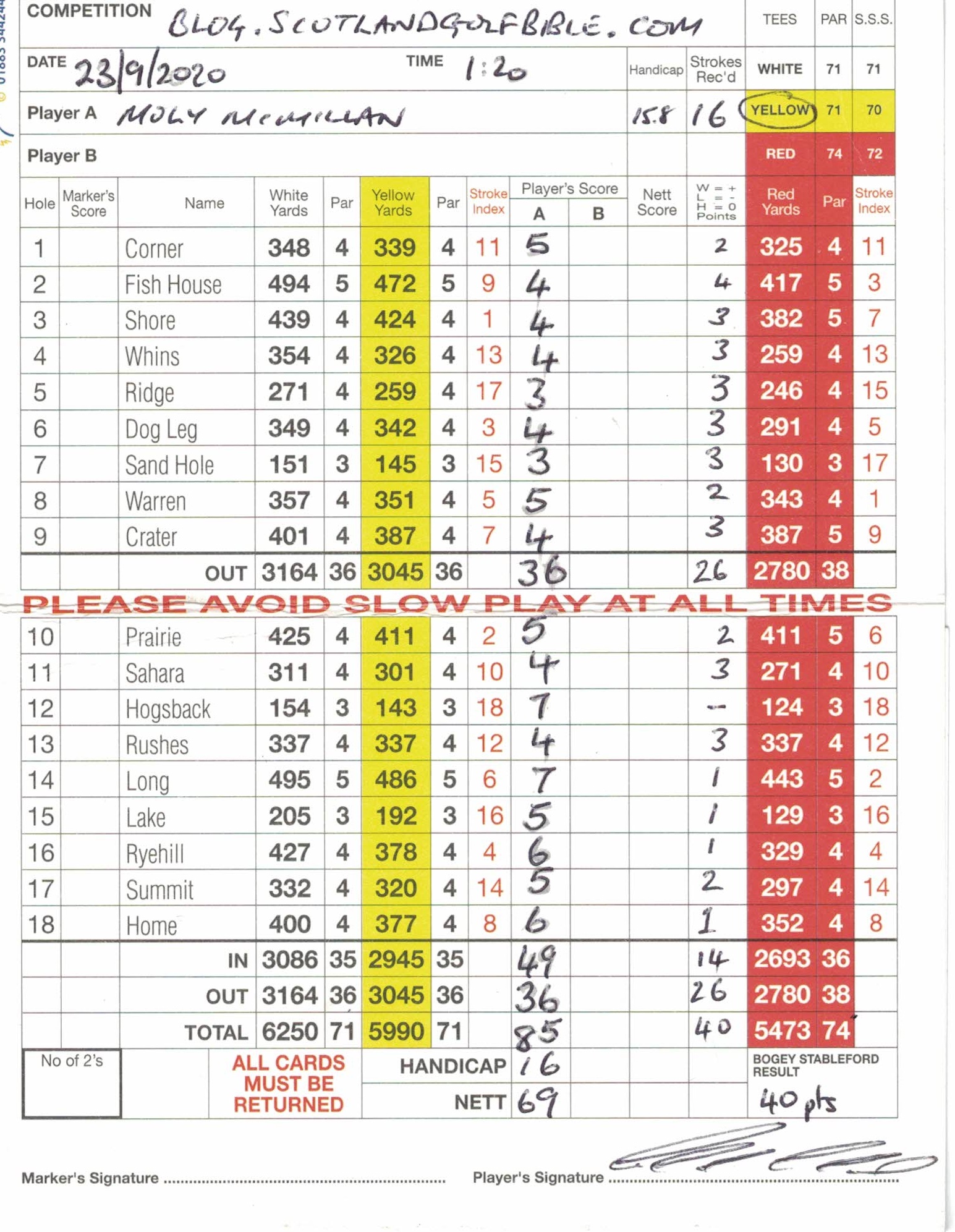
Moly’s Gross score85

The cruel game of golf – level par front 9, 14 over on back 9.

79. Fortrose & Rosemarkie. 24 June 2018.

Possibly the best located Scottish golf course, with evidence that James Braid’s bunkering came pretty cheap!      

Round £55.   Par 69.  Value (out of 5) – 4.5

“The Black Isle?”  Well, it’s not an isle and it’s not particularly black!  But it is a 10 mile wide by 20 mile long peninsular just north of Inverness, which also has a further very small peninsular on it’s southern Moray Firth coastline which is the heavenly location of Fortrose & Rosemarkie golf course.

The 9th green looking back to the tee with the Moray and Beauly Firths in the background.

Scots sometimes refer (tongue in cheek) to being “from God’s own country”.  If that were the case, it might just be that God chose the Fortrose & Rosemarkie peninsular for his (or her!) own personal golf course.  I played the course on a wonderfully warm and sunny late midsummer evening for a twilight fee of only £30, shot 39 (4 over) on the back 9, including 2 birdies, and seriously thought that maybe I should just stop played with that golfing memory etched on my brain.  It really can’t get much better…can it?

The Black Isle has recently become a popular destination with the creation of the North Coast 500  but has long been a destination to play some of the cream of Scottish Links, with Royal Dornoch, Nairn and Tain all close by, plus the recent addition of Castle Stuart. Fortrose & Rosemarkie has actually been attracting golfing visitors in high numbers since the expansion of the railways in the late 19th century and golf in the course location is traceable back to 1702.  Established in 1793, is the Club is the 15th oldest in the world, of which they are very proud.

The 11th tee, which is one of several arguably bland holes around the turn at Fortrose and Rosemarkie.

The course is quite short, at only 5893 yards from white tees and 5594 yards from yellow tees which I used.   It is essentially 2 horseshoe loops with the outer loop played clockwise with sea (only in play at a few holes) on your left , then an inner smaller loop played in opposite direction.  The difficulty will be dominated by the weather, but the bunkering and greens are tricky and provide protection when the wind is down.    Originally a 9 hole layout, it was extended to 18 in 1924 and in both 1932 and 1934 James Braid was engaged to advise on layout and bunkering – his 1934 fee was £12.10/  which ended in the course in its current layout.   That is only about  £1000 in current value!

The 17th at Fortrose & Rosemarkie; play left to ensure reaching to the plateau fairway.

There are some majestic holes, most notably the long par 4 4th, played towards the lighthouse at Chanonry Point, which protects the small channel through the Moray Firth towards Inverness, which is a popular viewpoint to see the many dolphins which inhabit the area.  I have spoken to people who have played the course many times and never parred the 4th.

Mission Impossible – the long par 4 4th hole at Fortrose and Rosemarkie, with Lighthouse and Fort George in view.

The 13th is also a great example of visible links architecture and Braid’s bunkers.  A hole with many options from the tee box.

The 13th – a magnificent short par 4.

The course was in all round excellent condition when I played and the club are happy for visitors to use any of the tee boxes.    In the benign conditions I shot gross 84 (net 2 under), including 4 double bogies – inevitably one of these was at the 4th!.

This is a must play course, with a twilight fee at only £30 being especially great value.

Facts:

Course Type: Links

Par 69 (yellow; 15 par 4s,  3 par 3s)

Distance: 5594 yards

Moly’s Gross score84

Moly’s scorecard – 84 with only 39 on the back 9.

« Older posts Newer posts »

© 2026 Scotland Golf Bible

Theme by Anders NorenUp ↑