A guide to green fee value for money

Category: 4 star (Page 7 of 11)

95. Alyth. 7th June 2019.

Great Value with Architectural Pedigree, along with a recent 9 hole expansion

Round £42.   Par 70.  Value (out of 5) – 4.5
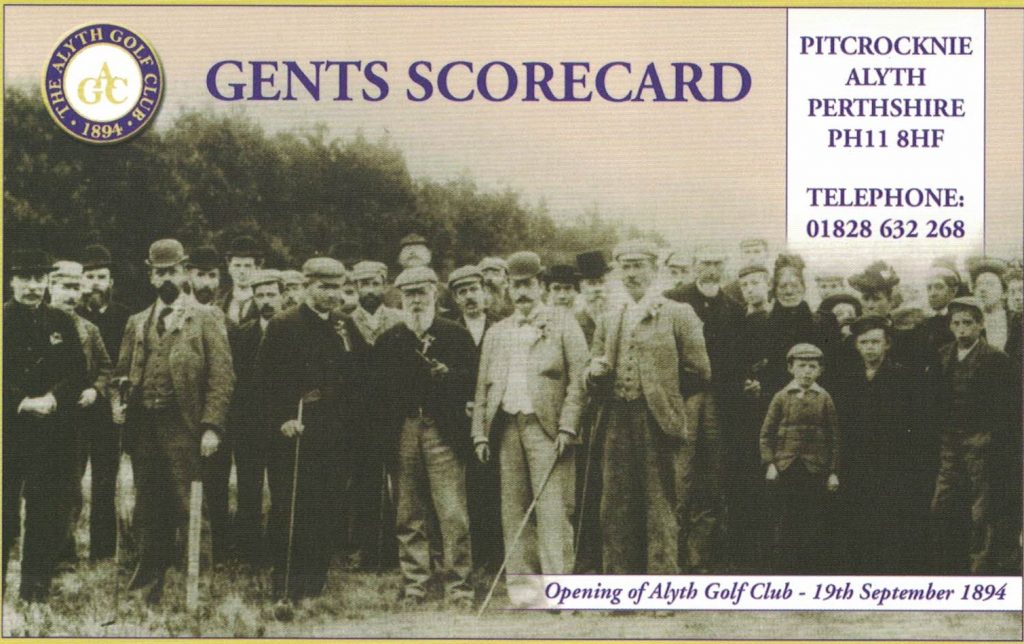
The Alyth scorecard immortalises the founding members

Alyth is a small town of around 3000 with an abundance of golfing choices in this agriculturally rich area of Perthshire. The Alyth golf club now boasts 2 courses – the main 18 hole course (subject of this blog), described as heathland albeit I think it is a parkland course, and dating back to 1895; Old Tom Morris laid out the first 9 holes, then extended to 18 in 1934 by James Braid. Much more recently, in 2016, the club took over the back 9 holes of the Glenisla course when that club closed down. It is one of the small bits of good news in the general decline of golf in Scotland.
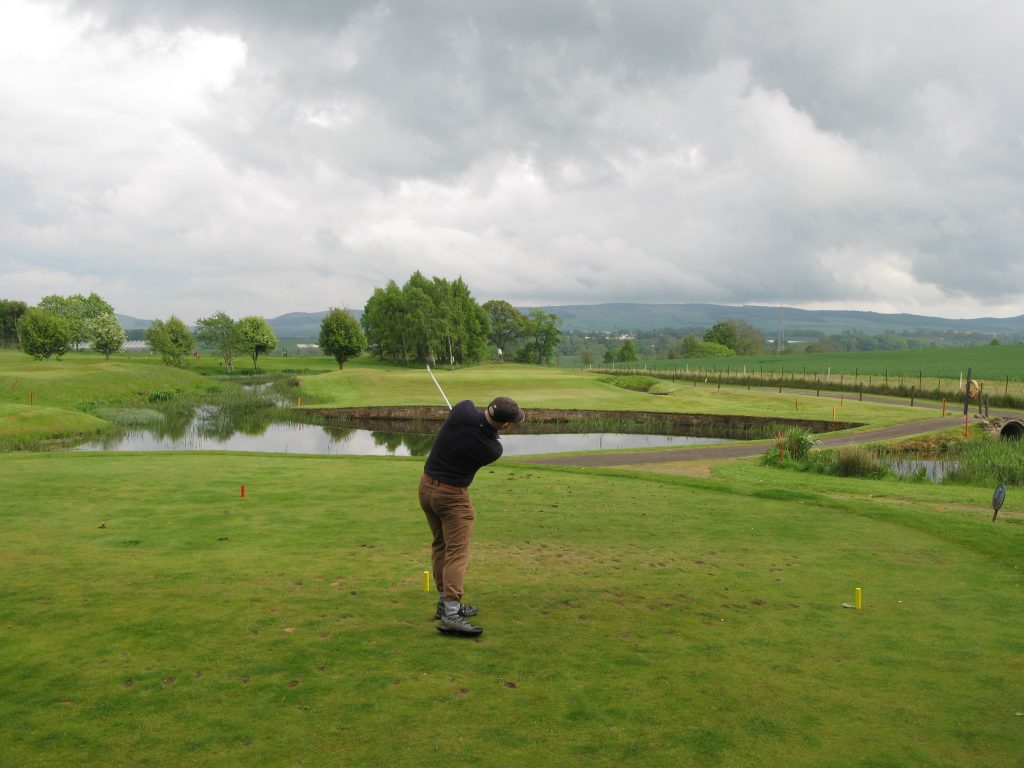
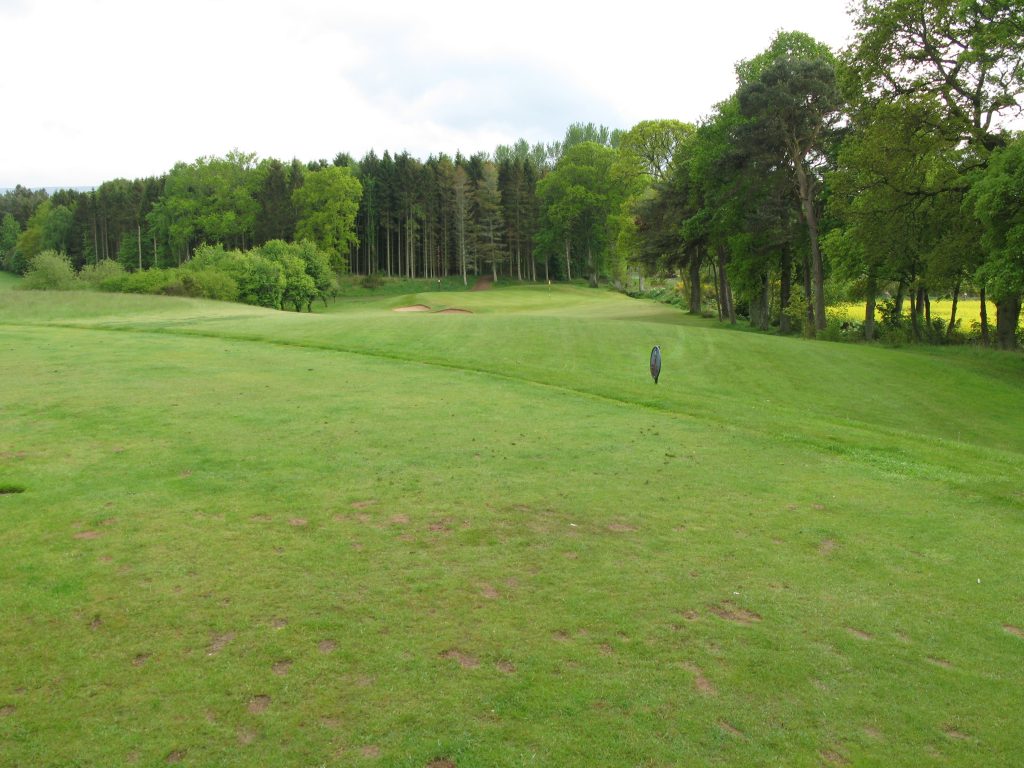
The wonderful Stroke Index 1, 5th hole at Alyth requiring both strategy and shot making

The main 18 hole course is really great value, with offers available through several sources, I suspect prices driven to attract the many tourist golfers who might otherwise just play the nearby world class Blairgowrie or Carnoustie courses. I strongly recommend playing Alyth, where the slightly shorter course, compared with those nearby giants, makes it a much more pleasurable experience, especially given the very picturesque landscape. The course has won awards for “best value”.
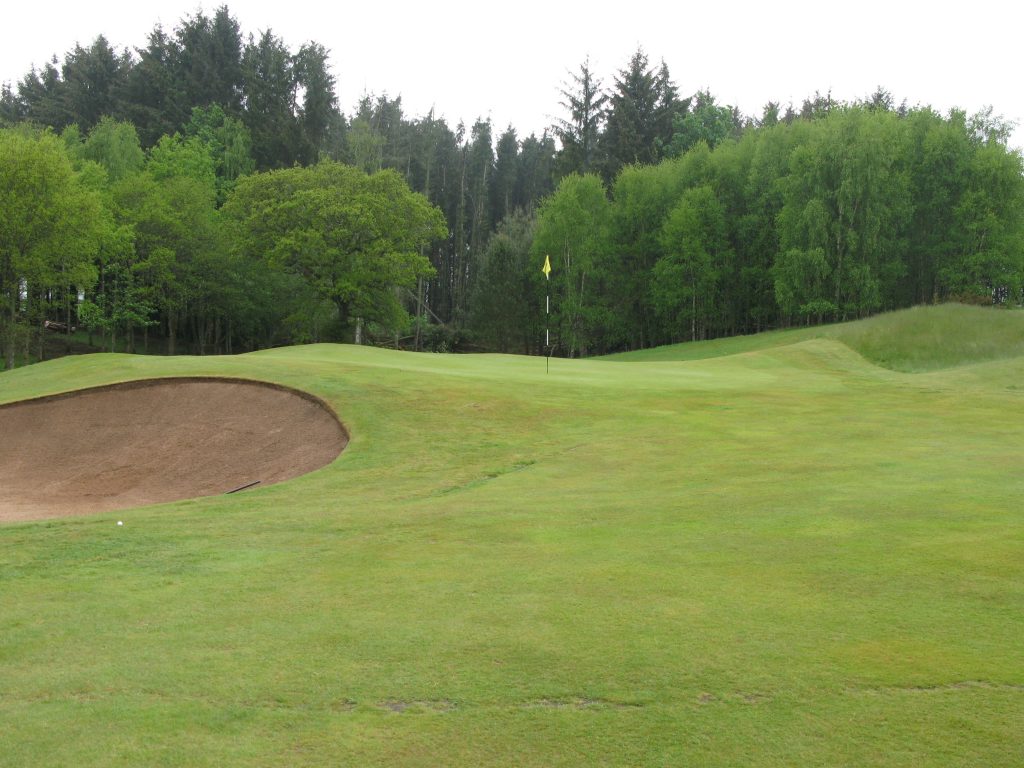
The first green at Alyth, showing the fine standard of the course’s conditioning

Although the course is set amongst tree lined fairways, the course is quite wide and the rough and tree areas not overly penalising, which makes it probably attractive to societies and more occasional golfers.

There are some great holes. The Strike Index 1, 5th hole, is a relatively short par 4, but the fairway ditch which runs diagonally across the fairway needs to be avoided, prior to finding the right club to reach the plateaued green. I was delighted with a bogie and moved on.

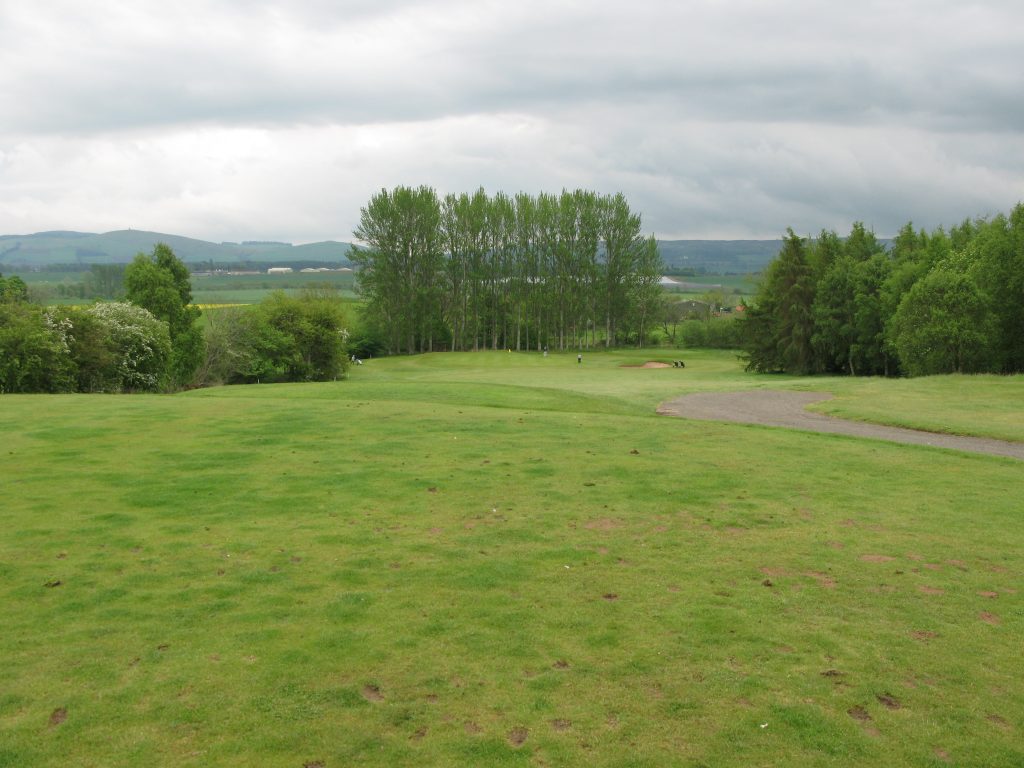
The 11th is another really nice hole, a short par 5 with well placed bunkers, that should reward those whose smart club selections take the bunkers out of play.
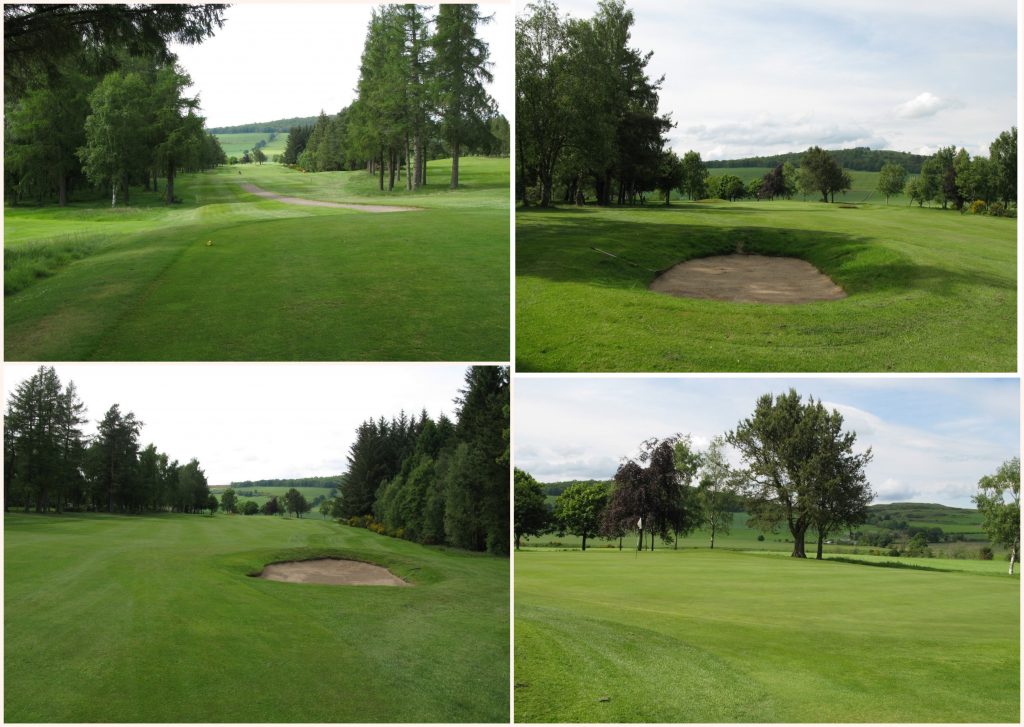
The short par 5 11th at Alyth, a lovely looking hole

When I played, the course was in excellent condition, with all bar the bunkers immaculate. I shot a gross 94 for 29 stableford points; the most enjoyable part being the very tidy finish over the last 3 holes, which should have been all pars, but for 3 putting the last after hitting my longest drive of the day!

I will go back to Alyth – highly recommended.

Facts:

Course Type: Parkland

Par 70 (2 par 5s, 12 par 4s, 4 par 3s)

Distance (yellow): 5990

Moly’s Gross score: 94
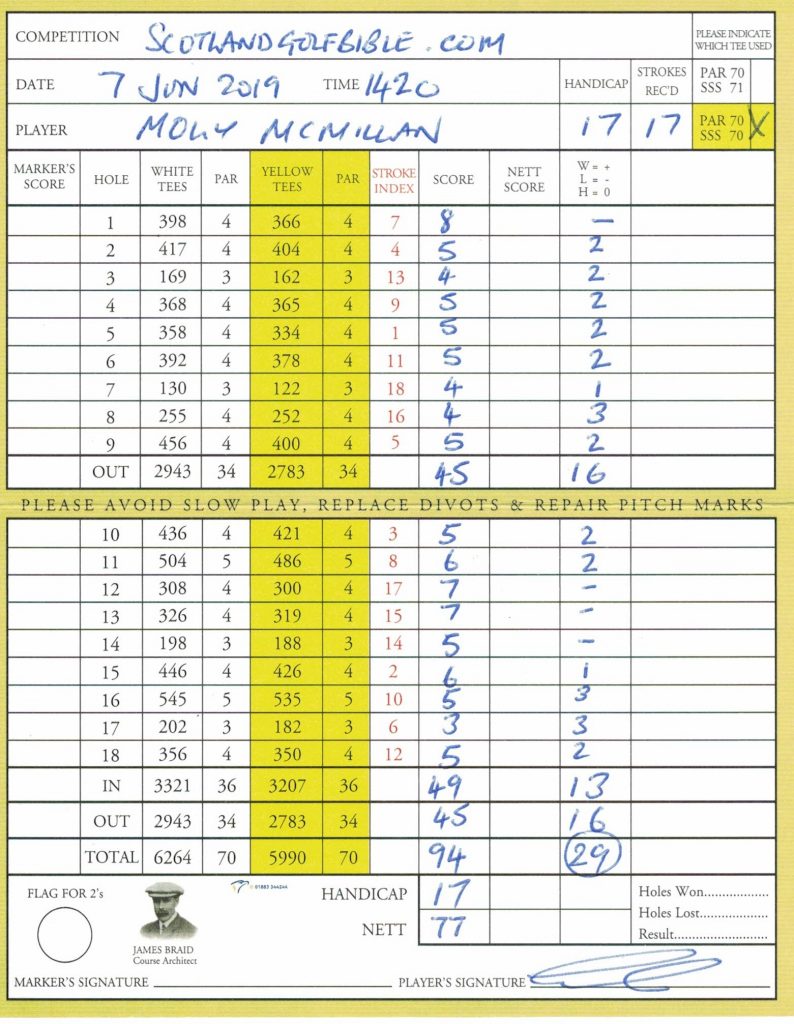
Moly’s 94 scorecard at Alyth

93. Strathmore Rannaleroch. 18 May 2019.

Ideal Golfing Society venue with a challenging course     

Round £36.   Par 71.  Value (out of 5) – 4

“A Challenging course for golfers of all abilities”. How often do you read that on golf course websites? I suspect it really means “please come and play no matter what standard you are, we could do with the money?”. The wealthier clubs, in much less need of visitors, rarely say it.

The nice par three 6th, one of the few holes with water in play

So, if a “for all abilities” layout does really exist, I propose the Rannaleroch course at the Strathmore Golf Centre, near Alyth in Perthshire, might be the closest I’ve found. But the more you think about it, the more obscure the statement is. Firstly, how can any one player know? I have played many times with low handicap players and I regularly play with my mid to high 20s handicap peers. Neither group has sufficient empathy, I suggest, of what constitutes a comparable challenge for the other group! Again, one of the many “unsolvable” debates golfers love.

The first green at Rannaleroch, a good example of the greens and surrounds at this main Stranthmore Golf Centre course.

Strathmore Golf Centre, near Alyth in Perthshire, was opened in 1996, and also has a 9 hole course, Leiftie Links, which I blogged in 2016. The Rannaleroch course was designed by former R&A Captain, John Salveson, now deceased; John turned to golf course design later in life after retiring as a farmer, mainly in conjunction with Donald Steel.

The 17th, the last of the nice par threes at Rannaleroch

The par 72 main course (although 70 off the yellow tees I used) is very picturesque, amongst rolling countryside, with mature trees, and the wide fairways means you can afford to use driver on all the longer holes. It’s an excellent architecture job.

The greens are large and I suggest you spend sometime on the practice greens to avoid several 3 putts; I putted very well on the front 9, then lost it on the back.

There are some really memorable holes, but I think the par 3s are the star here, with the 4th and the 17th both needing long irons. The short 6th over water is also a nice hole.

The difficult long iron par three 4th hole, with trouble left and right

The course was in excellent condition when I played along with Fran, despite the very wet weather that had prevailed the previous month. The tees, fairways and greens were all very good, albeit the bunkers were a little in need of raking and a bit of maintenance. Having said that, the course represented really good value. It would be a great course to add to a Blairgowrie centered golfing break. It also has a very good reputation for food, and I would recommend booking, as the restaurant is popular amongst local non golfers.

It’s really worth going out of your way to play Rannaleroch.

Facts:

Course Type: Parkland

Par 70 (2 par 5, 12 par 4s, 4 par 3s)

Distance (yellow): 5848

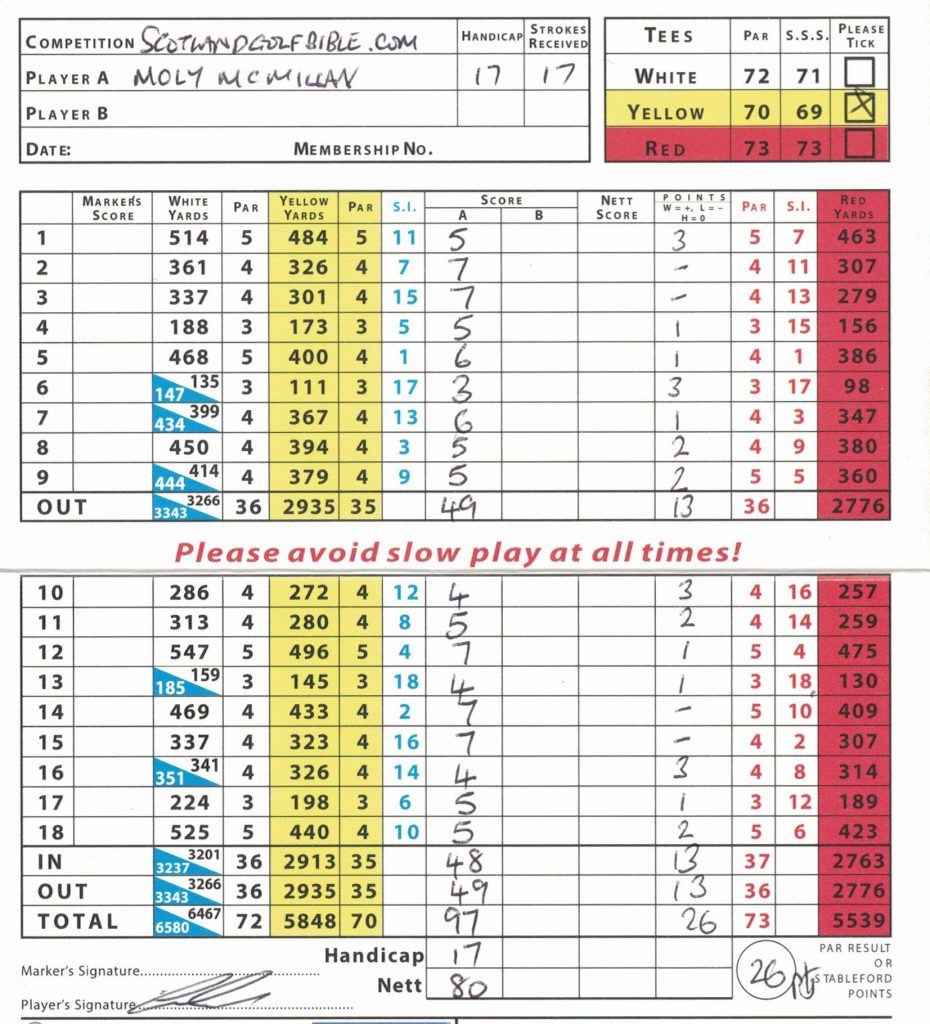
Moly’s Gross score97

Moly’s 97 at Strathmore Rannaleroch, not helped by the rain making it play long!

69. Moray New. 24th Oct 2017.

The junior of the two Moray courses is a fine example of links golf.   

Summary:  Round  £50.   Par 70.  Value (out of 5) – 4

Moray Golf Club is in Lossiemouth on the south shore of the Moray Firth, about 6 miles north of Elgin.  The main course, Moray Old, designed by Old Tom Morris, opened in 1889 and is one of the great Scottish Links whose 18th hole has a magnificent green in front of the fine old clubhouse.

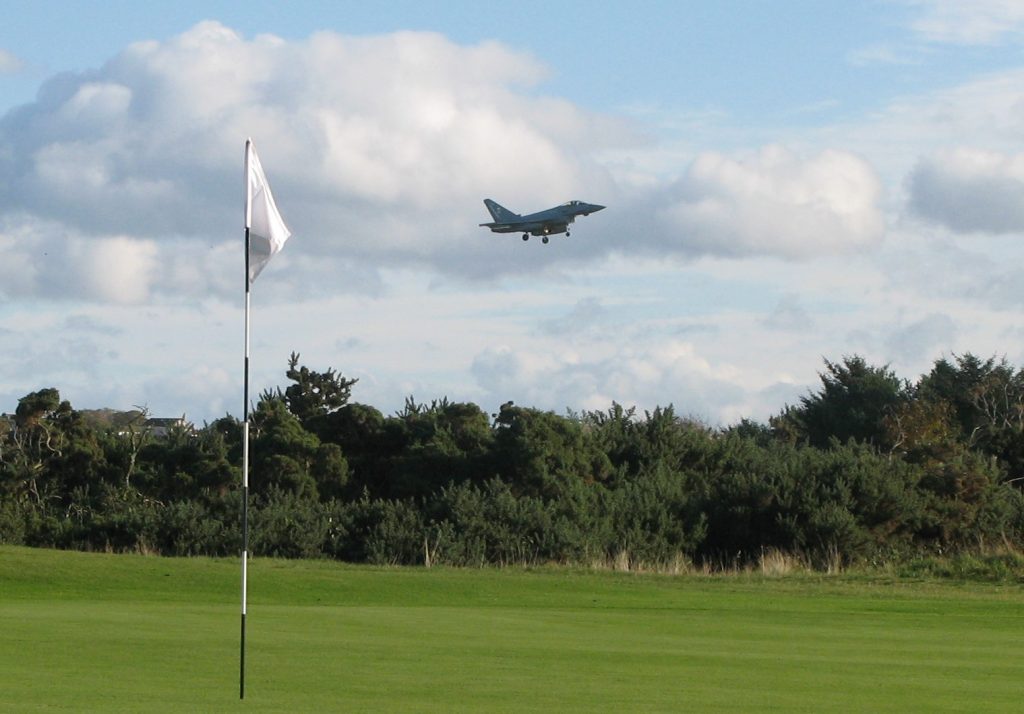
Beware aircraft noise – a Typhoon from RAF Lossiemouth passes over the 6th green at Moray New

The Moray New 18 hole course was designed by Sir Henry Cotton and opened in 1979, and extended the 9 hole “Ladies Relief” course which had been laid out in 1905.  This is one of only 2 Scottish courses “re”-designed by Sir Henry (the other being Stirling).

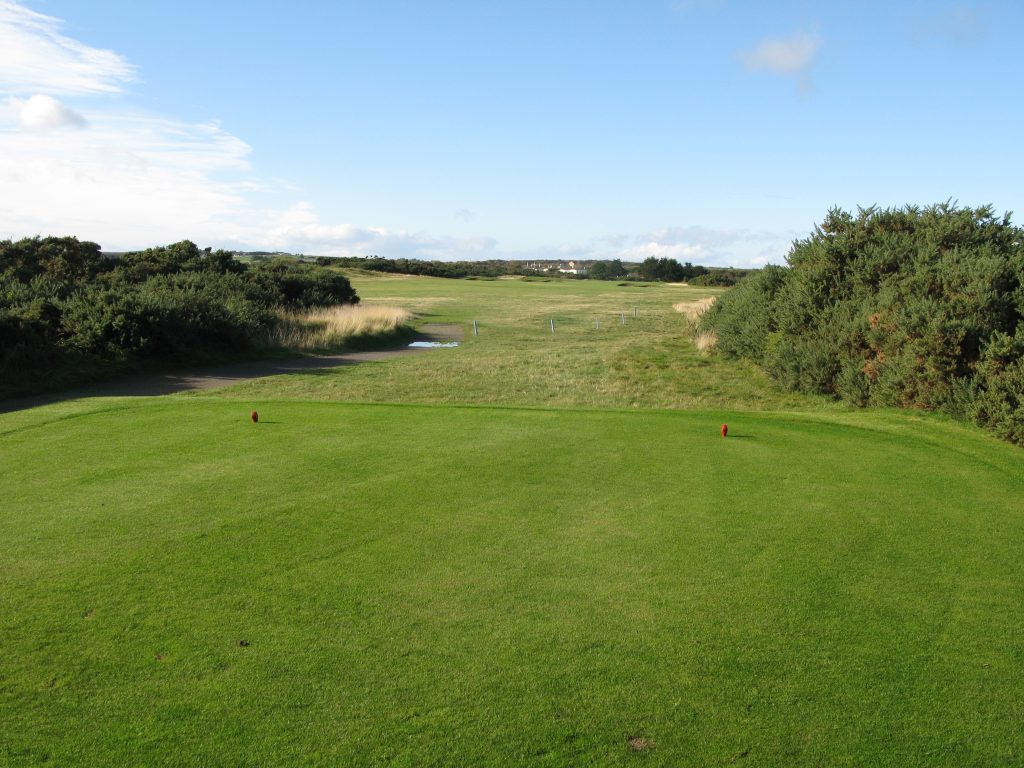
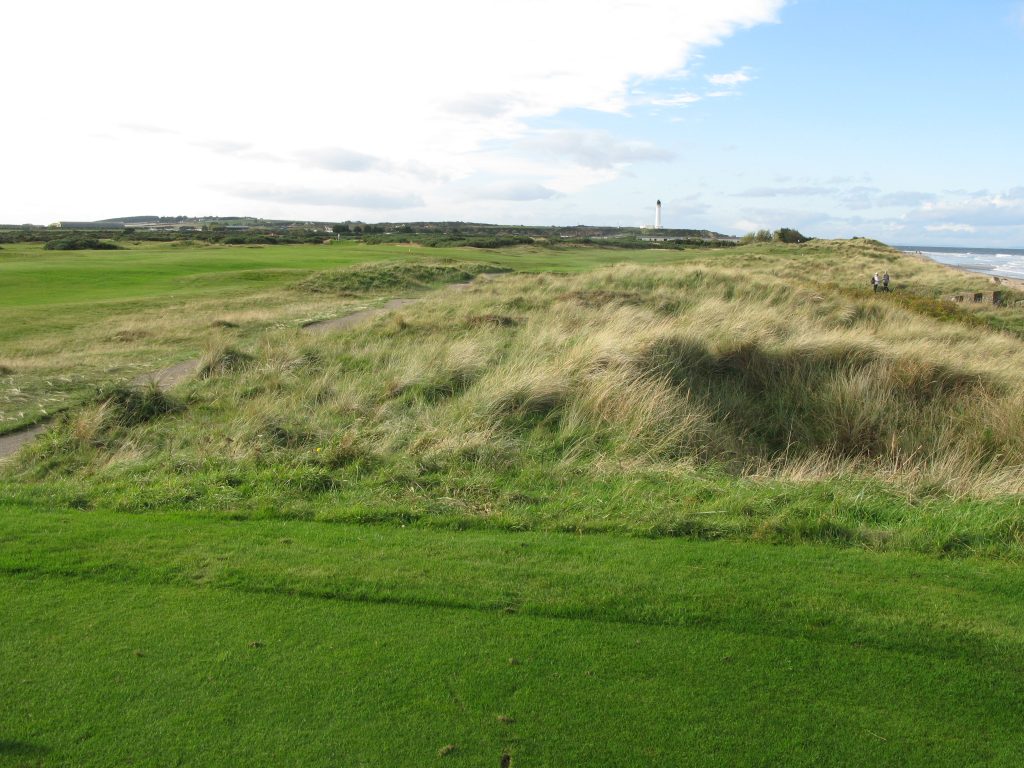
At just over 6000 yards, off the white tees, Moray New is still a substantial test of golf.  With the wind blowing and the abundance of gorse, accuracy from the tee is very important here.

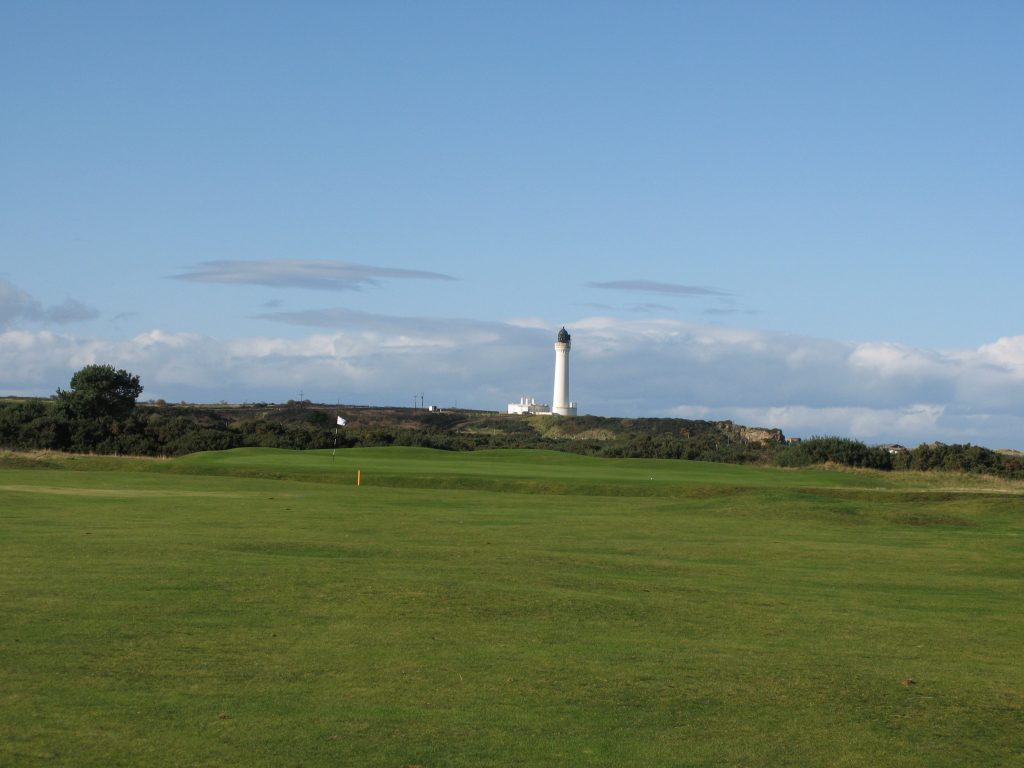
The beautiful looking 3rd at Moray New

The New course is closely intertwined with the Old and it’s important to check which coloured flags are in use on each course.

A significant hazard can be the noise from jet aircraft from the adjacent RAF Lossiemouth base, which is closest to the 6th green on the New.  When I played there was a busy flying day and I was treated to some fast climbing displays by the local Typhoon jets of No’s 1(F), II(AC) and 6 squadrons – the primary task at RAF Lossiemouth is to maintain the Quick Reaction Alert (Interceptor) North mission.

Approach to the 5th at Moray New – with burn in front of green

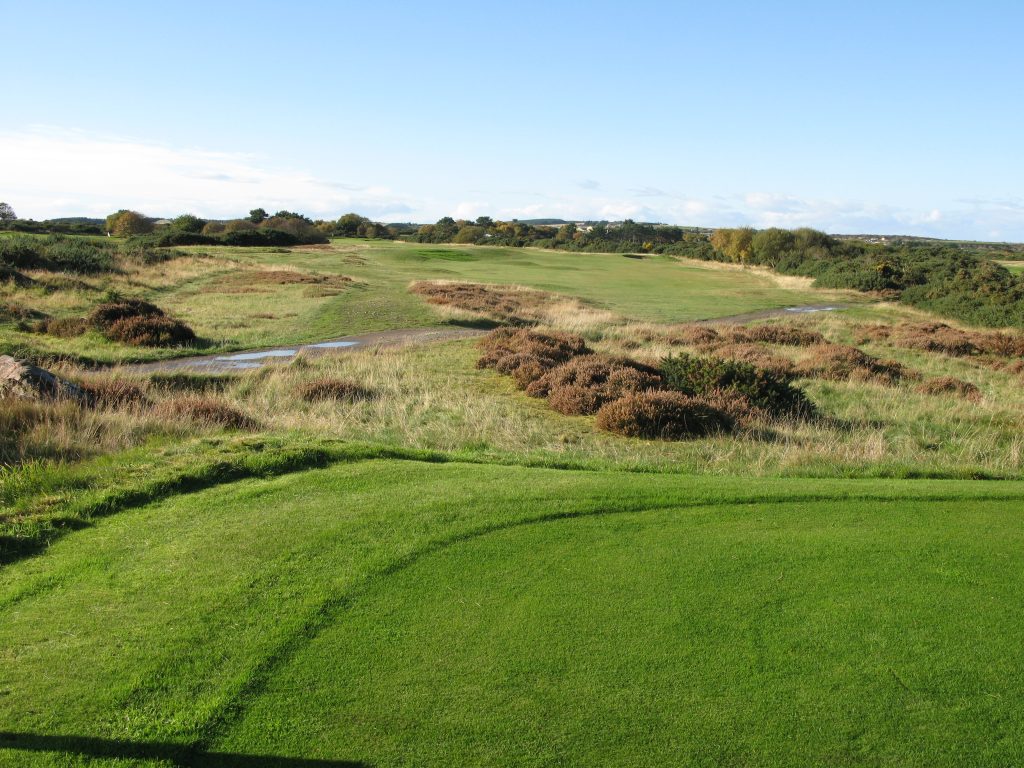
The course has some fine holes, dominated by the wind of the day.  The 10th is the closest to the coast, and the prevailing wind will normally be against and from the left, making it difficult for a right handed slicer – the green is on a slight plateau and difficult to find.  The par 4 14th, Stroke index 1, will play like a par 5 for all bar the really long hitters.

There are some tricky par 3s, with the innocuous looking short 6th having the burn passing directly in front of the green, making a front tee position very difficult.  The 17th, the longest of the par 3s, has 4 well placed green side bunkers awaiting.  In general, there is some clever bunkering on both fairways and greens throughout the course, although this course does not have the deep re-vetted bunkers found on many a links course.

7th at Moray New, one of the challenging par 4s (SI 7)

The course was in excellent condition for a late October day, demonstrating how accessible Scottish Links courses can be all year round – by comparison many courses inland were closed due to being waterlogged on the same day.

Other than plane spotting, playing at Moray is highly recommended for whisky lovers, since Moray has a well established and long relationship with nearby distillers (several of whom were original members of Moray) from whom the club has bought several vintage whiskys.  It has its own label “Club malt”, currently a Macallan.  Curiously, there is more about the history of whisky on the club’s web site than the golf courses!

Par 4 10th tee, a nightmare in the prevailing wind from the left!

A story worth noting is the political dispute Moray GC had with, probably in hindsight, its most famous member, the first UK Labour Prime Minister, Ramsay MacDonald –  he was removed from the membership list in 1916 for his opposition to the First World War.  He was finally reinstated as a member in 1929, but never played Moray again.

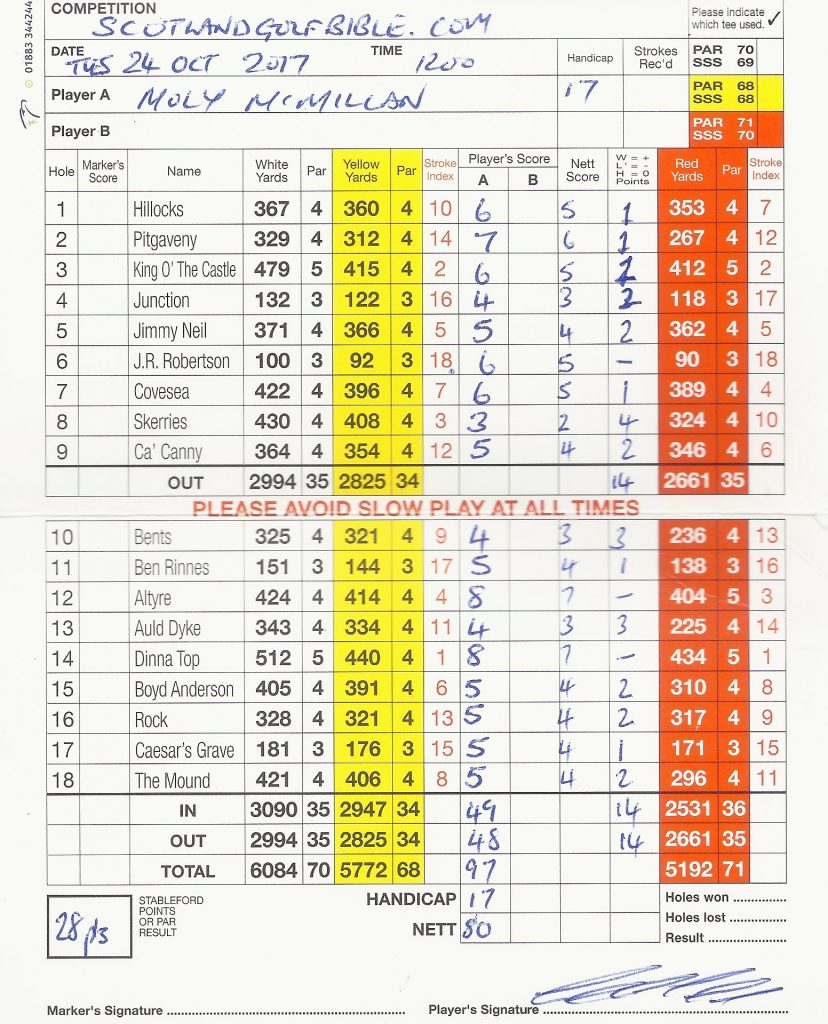
On the day, I played reasonably well for 28 points, although had a few disasters (on 12 and 14 especially), which meant I scored a gross 97.  I got a birdie on 8, which was my highlight.

If you plan to play the Old course at Moray, try and make sure you savour the New as well.  Highly recommended.  I played using The Courier golf voucher deal for only £15 – an absolute bargain.

Facts:

Course Type: Links

Par 68 (14 par 4s, 4 par 3s)

Distance (yellow): 5772

Moly’s Gross score97

Moly’s Moray Old scorecard – 97 for 28 points


68. Braid Hills No 1. 16th Oct 2017.

Edinburgh’s public gem too prominent to be called “hidden”   

Summary:  Round  £25.30.   Par 70.  Value (out of 5) – 4.5

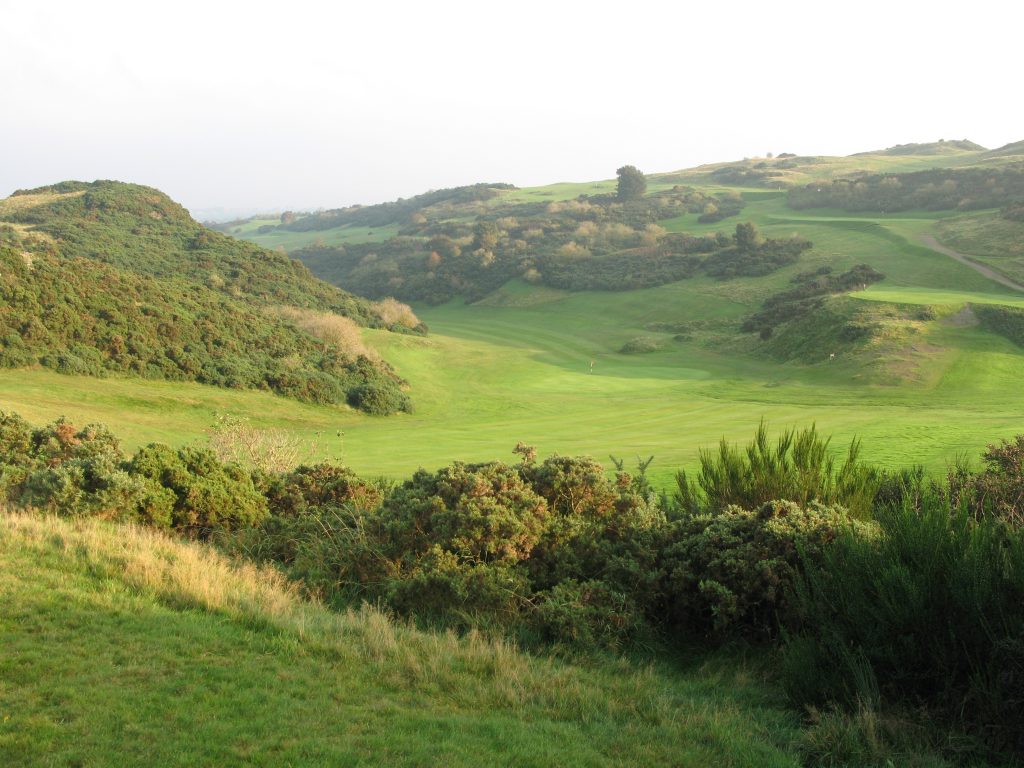
Braid Hills “No 1” is a wonderful public 18 hole golf course carved among the gorse and hillocks of Braid Hills on the south western edges of Edinburgh.  It has magnificent views of the Edinburgh skyline towards the Firth of Forth and also the Pentland Hills.  Although often misused, the term “gem” could well have been defined just for this golf course.  It is sometimes described as “one of the best loved public courses in Scotland”, and a real gem it is.

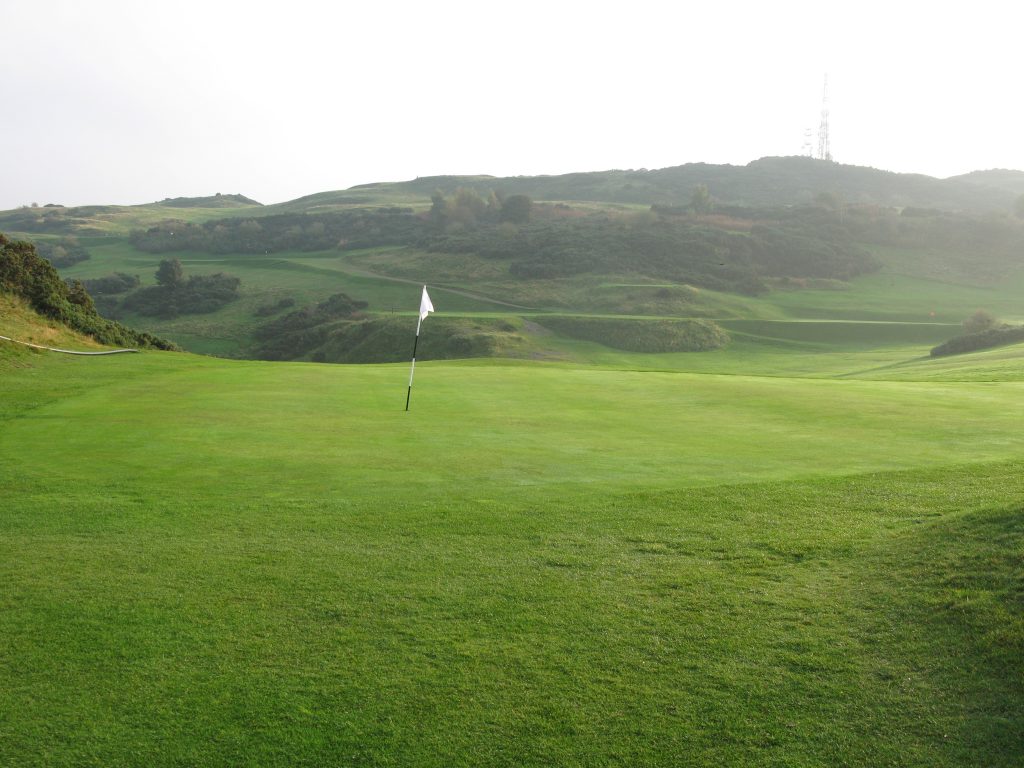
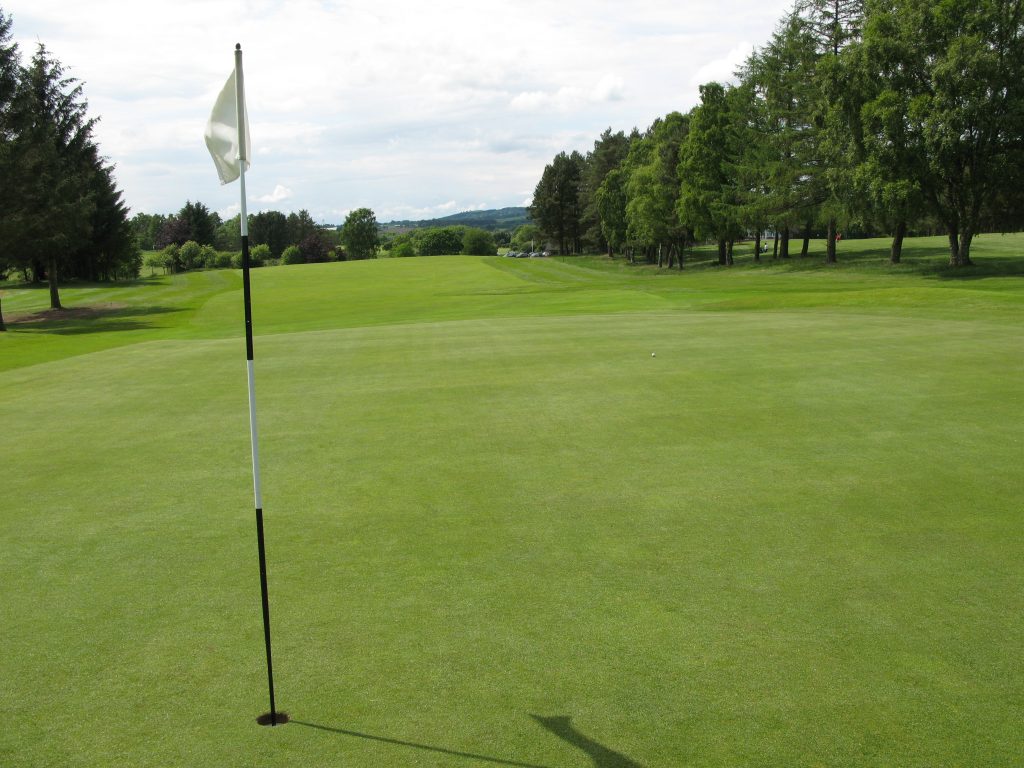
Overlooking the 16th green and 17th tee, with the view representing the feel of Braid Hills

“The Braids” takes its name historically from the nearby Braid estate originally the property of the “de Brad” family, one of whom, Henri de Brad, was Sheriff of Edinburgh in the 12th century.  The name has nothing to do with the famous course architect James Braid who, ironically, did not in any way shape his namesake course!

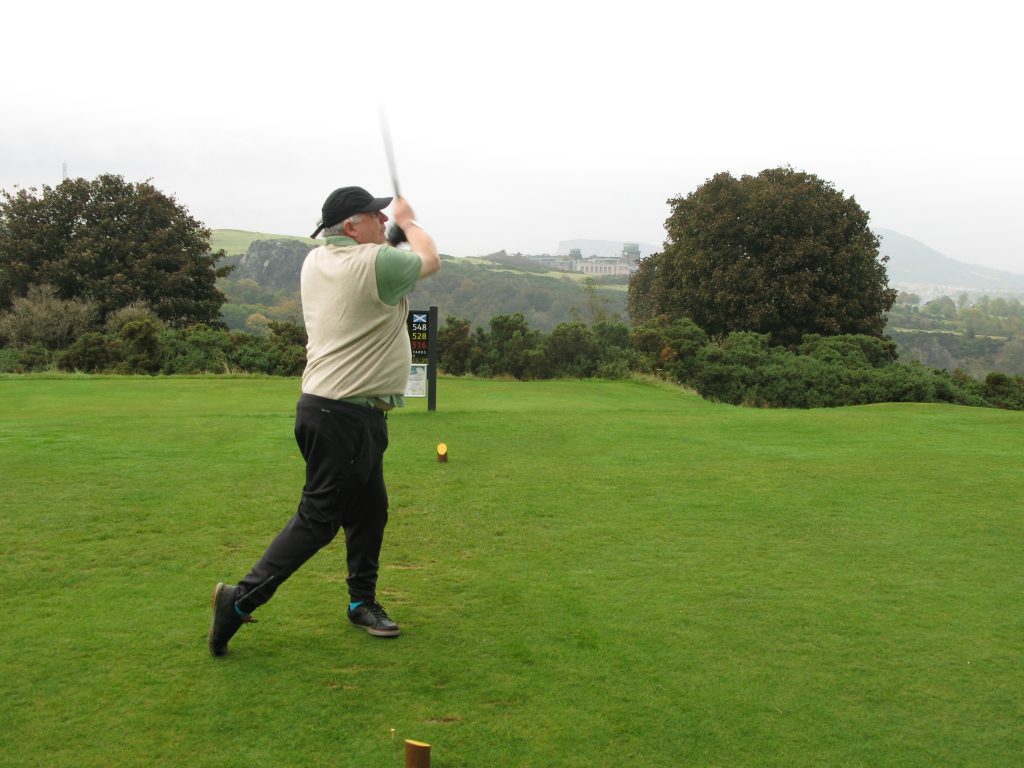
It was appropriate to play here with Sheriff Frank Crowe, fully equipped with Tommy Armour irons, given that Henri de Brad, the 12th Century Sheriff of Edinburgh, is the origin of the Braid Hills name.

The golf course was opened in 1893 and several golf clubs sprang up to accommodate the popularity of the sport with many of those clubs still affiliated: Edinburgh Thistle, Edinburgh Western, Harrison, Comiston Ladies and Braids United.  The 1931 Open Champion Tommy Armour was a member at Edinburgh Western.  Such was the popularity of golf, the nearby Braid Hills Hotel, immortalised in Muriel Spark’s ‘The Prime of Miss Jean Brodie’, originally had a Golf Room erected to serve the golfers playing the new Braid Hills golf course.

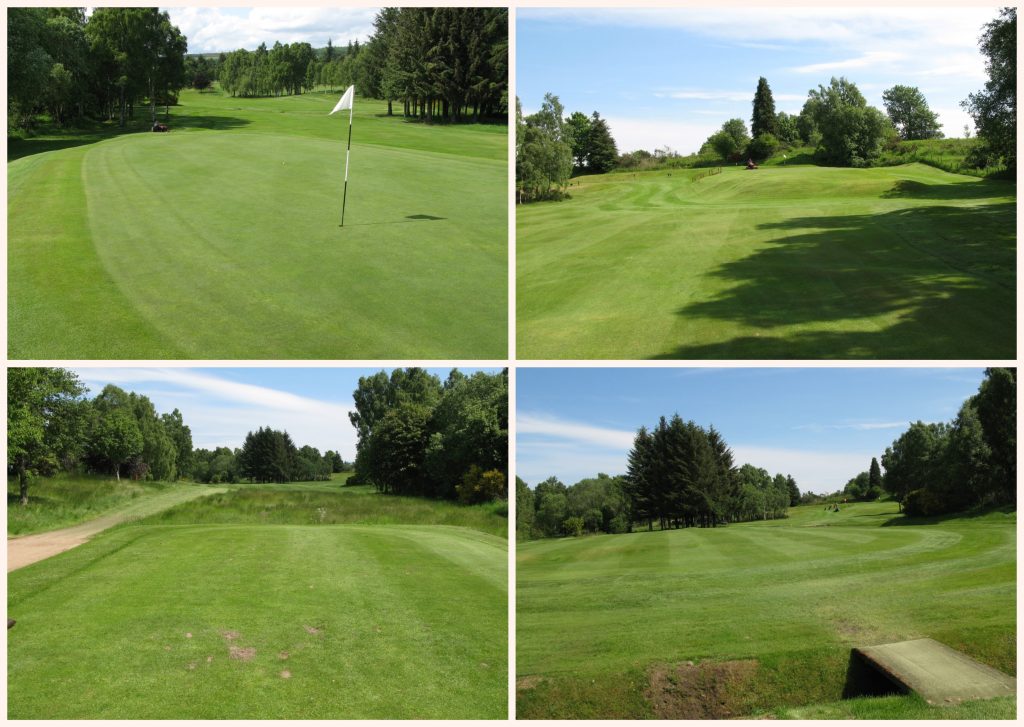
It’s a relatively short course, but there are many blind or semi blind tee shots, and I would highly recommend buying the course planner, as some of the holes can be played with very different strategies, most notably the par 4 7th and 14th holes, where successful drives can be 60 yards wide on either left or right.

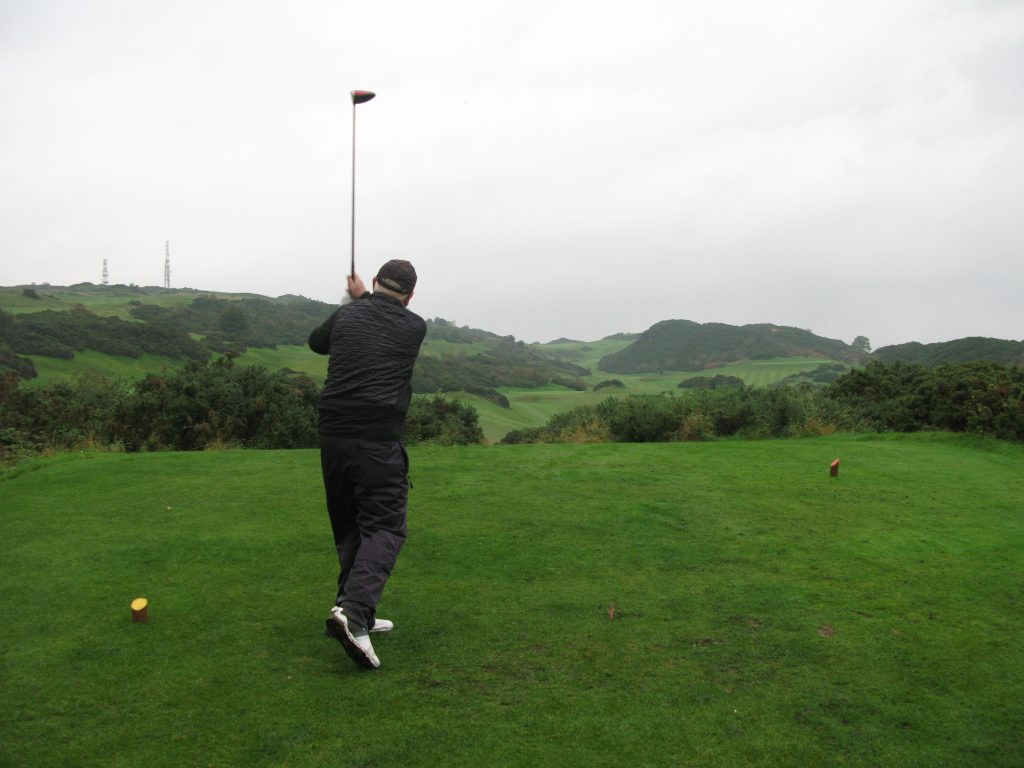
Brian Fearon teeing off at the very difficult par 4 7th hole. Choose your line with care; my shot seemed the best drive but was never found!

Although easily accessed from the city, whilst on the course if feels incredibly remote, especially in one of the holes surrounded by the gorse.  The main hazard on this course is the pervasive gorse bushes, and the need to get the correct alignment from the tee.  If you play well off the tee here, you will score low, otherwise disaster awaits.  This is reflected abundantly on my card, where I had several disasters, resulting in lost balls.  However, I found many more that I lost – on the 4th hole my own ball was the 7th I found.  Make sure you remember the ball you played with!  Also take care with approach shots, which often seem to take at least one extra shot here – this was evident from the 17th tee, which has about 140 yards of “valley” between the tee and green – you need to get up here to make par.

The lovely par 3 17th, one of 4 nice par 3s, of which the uphill 9th was the most challenging

The walk is quite hilly with some hazardous steps up and down from teeing grounds, but the walk is well worth it just to get to the 18th tee alone which must have one of the best views in Edinburgh.  Even on a fairly misty day we were able to appreciate it.

The course was in pretty good condition when I played with some colleagues from the Apex organisation.  The greens were quite quick and the fairways good; there were some bunkers although they are quite spare and very basic in construction.

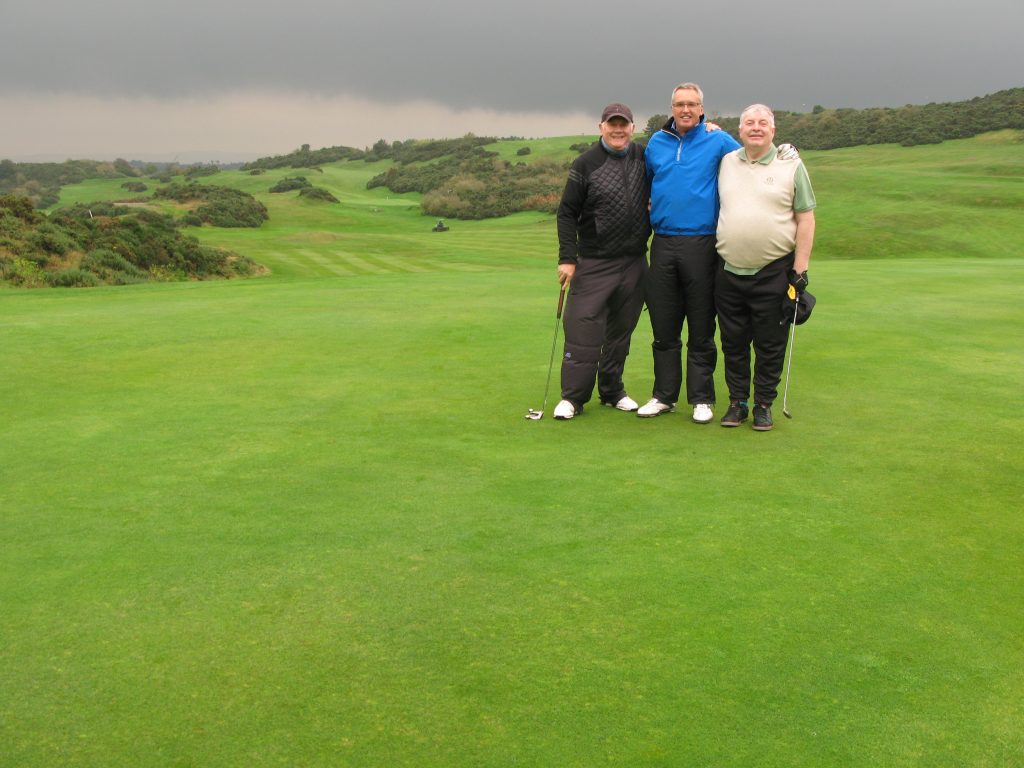
A set of happy golfers on the characteristic 8th hole of Braid Hills.

For the record, there once was a Braid Hills No 2 course of 18 holes, but that disappeared a few decades ago, and there is now nearby a small 9 hole course called Wee Braids and also a Braid Hills Golf Centre.

This is a really great little golf course highly recommended.

Facts:

Course Type: Heathland

Par 70 (2 par 5s, 12 par 4s, 4 par 3s)

Distance (yellow): 5508

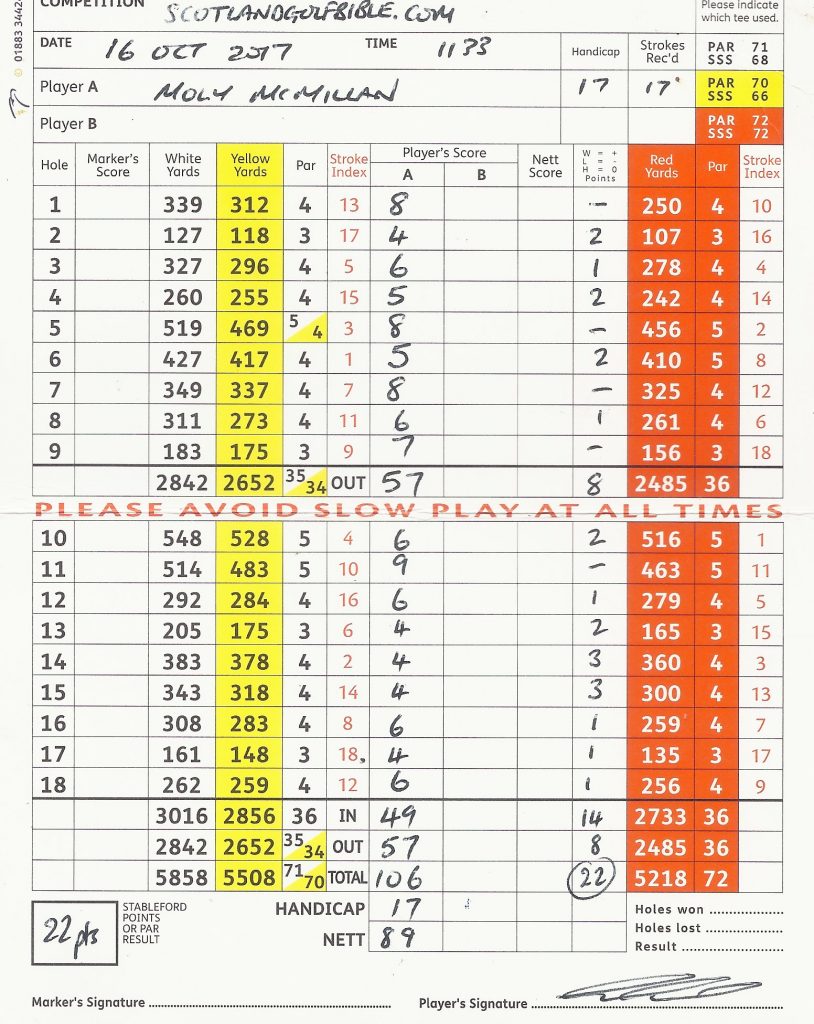
Moly’s Gross score: 106

Moly’s disastrous Braid Hills Card – 106 including 10 penalty shots and 40 putts

« Older posts Newer posts »

© 2026 Scotland Golf Bible

Theme by Anders NorenUp ↑