A guide to green fee value for money

Category: 4 star (Page 15 of 22)

69. Moray New. 24th Oct 2017.

The junior of the two Moray courses is a fine example of links golf.   

Summary:  Round  £50.   Par 70.  Value (out of 5) – 4

Moray Golf Club is in Lossiemouth on the south shore of the Moray Firth, about 6 miles north of Elgin.  The main course, Moray Old, designed by Old Tom Morris, opened in 1889 and is one of the great Scottish Links whose 18th hole has a magnificent green in front of the fine old clubhouse.
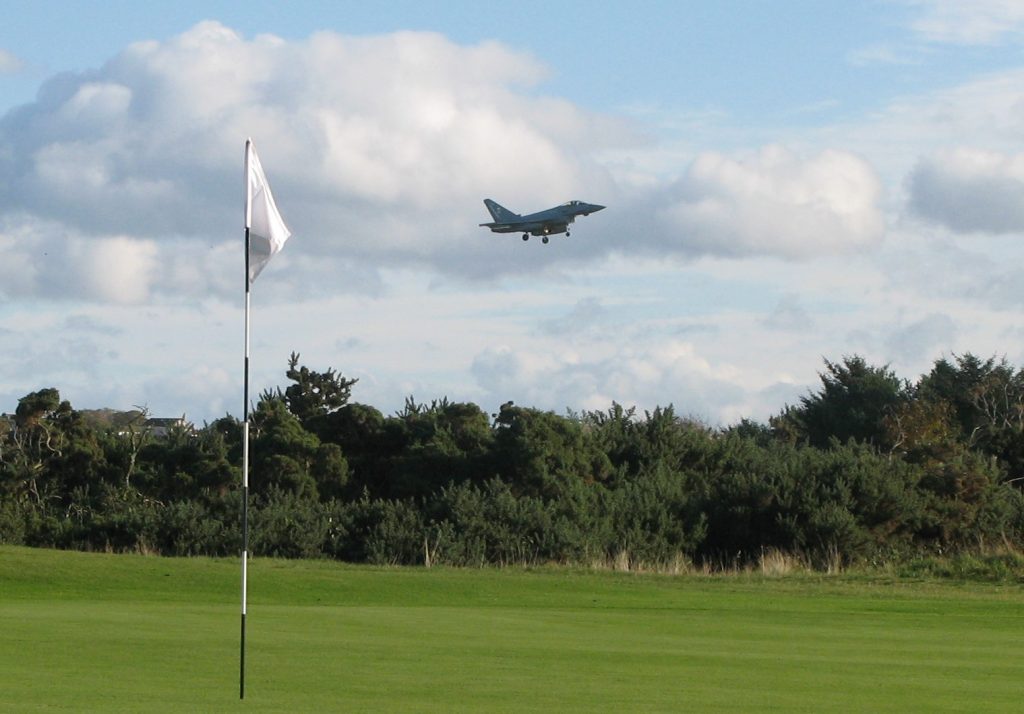
Beware aircraft noise – a Typhoon from RAF Lossiemouth passes over the 6th green at Moray New

The Moray New 18 hole course was designed by Sir Henry Cotton and opened in 1979, and extended the 9 hole “Ladies Relief” course which had been laid out in 1905.  This is one of only 2 Scottish courses “re”-designed by Sir Henry (the other being Stirling).

At just over 6000 yards, off the white tees, Moray New is still a substantial test of golf.  With the wind blowing and the abundance of gorse, accuracy from the tee is very important here.
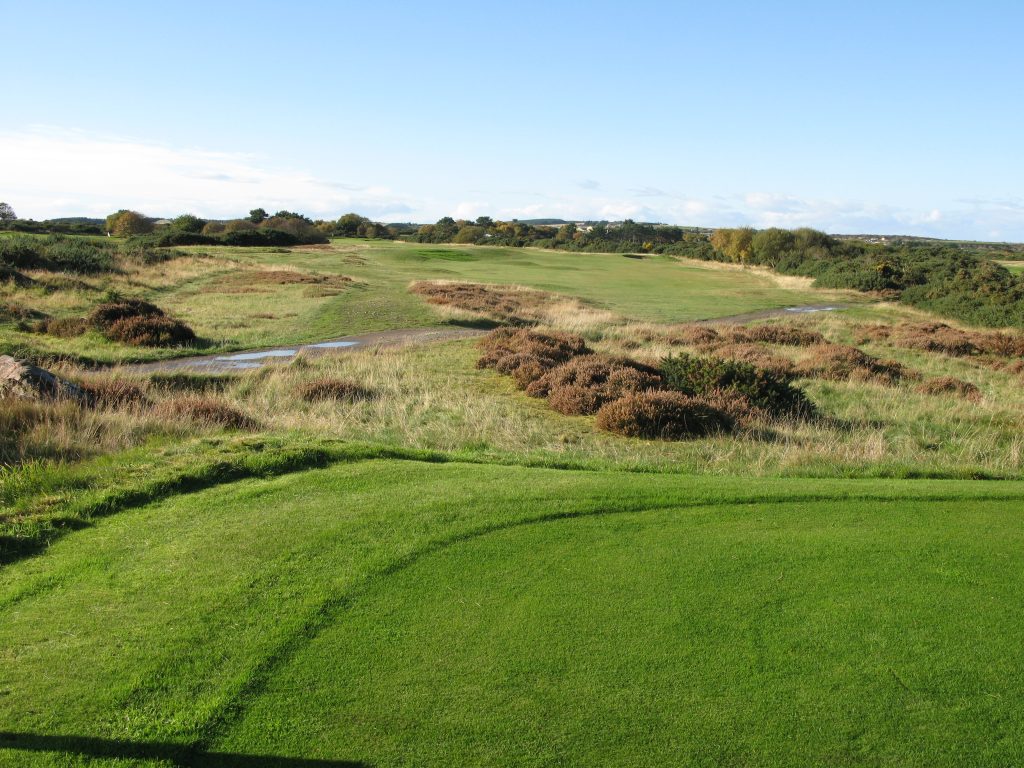
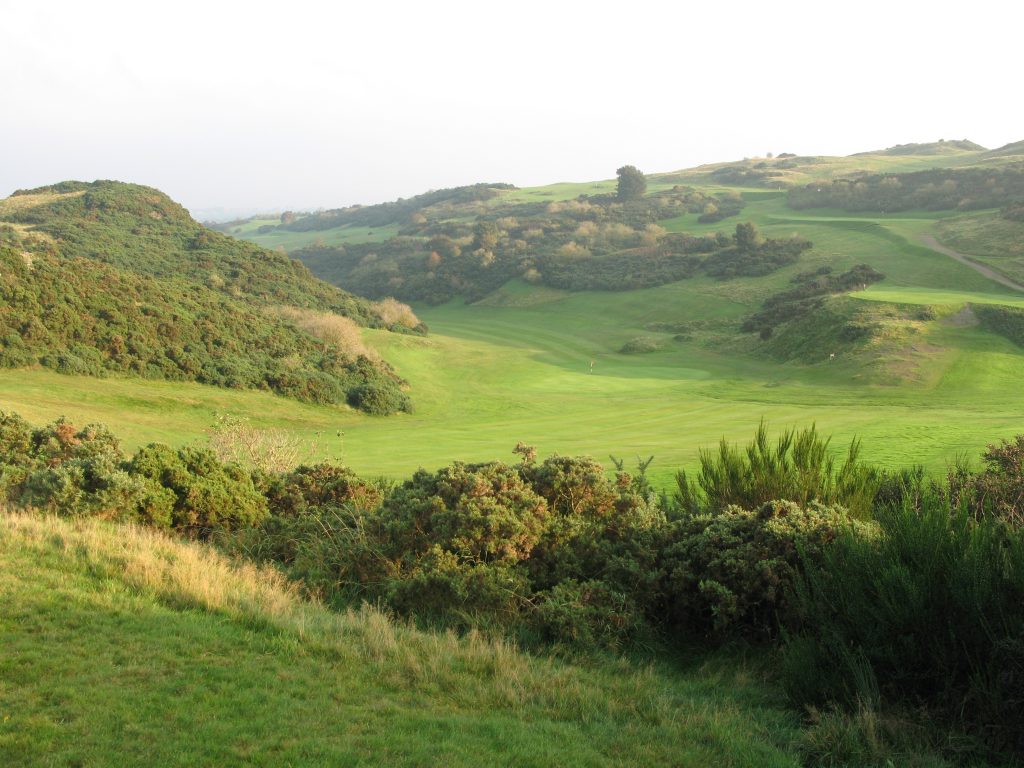
The beautiful looking 3rd at Moray New

The New course is closely intertwined with the Old and it’s important to check which coloured flags are in use on each course.

A significant hazard can be the noise from jet aircraft from the adjacent RAF Lossiemouth base, which is closest to the 6th green on the New.  When I played there was a busy flying day and I was treated to some fast climbing displays by the local Typhoon jets of No’s 1(F), II(AC) and 6 squadrons – the primary task at RAF Lossiemouth is to maintain the Quick Reaction Alert (Interceptor) North mission.
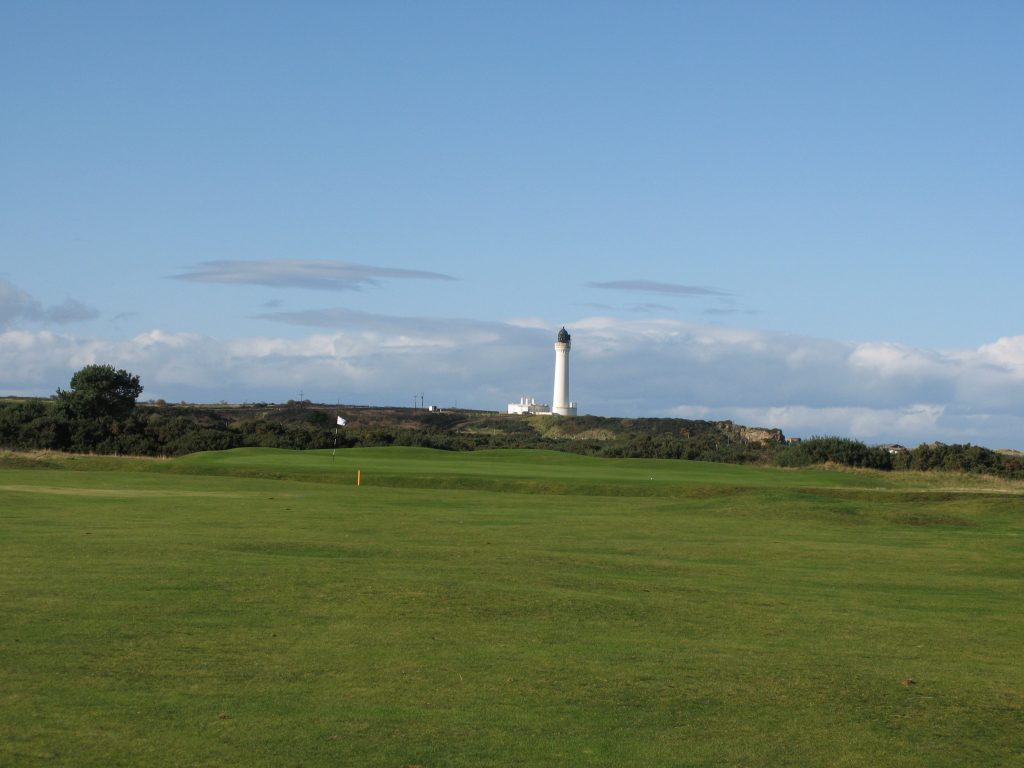
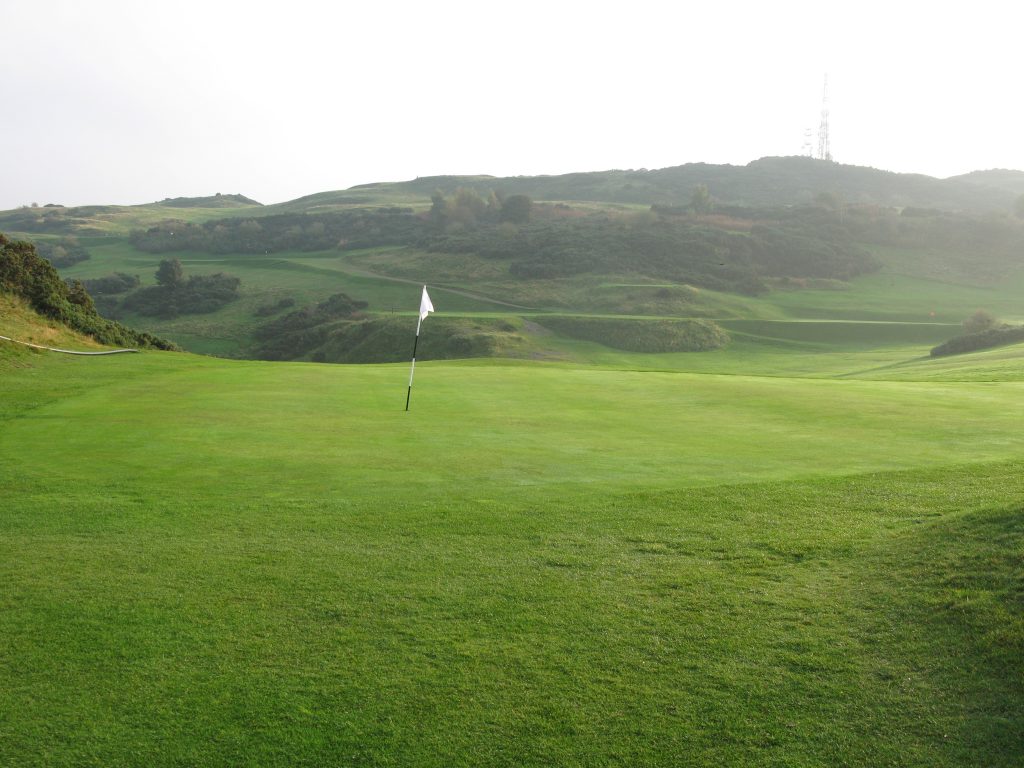
Approach to the 5th at Moray New – with burn in front of green

The course has some fine holes, dominated by the wind of the day.  The 10th is the closest to the coast, and the prevailing wind will normally be against and from the left, making it difficult for a right handed slicer – the green is on a slight plateau and difficult to find.  The par 4 14th, Stroke index 1, will play like a par 5 for all bar the really long hitters.

There are some tricky par 3s, with the innocuous looking short 6th having the burn passing directly in front of the green, making a front tee position very difficult.  The 17th, the longest of the par 3s, has 4 well placed green side bunkers awaiting.  In general, there is some clever bunkering on both fairways and greens throughout the course, although this course does not have the deep re-vetted bunkers found on many a links course.
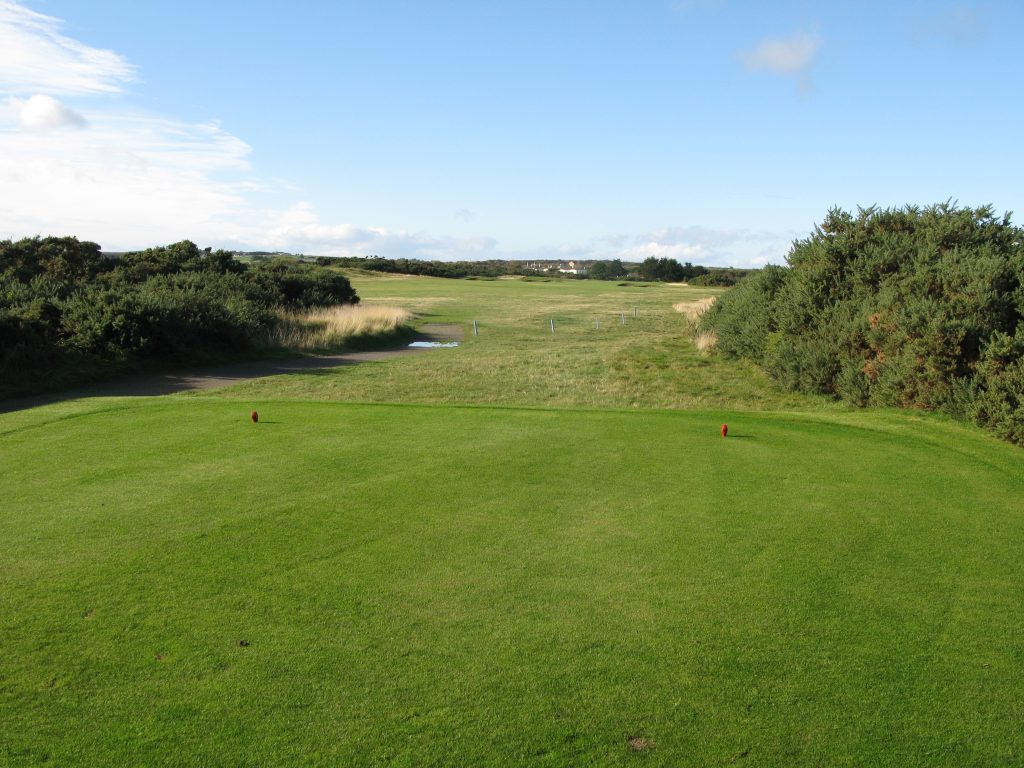
7th at Moray New, one of the challenging par 4s (SI 7)

The course was in excellent condition for a late October day, demonstrating how accessible Scottish Links courses can be all year round – by comparison many courses inland were closed due to being waterlogged on the same day.

Other than plane spotting, playing at Moray is highly recommended for whisky lovers, since Moray has a well established and long relationship with nearby distillers (several of whom were original members of Moray) from whom the club has bought several vintage whiskys.  It has its own label “Club malt”, currently a Macallan.  Curiously, there is more about the history of whisky on the club’s web site than the golf courses!
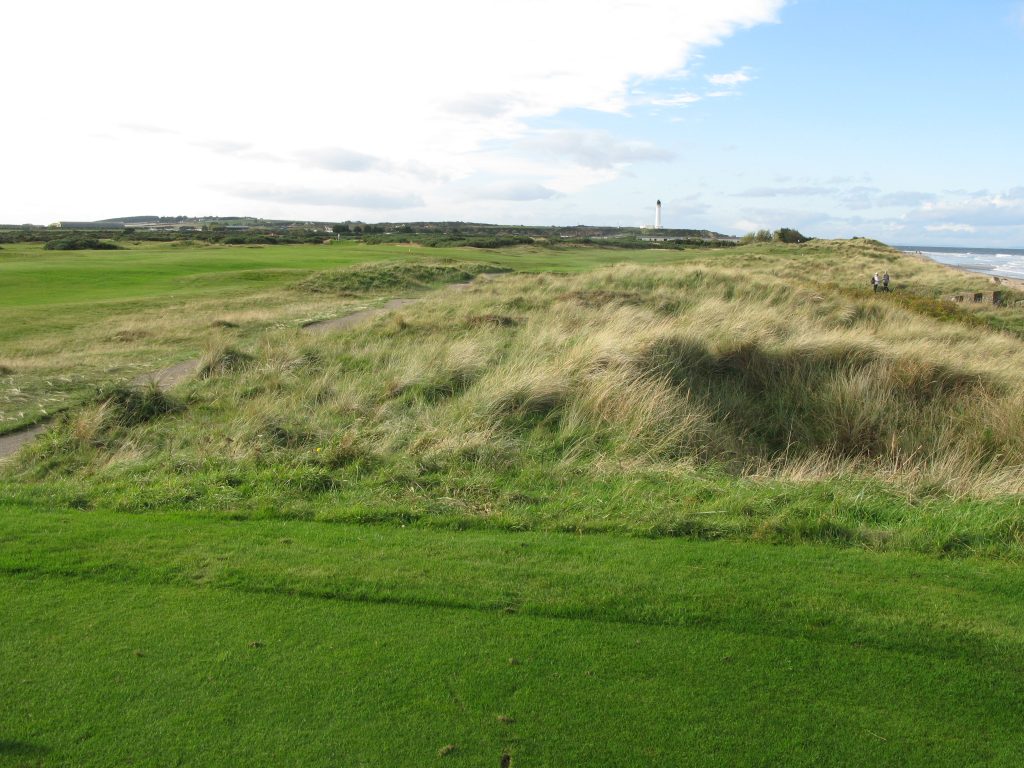
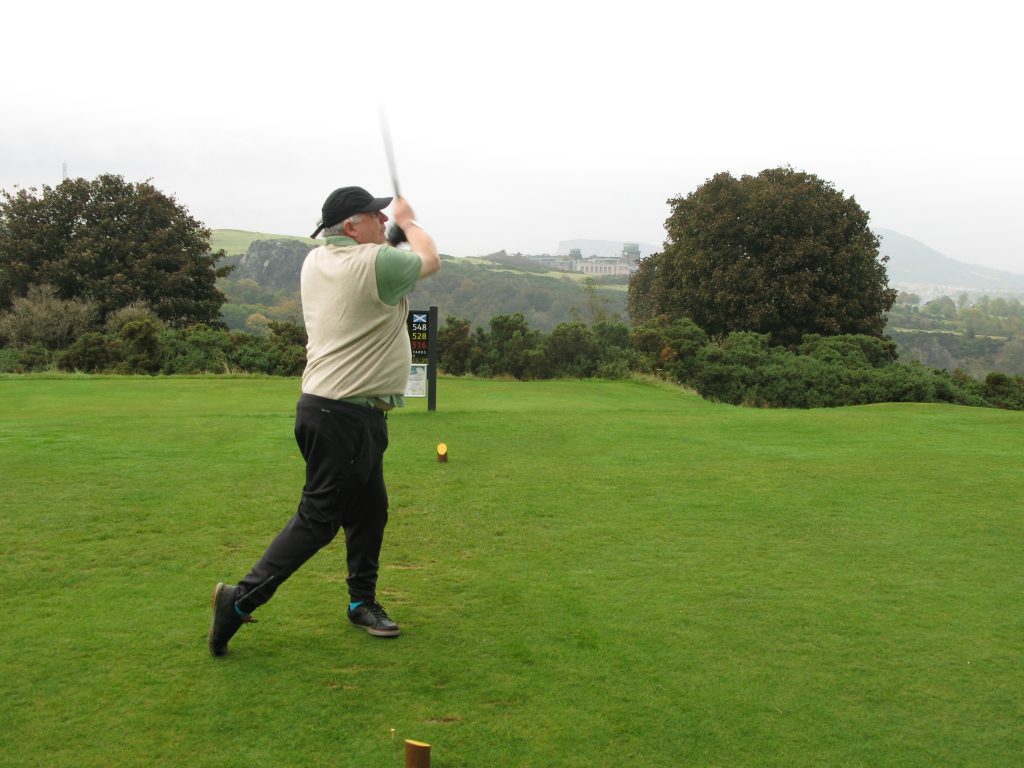
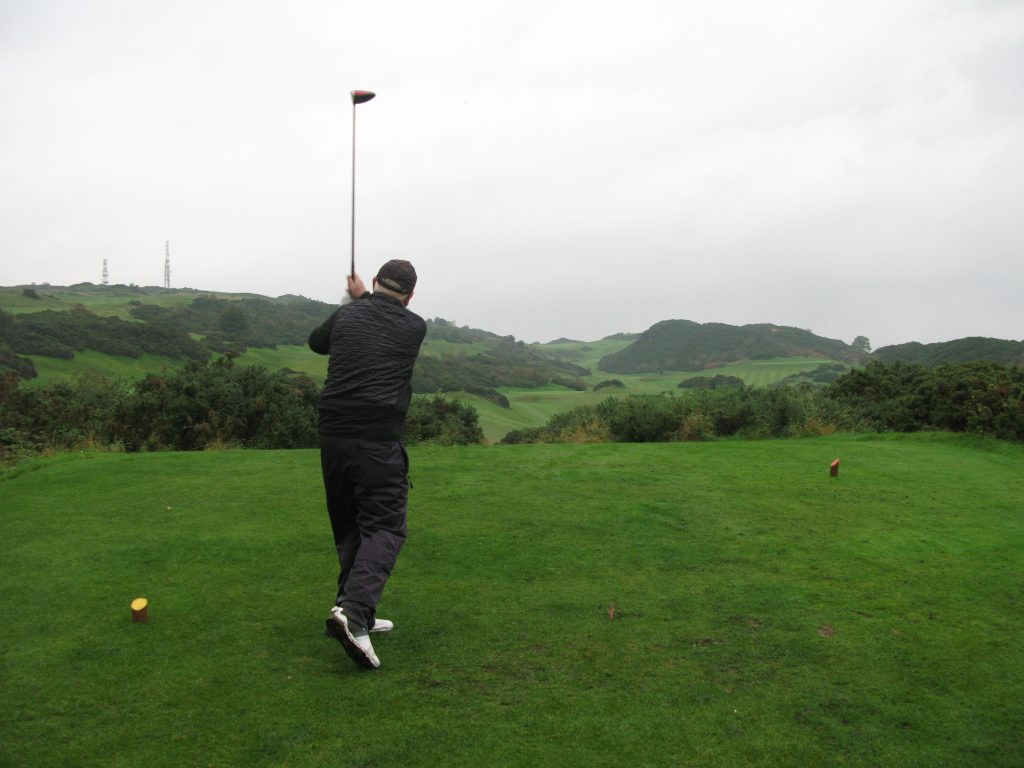
Par 4 10th tee, a nightmare in the prevailing wind from the left!

A story worth noting is the political dispute Moray GC had with, probably in hindsight, its most famous member, the first UK Labour Prime Minister, Ramsay MacDonald –  he was removed from the membership list in 1916 for his opposition to the First World War.  He was finally reinstated as a member in 1929, but never played Moray again.

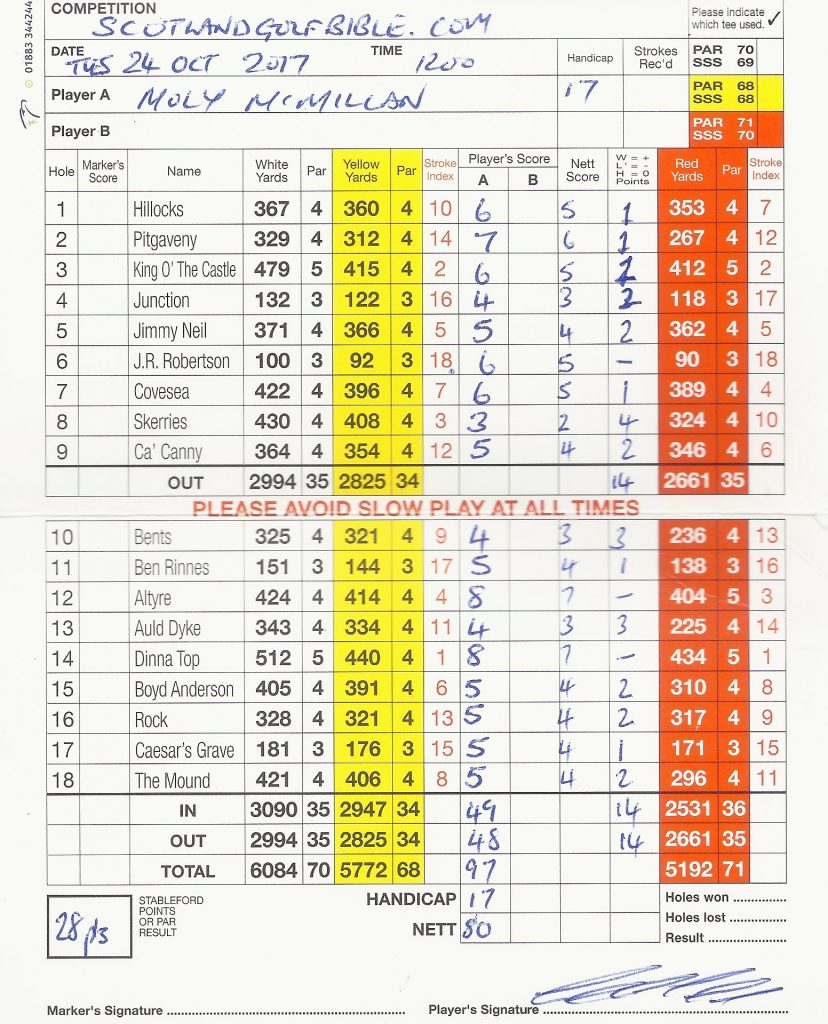
On the day, I played reasonably well for 28 points, although had a few disasters (on 12 and 14 especially), which meant I scored a gross 97.  I got a birdie on 8, which was my highlight.

If you plan to play the Old course at Moray, try and make sure you savour the New as well.  Highly recommended.  I played using The Courier golf voucher deal for only £15 – an absolute bargain.

Facts:

Course Type: Links

Par 68 (14 par 4s, 4 par 3s)

Distance (yellow): 5772

Moly’s Gross score97

Moly’s Moray Old scorecard – 97 for 28 points
 

68. Braid Hills No 1. 16th Oct 2017.

Edinburgh’s public gem too prominent to be called “hidden”   

Summary:  Round  £25.30.   Par 70.  Value (out of 5) – 4.5

Braid Hills “No 1” is a wonderful public 18 hole golf course carved among the gorse and hillocks of Braid Hills on the south western edges of Edinburgh.  It has magnificent views of the Edinburgh skyline towards the Firth of Forth and also the Pentland Hills.  Although often misused, the term “gem” could well have been defined just for this golf course.  It is sometimes described as “one of the best loved public courses in Scotland”, and a real gem it is.

Overlooking the 16th green and 17th tee, with the view representing the feel of Braid Hills

“The Braids” takes its name historically from the nearby Braid estate originally the property of the “de Brad” family, one of whom, Henri de Brad, was Sheriff of Edinburgh in the 12th century.  The name has nothing to do with the famous course architect James Braid who, ironically, did not in any way shape his namesake course!

It was appropriate to play here with Sheriff Frank Crowe, fully equipped with Tommy Armour irons, given that Henri de Brad, the 12th Century Sheriff of Edinburgh, is the origin of the Braid Hills name.

The golf course was opened in 1893 and several golf clubs sprang up to accommodate the popularity of the sport with many of those clubs still affiliated: Edinburgh Thistle, Edinburgh Western, Harrison, Comiston Ladies and Braids United.  The 1931 Open Champion Tommy Armour was a member at Edinburgh Western.  Such was the popularity of golf, the nearby Braid Hills Hotel, immortalised in Muriel Spark’s ‘The Prime of Miss Jean Brodie’, originally had a Golf Room erected to serve the golfers playing the new Braid Hills golf course.

It’s a relatively short course, but there are many blind or semi blind tee shots, and I would highly recommend buying the course planner, as some of the holes can be played with very different strategies, most notably the par 4 7th and 14th holes, where successful drives can be 60 yards wide on either left or right.

Brian Fearon teeing off at the very difficult par 4 7th hole. Choose your line with care; my shot seemed the best drive but was never found!

Although easily accessed from the city, whilst on the course if feels incredibly remote, especially in one of the holes surrounded by the gorse.  The main hazard on this course is the pervasive gorse bushes, and the need to get the correct alignment from the tee.  If you play well off the tee here, you will score low, otherwise disaster awaits.  This is reflected abundantly on my card, where I had several disasters, resulting in lost balls.  However, I found many more that I lost – on the 4th hole my own ball was the 7th I found.  Make sure you remember the ball you played with!  Also take care with approach shots, which often seem to take at least one extra shot here – this was evident from the 17th tee, which has about 140 yards of “valley” between the tee and green – you need to get up here to make par.

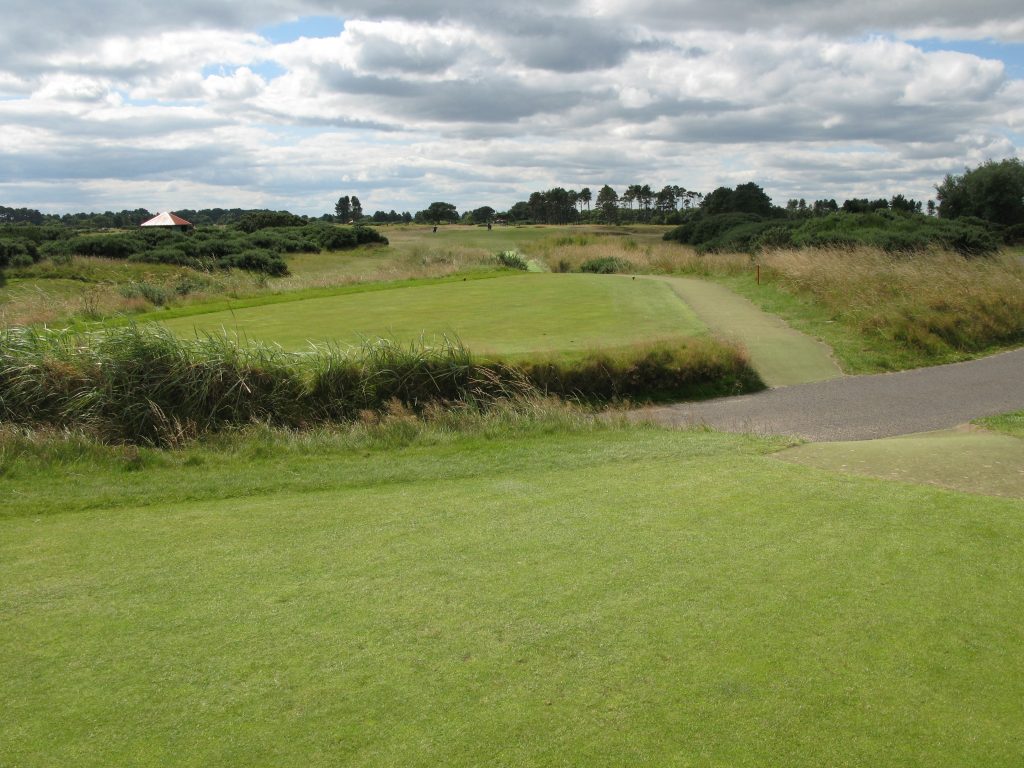
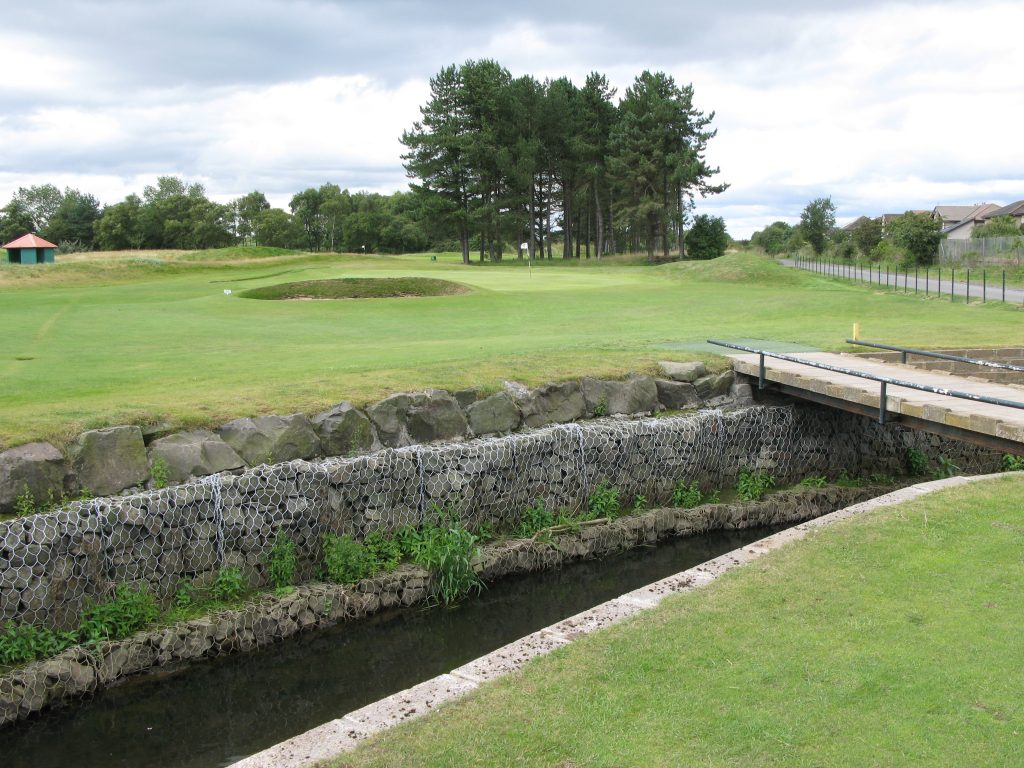
The lovely par 3 17th, one of 4 nice par 3s, of which the uphill 9th was the most challenging

The walk is quite hilly with some hazardous steps up and down from teeing grounds, but the walk is well worth it just to get to the 18th tee alone which must have one of the best views in Edinburgh.  Even on a fairly misty day we were able to appreciate it.

The course was in pretty good condition when I played with some colleagues from the Apex organisation.  The greens were quite quick and the fairways good; there were some bunkers although they are quite spare and very basic in construction.

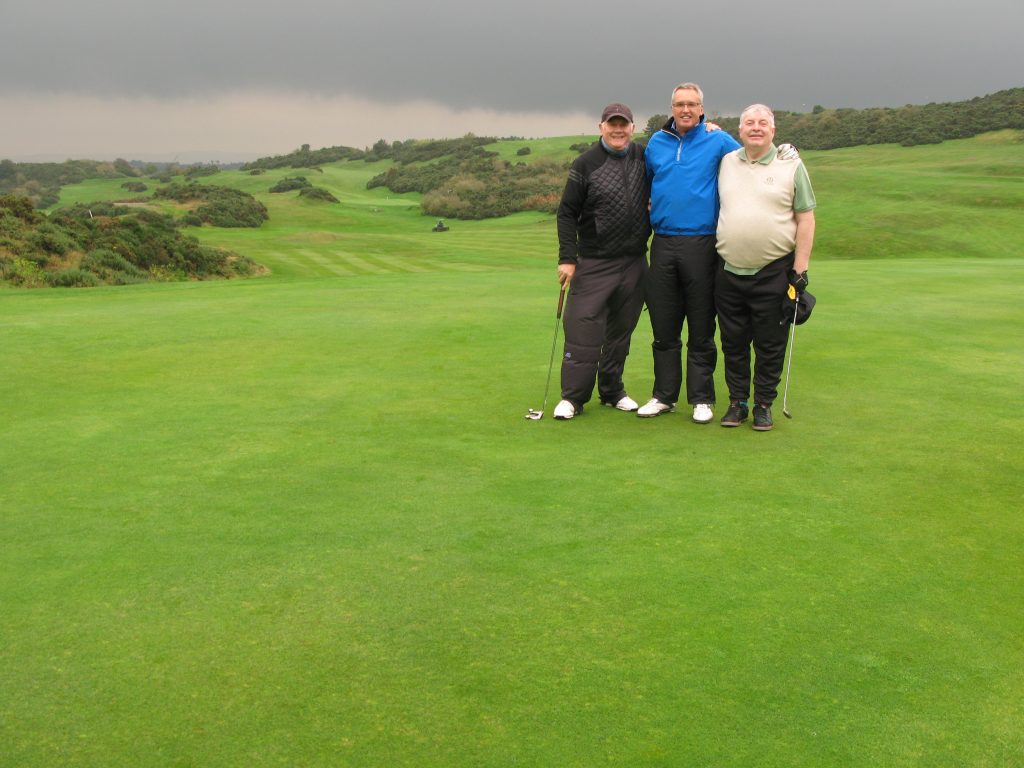
A set of happy golfers on the characteristic 8th hole of Braid Hills.

For the record, there once was a Braid Hills No 2 course of 18 holes, but that disappeared a few decades ago, and there is now nearby a small 9 hole course called Wee Braids and also a Braid Hills Golf Centre.

This is a really great little golf course highly recommended.

Facts:

Course Type: Heathland

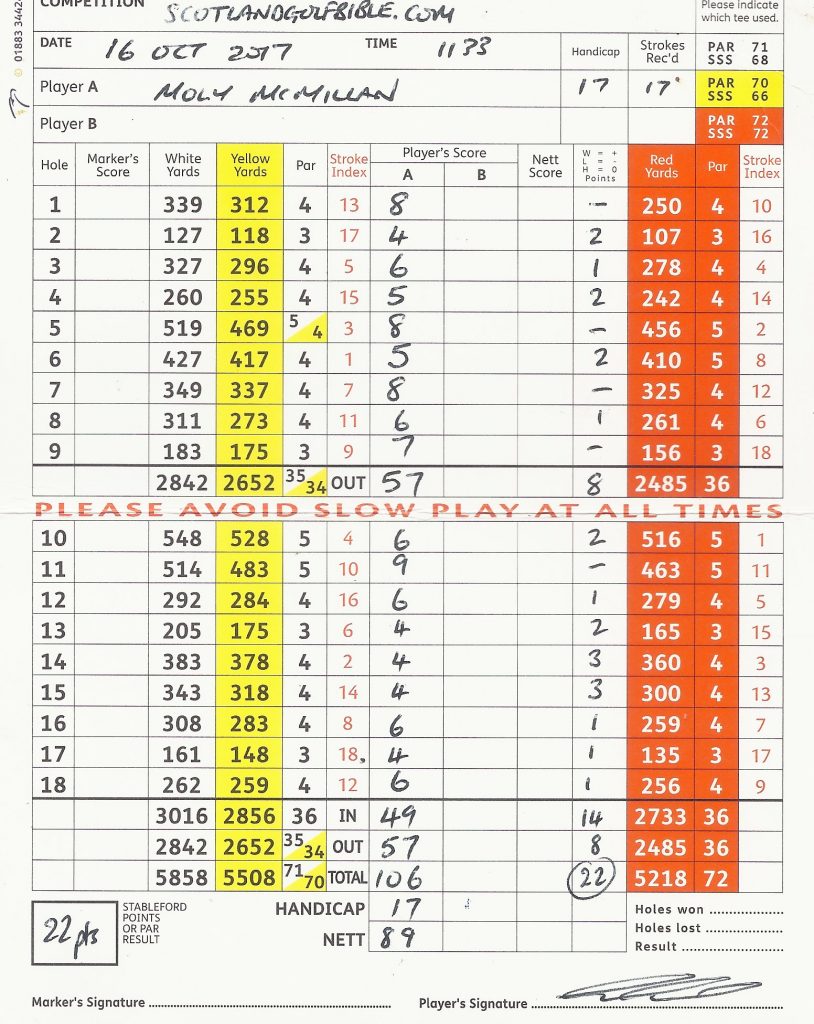
Par 70 (2 par 5s, 12 par 4s, 4 par 3s)

Distance (yellow): 5508

Moly’s Gross score: 106

Moly’s disastrous Braid Hills Card – 106 including 10 penalty shots and 40 putts

62. Carnoustie Burnside. 9th Aug 2017.

Treading on possibly the very origins of links golf

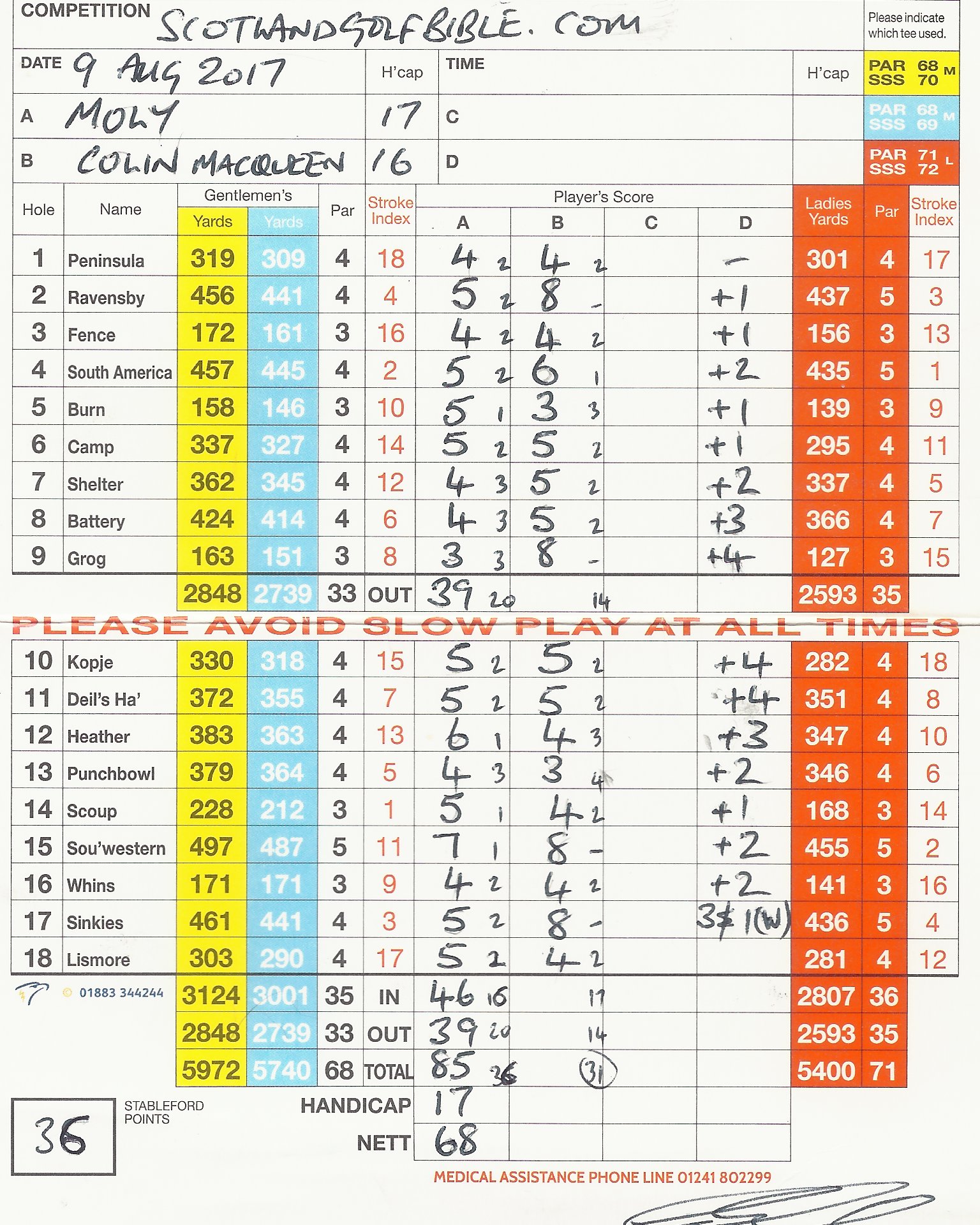
Summary: Cost £46. Par 68.  Score 85. Value (out of 5) – 4.5.

The Burnside course, or more correctly the Carnoustie Burnside course, is eclipsed by its magnificent Championship course neighbour, but that’s only because the Championship course is one of the greatest courses in the world!  Do not play the Championship course without also trying The Burnside, which is a great naturally laid out links course.

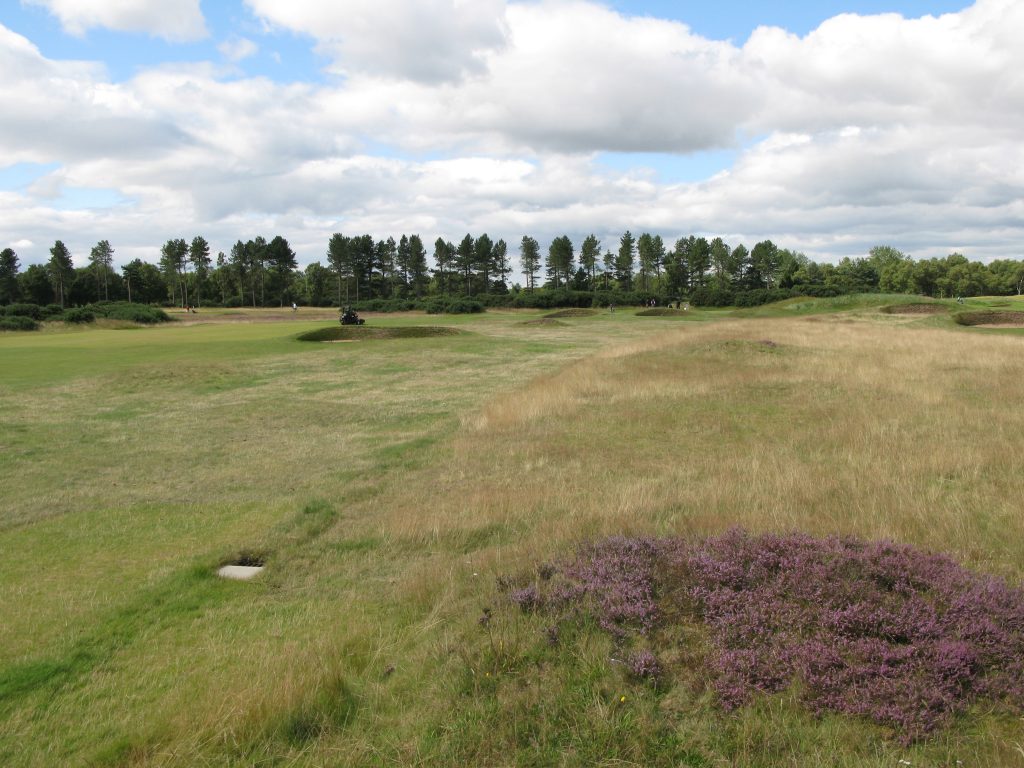
The wonderful links land view from the 15th tee of The Burnside

Golf on the “Barry Links” was recorded as early as 1527, nearly 50 years earlier than St Andrews, making this the area that “Links” golf was first played.  The Scottish Golf History web site lays out a strong case that these first games of links golf were most likely played on the land between the Barry Burn (more of that later) and the railway line currently where holes 1 to 5 of the Burnside course are.

Therefore, arguably, “The Burner” is the most historical of all links golf courses!  You are truly walking among the ghosts of golf’s distant past playing here.

The 3rd hole, the first of 5 wonderful par 3s, the highlight of Burnside – the Barry Burn awaits!

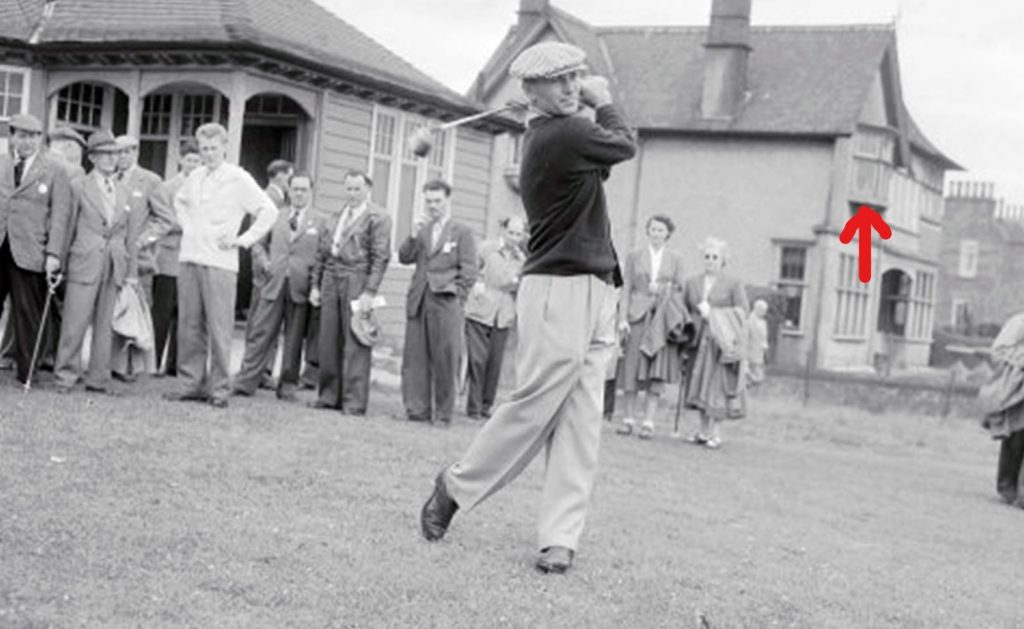
Of course, there are more recent historical stories worth telling.  It’s largely forgotten that when Ben Hogan famously won his 1953 Open at Carnoustie he qualified on The Burnside course.  It was therefore very apt that I played The Burnside with my brother-in-law, Colin Macqueen, since his fascination with golf started during the same summer of 1953 when he and his elder brothers were mesmerised by the large crowds watching Ben Hogan outside the window of their home, “Lismore House”, which overlooks the Burnside’s 18th green.

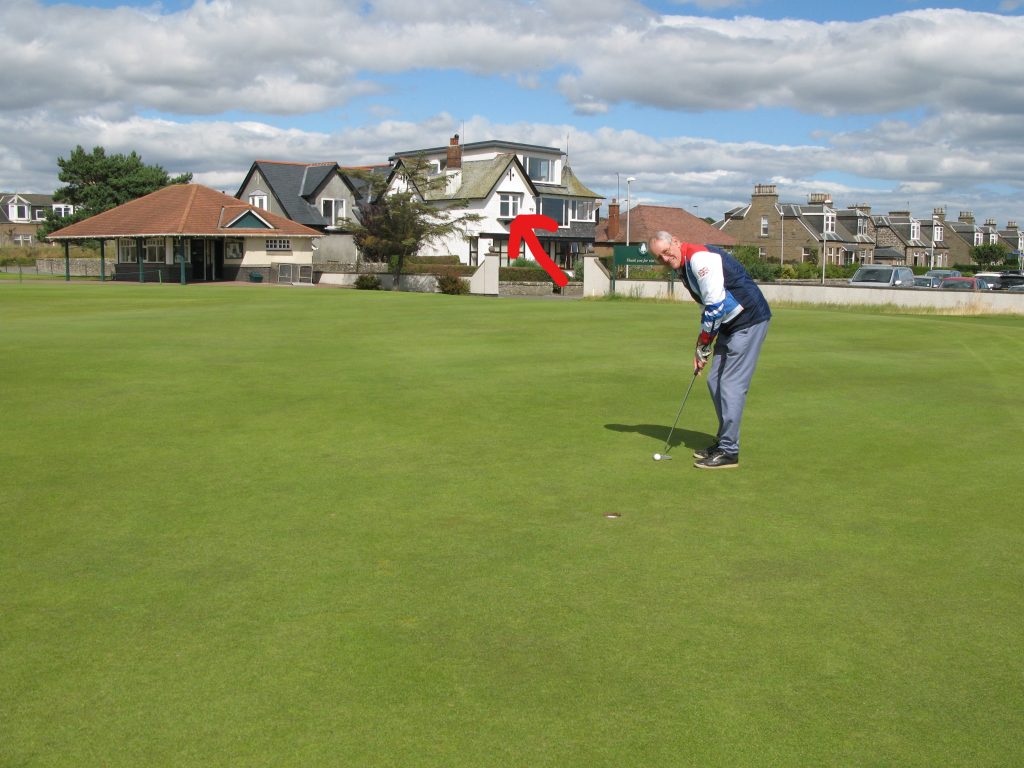
Hogan playing the Burnside; Colin Macqueen’s “Lismore House” bedroom highlighted.

Colin has dined in Australia, his home of 50 years now, on the true story of him falling out of the upper floor bay window nearly causing Ben to miss a crucial putt!

The Burnside was designed by James Braid and opened in 1934, not long after Braid had redesigned the Championship course in 1926.  Although a relatively short golf course at just under 6000 yards, many of the holes would easily be at home on an Open venue.  The 5th, 9th and 14th are par 3s of the highest calibre, each with a very different challenge.

The beautifully difficult par 3 9th green.

The 5th is surrounded by the Barry Burn (that of Jean van de Velde fame) where it’s virtually impossible to get close to a right-hand pin. The large plateau green at the 9th makes it imperative to hit the green with the tee shot. The long 14th is stoke index 1 for a good reason, and is a magnificent test.

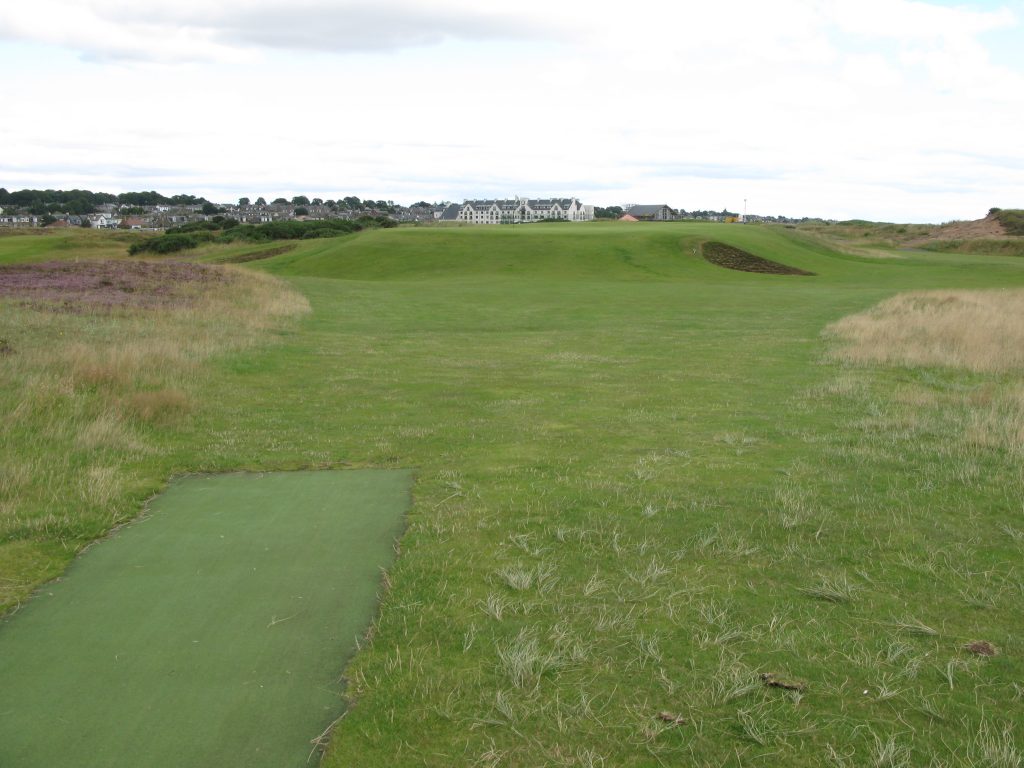
Bunkers sprinkle the 6th fairway at The Burnside

The 17th, a par 4 of about 450 yards, needs to be played with a 3-shot strategy for all bar the very long hitters.   I could also get into details on many other holes, the course is that good.  To cap it all, the greens have very subtle borrows, so putting needs extra concentration.  It is one of the great small James Braid courses.

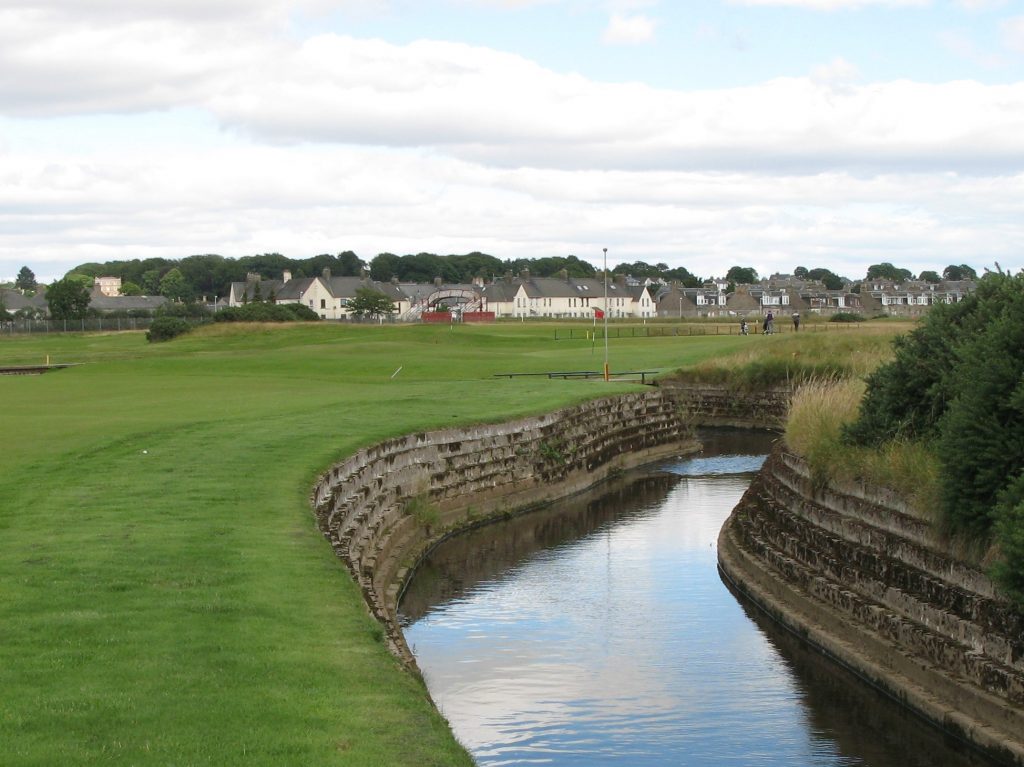
The Barry Burn (of Jean van de Velde fame) at the long par 4 17th – a card wrecker

With the large green keeping staff at Carnoustie, it was no surprise that the course was in such fine condition.  The tees, fairways, bunkers, rough and greens were all superb, and to have the sun shine made for a quite memorable round.  I scored 85 for a net level par score off my new handicap of 17; this was enough to beat Colin 3 and 1, which at least meant he could focus on the 18th green photograph, close to the site of Hogan’s zenith and also Colin’s boyhood fall.

My playing partner, Colin Macqueen, on the 18th with his bedroom highlighted in the background, where he fell in 1953 during Hogan’s Open!

A quite magnificent days’ golf.

Key Facts

Course Type: Links

Par 68 (1 par 5, 12 par 4s, 5 par 3s)

Distance (blue): 5740

Moly’s Gross score: 85

Moly’s Burnside scorecard – 85 for 36 points (off 17)

61. Ballater. 2nd Aug 2017.

Ballater seemed a good choice to return to golf blogging after several months absence due mainly to my sojourn to watch the British Lions take on the All Blacks. Ballater is 40 miles east of Aberdeen, in the heart of Royal Deeside, an area I spent many happy years hill walking in during my teens.  The “royal” tag comes as Balmoral Castle, The Queen’s summer residence, is only a few miles away.

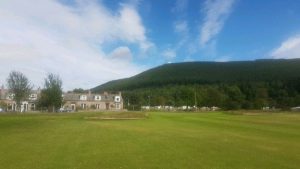
18th green and large clubhouse at Ballater

A nine hole golf course was founded in Ballater in 1892, and extended to 18 in 1905, the pedigree of the course demonstrated by an exhibition match between James Braid and Harry Vardon in 1906.

Although the course is described on it’s web site as mainly heathland with parkland characteristics, I beg to differ and say it’s actually the other way round, and felt much more parkland to me.  Although surrounded by hills and forest, the course is surprisingly flat and offers an easy walk.  With many fairways adjacent to each other, with only light rough in between, it offers regular opportunity to be wild off the tee and still easily find your ball – something I unfortunately took advantage of often!  However, overall this is not an easy course with some very tricky greenside bunkers (some of which are blind to your approach shots) and some very penal rough.

The very large 1st green at Ballater

Although the course lies close to the River Dee the river does not come into play as often, by comparison, as Braemar (further along the Dee).  These open fairways and lack of water in play, means the course is quite good for holiday golfers.  However, the course is quite busy and I would recommend booking, especially during the Summer months.

The course has some challenges in particular the opening six holes are very tough – I double bogied the first 5 holes, and actually felt I struck the ball well!   The 3 par 3s on the opening 9 holes are particularly tough, culminating with the 9th hole which has a semi blind small green.

The typically Scottish 2nd green at Ballater with the town houses in background

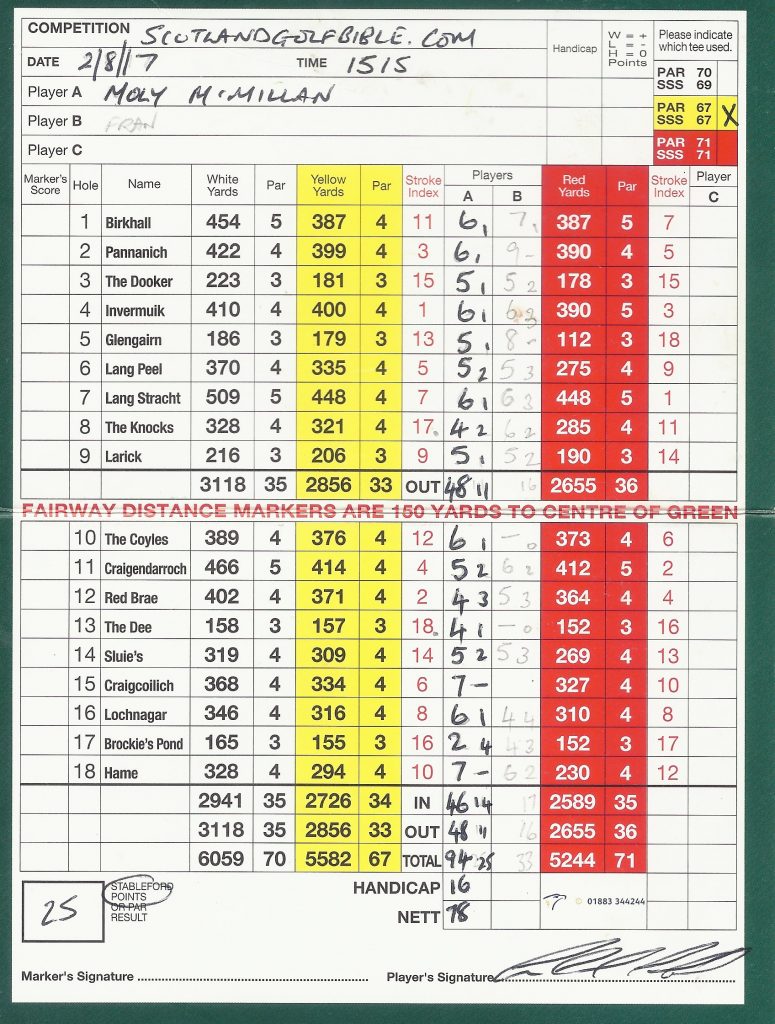
The course was in all round good condition when I played, with good greens and lush but firm fairways.   I played better than my scorecard would suggest.  It felt like a 30 point day, but with 3 balls lost, for 6 penalties, made it only 25 points.  I had a nice birdie 2 on the par 3 17th though.

I played having booked through the teeofftimes.co.uk website and paid £22.50 versus the course published price of £35 for a midweek round.  At £22.50 it would be worth 4/5 for value but only 3/5 using its rack rate.

It’s worth playing this nice course, which also has a big bar and good value restaurant food.

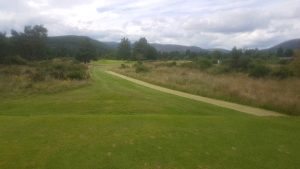
Tricky Par 3 5th at Ballater

Note: I had to use my phone for pictures, which are not the usual standard….sorry!

Key Facts

Course Type: Parkland

Par 67 (0 par 5s, 13 par 4s, 5 par 3s)

Distance (yellow): 5582

Moly’s Gross score94.

Moly’s Ballater scorecard – 94 for only 25 Stableford points:(

« Older posts Newer posts »

© 2026 Scotland Golf Bible

Theme by Anders NorenUp ↑