A guide to green fee value for money

Category: 4 star (Page 14 of 22)

76. Meldrum House. 19 June 2018.

Aberdeenshire’s “exclusive golf experience” is untypically Scottish and fails to deliver value   

Round £85 + hotel residency.   Par 70.  Value (out of 5) – 2

Let’s get something clear – Meldrum House is a beautifully crafted parkland golf course cut among the agricultural heartland of Aberdeenshire.  The quality and design, by Graham Webster, is of a very high standard.  However (yes, there is a big one), in establishing the course as “the exclusive golf experience”, Meldrum House feels so untypically Scottish.  It felt much more like playing, for example, the AA Golf Club in Epsom, than a Scottish golf course.

Perhaps that’s why there was a need to stock some Highland Cattle between the 17th fairway and the manufactured lawns of the Country House hotel of the same name, otherwise one might think you were playing the very many lookalike late 1900s courses developed in the southern counties of Surrey or Hampshire.
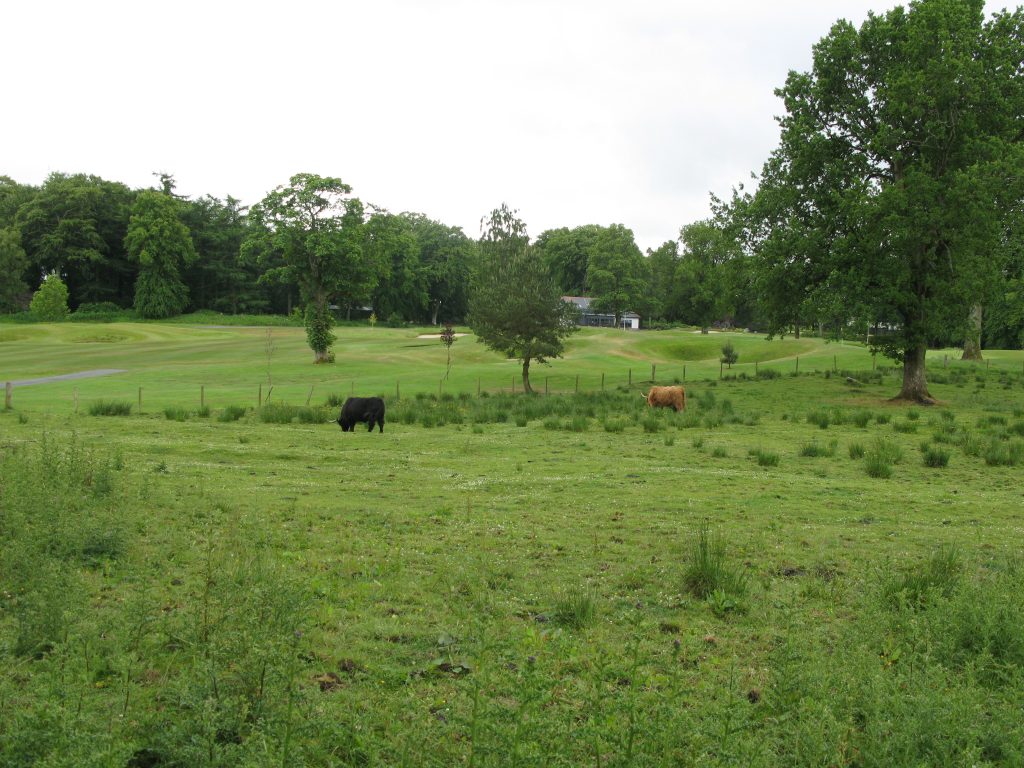
The rare Highland Cattle compliment the surroundings at Meldrum House – 17th hole behind.

The only way to play a single round is to stay at the 4-star Meldrum House hotel, which allows guests to play the course for a fee of £85.   Therefore, with dinner, bed and breakfast, a round here is going to cost at least £250+.  Hence why I’ve assessed its value rating as 2.

Meldrum House hotel provides great accommodation and the estate of the same name has a long heralded history, with the Barony of Meldrum dating back to the 13th Century.  So, if you were looking for an Aberdeenshire short break with a bit of golf and good food, it’s a great option.

For the record, individual membership (2018 prices) of Meldrum House golf club is £1,895, although for that the club does consider it “our privilege to have our members”.  Unsurprisingly, business memberships are available, and start at over £5,000.   Of course, there lies the likely clue to the golf course’s existence, which seems to rest on the wealthy oil industry of the North East.  I’ll wager that this course will not be around in it’s current format, once the North Sea oil is long gone.  Why pay these Meldrum House fees when membership of one of the world’s best courses, Cruden Bay, is £680, and only about 22 miles away?
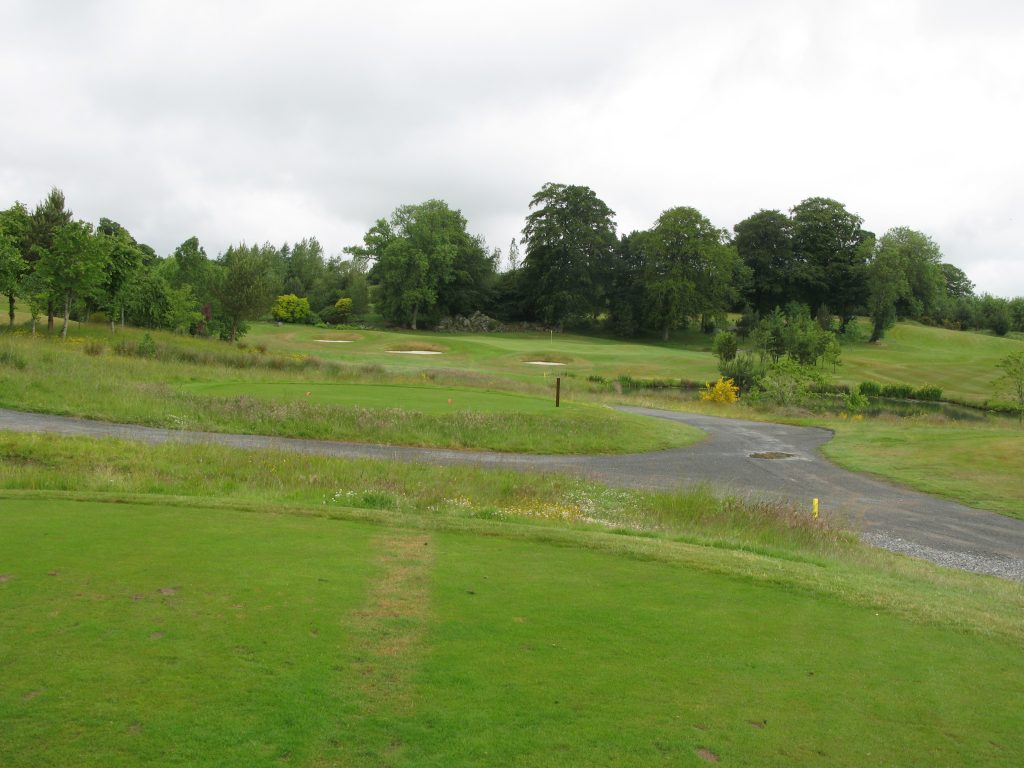
Par 3 10th hole, one of the 7 water feature holes in the first 10 at Meldrum House.

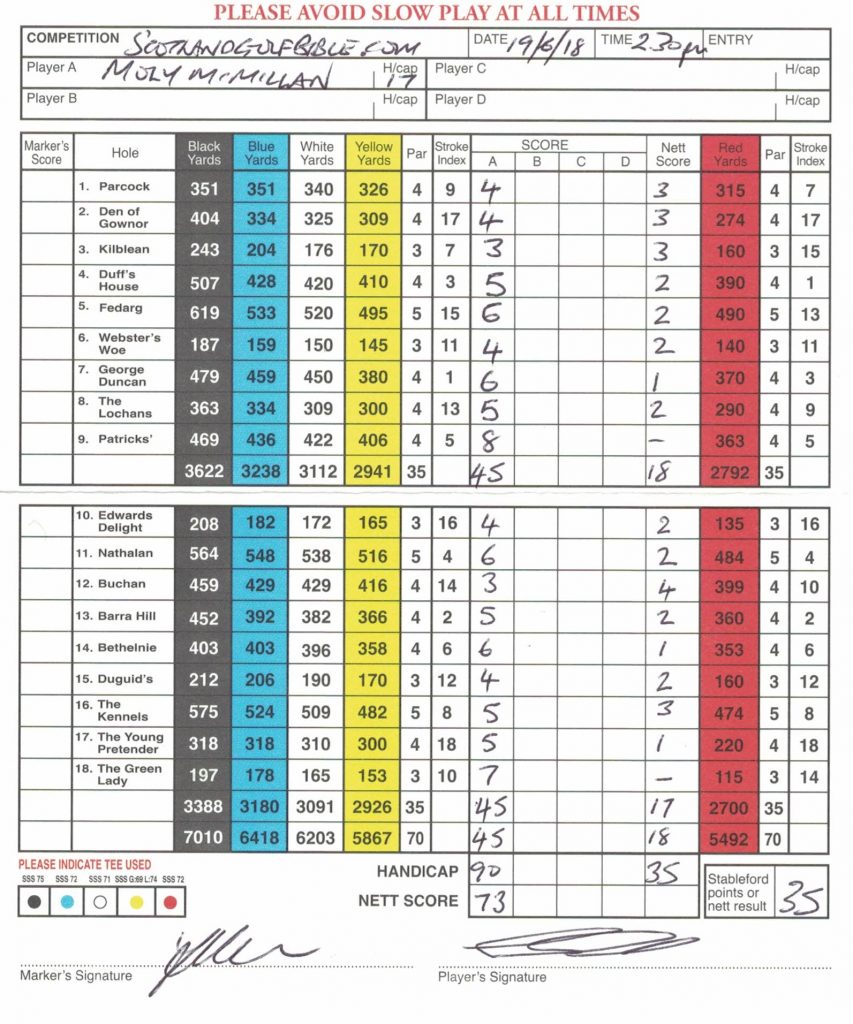
The course has a headline length of over 7000 yards from the black tees, but I suspect most will play from the White (6203) or Yellow (5867) tees, the latter which I used while playing with my wife Fran who used the Red (5492).

There is water genuinely in play at 11 of the 18 holes, and at 7 of the first 10.   There is also many very deep bunkers.  To score well, you need to play strategically around here and pay close attention to the course planner (included in the fee!).  I did this pretty well other than at the 8th, the aptly named “The Lochans”, and the 18th (more of later);  the 8th fairway slopes left to right towards the water hazard, which I surprisingly found after a well struck drive;  the smart play is a hybrid from the tee to the left side of the fairway.

The beautiful 16th hole at Meldrum House, characteristic of the course.

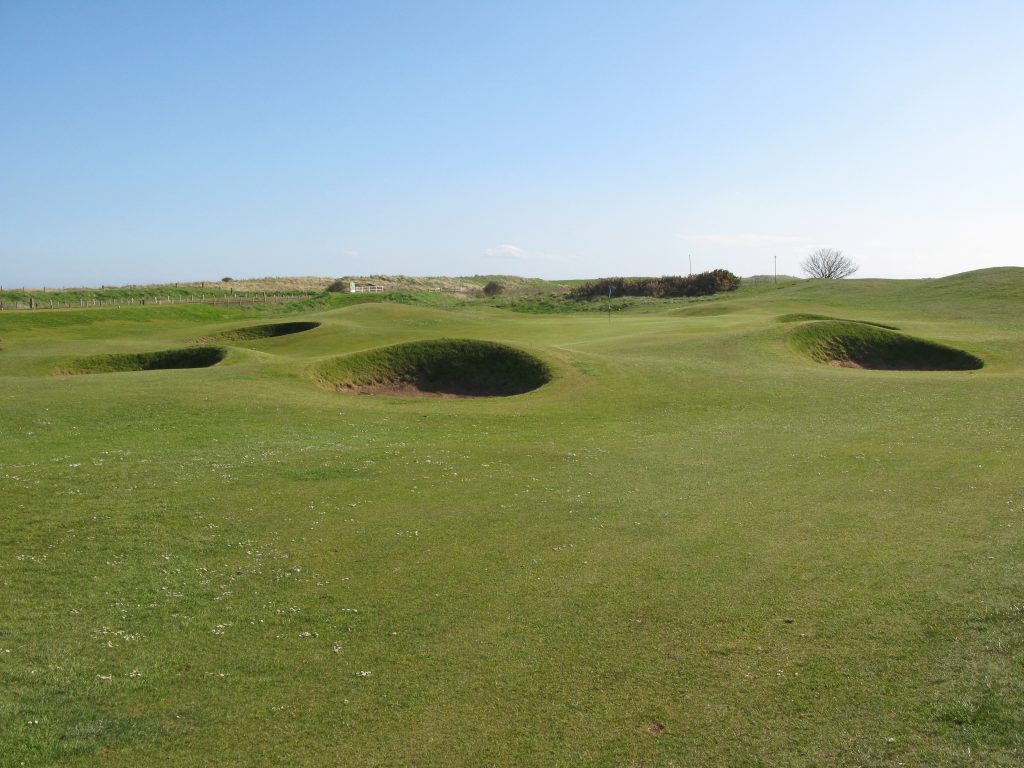
Holes 11 through 15 play on the higher part of the course, with no water hazards, but the stretch starts with what can be described as a “gimmicky” 11th hole which has a disaster of 15 (yes 15) bunkers in front of the green approach.  I couldn’t help wondering what the record is for the most, separate, bunkers ever played from on a single hole??
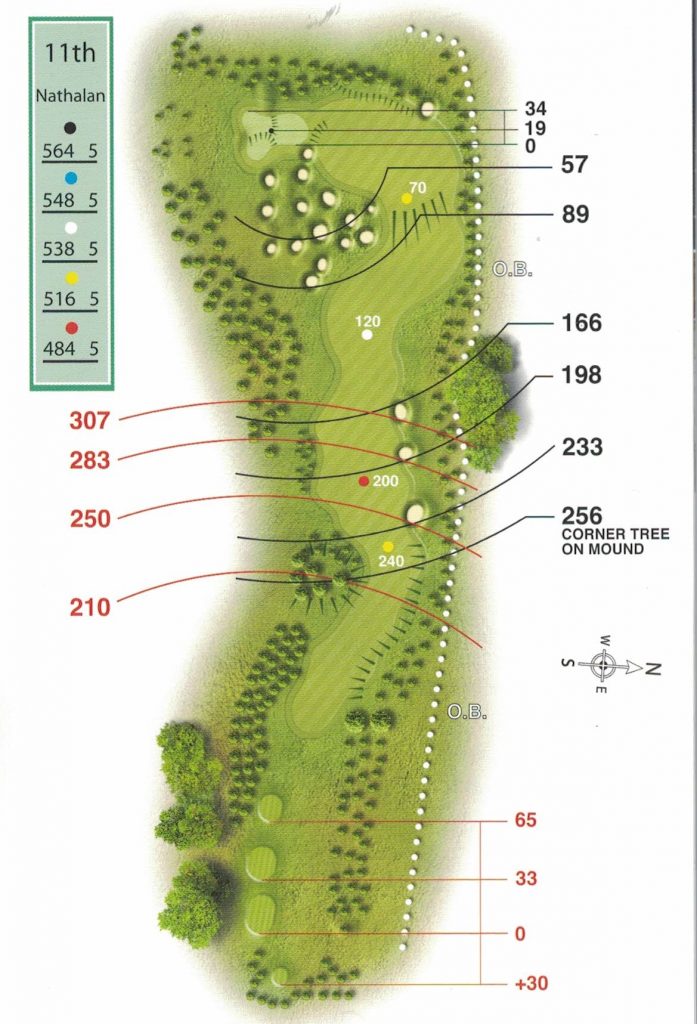
The “gimmicky” long par 5 11th, with bunkers covering 70 yards of the green approach.


The course was in very good condition when I played other than one fairway (9th) which was poor.  The greens were beautiful, the tees and bunkers well kept and manicured.  It was also a very pleasant walk and, of course, there was hardly any other players!

The 18th, unusually, was a short to medium iron, par 3, played over 2 sets of marshy water hazards.  Unfortunately, I found both hazards for a 7, my second quadruple bogie of the day, along with the 9th, which ruined an otherwise impressive card.  I still shot 90 for 35 points.
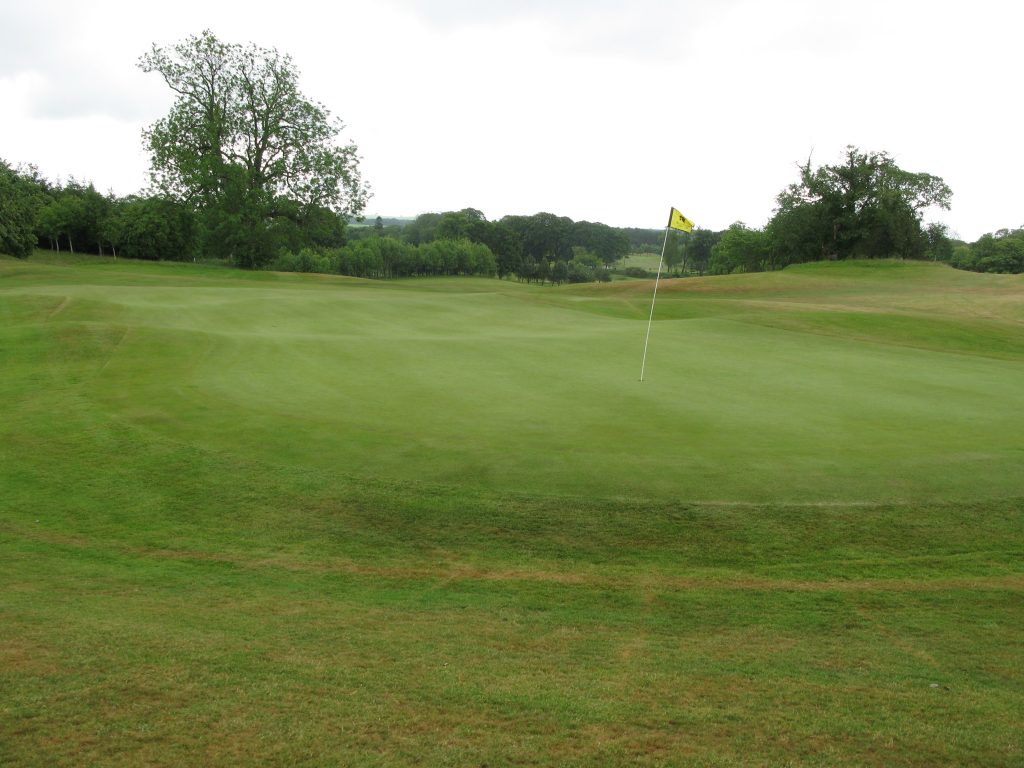
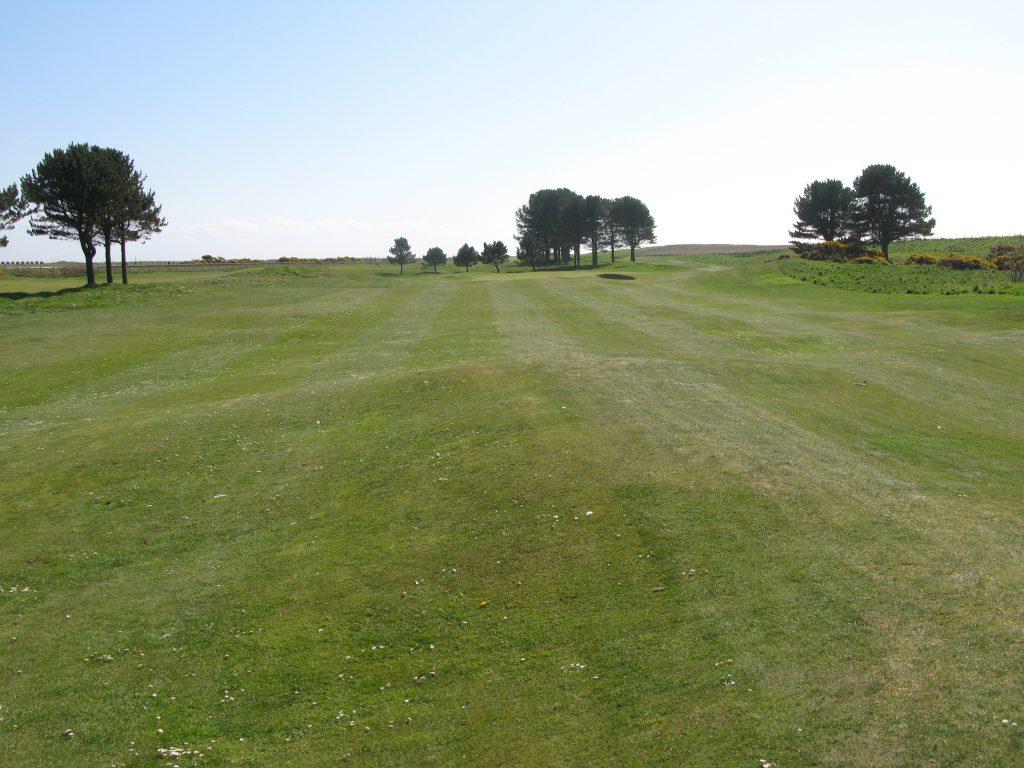
13th green, site of my only birdie of the day at Meldrum House

Oh, I nearly forgot to mention – coffee & tee were “free” in the clubhouse;)

Facts:

Course Type: Parkland

Par 70 (3 par 5s, 10 par 4s, 5 par 3s)

Distance (yellow): 5867

Moly’s Gross score90

Moly’s Meldrum House Scorecard – 90 for 35 points
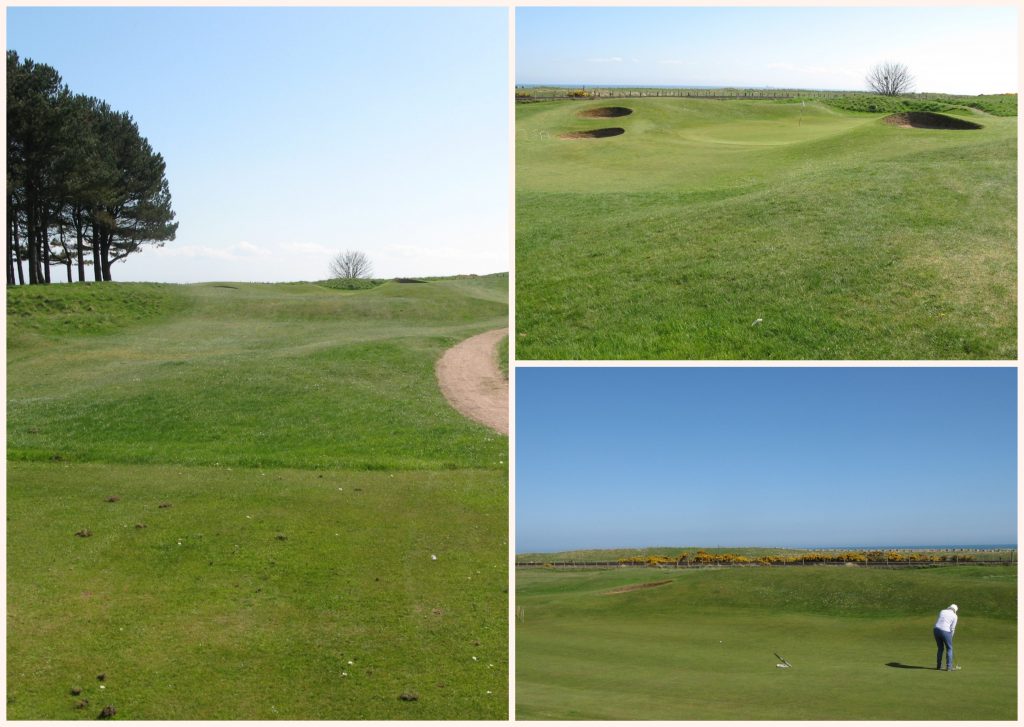
75. Arbroath. 6 May 2018.

A must visit course for US Historians, fish lovers and record book chasers!       

Round £40.   Par 70.  Value (out of 5) – 4

Arbroath is the largest town in Angus and it’s golf course sits about 2 miles to the east of the town and only 6 miles from Carnoustie.  It probably gets bypassed by many visiting golfers moving north from Carnoustie towards the wonderful links courses in Aberdeenshire – this would be a wasted opportunity.

Arbroath has a remarkable claim for it’s influence on the modern world.  The “Declaration of Arbroath”, a Scottish declaration of independence of 1320, is regarded by several historians as the model for the American Declaration of Independence.

The delightful par 3 7th hole at Arbroath (159 yards)

The golf course can also argue a potentially unrivaled and rich architectural history.  Designed by Old Tom Morris, it opened in 1878,  was redesigned by the Troon professional Willie Fernie about 30 years later, then James Braid remodeled the tees, to add length, and bunkers in 1931.  That’s a strong golfing pedigree.

The course is predominantly an out and back layout.  The first 7 holes are played westward into the, normally very strong and cold, prevailing wind, before turning back for the 8th to 10th;  westward again for the 11th and 12th, then with 5 of the last 6 holes played eastward downwind back to the clubhouse.  Strategically, 11 of the holes have reachable out of bounds to the right, so right handed slicers may wish to consider their options off the tee.

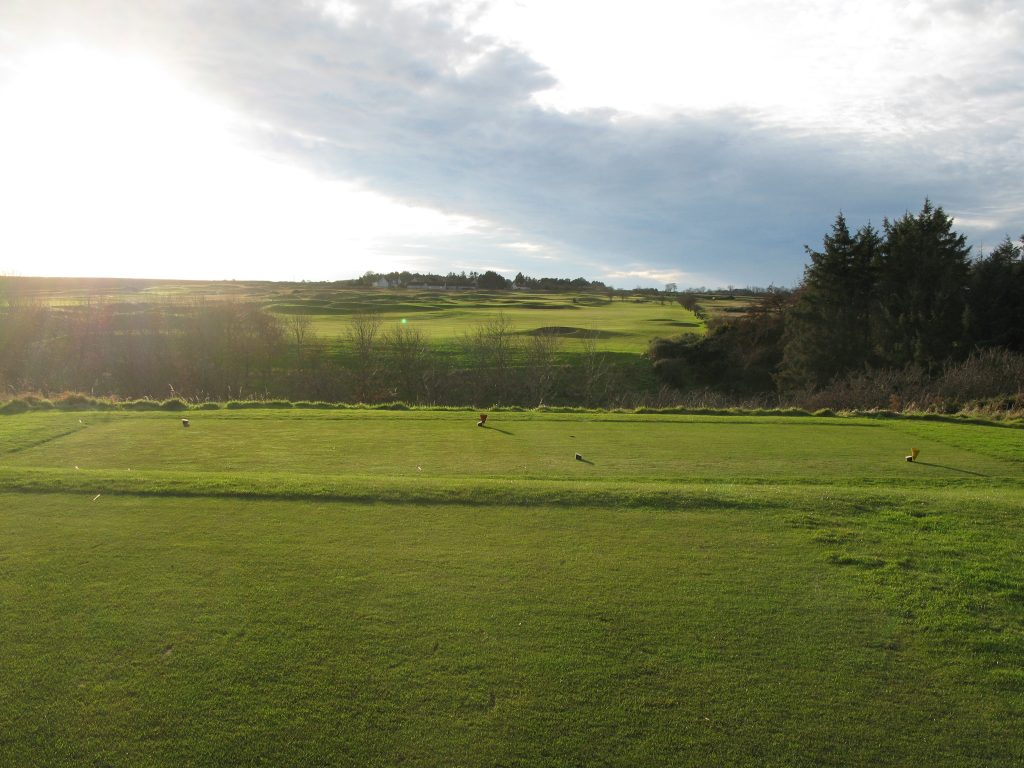
The Stroke Index 7, 375 yard 6th hole at Arbroath, a typically difficult par 4 on the opening stretch of holes.

Viewed from the tees, Arbroath seems at times flat and innocuous, but it has been very cleverly bunkered by Braid, and I’m sure the locals will have many advisory comments on where to miss the greens.  The greens were also very hard when I played and difficult to hold (for all I guess other than very good golfers).  Playing off the yellow tees didn’t give  much respite either, as the 2nd and 17th both played as long par 4s, rather than par 5s from the white tees.  There are also 3 ditches that cross the course, and these need to be carefully considered, especially as the flat terrain makes them invisible to the eye.

I rather suspect first time visitors rarely score much above 30 stableford points.

The very difficult green to find in 2 at the 13th at Arbroath, with the railway OOB on the right

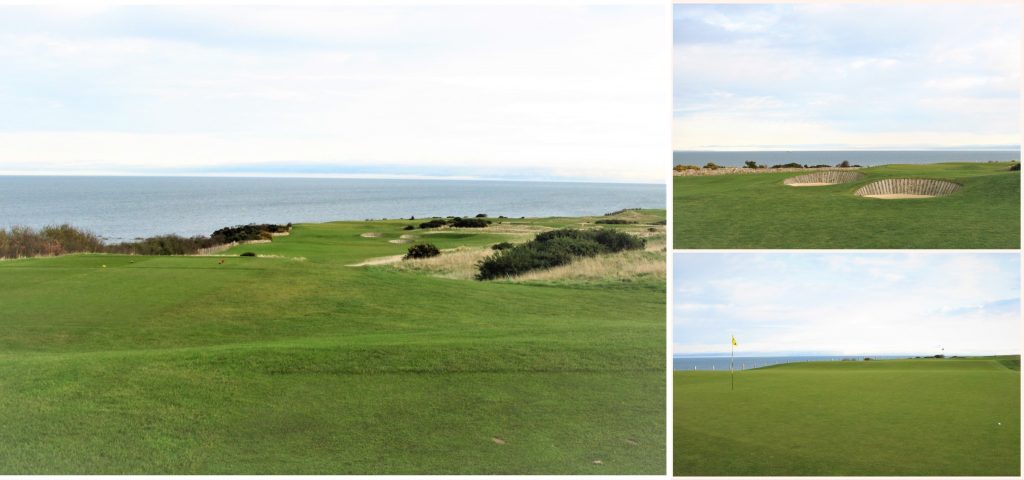
The highlights for me were the par 3s, all of which had good surrounds, with the two on the back 9, the 14th at 200 yards (white at 232) and the 16th, being especially difficult.

It’s a well kept course, with good tees, greens, fairways and bunkers.  The clubhouse has a friendly staff and good food, where you can try the Arbroath Smokie, the local smoked haddock delicacy protected by EU Trade regulations.

The wonderfully bunkered par 3 16th green at Arbroath

The other Arbroath claim to fame is the local Football Club, which holds 2 world records – the highest professional scoring record (winning 36-0), and their ground, Gayfield Park, being the closest to the sea in the world – only 5 and 1/2 yards away!  Apparently, one famous game was abandoned after all balls were “lost at sea!”.

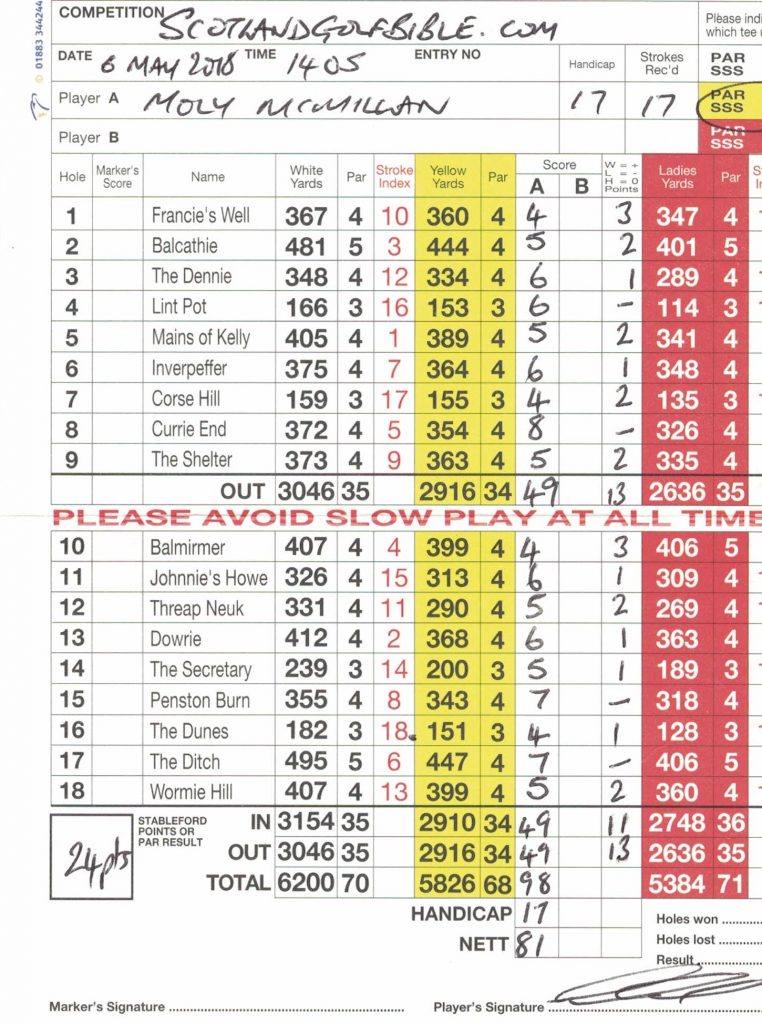
Not a great day for me, I lost 3 balls (6 shots) and 3 putted 7 times!  I suppose that explains completely my 13 over par net!  Oh, and yes, the greens are rather large and difficult!

Well worth a visit.

Facts:

Course Type: Links

Par 68 (14 par 4s, 4 par 3s)

Distance (yellow): 5826

Moly’s Gross score98

Moly’s Arbroath scorecard – 98

74. Fairmont Kittocks. 20 Dec 2017.

American style resort “Links” 2 miles south east of St Andrews       

Round £95.   Par 71.  Value (out of 5) – 3.5

The Kittocks is one of two courses on the Fairmont hotel complex just outside St Andrews.  The resort was opened as the St Andrews Bay Golf Resort and Spa by the American pharmaceutical entrepreneur Dan Panoz in 2001, but has transferred ownership a number of times since.  The sister course is the Torrance named after its architect Sam Torrance the Scottish golfer.   Both courses are championship venues and have hosted major qualifying and senior events.

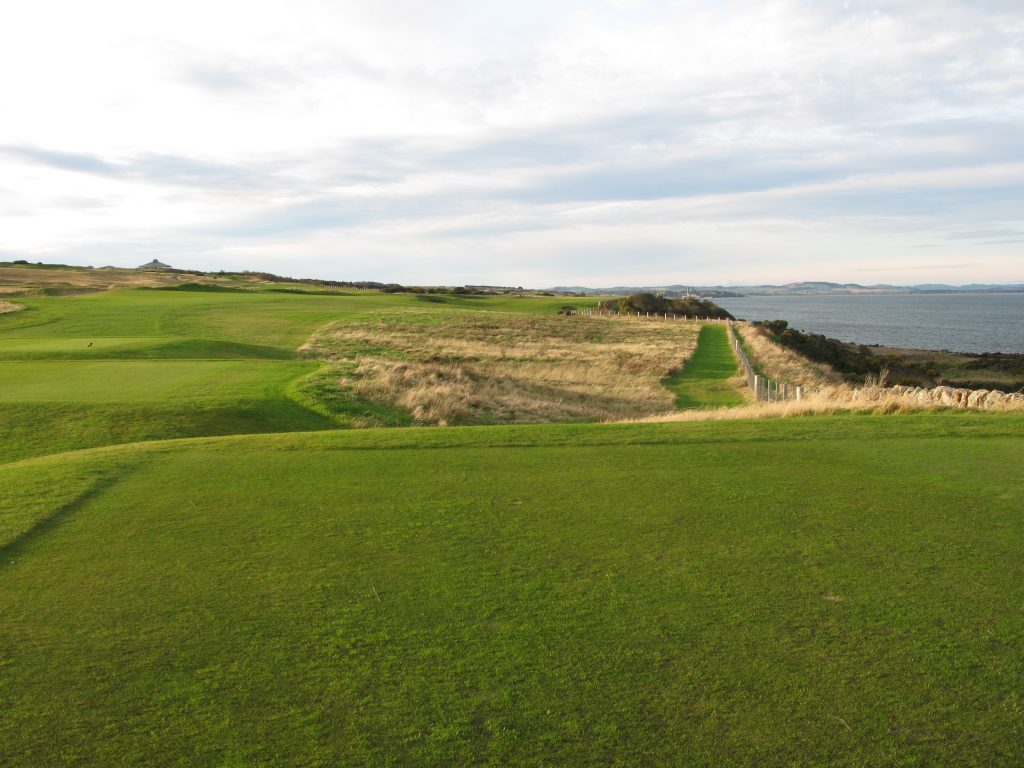
The 12th tee at Kittocks shows the well laid our fairways

The Kittocks course was originally called the Devlin after its golfing designer, the Australian Bruce Devlin, who developed the course in partnership with Denis Griffiths, the well known designer and past President of the American Society of Golf Course Architects.  The Kittocks is named after an area of land on the course which is inhabited by a family of deer.

Until recently, both courses had a headline Summer rate of £140, although new management has repriced it at “only” £95.  I say “only” to highlight how crazy, in my opinion, golf prices in Scotland have become at the higher end of the market – Kingsbarns, only a couple of miles away, is £268 for a 2018 summer round!  Assessing “value”, my key course assessment, is inevitably subjective, especially considering the different types of golfers each course targets – Kingsbarns starter box has a toll free American number!  Comparing “value” between Kingsbarns (£268), St Andrews New (£80), Scotscraig (£70), Tain (£60), or the Kittocks at £95, is highly debatable….but good fun!

The signature 7th hole at Fairmont Kittocks, with the North Sea in view

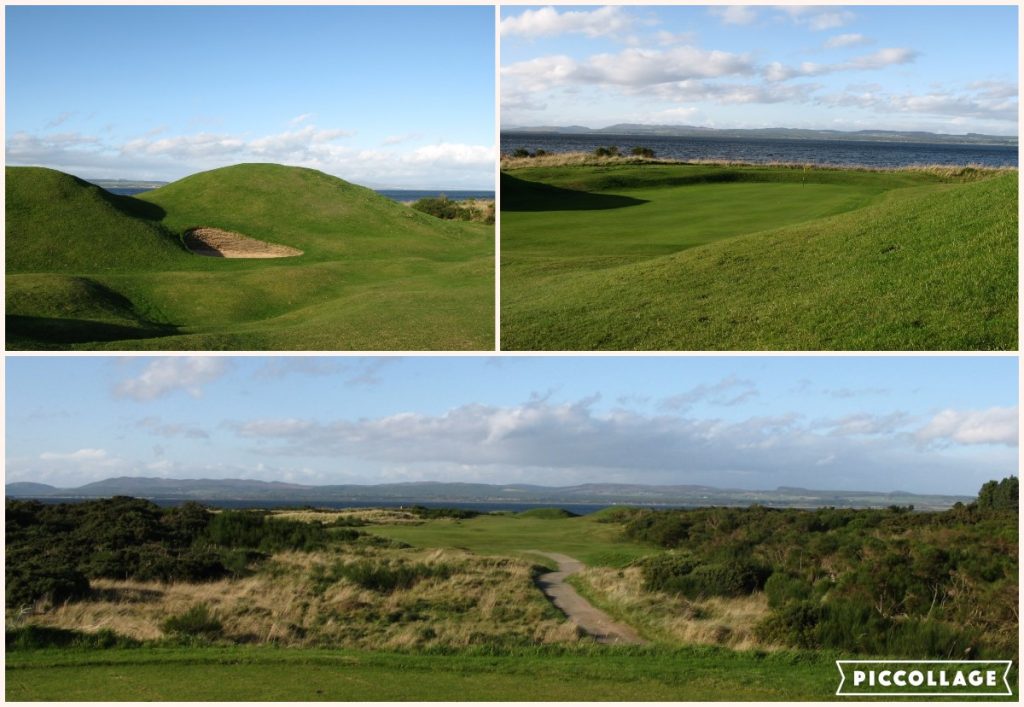
The Kittocks has many original links design attributes, including 2 double greens (the 1st and 13th, and 7th and 10th), deep and revetted bunkers (although slightly oddly built), whispy rough, boundary dykes  and several dune like mounds.  The layout is a mesmerising number of interlinking horseshoes, meaning wind changes direction from hole to hole. The very clever use of contours and rough means each hole feels isolated from the others displaying high level architecture.

The tough long par 4 18th hole at The Kittocks

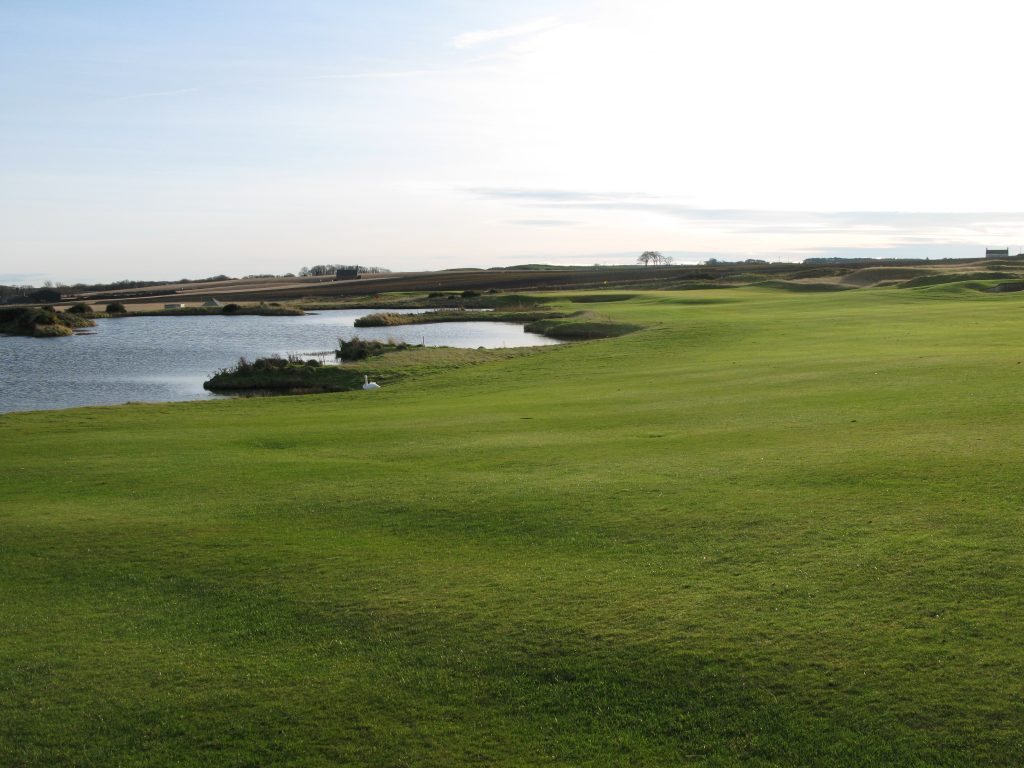
After a fairly straight forward par 5 opening hole, the very picturesque 2nd hole, with its manufactured lake along the left, lets you know this course is not trying to be a classic links design.   The 4th hole, stroke index 1, is the first of several very difficult holes, where a long second shot is needed over a deep gully into a green surrounded by gorse.  Having hitting my best drive and 5 wood of the day, my ball was never to be found again in the gorse to the left of the green!

The man made lake alongside the beautiful Kittocks 2nd hole gives away this is a modern “links”

The course then winds down to the North Sea, with the dog leg par 5 5th hole presenting one of the few blind tee shots on the course, with its green giving outstanding views back towards the “Toon” of St Andrews.  After the nice par 3 6th hole you then reach the signature par 4 7th hole, which has a great vista showing the unusual bunkers and, finally, the huge double green.

There then follows a range of nicely varied holes, whereby there is no stretch of incredibly difficult back to back holes.  Looking at the stroke indexes on the card you see how balanced the course is.  The 10th presents the first time the combination of the prevailing westerly wind really comes into play along with the sea tight along the right of the fairway.  The highlight for me, both visibly and playing, was the difficult par 3 16th hole, where the yellow tee of the day had been mischievously placed on the championship tees, giving me a slightly uphill shot of almost 200 yards into a 15 mph wind – I didn’t lose my ball!  Its worth noting that there are a range of tee options with big differences between the blue/white/yellow/red tees, suiting all standards.

The Kittocks 10th tee with the Fife coastal path verging the course and St Andrews in the background

The final 2 holes were originally part of the Torrance course, but incorporated into the Kittocks after a redesign in 2009 and present 2 very fine long par 4s to finish.

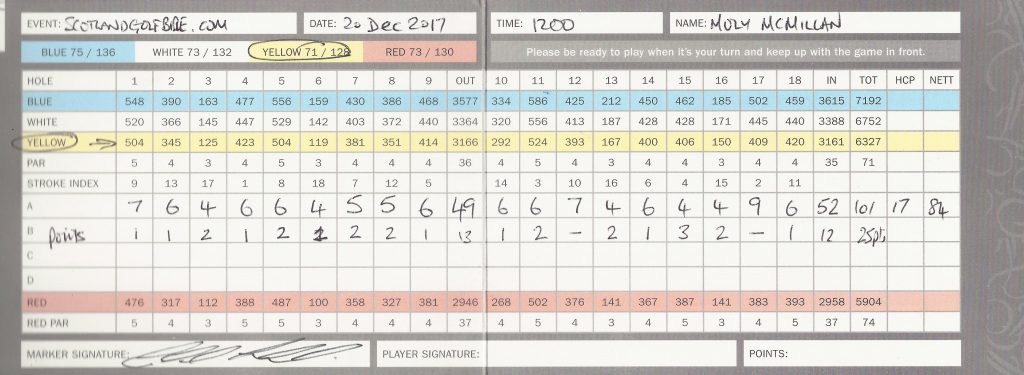
The course was in great condition for a December, with full tees and greens in play.  The course is quite open with wide fairways and the greens were surprisingly fast.  The greens are generally very large, and I imagine not many amateurs will go without 3 putting the odd green – I did it 7 times….ouch!    Along with 2 lost balls, this was the reason for my gross 101 for 25 stableford points.

If you are looking for a golf resort whilst in St Andrews, the Fairmont offers a great location with the fees for unlimited golf on both courses during your stay being very reasonable and much better value than a single round.   I got a good deal with a winter fee of only £30, but my score of 3.5 represents a value at £95 per round.

Facts:

Course Type: Links

Par 71 (3 par 5, 11 par 4s, 4 par 3s)

Distance (yellow): 6327

Moly’s Gross score: 101

Moly’s Fairmont Kittocks scorecard – 101 for 25 points

70. Tain. 25th Oct 2017.

Old Tom Morris’ creation is a “must play” if you head North.    

Summary:  Round up to £60.   Par 70.  Value (out of 5) –4.5

Standing on the innocuous looking first tee at Tain, visitors will most likely think “is this it?”;  fast forward 3 holes they may well be thinking “I can’t cope with this!”  The second shot into the 1st is blind over a fenced road with a well placed green side bunker; the approach at the 2nd (SI 4) is also blind with a ditch and engulfing bunker awaiting; and the long par 4 3rd (SI 2) requires a drawing approach shot to have any chance of being close to a left sided or even centre pin – thankfully these holes are assisted by the prevailing wind!  Given the old hickories and gutty balls used in 1890 when the course was opened, Old Tom must have been an incredible golfer.  Welcome to Old Tom’s “Northern Jewel”.

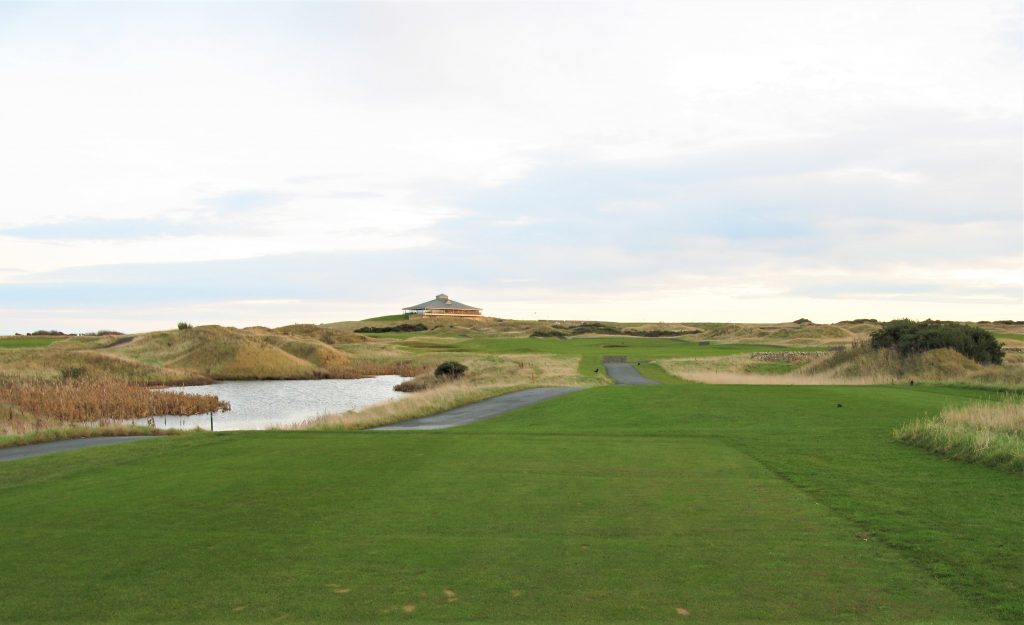
The signature 11th “Alps” – for obvious reasons!

Tain is situated on the Dornoch Firth, 34 miles north of Inverness and 9 miles south of Dornoch.  There is record of 6 holes existing from around 1870, prior to Old Tom Morris designing a 15 hole course which finally extended to 18 in 1894.  Initially called St. Duthus Golf Club, after the patron saint of the town, the name evolved to “Tain” during the 1900s.

The difficult par 4 2nd hole, with this approach being blind for most average golfers – the ditch is deep!

In assessing Tain’s layout, it’s interesting to consider the originality of the course design and what remains today.   There are several detailed maps on the club’s excellent website – in truth, although the general layout remains similar, due to many adjustments and lengthening over the years, only a few holes, the present 9th (still playing to the original green), 10th, 14th and 15th, remain as Old Tom Morris designed them.   In contrast, Bridge of Allen ,is almost untouched from Old Tom’s original design.

After the opening 3 holes, you are then faced with the long par 5 4th, actually a respite, then a mid iron par 3 5th, with deep pot bunkers, then turning partly back into the prevailing wind to play the par 4 6th hole, which worryingly has the name “Bunker”.   By which time on the day I was 13 over par!

The mid iron par 3 8th hole at Tain

After some holes that then feel more like highland golf (trees, turf, ‘feel’), the signature 11th hole, “Alps”, takes you closest to the shore, followed immediately by the aptly named “Glenmorangie”, 12th, with views to the distillery.

By which time, if you’ve still got a card going, beware the SI 1 14th, played into the prevailing wind, then an interesting pair of back to back par 3s, at 16 and 17, both with water in play.

A typical well placed Tain bunker at the 8th.

After a very friendly and helpful discussion before my game with the pro, Stuart Morrison,  in the end I shot 106 (Aaagh), completely down to my very poor play, albeit the wind blew up to 30 mph.  The course was in very good condition with play still on full tees and greens.

It must be said that Tain has very many characteristics of a links course (layout, location, pot bunkers, hillocks) but the turf in many places is distinctly more arable and I suspect Tain will play longer in the summer months than the more harder fairwayed links courses.

A more highland feel at the dog leg par 4 9th at Tain.

This is rightly regarded as a “must play” links course, and I would urge anyone venturing north to play Royal Dornoch, its more prestigious neighbour, to play Tain, which could be argued is better value.

Facts:

Course Type: Links

Par 70 (2 par 5s, 12 par 4s, 4 par 3s)

Distance (yellow): 6109

Moly’s Gross score: 106

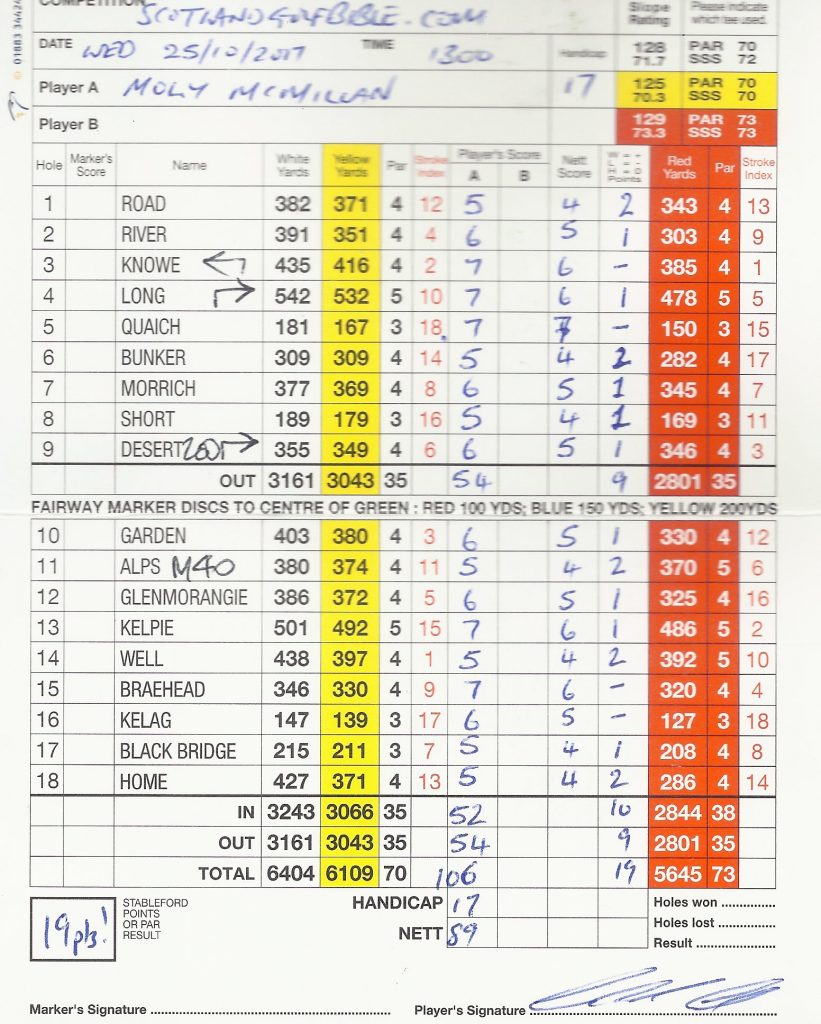
Moly’s 106 card at Tain!

« Older posts Newer posts »

© 2026 Scotland Golf Bible

Theme by Anders NorenUp ↑