A guide to green fee value for money

Category: Members (Page 16 of 27)

95. Alyth. 7th June 2019.

Great Value with Architectural Pedigree, along with a recent 9 hole expansion

Round £42.   Par 70.  Value (out of 5) – 4.5

The Alyth scorecard immortalises the founding members

Alyth is a small town of around 3000 with an abundance of golfing choices in this agriculturally rich area of Perthshire. The Alyth golf club now boasts 2 courses – the main 18 hole course (subject of this blog), described as heathland albeit I think it is a parkland course, and dating back to 1895; Old Tom Morris laid out the first 9 holes, then extended to 18 in 1934 by James Braid. Much more recently, in 2016, the club took over the back 9 holes of the Glenisla course when that club closed down. It is one of the small bits of good news in the general decline of golf in Scotland.

The wonderful Stroke Index 1, 5th hole at Alyth requiring both strategy and shot making

The main 18 hole course is really great value, with offers available through several sources, I suspect prices driven to attract the many tourist golfers who might otherwise just play the nearby world class Blairgowrie or Carnoustie courses. I strongly recommend playing Alyth, where the slightly shorter course, compared with those nearby giants, makes it a much more pleasurable experience, especially given the very picturesque landscape. The course has won awards for “best value”.

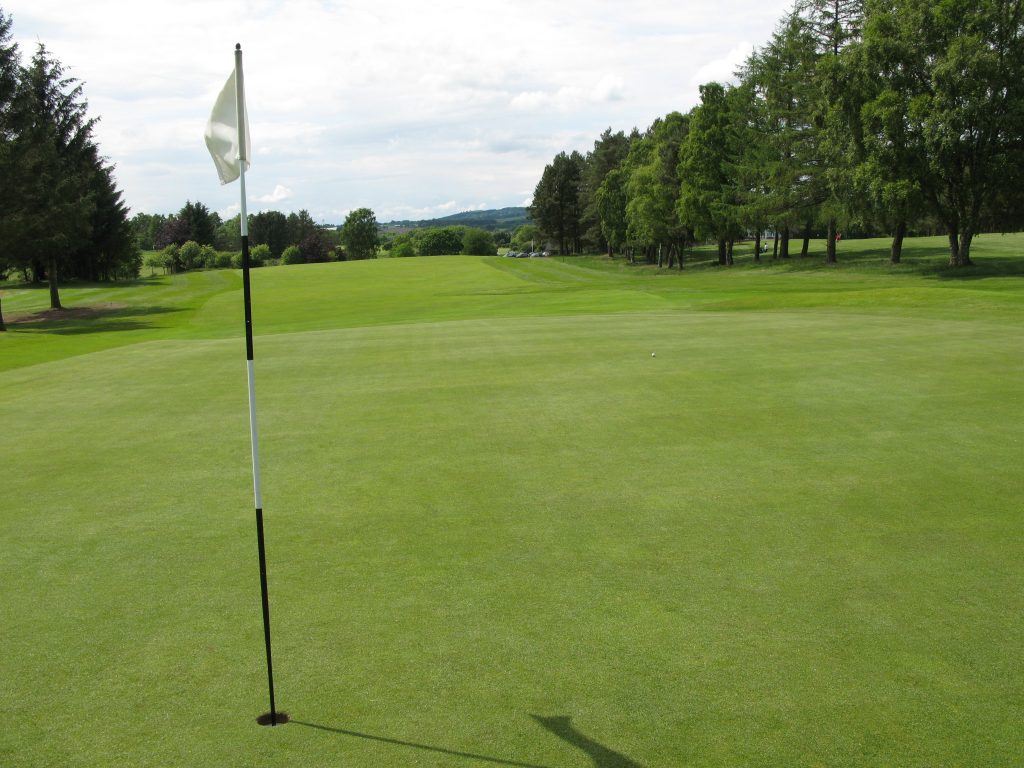
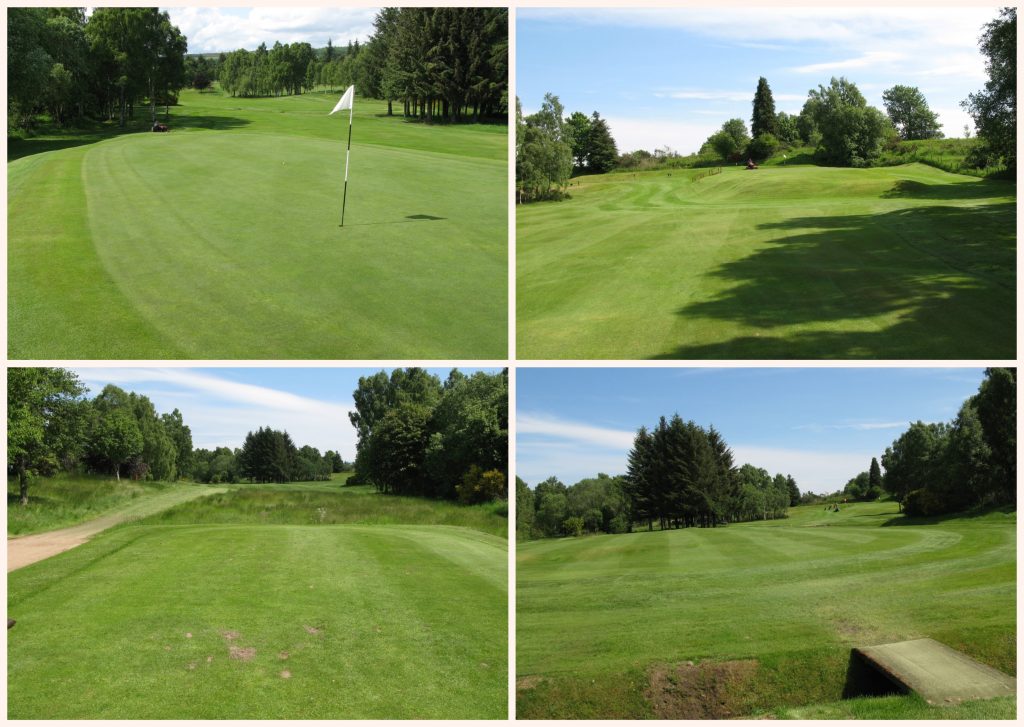
The first green at Alyth, showing the fine standard of the course’s conditioning

Although the course is set amongst tree lined fairways, the course is quite wide and the rough and tree areas not overly penalising, which makes it probably attractive to societies and more occasional golfers.

There are some great holes. The Strike Index 1, 5th hole, is a relatively short par 4, but the fairway ditch which runs diagonally across the fairway needs to be avoided, prior to finding the right club to reach the plateaued green. I was delighted with a bogie and moved on.

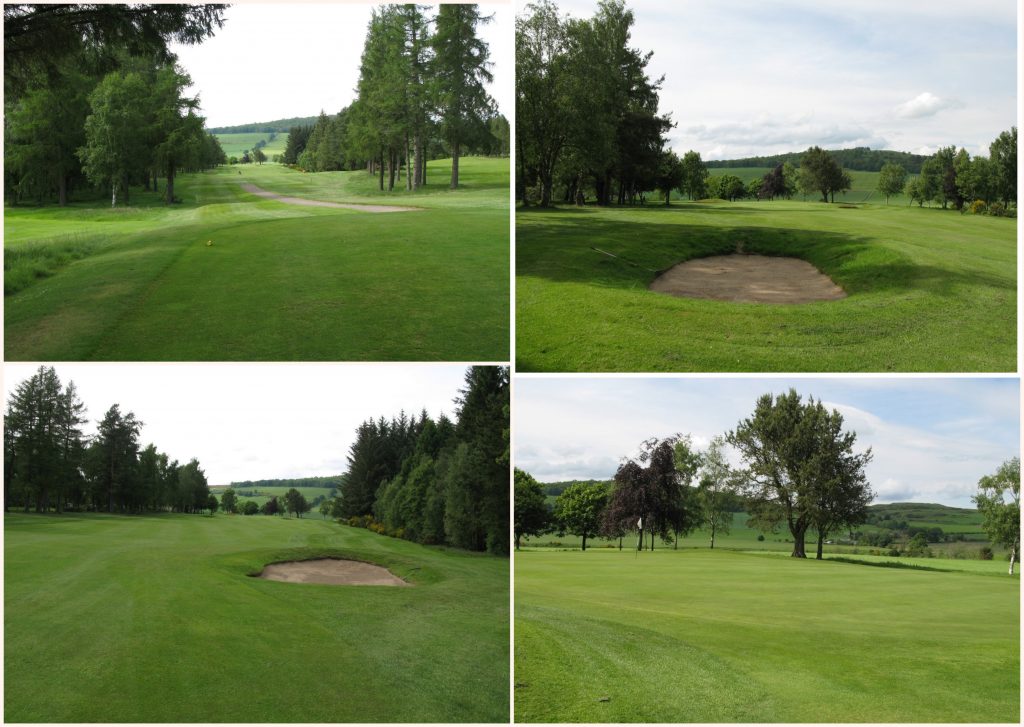
The 11th is another really nice hole, a short par 5 with well placed bunkers, that should reward those whose smart club selections take the bunkers out of play.

The short par 5 11th at Alyth, a lovely looking hole

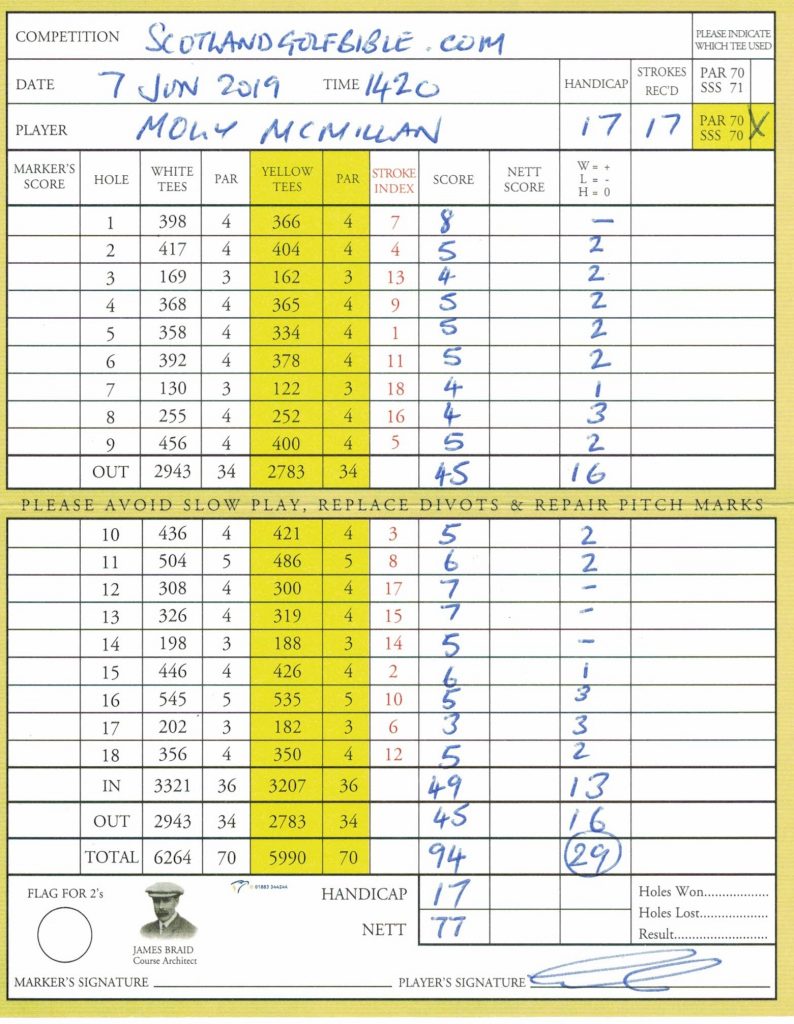
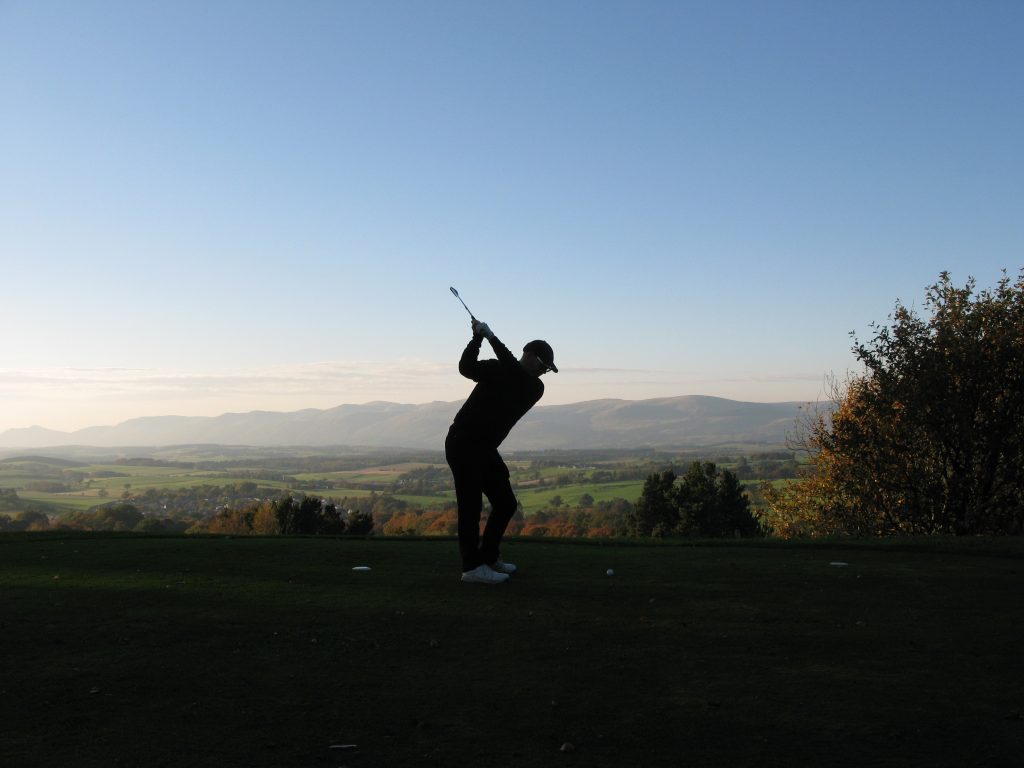
When I played, the course was in excellent condition, with all bar the bunkers immaculate. I shot a gross 94 for 29 stableford points; the most enjoyable part being the very tidy finish over the last 3 holes, which should have been all pars, but for 3 putting the last after hitting my longest drive of the day!

I will go back to Alyth – highly recommended.

Facts:

Course Type: Parkland

Par 70 (2 par 5s, 12 par 4s, 4 par 3s)

Distance (yellow): 5990

Moly’s Gross score: 94

Moly’s 94 scorecard at Alyth

89. Saline. 10 Oct 2018.

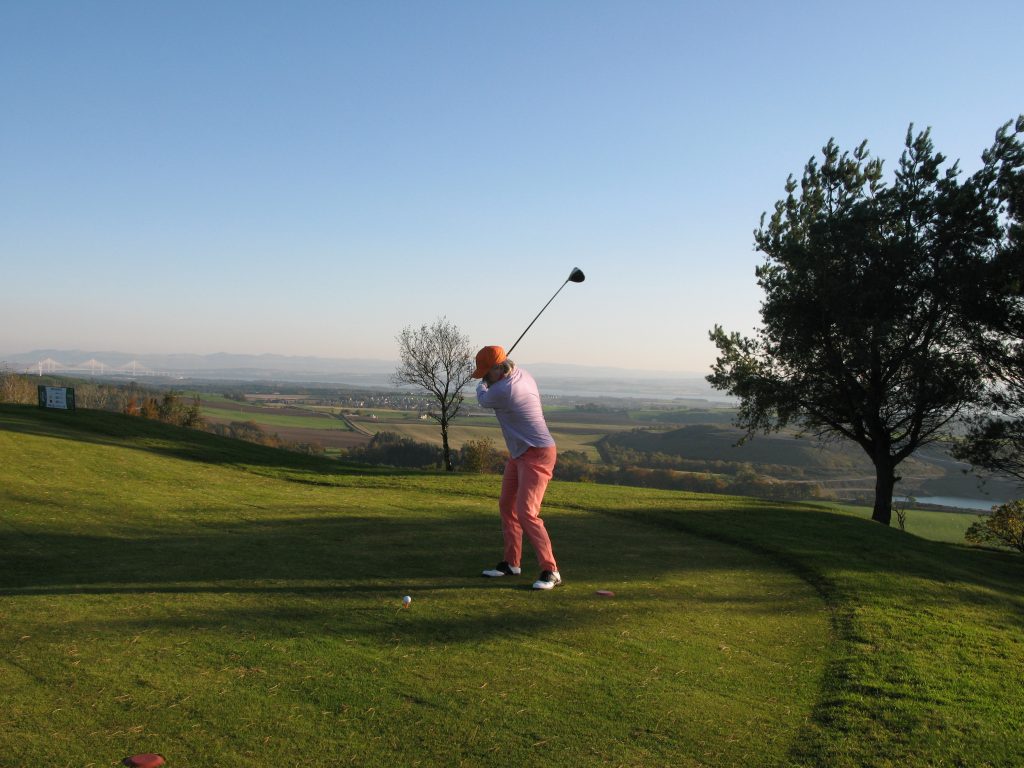
‘Salin’ feels like an intrinsic part of Scotland where community and golf are as one entity

Round  £15.   Par 34.  Value (out of 5) – 3

Courses like Saline, pronounced ‘Salin’ by the locals, somehow define Scotland, not just Scottish golf.

The Cleish Hills provide the backdrop to the par 3 8th hole.

Saline is a village in Fife, not far from Dunfermline. Its elevation on the western slopes of the Cleish Hills, mean that any visitor will get spectacular views of the Forth Valley estuary and river. However, for the great views, you have to work hard to walk to the top of the course, but it’s well worth it.

The magnificent Forth backdrop from the 6th tee at Saline

The club was founded in 1912, but as the club’s own website admits there is virtually no history documented about the course and club development, which is clearly a shame.

The village on the other hand, with a declining population, now around 1000, down from the almost 2000 in its heyday, has an interesting history as a weaving centre. It still has several listed weavers cottages, as a legacy to its former glory.

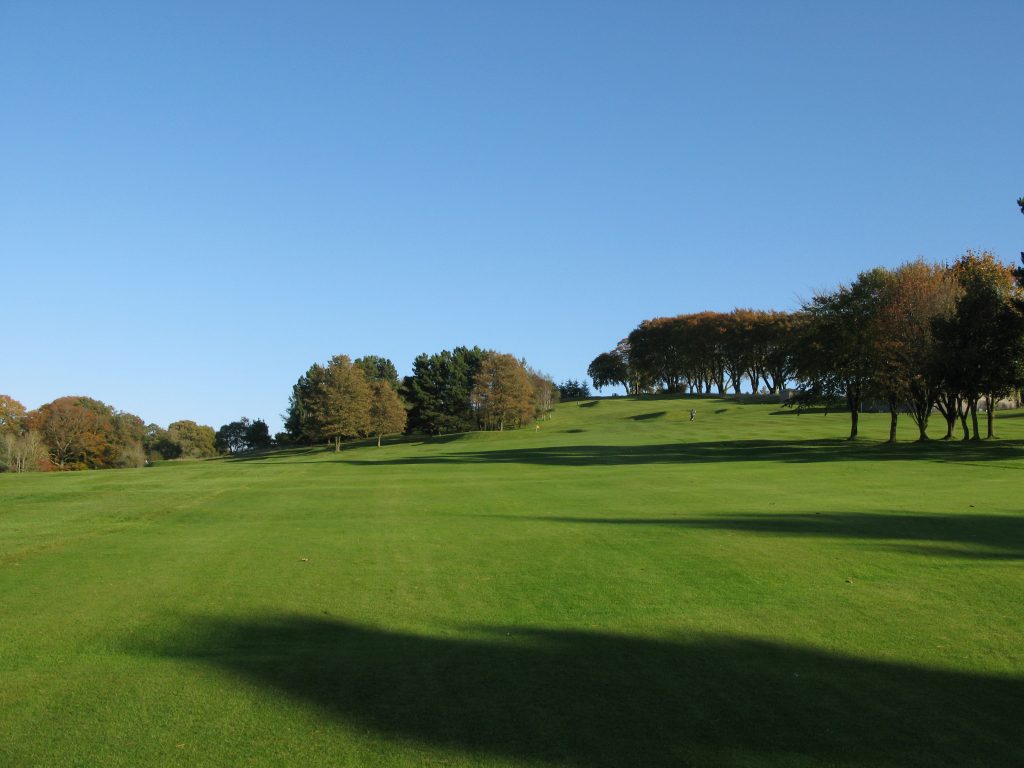
The 1st at Saline, which gets the heart pumping from the first minute.

The 9 hole course, was in fair condition when I played, along with my wife Fran. The fairways were lush and wide enough to allow for an errant drive or two, but the greens were a little bumpy, which could have been down to the amount of recent rain.

There were some decent holes as well. The steeply uphill par 4 5th at 368 yards is a really tough 2 shots, where I suspect most will require driver and fairway wood to reach. The par 3 8th is a great short hole, against the backdrop of the Cleish Hills; it required much less club due to the drop and it’s better playing long due to the front bunkers.

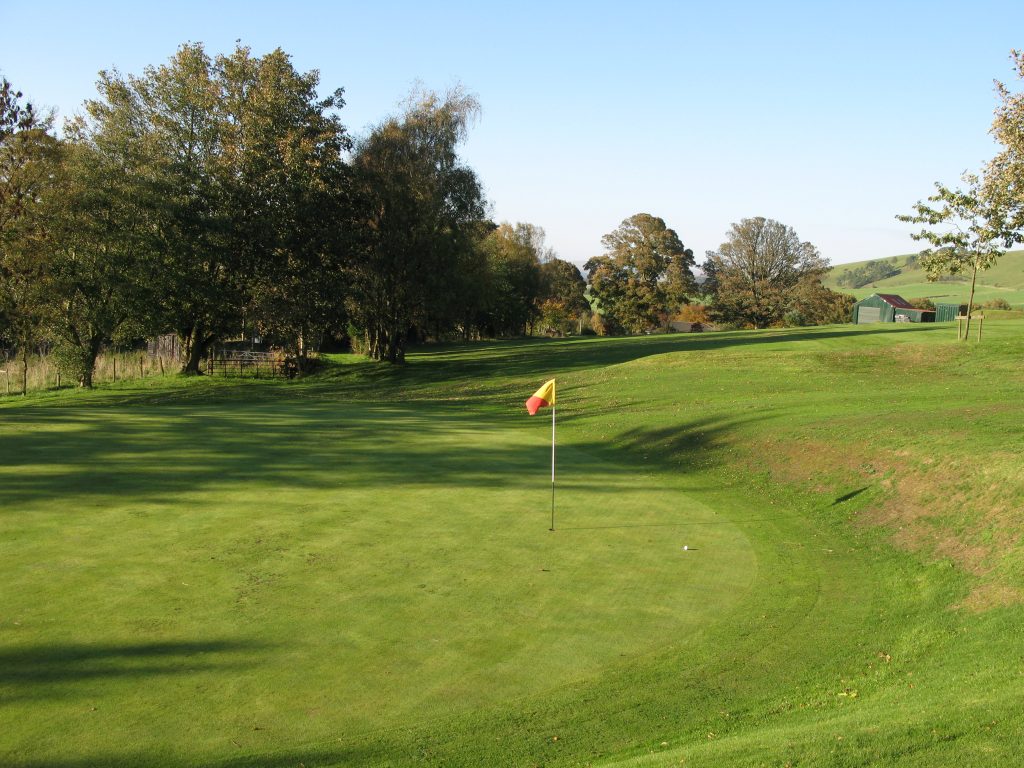
The tricky par 3, third hole at Saline, at over 160 yards

The golf club bar, acts as a community hub and social club, and from looking at the notice boards it was clear that the bar is an important part of the community. The welcome was extremely warm from the barman/host, and this alone would “hasten ye back”.

Some Facts

Course Type: Parkland

Par 34 (0 par 5s, 7 par 4s, 2 par 3s)

Distance (white)   2700 yards

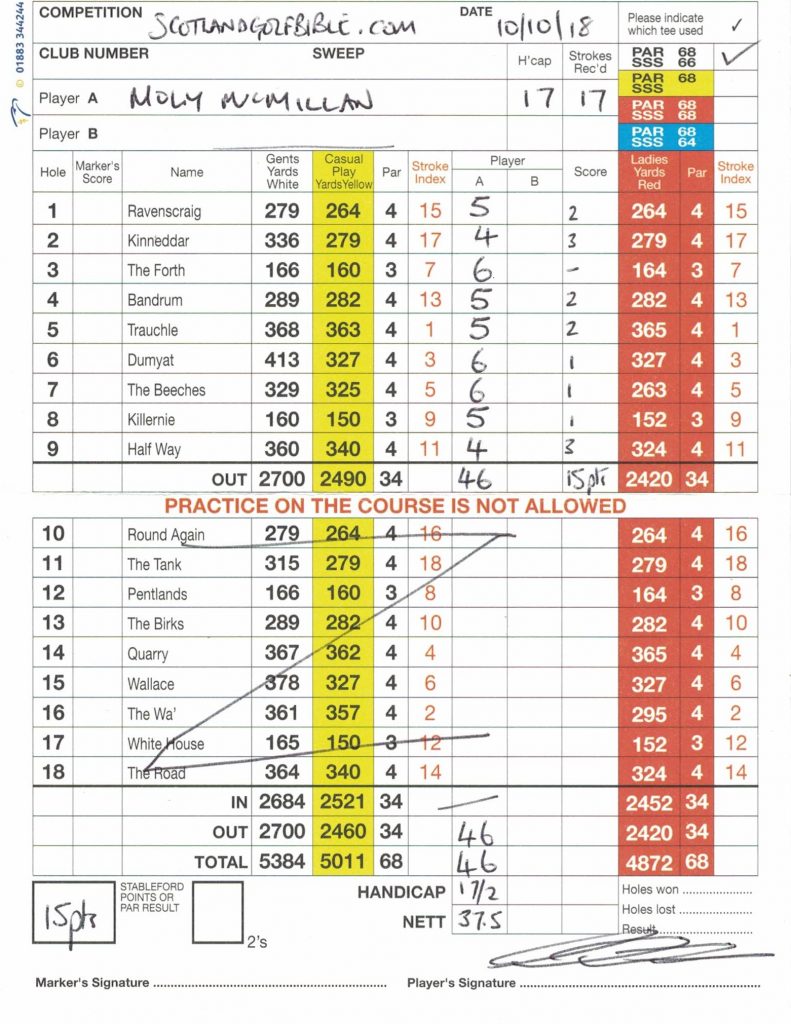
Moly’s Gross Score  46

Moly’s card at Saline – 46

85. Portlethen. 2 Sep 2018.

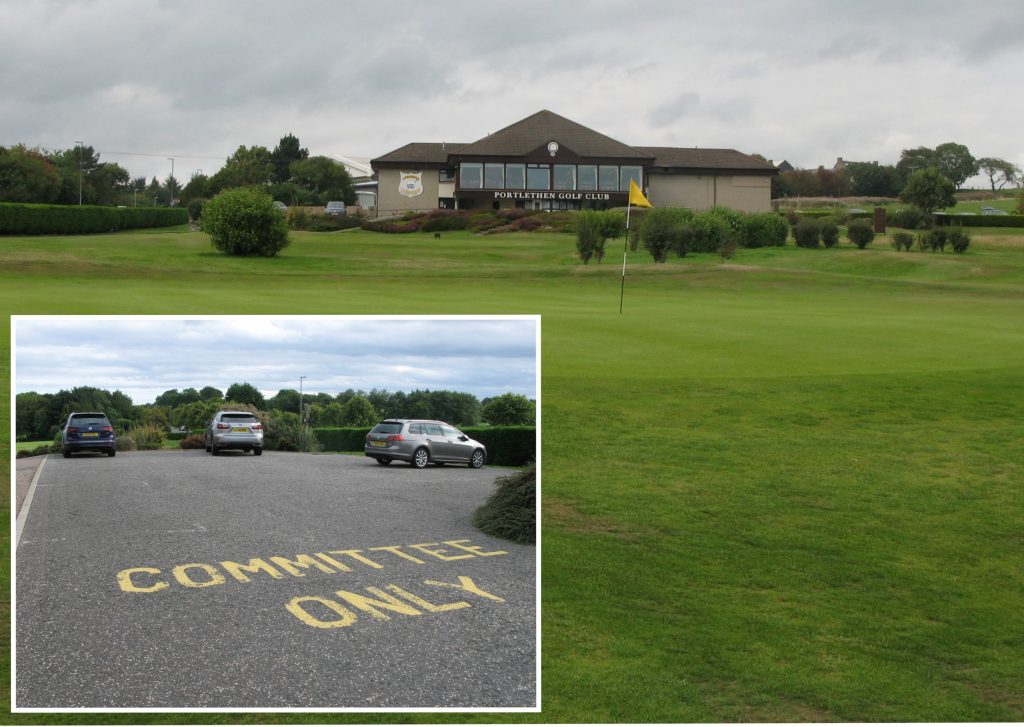
The “Committee Only” Car Park sums up why Golf has to change to survive.

Round £45.   Par 70.  Value (out of 5) – 3

Portlethen, about 7 miles south of Aberdeen, on the A90,  is one of the fastest growing areas in Scotland over the last 30 years.  When the golf course was opened in 1989 the population was recorded as 1500, yet in 2011 it was over 7000 – no doubt driven by the North Sea oil boom.   With the opening of the substantial Aberdeen bypass imminent, Portlethen continues to grow, albeit the area is also suffering from the collapse in oil prices in 2015.

The welcome wasn’t warm at Portlethen – Beware of any clubs with “Committee Only” anything. No wonder some clubs are struggling.

The course, designed by the renowned Donald Steel, along with the substantial clubhouse, seems apt testimony to the ambitions of the area.  Yet somehow, for me, the course fails to deliver on the initial optimism demonstrated by the designer chosen.  When asked what I thought of Portlethen, my answer was “It’s OK”, which sums up my experience.

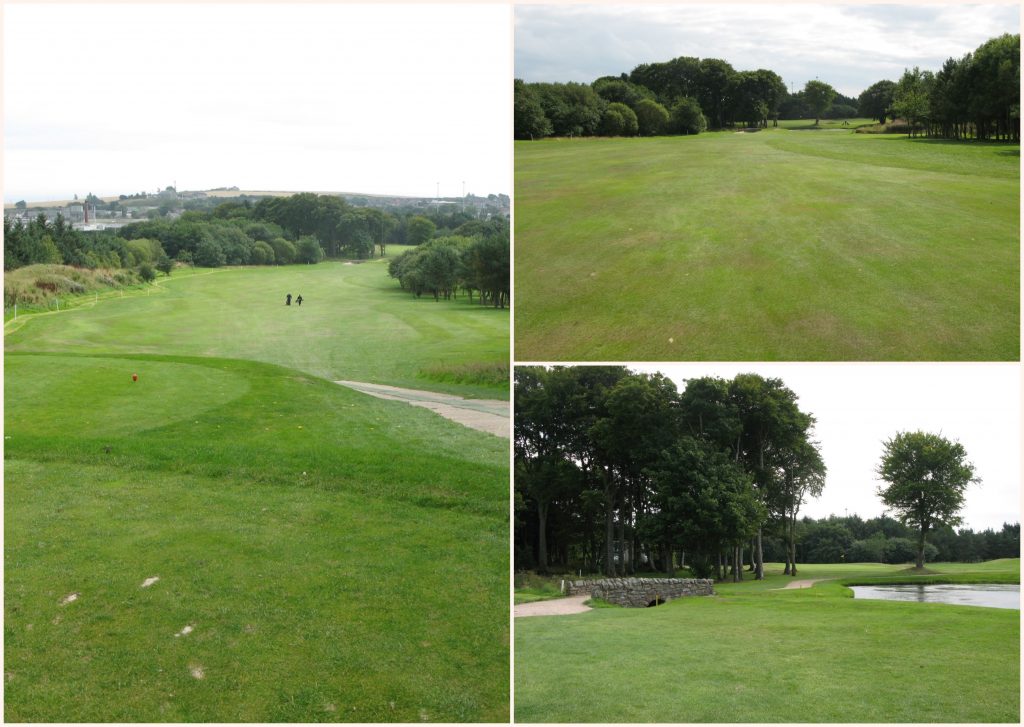
The 4th at Portlethen, one of the best holes.

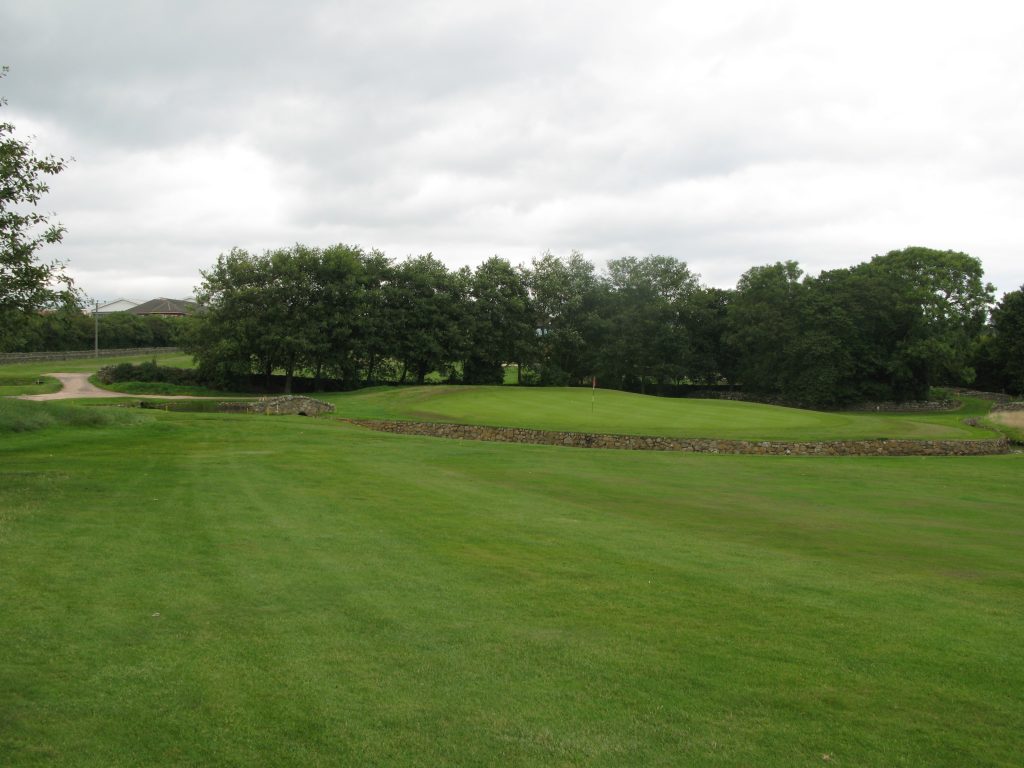
It’s a generous parkland setting, and after a few ordinary holes, the 4th tee provides an excellent view of the par 5 signature hole;  after a good drive I hit an excellent 3 wood over the pond guarding the green – my best strike of the day – which caught the top of a large tree and ended in the water.  The 5th is also a picturesque water featured par 3.  After those highlights, I thought the course somewhat fell away in quality, other than the superb 15th, the SI 2 par 4, which also had a green fronted by water.

The difficult par 4 15th at Portlethen.

The course was in reasonably good condition.  But it was the lack of welcome which stuck with me.  As a www.teeofftimes.co.uk customer I was advised I would be paired together – not a problem, but expressed in a manner that made me feel a second class citizen.  However, shortly thereafter, I was advised I could play on my own as there was space on the tee!  Nevertheless, my round was very slow, and it was clear that people in front of me were determined not to let me through, even when there was space in front.

The aesthetic 5th at Portlethen, a short iron par 3.

This seemingly unfriendly approach by a couple of players cannot, of course, be judged representative – however, when I saw the size of the “Committee Only” car park, this seemed so representative of the welcome I’d received.

My overall assessment was that Portlethen was about a 3 for value.  The club’s website makes a big sell of “The Portlethen Experience” – but I must say, for me, it just felt a little bit pretentious overall.

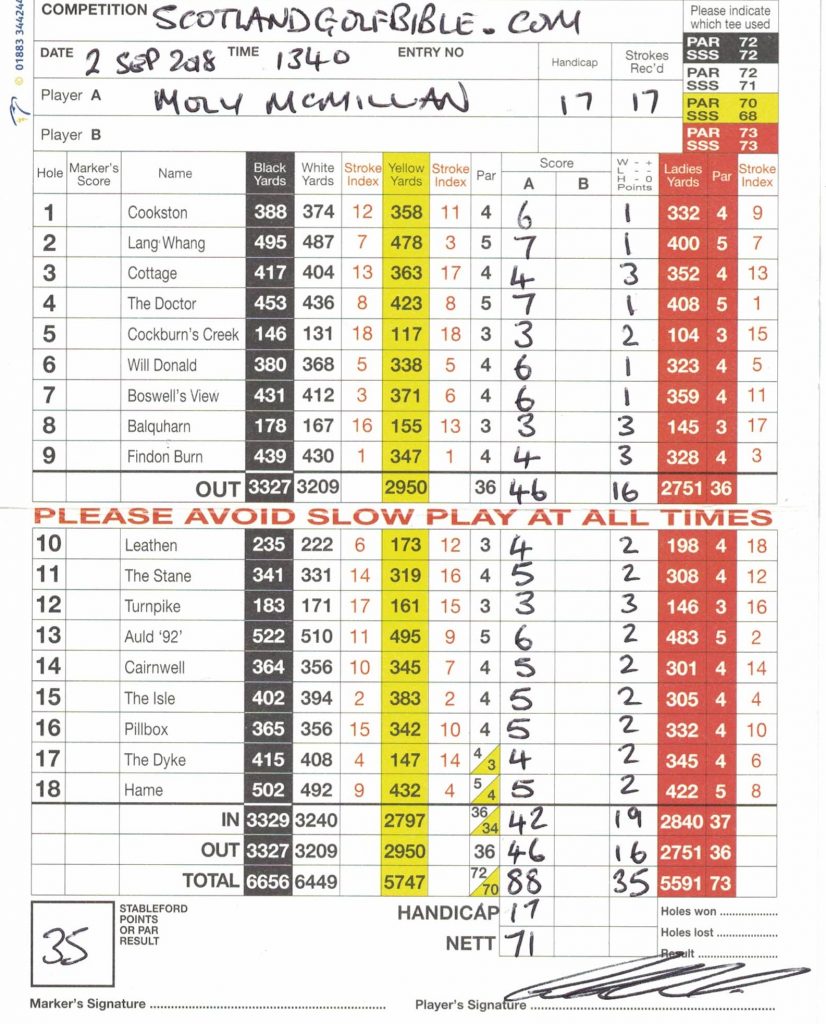
On the day I played well for my net 71.

Facts:

Course Type: Parkland

Par 70 (3 par 5s, 10 par 4s,  5 par 3s)

Distance (yellow): 5747 Yards

Moly’s Gross score: 88

Moly’s Portlethen 88, with only 1 lost ball – which was the best strike of the day, including direction!

84. Lundin. 31 Aug 2018.

This historic links is a marriage made in golfing heaven 

Round £75.   Par 70.  Value (out of 5) – 5

Winston Churchill one said “this is a long speech because I’ve not had time to prepare a short one”.  That feels like my dilemma in writing about the wonderfully crafted golf course at Lundin Links; what to leave out?  I say the golf course “at” Lundin Links, because that is actually the name of the town, which sits on the southerly Fife coast about 12 miles south of St Andrews, where the Lundin Golf Club is based.  I think it’s the only place in the world where the town has the more appropriate golfing name than its golf course!
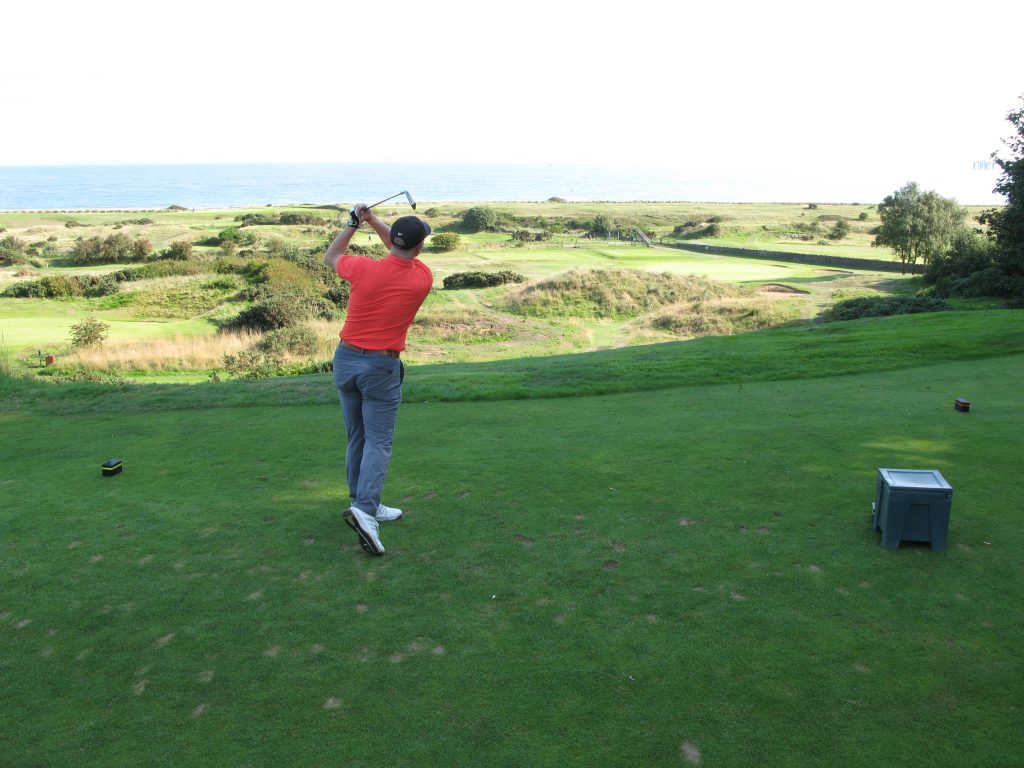
Moly at Lundin’s par 3 14th – where you can see all the 18 greens!

This naming conundrum is aesthetically appropriate because Lundin golf course poses a few other riddles.  Along with the adjacent Leven Links (the name of the golf course by the way, not the town, which is simply called Leven; au contraire!) it had the first ever 18 hole golf course with 18 separate greens, established in 1868.  That original 18 hole layout, 9 holes of the current Leven Links course plus 9 from Lundin, separated by the Mile Dyke, is still played, but only once per year in a competition to mark its history.  I covered the history of the split in the courses fully in the Leven Links blog here.
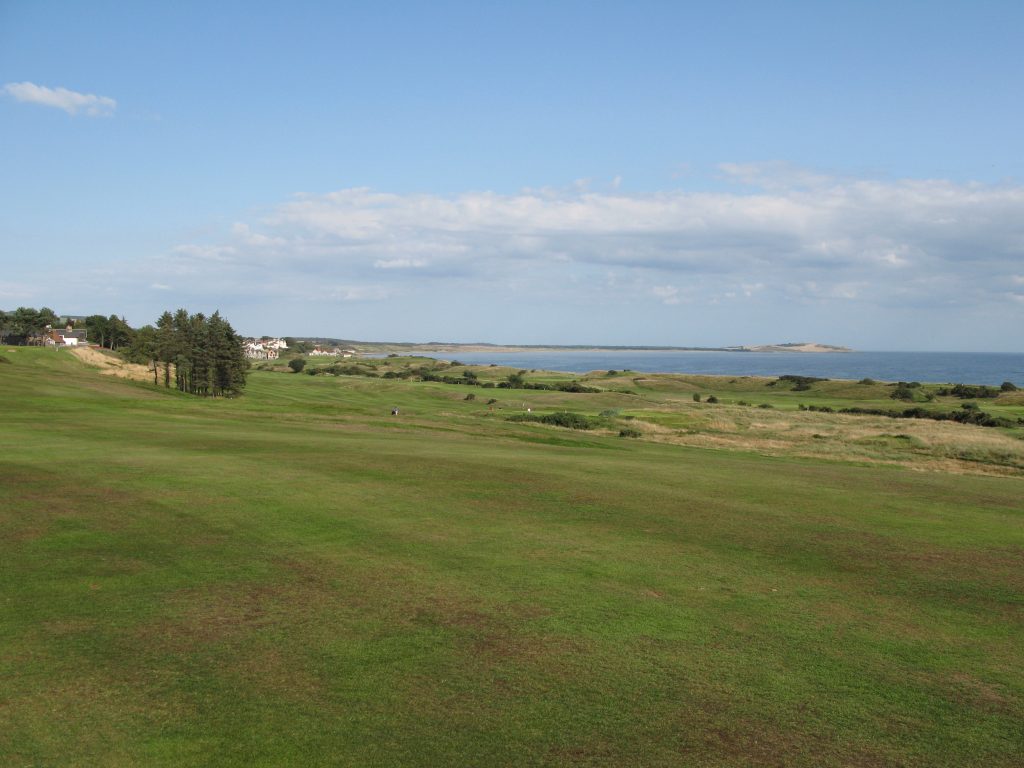
View across the Lundin course from the 13th fairway.

The real riddle at Lundin was the architectural one given to James Braid, who was tasked in 1908 with adding 9 holes on the inland side of the 9 holes crafted by Old Tom Morris, to leave us with the current 18 hole layout.  The resulting course is an absolute beauty, and I’m sure Braid tinkered with the bunkering of Old Tom’s holes as well.  Old Tom’s holes are now the first 5 and last 4.

The course is a nice length at about 6400 yards; not long by today’s standards, but with some fascinating decision making, especially from the tee.  Until very recently it was used for final qualifying when the Open was staged at St Andrews, a measure of its quality and condition.
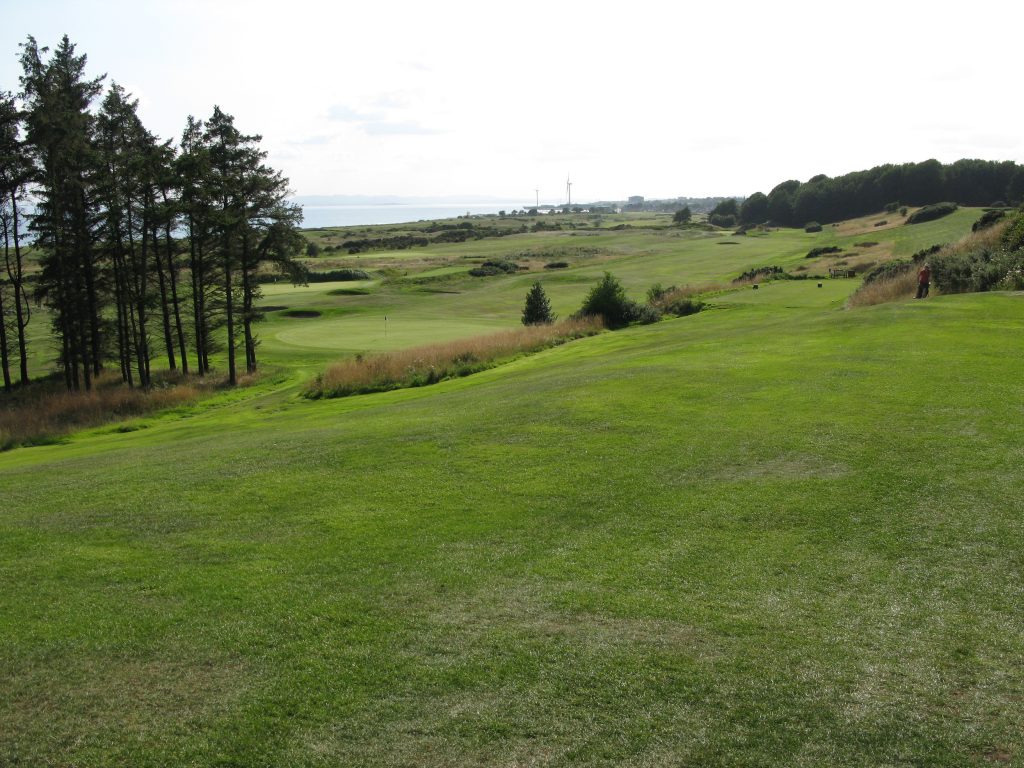
View from the 12th green at Lundin, looking towards Leven

The course was in excellent condition when I played, as a guest of local member Eric Brown and his wife, Moira.  I ungraciously won the “6 point per hole” match play game, although it was nip and tuck most of the way round.  My 9 pars off my 16.8 handicap did rightly elicit a self induced “bandit” conversation, albeit my 3 lost balls (1 resulting in an 8 at the par 4 18th), meant that my 36 points on a fine day would likely have been only in the handicap buffer zone!  That’s my defence anyway M’Laud!

Enough about me, the golf course is the star here.   It’s also a good time to introduce readers to Golf Club Atlas a non commercial web site run by and for golf course architects, where you can find some excellent reviews of many of the worlds great courses.  Being reviewed by Golf Club Atlas is a measure of a course’s pedigree, as well as giving great insight as with their entry for Lundin.

The first 4 holes are classic links holes, played normally into the prevailing wind, with OOB along the left with the beach awaiting a wild hook.  The first is a difficult 400+ yards par 4, with a mid to long iron needed to an uphill plateaued green;  the second, a shorter par 4, requires good judgement to stop short of a fairway burn with your tee shot;  then the 3rd, another short par 4, presents a challenging drive to miss several fairway bunkers.    The 4th, however, is where many a round will come unstuck.  Any time a James Braid influenced course has a stroke index 1 hole without any fairway bunkers, one needs to probable play it as a par 5.  I failed to adhere to this plan, and ended up hitting a decent second shot with a hybrid to the right on the green and never saw it again – whether it cleared the deep burn I will never know!
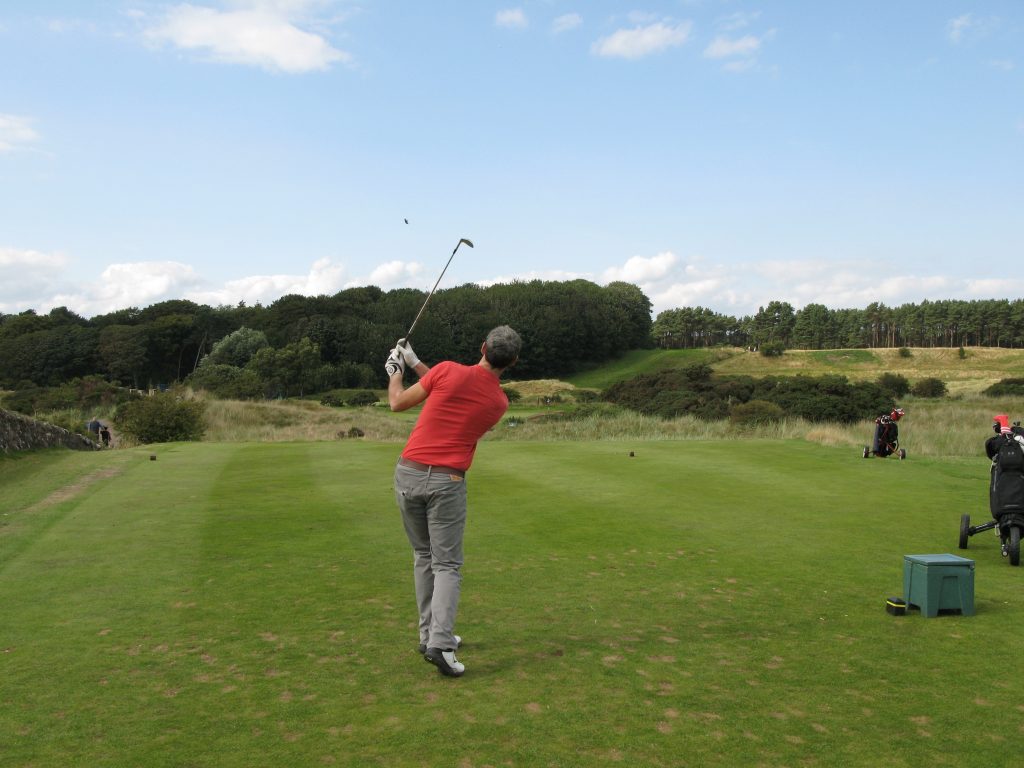
Eric Brown playing at the par 3 5th hole, one of only 2 holes at Lundin not playing in the coastline direction.

After a relatively short par 3 5th, you leave Old Tom’s legacy and move to the other side of an old railway line that slices the course in half, and play the 9 Braid holes, the first 3 of which have the railway as OOBs to the right.    By the time you have played the 6th and 7th, you might also have picked up another clever feature of this course – the short par 4s tend to have very tricky greens.
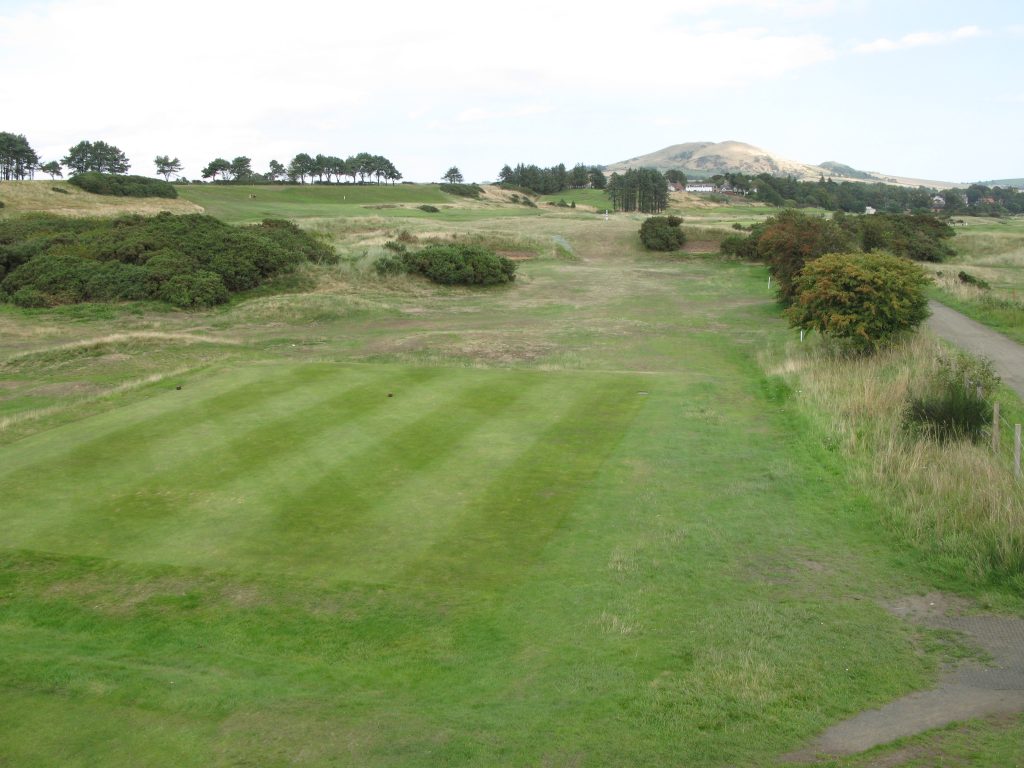
The view from the 6th tee, one of the short par 4s with a very tricky green.

The 10th hole was another of the typical strategic challenges;  the fairway is cut in two between the tee and green;  go left where no bunkers exist, but leave a blind second with the green side bunkering obscured, or go right for an easier approach shot, as long as you miss the well placed fairway bunkers.  A joy of a hole.

After playing the, arguably parkland, inland holes of 11 through 13, you reach a place arguably unique in world golf.  From the 14th tee, you can see every green on the course, along with a magnificent view of the Firth of Forth and the North Berwick coast in the distance.  This view is worth the green fee alone.  The 14th is also a great par 3, with a significant drop, so club selection is key to this hole – it’s better being long than short here by the way.

After a nice set of par 4s, you come to the very difficult last hole, a long par 4 played to a long and slightly raised green that slopes from back to front in front of the terrific clubhouse.  I think the number of visiting golfers that find this green in regulation will be low;  plus the sting in the tail is that it has a very difficult green to finish.  I ended up with an 8, having put my second OOB to the left.
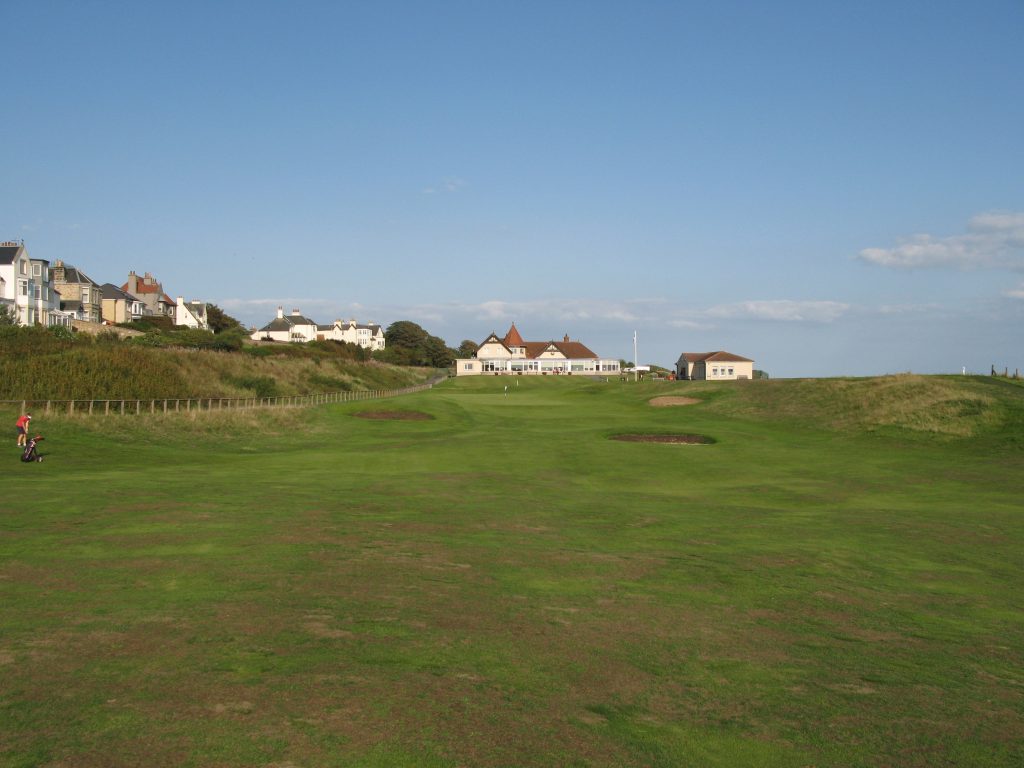
The difficult long par 4 18th hole, in front of the lovely Lundin clubhouse.  Moira, seen here playing her approach, having just stayed in bounds on the left.

People say that Lundin is a “gem”, but I disagree.  Its much better than that;  for me, the term “gem” has evolved into one used to describe “great courses, but somewhat unknown or off the beaten track”.  Lundin is very much on the well trodden track, is a merge of architectural significance by 2 of the greats, and it is a joy, for many reasons.

A must play Scottish golf course.   Buy the Course Guide, and study the holes!

Facts:

Course Type: Links

Par 70 (2 par 5s, 13 par 4s,  3 par 3s)

Distance (yellow): 6138 Yards

Moly’s Gross score: 91
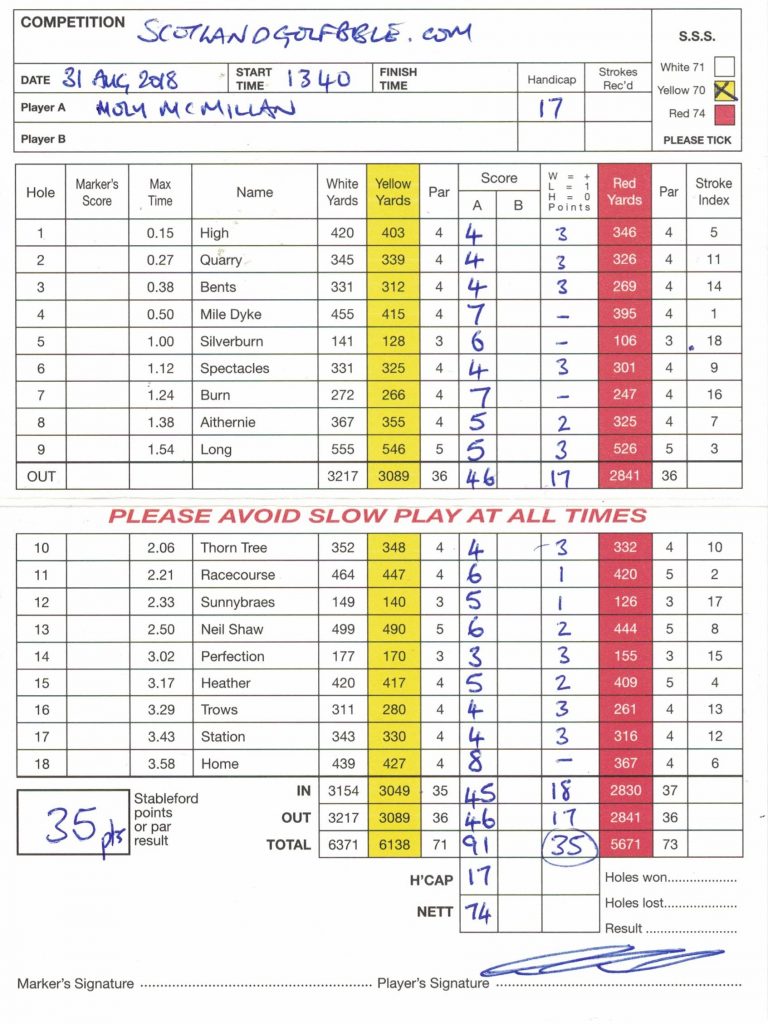
Moly’s very mixed Lundin scorecard – 9 pars, but still 21 over par for 91!
« Older posts Newer posts »

© 2026 Scotland Golf Bible

Theme by Anders Noren — Up ↑