A guide to green fee value for money

Category: 1901 – 1945 (Page 10 of 15)

90. Musselburgh. 22 Oct 2018.

The highest ranked of the three Musselburgh courses even though the other two are more historically significant

Round  £60.   Par 71.  Value (out of 5) – 4

Musselburgh is the largest of the towns in East Lothian, situated on the coast about 5 miles from Edinburgh and close to the start of the great North Berwick coastal run of courses which includes Muirfield.
1st at Musselburgh, a very typically picturesque example of this courses holes

But to say you’re playing ‘Musselburgh’ doesn’t really clarify matters, nor indeed is saying you’re playing in Musselburgh. There are in fact three named ‘Musselburgh’ courses: ‘Musselburgh Links’, which is in Musselburgh and recognised by the Guinness Book of Records as the oldest course in the world; ‘Royal Musselburgh’, the regally appointed course somewhat nearer to Prestonpans than Musselburgh and; plain old ‘Musselburgh’, which is actually in Monktonhall. Confused?

Given that the two other Musselburgh courses enjoy either a pedigree as the oldest course in the world or has a ‘royal’ appendage, I suspect many people are surprised to learn that the course simply called ‘Musselburgh’ is the highest rated of the 3 in most compilations of Scotland’s courses.
The well bunkered short 3rd hole at Musselburgh

This Musselburgh course opened in 1938 having been designed by James Braid as “a championship” layout. Off the back tees it’s over 6800 years long, and hosts many regional standard competitions, and in the past has held regional Open qualifiers and the Final Qualifier as recently as 2013, such is the best measure of this course.

Off the yellow tees, Musselburgh is still over 6200 yards, and given the amount of breeze on the day I played, presented a very stiff challenge. I shot 99, but 3 lost balls accounted for my scoring only 27 stableford points. I drove the ball well, and the often generous fairways allowed for that. The course was in good condition, although it was let down by the poor maintenance of the teeing areas and readers of my other blogs will realise this is one of my common misgivings, especially with a green fee of £60.
The ‘hidden’ hazard behind the difficult par 4 15th hole at Musselburgh

Apparently, the golf course was laid out in open parkand, but visionary tree planting during the 1950s has transformed this into a mature parkland setting and I benefited from the late autumnal colour.
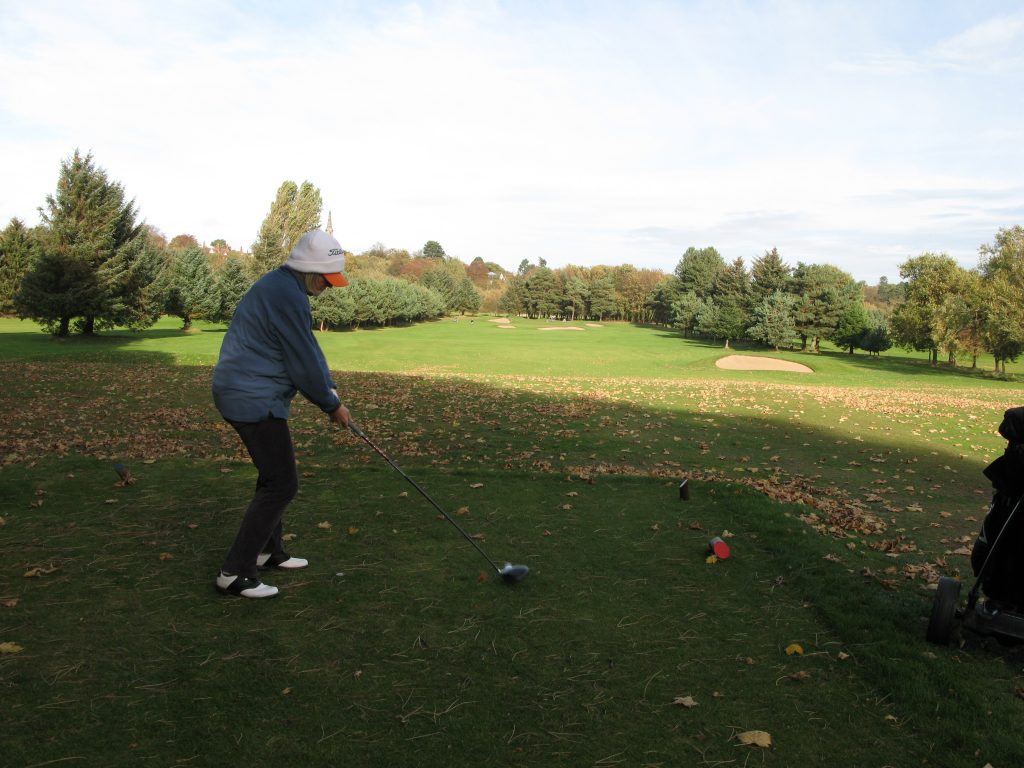
Fran drives at the inviting fairway on the 17th at Musselburgh

The greens were in great condition and very true to putt on, but you needed to be careful with the greenside bunkering, which I thought was the best feature of this nice layout. With the trees fully matured and the constant changes in direction, one needed to keep track of the wind direction.

My favourite holes were the short 3rd, the slight dog leg right 9th, which had a ditch which long drivers needed to be mindful of, and the tough par 4 15th where a water hazard lies at the back of the green which I found having hit my longest 7 iron of the season!

The last hole is a very long par 4 uphill to a welcoming clubhouse. Its worth mentioning the friendliness of the staff in the bar.
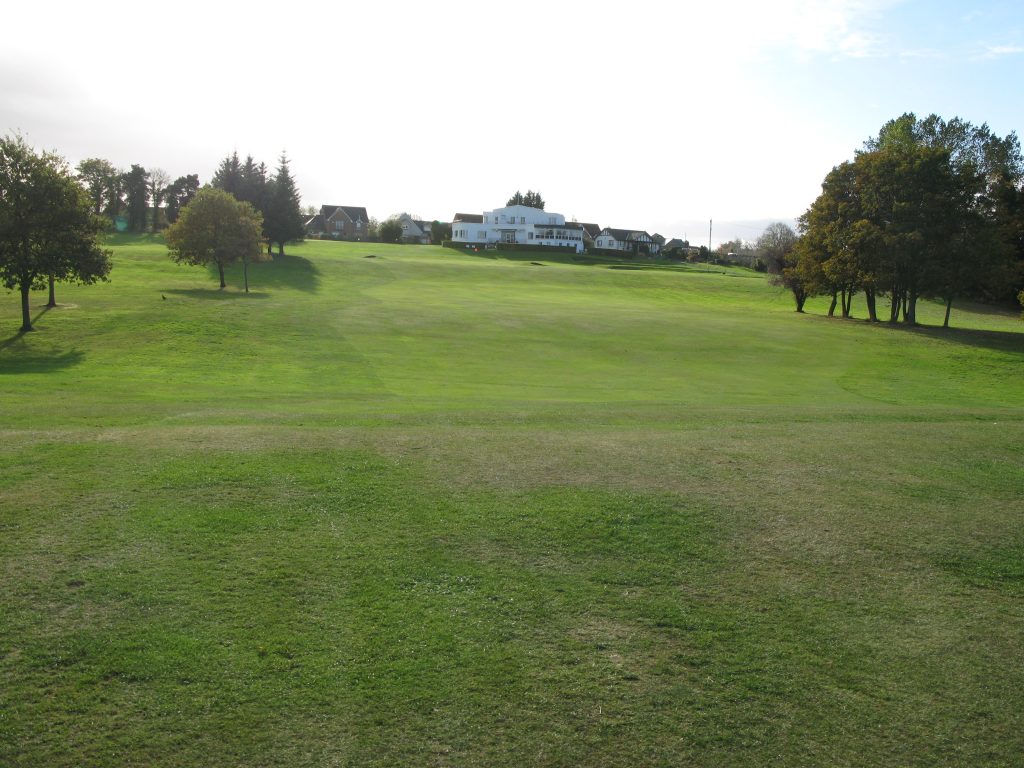
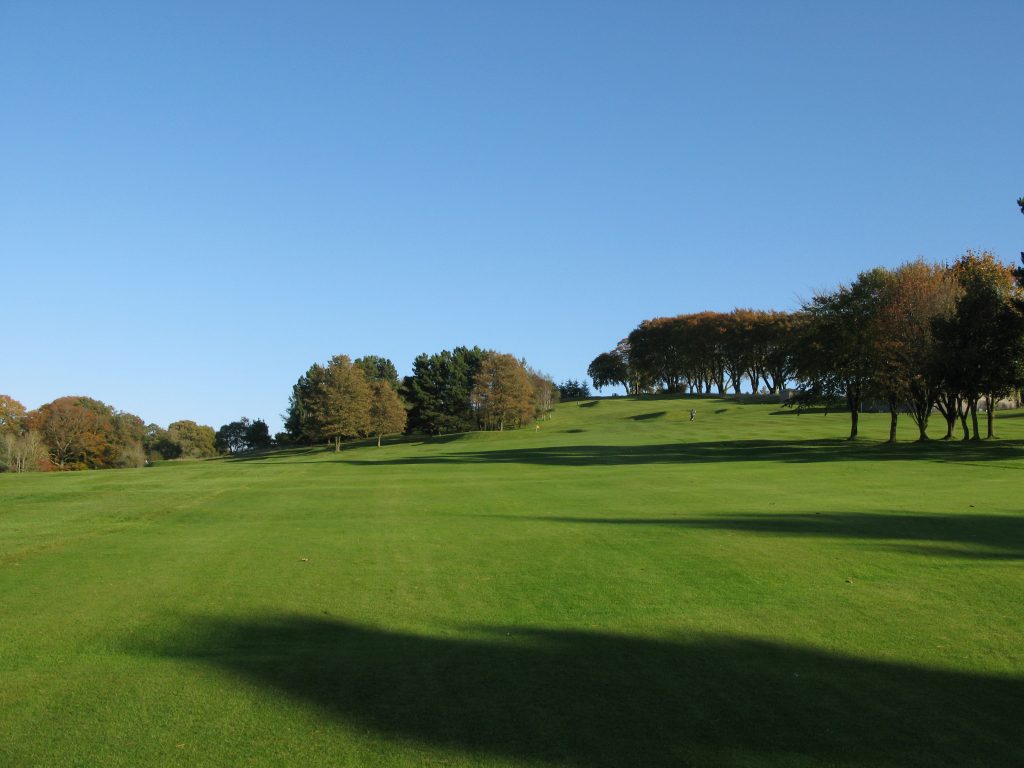
The brutish finishing uphill par 4 to the awaiting and impressive clubhouse at Musselburgh

Some Facts

Course Type: Parkland

Par 71 (3 par 5s, 11 par 4s, 4 par 3s)

Distance (yellow)   6241 yards

Moly’s Gross Score  99
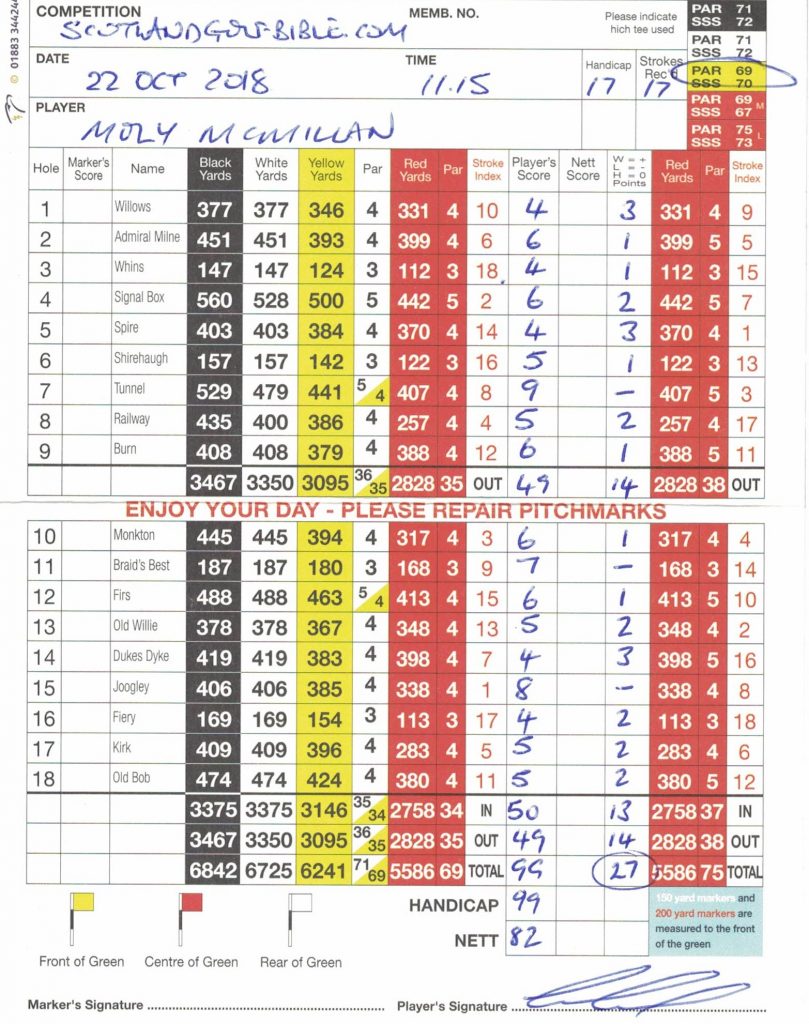
Moly’s Musselburgh scorecard – 99 for 27 points

89. Saline. 10 Oct 2018.

‘Salin’ feels like an intrinsic part of Scotland where community and golf are as one entity

Round  £15.   Par 34.  Value (out of 5) – 3

Courses like Saline, pronounced ‘Salin’ by the locals, somehow define Scotland, not just Scottish golf.

The Cleish Hills provide the backdrop to the par 3 8th hole.

Saline is a village in Fife, not far from Dunfermline. Its elevation on the western slopes of the Cleish Hills, mean that any visitor will get spectacular views of the Forth Valley estuary and river. However, for the great views, you have to work hard to walk to the top of the course, but it’s well worth it.

The magnificent Forth backdrop from the 6th tee at Saline

The club was founded in 1912, but as the club’s own website admits there is virtually no history documented about the course and club development, which is clearly a shame.

The village on the other hand, with a declining population, now around 1000, down from the almost 2000 in its heyday, has an interesting history as a weaving centre. It still has several listed weavers cottages, as a legacy to its former glory.

The 1st at Saline, which gets the heart pumping from the first minute.

The 9 hole course, was in fair condition when I played, along with my wife Fran. The fairways were lush and wide enough to allow for an errant drive or two, but the greens were a little bumpy, which could have been down to the amount of recent rain.

There were some decent holes as well. The steeply uphill par 4 5th at 368 yards is a really tough 2 shots, where I suspect most will require driver and fairway wood to reach. The par 3 8th is a great short hole, against the backdrop of the Cleish Hills; it required much less club due to the drop and it’s better playing long due to the front bunkers.

The tricky par 3, third hole at Saline, at over 160 yards

The golf club bar, acts as a community hub and social club, and from looking at the notice boards it was clear that the bar is an important part of the community. The welcome was extremely warm from the barman/host, and this alone would “hasten ye back”.

Some Facts

Course Type: Parkland

Par 34 (0 par 5s, 7 par 4s, 2 par 3s)

Distance (white)   2700 yards

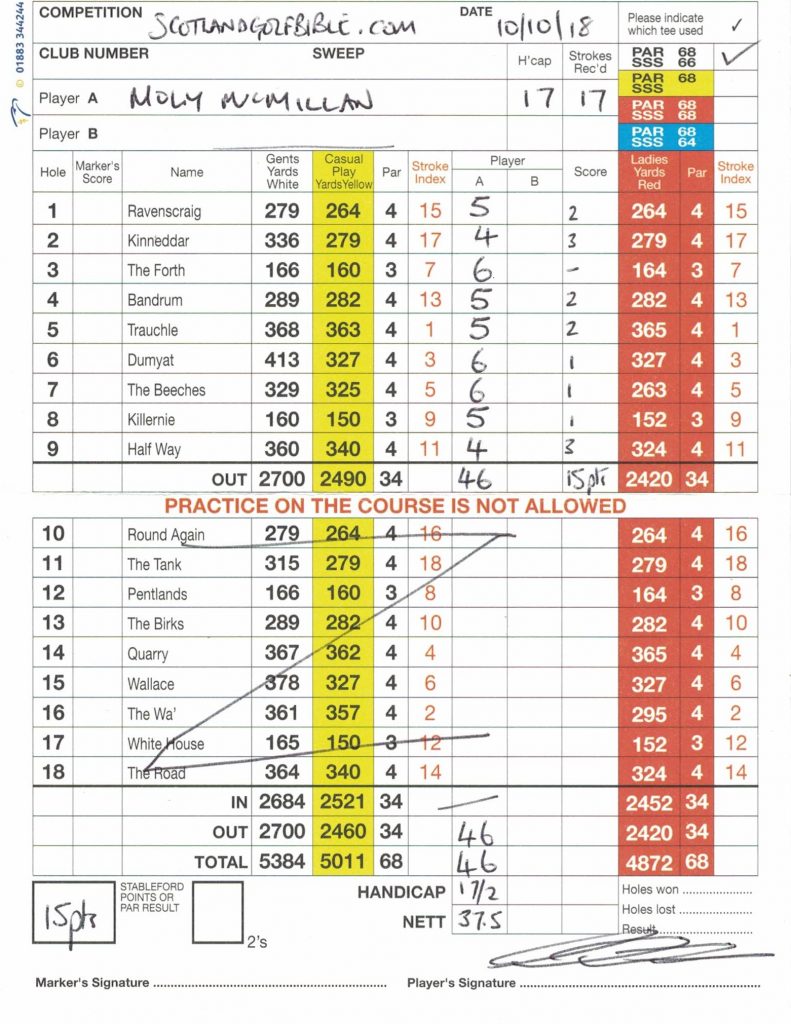
Moly’s Gross Score  46

Moly’s card at Saline – 46

82. The Glen, East Links, North Berwick. 11 Aug 2018.

Excellent vistas, with some memorable holes, but clearly an overplayed course and a little worse for wear.

Round £58.   Par 70.  Value (out of 5) – 3

The seaside town of North Berwick, about 25 miles east of Edinburgh, sits along an outstanding coastline that is home to many renowned and world class golf courses, helpfully listed in the East Lothian golf website here.

The Glen golf course sits on the east of the town, and has historically been called “East Links”, to differentiate it from its more westerly and much older “West Links” neighbour, North Berwick golf course, which is one of Scotland’s great championship golf courses.

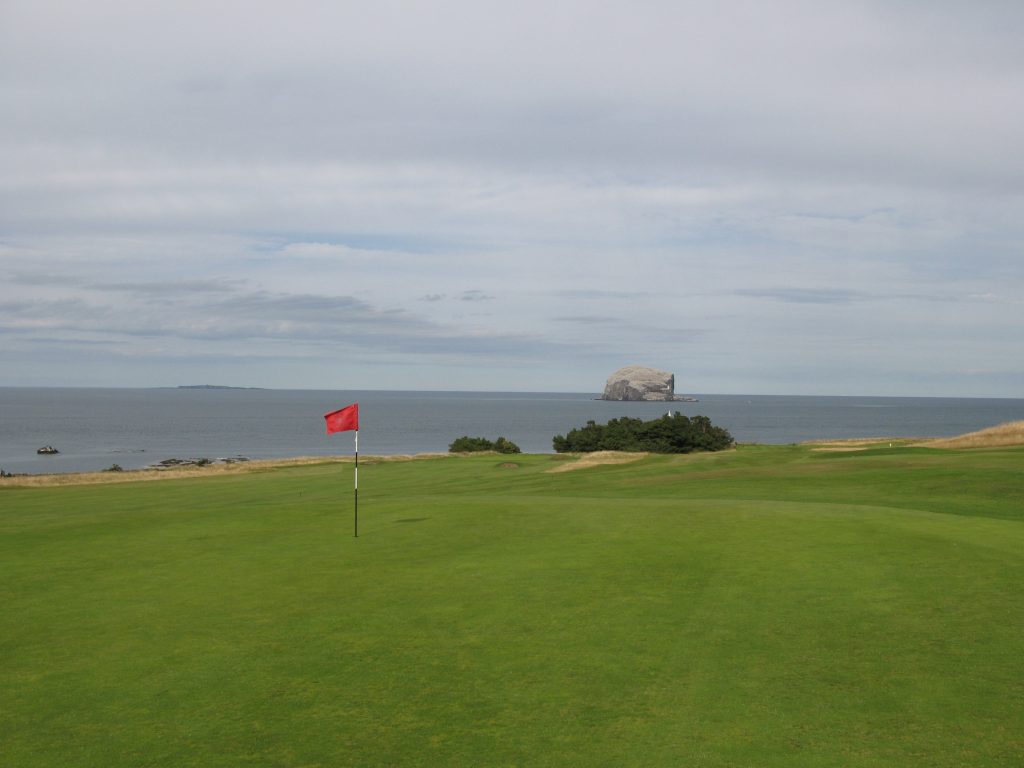
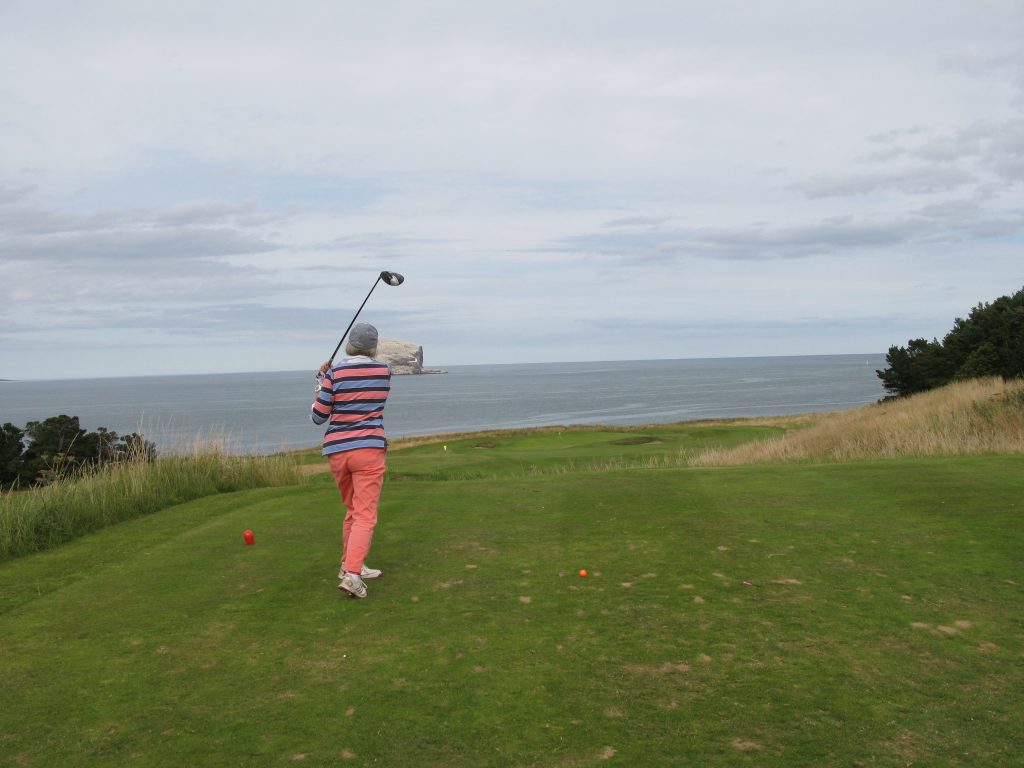
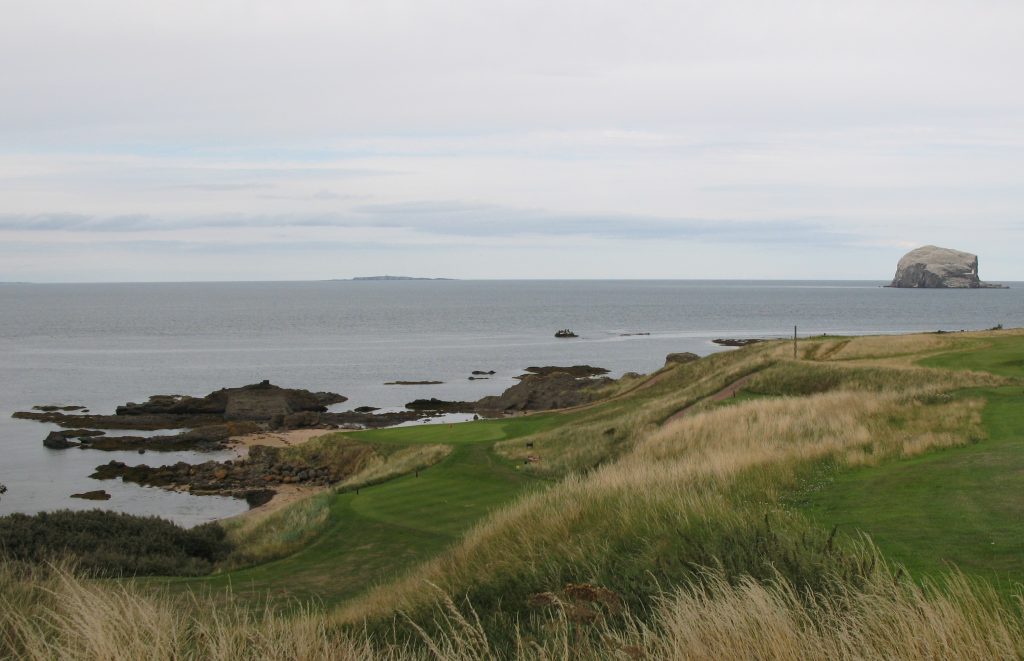
The Bass Rock from the 10th tee at The Glen.

The North Berwick “West Links” golf club actually opened in 1832.  Demand for golf expanded rapidly towards the latter part of the 19th Century along with the expansion of the railways and the increased wealth and leisure time which came from the Industrialised age.  A second 9 hole golf course to meet this demand was laid out in the east of the town in 1894, designed by Ben Sayers, the legendary Scottish golf professional and club innovator, who played a match to mark its opening.    Then, only a little over 10 years later, Sayers again, this time in conjunctions with James Braid, oversaw the extension to 18 holes, of what is now The Glen golf course.

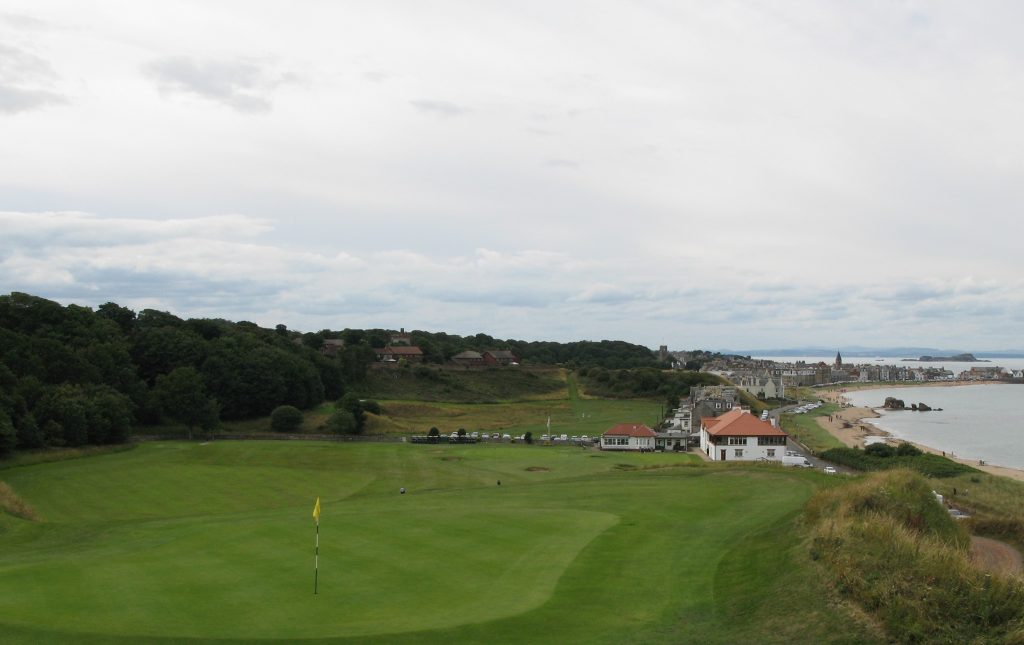
The view from the 1st green at The Glen towards the nice clubhouse.

The course is dominated by the views of the Bass Rock, one of the several islands which dot the outer part of the Firth of Forth.  The rock can appear almost fluorescent in the correct light, which is the result of the white droppings of the large colony of gannets which inhabit it.

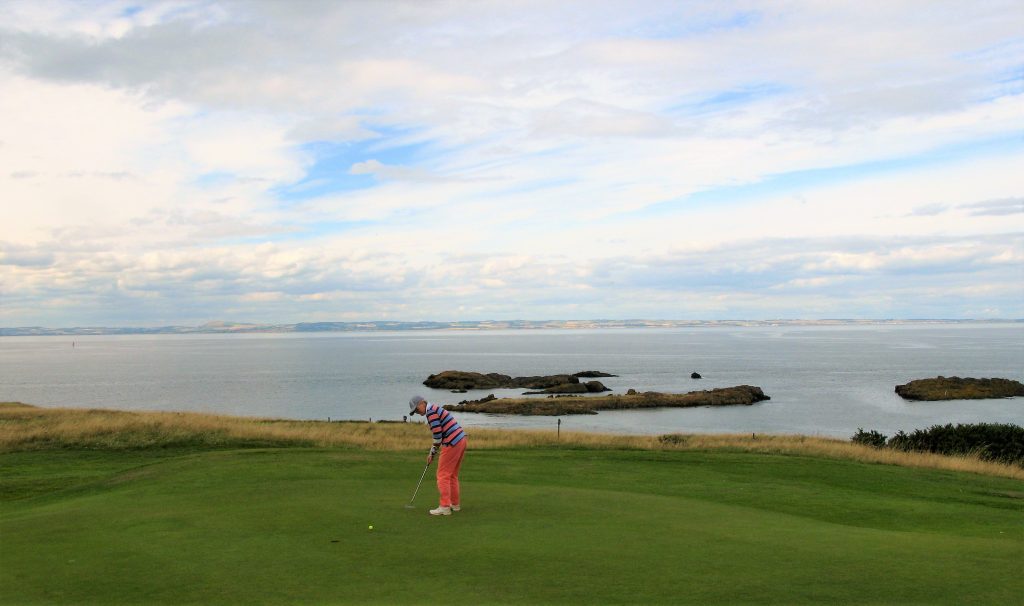
Views North towards the Fife Coast from the mid iron par 3 4th hole, where Fran and I both kept right as guided in the Course planner!

In fact, the coastal views from the course are among the best in Scotland, extending far north to the Kingdom of Fife; however, they serve as a rather flattering deception as many of the holes of the course are in my opinion pretty bland.  In particular, the several holes on the inland most side of the course are built on arable turf and don’t feel particularly links like at all.

Fran at the 9th, with a view of the typically worn teeing ground.

The course is basically an out and back layout, and starts with one of the most challenging holes, which after a fairly innocuous drive to around 200 yards, requires an uphill shot to a blind green – take at least 2 clubs more than normal, as the green is very long.  If you just get to the top of the hill, you’re faced with almost an inevitable 3 putt!.  This brings me to the greens – they were in good condition but seemed to have a great deal of variability of pace, which I never got used to and I three putted 8 times, which I think must be my record.

The course was otherwise in fair condition, except for the tees which were really very poor, and a clear sign of the amount of play throughout the summer – granted, the dry summer may not have helped the green keepers.  Nevertheless, the high amount of golf played is a really good thing, as golf in Scotland is in general decline.  I think The Glen provide a nice welcome and the facilities and clubhouse are new and very good, another sign of the general wealth on the coastline.

The signature par 3 13th green here seen from a distance. Note the hole is not played in this direction.

The course does have some excellent holes, and some very challenging ones, in its 6000+ yards locker.  The best known is its signature hole, the 13th, which has been likened to the famous short 7th at Pebble Beach in California, which if you look at comparable pictures is not unreasonable.

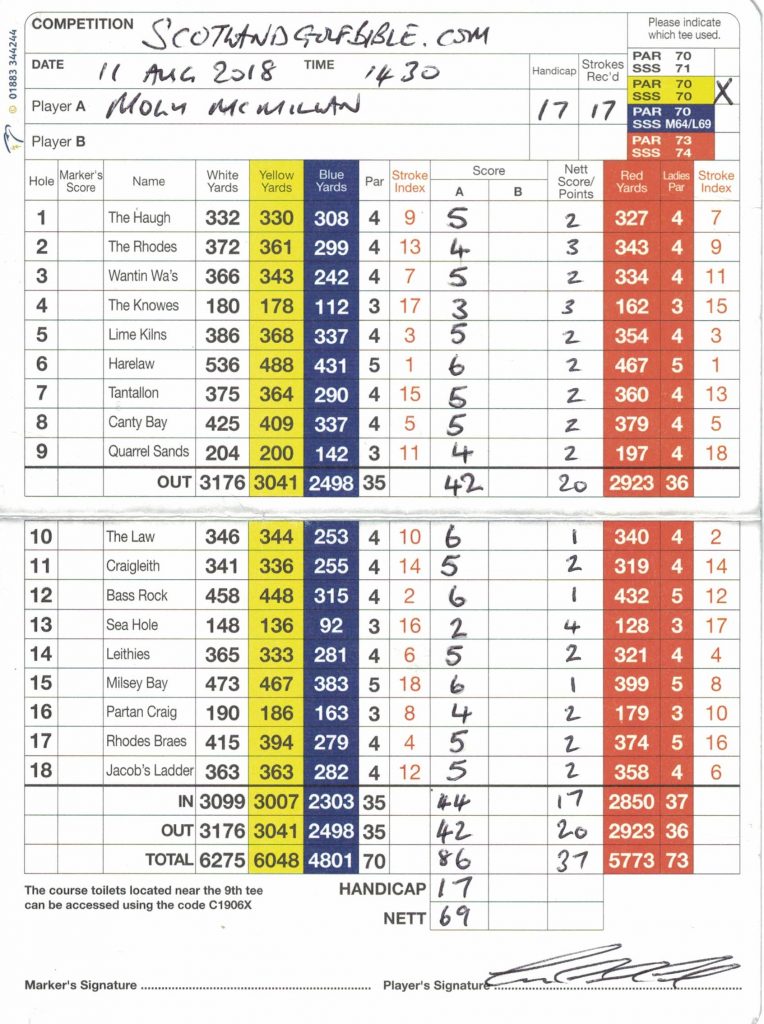
Other than my putting I had an excellent day, scoring 86, having hit 10 greens in regulation;  this was greatly helped by the pretty wide fairways the course has.  The nicest thing was having a birdie 2 at the signature hole.

It’s worth playing The Glen, but if possible I would think that early season would be a time the course is at its best before the Summer visitor season.

Facts:

Course Type: Links

Par 70 (yellow:  2 par 5s, 12 par 4s,  4 par 3s)

Distance (yellow): 6048 Yards

Moly’s Gross score: 86

Some excellent play for 86 at The Glen; but included 3 putting 8 greens!

69. Moray New. 24th Oct 2017.

The junior of the two Moray courses is a fine example of links golf.   

Summary:  Round  £50.   Par 70.  Value (out of 5) – 4

Moray Golf Club is in Lossiemouth on the south shore of the Moray Firth, about 6 miles north of Elgin.  The main course, Moray Old, designed by Old Tom Morris, opened in 1889 and is one of the great Scottish Links whose 18th hole has a magnificent green in front of the fine old clubhouse.

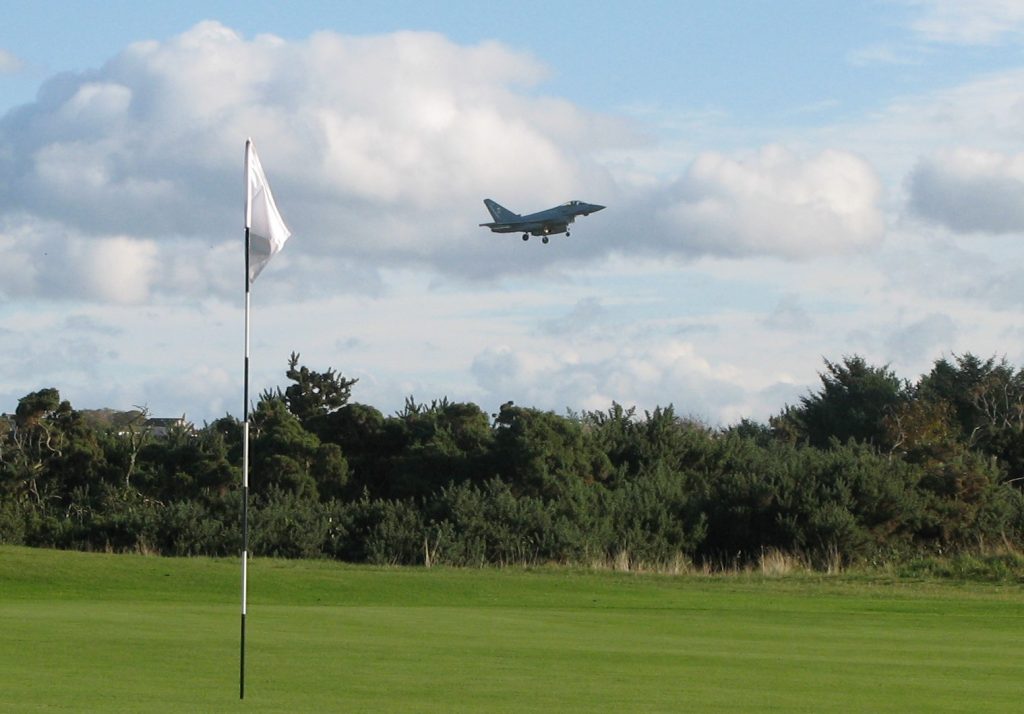
Beware aircraft noise – a Typhoon from RAF Lossiemouth passes over the 6th green at Moray New

The Moray New 18 hole course was designed by Sir Henry Cotton and opened in 1979, and extended the 9 hole “Ladies Relief” course which had been laid out in 1905.  This is one of only 2 Scottish courses “re”-designed by Sir Henry (the other being Stirling).

At just over 6000 yards, off the white tees, Moray New is still a substantial test of golf.  With the wind blowing and the abundance of gorse, accuracy from the tee is very important here.

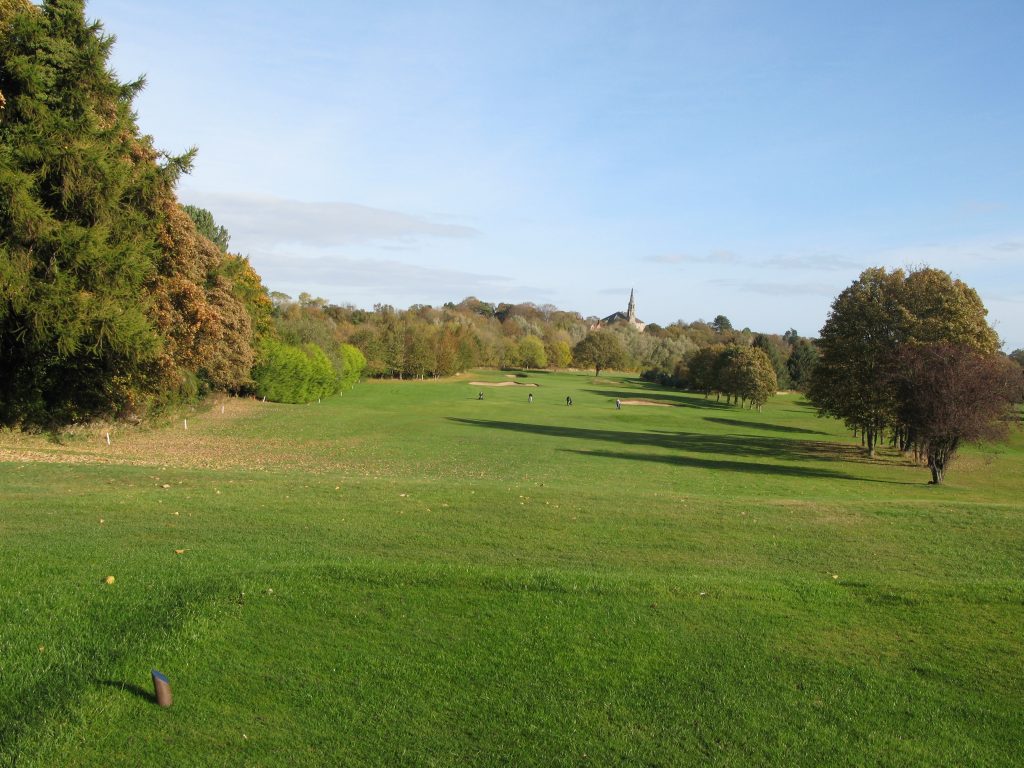
The beautiful looking 3rd at Moray New

The New course is closely intertwined with the Old and it’s important to check which coloured flags are in use on each course.

A significant hazard can be the noise from jet aircraft from the adjacent RAF Lossiemouth base, which is closest to the 6th green on the New.  When I played there was a busy flying day and I was treated to some fast climbing displays by the local Typhoon jets of No’s 1(F), II(AC) and 6 squadrons – the primary task at RAF Lossiemouth is to maintain the Quick Reaction Alert (Interceptor) North mission.

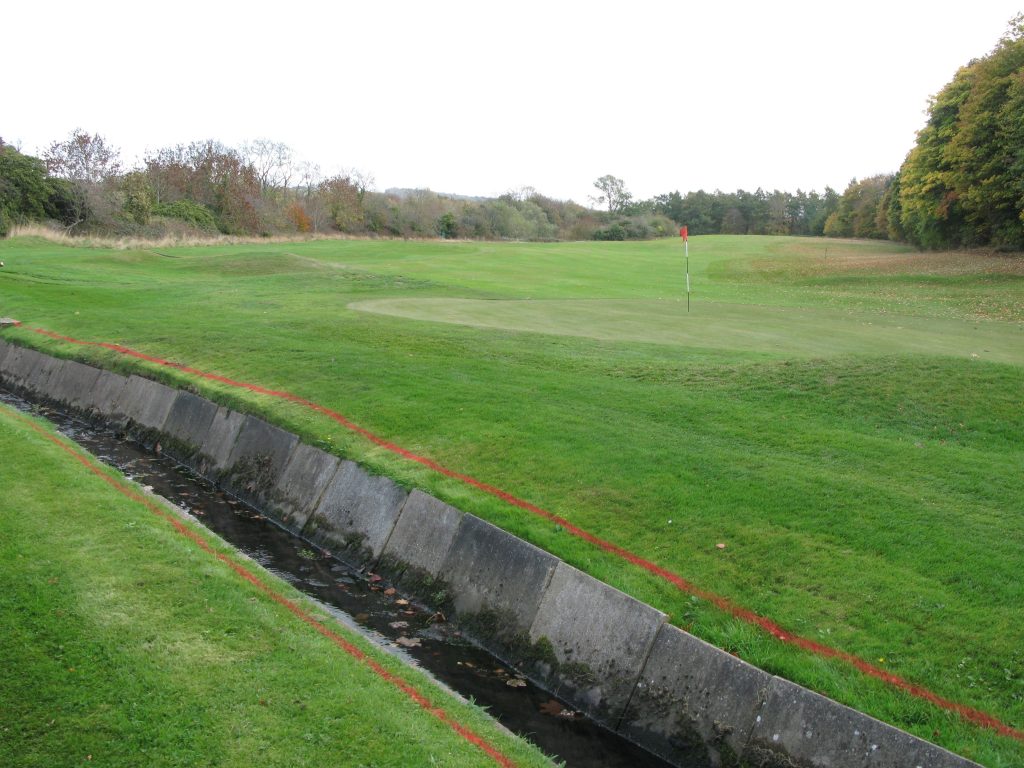
Approach to the 5th at Moray New – with burn in front of green

The course has some fine holes, dominated by the wind of the day.  The 10th is the closest to the coast, and the prevailing wind will normally be against and from the left, making it difficult for a right handed slicer – the green is on a slight plateau and difficult to find.  The par 4 14th, Stroke index 1, will play like a par 5 for all bar the really long hitters.

There are some tricky par 3s, with the innocuous looking short 6th having the burn passing directly in front of the green, making a front tee position very difficult.  The 17th, the longest of the par 3s, has 4 well placed green side bunkers awaiting.  In general, there is some clever bunkering on both fairways and greens throughout the course, although this course does not have the deep re-vetted bunkers found on many a links course.

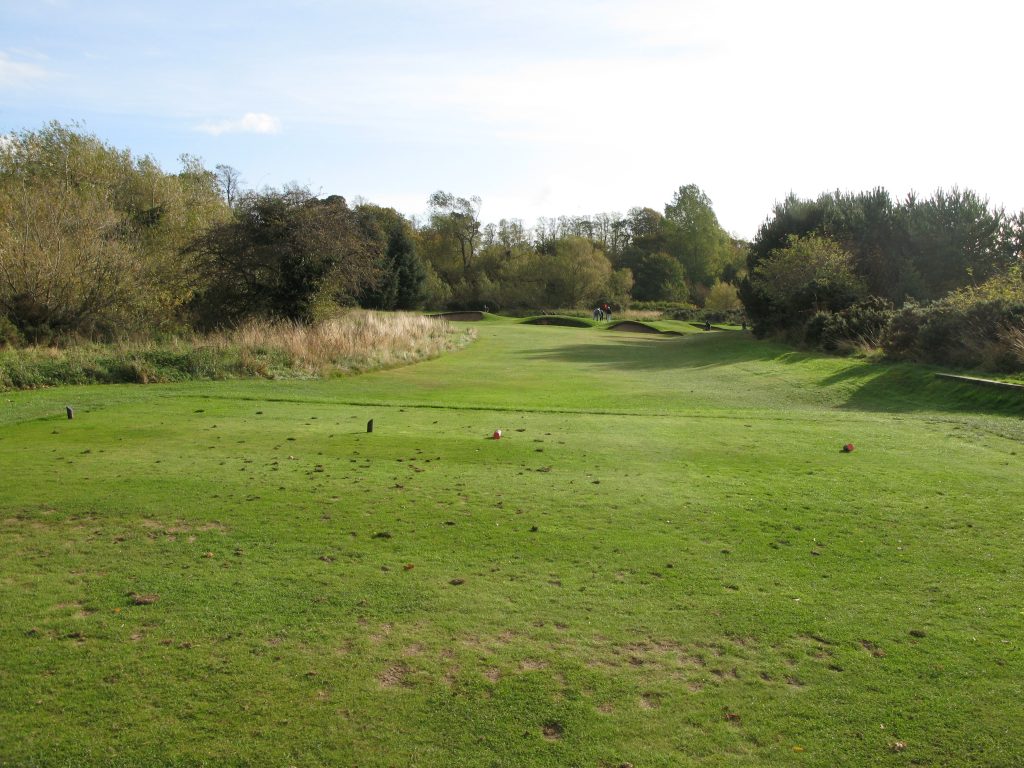
7th at Moray New, one of the challenging par 4s (SI 7)

The course was in excellent condition for a late October day, demonstrating how accessible Scottish Links courses can be all year round – by comparison many courses inland were closed due to being waterlogged on the same day.

Other than plane spotting, playing at Moray is highly recommended for whisky lovers, since Moray has a well established and long relationship with nearby distillers (several of whom were original members of Moray) from whom the club has bought several vintage whiskys.  It has its own label “Club malt”, currently a Macallan.  Curiously, there is more about the history of whisky on the club’s web site than the golf courses!

Par 4 10th tee, a nightmare in the prevailing wind from the left!

A story worth noting is the political dispute Moray GC had with, probably in hindsight, its most famous member, the first UK Labour Prime Minister, Ramsay MacDonald –  he was removed from the membership list in 1916 for his opposition to the First World War.  He was finally reinstated as a member in 1929, but never played Moray again.

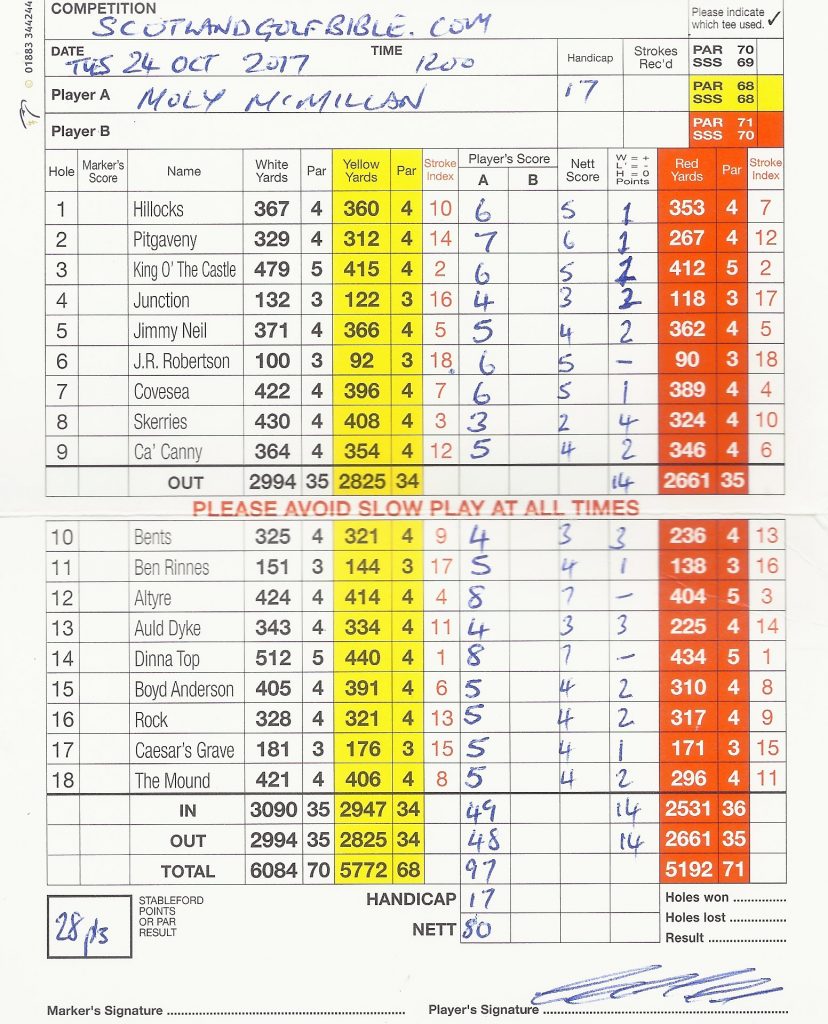
On the day, I played reasonably well for 28 points, although had a few disasters (on 12 and 14 especially), which meant I scored a gross 97.  I got a birdie on 8, which was my highlight.

If you plan to play the Old course at Moray, try and make sure you savour the New as well.  Highly recommended.  I played using The Courier golf voucher deal for only £15 – an absolute bargain.

Facts:

Course Type: Links

Par 68 (14 par 4s, 4 par 3s)

Distance (yellow): 5772

Moly’s Gross score: 97

Moly’s Moray Old scorecard – 97 for 28 points


« Older posts Newer posts »

© 2026 Scotland Golf Bible

Theme by Anders Noren — Up ↑