A guide to green fee value for money

Category: 1851 – 1900 (Page 8 of 14)

84. Lundin. 31 Aug 2018.

This historic links is a marriage made in golfing heaven 

Round £75.   Par 70.  Value (out of 5) – 5

Winston Churchill one said “this is a long speech because I’ve not had time to prepare a short one”.  That feels like my dilemma in writing about the wonderfully crafted golf course at Lundin Links; what to leave out?  I say the golf course “at” Lundin Links, because that is actually the name of the town, which sits on the southerly Fife coast about 12 miles south of St Andrews, where the Lundin Golf Club is based.  I think it’s the only place in the world where the town has the more appropriate golfing name than its golf course!
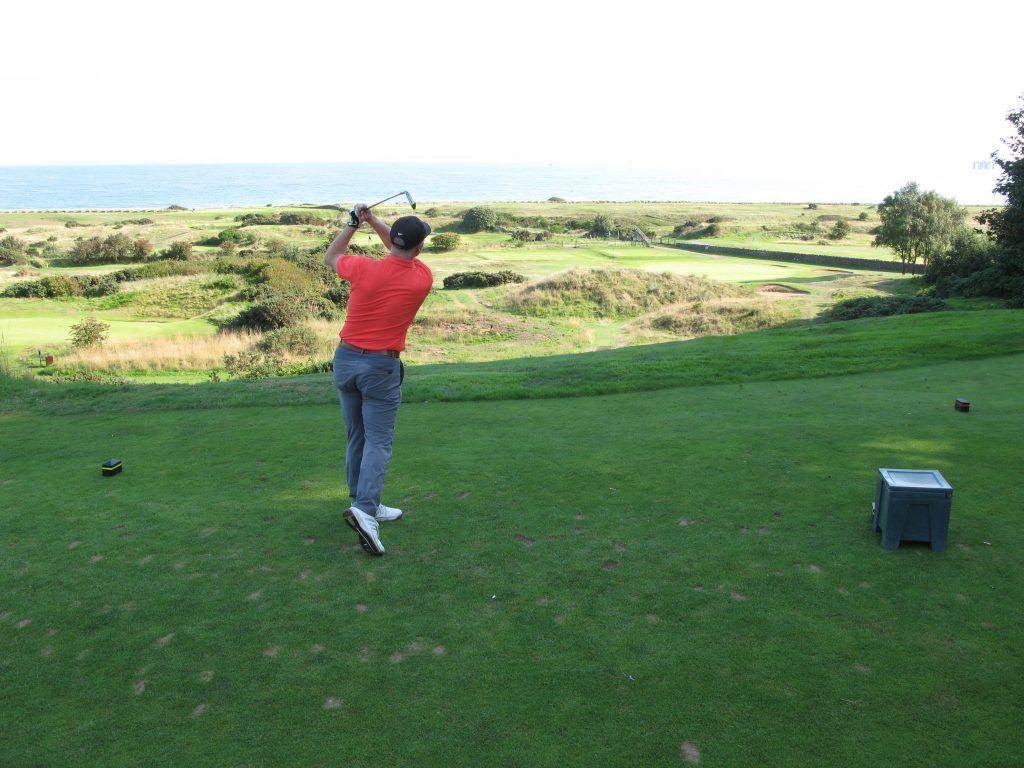
Moly at Lundin’s par 3 14th – where you can see all the 18 greens!

This naming conundrum is aesthetically appropriate because Lundin golf course poses a few other riddles.  Along with the adjacent Leven Links (the name of the golf course by the way, not the town, which is simply called Leven; au contraire!) it had the first ever 18 hole golf course with 18 separate greens, established in 1868.  That original 18 hole layout, 9 holes of the current Leven Links course plus 9 from Lundin, separated by the Mile Dyke, is still played, but only once per year in a competition to mark its history.  I covered the history of the split in the courses fully in the Leven Links blog here.
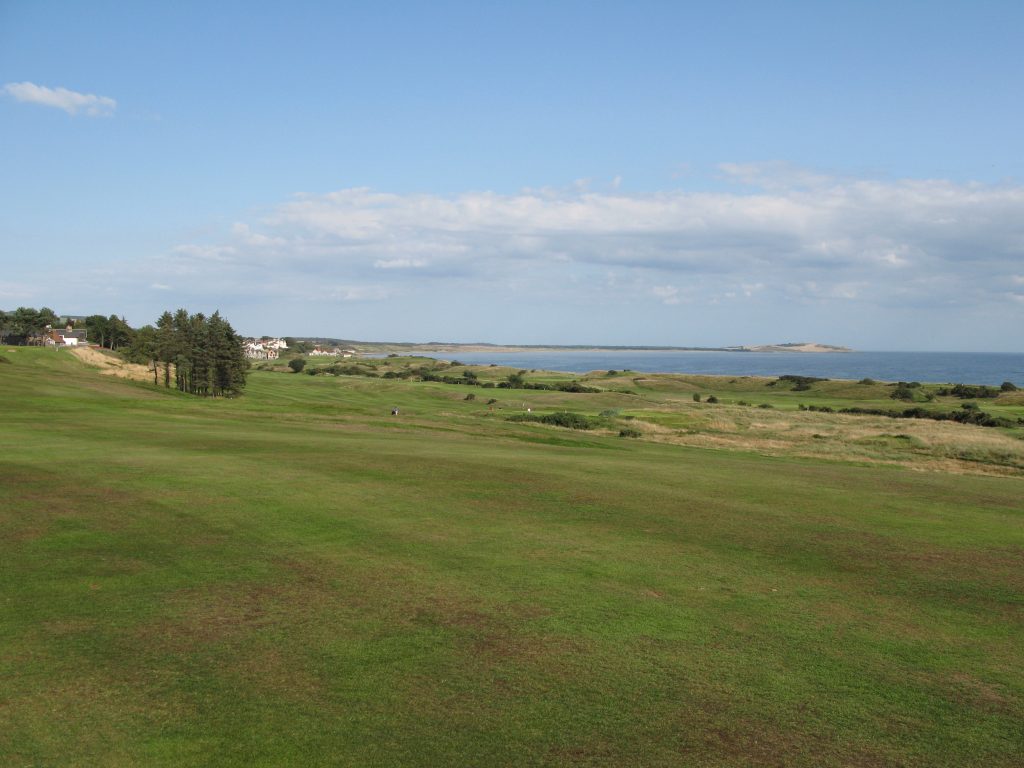
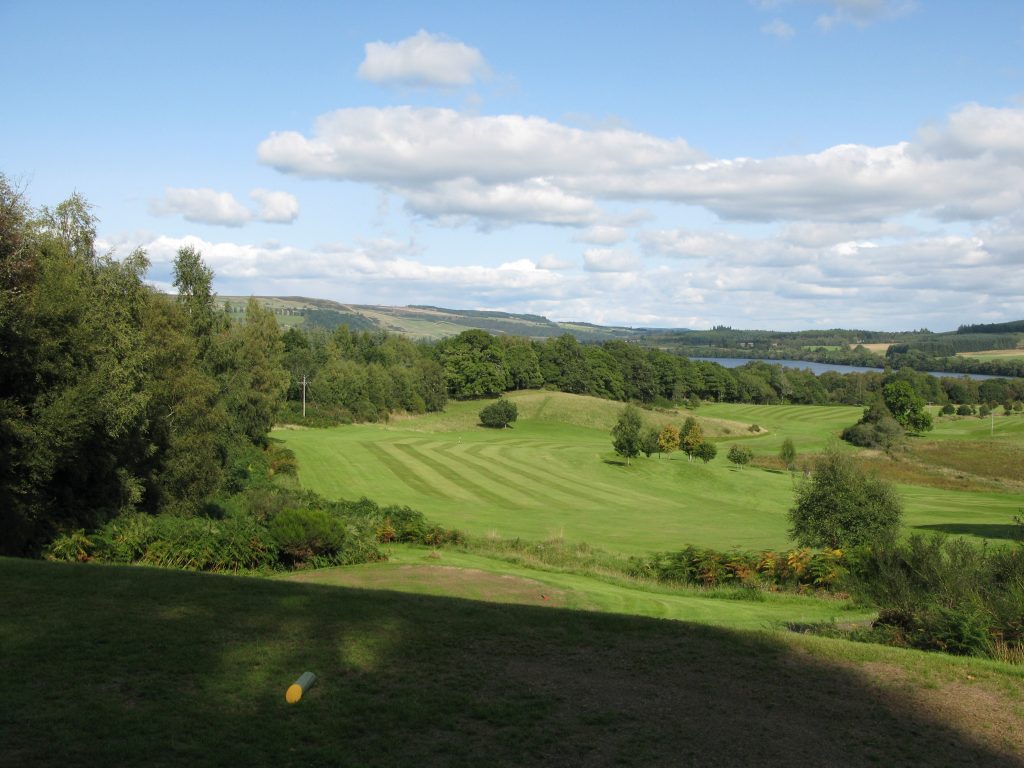
View across the Lundin course from the 13th fairway.

The real riddle at Lundin was the architectural one given to James Braid, who was tasked in 1908 with adding 9 holes on the inland side of the 9 holes crafted by Old Tom Morris, to leave us with the current 18 hole layout.  The resulting course is an absolute beauty, and I’m sure Braid tinkered with the bunkering of Old Tom’s holes as well.  Old Tom’s holes are now the first 5 and last 4.

The course is a nice length at about 6400 yards; not long by today’s standards, but with some fascinating decision making, especially from the tee.  Until very recently it was used for final qualifying when the Open was staged at St Andrews, a measure of its quality and condition.
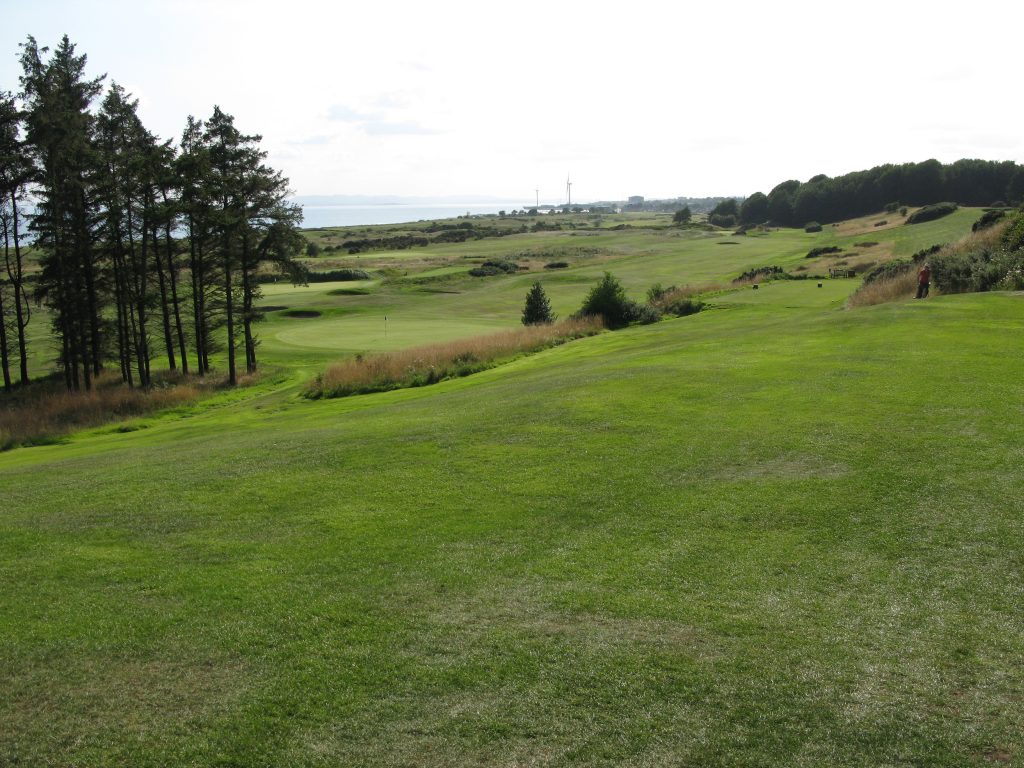
View from the 12th green at Lundin, looking towards Leven

The course was in excellent condition when I played, as a guest of local member Eric Brown and his wife, Moira.  I ungraciously won the “6 point per hole” match play game, although it was nip and tuck most of the way round.  My 9 pars off my 16.8 handicap did rightly elicit a self induced “bandit” conversation, albeit my 3 lost balls (1 resulting in an 8 at the par 4 18th), meant that my 36 points on a fine day would likely have been only in the handicap buffer zone!  That’s my defence anyway M’Laud!

Enough about me, the golf course is the star here.   It’s also a good time to introduce readers to Golf Club Atlas a non commercial web site run by and for golf course architects, where you can find some excellent reviews of many of the worlds great courses.  Being reviewed by Golf Club Atlas is a measure of a course’s pedigree, as well as giving great insight as with their entry for Lundin.

The first 4 holes are classic links holes, played normally into the prevailing wind, with OOB along the left with the beach awaiting a wild hook.  The first is a difficult 400+ yards par 4, with a mid to long iron needed to an uphill plateaued green;  the second, a shorter par 4, requires good judgement to stop short of a fairway burn with your tee shot;  then the 3rd, another short par 4, presents a challenging drive to miss several fairway bunkers.    The 4th, however, is where many a round will come unstuck.  Any time a James Braid influenced course has a stroke index 1 hole without any fairway bunkers, one needs to probable play it as a par 5.  I failed to adhere to this plan, and ended up hitting a decent second shot with a hybrid to the right on the green and never saw it again – whether it cleared the deep burn I will never know!
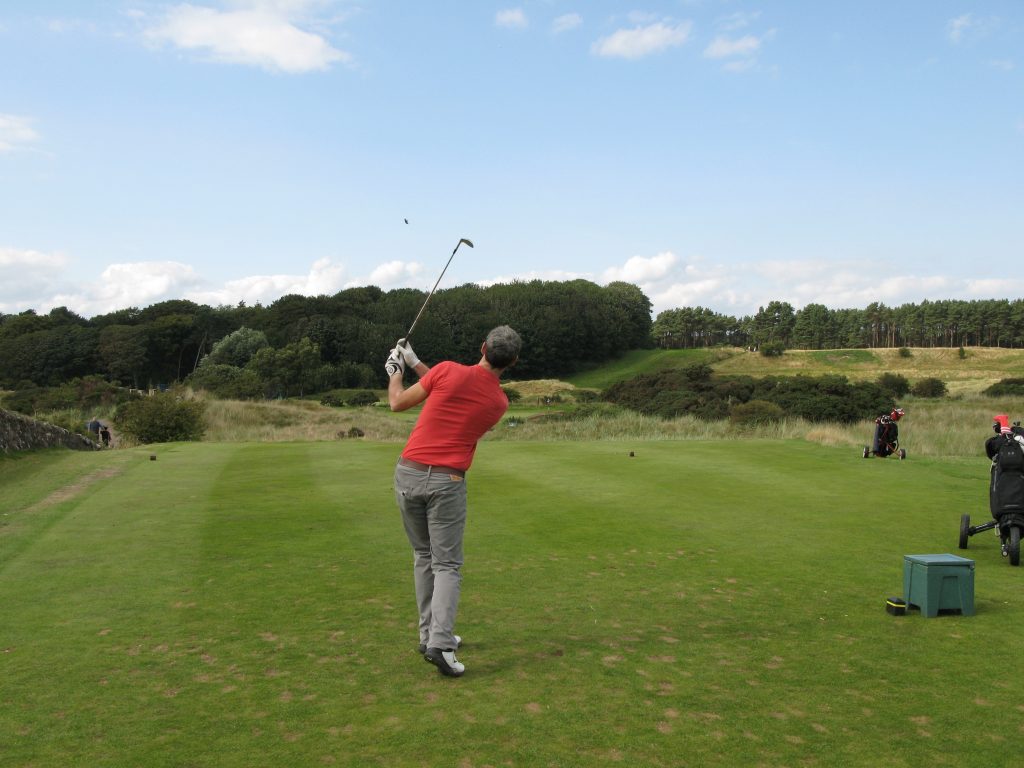
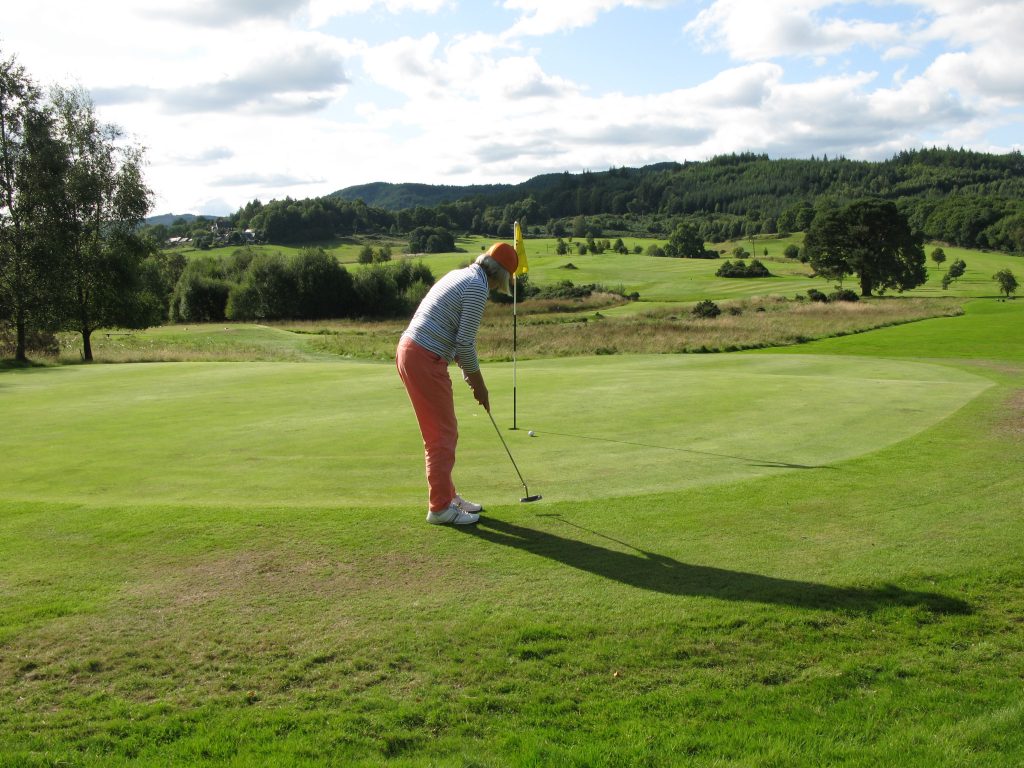
Eric Brown playing at the par 3 5th hole, one of only 2 holes at Lundin not playing in the coastline direction.

After a relatively short par 3 5th, you leave Old Tom’s legacy and move to the other side of an old railway line that slices the course in half, and play the 9 Braid holes, the first 3 of which have the railway as OOBs to the right.    By the time you have played the 6th and 7th, you might also have picked up another clever feature of this course – the short par 4s tend to have very tricky greens.
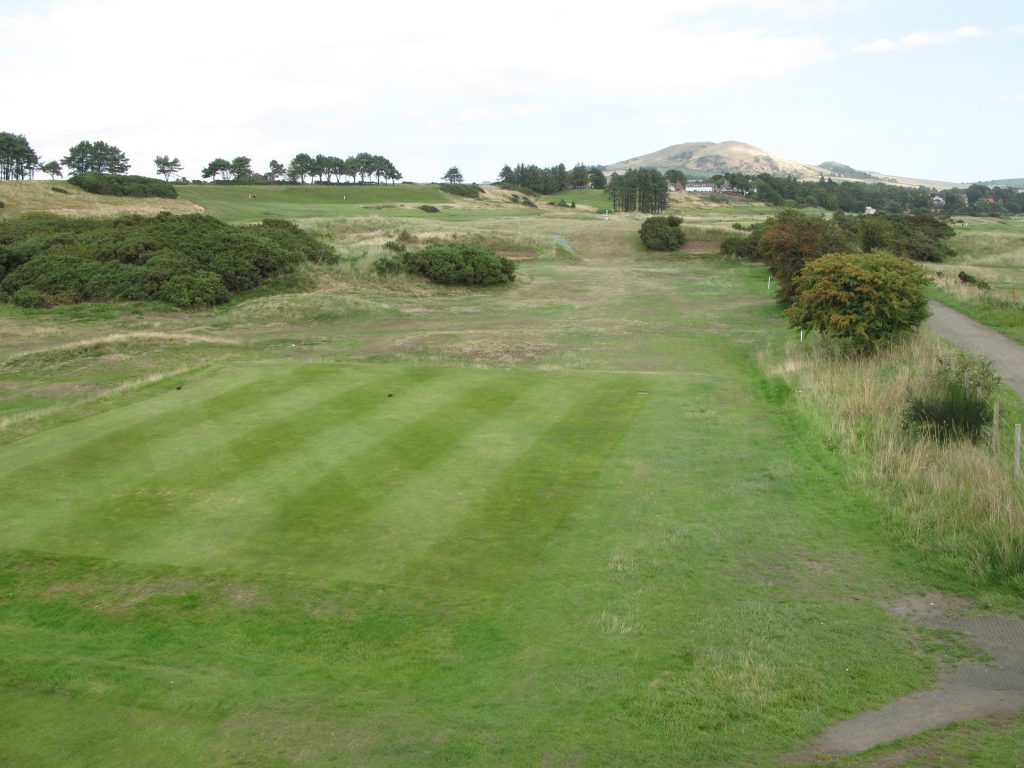
The view from the 6th tee, one of the short par 4s with a very tricky green.

The 10th hole was another of the typical strategic challenges;  the fairway is cut in two between the tee and green;  go left where no bunkers exist, but leave a blind second with the green side bunkering obscured, or go right for an easier approach shot, as long as you miss the well placed fairway bunkers.  A joy of a hole.

After playing the, arguably parkland, inland holes of 11 through 13, you reach a place arguably unique in world golf.  From the 14th tee, you can see every green on the course, along with a magnificent view of the Firth of Forth and the North Berwick coast in the distance.  This view is worth the green fee alone.  The 14th is also a great par 3, with a significant drop, so club selection is key to this hole – it’s better being long than short here by the way.

After a nice set of par 4s, you come to the very difficult last hole, a long par 4 played to a long and slightly raised green that slopes from back to front in front of the terrific clubhouse.  I think the number of visiting golfers that find this green in regulation will be low;  plus the sting in the tail is that it has a very difficult green to finish.  I ended up with an 8, having put my second OOB to the left.
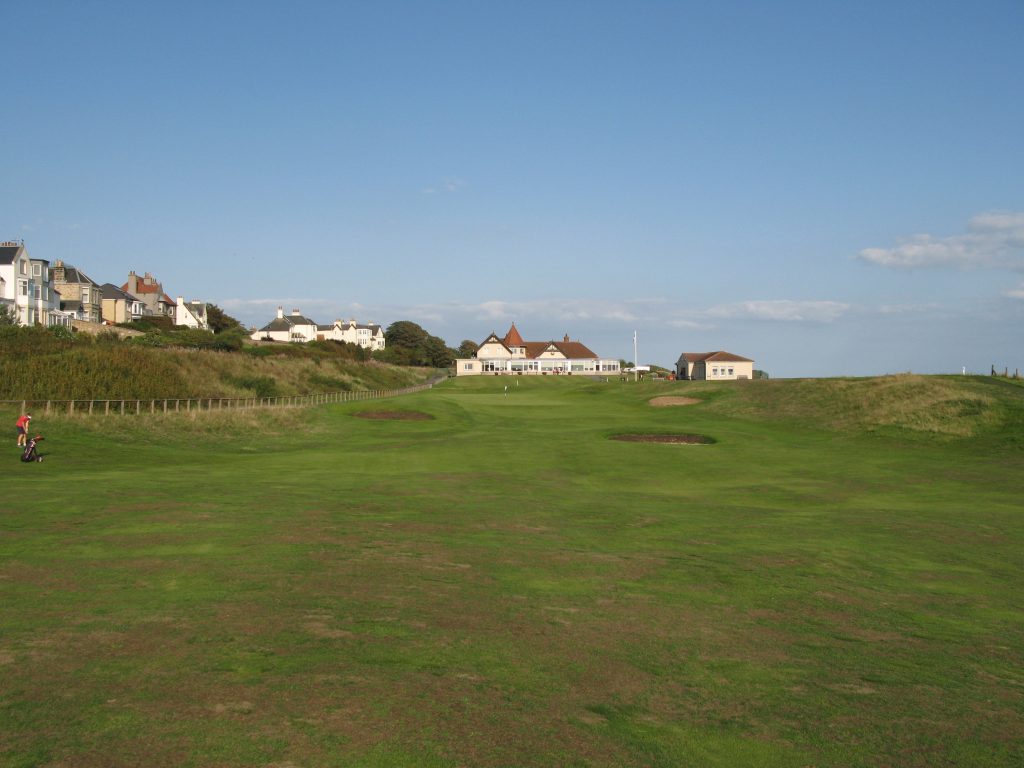
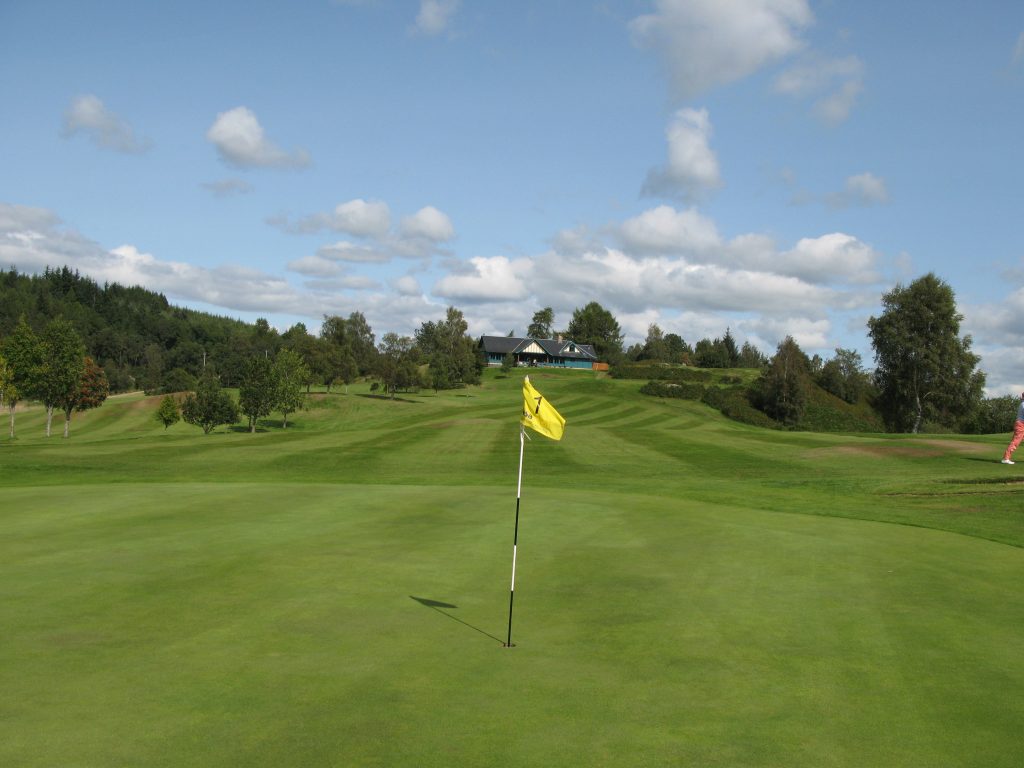
The difficult long par 4 18th hole, in front of the lovely Lundin clubhouse.  Moira, seen here playing her approach, having just stayed in bounds on the left.

People say that Lundin is a “gem”, but I disagree.  Its much better than that;  for me, the term “gem” has evolved into one used to describe “great courses, but somewhat unknown or off the beaten track”.  Lundin is very much on the well trodden track, is a merge of architectural significance by 2 of the greats, and it is a joy, for many reasons.

A must play Scottish golf course.   Buy the Course Guide, and study the holes!

Facts:

Course Type: Links

Par 70 (2 par 5s, 13 par 4s,  3 par 3s)

Distance (yellow): 6138 Yards

Moly’s Gross score: 91
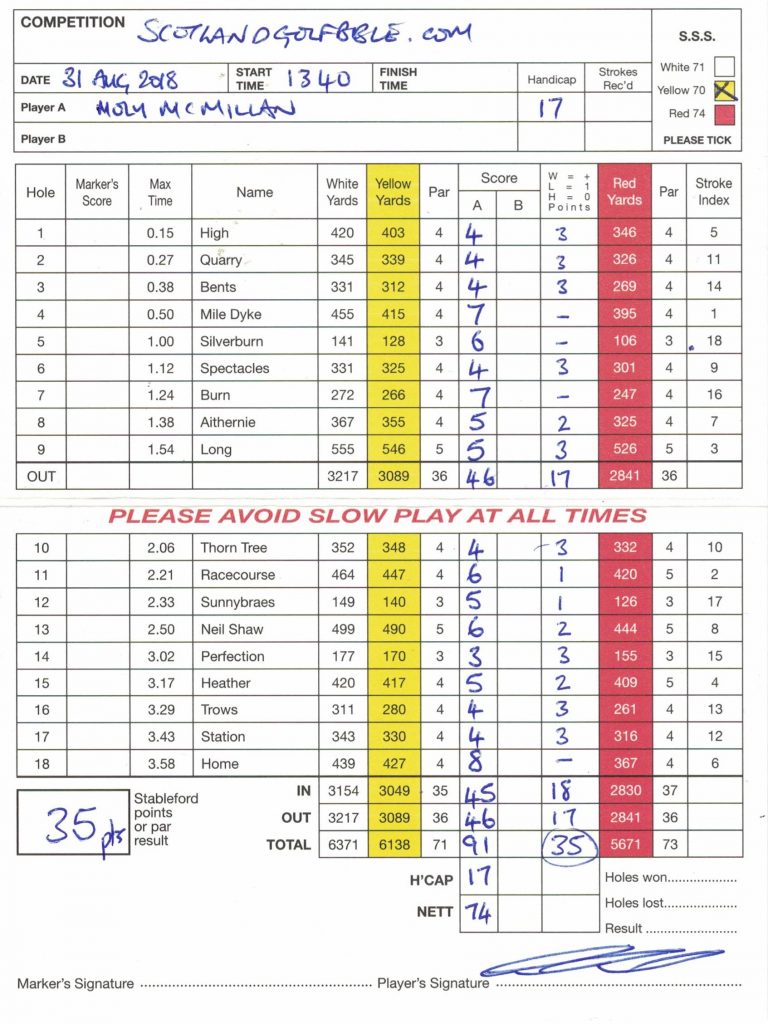
Moly’s very mixed Lundin scorecard – 9 pars, but still 21 over par for 91!
83. Dunkeld & Birnam. 25 Aug 2018.

This brilliantly located course, with great countryside views, is a tough 18 hole undulating walk – I wonder whether in time the club may reflect it should have stayed as a 9 hole layout? 

Round £30.   Par 69.  Value (out of 5) – 3.5

Dunkeld and Birnam Golf  Course is just a few miles east of Dunkeld, in the village of Birnam,  in what the club describe on their website as “Highland Perthshire”.    Birman and Dunkeld were actually different villages set on opposite banks of the river Tay, until they were connected in 1809 by a Thomas Telford bridge.  It is in an area of outstanding beauty, and I suspect many visitors may decide to play golf whilst on holiday.

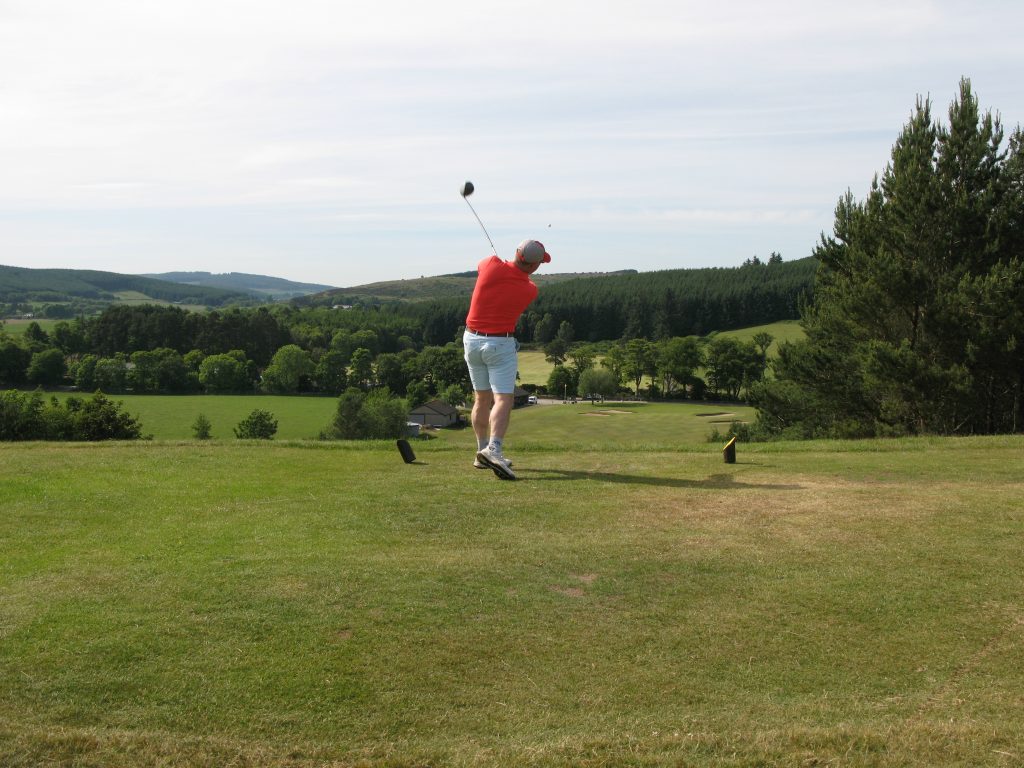
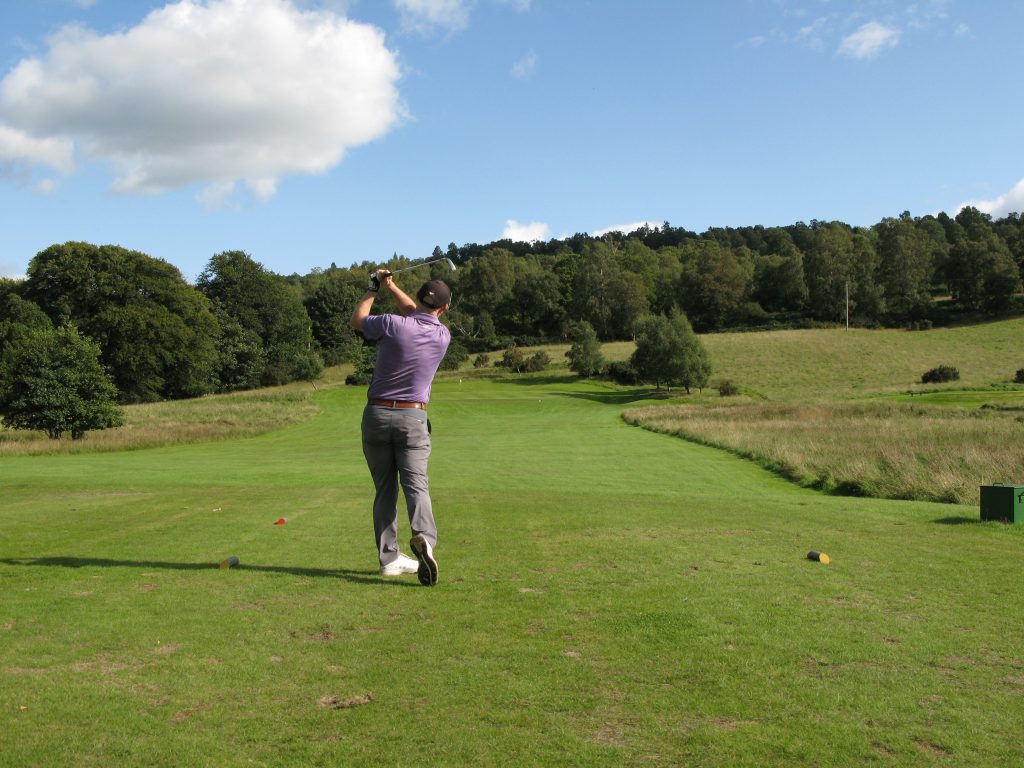
Moly at the par 3 11th, one of the new holes created in 2000.

The course was designed by Old Tom Morris in 1892, and was only extended to 18 holes in 2000.  The new holes are very much more open parkland, and slightly out of sorts with many of the original holes, which provide some typical “highland” holes.

The new layout also caused a change in the hole order, with the 17th and 18th (both originally part of the 9 hole course) being 2 of the 4 par 3s of the 18 hole course.  This makes for a rather unbalanced course in my view.  With the increasing debate about 9 hole golf competitions, as a means of encouraging play, I wonder whether Dunkeld and Birnam should have remained a 9 hole course?  I certainly think there is a charm in the “highland 9 holer”, which arguably has been lost.

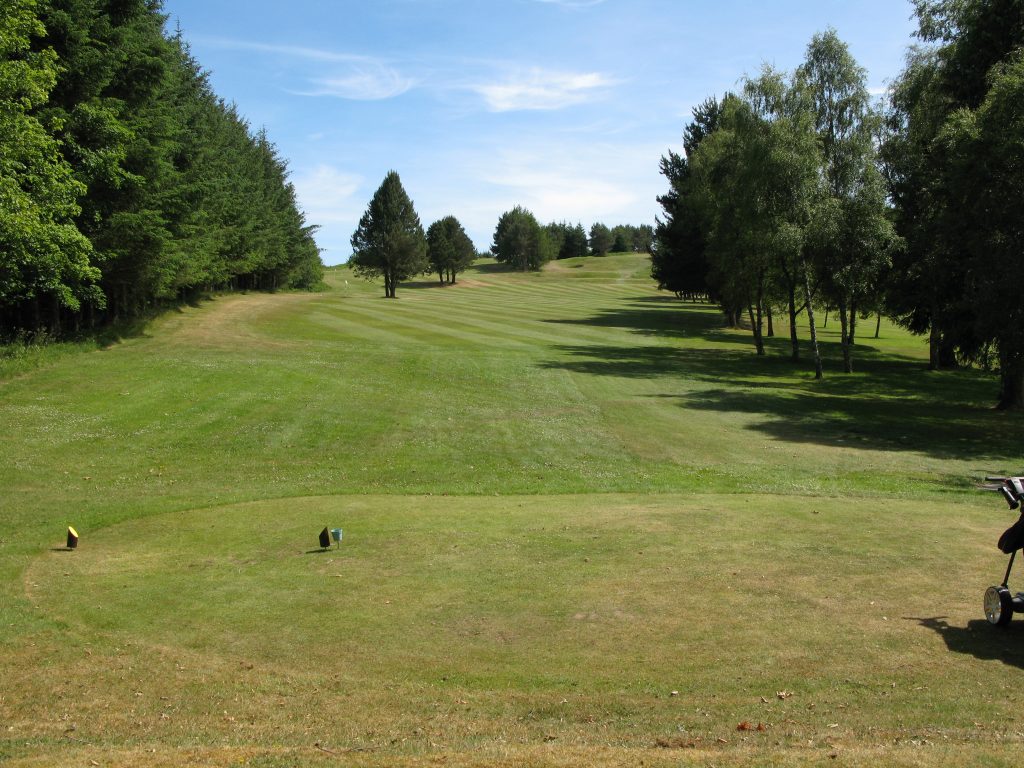
The risk reward par 4 6th hole, with the picturesque surrounds.

The course is relatively short, but it feels much longer, due to the many undulating holes, and there are a couple of fairly long walks between green and tee (the 7th to 8th being the longest, between the old and new holes).  The walk up to the 18th green warrants a buggy hire in its own right and, thankfully, there are several available for hire.

The tough approach shot at the par 4 8th at Dunkeld and Birnam

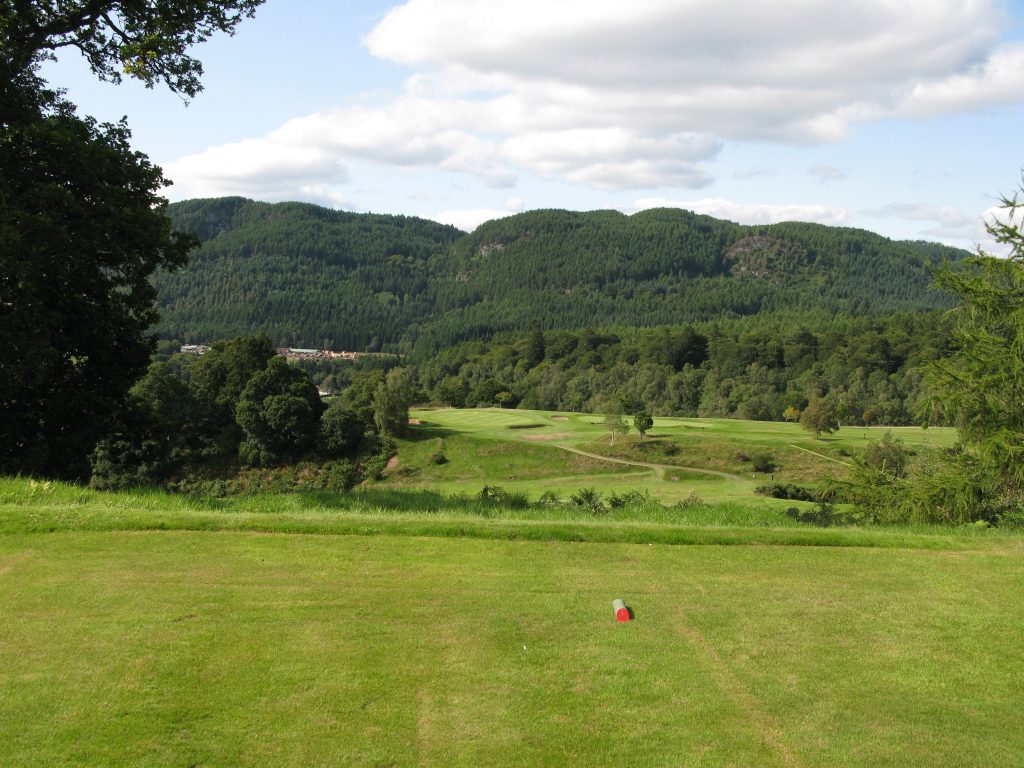
Having said all this, which might be unfairly critical, it’s really well worth the visit to play Dunkeld and Birnam.  The overall condition of the course was excellent and the greens were lovely.  The views were outstanding, including overlooking Dunkeld and taking in The Loch of the Lowes, and I think that playing in early Autumn must be particularly spectacular, due to the many trees surrounding the local hillsides.  It is an area renowned for local bird life.

The 9th tee, with The Loch of the Lowes in the distance.

Even if not playing golf here, the Golf Club has a really nice clubhouse, with beautiful countryside views and would be nice to visit for the good food also on offer.   The members were very friendly to Fran and I, and they were very proud of their club.   They are also an enterprising club and have an apartment for rent in the clubhouse.

The first green looking towards the lovely club house at Dunkeld and Birnam

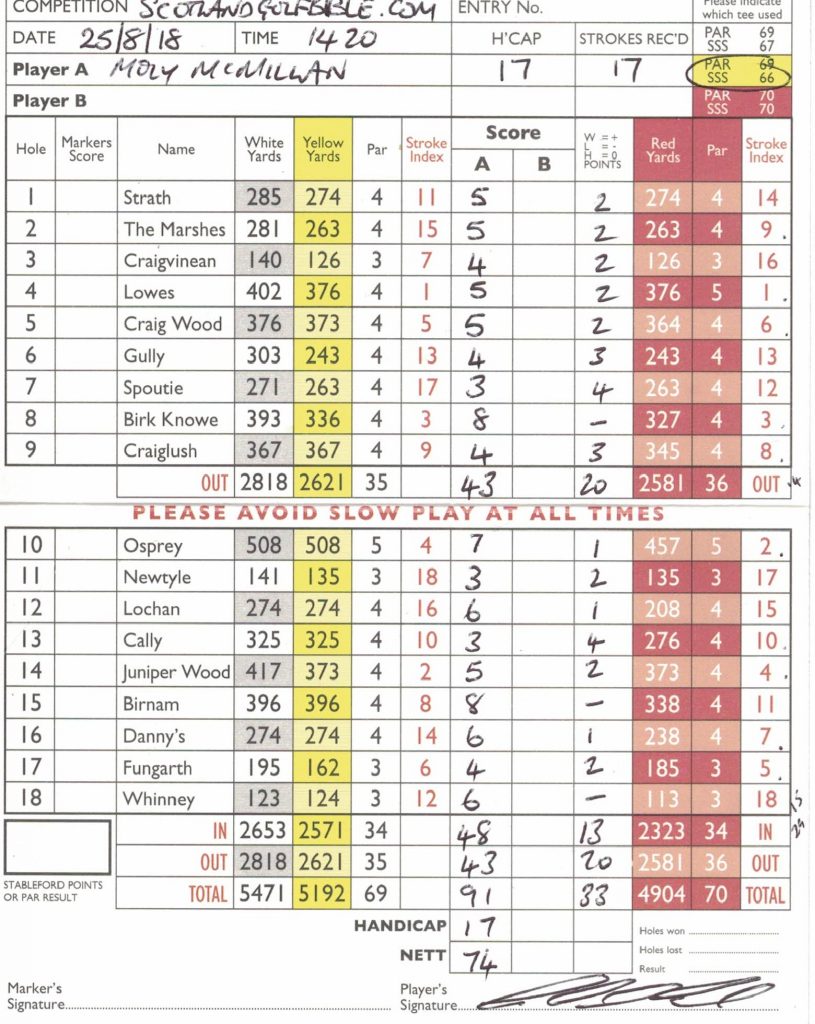
The course has some very interesting holes, and also several short par 4s which present the classic risk and reward dilemma, no more so than the 6th, one of several drive-able holes; on the day I stuck to a conservative strategy, albeit my scoring (91 for 33 points), may indicate I should have played driver more often!

The best hole for me was the SI3 7th hole, where a mid iron is likely needed to a raised green surrounded by trouble.    I suggest you play more club than you think towards the left side of the green.

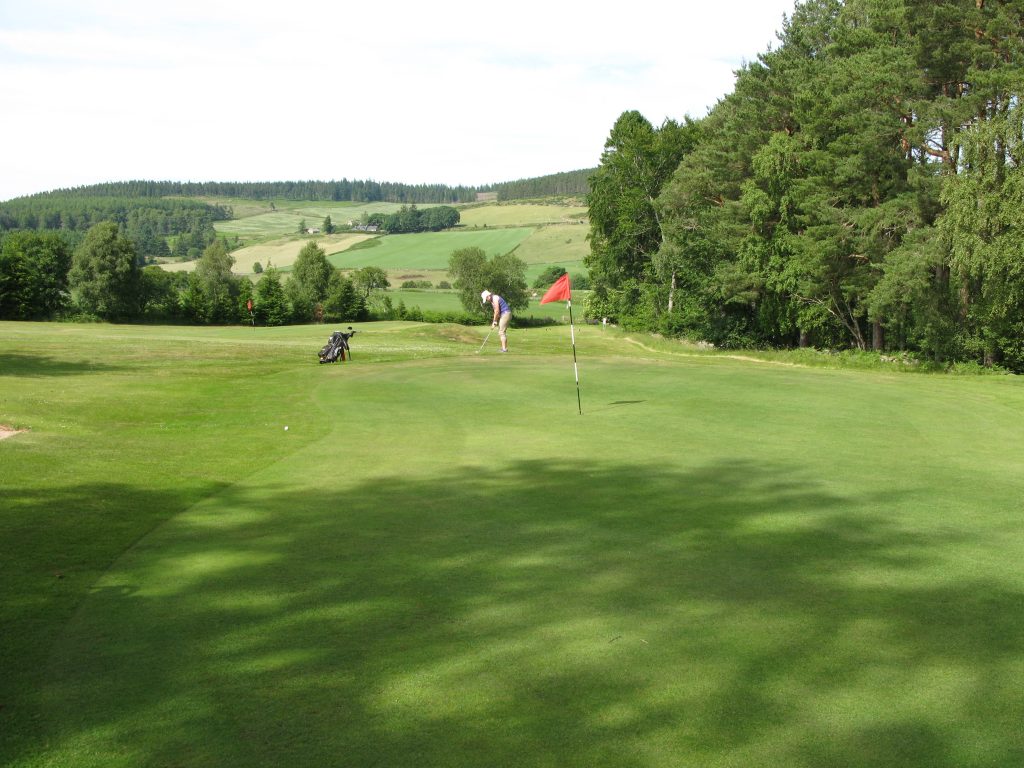
Fran putting at the 11th at Dunkeld and Birnam


Worth playing Dunkeld and Birnam, not least for the friendly welcome and the outstanding views from the clubhouse, over the tipple of your choice.

Facts:

Course Type: Heathland

Par 69 (1 par 5s, 13 par 4s,  4 par 3s)

Distance (yellow): 5192 Yards

Moly’s Gross score: 91

Moly’s 91 scorecard at Dunkeld & Birnam

80. Torphins. 25 June 2018.

Incredible value at this gem of a 9 hole course       

Round £10.   Par 32.  Value (out of 5) – 5

Torphins Golf Club is situated in Royal Deeside, in the village of the same name, 23 miles west of Aberdeen and 7 miles north-west of Banchory.   This 9 hole golf course was founded in 1891 and the club established in 1896.  I couldn’t find any record of the course designer or the course’s history, which is a real pity, as this really is a “Hidden Gem”, that oft-used but, so often, disappointingly flattering term.

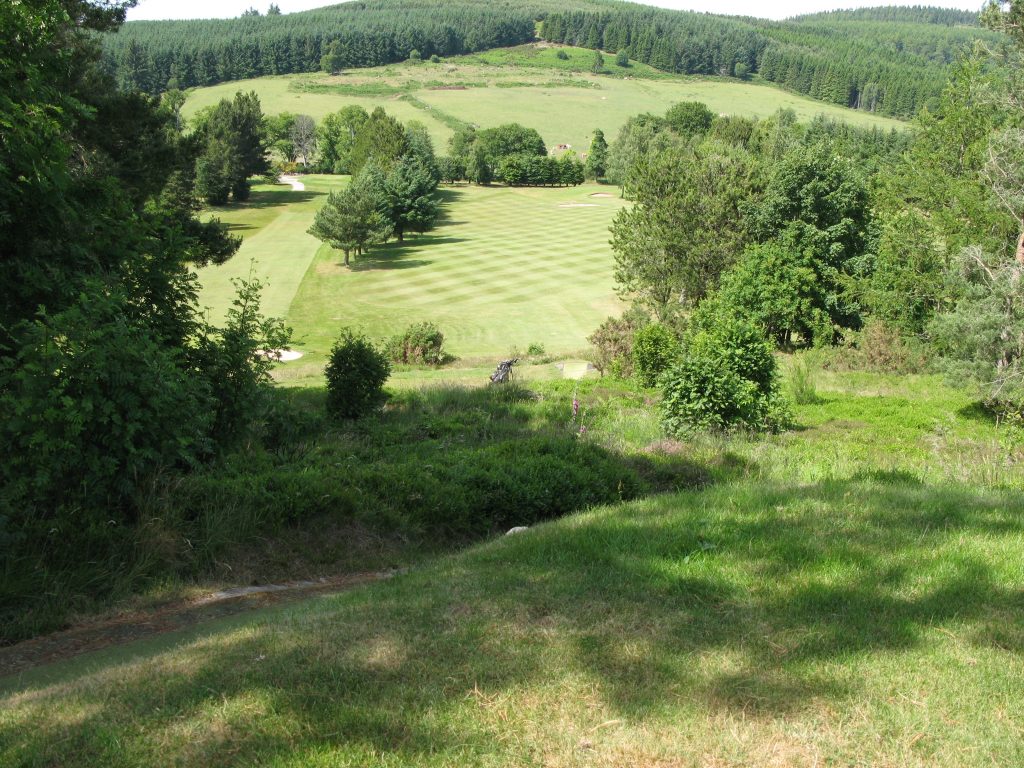
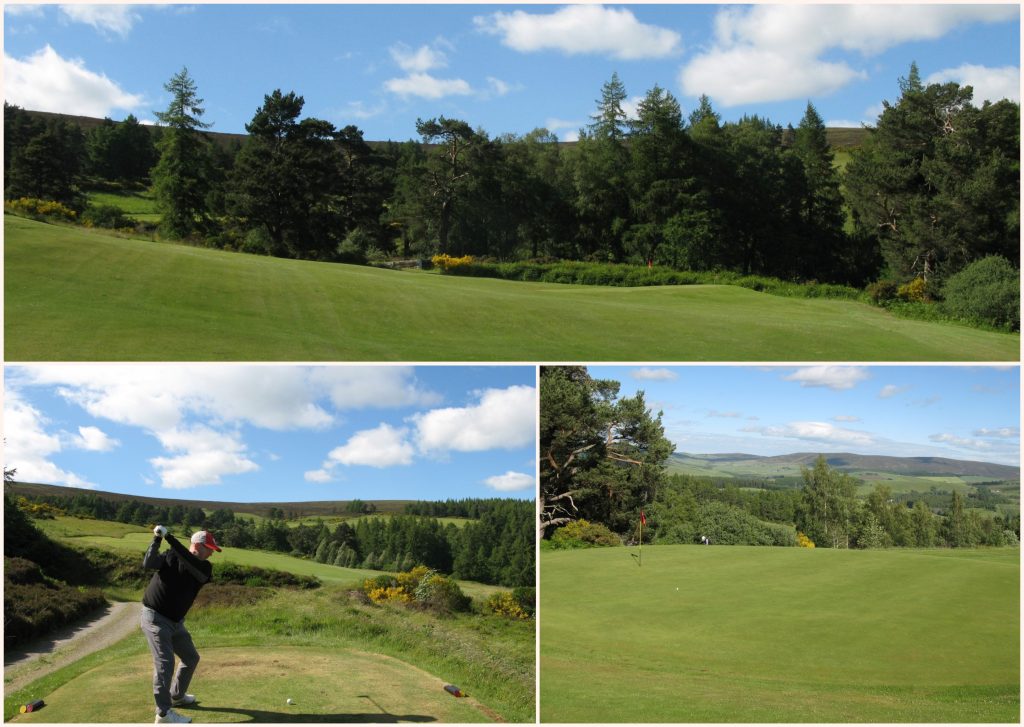
My drive at the 9th at Torphins heading to the left of the fairway (but in play)

Torphins is an undulating parkland course with far reaching views of the countryside and it is worth going out of your way to play.  It actually has 10 greens, with the 3rd and 12th holes sharing the same teeing ground and fairway, but the 2 greens are separated by a copse of trees.

The lovely 3rd and 12th fairway from the common teeing ground at Torphins.

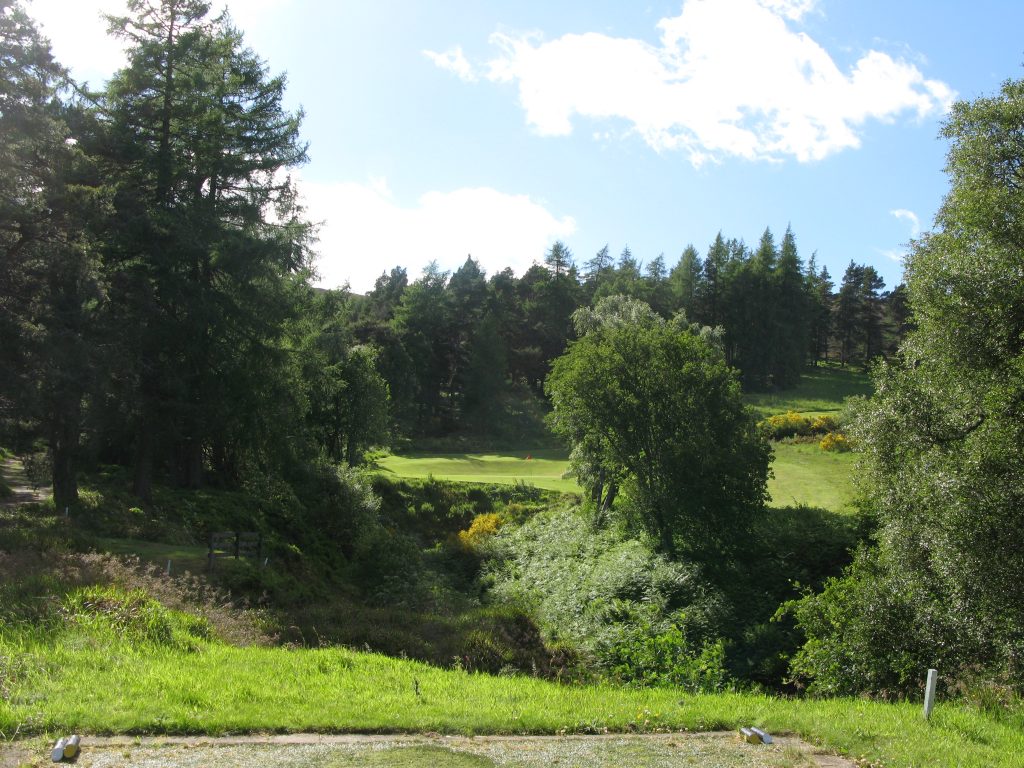
It is a great little golf course, with plenty of variation, and some really tricky holes.  There are 4 blind tee shots, one being the par 4 6th (SI 1), a tough dog leg left hole, which I should have taken driver from the tee, as the apex to the dog leg is further than in looks as it is quite uphill.

The greens were pretty small but in really excellent condition as were the fairways and tees.

Fran chipping at the short par 3 5th at Torphins. A bit of respite before the challenging 6th hole

Value:  whether as a member or as a visitor, Torphins represents incredible golfing value.  The 9 hole quoted rate was only £10, but my wife Fran and I payed only £7.50 each through the club website.  A Monday to Friday annual membership, allowing 9 holes per day, is only £90, with Junior memberships starting at £20.  This is 5 star value golf.

The 2nd, a short par 4, at Torphins – my birdie hole on the day.

An interesting fact – Macbeth was killed on 15 August 1057 only 3 miles from Torpins.  “What’s done cannot be undone”, sayeth Macbeth – that’s how I felt on the 7th after my 10, having lost 2 balls!  I still shot 17 point for the 9 holes.

Really enjoyable, highly recommended.

Facts:

Course Type: Parkland

Par 32 (white; 5 par 4s,  4 par 3s)

Distance: 2338 yards

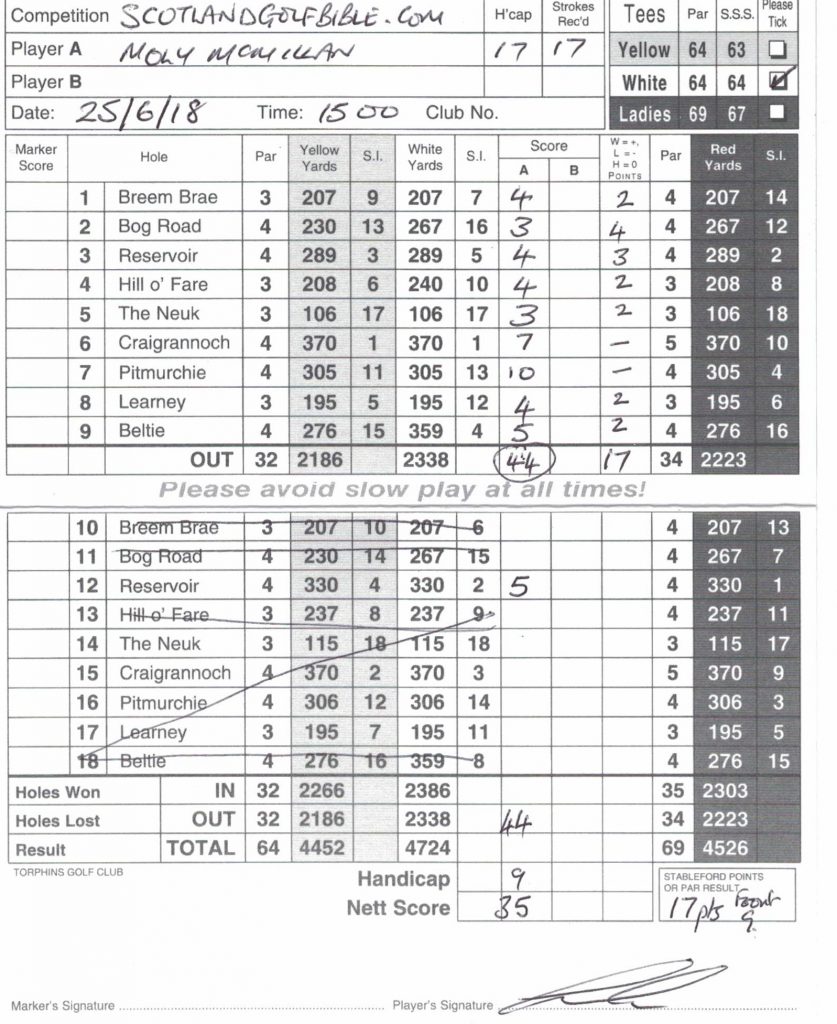
Moly’s Gross score44

Torphins scorecard – 44 for 17 points (with a 7 and 10!)

77. Dufftown. 21 June 2018.

Combine two of Scotland’s great pastimes – golf and hill walking – at this great value course   

Round £20.   Par 68.  Value (out of 5) – 5

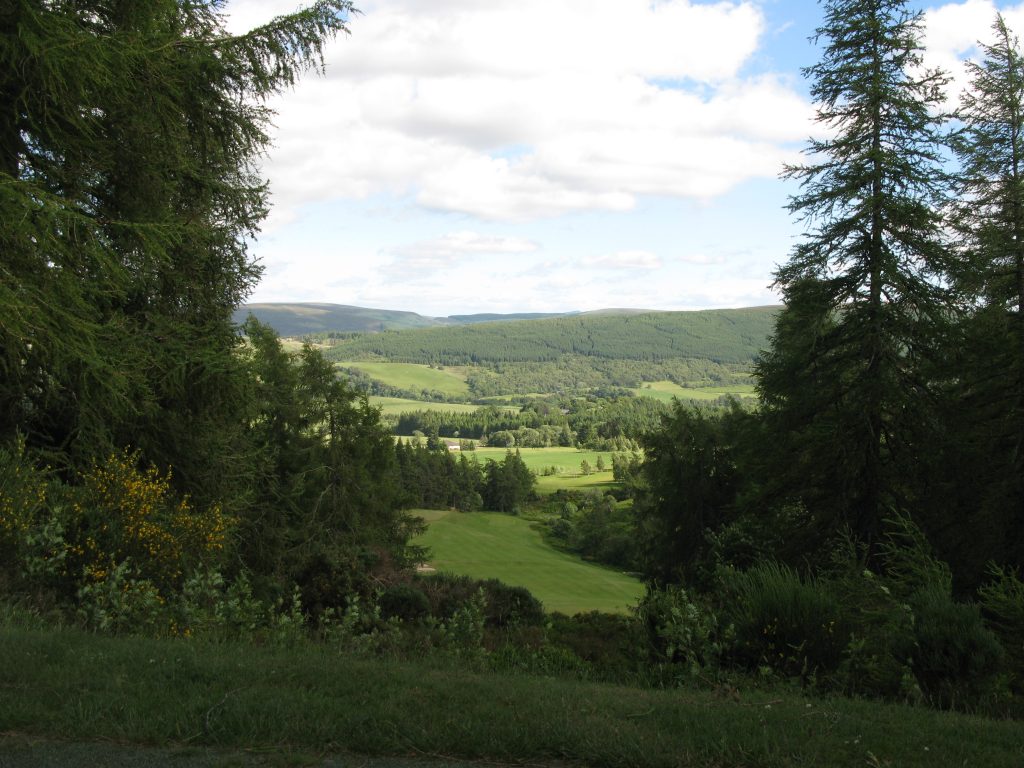
Dufftown has a variety of claims among UK golf courses;  highest hole (9th), biggest drop from tee to green (10th) and highest climb from clubhouse to top of course.  You probably get the picture.  If you are looking to play an occasional bit of holiday golf with young kids, treat them to a buggy to avoid the inevitable “I’m tired” conversations after 9 holes.  Thankfully, buggies are available for hire at this course!

Moly at the 6th tee at Dufftown on a beautiful mid-summer evening.

Dufftown is well worth a visit for a variety of  reasons.  It’s the “whisky capital of the world” and home to William Grant & Sons distillers, producer of the biggest global selling single malt whisky, The Glenfiddich.  There are still traces of the early Picts and Christian communities dotted around Dufftown, so historians are also well served.   The pure local water made it a good location for illegal whisky and there are numerous villainous stories related to that.

Dufftown’s short 7th hole – “Fittie Burn”

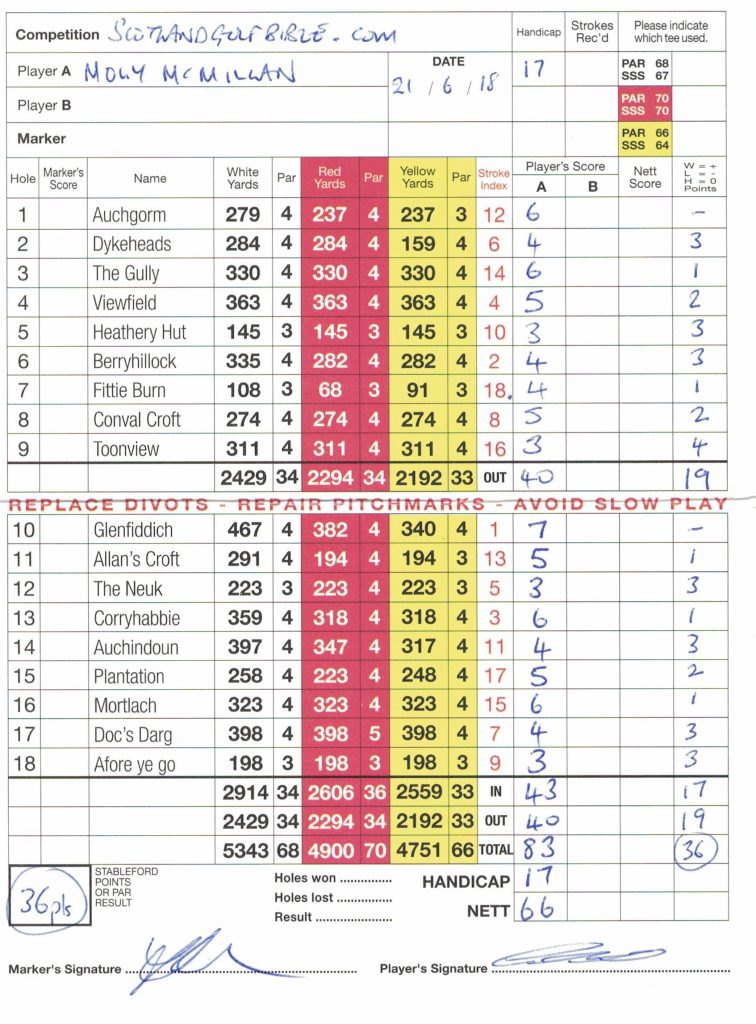
The golf course also has some villainous holes ready to capture and destroy your round.  Although short at only 5343 yards (white), 4751 (yellow) and (4900) red, there is great variety here.  There are many severely uphill or downhill holes and the stroke indexes don’t necessarily follow the normal “length = difficulty” rule.   There are several blind tee  shots and the greens are often on plateaus with dangerous surrounds.  All in all, its going to be difficult to avoid a calamitous hole over the round.

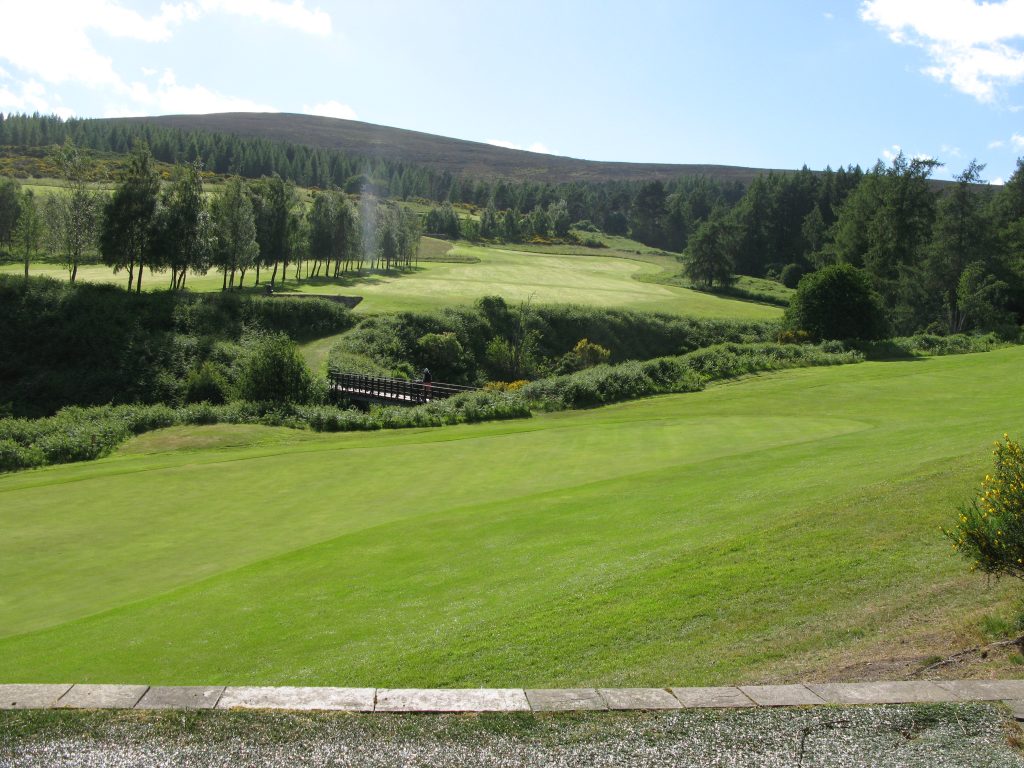
The 10th, the signature hole, is a great example.  Although the landing area is large, the view from the tee is intimidating, then the second shot needs to be played into a ever narrowing channel, to a long and thin green, with OOB all along the right of the left to right sloping fairway.  Record a par 4 and be delighted, record a 5 and be happy to move on.  I took a great triple bogie 7, having lost my drive (2 shot penalty), going through the back to a lateral hazards with my approach (1 penalty), then having a good chip and single putt!

The intimidating 10th at Dufftown – reputed the biggest drop in height on any course in the UK 

The course has one of the shortest holes in Scotland, the 7th (“Fittie Burn”), at around 100 yards, played over a deep gully.  As it was a nice day and we were pretty much alone, I spent 5 minutes looking for balls in the ravine, and found about a dozen – my hay fever took a battering though!

11th tee at Dufftown

The course was in wonderful condition and the greens true and even, albeit they had “lost” the 12th green, which was, according to the local green keeper, due to severe frost damage over the winter.  I had a good day shooting 83 including a birdie 3 at the downhill 9th.

What a wonderful treat to play this golf course on a beautiful mid-summer evening during the warmest June on record in Scotland.  If heaven does exist, and you have to pay green fees up there from a limited budget, then there is a strong argument that says Dufftown is where you would play

Facts:

Course Type: Heathland

Par 66 (12 par 4s, 2 par 3s)

Distance (yellow): 4751

Moly’s Gross score83

Moly’s Dufftown card – 83 for 36 points.

« Older posts Newer posts »

© 2026 Scotland Golf Bible

Theme by Anders NorenUp ↑