A guide to green fee value for money

Category: 1851 – 1900 (Page 4 of 14)

130. Kilmarnock (Barrassie). 22 Mar 22

A course to play to help appreciate “Golf; from a new angle”

Round £95. Par 72. Course Rating / Slope Rating (yellow) 71.9/125. Value (out of 5) – 3.5

The Ayrshire coast is home to some of the finest golf Scotland has to offer. Barrassie used to be a village in its own right, but is now considered part of the town of Troon. Ironically, it was the ‘long’ distance from Troon golf course, that caused the locals of Barrassie to establish a course in 1894, designed by the Prestwick professional, John Allan.

It was in the early 1930s that a new 18 holes course was designed by Matthew M Monie, who was an author who wrote under the pseudonym ‘Theodore Moone’. As for the course in play today, it comprises nine holes from Moone’s 1930s design and nine new holes built in 1997. Nine of Moone’s original holes are retained as a 9 hole course called ‘Hillhouse’.
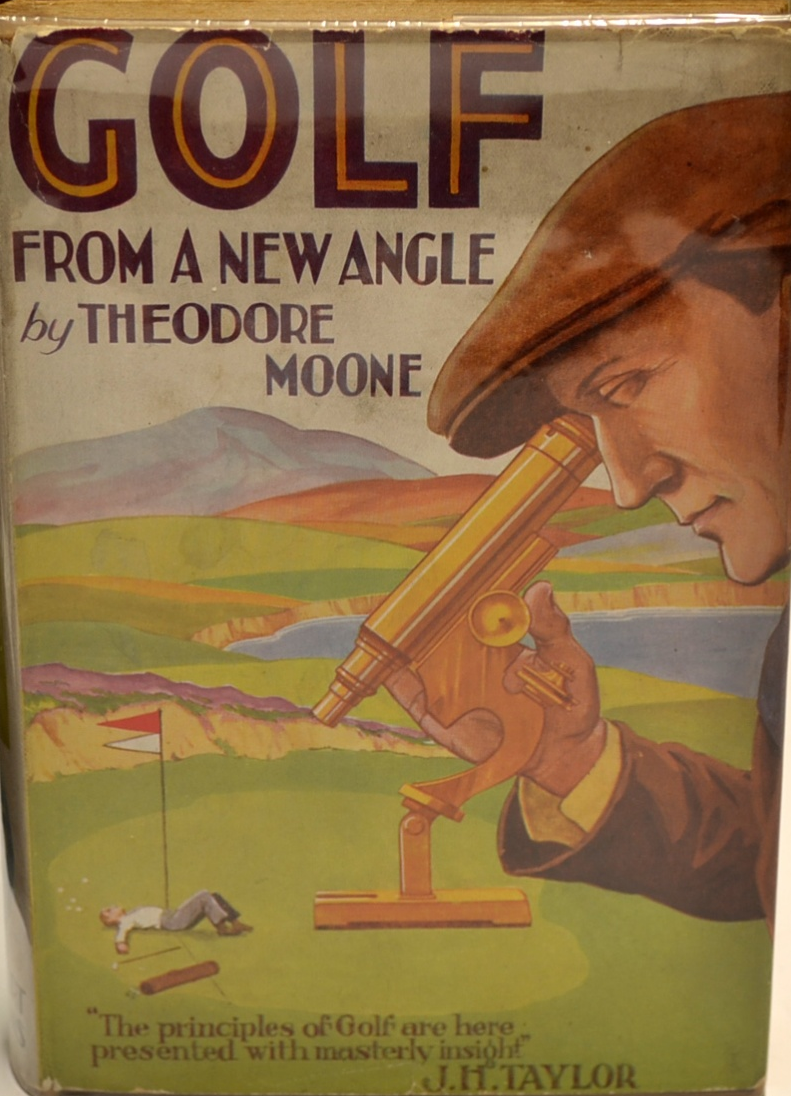
The scientist, golfer and author, Theodore Moone, proved that golf course architecture was also one of his numerous talents, with Barrassie being one of only a few courses he designed. I suspect we all recognise the subject of the book’s cover!

Search for Moone on the internet and you will be presented with opportunities to buy his book, “Golf from a New Angle”, based around fictional letters about the fundamentals of golf. Look a little deeper and his scientific approach to golf, may have been way ahead of his time – I suspect Bryson DeChambeau may be a fan.
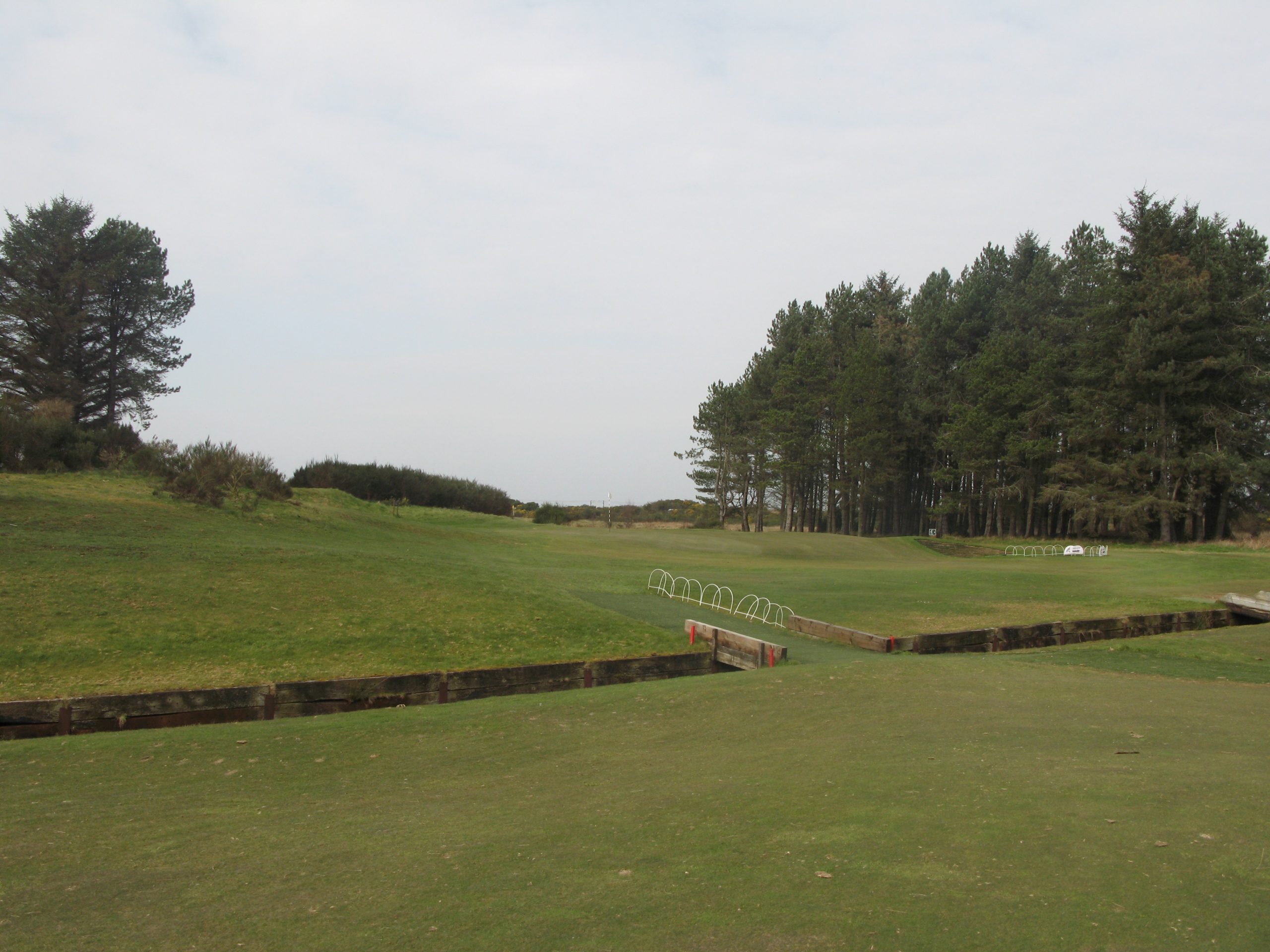
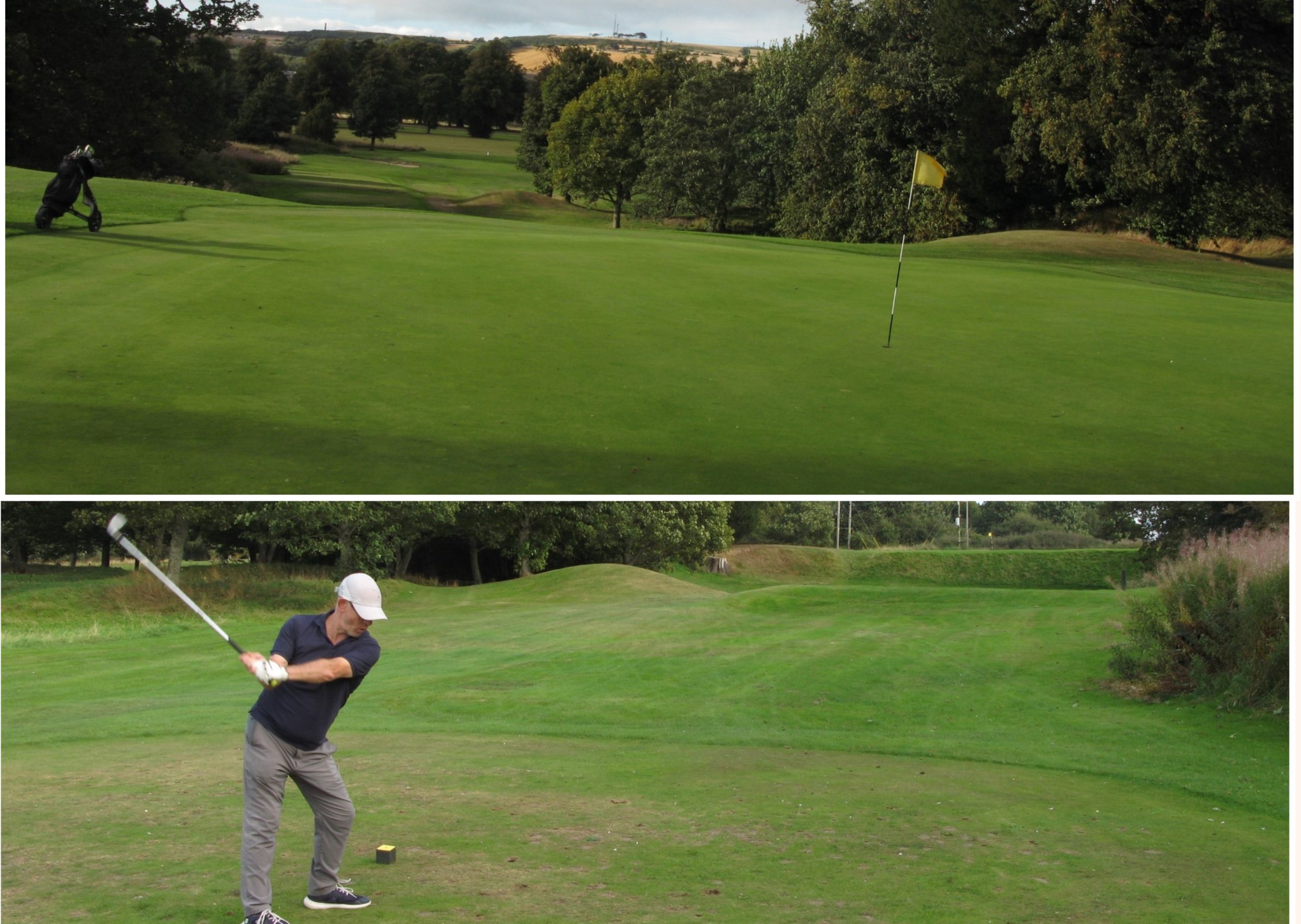
The brilliantly designed approach at the par four 3rd, the stroke index 3 hole. Note the obscured view to the left hand side of the green and the sharp left to right slope towards the front right bunker; coupled with the burn 40 yards short of the green, this is a great hole, typifying Barrassie’s architectural guile. It is stroke index 1 on the Ladies card.

Although no sea is in sight, this is unquestionably a classic links course of a high standard. Playing at almost 6500 yards from the yellow tees, and with several dog leg holes and semi-blind approaches, this is also a course with plenty of guile. It was handy that I played in a group that included a long term member, who was on hand to offer advice when needed.
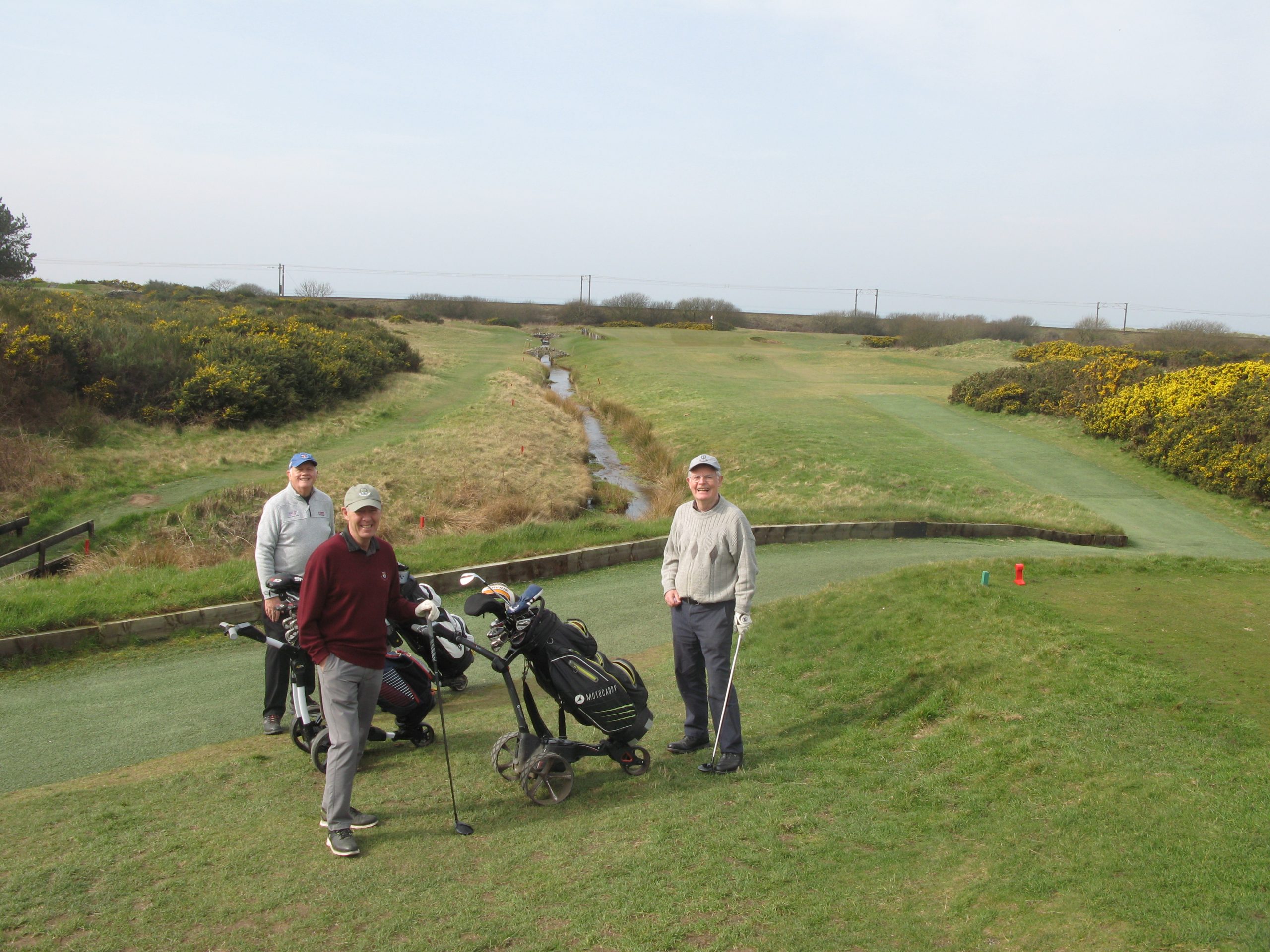
The aesthetic, or terrifying, view of the par three 4th hole, at 150 yards. Here, old pals, from left to right, Brian, Douglas (our host) and Stephen, look happy – before teeing off! I think this might be one of the most obvious “lateral hazards” in Scotland?

Nevertheless, I suspect you need to play Barrassie a great many times to appreciate which sides of the greens to play into, as there are often ‘hidden’ gullies and slopes which make getting up and down impossible for all, but the most gifted players, if you are “short sided”. The club has a delightful video on it’s website here – once viewed, it is clear why Barrassie has hosted many top amateur competitions and is also an Open Final Qualifying venue.
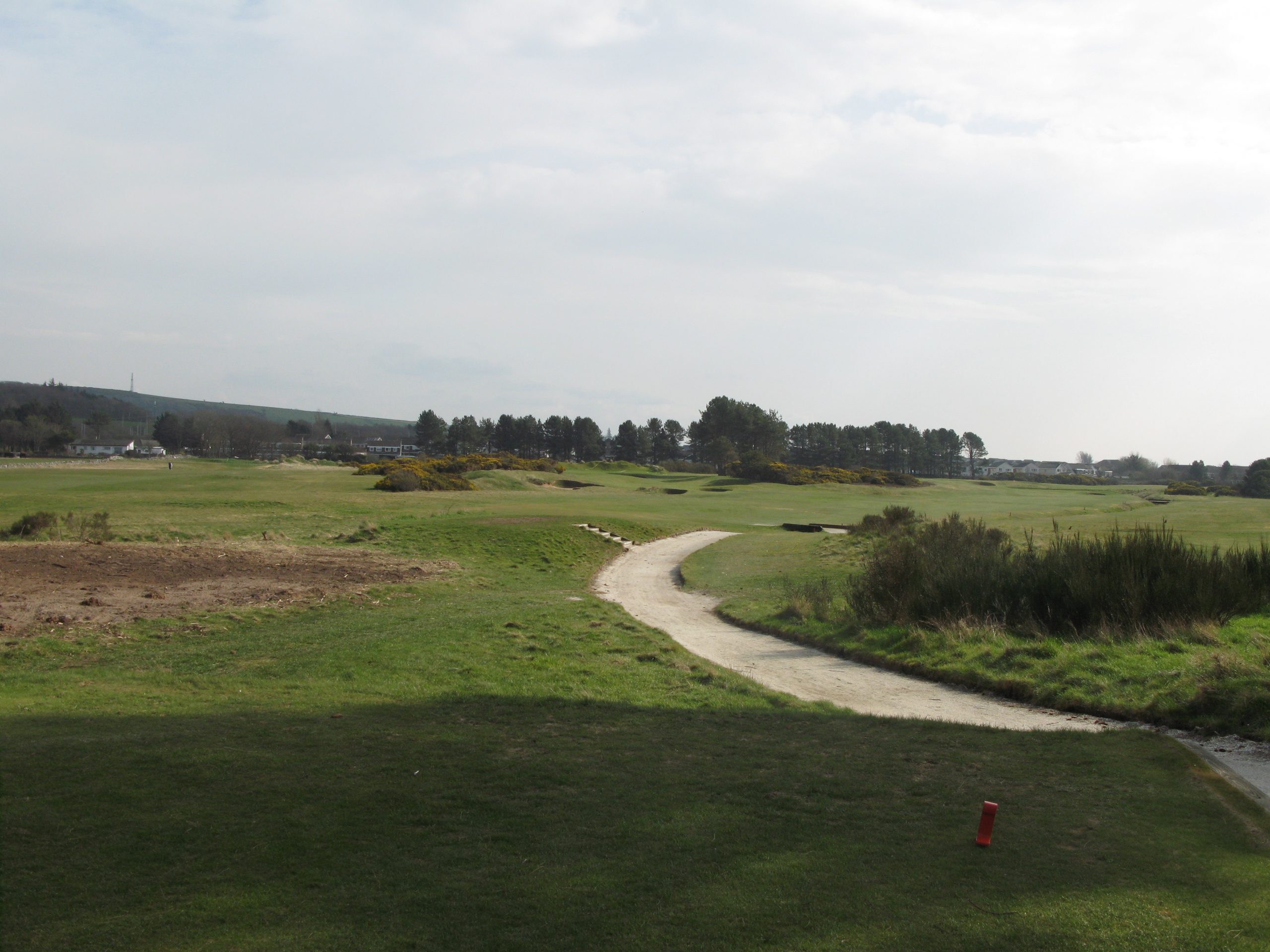
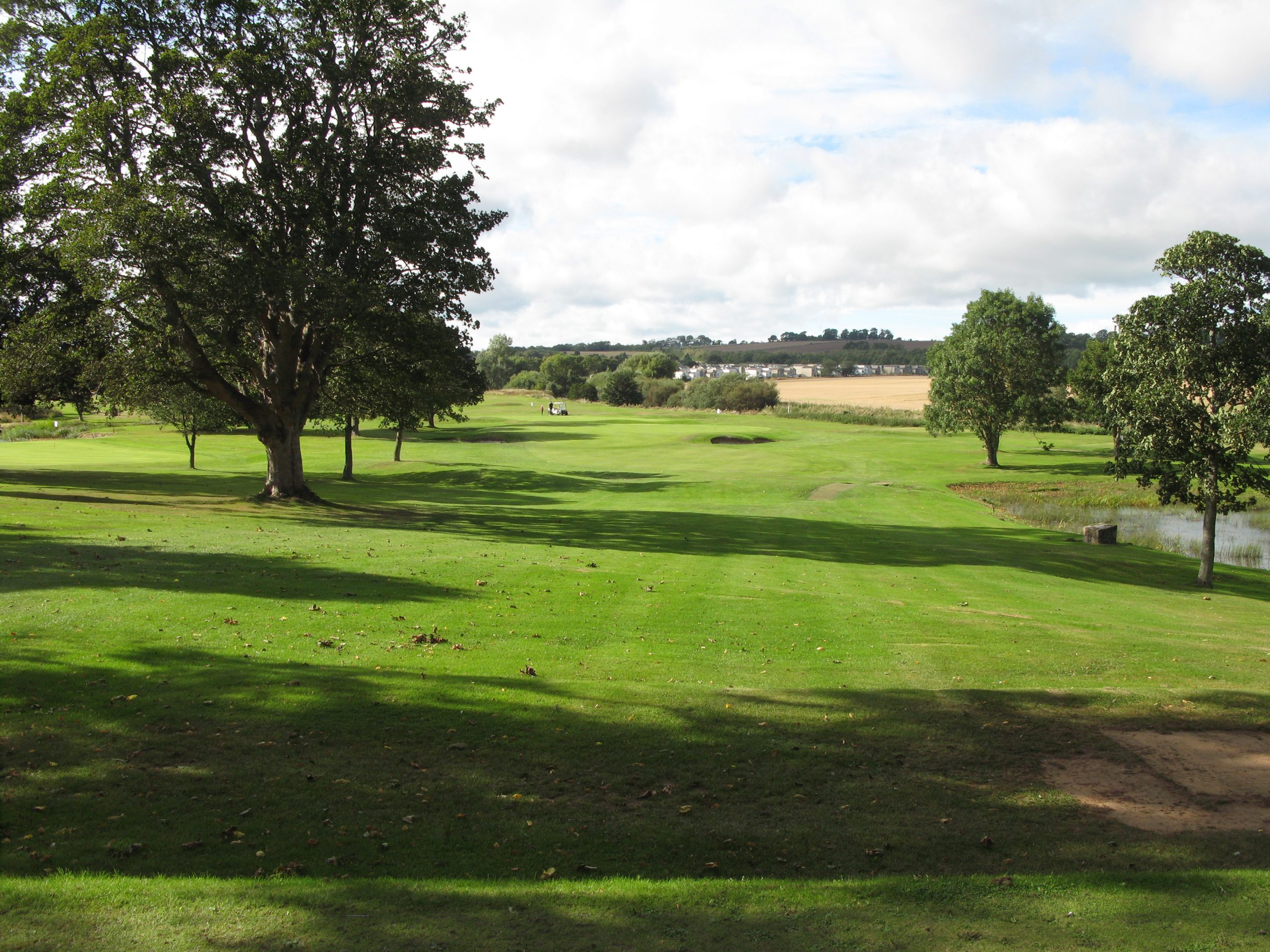
The majestic framing around the newly re-built par four 13th hole.

The course was in magnificent condition for a mid March day, with the fairways and greens playing as if it were already June. The bunker conditioning was the only thing I would criticise, but even that was likely down to the legacy of the pandemic which was just easing off.
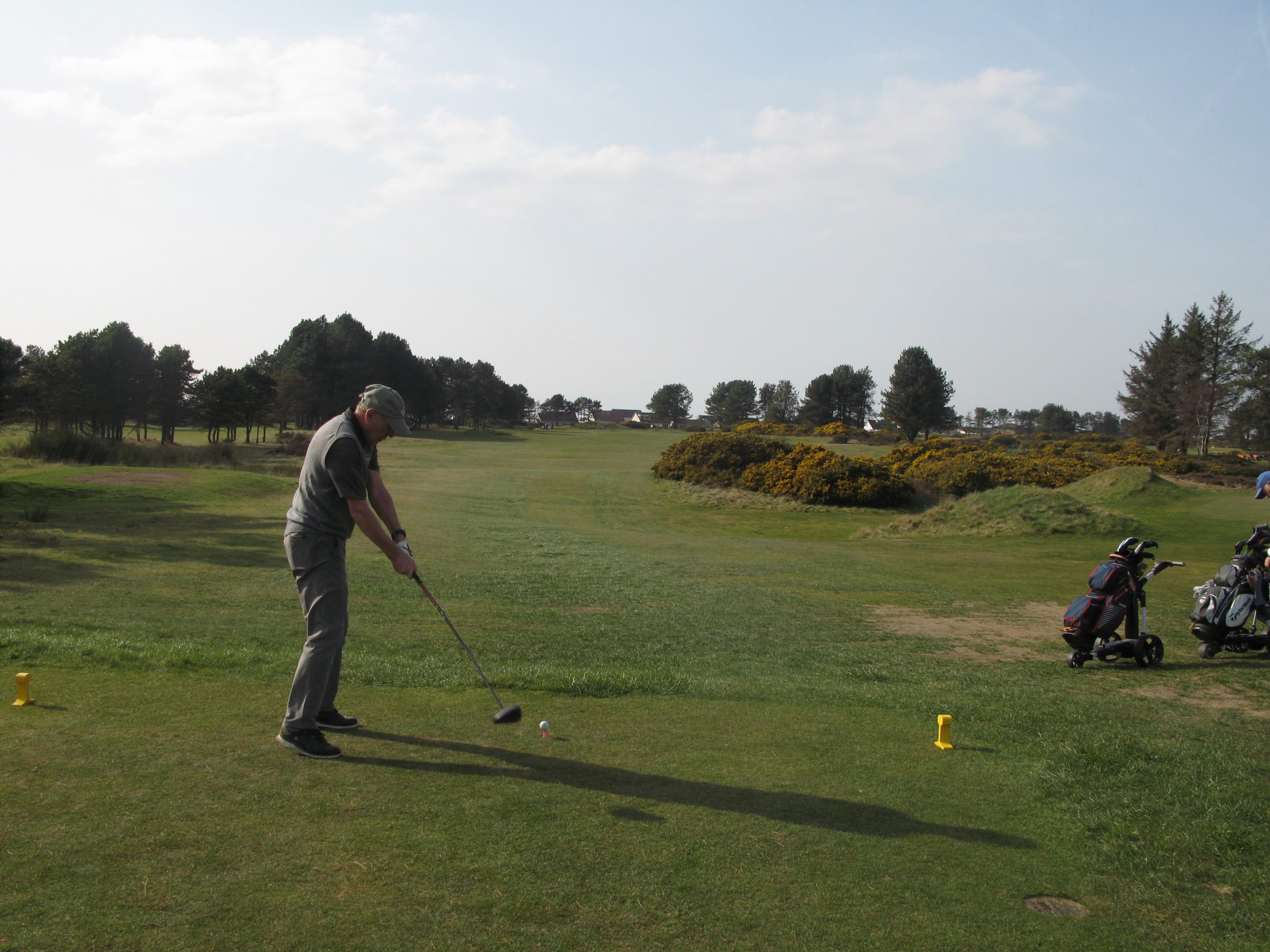
Barrassie member Douglas driving at the 401 yard par four 17th hole.

We all played about the same with respect to our handicaps and my partner, Brian, and I, halved a closely fought 4BBB game against Douglas and Stephen, having come back from 3 down (well played Brian!). It is always nice for a ‘friendly matchplay’ (although an oxymoron for some) to be in the balance until the very last putt is holed.
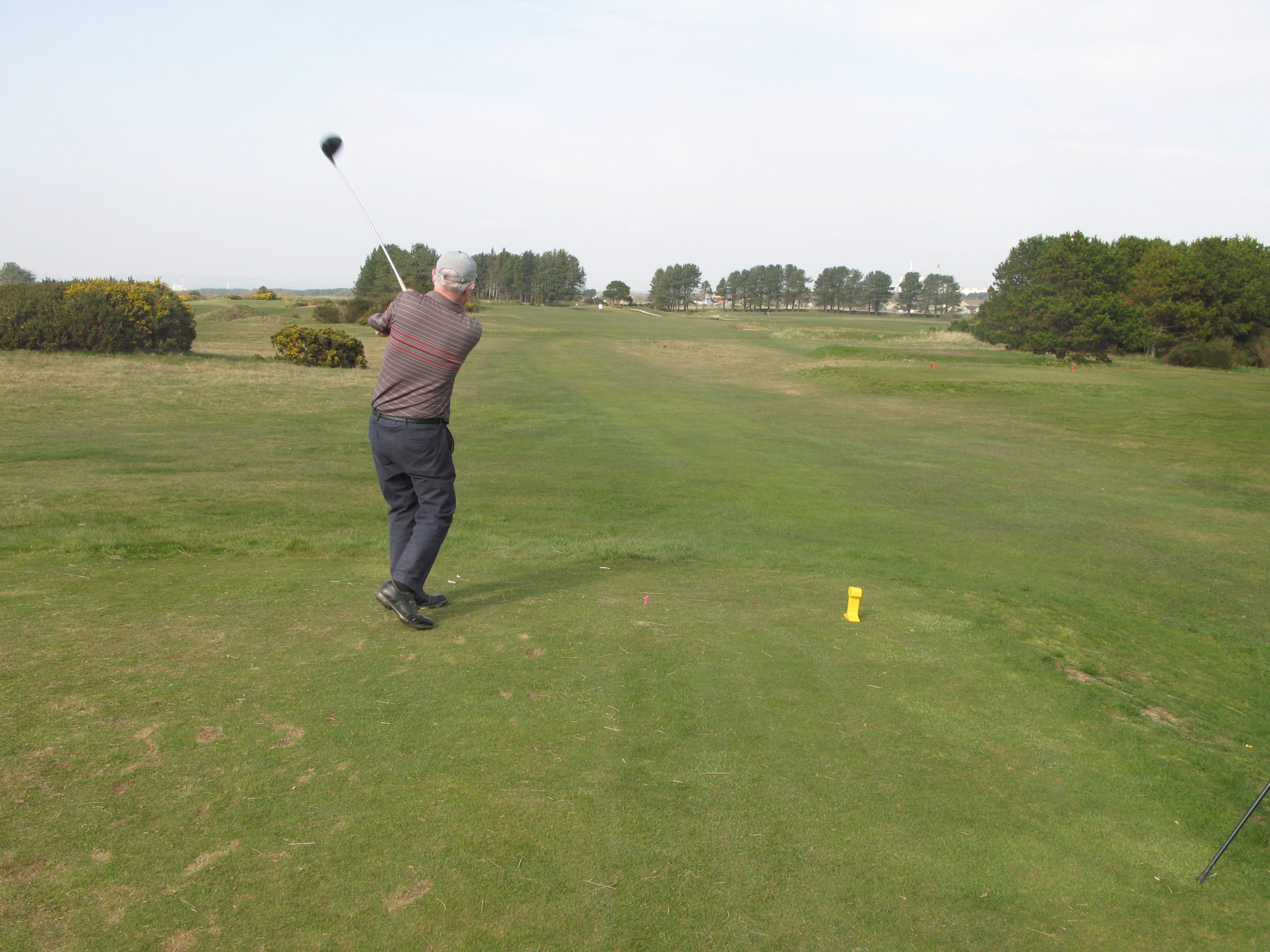
Stephen eyeing another fine drive down the middle – almost right through the eye of a needle.

One thing about Barrassie worth mentioning; the winter golf rate of £45 is brilliant value, especially when compared with the £95 summer fee, an amount reflecting the significant recent price growth I’ve witnessed across Scotland. I think this has been driven by both the increased demand for golf due to the pandemic and also the ongoing tussle between clubs’ loyalty to their membership versus serving the needs of the peripatetic golfer, for whom membership is not desired. The latter conflict is a matter of fierce debate within the Scottish Golf Union organisation.
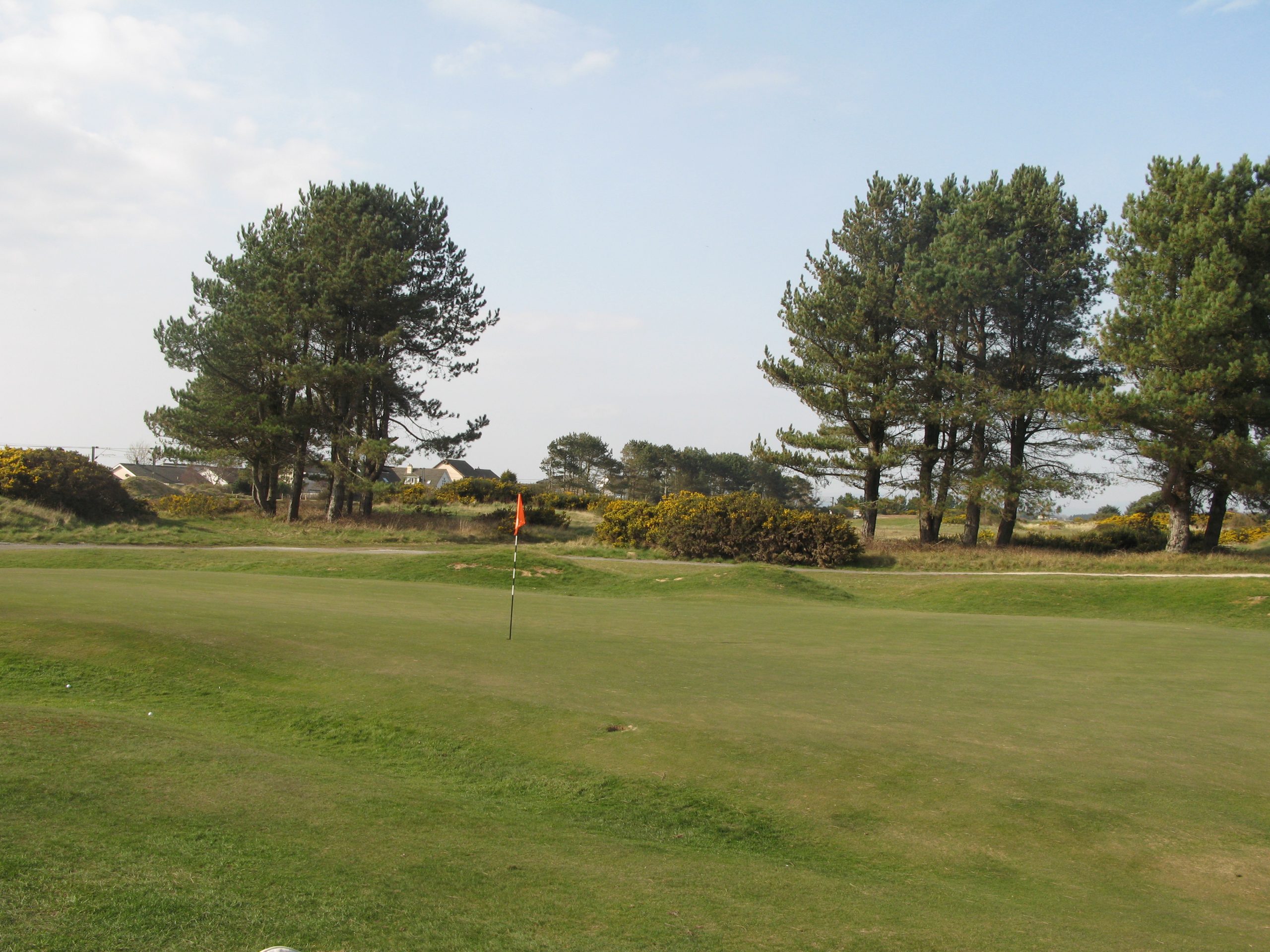
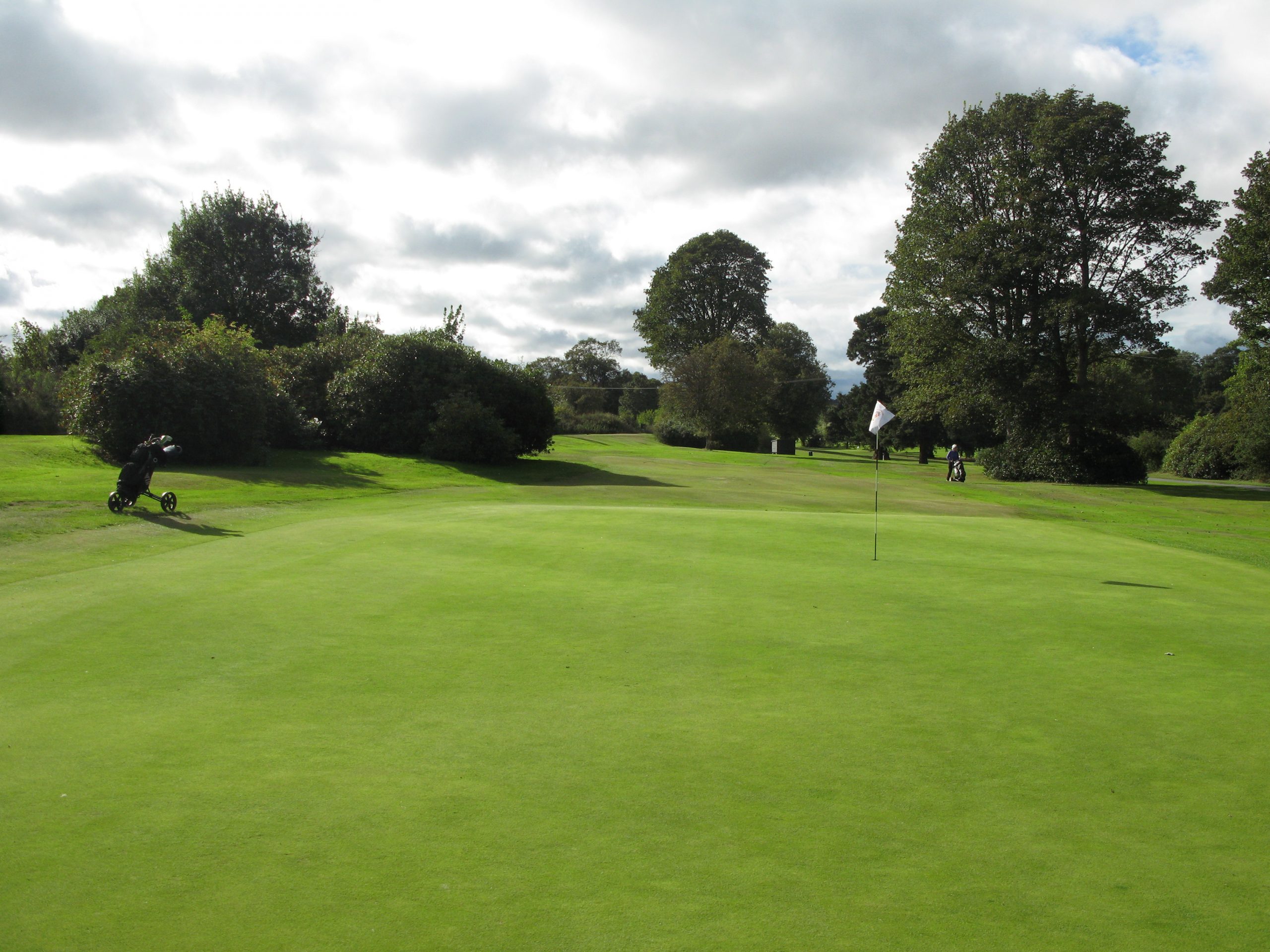
The 17th green, showing the great conditioning of the course in mid March, and the little gully left being a treacherous ‘leave’, for two of us.

I once heard the great football manager Bill Shankly describing a Stallworth player as “honest” meaning they always gave their all and could be completely relied upon. That’s how I felt when playing Barrassie – it is an “honest” links golf course, if such a thing is possible.

Course Type: Links

Par 72 (3 par 5s, 12 par 4s, 3 par 3s)

Distance: 6460 (yellow)

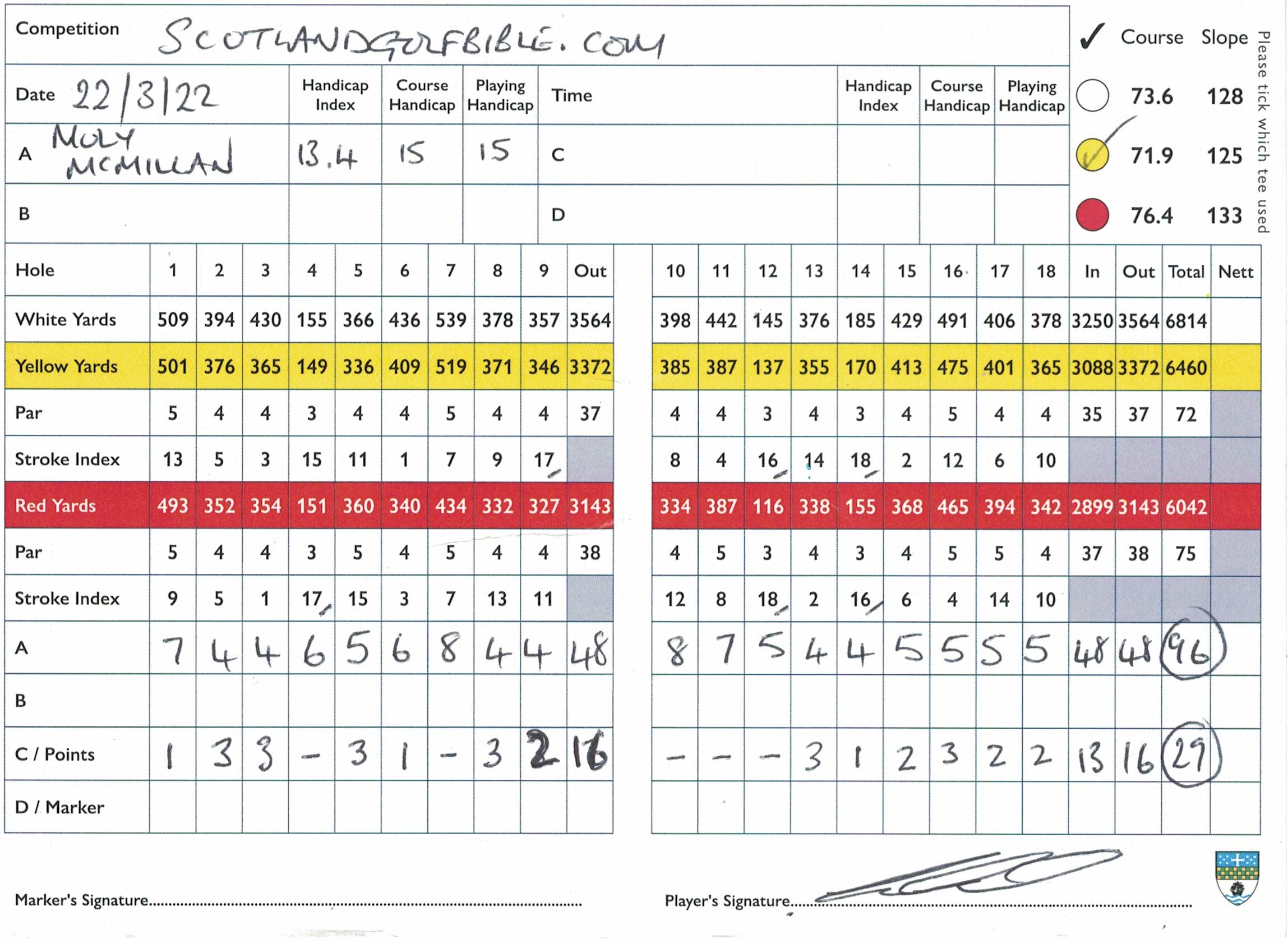
Moly’s Gross score96

Up and down round of golf. Gross 96, but still 29 stableford points.

126. Haddington. 24 Sep 2021

You’ll need your best putting game on the excellent greens

Round £55. Par 71. Course Rating / Slope Rating (yellow) 69.3/124. Value (out of 5) – 3

The town of Haddington, lies just off the A1, about 17 miles east of Edinburgh, and is very easily accessed. At the heart of East Lothian, Haddington is likely to be a popular venue to stay if on a golfing holiday to play the many world class golf courses on the self proclaimed “Golf Coast”, home to Muirfield and Gullane to name but two.

Moly playing the challenging par three 16th hole – take 2 more clubs than the distance, to get up the hill, plus there is little danger over the back of the green.

So if you’re planning to visit the area, should Haddington be on the play list?

First thing to say is that for a course, or rather club, founded in 1865 and claiming to be the “19th oldest course in the world”, no mention of the course architect can be found.

We found the greens very slick at Haddington, here the large green at the par three 10th.

The course is set in the nice mature parkland of Amisfield Park, much of it still walled, with some spectacular trees; it is a place with a wide and rich history, ranging from a Medieval Cistercian nunnery, through to playing a part in the Jacobean rebellion, the Napoleonic war and both world wars. The former grand Amisfield House is long gone, but its sandstone was, interestingly, used to build Longniddry Golf Course clubhouse. The park’s boundary to the north is the River Tyne, but the river doesn’t play a part on the course.

The short par three 4th, showing the mature parkland setting of Haddington.

The town of Haddington is relatively small with a population of 10,000, but in the “high middle ages” (AD 1000 – 1250) it was the fourth most significant Scottish city. So its glory days are long gone – that seems fitting in that the golf course is also a minor player in the Lothians. It’s Okay, but priced too high in my opinion.

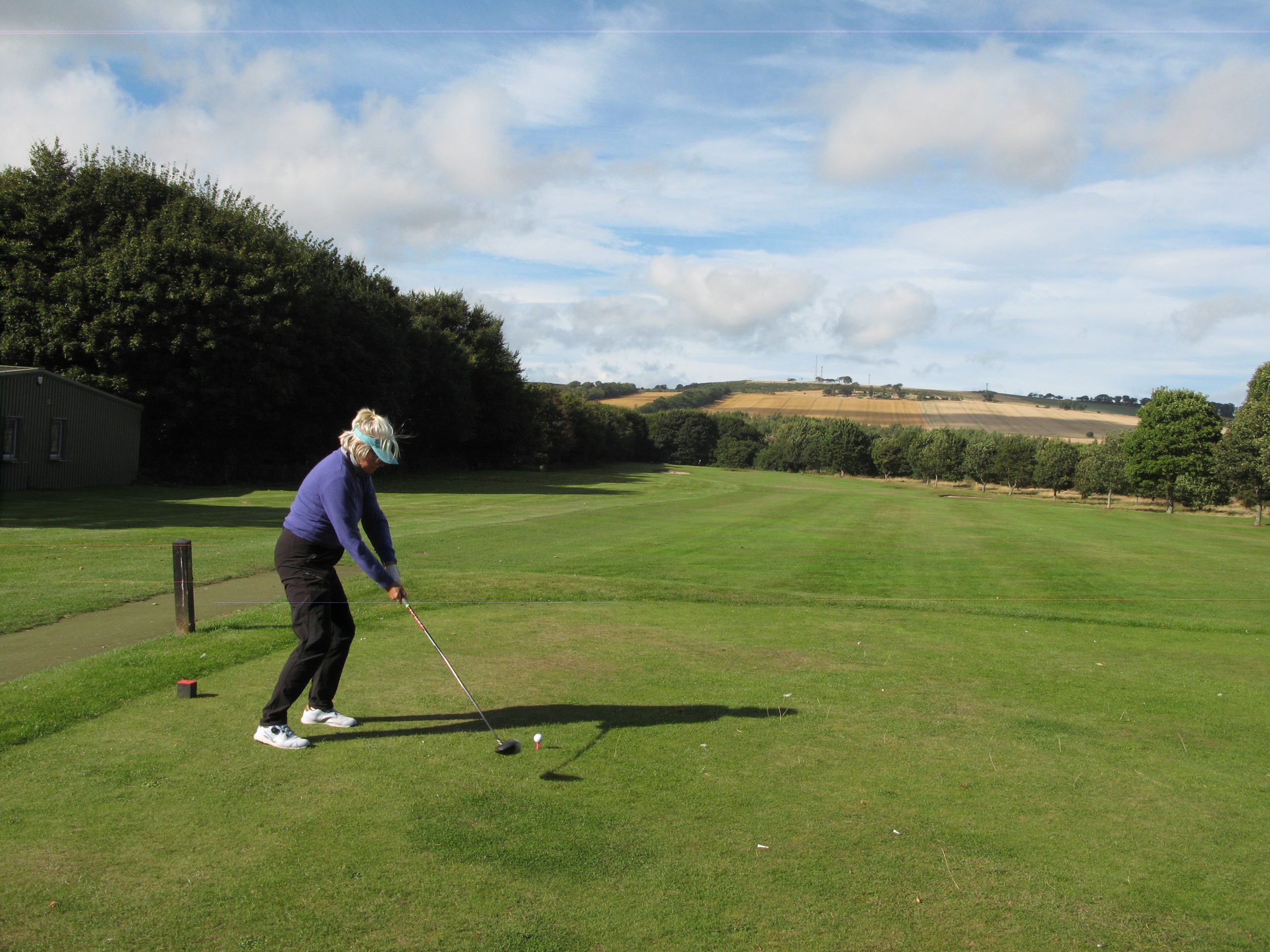
Fran tees off at the 6th at Haddington – a par 4 of 375 yards (yellow)

The condition of the course was very mixed. The greens and fairways were very good, but the tees were terrible, other than the red ladies tees. The greens were also very large, and coupled with the fast speed, led for a real challenge to avoid 3 putting. The fairways, were wide and forgiving, but there are some excellently placed fairway bunkers, that need to be navigated.

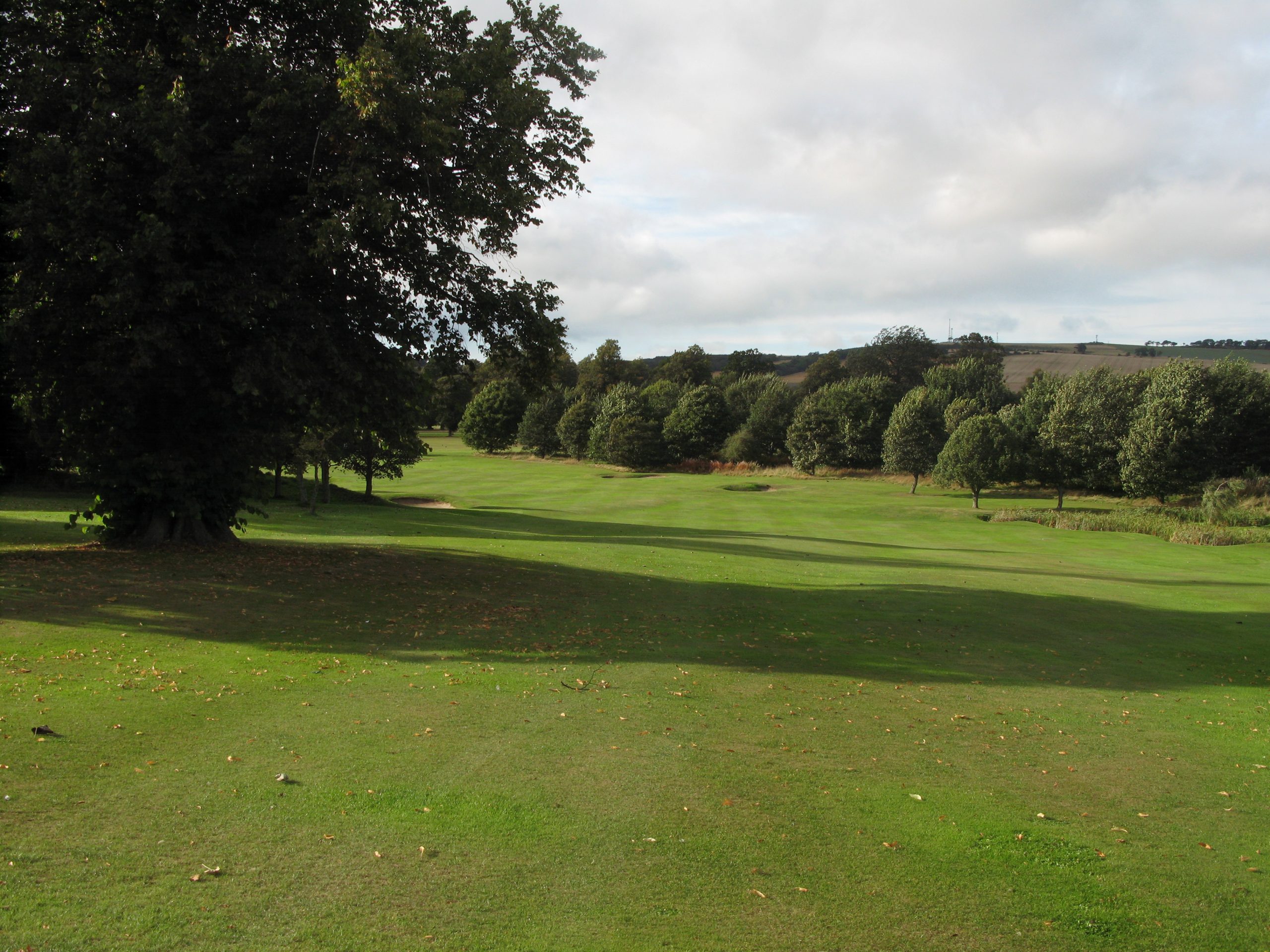
The nice fairways at Haddington, here shown at the 9th, a par four of 329 yards (yellow)

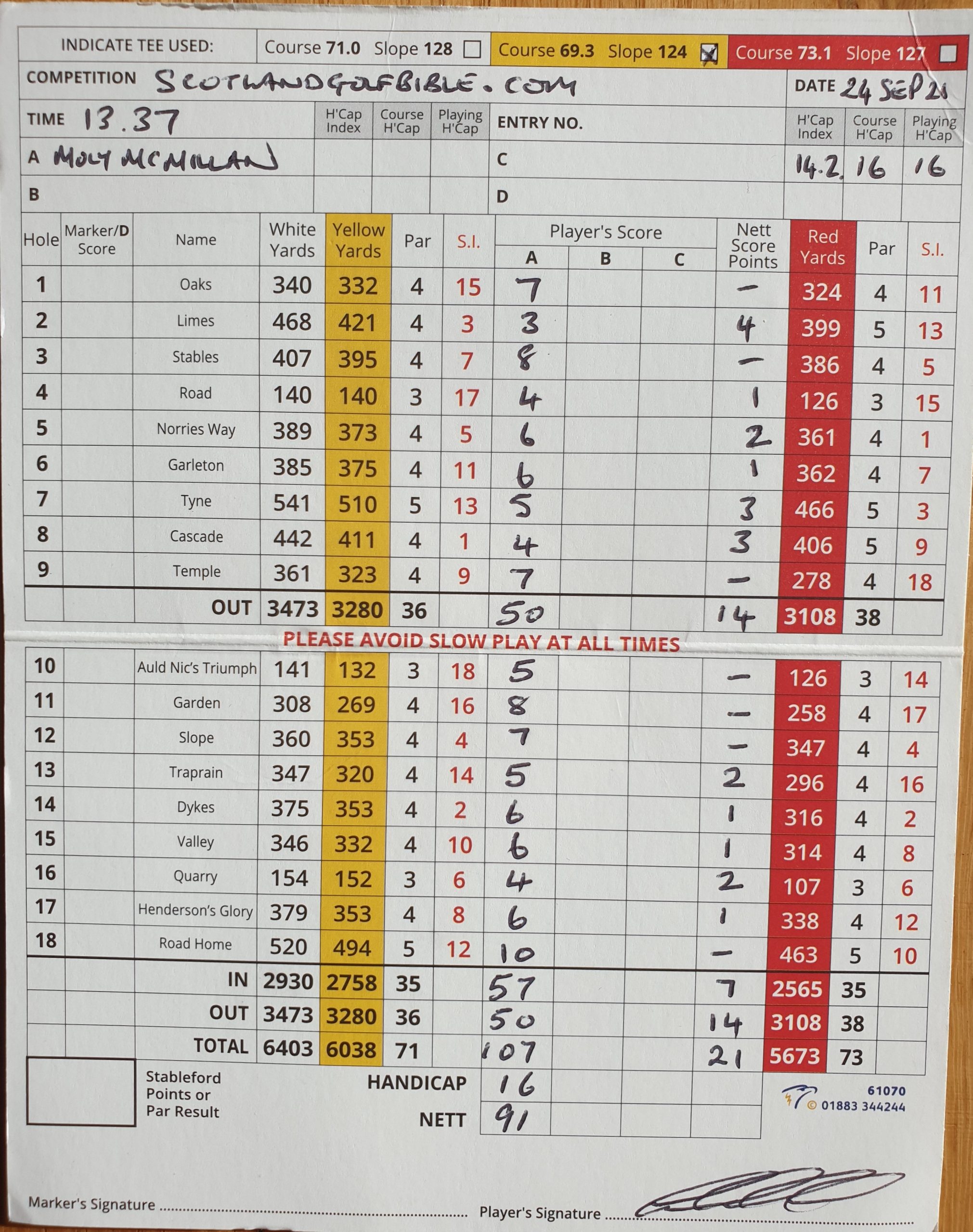
In extremely high winds, I struggled to a gross 107, for 21 stableford points (from a playing HCP of 16). This included a birdie 3 at the long par four second hole, measuring 421 yards from the yellow – the wind was strongly behind of course! In total I lost 5 balls, never nice!

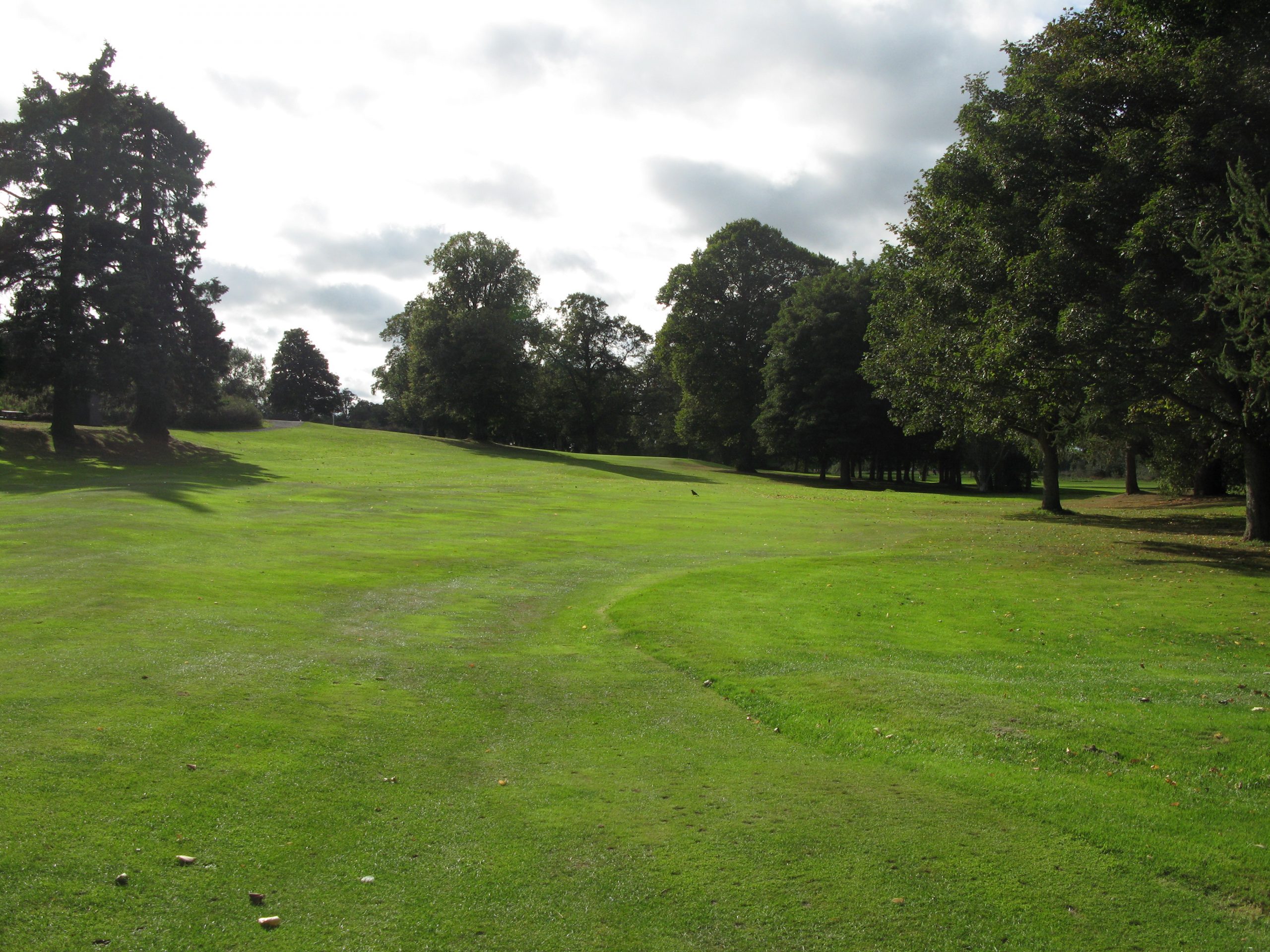
The approach to the par four 15th at Haddington, again showing the mature setting.

Haddington, is in summary over-priced in my opinion, and not worth prioritising in a Lothian golfing trip. The clubhouse building is also rather run down.

Course Type: Parkland

Par 72 (2 par 5s, 13 par 4s, 3 par 3s)

Distance: 6038

Moly’s Gross score107

Wind played havoc with Moly’s game, finishing with a 107, including a 10 at the last.

122. Eyemouth. 23rd June 2021.

Not one, but two notable challenges making it worth the drive, but mainly for the ‘fish n’ chips’ and a warm welcome.

Round £37.50. Par 72. Course Rating / Slope Rating (yellow) 70.2 /122. Value (out of 5) – 3.5

I’m glad I don’t overly research courses before I play and I learnt long ago to ignore the marketing hype golf clubs use on their websites. It’s similar to reading the tantalising comments on the latest ‘best selling’ book, before you consign it to the charity shop after 50 pages!

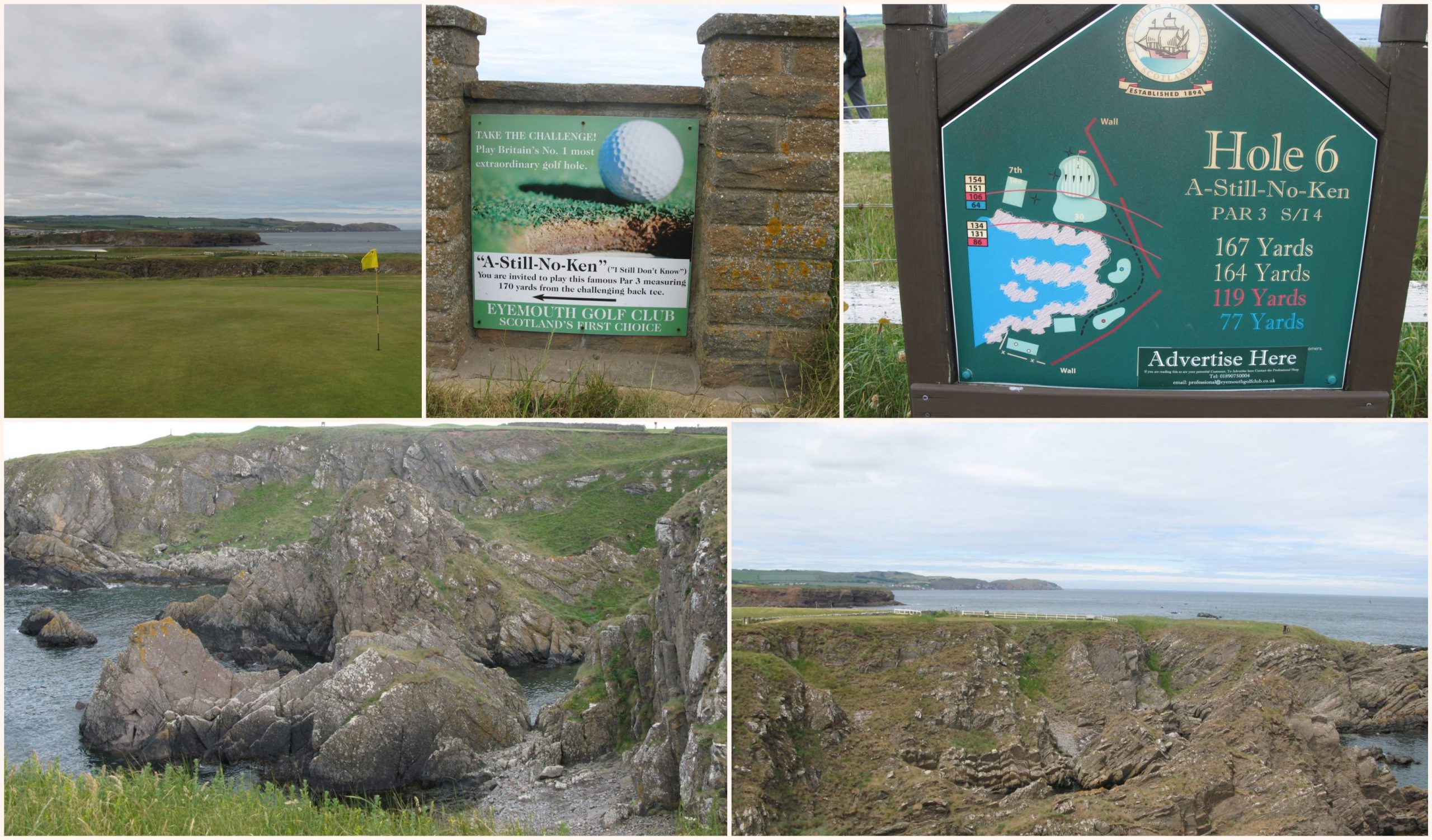
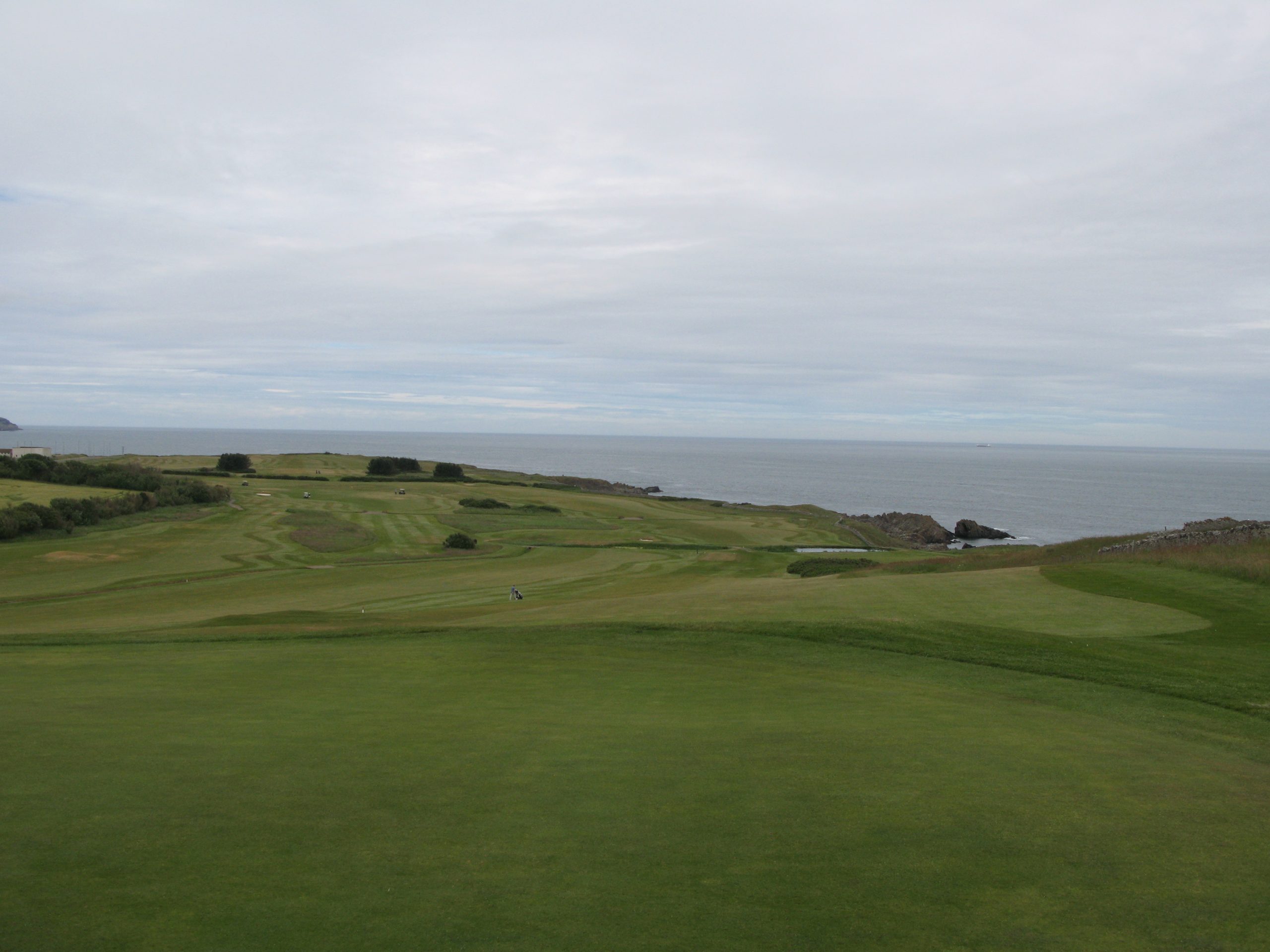
The 6th, one of the ‘challenge’ holes at Eyemouth – a watery grave got all 3 of our balls.

Therefore, please ignore “The club was formed in 1894” – the original 9 hole course is completely gone and has been replaced by a ‘home made’ design in 1997 on a different piece of arable (not links) land, known as Gunsgreen Hill, to the south-east of the original course. The course feels like a new ‘parkland’ layout, before saplings mature to properly frame the course.

It is worth playing Eyemouth though; it’s good value, has a couple of notable challenges (more of below) and excellent fresh locally caught ‘fish ‘n chips’, served in the clubhouse restaurant that has long reaching views of the Berwickshire coastline.

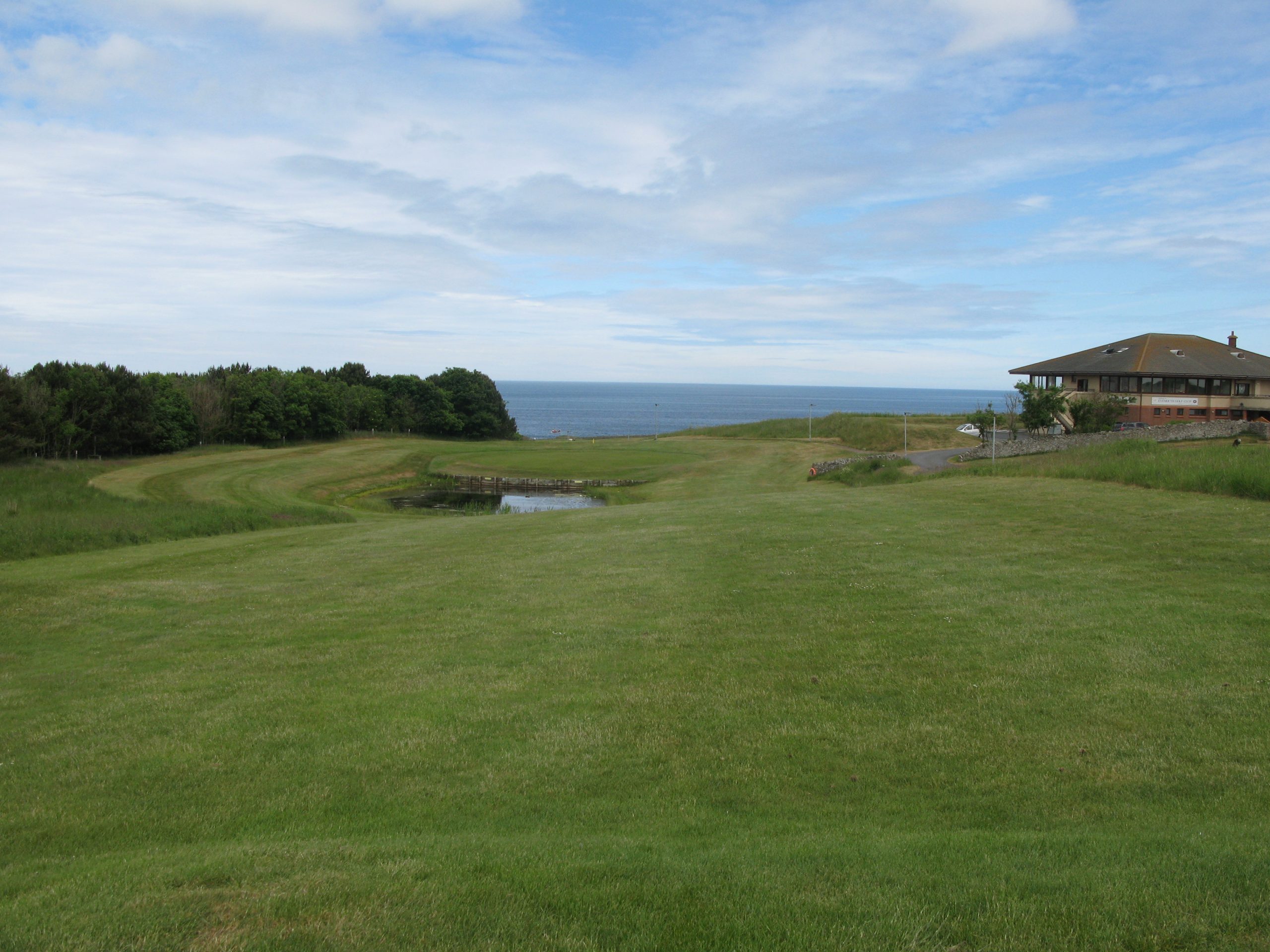
The short par three 3rd hole, with the clubhouse on the right that has commanding views. All three of us playing made par, which was unusual for us!

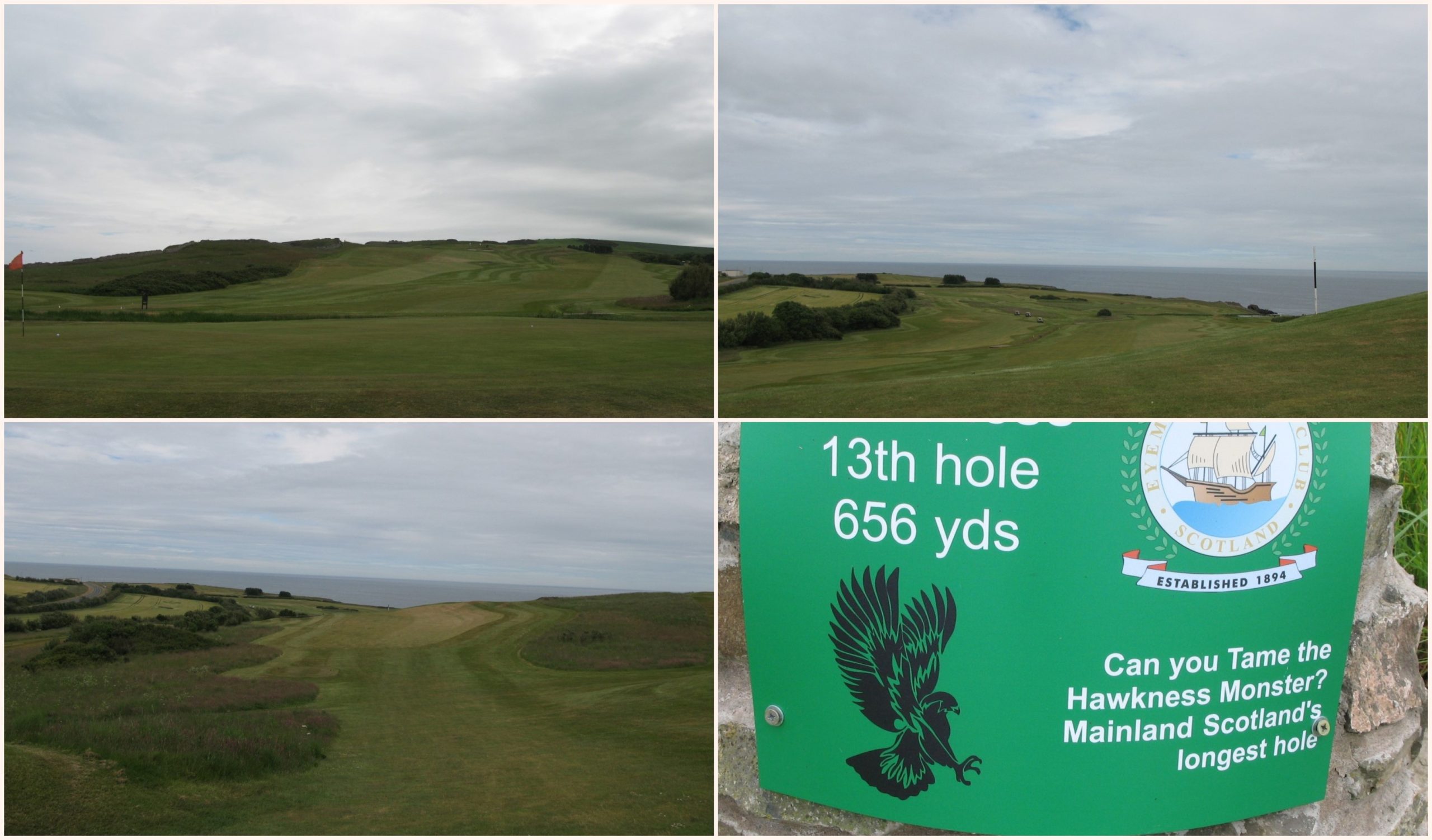
It’s certainly a meaty, if not fishy, course, which has hosted a number of regional and Scottish amateur competitions. Many of the longer holes playing uphill are very difficult, none more so that the 450 yard par four 15th hole, the stroke index 1; albeit, at 450 yards, it is still 200 yards shorter than one of the two ‘challenge’ holes – the par five 13th, cheesely named ” The Hawkness Monster”, at 656 yards it is reputedly Scotland’s longest hole; thankfully it is all downhill. On the day I actually parred the longest hole in Scotland, yet scored a quadruple bogie 9 on the Par 4 15th, That’s golf in a nutshell.

The ‘Hawkness Monster’ – Scotland’s longest hole. 656 yards.

The other notable, and more attractive, hole, is the 6th; curiously named ‘A Still No Ken’ [‘I still don’t know’] it is a visually stunning mid-iron hole over craggy coastline, at 167 yards from the white tee, albeit the actual carry required is only about 140 yards. It’s all in the mind. Played into a stiff North Sea breeze, this would obviously compound the difficulty. All 3 of us playing (Brian and Frank being my partners), found the sea. On reflection I would call the hole something like ‘North Sea Graveyard’.

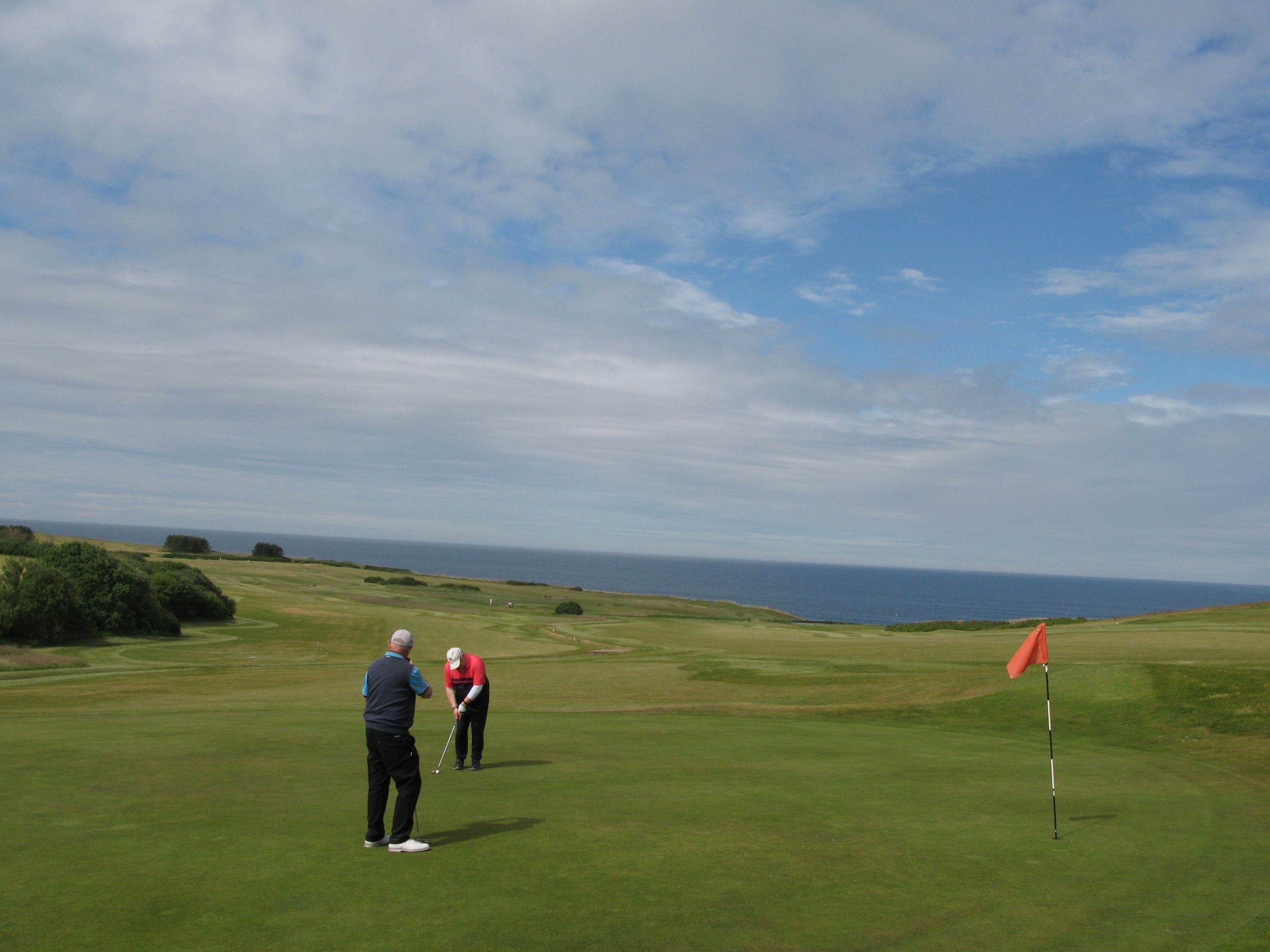
Frank putting out on the tough par four 15th hole, his technique scrutinised by Brian.

We paid through www.golfnow.co.uk and received about 20% off the ‘rack rate’ prices. Golfnow, has been a great development for peripatetic golfers who prefer to not join a club, but as yet less than 50% of Scottish clubs allow this means of booking, and disappointingly, hardly any of the premier clubs. This is a shame and the pricing of the top100 clubs remains elusively high, compared with the annual fees paid by their members; the ‘must play’ courses leveraging their attractiveness, which I guess is understandable.

The very difficult 11th green overlooking this relatively new course at Eyemouth.

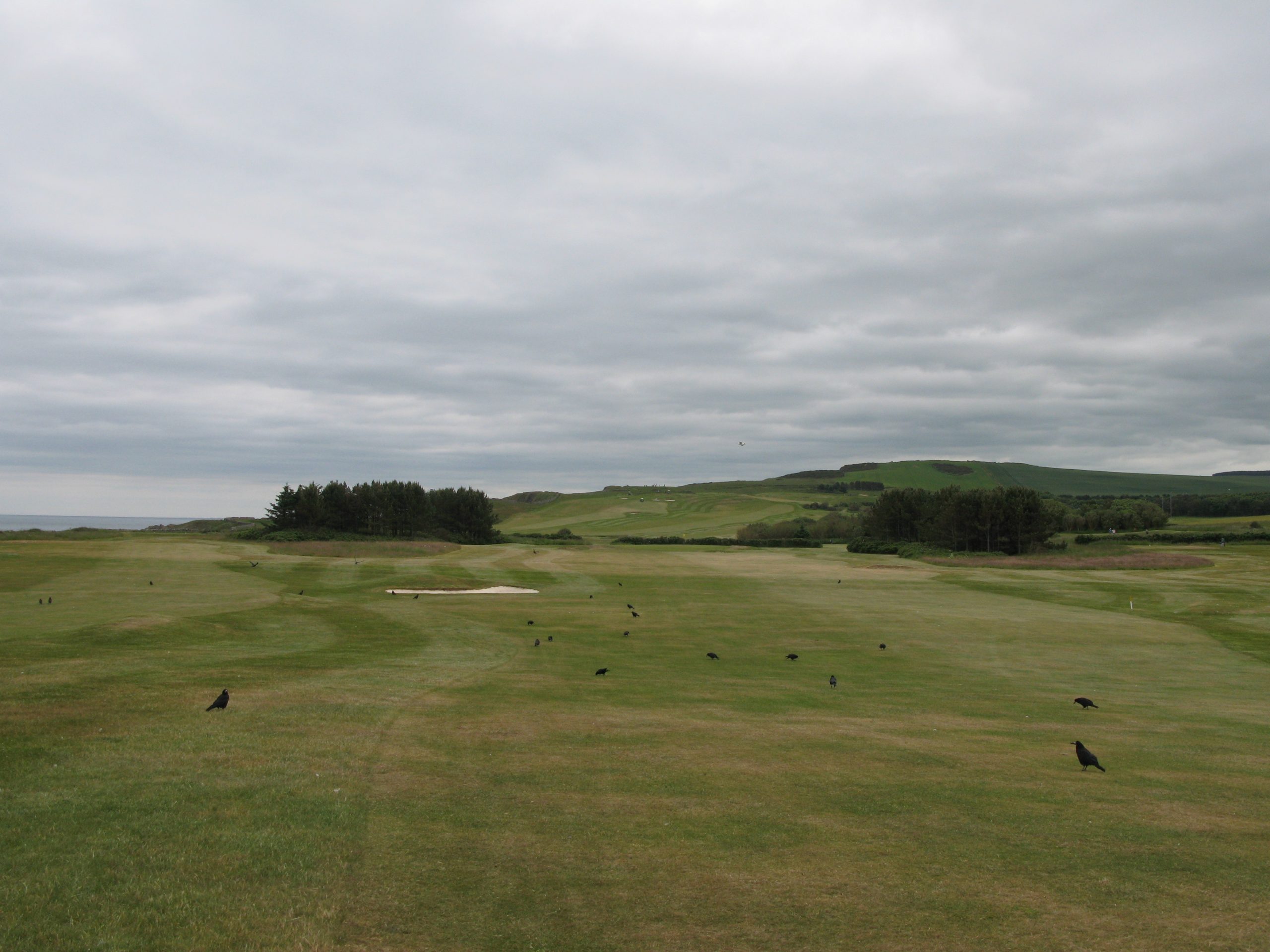
The course was in decent, but not great, condition when we played, despite it being high season; the tees and very large greens were no more than average. Some of the greens were very tricky, most notably the 11th, where you couldn’t afford to be over the back of the green. The fairways are wide, but miss them and the rough is deep – there is no semi-rough to speak of. Although in dry seaside conditions, this might feel like a links, it is arable land, and I consider it a parkland course.

If you plan to play Eyemouth, I recommend considering a buggy if you’re not as fit as you once were. More importantly, the ‘fish ‘n chips’ in the clubhouse were as good as I’ve tasted anywhere. Those, and the very friendly staff at the club, make it a decent place to visit and play.

The openness and wide fairways at Eyemouth, typified here at the 9th.

Finally, in writing about Eyemouth, I came across an extraordinary sporting story in the excellent https://www.golfsmissinglinks.co.uk/ web site, which charts the long lost history of Scottish Links. In the 1880s, during which time golf was played on a 5 hole course around the Eyemouth beach fort, the world famous cricketer, WG Grace actually played two seasons for Eyemouth cricket team. Now there’s a context for a film.

Course Type: Parkland

Par 72 (4 par 5s, 10 par 4s, 4 par 3s)

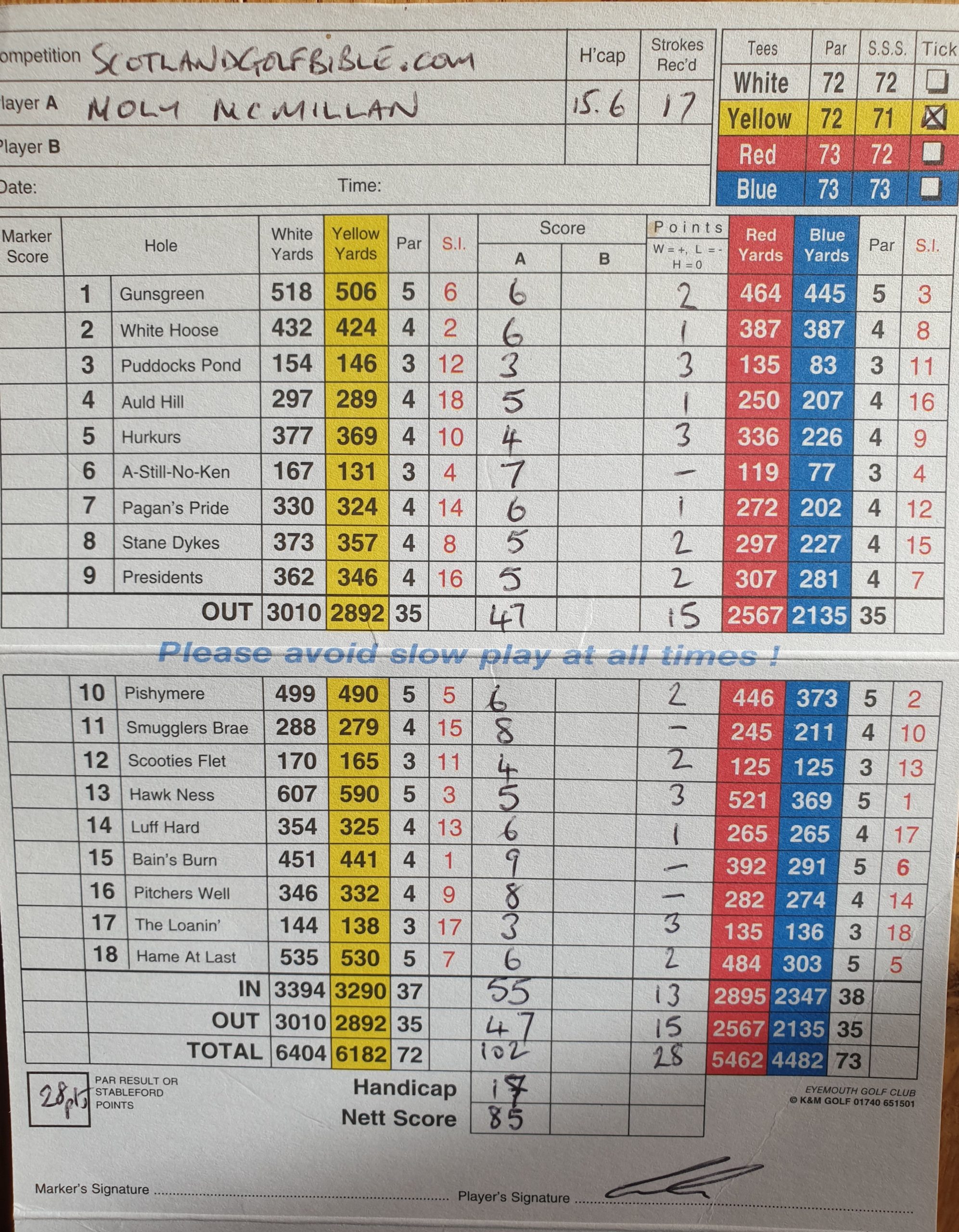
Distance: 6182

Moly’s Gross score102

Eyemouth – 102 reflects the challenge of this tough layout

121. Newbattle. 22 June 2021.

This oasis might be the cheapest Harry Colt course in the world?

Round £40. Par 69. Course Rating / Slope Rating (yellow) 68.1/127. Value (out of 5) – 5

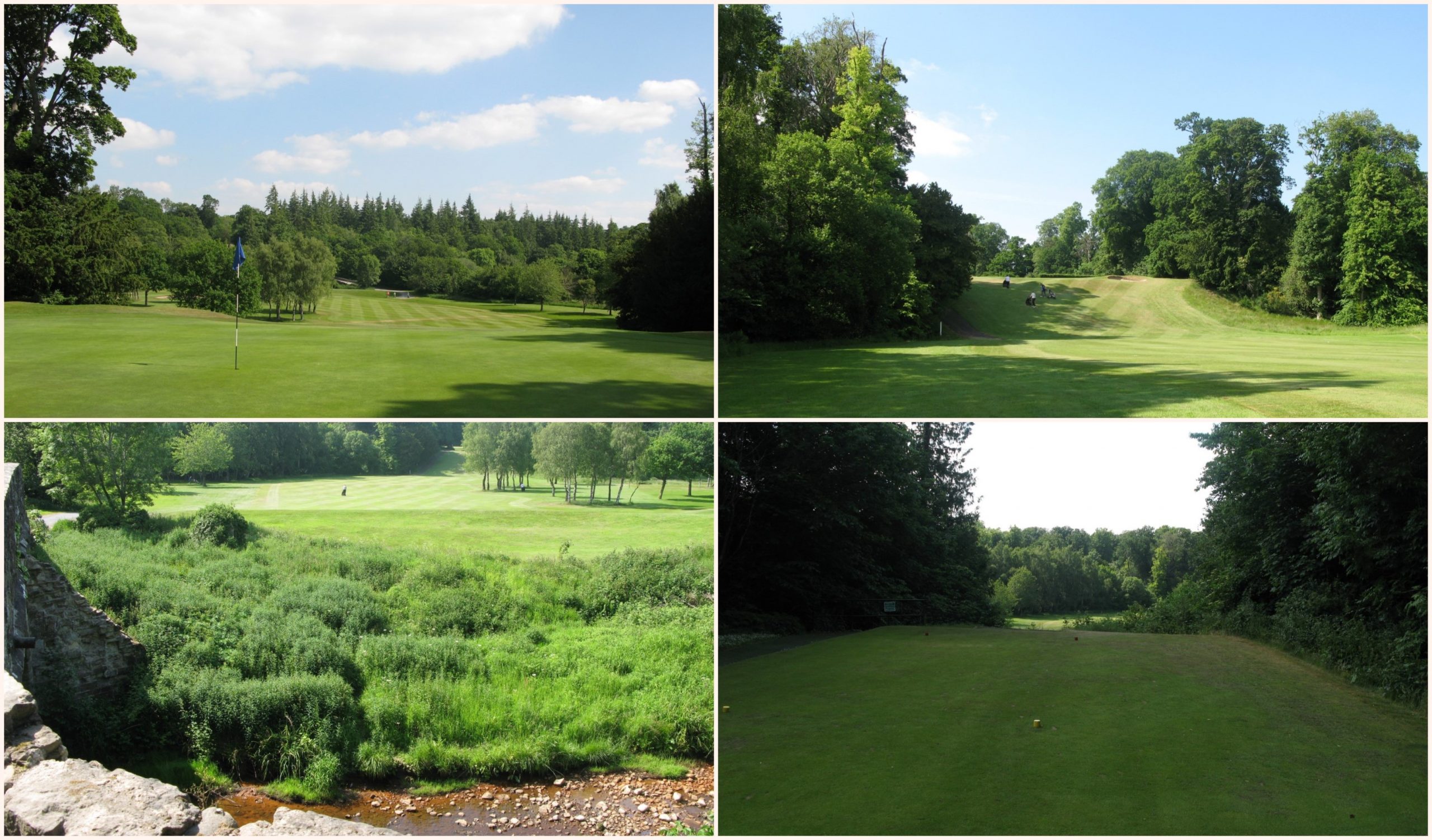
Drive through Dalkeith, which might appear a bit drab, and through the car park of Newbattle GC and you are met with a graceful parkland layout, with many magnificent trees, that just seems so unexpected. The course is an easy walking affair, other that the 2 holes (2nd and 17th) that play across the river esk valley that sits between the opening and closing holes and the rest of the course. With a substantial club house, this makes Newbattle a great venue for a group or society day out.

The delightful 17th at Newbattle, a par 4, stroke index 4, which must be a formidable match play hole. The River Esk is just visible, and never comes into play.

We know about the genius of some golf course design; the majestic Augusta of Alister McKenzie, the natural beauty and guile of The Old Course, the brutal nature of Pete Dye’s Ocean Course at Kiawah Island. Sometimes though, great golf course design is difficult to put your finger on.

When I played Newbattle, in Dalkeith near Edinburgh, it felt great, not because I played well, not because the weather was nice, but because ‘it just did’. It was almost indescribable why the course flowed so well and that I think is real genius. That was what Harry Colt design can be.

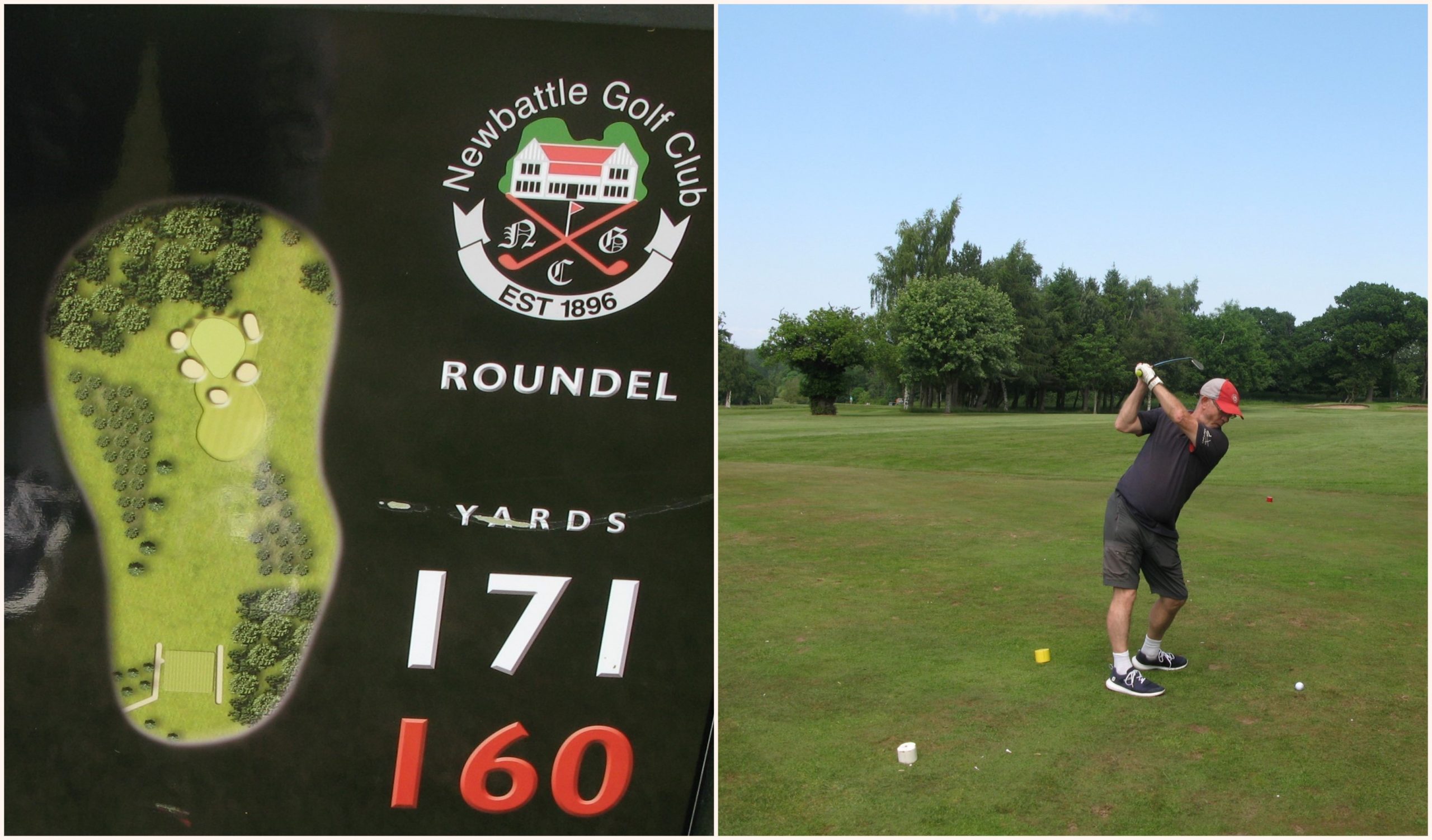
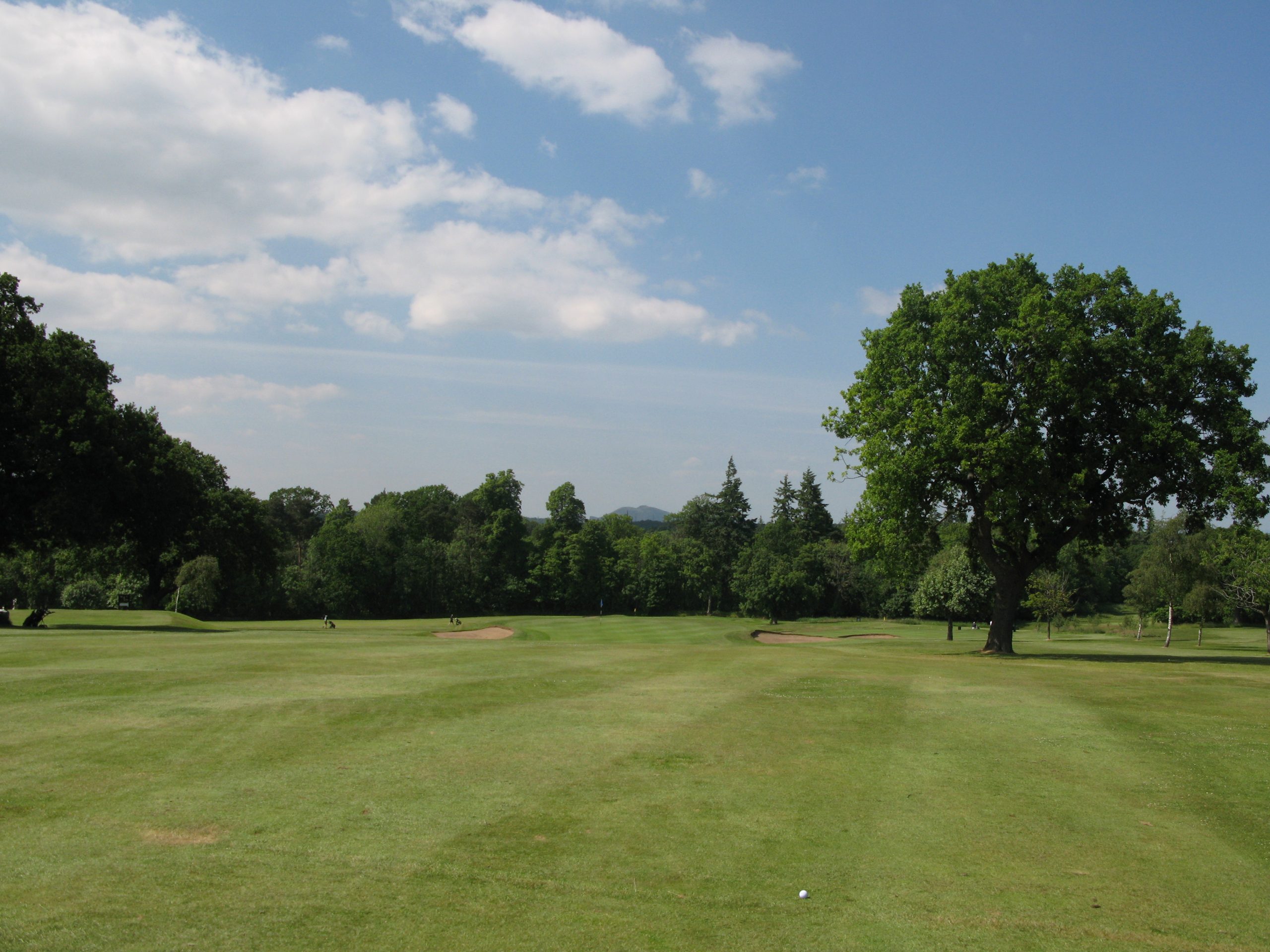
The very well bunkered par three 11th hole, ‘Roundel’, at Newbattle.

Although the Newbattle club was formed in 1896, the current full 18 hole course, the Colt legacy, was built in Dalkeith in 1934. Originally linked to Dalkeith Golf Club (1880), it’s called Newbattle as it’s within the historic boundary of Newbattle Abbey, a Roman Catholic monastery, and a key part of the Scottish religious story.

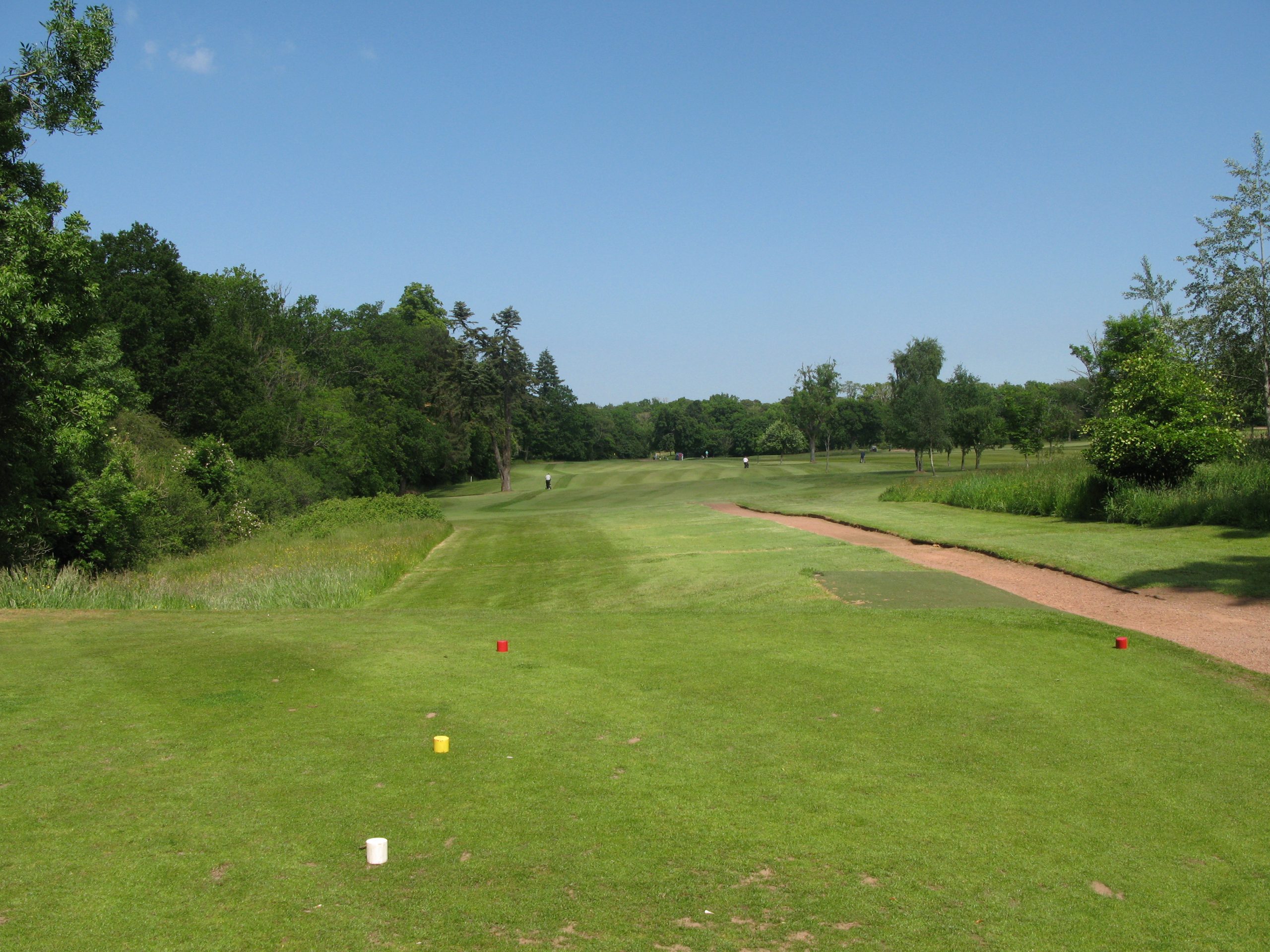
The tee markers, here at the 9th, are typical of the small yardage differences at Newbattle

When Fran and I played on a delightful mid summer day, the course was very busy, but never seemed to get back logged. The tees, fairways and greens were immaculate, with the bunkers still unraked due to the ongoing Covid Pandemic.

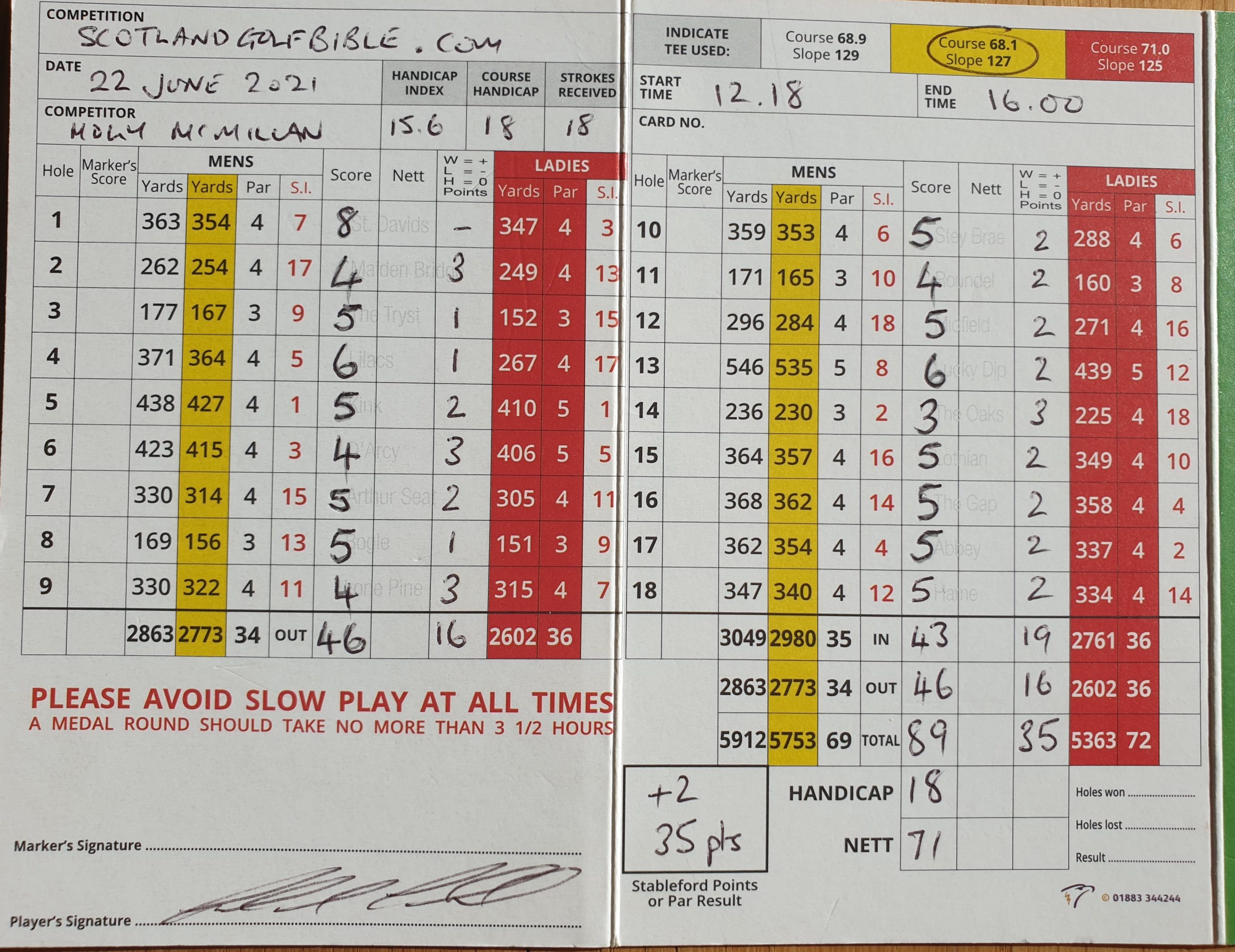
After pulling my opening drive about 2 yards out of bounds left, then hitting my second ball over the back of the first green, that turned out to be my only ‘blob’ in returning an 89, for 35 stableford points. If it were a competition though, it wouldn’t have troubled the scorers on this ideal day for golf.

The approach to the 13th at Newbattle, with Arthur’s Seat in the background

Play aside, this is a great little course well worth playing as part of an East Lothian tour. In terms of East Lothian value for money, it must be near the top of the pile. It’s certainly underrated in my opinion. The stand out holes for me, were the 5th, a long par 4, and easily the Stroke Index 1 hole and the long par 3 14th hole. To score well though, you need to avoid the clever and penalising bunkers.

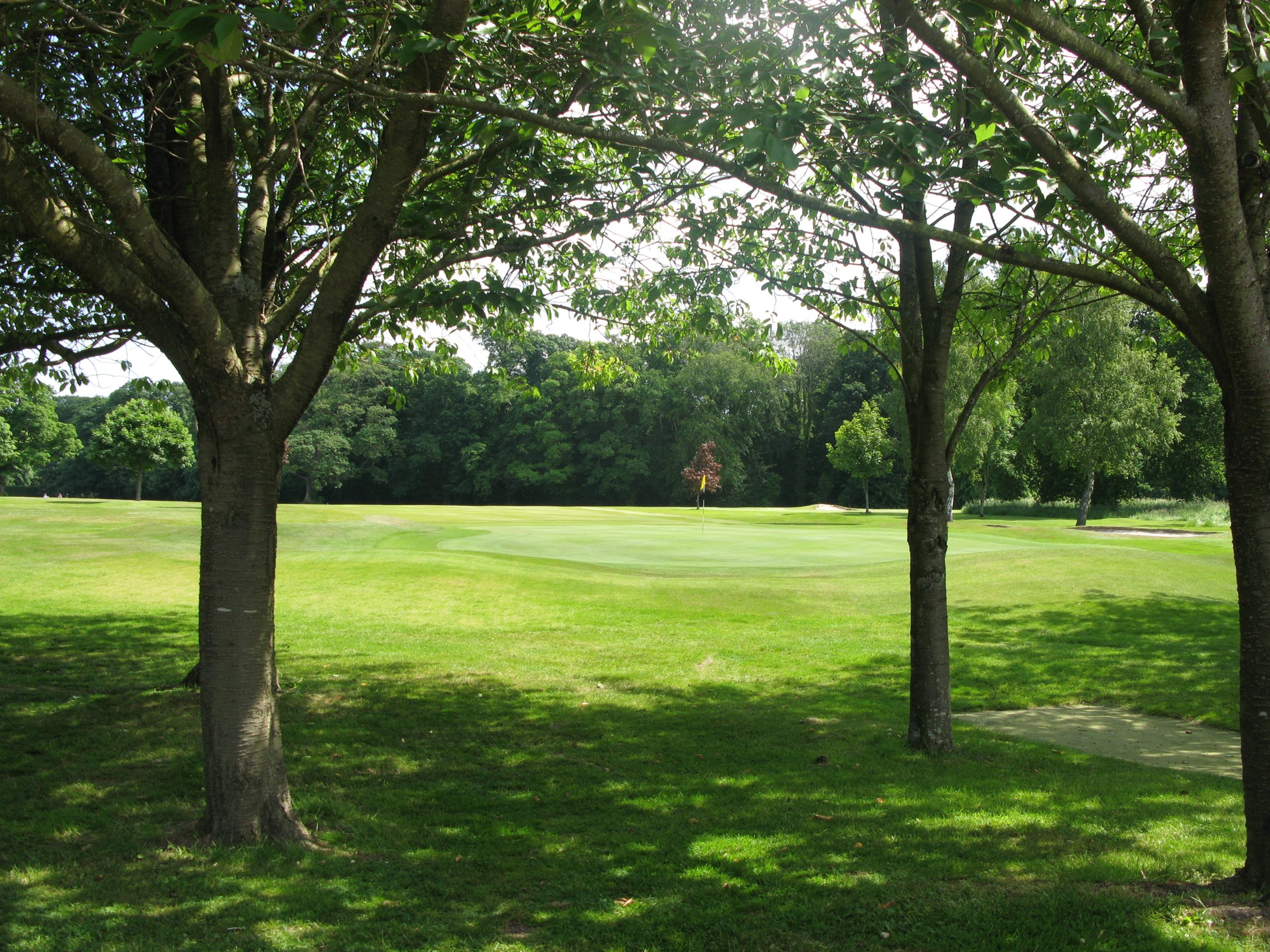
The relatively easy finish at Newbattle, except if you find the copse of trees beside the green

There is an argument to say Harry Colt, the main contributor to many of the world’s great courses, including 3 on the Open Championship rota (Muirfield, Royal Liverpool, Royal Portrush), is the foremost designer of his age. I think Newbattle might just be the cheapest green fee of the more than 100 courses designed in whole or part by Colt.

Course Type: Parkland

Par 69 (1 par 5s, 13 par 4s, 4 par 3s)

Distance: 5753

Moly’s Gross score89

Moly’s scorecard – a very decent 89
« Older posts Newer posts »

© 2026 Scotland Golf Bible

Theme by Anders NorenUp ↑